Architecture and Engineering Science:
Increasing the Coefficient of
Transversality
Presented at the Hawaii International Conference on Arts
and Humanities, Honolulu, 13th-16th January 2010
Graham Thorpe and Sam Kashuk
Centre for Environmental Safety and Risk Engineering
Victoria University
PO Box 14428, Melbourne 8001
Architecture and Engineering Science: Increasing the Coefficient of
Transversality
1Summary
Architects operate on many intersecting planes – aesthetic, economic, political, social – whereas engineers' roles are seen to serve to concretise the ideal. From this perspective architecture displays a certain rhizomaticity, whereas engineering science is viewed as an arborescent hierarchical system of knowledge, a territorialised assemblage of facts, design rules and building codes. It is argued that this is a highly distorted view of reality, and that engineering science will be subsumed into the architectural design process. An appreciation of engineering science can lead to new and imaginative deployments of building materials to create interesting and functional spaces. In creative endeavours engineering science increases the coefficient of transversality; it catalyses rhizomaticity. There are two further pressures shaping the evolution of the architectural profession. Firstly, environmental concerns are encouraging architects to design buildings that are ecologically benign. Secondly, information technology enables knowledge to be accessed and shared, rather than simply transmitted. In other words, information technology is increasing the rhizomaticity of the architectural profession, and a range of professionals will participate in the design process on more or less equal terms. Victoria University is responding to these pressures by developing a pedagogy that syncretises architecture and engineering – that melds them into a seamless whole.
1
Presented at the Hawaii International Conference on Arts and Humanities, Honolulu, 13th-16th January 2010
Contents
Summary i
Contents ii
Introduction 1
The essential creativity of engineering science 1
The ubiquity of molecular phenomena – a didactic interlude 2
Architecture and the liberatory nature of engineering science 3
Parametric design and building information models 6
The syncresis of architecture and engineering science
– a proposed pedagogy 10
References 12
Introduction
Deleuze and Guattari (1980) suggested that modes of thinking and behaviour manifest themselves on a rhizomatic-arborescent spectrum. Although architecture assumes some hierarchical forms – the architect as Leader – it is perhaps perceived as being rhizomatic whereas engineering science is viewed as displaying a distinctly arborescent sessility. A possible reason is that architects practice overtly at the intersections of different planes such as aesthetic, political, social and economic planes. In comparison, engineering science is viewed as being sequential and hierarchical - a territorialised assemblage of facts, design sheets and building codes. It is argued here that this view
of engineering science is highly distorted. Engineering science is axiomatic, but its
hand-full of axioms permeate our very existence. For example, one axiom includes the second law of thermodynamics that gives rise to the idea of ‘time’s arrow’. When architects design a building they may consciously realise it will have a finite life – its structure will eventually oxidise, its decorations will fade and it will eventually crumble unless it undergoes repeated renovation. The second law of thermodynamics reminds us of the essential ephemerality of our work, and it reminds us of issues concerning environmental sustainability. On a more pragmatic level, the first law of thermodynamics points to the principle that energy is neither created nor destroyed. This law comes into play when architects set out to design energy-efficient buildings. Whatever the rate of energy flowing into a surface, such as an exterior wall of a building, the energy must flow out at exactly the same rate – surfaces have no substance so heat cannot accumulate at a surface. Just how these energies flow depends on the texture and colour of the surface, the intensive and extensive properties of the substrate of the surface, as well as its orientation and its milieu. The flows of energy impact on the comfort and energy-efficiency of the building, and how they affect the ways that architects design spaces. The laws of thermodynamics appear to be immutable – but architects have freedom to respond creatively to these laws. The axioms of continuum mechanics are always immanent on the plane of architects' nomadic peregrinations. Although we have termed the axioms constraints, an awareness of the axioms of continuum mechanics is actually liberatory – they give us the power to explore new forms and textures with more assurance. Where potential driving forces exist in creative constitutive relationships, engineering science can increase the coefficient of transversality, it can catalyse rhizomaticity. Lines of flight are less likely to lead into voids of irrelevance. As a practicing architect and engineering scientist one of our pedagogic goals at Victoria University is to syncretise our two disciplines – to unify architecture and engineering so that each contributes seamlessly to creativity and productivity. Our early attempts at achieving this are outlined. On a larger scale it is suggested that architectural practice will evolve to subsume a much wider range of disciplines. This will be driven by two forces, namely the need for buildings and urban spaces to be environmentally benign and by the ever increasing ubiquity of information technology. Architects will be located within information networks in which the knowledge of design-and-build projects will be shared amongst a wide range of participants, and the education of architects and engineers will evolve to meet the new realities.
The essential creativity of engineering science
One of us – the engineer – was attending an interdisciplinary meeting at our university when an economist-colleague suggested that engineers have little imagination. I
pointed to a ceiling light and a table and asked him how the thermal energy from the light was transferred to the table, and then transferred from the table to other objects in the room. He didn't know. I said "Can't you imagine how energy might be radiated to the
table? Can't you imagine how the molecules in the table might be excited and vibrate
more vigorously and in turn excite air molecules that are in contact with the table. These more energetic molecules then push the cool air aside to form a bubble of warm air that rises and takes heat into the room. The heat then dissipates and heats other objects in
the room. Couldn't the economist imagine these phenomena?
Engineers can be equally closed-minded. They are often sceptical when architects claim to be able to design environmentally sustainable buildings.
The ubiquity of molecular phenomena – a didactic interlude
In the anecdote concerning the economist the concept of vibrating and excited molecules was raised. This resonates with Ballantyne's (2007) advice to architects to "Lose sight of form as an intention – immerse yourself in the politics of molecules, the lives, the affects of various milieux." Whilst it is sometimes useful and satisfying to think of phenomena that occur on the length scales of molecules we cannot actually see the molecules that constitute an artefact in a building. Neither can we determine all of their speeds and locations at a given time. We do not need to know about the ‘politics’ of molecules, the concept just helps us to get a deeper understanding of our world. However, when an architect designs a building its occupants are likely to want to know how much energy must be consumed to keep the building comfortable, and here is where the speed of molecules enters the picture. When we say we sense a temperature of 20°C we are sensing our bodies being bombarded by air molecules that have an average speed of about 490m/s which is over 1000 miles per hour. If the temperature is raised to 35°C the average speed of the molecules increases to about 500 m/s and these impacts make us less comfortable. Clearly the molecules must have received some extra energy from somewhere. How do architectural designers relate this kinetic theory of gases to their projects? The answer is they do not, but architects and engineers assume that they are not dealing with individual molecules but with ensembles of several millions of molecules that occupy a cube with sides that have a length of about one thousandth of a millimetre. Instead of measuring the average speed of the molecules in this region we measure the temperature of the molecules using some kind of thermometer. If we consider a simple mercury-in-glass thermometer the air molecules strike the glass of the bulb, the glass molecules 'jiggle' more vigorously and this jiggling makes the mercury molecules jiggle more vigorously and they vibrate apart from each other and the liquid mercury expands in the capillary tube of the thermometer and we can read the temperature. If we move the thermometer about a space in a building we would notice that the air temperature changes in continuous manner – instead of envisioning the air as a collection of discrete molecules we treat it as a continuum.
When writing for architects Ballantyne (2007) sums up this state of affairs by noting that "We have to understand miniscule and vast things by making analogies with things that are closer to the range of things we can perceive directly …." We can perceive the thickness or viscosity of flowing honey and the temperature in a room far more clearly than we can perceive the molecular motions that determine them.
Architecture and the liberatory nature of engineering science
The point of the preceding didactic exercise is this: Continuum mechanics is providing architects with tools that enable us to design in ever increasing spatial and temporal detail. For example, we can now estimate how the placement of an air conditioning register will affect the comfort of a person sitting several meters away from the duct. We can estimate if an occupant's feet will be cold whilst the upper region of the person's body will be located in a comfortable region. We are now able to predict how thermal radiation between the occupant of a building and a chilled ceiling, for example, affects the occupant's comfort. Thermal radiation is an artefact of the changes in energy states of electrons – subatomic particles – and this reminds us of Deleuze and Guattari’s (1980) observation that “Transversal communications between different lines scramble the genealogical trees. Always look for the molecular, or even sub-molecular, particles with which we are allied”. The architect's knowledge of these fine details can be established by making use of the rapidly emerging field of computational fluid dynamics. In this technique an architectural space is notionally divided into many tens of thousands or hundreds of thousand tetrahedrons or rectangular boxes and the flow of heat and air through each notional box is calculated. In this way it is possible to calculate the microclimate throughout an entire space. It should be noted that the spatial resolution has to be very fine adjacent to solid surfaces. For example, if architects wish to calculate the rate of ingress of heat through a glass window, the rate of heat transfer is largely determined by the films of moving air that form within a few millimetres of the inner and outer surfaces of the window. Strictly speaking it is essential to resolve the nature of the air flow and temperature fields within these very thin films, and this requires that we resolve the phenomena on a length scale of about one millimetre. This requires quite a lot of computing power, but personal computers can be used to obtain meaningful results within a day or so of run-time.
The immediately preceding quote of Ballantyne (2007) continues “ … and the study of fluids and flows is in its infancy compared with the study of straight lines and cubes, which our mathematics finds so much easier to define, but which are more exceptional in our experiences of nature." The study of fluid flow, such as the air flowing adjacent to building surfaces is indeed complicated, yet such flows really do control heat transfer between a surface and its milieu. Even those computer programs that take several days to provide solutions to the problem contain sub-models that are breathtakingly naïve simplifications expressed in terms the human mind can grasp.
The approach we have just outlined seems positively reductionist, and architects may feel more comfortable by responding to these phenomena by carrying out some form of eidetic reduction. What is the essence of natural convectiveness that causes heat to be transported from the hot surface of a window, say, to the cool interior of a space? How would an occupant respond to the buoyancy induced zephyrs? Provided the reasoning is soundly based this approach is quite valid and it can lead to novel design outcomes. For example it might give rise to the idea of combining air conditioning registers and thermal radiators. Such devices might provide occupants with excellent comfort at low cost.
The power of computational fluid dynamics is demonstrated in Figure 1 that depicts the flow paths of air entering a room via a circular diffuser, and which are coloured to represent the air temperature. Blue represents cold air, which changes to red as it heats
due to its proximity to an appliance, which also causes it to rise by the buoyancy forces - a reprise to the dialogue between an engineer and an economist outlined above. Figure 1 that shows contours of the age, or staleness of air. The youngest air is denoted by a blue colour and stale air is red. The power of the technique is that it enables architects to explore the effects of a range of construction materials, colour schemes, the effects of tinting
Figure 1. It is now quite straightforward for architectural professionals to map conditions such as temperature, humidity and air speed throughout a room. In this figure we can observe cold air leaving a circular diffuser, and the colour of the paths changes from blue where the air is cold, to red where it has been heated. Reproduced with the permission of ANSYS Inc.
Figure 2. Architectural professionals now have the ability to estimate factors such as the age of the air in a room. The figure shows air that has been in the room between 140 and 157.5 seconds in blue, and air that has been in the room for between and 262.5 and 280 seconds in red. Reproduced with the permission of ANSYS Inc.
.
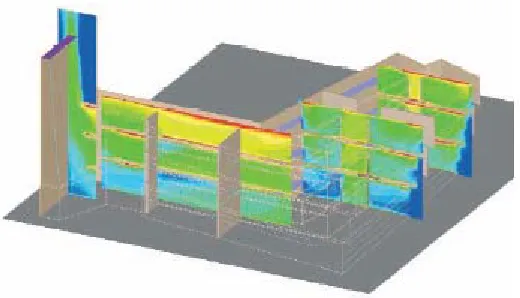
windows, the effects of floor coverings and other design features on the thermal condition and energy consumption of architectural spaces. Figure 3 shows the temperature distributions on selected planes in a naturally ventilated building that appear to suggest temperatures are higher on the upper stories compared with the lower
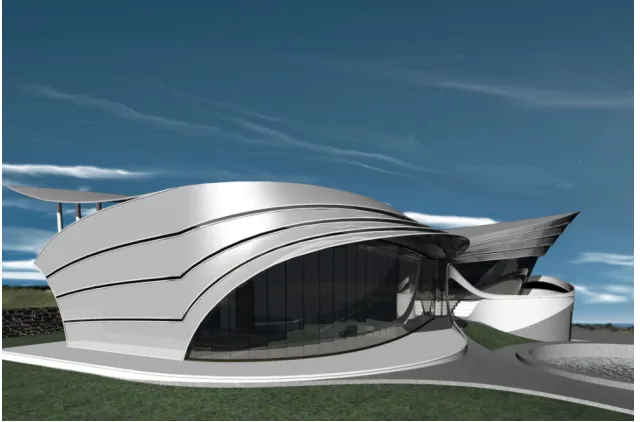
stories. Figure 4 shows a beach house exhibited at the Casas de Playas international
urban exhibition in Lima, Peru by the authors (Thorpe and Kashuk, 2009) designed by applying fundamental principles of engineering science to estimating the external surface temperatures of the building and then estimating the heating and cooling loads. In their design, the authors harnessed the principles of engineering science and architecture in order to use the complexity of floating surfaces and spaces and redirect them so buildings will be energy efficient. When using traditional methods designers try to simplify the form in order to make the space energy efficient which leads to them having simple cubic spaces that are energy efficient but with very poor quality of space.
Figure 3. A computer generated estimate of the temperature distributions along selected planes in a naturally ventilated building. It appears that the temperatures are higher on the upper stories of the building. Reproduced with the permission of ANSYS Inc.
Computational fluid dynamics enables architects to explore phenomena that occur not only in the spatial domain, but also the temporal domain. This is particularly the case when eco-friendly buildings are to be designed that exploit thermal inertia. During the day the exterior surfaces of building heat up due to increases in ambient temperature and perhaps solar radiation. We have already noted that a surface has no substance hence heat impinging on it from the external environment must either enter the building element or be returned to the external environment. No other possibility exists. But how is this heat partitioned? During the day some heat diffuses (some might say conducted) into the building element. Its rate of diffusion depends on the thermal conductivity, the density and the specific heat of the building element. When heat flows through cavity walls it may also be transmitted by thermal radiation, and this occurs instantaneously – at least as far as humans are concerned. It should be noted that heat is transferred in cavity walls not only by conduction and radiation, but also by natural convection and quantifying this phenomenon requires a deep understanding of fluid dynamics. One design objective might be to slow the rate of heat transfer through a wall and attenuate the amplitude of the temperature so that the interior space remains at a uniform
temperature. An alternative design objective might be to design a building envelope so that the external temperature travels with a celerity that keeps the interior cool during the day, but which heats the space during the evening.
Figure 4. The design of a beach house exhibited by Thorpe and Kashuk (2009) that was the prototype of their syncretic approach to architectural design.
It takes about 60 times more energy to evaporate 1 kg of water than it does to increase its temperature by 10ºC. It may be possible to exploit this physical phenomenon by fabricating building insulation from natural materials such as sheep's wool. Wool dries during the day, and this absorbs energy from the environment and it therefore stays cool. During the night that the wool re-wets due to the high relative humidity of the air and releases heat to keep the interior of a building warm. To be able to quantify the effects of conduction, radiation, convection and evaporation requires quite deep insights into physical phenomena. If architects are familiar with these ideas they can at least ask pertinent questions that prompt the emergence of new building materials and forms.
Parametric design and building information models
Computer-based information technology (IT) is transforming the practice of architecture. Perhaps one of the most apparent manifestations of IT in architecture are building information models (BIM) that track the development of a design, and successively add information and manage the information as the design becomes more refined. Ultimately the information carried by the BIM program includes information such as the type and quantities of construction materials required their cost, the names of the suppliers and the schedule of arrival on the building site. Kalay (2009) points out that contemporary IT systems manage communication and they organise the transfer of information amongst the design and construction team who are subject to centralised control. This corresponds to an arborescent organisation of knowledge, and whilst each step in the process may be optimised there is no guarantee that the process as a whole
is optimised. Kalay (2009) suggests that in future information will be distributed and it will be freely accessible to all members of the team – knowledge will be accessed and not transferred. In other words, as the profession of architecture develops it is likely that IT will promote a greater rhizomaticity. This will enable all members of design and construction teams to make contribution throughout their projects, and this will enable specialist insights to be brought to bear on decisions, and this will enhance the design. Furthermore, it will help to prevent mistakes being made. This vision of architectural practice is not only rhizomatic, but it is inherently syncretic in which many strands of knowledge are gathered together on equal terms. It seems that this new reality will ultimately impact on the education or formation of architectural professionals.
Architects now have access to design tools that have supplanted early two-dimensional drawing programs with three-dimensional parametric design tools. Although Kalay (2009) points out that architects may replace the old tools with new ones and use them inappropriately, contemporary three-dimensional design tools can help architects to visualise the outcomes of their work. Thorpe and Kashuk (2009) made use of several
advanced 3-D modelling and advanced parametric design tools such as Rhinoceros®
and Bentley Generative Components® to design a beach house exhibited at Casas de
Playas international urban exhibition in Lima, Peru. However, it is argued in this work
that conventional approaches to design are no longer adequate and the design process should be distributed. As a design emerges it should be informed by the effects of design changes on factors such as environmental performance and the constructability of the building. The beach house was Thorpe and Kashuk’s (2009) first attempt to syncretise engineering and architecture, and it was prompted by their pedagogical approach to Environmentally Sustainable Design studies by third year architectural engineering students. It is possible to retain the form of a building, but its materials and methods of construction can be modified to satisfy constraints imposed by environmental consideration, for example.
Architects have considerable freedom during the design process even though their buildings may have to satisfy constraints. The constraints will arise from environmental, end-use, land area, capital cost and so on. The objective of the design team is to optimise the design subject to the requirements and constraints that are combined into an objective function that must be minimised. For example, some weight will be given to capital cost, and it may be that the annual energy consumption must not exceed a pre-set value, and limits may be pre-set on the floor areas of rooms to be devoted to specific tasks. This is clearly a very complicated multidisciplinary problem, and one approach is to use an evolutionary approach such as that being pursued by Janssen (2009). The basic idea is that building designs will emerge as a result of a scheme analogous to Darwin’s model of evolution. A genotype is established that incorporates all of the information needed for a design to be realised. The realisation of the form in terms of a computer model is known as a phenotype. The next step in the optimisation process is to test the model for fitness for purpose. The fitness of the models is ranked and the next generation is ‘bred’ from these parents so that buildings that meet the designers’ criteria evolve. As Janssen (2009) points out, determining the fitness of the buildings is computationally very resource intensive and it is important that engineers, computer scientists and architects work together when developing the evolutionary models. It could be that during the initial stages of the evolutionary process relatively simple performance evaluation tools could be used, and the more refined and computationally intensive tools reserved for the final stages of evolution.
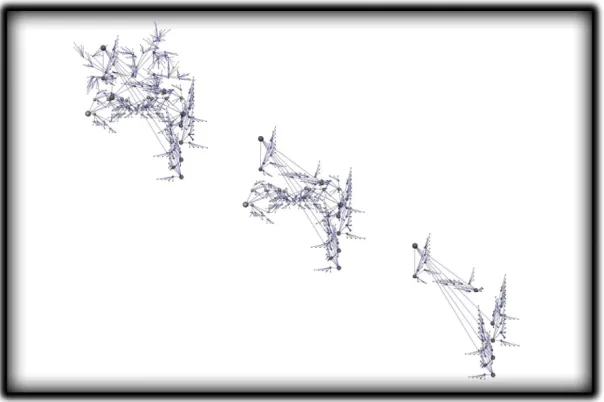
Computers are supremely efficient at carrying out logical operations. Architects can exploit this at the pre-design stage of a project when the design brief is treated in the most abstract and conceptual manner. For example, it may be required to design a building that has certain requirements, such as the connectivity of certain spaces the relative sizes of which are known at the preliminary design stage. These requirements can be programmed in terms of Lindenmayer systems, the underlying principles of are basically quite straightforward. For example, it might be decided at the pre-design stage that building spaces used for specific purposes should be located adjacent to each other, and these spaces in turn be located adjacent to a public space. Other spaces should be located distant from public spaces. Connectivities between the various spaces can also be specified at the pre-design stage which are implemented by Lindenmeyer that enable suitable assemblages of spaces evolve. As a student exercise Sam Kashuk, Eun Sung Gu and Soosun Oh implemented a Lindenmayer system to develop appropriate layouts in proposal for Australian Carbon Exchange building to be located in Sydney, and the evolution of the arrangement of spaces and their interconnectivities are shown in Figure 5.
Figure 5. A proposed schematic of Australian Carbon Exchange complex in Sydney. Using the Lindenmayer system the schematic evolves to capture the requirements such as connectivity between the various activities of the complex, shown in the top left hand corner.
Powerful software is available to translate preliminary design information into structures. One such software is Generative Components which allows the designer to produce many different design iterations within short period of time. By setting series of constraints based on diverse needs such as planning regulation, building height and gross floor area designers using Generative Components can experiment several building design iteration and ensure that if they change one part of the project the other parts will automatically adapt themselves. A preliminary Generative Components approach to the design was used in a proposal for East Darling Harbour urban design in Sydney by Sam Kashuk, Sylvie Milosevic, Ravi Adusumilli who used information to generate a design that highlights features such as pedestrian movement, building density, maximum use of solar radiation in winter and view to water front. The results are shown in Figure 6 Figure 7 demonstrates how the software is able to generate
specific the geometries of the individual components of the building, and although the components may be non-standard their dimensions are also generated by the software. This information may be transmitted directly to machine tools that automatically produce and label the components so that they can be easily assembled.
Figure6. A preliminary step in using generative components is to develop general features of a building, in this case a proposed design to be located at East Darling Harbour in Sydney.
Figure 7. A proposed design for East Darling Harbour in Sydney emerges from the overall requirements indicated in Figure 6.
Although this information is extraordinarily useful, and it gives architects hitherto unknown freedom in their approaches to design there remains a need for the system to
be further integrated with engineering and construction expertise and functions. In other words, there is a need for syncretisation of architecture, engineering and construction (A/E/C).
Parametric design has been used by Sam Kashuk in his role as an architect with LAB architecture studio Pty Ltd to design several projects in China and Middle East. The main goal for him is to extract information from complexity and use to design high quality spaces rather than simplifying the complexity. Figure 8 shows models of three buildings exhibited by LAB architecture studio Pty Ltd at the National Gallery of Victoria, July-September 2009.
It is clear that the development of new architectural tools is certainly multidisciplinary. Although the marketers of such tools will attempt to make their use easy we believe that the next generation of architects must be familiar with some of the concepts on which they are based.
The syncresis of architecture and engineering science – a proposed pedagogy
Much of the above engineering science and generative methods described above are available in commercial computer software packages. As a result architects do not need to be familiar with the minutiae associated with formulating and solving the partial differential equations that govern the comfort in an architectural space. But to use the tools creatively it helps to be familiar with the principles that underpin the software. Furthermore, computer software generates knowledge and not necessarily understanding, and the machine-generated knowledge must be treated with extreme caution. Another feature of the software is that it is extremely general, but that does not mean that it can solve every problem that arises. On the contrary, the generality means that some specific problems cannot be solved by the software and it must be suitably modified by the user. A case in point arose when the engineer wished to study how grain stores can be air conditioned to control the growth of insect numbers. The problem is that food grains share a property with wool – they adsorb water and when they adsorb water which causes them to give out heat. When we discussed using wool as an insulation material this was seen as an advantage because at night the latent heat that is liberated can be used to keep a building warm. Dry grains become warm when they are air conditioned with humid air, and wet grains stay cool. It so happens that the insects breed equally well in warm dry grains as in wet cool grains. Unfortunately, commercial building software does not account for the fact that grains adsorb and desorb moisture when they are air conditioned and the programs have to be suitable modified. It is in these applications that a good grasp of the fundamentals is useful.
Figure 8. Models of three buildings exhibited by LAB architecture studio Pty Ltd at the National Gallery of Victoria, July-September 2009. In the foreground is the Rhino Tower design for Dubai, in the left background are the Zovie Plaza in China and in the right background in The Dune complex in Bahrain.
Some architectural schools are beginning to appreciate the complex and interdisciplinary nature of architectural design and in response they have begun to teach how to use computerised design tools, rather than teach core concepts (Sanguinetti, 2009). This is fraught with problems. Soebarto (2005) reports that when students have the opportunity to use designer friendly tools they do not understand the kinds of inputs required or how to interpret the simulation results. They had little understanding of the thermal properties of building materials, and they had difficulty in searching for physical properties not in the built-in library of the software. In some ways, this is only the start of the problems because in reality most software has to be tailored to suit specific needs. Sanguinetti (2009) notes that most architectural schools in the United States have a larger offering of courses in history and theory than in building technology. However, an approach to building technology that simply teaches how to use tools is a superficial approach.
We somehow need to syncretise architecture and engineering science, and the place to start is during students' formation. At Victoria University the authors present a subject, Environmentally Sustainable Design, in a way that students perceive that architecture and engineering as being inextricably bound. From the very first class students – who have an engineering background – are invited to design a simple building such as a beach house. However, they are expected to design buildings that have free flowing forms, or possibly angular forms. Anything except a box. However, the real world does have constraints and students are expected to design a 5 star energy rated house, in
other words the annual energy consumption used for heating and cooling a house
located in Melbourne, say, must not exceed 165 MJ/m2 of energy. We attempt to
achieve a syncresis of architecture and engineering science by providing the students with a deep knowledge of science as they design their buildings. As a result their buildings adapt and evolve as they respond to the climate. The effects of building materials and building form on energy consumption are explored, but the aesthetic integrity is not compromised. Students write their own computer programs that incorporate the fundamentals of heat transfer and they produce didactic expositions that demonstrate their understanding of the material. This is a design subject and we try to avoid scientism and relegate it to a minor component of the experience. We invite our students to imagine they are entering the houses they are designing – what do they feel, what do they see and hear?
Our nascent pedagogic exercise is limited in time, scope and location. However, it seems that it may presage a much more radical and widespread change in the education of architectural professionals.
References
Ballantyne, A, 2007. Deleuze and Guattari for Architects, Routledge, London.
Deleuze, G and Guattari, F, 1980 Capitalisme et schizophrénie 2: mille plateaux, English
edition 1987 A Thousand Plateaus: Capitalism and Schizophrenia. Translated by
Massumi, B, University of Minnesota Press, Minneapolis.
Janssen, PHT (2009) An evolutionary system for design exploration. Proceedings of the International Conference on Computer Aided Architectural Design Futures, Montréal, Canada17th-19th June 2009, Les Presses de l'Université de Montréal, pp 260-272.
Kalay, YE, 2009 The impact of Information Technology on architectural design in the
21st century. Proceedings of the International Conference on Computer Aided
Architectural Design Futures, Montréal, Canada17th-19th June 2009, Les Presses de l'Université de Montréal, pp 21-34.
Sanguinetti, P, 2009. BIM in academia: Shifting our attention from product to process. Proceedings of the International Conference on Computer Aided Architectural Design Futures, Montréal, Canada17th-19th June 2009, Les Presses de l'Université de Montréal, pp395-409.
Soebarto, V, 2005. Teaching An Energy Simulation Program in An Architecture School: Lessons Learned. Building Simulation, Proceedings of the 9th International Building Performance Simulation Association Conference, International Building Performance Simulation Association, Montréal, Canada ISSN/ISBN: 2-553-01152-0, pp 1147-1153.
Thorpe, G. R. and Kashuk, K. (2009) Casas de Playa, Agencia de Arquitectos, Lima, Peru, 20th February – 1st March 2009.