Afonso Arriaga1, Vincenzo Iovino1, and Qiang Tang1 SnT, University of Luxembourg, Luxembourg City, Luxembourg [email protected], [email protected], [email protected]
Abstract. Functional encryption (FE) allows an authority to issue to-kens associated with various functions, allowing the holder of some token for functionfto learn onlyf(D) from a ciphertext that encryptsD. The standard approach is to modelfas a circuit, which yields inefficient eval-uations over large inputs. Here, we propose a new primitive that we call updatable functional encryption(UFE), where instead of circuits we deal with RAM programs, which are closer to how programs are expressed in von Neumann architecture. We impose strict efficiency constrains in that the run-time of a tokenPon ciphertextCTis proportional to the run-time of its clear-form counterpart (programPon memoryD) up to apolylogarithmicfactor in the size ofD, and we envision tokens that are capable to updatethe ciphertext, over which other tokens can be sub-sequently executed. We define a security notion for our primitive and propose a candidate construction from obfuscation, which serves as a starting point towards the realization of other schemes and contributes to the study on how to compute RAM programs over public-key en-crypted data.
Keywords: Updatable functional encryption, RAM model, Persistent memory.
1
Introduction
The concept of functional encryption (FE), a generalization of identity-based en-cryption, attribute-based enen-cryption, inner-product encryption and other forms of public-key encryption, was independently formalized by Boneh, Sahai and Waters [7] and O’Neil [20]. In an FE scheme, the holder of a master secret key can issue tokens associated with functions of its choice. Possessing a token forf
allows one to recoverf(D), given an encryption ofD. Informally, security dictates that onlyf(D) is revealed aboutDand nothing else.
Garg et al. [13] put forth the first candidate construction of an FE scheme supporting all polynomial-size circuits based on indistinguishability obfuscation (iO), which is now known as a central hub for the realization of many crypto-graphic primitives [22].
obfuscation. Nonetheless, their work does not tackle the problem of having the token update the encrypted message, over which other tokens can be subse-quently executed.
In the symmetric setting, the notion of garbled RAM, introduced by Lu and Ostrovsky [18] and revisited by Gentry et al. [14], addresses this important use-case where garbled memory data can be reused across multiple program ex-ecutions. Garbled RAM can be seen as an analogue of Yao’s garbled circuits [23] (see also [5] for an abstract generalization) that allows a user to garble a RAM program without having to compile it into a circuit first. As a result, the time it takes to evaluate a garbled program is only proportional to the running time of the program on a random-access machine. Several other candidate constructions were also proposed in [15,10,11,9].
Desmedt et al. [12] proposed an FE with controlled homomorphic properties. However, their scheme updates and re-encrypts the entire data, which carries a highly inefficient evaluation-time.
Our contribution. We propose a new primitive that we callupdatable func-tional encryption(UFE). It bears resemblance to functional encryption in that encryption is carried out in the public-key setting and the owner of the master secret key can issue tokens for functions—here, modeled as RAM programs—of its choice that allow learning the outcome of the function on the message un-derneath a ciphertext. We envision tokens that are also capable to update the ciphertext, over which other tokens can be subsequently executed. We impose strict efficiency constrains in that the run-time of a tokenPon ciphertextCTis proportional to the run-time of its clear-form counterpart (programPon mem-oryD) up to apolylogarithmicfactor in the size ofD. We define a security notion for our primitive and propose a candidate construction based on an instance of distributional indistinguishability (DI) obfuscation, a notion introduced by [4] in the context of point function obfuscation and later generalized by [2]. Recent results put differing-inputs obfuscation (diO) [1] with auxiliary information in contention with other assumptions [6]; one might question if similar attacks ap-ply to the obfuscation notion we require in our reduction. As far as we can tell, the answer is negative. However, we view our construction as a starting point towards the realization of other updatable functional encryption schemes from milder forms of obfuscation.
2
Preliminaries
Notation. We denote the security parameter by λ∈ N and assume it is
cardinality by|X|and the action of sampling a uniformly random elementafrom Xbya←$X. IfAis a probabilistic algorithm we writea←$A(i1,i2, . . . ,in;r) for
the action of runningAon inputsi1,i2, . . . ,inwith random coinsr, and assigning the result to a. For a circuit Cwe denote its size by |C|. We call a real-valued functionµ(λ) negligible if µ(λ)∈ O(λ−ω(1)) and denote the set of all negligible functions byNegl. We adopt the code-based game-playing framework. As usual “ppt” stands for probabilistic polynomial time.
Circuit families. Let MSp := {MSpλ}λ∈N and OSp := {OSpλ}λ∈N be two
families of finite sets parametrized by a security parameter λ ∈ N. A circuit
family CSp:={CSpλ}λ∈N is a sequence of circuit sets indexed by the security
parameter. We assume that for all λ∈N, all circuits in CSpλ share a common input domain MSpλ and output spaceOSpλ. We also assume that membership in sets can be efficiently decided. For a vector of circuitsC= [C1, . . . ,Cn] and a message mwe define C(m) to be the vector whoseith entry isCi(m).
Trees.We associate a tree Twith the set of its nodes {nodei,j}. Each node is indexed by a pair of non-negative integers representing the position (level and branch) of the node on the tree. The root of the tree is indexed by (0,0), its children have indices (1,0), (1,1), etc. A binary tree isperfectly balancedif every leaf is at the same level.
2.1 Public-key encryption
Syntax.A public-key encryption schemePKE:= (PKE.Setup,PKE.Enc,PKE.Dec)
with message spaceMSp:={MSpλ}λ∈Nand randomness spaceRSp:={RSpλ}λ∈N
is specified by three ppt algorithms as follows. (1) PKE.Setup(1λ) is the prob-abilistic key-generation algorithm, taking as input the security parameter and returning a secret keyskand a public keypk. (2)PKE.Enc(pk,m;r) is the prob-abilistic encryption algorithm. On input a public key pk, a messagem∈MSpλ and possibly some random coinsr ∈RSpλ, this algorithm outputs a ciphertext c. (3) PKE.Dec(sk,c) is the deterministic decryption algorithm. On input of a secret keyskand a ciphertextc, this algorithm outputs a messagem∈MSpλ or failure symbol⊥.
Correctness.The correctness of a public-key encryption scheme requires that for anyλ∈N, any (sk,pk)∈[PKE.Setup(1λ)], anym∈MSpλ and any random coins r∈RSpλ, we have thatPKE.Dec(sk,PKE.Enc(pk,m;r)) =m.
Security.We recall the standard security notions ofindistinguishability under chosen ciphertext attacks(IND-CCA) and its weaker variant known as indistin-guishability under chosen plaintext attacks(IND-CPA). We say that a public-key encryption schemePKEis IND-CCA secure if for everylegitimateppt adversary A
AdvindPKE-cca,A(λ) := 2·Pr[IND-CCAAPKE(λ)]−1,
IND-CCAAPKE(λ):
(sk,pk)←$PKE.Setup(1λ)
b←${0,1}
b0 ←$ALR,Dec(1λ,pk)
return (b=b0)
LR(m0,m1):
c←$PKE.Enc(pk,mb)
List←c:List returnc
Dec(c):
m←PKE.Dec(sk,c) returnm
Fig. 1.Game defining IND-CCA security of a public-key encryption schemePKE.
say that A is legitimate if: (1) |m0|= |m1| whenever the left-or-right oracle is queried; and (2) the adversary does not call the decryption oracle withc∈List. We obtain the weaker IND-CPA notion if the adversary is not allowed to place any decryption query.
2.2 NIZK proof systems
Syntax.A non-interactive zero-knowledge proof system for anNPlanguageL
with an efficiently computable binary relationRconsists of three ppt algorithms as follows. (1)NIZK.Setup(1λ) is the setup algorithm and on input a security pa-rameter 1λit outputs a common reference stringcrs; (2)NIZK.Prove(crs,x, w) is the proving algorithm and on input a common reference stringcrs, a statementx and a witnesswit outputs a proofπor a failure symbol⊥; (3)NIZK.Verify(crs,x, π) is the verification algorithm and on input a common reference stringcrs, a state-mentxand a proofπit outputs either trueor false.
Perfect completeness. Completeness imposes that an honest prover can
always convince an honest verifier that a statement belongs toL, provided that it holds a witness testifying to this fact. We say a NIZK proof isperfectly complete
if for every (possibly unbounded) adversaryA
AdvcompleteNIZK,A (λ) := PrhCompleteANIZK(λ)i= 0,
where game CompleteANIZK(λ) is shown in Fig.2 on the left.
Computational zero knowledge. The zero-knowledge property guarantees
that proofs do not leak information about the witnesses that originated them. Technically, this is formalized by requiring the existence of a ppt simulatorSim= (Sim0,Sim1) where Sim0 takes the security parameter 1λ as input and outputs a simulated common reference stringcrs together with a trapdoortp, andSim1 takes the trapdoor as input tp together with a statement x for which it must forge a proofπ. We say a proof system is computationally zero knowledgeif, for every ppt adversaryA, there exists a ppt simulatorSimsuch that
AdvzkNIZK,A,Sim(λ) :=
Pr
h
ZK-RealANIZK(λ)i−hZK-IdealA,NIZKSim(λ)i
∈Negl,
Statistical simulation soundness.Soundness imposes that a malicious prover
cannot convince an honest verifier of a false statement. This should be true even when the adversary itself is provided with simulated proofs. We sayNIZKis sta-tistically simulation sound with respect to simulator Simif, for every (possibly unbounded) adversaryA
AdvNIZKsound,A(λ) := PrhSoundNIZKA,Sim(λ)i∈Negl,
where game SoundANIZK(λ) is shown in Fig.2on the right.
CompleteANIZK(1λ): crs←$NIZK.Setup(1λ)
(x, w)←$A(1λ,crs)
if (x, w)∈ R/ return 0 π←$NIZK.Prove(crs,x, w)
return¬(NIZK.Verify(crs,x, π))
SoundANIZK(1λ): crs←$NIZK.Setup(1λ)
(x, π)←$A(1λ,crs)
return (x∈ L ∧/ NIZK.Verify(crs,x, π))
Fig. 2.Games defining the completeness and soundness properties of a non-interactive zero-knowledge proof systemNIZK.
ZK-RealANIZK(1 λ
): crs←$NIZK.Setup(1λ)
b←$AProve(1λ,crs)
Prove(x, w):
if (x, w)∈ R/ return⊥
π←$NIZK.Prove(crs,x, w)
returnπ
ZK-IdealANIZK,Sim(1λ): (crs,tp)←$Sim1(1λ)
b←$AProve(1λ,crs)
Prove(x, w):
if (x, w)∈ R/ return⊥
π←$Sim2(crs,tp,x)
returnπ
Fig. 3. Games defining the knowledge property of a non-interactive zero-knowledge proof systemNIZK.
2.3 Collision-resistant hash functions
A hash function familyH:={Hλ}λ∈Nis a set parametrized by a security
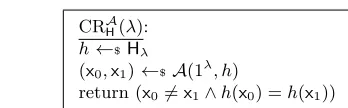
param-eterλ∈N, where eachHλis a collection of functions mapping{0,1}mto{0,1}n such thatm > n. The hash function familyHis said to be collision-resistant if no ppt adversaryAcan find a pair of colliding inputs, with noticeable probability, given a function picked uniformly fromHλ. More precisely, we require that
AdvcrH,A(λ) := Pr[CRAH(λ)]∈Negl,
CRAH(λ): h←$Hλ
(x0,x1)←$A(1λ, h)
return (x06=x1∧h(x0) =h(x1))
Fig. 4.Game defining collision-resistance of a hash function familyH.
2.4 Puncturable pseudorandom functions
A puncturable pseudorandom function family PPRF:= (PPRF.Gen,PPRF.Eval,
PPRF.Punc) is a triple of ppt algorithms as follows. (1) PPRF.Gen on input the security parameter 1λ outputs a uniform element in K
λ; (2) PPRF.Eval is deterministic and on input a key k ∈ Kλ and a point x ∈Xλ outputs a point y∈Yλ; (3)PPRF.Puncis probabilistic and on input ak∈Kλand a polynomial-size set of pointsS⊆Xλoutputs a punctured keykS. As per [22], we require the
PPRFto satisfy the following two properties:
Functionality preservation under puncturing : For everyλ∈N, every
polynomial-size setS⊆Xλand everyx∈Xλ\S, it holds that Pr
PPRF.Eval(k,x) =PPRF.Eval(kS,x)
k←$PPRF.Gen(1λ)
kS ←$PPRF.Punc(k,S)
= 1.
Pseudorandomness at punctured points : For every ppt adversary A:=
(A0,A1),
AdvpprfPPRF,A(λ) := 2·Pr[PPRFAPPRF(λ)]−1∈Negl,
where game PPRFAPPRF(λ) is defined in Fig.5.
PPRFAPPRF(λ): (S,st)←$A0(1λ)
k←$PPRF.Gen(1λ)
kS ←$PPRF.Punc(k,S)
b←${0,1}
b0 ←$AFn1 (1λ,kS,st)
return (b=b0)
Fn(x):
ifx∈/SreturnPPRF.Eval(kS,x) ifT[x] =⊥then
T[x]←$Yλ
ifb= 1 returnT[x] else returnPPRF.Eval(k,x)
Fig. 5. Game defining pseudorandomness at punctured points of PPRF :=
(PPRF.Gen,PPRF.Eval,PPRF.Punc).
2.5 Obfuscators
Syntax.An obfuscator for a circuit familyCSpis a uniform ppt algorithmObf
outputs the description of another circuitC. We require any obfuscator to satisfy the following two requirements.
Functionality preservation : For anyλ∈N, any C∈CSpλ and any m∈
MSpλ, with overwhelming probability over the choice ofC←$Obf(1λ,C) we
have thatC(m) =C(m).
Polynomial slowdown : There is a polynomialpolysuch that for anyλ∈N,
anyC∈CSpλ and anyC←$Obf(1λ,C) we have that|C| ≤poly(|C|).
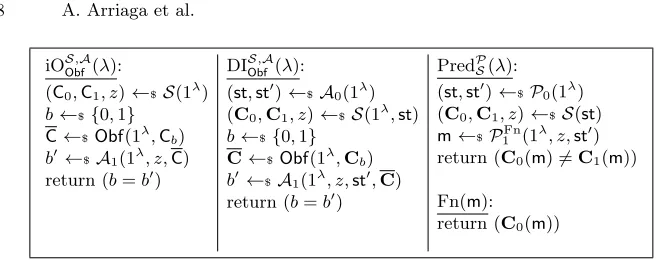
In this paper we rely on the security definitions ofindistinguishability obfus-cation(iO) [13] anddistributional indistinguishability(DI). The latter definition was first introduced by [4] in the context of point function obfuscation and later generalized by [2] to cover samplers that output not only point circuits. We note that the work of [2] considers only statistically unpredictable samplers, which is a more restricted class of samplers, and therefore is a more amenable form of obfuscation. Unfortunately, for the purpose of proving the construction we present in Section3.2secure, we rely on a DI obfuscator against a computation-ally unpredictable sampler.
Indistinguishability obfuscation (iO). This property requires that given
any two functionally equivalent circuitsC0andC1of equal size, the obfuscations ofC0andC1should be computationally indistinguishable. More precisely, for any ppt adversaryAand for any samplerS that outputs two circuitsC0,C1∈CSpλ such thatC0(m) =C1(m) for all inputsmand|C0|=|C1|, we have that
AdvioObf,S,A(λ) := 2·Pr[iOS,AObf(λ)]−1∈Negl,
where game iOS,AObf(λ) is defined in Fig.6on the left.
Distributional indistinguishability (DI). We define this property with
respect to some class of unpredictable samplers S. A sampler is an algorithm S that on input the security parameter 1λ and possibly some state information st outputs a pair of vectors of CSpλ circuits (C0,C1) of equal dimension and possibly some auxiliary information z. We require the components of the two circuit vectors to be encoded as bit strings of equal length. S is said to be
unpredictable if no ppt predictor with oracle access to the circuits can find a differing inputmsuch thatC0(m)6=C1(m). An obfuscatorObfis DI secure with respect to a class of unpredictable samplersSif for allS ∈Sthe obfuscations of
C0 andC1 output byS are computationally indistinguishable. More precisely, for everyS ∈Sand every ppt adversaryAwe have that
AdvdiObf,S,A(λ) := 2·Pr[DIS,AObf(λ)]−1∈Negl,
where game DIS,AObf(1λ) is defined in Fig.6(middle). Furthermore, we say sampler S iscomputationally unpredictable if for any ppt predictorP
AdvpredS,P(λ) := PrhPredPS(1λ)i∈Negl,
iOSObf,A(λ):
(C0,C1, z)←$S(1λ)
b←${0,1}
C←$Obf(1λ,Cb)
b0 ←$A1(1λ, z,C) return (b=b0)
DISObf,A(λ):
(st,st0)←$A0(1λ)
(C0,C1, z)←$S(1λ,st)
b←${0,1}
C ←$Obf(1λ,Cb)
b0 ←$A1(1λ, z,st0,C)
return (b=b0)
PredPS(λ):
(st,st0)←$P0(1λ)
(C0,C1, z)←$S(st)
m←$P1Fn(1λ, z,st
0
) return (C0(m)6=C1(m))
Fn(m):
return (C0(m))
Fig. 6.Games defining iO and DI security of an obfuscatorObf, and unpredictability of a samplerS.
2.6 RAM programs
In the RAM model of computation, a program P has random-access to some initial memory dataD, comprised of |D|memory cells. At eachCPU stepof its execution, P reads from and writes to a single memory cell address, which is determined by the previous step, and updates its internal state. By convention, the address in the first step is set to the first memory cell of D, and the initial internal state is empty. Only whenP reaches the final step of its execution, it outputs a result yand terminates. We use the notationy←PD→D?
to indicate this process, where D? is the resulting memory data when P terminates, or simply y ← PD if we don’t care about the resulting memory data. We also
consider the case where the memory datapersistsbetween a sequential execution of n programs, and use the notation (y1, ...,yn) ← (P1, ...,Pn)D→D
?
as short for (y1 ← PD1→D1 ; ... ; yn ← P
Dn−1→D?
n ). In more detail, a RAM program description is a 4-tupleP:= (Q,T,Y, δ), where:
– Qis the set of all possible states, which always includes the empty state.
– T is the set of all possible contents of a memory cell. If each cell contains a single bit,T ={0,1}.
– Y is the output space ofP, which always includes the empty output.
– δ is the transition function, modeled as a circuit, which maps (Q × T) to (T × Q ×N× Y). On input an internal state sti ∈ Q and a content of a memory cellreadi∈ T, it outputs a (possibly different) content of a memory cell writei ∈ T, an internal state sti+1 ∈ Q, an address of a memory cell addri+1∈Nand an outputy∈ Y.
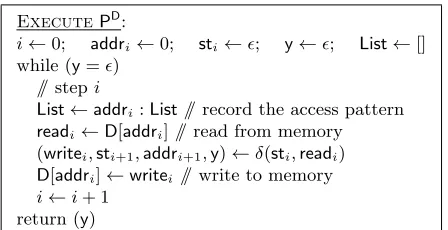
In Figure 7 we show how program Pis executed on a random-access machine with initial memory dataD.
returnsList. More generally, we also allow these functions to receive as input a
set of programs (P1, ...,Pn) to be executed sequentially on persistent memory, initially set toD.
ExecutePD:
i←0; addri←0; sti←; y←; List←[] while (y=)
// stepi
List←addri:List// record the access pattern readi←D[addri] // read from memory (writei,sti+1,addri+1,y)←δ(sti,readi) D[addri]←writei // write to memory i←i+ 1
return (y)
Fig. 7.Execution of programPon a RAM machine with memoryD.
3
Updatable Functional Encryption
We propose a new primitive that we call updatable functional encryption. It bears resemblance to functional encryption in that encryption is carried out in the public-key setting and the owner of the master secret key can issue tokens for functions of its choice that allows the holder of the token to learn the outcome of the function on the message underneath a ciphertext. Here, we model functions as RAM programs instead of circuits, which is closer to how programs are expressed in von Neumann architecture and avoids the RAM-to-circuit compilation. Not only that, we envision tokens that are capable to update the ciphertext, over which other tokens can be subsequently executed. Because the ciphertext evolves every time a token is executed and for better control over what information is revealed, each token is numbered sequentially so that it can only be executedonce
and after all previous extracted tokens have been executed on that ciphertext. Informally, the security requires that the ciphertext should not reveal more than what can be learned by applying the extracted tokens in order. As for efficiency, we want the run-time of a token to be proportional to the run-time of the program up to apolylogarithmicfactor in the length of the encrypted message.
3.1 Definitions
Syntax. An updatable functional encryption scheme UFEfor program family
P :={Pλ}λ∈Nwith message space MSp:={MSpλ}λ∈Nis specified by three ppt
algorithms as follows.
– UFE.TokenGen(msk,P,tid) is the token-generation algorithm and on input a master secret keymsk, a program descriptionP∈ Pλand a token-idtid∈N,
outputs a token (i.e. another program description)Ptid;
– UFE.Enc(mpk,D) is the encryption algorithm and on input a master public keympkand memory dataD∈MSpλ outputs a ciphertext CT.
We do not explicitly consider an evaluation algorithm. Instead, the RAM pro-gram Poutput by UFE.TokenGen executes directly on memory data CT, a ci-phertext resulting from the UFE.Enc algorithm. Note that this brings us close to the syntax of Garbled RAM, but in contrast encryption is carried out in the public-key setting.
Correctness.We say thatUFEis correct if for every security parameterλ∈N,
for every memory data D∈MSpλ and for every sequence of polynomial length in λof programs (P1, ...,Pn), it holds that
Pr
y1=y01∧...∧yn=yn0
(msk,mpk)←$UFE.Setup(1λ)
CT←$UFE.Enc(mpk,D)
fori∈[n]
Pi ←$UFE.TokenGen(msk,Pi, i) (y1, ...,yn)←(P1, ...,Pn)D
(y10, ...,y0n)←(P1, ...,Pn)CT
= 1.
Efficiency. Besides the obvious requirement that all algorithms run in
poly-nomial-time in the length of their inputs, we also require that the run-time of token P on ciphertext CT is proportional to the run-time of its clear-form counterpart (programPon memoryD) up to a polynomial factor inλand up to a polylogarithmic factor in the length ofD. More precisely, we require that for everyλ∈N, for every sequence of polynomial length inλof programs (P1, ...,Pn) and every memory dataD∈MSpλ, there exists a fixed polynomial functionpoly and a fixed polylogarithmic functionpolylogsuch that
Pr
runTime((P1, ...,Pn),CT)≤ runTime((P1, ...,Pn),D)·
poly(λ)·polylog(|D|)
(msk,mpk)←$UFE.Setup(1λ)
CT←$UFE.Enc(mpk,D)
fori∈[n]
Pi ←$UFE.TokenGen(msk,Pi)
= 1
over the random coins of all probabilistic algorithms. In particular, this means that for a program Prunning in sublinear-time in |D|, the run-time of P over the encrypted data remains sublinear.
Security.LetUFEbe an updatable functional encryption scheme. We sayUFE
isselectively secureif for any legitimate ppt adversaryA
AdvselUFE,A(λ) := 2·Pr
SELAUFE(λ)
−1∈Negl,
1. (P1, ...,Pn)D0 = (P1, ...,Pn)D1
2. accessPattern((P1, ...,Pn),D0) =accessPattern((P1, ...,Pn),D1)
These conditions avoid that the adversary trivially wins the game by requesting tokens whose output differ on left and right challenge messages or have different access patterns.
SELAUFE(λ):
(D0,D1,(P1, ...,Pn),st)←$A0(1λ) (msk,mpk)←$UFE.Setup(1λ)
b←${0,1}
CT←$UFE.Enc(mpk,Db)
fori∈[n]
Pi←$UFE.TokenGen(msk,Pi)
b0 ←$A1(CT,(P1, ...,Pn),st) return (b=b0)
Fig. 8.Selective security of an Updatable FE schemeUFE.
3.2 Our construction
The idea of our construction is the following. Before encryption we append to the cleartext the token-id of the first token to be issued, the address of the first position to be read and the initial state of the program. These values are all pre-defined at the beginning. We then split the data into bits and label each of them with a common random tag, their position on the array and a counter that keeps track of how many times that bit was updated (initially 0). Then, we build a Merkle tree over the labeled bits. Later, this will allow us to check the consistency of the data without having to read through all of it. It also binds a token-id, a read-position and a state to the data at a particular stage. Finally, we encrypt each node of the tree, twice, and attach a NIZK proof attesting that they encrypt the same content. Tokens include the decryption key inside their transition circuit in order to perform the computation over the clear data and re-encrypt the nodes at the end of each CPU step. These circuits are obfuscated to protect the decryption key and the random coins necessary to re-encrypt come from a puncturable PRF. The proof then follows a mix of different strategies seen in [19,17,13,2,16].
• UFE.Setup(1λ) samples two public-key encryption key pairs (sk
0,pk0) ←$
PKE.Setup(1λ) and (sk
1,pk1)←$PKE.Setup(1λ), a common reference string
• UFE.Enc(mpk,D) parses mpk as (pk0,pk1,crs,H,(l1, l2, l3)) and appends to the memory data D the token-id 1, address 0 and the empty state , en-coded as bit-stings of length l1, l2 and l3, respectively: D ← (D,1,0, ). (We assume from now on that |D| is a power of 2. This is without loss of generality since D can be padded.) UFE.Enc sets z ← log(|D|), samples a random string tag ←$ {0,1}λ and constructs a perfectly balanced binary
treeT:={node(i,j)}, where leafs are set as
∀j ∈ {0, ...,(|D| −1)}, node(z,j)←(D[j],tag,(z, j),0) and intermediate nodes are computed as
∀i∈ {(z−1), ...,0}, ∀j∈ {0, ...,(2i−1)},
node(i,j)←(H(node(i+1,2j),node(i+1,2j+1))).
UFE.Enc then encrypts each node independently underpk0 andpk1, i.e. ∀i∈ {0, ...,z}, ∀j ∈ {0, ...,(2i−1)},
r(0i,j)←$ RSpλ ; r
(i,j)
1 ←$RSpλ
CT(0i,j)←PKE.Enc(pk0,node(i,j);r(0i,j)) CT(1i,j)←PKE.Enc(pk1,node(i,j);r(1i,j))
and computes NIZK proofs thatCT(0i,j)andCT(1i,j)encrypt the same content. More precisely,
∀i∈ {0, ...,z}, ∀j∈ {0, ...,(2i−1)},
π(i,j)←$NIZK.Prove(crs,x(i,j),(node(i,j),r
(i,j) 0 ,r
(i,j) 1 )), wherex(i,j)is the NP statement
∃(m,r0,r1) :CT (i,j)
0 =PKE.Enc(pk0,m;r0)∧CT (i,j)
1 =PKE.Enc(pk1,m;r1). Finally,UFE.Enclets
CT:={(CT(0i,j),CT1(i,j), π(i,j))},
which encodes a perfectly balanced tree, and outputs it as a ciphertext of memory dataDundermpk.
• UFE.TokenGen(msk,mpk,P,tid) parses (pk0,pk1,crs,H,(l1, l2, l3)) ← mpk, (Q,T,Y, δ)←Pandsk0←msk. It then samples a new puncturable PRF key k←$PPRF.Gen(1λ). Next, it sets a circuitbδas described in Fig.9, using the
parsed values as the appropriate hardcoded constants with the same nam-ing.UFE.TokenGenthen obfuscates this circuit by computingδ ←$ Obf(bδ).
data structure in the ciphertext, and following a similar approach as in [8], we define tokenPnot by its transition function, but by pseudocode, as the RAM program that executes onCTthe following:
1. Set initial statest←, initial addressaddr←0 and empty outputy←. 2. While (y=)
(a) Construct a treeTby selecting fromCTthe leaf at addressaddrand the last (l1+l2+l3) leafs (that should encodetid,addrandstifCTis valid), as well as all the necessary nodes to compute the hash values of their path up to the root.
(b) Evaluate (T,addr,y)←δ(T).
(c) UpdateCTby writing the resultingTto it. 3. Outputy.
Theorem 1. LetPKEbe anIND-CCAsecure public-key encryption scheme, let
NIZKbe a non-interactive zero knowledge proof system with perfect completeness, computational zero knowledge and statistical simulation soundness, let H be a collision-resistant hash function family, letPPRFbe a puncturable pseudorandom function and let Obf be an iO-secure obfuscator that is also DI-secure w.r.t. the class of samplers described inGame4. Then, the updatable functional encryption
schemeUFE[PKE,NIZK,H,PPRF,Obf]detailed in Section3.2is selectively secure (as per definition in Fig.8).
Proof (Outline). The proof proceeds via a sequence of games as follows. Game0 : This game is identical to the real SEL game when the challenge bit
b= 0, i.e. the challenger encryptsD0in the challenge ciphertext.
Game1 : In this game, the common reference string and NIZK proofs are simu-lated. More precisely, at the beginning of the game, the challenger executes (crs,tp) ←$ Sim0(1λ) to produce the crs that is included in the mpk, and proofs in the challenge ciphertext are computed withSim1 andtp. The dis-tance to the previous game can be bounded by the zero-knowledge property ofNIZK.
Game2 : LetT0:={node (i,j)
0 }be the perfectly balanced tree resulting from the encoding ofD0 with tag0, andT1 :={node
(i,j)
1 } the one resulting from the encoding ofD1withtag1, where (D0,D1) are the challenge messages queried by the adversary and (tag0,tag1) are independently sampled random tags. In this game,CT(1i,j)in the challenge ciphertext encryptsnode(1i,j); the NIZK proofs are still simulated. This transition is negligible down to the IND-CPA security ofPKE.
Game3 : In this game we hardwire a pre-computed lookup table to each circuit
b
right branch. Because the challenge ciphertext evolves over time as tokens are executed, to argue this game hop we must proceed by hardwiring one input/output at the time, as follows: (1) We hardwire the input/output of the regular execution [iO property ofObf]; (2) we puncture thePPRFkey of
b
δl on the new hardwired input [functionality preservation under puncturing ofPPRF+ iO property ofObf]; (3) we replace the pseudorandom coins used to produce the hardwired output with real random coins [pseudorandomness at punctured points ofPPRF]; (4) we use simulated NIZK proofs in the new hardwired output [zero-knowledge property ofNIZK]; (5) we compute circuit
δlindependently on the right branch before encrypting the hardwired output [IND-CPA security ofPKE].
Game4 : In all circuitsδbl, we switch the decryption keysk0withsk1and perform the operations based on the right branch, i.e. we modify the circuits such that node(i,j)←PKE.Dec(sk1,CT
(i,j)
1 ). This hop can be upper-bounded by the distributional indistinguishability ofObf. To show this, we construct an adversary (S,B) against the DI game that runs adversary Aas follows. Sampler S runs A0 to get the challenge messages (D0,D1) and circuits δl. Then, it produces the challenge ciphertext (same rules apply on Game3 and Game4), and compute circuitsbδlaccording to rules of Game3 (with decryp-tion keysk0) on one hand and according to rules of Game4(with decryption keysk1) on the other. Finally, it outputs the two vectors of circuits and the challenge ciphertext as auxiliary information.
AdversaryBreceives the obfuscated circuitsδl either containing sk0 or sk1 and the challenge ciphertext. With those, it runs adversaryA1perfectly sim-ulating Game3 or Game4. Boutputs whateverA1outputs.
It remains to show that samplerSiscomputationallyunpredictable. Suppose there is a predictor Pred that finds a differing input for the circuits output by samplerS. It must be because either the output contains a NIZK proof for a false statement (which contradicts the soundness property of NIZK), or there is a collision in the Merkle tree (which contradicts the collision-resistance ofH), or the predictor was able to guess the random tag in one of the ciphertexts (which contradicts the IND-CCA security ofPKE). Note that (1) the random tag is high-entropy, so lucky guesses can be discarded; (2) we cannot rely only on IND-CPA security ofPKEbecause we need the decryption oracle to check which random tag the predictor was able to guess to win the indistinguishability game againstPKE. We also rely on the fact that adversaryA0 is legitimate in its own game, so the outputs in clear of the tokens are the same in Game3and Game4.
Game5 : In this game, we remove the lookup tables introduced in Game3. We remove one input/output at the time, from the last input/output pair added to the first, following the reverse strategy of that introduced in Game3. Game6 : Here, the challenge ciphertext is computed exclusively fromD1 (with
Game7 : In this game, we move back to regular (non-simulated) NIZK proofs in the challenge ciphertext. The distance to the previous game can be bounded by the zero-knowledge property ofNIZK.
Game8 : We now switch back the decryption key to sk0 and perform the de-cryption operation on the left branch. SinceNIZKis statistically sound, the circuits are functionally equivalent. We move from sk1 to sk0 one token at the time. This transition is down to the iO property ofObf. This game is identical to the real SEL game when the challenge bitb= 1, which concludes our proof.
u t
It is easy to check that the proposed scheme meets the correctness and efficiency properties as we defined in Section3.1for our primitive. The size of the ciphertext is proportional to the size of the cleartext. The size expansion of the token is however proportional to the number of steps of its execution, as the circuit δ
must be appropriately padded for the security proof.
4
Future Work
The problem at hand is quite challenging to realize even when taking strong cryptographic primitives as building blocks. Still, one might wish to strengthen the security model by allowing the adversary to obtain tokens adaptively, or by relaxing the legitimacy condition that imposes equal access patterns of extracted programs on left and right challenge messages using known results on Oblivious RAM. We view our construction as a starting point towards the realization of other updatable functional encryption schemes from milder forms of obfuscation.
Acknowledgements. The authors would like to thank Karol Zebrowski for his contribution to an earlier version of this work. Afonso Arriaga is supported by the National Research Fund, Luxembourg, under AFR Grant No. 5107187, and by the Doctoral School of Computer Science & Computer Engineering of the University of Luxembourg. Vincenzo Iovino is supported by the National Research Fund, Luxembourg. Qiang Tang is supported by a CORE (junior track) grant from the National Research Fund, Luxembourg.
References
1. P. Ananth, D. Boneh, S. Garg, A. Sahai, and M. Zhandry. Differing-inputs ob-fuscation and applications. IACR Cryptology ePrint Archive, Report 2013/689, 2013.
3. P. Ananth, and A. Sahai. Functional encryption for Turing machines. In TCC 2016, vol. 9562 of LNCS, pp. 125–153. Springer, 2016.
4. N. Bitansky and R. Canetti. On strong simulation and composable point obfusca-tion. Journal of Cryptology, 27(2):317–357, 2014.
5. M. Bellare, V. Hoang, and P. Rogaway. Foundations of garbled circuits. InCCS 2012, pp. 784–796. ACM, 2012.
6. M. Bellare, I. Stepanovs and S. Tessaro. Contention in cryptoland: obfuscation, leakage and UCE. InTCC 2015, vol. 9563 of LNCS, pp. 542–564. Springer, 2015. IACR Cryptology ePrint Archive, Report 2015/487, 2015.
7. D. Boneh, A. Sahai, and B. Waters. Functional encryption: Definitions and chal-lenges. InTCC 2011, vol. 6597 of LNCS, pp. 253–27. Springer, 2011.
8. R. Canetti, Y. Chen, J. Holmgren, and M. Raykova. Succinct Adaptive Garbled RAM. IACR Cryptology ePrint Archive, Report 2015/1074, 2015.
9. R. Canetti and J. Holmgren. Fully succinct garbled RAM. In ITCS 2016, pp. 169–178. ACM, 2016.
10. R. Canetti, J. Holmgren, A. Jain, and V. Vaikuntanathan. Indistinguishability obfuscation of iterated circuits and RAM programs. IACR Cryptology ePrint Archive, Report 2014/769, 2014.
11. R. Canetti, J. Holmgren, A. Jain, and V. Vaikuntanathan. Succinct garbling and indistinguishability obfuscation for RAM programs. InSTOC 2015, pp. 429–437. ACM, 2015.
12. Y. Desmedt, V. Iovino, G. Persiano, and I. Visconti. Controlled homomorphic encryption: definition and construction. IACR Cryptology ePrint Archive, Report 2014/989, 2014.
13. S. Garg, C. Gentry, S. Halevi, M. Raykova, A. Sahai and B. Waters. Candidate indistinguishability obfuscation and functional encryption. for all circuits. InFOCS 2013, pp. 40–49. IEEE Computer Society, 2013.
14. C. Gentry, S. Halevi, S. Lu, R. Ostrovsky, M. Raykova, and D. Wichs. Garbled RAM revisited. InEUROCRYPT 2014, vol. 8441 of LNCS, pp. 405-422, Springer, 2014.
15. C. Gentry, S. Halevi, M. Raykova, and D. Wichs. Outsourcing private RAM com-putation. InFOCS 2014, pp. 404–4013. IEEE Computer Society, 2014.
16. V. Goyal, A. Jain, V. Koppula, A. Sahai. Functional encryption for randomized functionalities. InTCC 2015, vol. 9015 of LNCS, pp. 325–351. Springer, 2015. 17. Y. Ishai, O. Pandey, and A. Sahai. Public-coin differing-inputs obfuscation and its
applications. InTCC 2015, vol. 9015 of LNCS, pp. 668–697. Springer, 2015. 18. S. Lu, and R. Ostrovsky. How to garble RAM programs. InEUROCRYPT 2013,
vol. 7881 of LNCS, pp. 719-734, Springer, 2013.
19. M. Naor, and M. Yung. Public-key cryptosystems provably secure against chosen ciphertext attacks. InSTOC 1990, pp. 427–437. ACM, 1990.
20. A. O’Neill. Definitional issues in functional encryption. IACR Cryptology ePrint Archive, Report 2010/556, 2010.
21. A. Sahai, and B. Waters. Fuzzy identity-based encryption. InEUROCRYPT 2005, vol. 3494 of LNCS, pp. 457–473, Springer, 2005.
22. A. Sahai, and B. Waters. How to use indistinguishability obfuscation: deniable encryption, and more. InSTOC 2014, pp. 475–484. ACM, 2014.
public keys pk0 and pk1, common reference string crs, hash function Hand bit-length constants (l1, l2, l3).Input:TreeT.
1. Verify the NIZK proof in each node of treeT, and decrypt the first ciphertext of each node withsk0. LetTbe the resulting decrypted tree.
∀(i, j)∈N2:node
(i,j)
∈T,
parsenode(i,j)as (CT(i,j)0 ,CT(i,j)1 , π(i,j)) or return⊥ ifNIZK.Verify(crs,x(i,j), π(i,j)) =falsereturn⊥
node(i,j)←PKE.Dec(sk0,CT(i,j) 0 ) letT:={node(i,j)}
2. On the decrypted treeT, verify the path of each leaf up to the root (i.e. intermediate nodes must be equal to the hash of their children) and check that all leafs are marked with the same random tag.
z←max{i∈N:node(i,j)∈T,∃j∈N}
∀j∈N:node(z,j)∈T,
∀i∈ {(z−1), ...,0}
ifnode(i,b
j
2(z−i)c)6=H(node((i+1),2b
j
2(z−i)c),node((i+1),(2b
j
2(z−i)c+1))) return⊥
parsenode(z,j)as (value(z,j),tag(z,j),position(z,j),counter(z,j)) or return⊥
if∃(j, j0)∈N2:node(z,j)∈T∧node(z,j
0
)∈T∧tag(z,j)6=tag(z,j0) return⊥
3. Read the token-id, address and state of the current step encoded in tree T. Check that the token-id matches the one hardcoded in this token. Then, evaluate the transition circuitδ.
read (tid,addr,st) with fixed bit-length (l1, l2, l3) fromTor return⊥
iftid6=tid∗return⊥
(value(z,addr),st,addr,y)←δ(st,value(z,addr))
4. If the transition circuitδoutputs some resultythen increase the token-id and reset the internal state and address.
ify6=thentid←tid+ 1 ; st←0 ; addr←0
5. Write the (possibly new) token-id, address and state to treeT, update the counters of leaf nodes and recompute the path of each leaf up to the root.
write (tid,addr,st) with fixed bit-length (l1, l2, l3) toT
∀j∈N:node(z,j)∈T,counter(z,j)←counter(z,j)+ 1
∀j∈N:node(z,j)∈T,∀i∈ {(z−1), ...,0},
node(i,b
j
2(z−i)
c)
←H(node((i+1),2b
j
2(z−i)
c)
,node((i+1),(2b
j
2(z−i)
c+1)) )
6. Re-encrypt all nodes of T (as before, encrypt under pk0 and pk1 and add NIZK proofs under crs). To extract the necessary random coins, we use the puncturable PRF under keyk, providing as input the input of this circuit, i.e.T.
∀(i, j)∈N2:node(i,j)∈T, (r(i,j)0 ,r (i,j) 1 ,r
(i,j)
π )←PPRF.Eval(k,(T,(i, j)))
∀(i, j)∈N2:node(i,j)∈T,
CT(i,j)0 ←PKE.Enc(pk0,node (i,j)
;r(i,j)0 );CT(i,j)1 ←PKE.Enc(pk1,node (i,j)
;r1(i,j)) π(i,j)←NIZK.Prove(crs,x(i,j),(node(i,j),r(i,j)
0 ,r (i,j) 1 );r
(i,j) π )
7. Finally, output the updated (encrypted) treeT, the address for next iteration and possibly the outcome of the token.
return (T,addr,y)