LCPR: High Performance Compression Algorithm for Lattice-Based
Signatures
Rachid El Bansarkhani and Johannes Buchmann Technische Universit¨at Darmstadt
Fachbereich Informatik Kryptographie und Computeralgebra, Hochschulstraße 10, 64289 Darmstadt, Germany
[email protected], [email protected]
Abstract. Many lattice-based signature schemes have been proposed in recent years. However, all of them suffer from huge signature sizes as compared to their classical counterparts. We present a novel and generic construction of a lossless compression algorithm for Schnorr-like signatures utilizing publicly accessible ran-domness. Conceptually, exploiting public randomness in order to reduce the signature size has never been considered in cryptographic applications. We illustrate the applicability of our compression algorithm using the example of a current state-of-the-art signature scheme due to Gentry et al. (GPV scheme) instantiated with the efficient trapdoor construction from Micciancio and Peikert. This scheme benefits from increasing the main security parametern, which is positively correlated with the compression rate measuring the amount of storage savings. For instance, GPV signatures admit improvement factors of approximately lgnimplying compression rates of about 65% at a security level of about 100 bits without suffering loss of information or decrease in security, meaning that the original signature can always be recovered from its compressed state. As a further result, we propose a multi-signer compression strategy in case more than one signer agree to share the same source of public randomness. Such a strategy of bundling compressed signatures together to an aggregate has many advantages over the single signer approach.
Keywords: Lattice-Based Cryptography, Lattice-Based Signatures, Aggregate Signatures, Public Random-ness, Lattice-Based Assumptions
1 Introduction
transfer [PVW08], blind signatures [R¨uc10] and much more. But also conceptually new applications have recently been discovered such as fully homomorphic encryption [BV11,Gen09,GSW13] and multilinear maps [GGH+13b,GGH13a], just to name a few examples. The majority of those schemes additionally take advantage of the ring variant as it admits smaller key sizes and faster processing capabilities while simultaneously providing similar worst-case to average-case reductions.
1.1 Related Work
Lattice Signatures Digital signature schemes belong arguably to the most commonly used
crypto-graphic primitives in practice with a wide range of applications. Hence, digital signatures are subject to intense research. The same also holds for lattice-based cryptography resulting in new and efficient signature schemes. First attempts to build lattice-based signature schemes [GGH97,HNHGSW03] failed due to the vulnerability to statistical attacks as shown, for instance, in [NR06,DN12,GJSS01]. First prov-ably secure constructions, however, were independently introduced in [GPV08] and [LM08]. The former approach is based on the hash-and-sign principle, which initiated the design of improving preimage sam-pleable trapdoor functions [GPV08,AP09,Pei10,MP12], the main building block of the GPV signature scheme, which has recently become practical [MP12]. A recent result [BZ13] even shows that the scheme is secure in the quantum random oracle model (EUF-qCMA secure). The second approach, on the other side, takes its inspiration from Schnorr’s signature scheme, since it essentially follows the same method-ology of constructing signatures. Subsequent works followed and aim at increasing the efficiency based on conceptually new ideas [Lyu09,Lyu12] and efficient instantiations [GLP12,BG14]. The most recent construction [DDLL13] presented at Crypto 2013 has proved to be practically efficient taking advantage of an improved discrete Gaussian sampler and an NTRU-like key generation procedure.
1.2 Our Results and Contribution
In this work, we propose a generic and novel high performance compression algorithm for Schnorr-like signature schemes moving current state-of-the-art signature schemes towards practicality. This concept is realized based on the existence of publicly accessible randomness. The notion of public randomness was firstly introduced in [HL93]. We revisit this feature in the context of lattice-based cryptography and show how it can be extended to other distributions such as the discrete Gaussian distribution. In particular, we provide mechanisms that make use of public randomness in order to decrease the signature size. More specifically, we differentiate the randomness used to generate signatures into its public and secret portion. Randomness that is publicly accessible [HL93] can be read by all parties. Consequently, it is not required to hide this portion of randomness and hence can be generated publicly, for instance, by means of a random seed. The key idea underlying our lossless compression algorithm is to reduce the public share of a signature to a short uniform random seed. We exemplify the applicability of our new compression algorithm using the example of the GPV signature scheme employing the most recent PSTF construction [MP12]. To the best of our knowledge, such a compression strategy has never been used for cryptographic applications. In the full version of this paper we give a description of how to apply our compression scheme to other lattice-based signature schemes using essentially the same techniques.
Methodology of Compressing Schnorr-like Signatures. Conceptually, Schnorr signatures z =
from which the masking term y ∈ C was sampled. Here, h = max
s,c kfs(c)k∞ denotes the maximum bound on the entries for any choice of s and c. This range is publicly accessible and can be revealed by any party viewing the signature. This shows that one part of y can be learned publicly and the other part remains secret. Our goal is to exploit the public part (or public randomness) supplied by y and hence the set C. To illustrate the way our compression algorithm works more precisely, sup-pose we have a fresh vector z (e.g. signature ) distributed as above. We will show that arbitrary many other signers can exploit public randomness by secretly sampling their masking term y0 from C ac-cording to the conditional probability distribution Y(x)/Py∼Y[ y ∈ C ] for x residing in C. Since y is
independently sampled, we have y ∈ C with probability Py∼Y[ y ∈ C ] (or shortly P[ C ]) for
arbi-trary fixed z. Hence, exploiting public and secret randomness leads to a vector y0 that is distributed as
P[ y ∈ C ]·P[ y0 = x | y0 ∈ C] = P[ C ]· Y(x)/P[ C ] = Y(x), which exactly coincides with the required distribution using conditional probability rules. Following this approach, we derive an upper bound for the maximum distance of two signatures kz−z0k∞ = kz−s0·c0−y0k∞ ≤ 2h. A necessary condition for compression is given by 2h < kzk∞, which is typically satisfied for the current state-of-the-art signature schemes. A compressed signature is identified by the tupel (z,z−z0), where zis called the centroid and serves to recover z0. To prove security, we simulate our compression algorithm using an oracle for uncompressed signatures from the underlying signature schemes. Subsequently, we show that uncompressed signatures can publicly be transformed into compressed ones. An immediate consequence from this implies that the same centroid can be utilized by different other signers with different keys such that only one single centroid is required to uncompress the signatures of the respective signers. This obviously induces a conceptually new multi-signer compression scheme, where a set of users participate in producing a bundle of compressed signatures using the same source of public randomness. Such a strategy represents a trivial way of aggregating signatures. Going further, since the distribution Z of signatures z can always be simulated by a cryptographic hash function modeled as random oracle in combination with a rejection sampling algorithm, we forbear to store the centroid zand store a short seedr∈ {0,1}µ instead that serves as input to a sampler forZ (typically discrete Gaussian or uniform distribution). This strongly reduces the signature size, since the share of the signature associated to public randomness can deterministically be recovered by use of r. Doing this, it is even possible to compress individual signa-tures to (r,z−z0) of size µ+ log 2h bits, where the seed is always refreshed for every new signature. A corresponding aggregate signature is subsequently represented by the tupel (r,z−z1,z−z2, . . . ,z−zl), where zi denotes the signature of thei-th signer.
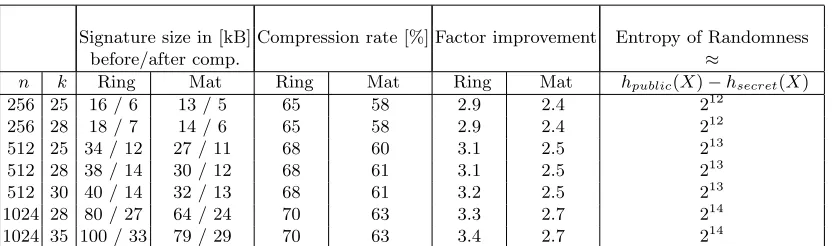
Geometrically speaking, the proposed compression algorithm is akin to vector quantization techniques [GG91], [Gra84] applied for lossy video and audio compression (e.g. MPEG-4). But from an algorithmic point of view our scheme works differently as it requires the signers to sample signatures z0 within short distance to a vector called centroidz(see Figure 1), which could be a signature or a vector sampled from the discrete Gaussian distribution using a short random seed as input. This allows for high compression rates without loss of quality because it is always possible to recover the signatures after compression. As a result, it suffices to store only the seed and the difference z−z0 of the signature to the centroid. This apparently avoids the need to store complete signatures (see Figures 2 and 3). When employing GPV signatures, for instance, the implied storage savings amount to approximately 65 % for practical parameters (see Table 1) yielding a factor improvement of approximately lgn with n being the main security parameter.
Fig. 1. Centroids (red circles) are surrounded by signatures from different signers (blue circles). Each signature belongs to one cluster defined by its centroid.
Signature size in [kB] Compression rate [%] Factor improvement Entropy of Randomness
before/after comp. ≈
n k Ring Mat Ring Mat Ring Mat hpublic(X)−hsecret(X)
256 28 18 / 7 14 / 6 66 58 3.0 2.4 212
512 30 40 / 14 32 / 13 68 61 3.2 2.5 213
1024 35 100 / 33 79 / 29 70 63 3.4 2.7 214
Table 1.Compression rates in the ring and matrix variant for different parameter sets.
Compression of GPV Signatures. Ever since the seminal work [GPV08] the hash-and-sign approach
for building signatures becomes more and more attractive for use in cryptographic applications. How-ever, the construction of new and more efficient preimage sampleable trapdoor functions entailing tighter bounds and simpler instantiations appears to be a challenging task in lattice-based cryptography. One of the main goals of those constructions is to reduce the signature size while preserving security. Decreasing the parameter sgoverning the signature size is often not readily possible without affecting the security, since the security proof [GPV08] requiress≥η(Λ⊥q(A)) to be satisfied for a random matrixA. Usually, the quality s is almost tight due to the construction of the public key A. Thus, enhancing the quality always involves the construction of new trapdoor families. In our work, we provide a very different ap-proach to reduce the signature size by exploiting large amounts of public randomness accessible to any party viewing the signature.
s1
s2 s3
s4
Fig. 2.Depicts signatures from different signers without compression. Complete signatures are stored.
s1
s2 s3
s4
Fig. 3. Depicts signatures with compression. Signatures from different signers are stored in relation to the centroid (red circle).
signature scheme that is most suitable for GPV: The signer generates a random matrix ¯A ∈Zn×n and a secret matrix R ∈Z2n×nk with entries sampled from the discrete Gaussian distribution D
Z,αq, where
αq > √n and q = 2k. The public key is given by A = [I
n |A¯ | G−AR¯ ], where G∈ Zn×nk is called the gadget, a matrix of special structure In⊗g> with g> = (1,2, . . . ,2k−1), which allows to sample preimages more efficiently. In the signing step the signer computes u=H(m) for a message mof choice, samples a perturbation vectorp and a preimagex← D$ Λ⊥
v(G),r forv=u−A·pandr > η(Λ
⊥
q(G)). The resulting signaturez= (z(1),z(2)) =
h
R I
i
·x+p= (Rx+p1,x+p2)∈Z2n×Znk is spherically distributed. Similar to the signature schemes [Lyu08,Lyu09,GLP12], the perturbation vector is used in order to keep the distribution of the signature independent from the secret key and thus not leaking information about its structure. Hence, it is no longer feasible to successfully mount an attack similar to [NR09,DN12]. Verification of signatures is performed by checking the validity of Az≡H(m) andkzk ≤s√2n+nk. We now turn our focus on the way p = (p1,p2) is generated, since it plays an important role for our compression algorithm. Specifically, we sample p =dp
Σp·dca, where d·ca denotes the randomized rounding operation from [Pei10] anddis sampled from the continuous Gaussian distributionD2n+nk1 with parameter 1. As a result of [EB13], the perturbation matrix can be represented by p
Σp =
R
√
b L
√
bInk 0
with b = s2 −5a2, a = r/2 =
q
ln 2n 1 +1/π and L denoting the decomposition matrix from [EB13]. This immediately leads to the simplified representation of the perturbation vector p with p2 = √
bd2+DZn·k−√bd
2,a and d2 $ ← Dnk
1 . Following the abstract form of a Schnorr-signature as above, the lower part of the signature is represented by z(2) = fI(x,y(2)) +y(2) = I·x+DZn·k−y(2),r +y(2) with y(2) = √bd2 and h = max
fI(x,y(2))
∞ ≤ 4.7·
√
5a. By scaling the lower part of any signature to z(2)/√b we extract large amounts of information about the continuous Gaussian d2 used for sampling the perturbation vector. This randomness is publicly accessible [HL93] and can be read by all parties without affecting the security. Indeed, the security level of cryptographic schemes should not be based on public random inputs according to [HL93], because any adversary can analyze public random strings and exploit them for potential attacks. In particular, we have d2 ∈C = z
(2)
√
b + [− h √ b, h √ b]
which is distributed just as Dnk
1 applying conditional probability rules. As a consequence, by one of our main statements (Theorem 5) the difference
z
(2)−z(2) 1
∞ ≤2h requires at most 7 bits per entry with
z1= (z(1)1 ,z (2)
1 ) being the signature of the second signer. Any number of parties with different secret keys can utilize the same source of public randomness in the same manner. Hence, an abitrary signaturez1can be represented by the centroid z(2) in combination with the compressed signature (z(1)1 ,z(2)−z(2)1 ) (see Figure 3). This, however, requiresz(2) always to be fresh such that the stream of signaturesz1 generated by a certain signer are uncorrelated. We highlight that even higher compression rates can be realized if the centroidz(2) is generated differently. Due to the dual role ofz(2) to serve as centroid for compression and source of public randomness, any signer can instead sample a fresh and short random seedr∈ {0,1}µ as input to a discrete Gaussian sampler producing vectors being distributed just like signatures. By doing this, our construction even allows to compress individual signatures because the large centroid is now replaced by a short seed. Furthermore, the dependency to a signature from a signer with different public key is removed. From r one can deterministically recover the centroid and uncompress signatures. As a consequence, the verification costs increase due to an additional call to the discrete Gaussian sampler before checking the validity. Employing this strategy leads to storage improvement factors of lgn.
Multi-Signer Compression Scheme (MCS). The above-described compression algorithm represents
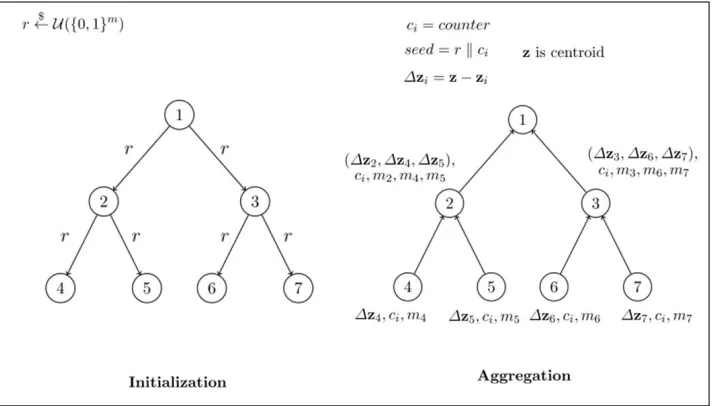
the heart of our conceptually new multi-signer compression scheme, where a set of signers participate to construct an aggregate signature (bundle of compressed signatures including the seed) on messages of choice such that its size is much smaller than the total size of all individual signatures. An intuitive way of aggregating signatures is to let the signers independently compress their signatures before forwarding them to the verifier. As a disadvantage, such a strategy places a burden on the verifier as it is required to invoke the Gaussian sampler for each transmitted seed, which leads to unsatisfactory running times due to costly computations. To overcome this obstacle, the signers agree on a random seed prior to the actual scheme execution. As a result, the verifier calls the Gaussian sampler once, whose output is used as centroid for each compressed signature (see Figures 3 and Figure 1). This drastically reduces the verification costs as well as the number of seeds to be transmitted. The security of this scheme trivially stems from the unforgeability of each individual (un)compressed signature since each of them is verified independently from the remaining ones. Note that as with individual signatures, random seeds have to be fresh for any newly computed aggregate signature.
Furthermore, one notices as an additional benefit of the multi-signer compression scheme that the ag-gregate signature is not completely rejected, if a compressed signature out of the bundle fails to verify, which is apparently different from classical aggregate signature schemes. In fact, only the signature, that failed the checks, is considered not valid. A potentially interesting modification requires the seed to be made a shared secret among the participants, which are subsequently the only ones being capable of un-compressing and verifying signatures. We exemplify the applicability of our construction within wireless sensor networks. We particularly show that it is conceivable to use a predistributed seed together with a counter maintained by each senor node. For any compression request, the actual counter is incremented and subsequently appended to the seed, which in turn serve as input to a cryptographic hash function modeled as random oracle outputting random strings to launch the discrete Gaussian sampler.
1.3 Organization
The rest of this paper is structured as follows:
Section 3 Explains the concept of public randomness and introduces the key features of our novel and generic compression algorithm. In particular, it aims at signatures following the abstract represen-tation form z = fs(c) +y subsuming Schnorr-like signature schemes. Furthermore, it presents a description of the main steps required to compress individual signatures.
Section 4 Describes how to compress GPV signatures using the generic framework from Section 3, be-cause GPV signatures are given byz=
hR
I
i
·x+pand thus can be viewed asz=fs(c)+ywiths=
hR
I
i
.
2 Preliminaries
An extended preliminary section is given in Appendix B introducing major concepts such as the idea of trapdoor functions as required in Section 4.
2.1 Notation
We denote vectors by lower-case bold letters e.g. x, whereas for matrices we use upper-case bold letters e.g. A. Integers modulo q are denoted by Zq and reals by R. By #»vi we denote a sequence of elements
v1, . . . , vi such as vectors or bit strings. The matrix product H = BB> is positive definite for any nonsingular matrixB∈Rn×n. A matrixB is called square root ofH, ifH=BB>. Therefore, we simply write √H = B. Any positive definite matrix has a square root and can be computed using Cholesky decomposition or related variants such as pivoted Cholesky decomposition.
2.2 Signature Sizes
The following lemma provides a bound on the signature size.
Lemma 1. ([EB13, Lemma 2]) Let v ∈ Zn be a vector with k v k2< b· √
n. Then the maximal bit size needed to store this vector is bounded by n·(1 +dlog(b)e).
2.3 Continuous and Discrete Gaussians
By ρ:Rn→(0,1] we define then-dimensional Gaussian function ρ(x) =e−π·kxk
2
2.It follows E[x·x>] = I
2π. Applying a linear function Bonxwithy=Bx leads to the following Gaussian function, whereB is a n×n-matrix with linearly independent columns
ρB(y) =ρ(B−1y) =e−π·<B
−1y,B−1y>
=e−π·y>Σ−1y,Σ=B>B.
One derives the probability density function f√
Σ(x) = ρ√
Σ(x)
√
detΣ of the continuous Gaussian distribution D√
Σ by scaling ρ√Σ by its total measure
R∞
−∞ρ√Σdx= √
detΣ. If Σ=s2·I, we simply writefs(x) =
ρs(x)/sn. The conditional probability density function is defined byf√Σ(x|x∈C) = ρ√
Σ(x)/
√
Σ P[C ]/√Σ =
ρ√
Σ(x)
P[C ] for x∈C ⊂Rn and P[C ] =R
Cρ√Σdx. The discrete Gaussian distributionDΛ+c,√Σ is defined to have support Λ+c, where c∈Rand Λ⊂Rn is a lattice. Forx∈Λ+c, it basically assigns the probability
DΛ+c,√
Σ(x) =
ρ√
Σ(x)
ρ√
Σ(Λ+c)
.
Definition 1 (Statistical distance). The statistical distance of two distributions Xn and Yn denoted
We recall the smoothing parameter introduced by Micciancio and Regev in [MR04]:
Definition 2. For any n-dimensional lattice Λ and positive real > 0, the smoothing parameter η(Λ)
is the smallest real s >0 such that ρ1/s(Λ∗\{0})≤
For any orthogonalized basis ˜B of a lattice Λ with basis B, the following bound on the smoothing parameter holds.
Lemma 2. ([GPV08, Theorem 3.1]) Let Λ⊂Rn be a lattice with basisB, and let >0. We have
η(Λ)≤kB˜ k ·
p
ln(2n(1 + 1/))/π .
In particular, for any function ω(√logn), there is a negligible (n) for which η(Λ)≤kB˜ k ·ω( √
logn).
2.4 Lattices and the SIS-Problem
A lattice Λ is a discrete additive subgroup of Rm with m ≥0. Λ is the set containing all integer linear combinations of k linearly independent vectors {b1, . . . ,bk} with k ≤ m. Formally speaking, we have
Λ = {Bx | x ∈ Zk}. In this work, we are mostly concerened with q-ary lattices Λ⊥
q(A), where q > 0 denotes the modulus, which is bounded by a polynomial inn, andA∈Zn×m
q is an arbitrary matrix. This lattice contains qZm as sublattice and is, hence, of full-rank.Λ⊥q(A) is defined by
Λ⊥q(A) ={x∈Zm |Ax≡0 mod q}.
Any cosetΛ⊥u(A) can be rewritten asx+Λ⊥q(A) withAx≡u.
For the SIS problem, we consider the full-rank m-dimesnional integer lattices Λ⊥q(A) consisting of all vectors that belong to the kernel of the matrix A. More specifically, SISq,n,β is an average-case variant of the approximate shortest vector problem on Λ⊥q(A) for β > 0. Given is a uniform random matrix A ∈ Zn×m with m = poly(n), the problem is to find a non-zero vector x ∈ Λ⊥
q(A) such that kxk< β. Forq ≥β√nω(√logn) finding a solution to this problem is at least as hard as probabilistically
˜
O(β√n)-approximating the Shortest Independent Vector Problem onn-dimensional lattices in the worst-case [GPV08,Ajt96].
3 Generic Lossless Compression of Schnorr-like Signatures
In this section we introduce a novel compression algorithm for signatures following a Schnorr-like con-structionz=fs(c) +y. Conceptually, such signature schemes are characterized by simple representations and efficient operations. After establishing a framework for lossless compression, we show how to derive a customized compression algorithm for the GPV signature scheme [GPV08] in conjunction with the trapdoor construction from [MP12,EB13].
rather rare due to low compression rates as compared to other alternatives. However, the approach we propose makes use of the fact that the centroids are known just before sampling the signatures, which is different to current vector quantization techniques. In particular, we exploit the structure and properties of signature constituents in order to reduce the amount of information needed to recover signatures. Con-ceptually, one defines the centroids in advance and each signer samples its signature around the centroids (see Figure 1). Doing this, one has only to store the direction vectors rather than all individual signatures as depicted in Figure 2 and Figure 3. Notably, we can even show that the large centroid (see Figure 3) needs not to be stored due to the existence of simulators for signatures such as random vectors or discrete Gaussians providing the required public randomness. By means of a short random seed, which serves as input to a RO or a discrete Gaussian sampler acting as simulator for signatures, one can determin-istically recover the centroid. Following this strategy, we achieve storage improvement factors of about 2.5−3.8 for practical parameters and approximately lgn for the general case. The compression factor is asymptotically optimal in the main security parameter.
3.1 Lossless Compression Algorithm
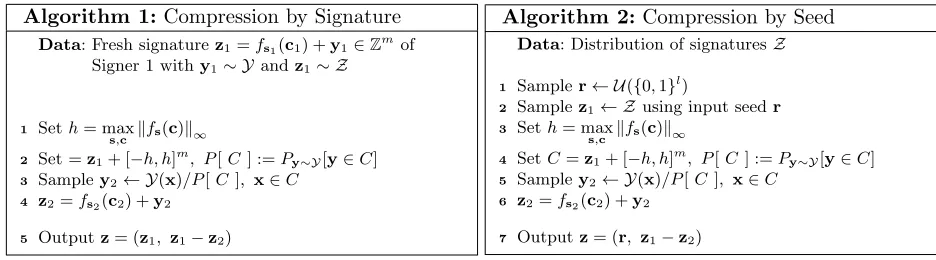
In the following, we introduce our generic compression algorithm. We call it the LCPR algorithm (Lattice-based Compression from Public Randomness). We consider two approaches. The first approach compresses signatures with respect to a given signature serving as a centroid. Therefore, we shortly write vis com-pressed wrtw, whenwis used as the source of public randomness and acts as the centroid for compression. The second approach requires to generate the centroid, that acts as a supplier of public randomness, from a short random seed. Specifically, the seed serves as input to a sampler that produces vectors being dis-tributed just like signatures.
Algorithm 1: Compression by Signature
Data: Fresh signaturez1=fs1(c1) +y1∈Z mof Signer 1 withy1∼ Yandz1∼ Z
1 Seth= max
s,c kfs(c)k∞
2 Set =z1+ [−h, h]m, P[C] :=Py∼Y[y∈C]
3 Sampley2← Y(x)/P[C], x∈C
4 z2=fs2(c2) +y2
5 Outputz= (z1, z1−z2)
Algorithm 2: Compression by Seed
Data: Distribution of signaturesZ
1 Sampler← U({0,1}l)
2 Samplez1← Z using input seedr
3 Seth= max
s,c kfs(c)k∞
4 SetC=z1+ [−h, h]m, P[C] :=Py∼Y[y∈C]
5 Sampley2← Y(x)/P[C ], x∈C
6 z2=fs2(c2) +y2
7 Outputz= (r, z1−z2)
Fig. 4. Lossless compression algorithms
Informal Description
In Figure 4 we present two generic compression algorithms. We briefly describe the main steps re-quired to compress a signature with respect to a given fresh signature (Algorithm 1) or using a simulator for signatures (Algorithm 2) with a short input seed. Each time the signer wants to compress its signa-ture he requires fresh public randomness (fresh seed or z1). Therefore, we consider signatures following a Schnorr-like construction in a more abstract representation form z =fs(c) +y, where fs(c) describes a function of the secret key and is, hence, kept secret within the process of signature generation. However,y is called the masking term required to conceal the secret key and to obtain the desired target distribution of the signature. In many schemes the magnitude of the entries in yare huge as compared tofs(c). This offers the opportunity to read and exploit public randomness. Let C =z1+ [−h, h]m. In Algorithm 1 a fresh signature z1 of an arbitrary signer is given. By using only public parameters a second signer, that is different from the first signer, extracts public randomness identified by a (narrow) set C from which y1 ∈C was sampled with overwhelming probability. Subsequently, he samples its own masking term y2 secretly from the setC using the conditional probability distribution Y(x)/P[C ], where P[C ] denotes the probability of the event y ∈ C under the distribution Y. Finally, the signer outputs a compressed signature (z1,z1 −z2) with z2 = fs2(c2) +y2. Algorithm 2 allows to compress individual signatures without involving any other party providing a fresh signature. In fact, the distribution Z of a signature can be simulated by use of a random oracle H : {0,1}µ → {0,1}t with µ < t in combination with a rejection sampling algorithm. Therefore, we replace a real signature by a sample z1 ← Z generated by means of a random seed r←R{0,1}µ. The remaining steps are identical to those in Algorithm 1. In the last step, however, the signer outputs the compression (r,z1−z2) including the short seed rather than a huge signature z1. We note, that arbitrary many other signers can exploit the same public randomness using either of the algorithms. But the same signer is not allowed to reuse the same randomness twice in order to keep the distribution of own signatures independent from previous samples. As a result, we need to sample always a fresh seed for every new signature such that the chain of signatureszi2are independent and identically distributed according to Z. The procedure of uncompressing signatures is very efficient, since it mainly requires to recoverz1 using the seed r( Algorithm 2).
3.2 Analysis
The authors of [HL93] were the first classifying the notion of randomness into its public and secret por-tion. Public accessible randomness is the part that can be read by all parties and particularly also by an adversary. The secret portion of the randomness, on the other hand, is only known to the party enacting the cryptographic primitive. This distinction is essential because a potential attacker can exploit public randomness in order to mount an attack on the respective cryptographic primitive. As a consequence, the security of any scheme should mainly depend on the secret portion of randomness. However, the authors made such a distinction only for uniformly random strings. In our work, we extend this notion also to other distributions such as Gaussians-like distributions and show how this allows to build a strong compression algorithm. The key idea underlying this construction is to reuse public randomness in order to sample signatures within short distance to the centroids.
We begin with a formal definition of public randomness and some technical results explaining how to use public randomness.
Theorem 1 (Public Randomness). Let Z be a distribution and y← Z with y ∈C =z+ [−h, h]for h >0andz∈R. Then, there exists a bijective transformationφ:{0,1}∗×[b1, b2)→Rfor b2, b1 ∈Rwith b2−b1= 1 such that φ−1(2hz + [−0.5,0.5]) = (a0, . . . , am)×[b1, b2) for(a0, . . . , am)∈ {0,1}m andm∈N. Moreover, we have φ−1(2hy )∈(a0, . . . , am)×[b1, b2), where (a0, . . . , am) is called public randomness, and
As already indicated above the m-bit string (a0, . . . , am) is called public randomness, that can be accessed by any party viewing the signature. Basically, the knowledge of h and the signature z suffice to determine C. As an immediate consequence of Theorem 1, we obtain less number of public random bits, in case the range of C gets wider due to increasing values for h. The following result states that it is possible to exploit (a0, . . . , am) or less bits of it in order to get a full realization from the target distribution.
Theorem 2 (Exploiting Public Randomness). Let y1 ← Z with y1 ∈ C = z+ [−h, h] for h > 0
and z ∈ R. And let φ : {0,1}∗ ×[b1, b2) → R be a bijective transformation as defined in Theorem 1. Then, we obtain a full realization y from Z by sampling y ∈C according to the probability distribution Py∼Z[y =y2 |y∈C ].
The proofs of Theorem 1 and Theorem 2 are given in Appendix C.1 resp. Appendix C.2.
Analogously, one obtains similar results for the continuous case. The main difference here is to consider the probability density function instead. With regard to the algorithms presented in Figure 4 the follow-ing theorem mainly states that exploitfollow-ing public randomness indeed does not change the distribution of signatures. Furthermore, it indicates a necessary condition for compression.
Theorem 3. The compression algorithm provided in Figure 4 outputs signatures z2 ∈ Zm distributed according to Z with maxkz1−z2k∞ ≤ 2h, for h = maxs kf(s)k∞. Hence, the size of a compressed
signature (r,z1−z2) is bounded by
dm·log 2he+µbits, where roccupies µ bits of memory.
Proof. For simplicity, assumem= 1 and we are given a signaturez1 =fs1(c1) +y1 as in Figure 4, where y1 is independently sampled according to the distribution Y. Then, we havey1 ∈C=z1+ [−c1·h, c2·h] for all c1, c2 ≥1 (see Theorem 1). Thus, let c1, c2 = 1. The probability of y1 ∈C =z+ [−h, h] for any fixed choice of z is P[ C ] under the distribution Y, since y1 is independently sampled. Subsequently, the term y2 is secretly sampled from C according to the distribution Y/P[ C ] by reusing the publicly accessible randomness C induced by y1. We now analyze the distribution of y2, when exploiting public and secret randomness. Indeed, the probability of the eventy2=xforx∈C is given byP[y1 ∈C∧y2 = x | y2 ∈ C] = P[ C ]· Y(x)/P[ C ] = Y(x) according to Theorem 2, which exactly coincides with the required distribution. The continuous case works similar and requires to consider the probability density function. Thus, we obtain maxkz1−z2k∞= maxkz1−fs2(c2) +y2k∞≤(c2+c1)h. We observe thatz1 is identified to be the source for public randomness and is subsequently required as a centroid for compression. With focus on compressing individual signatures, we can provide both features by a simulator for the distribution of signaturesZusing a short random seedr∈ {0,1}µas input to a cryptographic hash function modeled as random oracle in combination with a rejection sampler. Following this approach, z1 is replaced by r and can deterministically be recovered at any time by use of the simulator. Thus, the signature size is bounded by dm·log 2he+µ bits, (in generaldm·log(c2+c1)he+µ), whereµ denotes the bit size of r. Remarkably, it is even possible that arbitrary many other signers can exploit the same
source of public randomness in exactly the same way. ut
3.3 Security
The following Theorem essentially states that compressed signatures are as secure as uncompressed ones. Theorem 4. If there exists a (polynomial-time) adversaryA that can break compressed signatures, there is a (polynomial-time) algorithm BA that uses A in order to break the original signature scheme with
Proof. In order to prove that compressed signatures are as secure as standard uncompressed signatures (e.g. standard GPV signatures), we proceed via a sequence of games. In fact, we use Algorithm 1 as an oracle whose output vectors are distributed like signatures and finally serve as a centroid. The challenge compressed signature is given by (z∗1,z∗1−z∗2), where z∗1 denotes the centroid for compression.
Game 0
The game G0 represents the interaction of the challenger with the original compression scheme. The challenger is allowed to make polynomially many queries to a signing oracle producing compressed sig-natures (z1,z1−z2) in combination with the corresponding centroids z1 for compression. The centroids follow the same distributionZas signatures. In addition, the challenger is given access to a random oracle
H0 and an oracle H1, whereH0 is queried on messages of choice producing uniform random vectors. For a vector c distributed asZ as input,H1 produces in accordance to the generic construction in Figure 4 a compressed vector (c,c−x), where xis distributed asZ and the centroid is given byc.
Game 1
In game G1, we change the way the signing oracle responds to signature requests and the challenge compressed signature (z∗1,z∗1−z∗2) is produced, but in a way that it introduces only anegl(n) statistical distance toG0. The signing oracle now outputs only uncompressed signatures (standard signatures). The signing oracle fromG0, which generates compressed signatures together with the corresponding centroids, is now simulated as follows. The signing oracle is queried in order to obtain an uncompressed signature z2. Subsequently, H1 is called on input z2, which then returns a compressed vector (z2,z2−z1) withz2 being its centroid. Finally, the compressed signature (z1,z1−z2) is output, where z1 acts as centroid. Since z1 and z2 are distributed according toZ, the attacker can not distinguish between the games G0 and G1.
The security proof shows that an attacker cannot distinguish between the games G0 and G1. In fact we showed, that an attacker that can break signatures in G0 can also be used to attack uncompressed
signatures in G1. And this concludes the proof. ut
The theorem above mainly states that it is hard to break compressed signatures provided the hardness of the original signature scheme. Via a sequence of games, we showed that a challenger, who is given access to an oracle for uncompressed signatures, is able to produce centroids and signatures while preserving the required distributions.
3.4 Compression Rate of Individual Signatures
Leth= max
s,c kfs(c)k∞andzbe the centroid generated by use of the seedrof sizeµbits serving as input to a simulator for signatures. The compression rate of an individual signature z1 is given by
rate(1) = 1−size(zCS) size(z1)
= 1− dn·log 2he+µ dn·log maxkz1k∞e,
where the denominator indicates the maximum bit size of an uncompressed signature. In many signature schemes such as [DDLL13,MP12,Lyu12,GLP12,Lyu09,GPV08], we have maxkzk∞= ˜O(n) or ˜O(n1/2) de-pendend on the scheme and its instantiation with maxkz−z1k∞=o(n), when applying the compression
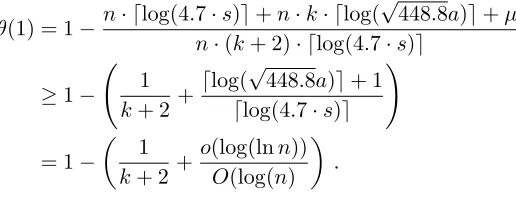
algorithm from Section 3.1. Following this, we achieve compression rates of roughly
τ(1) = 1− o(logn) ˜
4 Compression of GPV signatures
In the following section, we provide a detailed description of how to apply the framework from Section 3 on GPV signatures that are produced by means of the trapdoor construction [MP12]. Section 4 is structured as follows
Section 4.1 Starts with a description of the basic GPV signature scheme.
Section 4.2 Explains the main ingredients of the compression algorithm in the GPV Setting.
Section 4.3 Introduces our conditional rejection sampling algorithm used to sample vectors based on conditional densities.
Section 4.4 Provides the main algorithmic steps of how to compress signatures of a single signer.
4.1 Basic signature scheme
In what follows, we give a short description of the signature scheme [GPV08,MP12] when instantiated computationally, meaning that the matrix A is an instance of the LWE distribution and therefore pseu-dorandom when ignoring the identity submatrix. Considering the GPV-signature scheme one should preferably instantiate the trapdoor construction computationally, since it allows to represent the public key A by less number of columns as compared to a statistical instantiation.
KeyGen(1n): Sample ¯A ←$ Znq×n, and each entry of the secret key R ∈ Z2n×n·k from DZ,αq, where
q = 2k and αq≥2√n. Output the signing keyR, the verification key A = [ In | A¯ |G−AR¯ ] and parameter s such that A ∈Zn×m
q with m = 2n+n·k and G= In⊗g> ∈ Zn×n·k is the primitive matrix consisting ofn copies of the vectorg> = [1,2, . . . ,2k−1].
Sign(msg,R): Compute the syndromeu=H(msg), samplep← D Zm,
√
Σp with
p
Σp=
R
√
b L
√
bInk 0
.
Generating perturbations: [GPV08,MP12,EB13]
Sample d1 ←D2n1 ,d2 ←Dn1·k, where D1 is the continuous Gaussian distribution with parameter 1. Computep˜= (p˜1,˜p2), wherep˜1= √1bRd2+Ld1and˜p2 =
√
b·d2 according to [EB13]. Sample pertrubationp= (p1,p2) =p˜+DZn·(2+k)−˜p,a.
(η(Z)≤a= q
ln 2n 1 +1/π, p1 =˜p1+DZ2n−˜p
1,a, p2 =˜p2+DZn·k−˜p2,a)
Signing:
Determine adjusted syndrome v = u −Ap ∈ Zn. Sample vector x ← DΛ⊥
v(G),r with r = 2a.
Output signaturez←p+
h
R I
i
x.
Verify(msg,z,(H,A)): Check whether A·z ≡ H(msgi) and kzk2 ≤ s√m is satisfied. If so, output 1 (accept), otherwise 0 (reject).
Fo the purpose of sampling x← DΛ⊥
v(G),r in the signing step, the authors provide an efficient and simple
algorithm, which is derived from the randomized nearest plane algorithm.
4.2 Compression Algorithm in the GPV-Setting
Signatures generated within this framework essentially resemble Schnorr signatures (z(1),z(2)) =
hR
I
i
z = (fR(c) +y(1), fI(c) +y(2)). The exact specifications of f(·), y and c will be given below. However, we will focus particularly on the lower part of the signature z(2) =fI(c) +y(2) =I·x+p(2) due to the large difference of magnitudes associated to xand p(2).
Suppose we havelpartiesS1, . . . , Slthat want to sign individual messagesm1, . . . , ml. For the sake of simplicity, we restrict to the case, where l= 2 and both parties use in accordance to the basic signature scheme in Section 4.1 the same signing parameter s, security parameternand modulusq = 2k, meaning that the trapdoor functions fA1 and fA2 have the same domainB ={z∈Z
n(2+k) | kzk ≤sp
n(2 +k)} and range R =Znq. Our compression strategy focuses on the signature subvectorz(2) =x+p(2) ∈Zn·k, wherep(2) is distributed as˜p(2)+D
Zn·k−˜p(2),r withp˜(2)← √
b· Dn·k
1 andxis sampled fromDΛ⊥
vi(G),r with
vi =H(mi)−Aipi fori= 1,2. This leads to the following representation ofz(2) =fI(c) +y(2), where • y(2) ←p˜(2)=√b·d withd← Dn·k
1
• fI(x,y) :=I·x+DZn·k−y(2),r withc= (x,y).
Based on this representation we can apply the tools developed in Section 3. In fact, we have
y(2) ∈z(2)+ [−h, h]nk ⇐⇒d∈C = z (2) √
b +
−√h
b, h
√
b nk
, h= maxkfI(c)k∞ .
Prior to stating the main theorem of this section, which indicates an upper-bound for the size of a compressed signature, we prove some useful statements. For instance, in Lemma 3 we essentially show that we can sample any continuous Gaussiand← D1by first sampling a setBiwith probabilityP[Bi] and then selecting a continuous Gaussian fromBiaccording to the probability densitity functionf(x|x∈B). In Lemma 4 we provide a more general result than [Ban95, Lemma 2.4]. It is a very helpful instrument in order to bound sums of discrete Gaussians having different supports Λi, parameters si and centersci. It trivially subsumes Lemma [Ban95, Lemma 2.4]. By use of this result we give an upper-bound for h and hence for the compressed signature. In Theorem 5 we prove that an arbitrary signer, that is different from the first one, can reuse public randomness following essentially the same arguments as in Theorem 2 by sampling its own continuous Gaussian from C such that the difference of the lower part of its signature to the centroid z(2) is sufficiently small.
Lemma 3. Let X be distributed according to the countinous Gaussian distribution D1 with parameter
s= 1 and centerµ= 0. Directly sampling d← D1 is equivalent to first sampling a set Bi with probability
P[Bi] =
R
Bie
−πx2
dxand then sampling a continuous Gaussian fromBi according to the probability density
function f(x|x∈Bi) = P[Bi]1 e−πx 2
for x∈Bi, where Bi depicts a partition of Rfor 1≤i≤n. The proof of lemma 3 is given in Appendix C.3.
Lemma 4. Let (Λi)1≤i≤n∈Rni be a sequence ofni-dimensionial lattices. Then for any reals si 6=sj >0
such that 1≤i, j≤n and T >0, andxi∈Rni, we have
P r
di∼DΛi,ci,si[|
k
X
i=1
hxi,di−cii| ≥T· k(s1x1, . . . , skxk)k]<2e−πT 2
Proof. One can easily verify thatDΛi,ci,si and si· DΛ0i,c0i,1 define the same distribution, where Λ0i and c0i denote the scaled lattice Λi/si and center ci/si respectively. In the rest of the proof, we will use this equivalence when considering the distribution on the lattice Λi. The cartesian productL=Λ1/s1× · · · ×
Λk/sk of lattices is again a (P i
is defined by ρ(c0
1,...,c
0
k)(A) =
Q
i
ρc0
i(Ai). Letx= (x1, . . . ,xk) define the vector composed by ksubvectors xi ∈Rni andc0 = (c01, . . . ,c0k) respectively. Then we obtain the following equalities:
hx,(DΛ1,c1,s1−c1, . . . ,DΛk,ck,sk−ck)i (1) =hx1,DΛ1,c1,s1 −c1i+· · ·+hxk,DΛk,ck,sk−cki (2) =hx1, s1·(DΛ01,c01,1−c
0
1)i+· · ·+hxk, sk·(DΛ0k,c0k,1−c0k)i (3) =hs1·x1,DΛ10,c01,1−c01i+· · ·+hsk·xk,DΛk0,c0k,1−c0ki (4) =h(s1·x1, . . . , sk·xk),(DΛ01,c10,1−c01, . . . ,DΛ0k,c0k,1−c0k)i (5) =h(s1·x1, . . . , sk·xk),DL,c0,1−c0i. (6)
The claim now follows from equation 6 and [Pei07, Lemma 5.1] with unit vector (s1·x1,...,sk·xk)
k(s1·x1,...,sk·xk)k ut
If we set T ≈4.69 the probability of that inequality to hold is less than 2−100. In the following, we state our main theorem of this section, which enables an arbitrary group of signers to compress signatures. Theorem 5. Assume we have access to an oracle (e.g. a signing or discrete Gaussian oracle) providing a spherically distributed signature z= (z(1),z(2)) with z(1) ∈Z2n
q , z(2)∈Znkq and parameter s according to
the signing algorithm from Section 4.1. Then, each signerSi is capable of producing spherically distributed
signatures zi = (z(1)i ,z(2)i ) such that the following bound onz(2)−z(2)i holds with overwhelming probability
logkz(2)−z(2)i k∞≤7.
The proof of this theorem is given in Appendix C.4 explaining the usage publicly accessible randomness in order to sample within short distance to the centroid z(2). By the same arguments as in Section 3, it enables an arbitrary signerSito secretly sample a continuous Gaussian vectordifromC = z
(2)
√
b+[ h
√
b, h
√
b] nk
using, for instance, the conditional rejection sampler as provided in Section 4.3. The public randomness is supplied by z(2) and can be exploited by an unbounded number of users.
The following result shows that it is even possible to leave out the first n entries from z, which can always be recovered due to the existence of the identity submatrix inA.
Lemma 5. Suppose z = (z(1),z(2),z(3)) is a signature for a message m with hash value H(m) under public key A = [ In | A¯ | G−AR¯ ], where z(1), z(2) ∈ Zn. Then, the signer requires only to output (z(2),z(3))∈Zn(k+1) in order to ensure correct verification.
P roof.The verifier computest=H(m) and defines z(1) :=t−[ ¯A|G−AR¯ ]·(z(2),z(3))∈Zn(k+1). Then, the verifier needs only to check the validity of kzk ≤spn(k+ 2), since A·z = H(m) holds per
definition of z(1). ut
4.3 Conditional Rejection Sampling
In this section we briefly discuss how to perform the rejection sampling step based on conditional probabil-ities. Specifically, we want to sample a vectordfromC = √z
b+[− 4.7√·√5a
b , 4.7√·√5a
b ]
nkaccording to probability
density function f(x | x∈ C) = e−πkxk22/P[ C ] = nk
Q
i=1
e−πx2i/P[ Ci ] with Ci = √zi b + [−
4.7√·√5a b ,
4.7√·√5a b ] and
P[Ci] =
Z
Ci
By means of a simple rejection sampling algorithm, we can sample each entry of d independently from
Ci = √zib + [−4.7·
√
5a
√
b , 4.7√·√5a
b ]. For example, one samples a uniform random element di from Ci and a second random element ui from the interval [ 0,1 ]. We acceptdi, ifui < e−πd
2
i, otherwise we reject and resample. Due to the compact intervals of small width, the rejection sampling algorithm is very fast. This conditional rejection sampler can be used for other distributions as well.
4.4 Single Signer Compression Scheme in the GPV Setting
Our goal is to allow an individual signer to compress its own signatures following the generic approach from Section 3.1. In particular, we aim at replacing the large centroid by a short uniform random string that is used to produce vectors being distributed just like GPV signatures. As a result, we have a way of simulating signatures such that the output vectors take over the role of the centroid. In fact, lattice-based GPV signatures are distributed just like discrete Gaussian vectors. Therefore, a discrete Gaussian sam-pler can be used as a simulator for signatures providing the required public randomness. We know from previous works that a discrete Gaussian can be generated by rejection sampling algorithms parametrized by sequences of uniformly distributed numbers [GPV08,Lyu12] supplied for example by a cryptographic hash function modeled as random oracle. But it is also possible to produce discrete Gaussians by means of a continuous Gaussian sampler in combination with the technique from [Pei10].
Therefore, suppose we want to sample a vector being distributed negligibly close to a discrete Gaus-sian with parameter s representing the centroid as assumed by Theorem 5. According to the proof, we output a vector z(2) distributed as x+c +D
Zn·k−c,a, where c = √
s2−5a2 ·d, d ←$ Dn·k
1 and
x← D$
Zn·k,r holds. Following [Pei10] this is equivalent to first generating a continuous Gaussian vectord with parameter 1, multiplying it with √s2−a2 and rounding each component of the vector to a nearby integer using the randomized rounding operation with parameter a. This produces a vector distributed asd√s2−a2c
a= √
b·d+D Zn·k−
√
b·d,a with b=s 2−a2.
Note that the randomized rounding operation behaves in fact like a discrete Gaussian. Thus, for the scheme to work, a potential signer samples a fresh random seed r of size µ bits as input to a crypto-graphic hash function modeled as random oracle outputting a sequenence of random numbers that in turn serve as input to a discrete Gaussian sampler. Applying the compression algorithm (Algorithm 2) and using Theorem 5, the signer outputs the public seed r for the centroid z(2) and a compressed sig-nature (¯z1,z(2) −z(2)1 ), where ¯z1 contains only the last n entries of z(1)1 ∈ Z2n as per Lemma 5. The size of the compressed signature amounts to approximately n(log(4.7·s) +k·7) +µbits as compared to
n(k+2)·log(4.7·s) bits without compression. The verifier receives the compressed signature and computes the discrete Gaussianz(2) usingr. He then uncompresses the signature to (z(1)1 ,z(2)1 ) and verifies the GPV signature by invoking VerifyGPV(see Appendix B.1).
5 Generic Multi-Signer Compression Strategy from Public Randomness
seed r, signature or discrete Gaussian vector following the distribution of signatures. It is well known that the most trivial form of an aggregate signature scheme simply consists of bundling all signatures of all participating signers together. There is no compression in this case and the security of the aggregate signature stems from the unforgeability of each individual signature, because each signature is verified independently from the others (see Theorem 6). This approach is taken in our work with the difference that each signature is compressed by use of Algorithm 4 and a fresh seed r. Analoguous to the uncom-pressed case, all comuncom-pressed signatures are bundled together with the seed and subsequently handed over to the verifier who in turn verifies each individual signature independently.
The main advantages of such a group compression strategy can be summarized as follows. The overall signature size is reduced, since all signers aggree on a single seedras opposed tolseeds each for a different signer. Therefore, it suffices to transmit only r. The reduction of the computational costs at the verifier side are noticeable. In particular, the verifier has only to call the simulator of signatures once as opposed tol calls, because all signers use the same seed and hence the same centroid. As a result, uncompression of a signature bundle in a multi-signer compression scheme is essentially as fast as uncompressing a single signature.
Section 5 is structured as follows
Section 5.1 Starts with a related work section on aggregate signatures.
Section 5.2 Introduces a novel multi-signer compression strategy, that is more powerful than the single signer strategy.
Section 5.3 Explains how to apply the generic multi-signer compression scheme in the GPV setting.
5.1 Related Work
Due to the relationship of our multi-signer compression strategy and standard aggregate signature schemes, which mainly have the goal to reduce the total size of the signature and to verify that all parties correctly signed the corresponding documents, we start with a related work section for aggregate signature schemes.
directly connected to worst-case lattice problems. In this work, we also address the question whether it is possible to build (S)AS schemes that can be based on worst-case lattice problems.
5.2 Multi-Signer Compression Scheme
Prior to the description of our novel and generic multi-signer compression scheme from public randomness, we start by some definitions. In fact, the idea of the multi-signer compression scheme is strongly related to aggregate signatures in its simplest form, namely bundling l signatures together. We use the terms aggregate signature and bundle of compressed signatures as synonyms throughout the paper. Therefore, it is reasonable to tailor the definition of aggregate signatures to our multi-signer compression scheme.
Definition 3 (Multi-Signer Compression Scheme (MSC)). In a multi-signer compression scheme
lsignatureszionlmessagesmsgifromldistinct signers are combined into a signaturezM SC for1≤i≤l
such that the resulting aggregate signaturezM SC is much smaller than the total size of all individual
signa-tures (compression property). Moreover, each individual standard signature zi can efficiently be recovered
from zM SC (uncompression property).
The generic construction of our multi-signer compression scheme (MSC) from public randomness r in-volves 5 algorithms.
KGen(1n, iwith 1≤i≤l): Outputs secret keysk
i and public key pki to signeri. SeedGen(1n): Outputs a centroid generating seedr∈ {0,1}µ
Sign(ski,r∈ {0,1}µ,msgi): Outputs a messagemsgi of signeriand an individual signaturez0i =z−zi compressed with respect to z that is generated by means of the random seedr.
Bundle(pk# »,#»z,r,msg# »): Outputs the aggregate signaturezM SC as a bundle ofl compressed signatures including the seed.
Verify(pk# »,zM SC,r,msg# »): Verify the aggregate signature zM SC with the aid of the public keys pk# »= (pk1, . . . , pkl), the centroid generating seed rand messages msg# »= (msg1, . . .msgl). Set each entry of outto 1 for each valid signature in the bundlezM SC, else set 0. Output out.
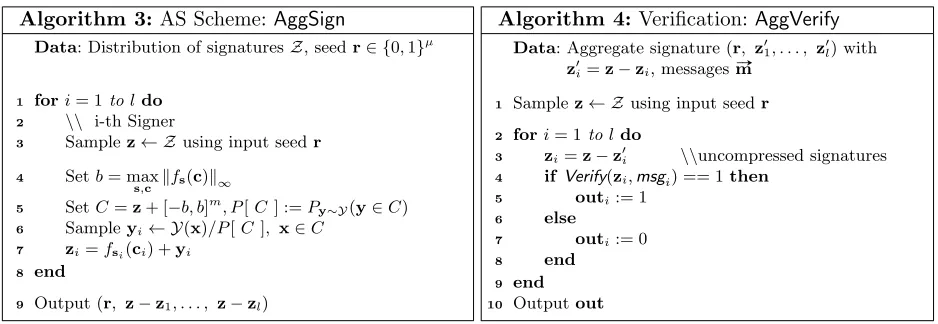
As already observed, the generic compression algorithms from Section 3 naturally induce multi-signer compression schemes, since all parties are allowed to consume the same source of public randomness as per Theorem 3. We hereby present a generic approach towards constructing a multi-signer compression scheme that is more efficient than the single signer approach. The security of the scheme inherently stems from Theorem 4.
proposed one verifies each compressed signature on its own. Following this, the aggregate signature is not completely rejected, in case some signatures fail to verify.
Algorithm 3: AS Scheme:AggSign
Data: Distribution of signaturesZ, seedr∈ {0,1}µ
1 fori= 1toldo 2 \\ i-th Signer
3 Samplez← Z using input seedr 4 Setb= max
s,c kfs(c)k∞
5 SetC=z+ [−b, b]m, P[C] :=Py∼Y(y∈C)
6 Sampleyi← Y(x)/P[C], x∈C 7 zi=fsi(ci) +yi
8 end
9 Output (r, z−z1, . . . , z−zl)
Algorithm 4: Verification:AggVerify
Data: Aggregate signature (r, z01, . . . , z0l) with z0i=z−zi, messagesm#»
1 Samplez← Z using input seedr 2 fori= 1toldo
3 zi=z−z0i \\uncompressed signatures
4 if Verify(zi,msgi) == 1then 5 outi:= 1
6 else
7 outi:= 0 8 end
9 end 10 Outputout
Fig. 5.Aggregate Signature Scheme
Theorem 6 (Security). Let r ∈ {0,1}µ be sampled uniformly at random. Then, the bundle of
com-pressed signatures (aggregate signature) in Algorithm 3 is secure assuming the hardness to break uncom-pressed signatures.
Proof. As per assumptionris uniform random. Since each compressed signature is recovered and subse-quently verified independently from the remaining compressed signatures in the bundle, we can directly
apply Theorem 4. ut
Indeed, the above described multi-signer compression scheme allows the verifier to recover all individ-ual signatures from zM SC. The centroid associated to r connects all the individual signatures together. Furthermore, if the seed is made a shared secret, the aggregate signature can only be recovered and verified by the holders of r. Such schemes are interesting within the context of wireless sensor networks, because WSNs are characterized by constrained ressources such that one observes an inherent need for data compression schemes reducing the amount of traffic. Therefore, we consider cluster-based sensor networks in Appendix E as a potential application scenario for our scheme.
5.3 Multi-Signer Compression Scheme in the GPV Setting
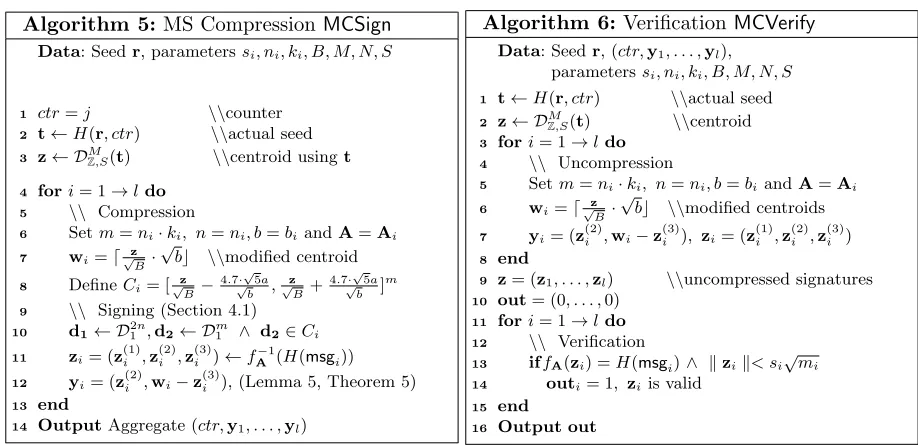
A usable and practical way of instantiating the scheme requires the participating signers to agree on a random string in advance. This is attained, for example, if each signer samples a random salt ri and broadcasts it to the remaining parties in order to produce the ultimate seed r = H(r1, . . . ,rl) using a cryptographic hash function modeled as random oracle. Each signer maintains a counter that is increased for every compression request. This counter is appended to rand serves as input to a second hash func-tion, whose output sequence is used to sample the centroid in order to compress GPV signatures. At this point we have to explain how to sample continuous Gaussians in the case when the signers’ parameters
ni and ki differ.
Gaussian parameter S = max
i si, the maximum dimension N = maxi ni and the maximum number of entries M = max
i niki with si, ni, ki and mi = ni·ki denoting the parameters of the i−th signer. Accordingly, we define bi =s2i −5a2 and B =s2−5a2 ≥bi. Following Theorem 5 and Theorem 2 each signer samples a continuous Gaussian from a set of proper width. This can be achieved by sampling di
$
← Dmi1 , di ∈ Ci = [z (3)
√
B − 4.7√·√5a
bi , z(3)
√
B + 4.7√·√5a
bi ]
mi, where z(3) is a discrete Gaussian vector with
pa-rameters and a=
q
ln 2n 1 +1/π. The choice ofsimplies C⊆Ci forC = z (3)
√
B + [− 4.7√·√5a
B , 4.7√·√5a
B ] and thus provides the required interval width.
Due to differing parameters, the number of signature entries varies among the signers such that
mi ≤m. For this reason, one takes as many entries as required fromz(3) starting from the first compo-nent ofz(3). Since each signer operates with different parametersbi and si when sampling signatures, we have to derive individual centroids from z(3) efficiently. The most reasonable way of doing this requires to use wi=dz
(3)
√
B · √
bic, which can be computed efficiently from public parameters, for signerisuch that its difference to the center of the scaled sets√bi·Ci is smaller than 0.5 in each entry. As a result, we still have logkwi−z(3)i k∞≤7 except with negligible probability. In case we havebi =B for alli,wi=z(3) is obtained as the centroid for all signers. In Figure 6 we provide the main steps of the multi-signer compres-sion scheme. Here DM
Z,S(t) denotes the discrete Gaussian sampler simulating signatures with parameter
S, input seed tand M = max i niki.
Algorithm 5: MS CompressionMCSign
Data: Seedr, parameterssi, ni, ki, B, M, N, S
1 ctr=j \\counter
2 t←H(r, ctr) \\actual seed
3 z← DMZ,S(t) \\centroid usingt 4 fori= 1→ldo
5 \\ Compression
6 Setm=ni·ki, n=ni, b=biandA=Ai
7 wi=d√z
B· √
bc \\modified centroid
8 DefineCi= [√zB−4.7·
√ 5a √ b , z √ B+ 4.7√·√5a
b ] m
9 \\ Signing (Section 4.1) 10 d1← D21n,d2← Dm1 ∧ d2∈Ci
11 zi= (z(1)i ,z(2)i ,zi(3))←fA−1(H(msgi)) 12 yi= (z(2)i ,wi−z(3)i ), (Lemma 5, Theorem 5) 13 end
14 OutputAggregate (ctr,y1, . . . ,yl)
Algorithm 6: VerificationMCVerify
Data: Seedr, (ctr,y1, . . . ,yl), parameterssi, ni, ki, B, M, N, S
1 t←H(r, ctr) \\actual seed
2 z← DMZ,S(t) \\centroid 3 fori= 1→ldo
4 \\ Uncompression
5 Setm=ni·ki, n=ni, b=biandA=Ai
6 wi=d√zB· √
bc \\modified centroids
7 yi= (z(2)i ,wi−z(3)i ), zi= (z(1)i ,z (2) i ,z
(3) i )
8 end
9 z= (z1, . . . ,zl) \\uncompressed signatures
10 out= (0, . . . ,0)
11 fori= 1→ldo 12 \\ Verification
13 iffA(zi) =H(msgi)∧ kzik< si √
mi
14 outi= 1, ziis valid 15 end
16 Output out
Fig. 6. Group Compression Scheme in the GPV Setting
References
[Ajt96] Mikl´os Ajtai,Generating hard instances of lattice problems (extended abstract), 28th Annual ACM Symposium on Theory of Computing, ACM Press, May 1996, pp. 99–108.
[Ajt99] ,Generating hard instances of the short basis problem, ICALP, LNCS, Springer, 1999, pp. 1–9. [AP09] Jo¨el Alwen and Chris Peikert, Generating shorter bases for hard random lattices, STACS, LIPIcs, vol. 3,
Schloss Dagstuhl - Leibniz-Zentrum fuer Informatik, Germany, 2009, pp. 75–86.
[Ban95] W. Banaszczyk, Inequalities for convex bodies and polar reciprocal lattices in rn, Discrete Computational Geometry13(1995), no. 1, 217–231.
[BG14] Shi Bai and StevenD. Galbraith, An improved compression technique for signatures based on learning with errors, CT-RSA 2014 (Josh Benaloh, ed.), LNCS, Springer, 2014, pp. 28–47.
[BGLS03] Dan Boneh, Craig Gentry, Ben Lynn, and Hovav Shacham,Aggregate and verifiably encrypted signatures from bilinear maps, Advances in Cryptology – EUROCRYPT 2003 (Eli Biham, ed.), Lecture Notes in Computer Science, vol. 2656, Springer, May 2003, pp. 416–432.
[BGR12] Kyle Brogle, Sharon Goldberg, and Leonid Reyzin,Sequential aggregate signatures with lazy verification from trapdoor permutations, ASIACRYPT’12, Springer-Verlag, 2012, pp. 644–662.
[BNN07] Mihir Bellare, Chanathip Namprempre, and Gregory Neven,Unrestricted aggregate signatures, ICALP 2007: 34th International Colloquium on Automata, Languages and Programming(Lars Arge, Christian Cachin, Tomasz Jurdzinski, and Andrzej Tarlecki, eds.), Lecture Notes in Computer Science, vol. 4596, Springer, July 2007, pp. 411–422.
[BR93] Mihir Bellare and Phillip Rogaway, Random oracles are practical: A paradigm for designing efficient proto-cols, ACM CCS 93: 1st Conference on Computer and Communications Security(V. Ashby, ed.), ACM Press, November 1993, pp. 62–73.
[BR96] ,The exact security of digital signatures: How to sign with RSA and Rabin, Advances in Cryptology – EUROCRYPT’96 (Ueli M. Maurer, ed.), Lecture Notes in Computer Science, vol. 1070, Springer, May 1996, pp. 399–416.
[BV11] Zvika Brakerski and Vinod Vaikuntanathan,Efficient fully homomorphic encryption from (standard) LWE, 52nd Annual Symposium on Foundations of Computer Science(Rafail Ostrovsky, ed.), IEEE Computer Society Press, October 2011, pp. 97–106.
[BY96] Mihir Bellare and Moti Yung,Certifying permutations: Noninteractive zero-knowledge based on any trapdoor permutation, Journal of Cryptology9(1996), no. 3, 149–166.
[BZ13] Dan Boneh and Mark Zhandry, Secure signatures and chosen ciphertext security in a quantum computing world, Advances in Cryptology CRYPTO 2013 (Ran Canetti and JuanA. Garay, eds.), LNCS, vol. 8043, Springer, 2013, pp. 361–379.
[CN11] Yuanmi Chen and Phong Q. Nguyen,BKZ 2.0: Better lattice security estimates, Advances in Cryptology – ASIACRYPT 2011 (Dong Hoon Lee and Xiaoyun Wang, eds.), Lecture Notes in Computer Science, vol. 7073, Springer, December 2011, pp. 1–20.
[Cor00] Jean-S´ebastien Coron,On the exact security of full domain hash, Advances in Cryptology – CRYPTO 2000 (Mihir Bellare, ed.), Lecture Notes in Computer Science, vol. 1880, Springer, August 2000, pp. 229–235. [DDLL13] Lo Ducas, Alain Durmus, Tancrde Lepoint, and Vadim Lyubashevsky,Lattice signatures and bimodal
gaus-sians, CRYPTO 2013 (Ran Canetti and JuanA. Garay, eds.), LNCS, vol. 8042, Springer Berlin Heidelberg, 2013, pp. 40–56.
[DN12] L´eo Ducas and PhongQ. Nguyen,Learning a zonotope and more: Cryptanalysis of ntrusign countermeasures, ASIACRYPT 2012 (Xiaoyun Wang and Kazue Sako, eds.), LNCS, vol. 7658, Springer, 2012, pp. 433–450. [EB13] Rachid El Bansarkhani and Johannes Buchmann, Improvement and efficient implementation of a
lattice-based signature scheme, Selected Areas in Cryptography (Lange Tanja, Kristin Lauter, and Petr Lisonek, eds.), LNCS, Springer, 2013.
[EFG+10] Oliver Eikemeier, Marc Fischlin, Jens-Fabian G¨otzmann, Anja Lehmann, Dominique Schr¨oder, Peter Schr¨oder, and Daniel Wagner,History-free aggregate message authentication codes, SCN 10: 7th International Conference on Security in Communication Networks(Juan A. Garay and Roberto De Prisco, eds.), Lecture Notes in Computer Science, vol. 6280, Springer, September 2010, pp. 309–328.
[Gen09] Craig Gentry, Fully homomorphic encryption using ideal lattices, 41st Annual ACM Symposium on Theory of Computing(Michael Mitzenmacher, ed.), ACM Press, May / June 2009, pp. 169–178.
[GG91] Allen Gersho and Robert M. Gray,Vector quantization and signal compression, Kluwer Academic Publishers, Norwell, MA, USA, 1991.
[GGH97] Oded Goldreich, Shafi Goldwasser, and Shai Halevi,Public-key cryptosystems from lattice reduction problems, Advances in Cryptology – CRYPTO’97 (Burton S. Kaliski Jr., ed.), Lecture Notes in Computer Science, vol. 1294, Springer, August 1997, pp. 112–131.
[GGH+13b] Sanjam Garg, Craig Gentry, Shai Halevi, Amit Sahai, and Brent Waters,Attribute-based encryption for circuits
from multilinear maps, CRYPTO 2013 (Ran Canetti and JuanA. Garay, eds.), LNCS, vol. 8043, Springer, 2013, pp. 479–499.
[GJSS01] Craig Gentry, Jakob Jonsson, Jacques Stern, and Michael Szydlo,Cryptanalysis of the NTRU signature scheme (NSS) from Eurocrypt 2001, Advances in Cryptology – ASIACRYPT 2001 (Colin Boyd, ed.), Lecture Notes in Computer Science, vol. 2248, Springer, December 2001, pp. 1–20.
[GLP12] Tim G¨uneysu, Vadim Lyubashevsky, and Thomas P¨oppelmann,Practical lattice-based cryptography: A signa-ture scheme for embedded systems, Cryptographic Hardware and Embedded Systems – CHES 2012 (Emmanuel Prouff and Patrick Schaumont, eds.), Lecture Notes in Computer Science, vol. 7428, Springer, September 2012, pp. 530–547.
[GPV08] Craig Gentry, Chris Peikert, and Vinod Vaikuntanathan,Trapdoors for hard lattices and new cryptographic constructions, 40th Annual ACM Symposium on Theory of Computing(Richard E. Ladner and Cynthia Dwork, eds.), ACM Press, May 2008, pp. 197–206.
[Gra84] R.M. Gray,Vector quantization, IEEE ASSP Mag., 1984, pp. 4–29.
[GSW13] Craig Gentry, Amit Sahai, and Brent Waters, Homomorphic encryption from learning with errors: Conceptually-simpler, asymptotically-faster, attribute-based, CRYPTO 2013 (Ran Canetti and JuanA. Garay, eds.), LNCSe, vol. 8042, Springer, 2013, pp. 75–92.
[HL93] Amir Herzberg and Michael Luby,Pubic randomness in cryptography, Advances in Cryptology – CRYPTO’92 (Ernest F. Brickell, ed.), Lecture Notes in Computer Science, vol. 740, Springer, August 1993, pp. 421–432. [HNHGSW03] Jeffrey Hoffstein, Jill Pipher Nick Howgrave-Graham, Joseph H. Silverman, and William Whyte,NTRUSIGN:
Digital signatures using the NTRU lattice, Topics in Cryptology – CT-RSA 2003 (Marc Joye, ed.), Lecture Notes in Computer Science, vol. 2612, Springer, April 2003, pp. 122–140.
[HPS98] Jeffrey Hoffstein, Jill Pipher, and JosephH. Silverman,Ntru: A ring-based public key cryptosystem, Algorithmic Number Theory, LNCS, vol. 1423, Springer Berlin Heidelberg, 1998, pp. 267–288.
[HSW+00] Jason Hill, Robert Szewczyk, Alec Woo, Seth Hollar, David Culler, and Kristofer Pister,System architecture
directions for networked sensors, SIGPLAN Not.35(2000), no. 11, 93–104.
[HSW13] Susan Hohenberger, Amit Sahai, and Brent Waters, Full domain hash from (leveled) multilinear maps and identity-based aggregate signatures, CRYPTO 2013 (Ran Canetti and JuanA. Garay, eds.), LNCS, vol. 8042, Springer, 2013, pp. 494–512.
[LM08] Vadim Lyubashevsky and Daniele Micciancio, Asymptotically efficient lattice-based digital signatures, TCC 2008: 5th Theory of Cryptography Conference(Ran Canetti, ed.), Lecture Notes in Computer Science, vol. 4948, Springer, March 2008, pp. 37–54.
[LMRS04] Anna Lysyanskaya, Silvio Micali, Leonid Reyzin, and Hovav Shacham,Sequential aggregate signatures from trapdoor permutations, Advances in Cryptology – EUROCRYPT 2004 (Christian Cachin and Jan Camenisch, eds.), Lecture Notes in Computer Science, vol. 3027, Springer, May 2004, pp. 74–90.
[LP11] Richard Lindner and Chris Peikert,Better key sizes (and attacks) for lwe-based encryption, CT-RSA, LNCS, Springer, 2011, pp. 319–339.
[Lyn99] Charles Lynn,Secure border gateway protocol (s-bgp), ISOC Network and Distributed System Security Sym-posium – NDSS’99, The Internet Society, February 1999.
[Lyu08] Vadim Lyubashevsky,Towards practical lattice-based cryptography, 2008.
[Lyu09] ,Fiat-Shamir with aborts: Applications to lattice and factoring-based signatures, Advances in Cryp-tology – ASIACRYPT 2009 (Mitsuru Matsui, ed.), Lecture Notes in Computer Science, vol. 5912, Springer, December 2009, pp. 598–616.
[Lyu12] , Lattice signatures without trapdoors, Advances in Cryptology – EUROCRYPT 2012 (David Pointcheval and Thomas Johansson, eds.), Lecture Notes in Computer Science, vol. 7237, Springer, April 2012, pp. 738–755.
[MP12] Daniele Micciancio and Chris Peikert, Trapdoors for lattices: Simpler, tighter, faster, smaller, Advances in Cryptology – EUROCRYPT 2012 (David Pointcheval and Thomas Johansson, eds.), Lecture Notes in Com-puter Science, vol. 7237, Springer, April 2012, pp. 700–718.
[MR04] Daniele Micciancio and Oded Regev, Worst-case to average-case reductions based on Gaussian measures, 45th Annual Symposium on Foundations of Computer Science, IEEE Computer Society Press, October 2004, pp. 372–381.
[Nev08] Gregory Neven, Efficient sequential aggregate signed data, Advances in Cryptology – EUROCRYPT 2008 (Nigel P. Smart, ed.), Lecture Notes in Computer Science, vol. 4965, Springer, April 2008, pp. 52–69. [NR06] Phong Q. Nguyen and Oded Regev,Learning a parallelepiped: Cryptanalysis of GGH and NTRU signatures,
Advances in Cryptology – EUROCRYPT 2006 (Serge Vaudenay, ed.), Lecture Notes in Computer Science, vol. 4004, Springer, May / June 2006, pp. 271–288.
[NR09] ,Learning a parallelepiped: Cryptanalysis of GGH and NTRU signatures, Journal of Cryptology22
(2009), no. 2, 139–160.
[Pei10] ,An efficient and parallel gaussian sampler for lattices, Advances in Cryptology – CRYPTO 2010 (Tal Rabin, ed.), Lecture Notes in Computer Science, vol. 6223, Springer, August 2010, pp. 80–97.
[PVW08] Chris Peikert, Vinod Vaikuntanathan, and Brent Waters,A framework for efficient and composable oblivious transfer, Advances in Cryptology – CRYPTO 2008 (David Wagner, ed.), Lecture Notes in Computer Science, vol. 5157, Springer, August 2008, pp. 554–571.
[R¨uc10] Markus R¨uckert,Lattice-based blind signatures, Advances in Cryptology – ASIACRYPT 2010 (Masayuki Abe, ed.), Lecture Notes in Computer Science, vol. 6477, Springer, December 2010, pp. 413–430.
[Sho97] Peter W. Shor, Polynomial-time algorithms for prime factorization and discrete logarithms on a quantum computer, SIAM Journal on Computing26(1997), no. 5, 1484–1509.