Scholarship@Western
Scholarship@Western
Electronic Thesis and Dissertation Repository
12-12-2012 12:00 AM
Charateristics and Impact of Interpersonal Conflicts on
Charateristics and Impact of Interpersonal Conflicts on
Requirements Risks
Requirements Risks
Avinder Walia
The University of Western Ontario
Supervisor
Dr. Nazim Madhavji
The University of Western Ontario Graduate Program in Computer Science
A thesis submitted in partial fulfillment of the requirements for the degree in Master of Science © Avinder Walia 2012
Follow this and additional works at: https://ir.lib.uwo.ca/etd
Part of the Computer Sciences Commons
Recommended Citation Recommended Citation
Walia, Avinder, "Charateristics and Impact of Interpersonal Conflicts on Requirements Risks" (2012). Electronic Thesis and Dissertation Repository. 1034.
https://ir.lib.uwo.ca/etd/1034
This Dissertation/Thesis is brought to you for free and open access by Scholarship@Western. It has been accepted for inclusion in Electronic Thesis and Dissertation Repository by an authorized administrator of
(Spine title: Impact of Interpersonal Conflicts on Requirements Risks)
(Thesis format: Monograph)
by
Avinder Walia
Graduate Program in Computer Science
A thesis submitted in partial fulfillment of the requirements for the degree of
Master of Science
The School of Graduate and Postdoctoral Studies The University of Western Ontario
London, Ontario, Canada
ii
THE UNIVERSITY OF WESTERN ONTARIO School of Graduate and Postdoctoral Studies
CERTIFICATE OF EXAMINATION
Supervisor
______________________________ Dr. Nazim Madhavji
Examiners
______________________________ Dr. Luiz Fernando Capretz
______________________________ Dr. Mark Daley
______________________________ Dr. Sylvia Osborn
The thesis by
Avinder Walia
entitled:
CHARACTERISTICS AND IMPACT OF INTERPERSONAL CONFLICTS ON REQUIREMENTS RISKS
is accepted in partial fulfillment of the requirements for the degree of
Master of Science
iii
Abstract
Interpersonal conflicts in software projects have an impact on project’s success, product’s quality, team’s performance, etc. However, in Requirements Engineering (RE), there is dearth of research on this topic; previous research has focused largely on conflicts among requirements. We conducted a case study of an industrial project to determine the characteristics (e.g., type, severity, conflict management styles, etc.) and impactof interpersonal conflicts rooted in RE (RE-Conflicts), on project risks associated with requirements (e..g., inadequately identified requirements, incorrect requirements, etc). The findings show that the conflicts over administrative procedures (47%) had the highest frequency count. The highest number of RE-Conflict incidences took place in the elicitation activity (46%). A significant impact of RE-Conflicts on requirements risks was also observed (e.g., ‘continually changing requirements’ was affected by 80% RE-Conflicts). This knowledge can aid in initiating risk management in RE and in developing tools, mitigation strategies and mid-range theories on RE-Conflicts.
iv
Acknowledgments
First and foremost, I would like to thank Dr. Nazim Madhavji for his constant guidance, supervision, dedication and encouragement during this time for which I am truly
indebted.
I am grateful to Mr. Puneet Arora, for participating in this study; I highly appreciate the energy and effort that was expended on his part. I would also like to thank all the
members in my research team. A special thanks goes to Khalid Sherdil and Rashed Nekvi who have suggested many valuable ideas for conducting the research.
v
Table of Contents
CERTIFICATE OF EXAMINATION ... ii
Abstract ... iii
Acknowledgments... iv
List of Tables ... viii
List of Figures ... ix
List of Boxes ... x
List of Appendices ... xi
Glossary: List of Abbreviations ... xii
Glossary: List of Terms ... xiii
Definitions... xv
Chapter 1 ... 1
1 Introduction ... 1
1.1 Motivation ... 1
1.2 Background Overview ... 2
1.3 Originality of Research ... 3
1.4 Generalized Research Question ... 4
1.5 Significance of Research ... 4
1.6 Key Results ... 5
1.7 Thesis Organization ... 6
Chapter 2 ... 7
2 Related Work ... 7
2.1 Conflicts in Software Engineering (SE) ... 8
2.1.1 Impact of Interpersonal Conflicts ... 9
2.1.2 Management of Interpersonal Conflicts... 9
2.1.3 Factors affecting Interpersonal Conflicts ... 10
2.2 Conflicts in Requirements Engineering (RE) ... 11
2.2.1 Conflicts in Requirements... 11
2.2.2 Interpersonal conflicts ... 12
2.3 Research Gap Analysis ... 13
Chapter 3 ... 17
3 The Case Study ... 17
vi
3.2 Study Context: Packaging and Printing Project ... 24
3.2.1 Organizational Structure and Team members... 24
3.2.2 Features and Components ... 27
3.2.3 Prototypical Development Process ... 27
3.2.4 Requirements Engineering Process... 28
3.3 Participants ... 29
3.4 Research Procedures ... 29
3.4.1 Study Design ... 30
3.4.2 Instrument Design ... 35
3.4.3 Data Collection ... 37
3.4.4 Data Analysis ... 38
3.5 Threats to Validity ... 42
3.5.1 Internal Validity ... 42
3.5.2 External Validity ... 42
3.5.3 Qualitative Validity ... 43
3.5.4 Construct Validity ... 45
3.5.5 Conclusion Validity ... 45
Chapter 4 ... 46
4 Results and Interpretations ... 46
4.1 Characteristics of RE-Conflicts ... 46
4.1.1 Types of RE-Conflicts ... 47
4.1.2 RE-Activities in which RE-Conflicts are encountered ... 50
4.1.3 Stakeholders involved in RE-Conflicts ... 52
4.1.4 Severity of RE-Conflicts ... 54
4.1.5 Degree of resolution of RE-Conflicts ... 56
4.1.6 Management styles adopted for RE-Conflicts 4.2 Impact of RE-Conflicts on requirements risks ... 59
4.3 Summary of the findings ... 63
Chapter 5 ... 65
5 Implications... 65
5.1 Implications on Requirements Engineering practice ... 65
5.2 Implications on Requirements Engineering tools ... 65
vii
5.3.2 Emerging hypotheses based on the background literature ... 68
Chapter 6 ... 70
6 Limitations, Future Work and Conclusions ... 70
6.1 Limitations and Future Work ... 70
6.2 Conclusions ... 71
References ... 74
viii
List of Tables
Table 1: The research gap on interpersonal conflicts in RE and the research questions
addressing the research gap ... 14
Table 2: Possible substances of interest to satisfy the goal and their corresponding research questions, metrics and instruments used... 19
Table 3 : Types of interpersonal conflicts ... 20
Table 4: Ordinal scale for severity levels of conflicts (Karn, 2008) ... 21
Table 5: Conflict management styles (Verma, 1998) ... 23
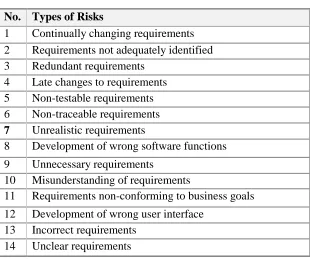
Table 6: Types of risks associated with requirements ... 24
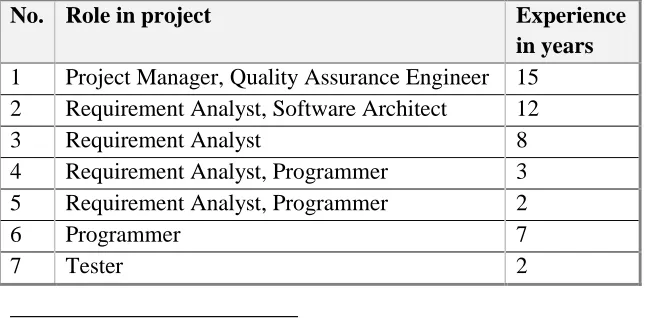
Table 7: Development team members of project under case study: Role and Experience 25 Table 8: Summary of the case study participants ... 29
Table 9: Summary of the experts that participated in the case study... 34
Table 10: Attributes of RE-Conflicts relevant to the study ... 36
Table 11: Types of RE-Conflicts identified in the case study and their description ... 48
Table 12: Types of risks associated with requirements affected by a specific RE-Conflict ... 61
Table 13: Seven major software project risks (Arnuphaptrairong, 2011) ... 63
Table 14: Summary of the related work on conflicts in SE ... 82
Table 15: Summary of related work on conflicts in RE ... 85
Table 16: Project risks and their associated dimensions ... 94
ix
List of Figures
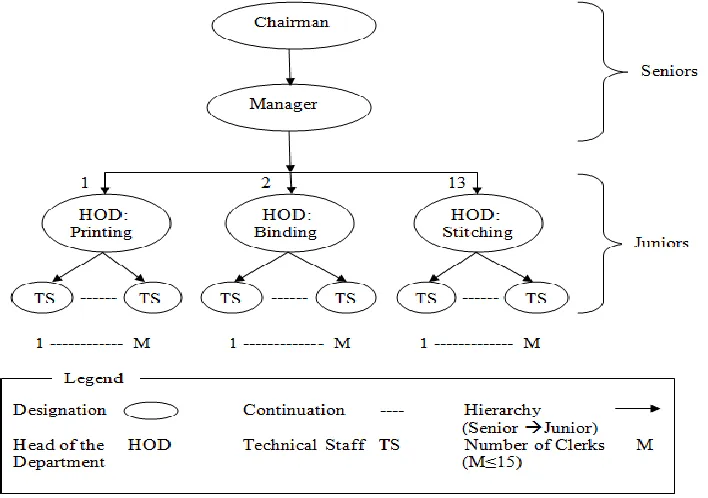
Figure 1: Hierarchy of the participating organization in the case study ... 26
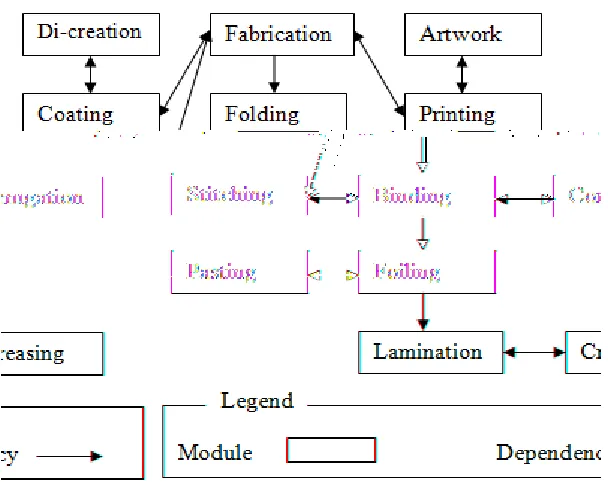
Figure 2: High Level Architecture of the project under case study ... 27
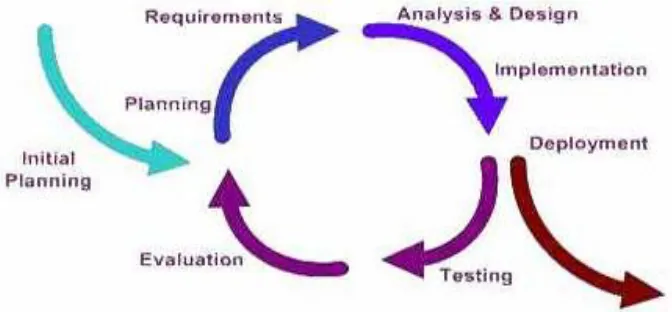
Figure 3: Agile prototypical development process followed for the development of the project under case study (Miyachi, 2011) ... 28
Figure 4: Phase 1 of the study design ... 31
Figure 5: Phase 2 of the study design ... 33
Figure 6: The Nominal Group Technique procedures (Potter et al., 2004) ... 38
Figure 7: Percentage distribution of types of RE-Conflicts in the case study ... 50
Figure 8: Percentage distribution of the RE-Activities in which RE-Conflicts were encountered in the case-study ... 51
Figure 9: Percentage distribution of RE-Conflicts among specific group of stakeholders in the case-study ... 53
Figure 10: Percentage distribution of severities of RE-Conflicts in the case-study ... 55
Figure 11: Percentage distribution of resolved and unresolved RE-Conflicts in the case-study ... 56
Figure 12: Percentage distribution of the management styles adopted for resolving RE-Conflicts in the case-study ... 58
x
List of Boxes
Box 1: Example Data Analysis procedure for identifying risks affected by the
RE-Conflicts ... 39
Box 2: Example of question, Q 1.1 ... 49
Box 3: Example of question, Q 1.2 ... 51
Box 4: Example of question, Q 1.3 ... 54
Box 5: Example of question, Q 1.4 ... 55
Box 6: Example of question, Q 1.5 ... 57
xi
List of Appendices
xii
Glossary: List of Abbreviations
AORE Aspect Oriented Requirements Engineering
DSD Distributed Software Development
GORE Goal Oriented Requirements Engineering
GQM Goal Question Metric
NFR Non Functional Requirements
NGT Nominal Group Technique
PM Project Manager
RA(s) Requirement Analyst(s)
RE Requirements Engineering
SE Software Engineering
SLR Systematic Literature Review
xiii
Glossary: List of Terms
Agile Software Development
It is a conceptual framework that follows iterative and incremental approach to software development. The requirements and solutions evolve through high collaborative process between self-organizing teams (Beck, 2003).
Aspect Oriented Requirements Engineering (AORE)
It is the process of identification of crosscutting properties of the system being developed at the requirements level. Crosscutting properties are those which either affect or rely on other system components or requirements (Grundy, 1999).
Case Study It is empirical method involving information gathering from entities (e.g. a person, group, event, etc.) and having lack of experiment control (Yin, 2009).
Compliance requirements
Compliance requirements are those which are compliant with the related regulations (Maxwell et al., 2011).
Descriptive statistics
Descriptive statistics are used on a sample to estimate characteristics, or traits of a population, i.e., describing the main features of a collection of data (Nick, 2007).
Delphi Study The Delphi method is a proven, popular tool in information systems research for identifying and prioritizing issues by considering opinions of all the participants who are isolated from each other. An anonymous summary of results of all the participants in the panel are shared to encourage them to revise their earlier answers in light of the replies of other participants (Ven & Delbecq, 1974).
Empirical Studies
Enterprise
Resource Planning (ERP)
It is a method of gaining knowledge or results from either direct/ indirect observations or experimentations, using qualitative and/or quantitative analysis methods (Shull, F., Singer, J., & Sjoberg, D. I. K., 2008).
ERP systems automate business functions of an organization by providing an integrated software application that considers the internal and external management information across an entire organization. For example, it embraces finance/ accounting, manufacturing, sales and service, etc. business functions of the organization to facilitate the flow of information between all business functions inside the boundaries of the organization and manage the connections to outside stakeholders (Dredden & Bergdolt, 2007).
Goal Oriented Requirements Engineering (GORE)
It is the process of identification of requirements that capture the goal and objectives, a system under consideration should achieve at different levels of abstraction (Yamamoto, S., Kaiya, H., Cox, K. & Bleistein, S., 2006).
Interpersonal Conflict
xiv
needs, interests, or concerns (Thomas, 1976). Mid-Range
Theories
Mid-range theories aim to discover and discuss relationships between abstract concepts and are closely linked to observations (Carroll, 2000). Nominal Group
Technique (NGT)
Nominal Group Technique (NGT) is an established, qualitative research tool that aids in developing a prioritized list of responses to a specific question by taking into account the opinions of all the participants (Harvey & Holmes, 2012).
Requirements Engineering (RE)
Requirements Engineering is a process of system and software development that covers all of the activities involved in discovering, documenting and maintaining a set of requirements for a computer-based system (Kotonya & Sommerville, 1998).
RE-Activities The activities performed during the Requirements Engineering (RE) process. They include elicitation, negotiation, prioritization, analysis, validation and specification of requirements (Kotonya & Sommerville, 1998).
RE-Conflict A conflict rooted in Requirements Engineering.
Risk Risk is an uncertain event or condition that might have positive or negative impact on objectives of a project (PMBOK, 2012 edition). Risks Dimensions The researchers have categorized software risks into six dimensions,
namely, user (U), requirement (R), project complexity (Comp), planning and control (P&C), team (T), and organizational environment (Org) (see Table 16, Appendix C).
Systematic Literature Review (SLR)
It is a systematic, rigorous literature reviewing technique that aims to gather all existing evidence relevant to the research questions. It follows a methodological approach by explicitly defining full protocol (e.g., research questions, search process, inclusion/exclusion criteria, etc.) to guide the process (Kitchenham et al., 2007).
Software
Engineering (SE)
“Software engineering refers to the disciplined application of engineering, scientific, and mathematical principles and methods to the economical production of quality software” (Humphrey, 1988). Software
Requirements Specification (SRS)
The requirements of the system under development are recorded in this document (SWEBOK, 2004 edition).
xv
Definitions
(i) A conflict is defined as a situation in which people involved in a disagreement over some issues; perceive threat to their needs, interests, or concerns (Thomas, 1976). These include the following example situations:
a) Disagreement among stakeholders over technical issues b) Disagreement among stakeholders over schedules c) Disagreement among stakeholders over project priorities
(ii) Risk is defined as an uncertain event or condition that might have a positive or negative impact on the objectives of a project (PMBOK, 2012 edition).
In the context of this thesis, risk is defined as an uncertain event or condition that could positively or negatively affect the system requirements. Examples of these include:
Chapter 1
1
Introduction
In significant software development projects, conflicts, if not inevitable, are known to occur. Though the interpersonal conflicts have been extensively explored in several fields such as general managerial projects (e.g.,Kerzner,1992;Posner,1986), Software Engineering (SE) projects ( e.g., Karn & Cowling, 2008; Liang, T. P., Jigan, J., Klein, G.S. & Liu, J.Y.C., 2010), etc., yet they have not been well researched in the current context of Requirements Engineering (RE) field. Our study investigates the characteristics and impact of interpersonal conflicts, rooted in RE (henceforth, termed as RE-Conflicts1), on the project risks (specifically those associated with requirements). Since the interpersonal conflicts impact several aspects of a project (Barki & Hartwick., 2001; Gobeli, D.H., Koenig, H.F., & Bechinger, I., 1998; Karn, 2008; Karn & Cowling, 2008; Liang, T. P., Jigan, J., Klein, G.S. & Liu, J.Y.C. , 2010; Sawyer, 2001; Sherif, K., Zmud, R.W., & Browne, G.J., 2006; Robey, D., Farrow, D., L., & Franz, C., R., 1989; Robey, D., Smith, L.A., & Vijayasarathy, L.R., 1993; Robey & Farrow, 1982), therefore, exploring the interpersonal conflicts in RE has its implications both in the software development practice and research.
In Section 1.1, we discuss the motivation for our study. Section 1.2 gives an overview of the related work on conflicts in RE and Section 1.3 describes the originality of the research. The generalized research question is given in Section 1.4. The significance of the study has been described in Section 1.5. The key results of the study have been discussed in Section 1.6. Finally, the chapter concludes by describing the organization of the thesis in Section 1.7.
1.1 Motivation
The literature has shown that unresolved interpersonal conflicts have a strong, negative effect on the software product success and customer satisfaction (Gobeli et al., 1998;
Robey et al., 1993). Further, conflict management has been stated as one of the eight most critical project success factors by Gemunden and Lechler (1997). Also, a manager is known to spend on an average 18-26% of their time dealing with the conflicts (Thomas & Schmidt, 1976). Kerzner (1992) claims that conflict “may be the single most important characteristic of the project environment.” Hence, conflicts are clearly an important topic for a project’s outcome, yet in the field of RE not much is known about interpersonal conflicts and their impact on project parameters.
In group interactions, requirements definition is a prime area for substantial conflicts (Elam & Walz, 1988). Also, a “close” relationship between conflicts and risks in downstream software development has been mentioned by Sage (2003); yet no scientific studies appear to exist on the “conflict-risk” relationship in RE. This is important to investigate because as much as 24% of the overall project risks which are “high level risks”, are rooted in the early phases of software development (Amber, S., Shawoo, N., & Begum, S., 2012).
1.2 Background Overview
In the conflicts area, the research in RE has largely focused on RE tools and frameworks to identify and resolve conflicts among requirements. Studies have been conducted on both conflicts in general requirements (Hartwell, 1991; Kim, M., Park, S., Sugumaran, V. & Yang, H., 2007) as well as conflicts in specific requirements such as Non Functional Requirements (NFR) (Boehm & In, 1996; Egyed & Grubacher, 2004; In H., Boehm, B., Rodgers, T., & Deutsch, M., 2001;Liu, 2010; Poort & De With, 2004; Sadana & Liu, 2007), compliance2 requirements (Maxwell, J.C., Anton, A.I., & Swire, P., 2011), requirements in Aspect Oriented Requirements Engineering3 (AORE) (Sardinha, A., Chitchyan, R., Weston, N., Greenwood, P. & Rashid, A.,2009) and requirements in Goal
2 Compliance requirements are those which are compliant with the related regulations (Maxwell et al., 2011).
Oriented Requirements Engineering4 (GORE) (Lamsweerde, A.V., Darimont, R., & Letier, E. ,1998).
A web-based model that supports resolving inter-personal conflicts among group members to produce a correct formal software specification document was presented by Sullabi, M.A., Abugharsa, M.B. and Taher, A.M. (2012). Elam and Walz (1988) showed that conflict is a consistent but fairly small percentage of the group interaction, and that the issues are not resolved in a top-down manner which causes them to resurface at later meetings. Damian and Zowghi (2003) studied how culture, conflict and distance interplay in globally distributed requirements. Khan, H.H., Malik, N., Usman, M., and Ikram, N. (2011) had reported a positive impact on the conflict resolution due to the change of sequence of communication medium in Distributed Software Development (DSD) settings. Beyond these works, there have been no studies, to our knowledge, on inter-personal conflicts in RE.
1.3 Originality of Research
While studies show that there is significant impact of interpersonal conflicts on project success (Gobeli et al.,1998; Robey et al., 1993), product’s quality (Liang et al., 2010), team’s performance (Karn & Cowling, 2008), etc., there is scarcity of research in RE, on the interpersonal conflicts. As discussed in Section 1.2, the research in RE has largely focused on RE tools and frameworks to identify and resolve conflicts among requirements. Our work, on exploring the characteristics and impact of interpersonal conflicts, rooted in RE, is thus quite complementary to these other works. To the best of our knowledge, no scientific studies have been conducted on these aspects of interpersonal conflicts in RE. An example of interpersonal conflict, rooted in RE, is disagreement between clients and developers over the selection or prioritization of requirements for the next release.
1.4 Generalized Research Question
A software project has several aspects such as costs (Boehm & Papaccio, 1988), quality (Berenbach, 2006), RE-Success factors (El Elam & Madhavji, 1995), risks (Arnuphaptrairong, 2011), etc. The RE-Conflicts might have an impact on these aspects of a software project. However, this thesis investigates specifically the impact of RE-conflicts on the project risks associated with requirements such as inadequately identified requirements, non-traceable requirements, incorrect requirements, etc.
In the quest to explore RE-Conflicts, the key generalized research question posed in this study is:
“What are the characteristics and impact of interpersonal conflicts, rooted in
requirements engineering, on the project risks associated with requirements?”
We conducted an exploratory case study on a software project of a small-sized software development company to investigate the research question.
1.5 Significance of Research
The project risks associated with requirements such as inadequate requirements, incomplete requirements, inconsistent requirements, etc. have critical impact on software’s quality (Bell & Thayer, 1976). Boehm (1981) estimated that late corrections done to requirements errors could cost up to 200 times more than the corrections performed during RE. Hence, to improve the quality of software and to lower the costs of project development, practitioners can utilize the findings of the study to create strategies for the mitigation and avoidance of RE-Conflicts affecting project risks associated with requirements.
To the best of our knowledge, there are no scientific studies conducted on the RE-Conflicts. Hence, this study can aid in developing emerging mid-range theories5 on the RE-conflicts. Similarly this study can also encourage researchers for conducting further confirmatory and complementary studies on RE-Conflicts. It can also motivate researchers to develop new RE technologies such as RE-Conflict sensitive tools. Our study can also provide a ground work for conducting further research to explore the impact of RE-Conflicts on other project parameters such as costs (Boehm & Papaccio, 1988), quality (Berenbach, 2006), RE-Success factors (El Elam & Madhavji, 1995), etc. 1.6 Key Results
The case study has explored the characteristics (e.g., type, severity, conflict management style, etc.) of RE-Conflicts and their impact on requirements risks. The findings have shown that conflicts over administrative procedures (47%) had the highest frequency count and conflicts over schedules (8%) had the lowest frequency count (see Figure 7, § 4.1.1). The highest numbers of RE-Conflicts were encountered in the elicitation (46%) and negotiation (31%) activities respectively (see Figure 8, § 4.1.2). 70% of the RE-Conflicts in the case study were between users and analysts (see Figure 9, § 4.1.3). 77 % of these Conflict incidences were unresolved and 80% of those unresolved Conflicts were between users and analysts (see Figure 11, § 4.1.5). Most of the RE-Conflicts (46%) were associated with high severity levels, i.e., 5 and 6 in the ordinal
scale ranging from 1 to 6 (see Figure 10, § 4.1.4). The ‘forcing’ (39%) conflict management style was observed to be the most widely adopted management strategy for resolving conflicts in the case study whereas ‘collaborating’ conflict management strategy was never used to resolve RE-Conflicts (see Figure 12, § 4.1.6).
A significant impact of RE-Conflicts on requirements risks was also reported by the findings of the case study. The following requirements risks were affected the most by the RE-Conflicts: ‘misunderstanding of requirements’ (80%), ‘continually changing requirements’ (80%), ‘late changes to requirements’ (80%) and ‘development of wrong software functions’ (60%) (see Figure 13, § 4.2).
1.7 Thesis Organization
Chapter 2
2 Related WorkInterpersonal conflicts are an important characteristic of project environment (e.g., Harris & Looney, 1999; Karn, 2008). They have been well researched in various fields such as project management, social sciences, psychology, etc. However, since the focus of our study is on RE, which is an integral part of SE field, therefore, in this chapter we have examined and demonstrated the work on conflicts in SE and RE.
In order to find the research gap in the area of interpersonal conflicts in the field of SE with focus on the field of RE, we performed a Systematic Literature Review (SLR)6 (Kitchenham, B., Brereton, O.P., Budgen, D., Turner, M., Bailey, J., & Linkman, S., 2007). The design, process and the outcomes of the SLR were validated by relevant experts. In addition, several brainstorming sessions were conducted with various software researchers and industry personnel to gain insights into the present demands of the industry and research on this topic. The following example questions were investigated using this technique:
What is the importance of exploring interpersonal conflicts?
What research topics have been addressed on interpersonal conflicts in SE and
RE?
What are the future works suggested by researchers on the interpersonal conflicts
in SE and RE?
What research topics have not yet been addressed by the previous works on
conflicts in SE and RE?
Several search strings (keywords) were used including the following example strings: Conflicts (or Interpersonal Conflicts) AND Software Engineering
Conflicts (or Interpersonal Conflicts) AND Software Projects
6
Conflicts (or Interpersonal Conflicts) AND Information Technology Projects Conflicts (or Interpersonal Conflicts) AND Requirements Engineering Conflicts (or Interpersonal Conflicts) AND Requirements
These strings were used in the search engines of some of the most important scientific publications such as IEEE Digital Library, ACM Digital Library, Wiley InterScience, Springer, Kluwer, Synthesis Digital Library of Engineering and Computer Science Literature and others. An important source of grey literature, i.e., Google Scholar was also taken into account. In SE, only studies regarding interpersonal conflicts were considered as the inclusion criteria because the focus of our study was on interpersonal conflicts in particular. Hence studies on the conflicts regarding specific phases of software development life cycle (e.g., architecture, testing, maintenance, etc.) were not selected for the review. Also, since our study focused on RE, research on conflicts in requirements were also examined along with the research on interpersonal conflicts.
The goal of our study and the associated research questions, which are discussed in detail in Section 3.1 were derived by analyzing the research gaps obtained (see § 2.3) by performing this SLR. Section 2.1 and Section 2.2 describe the work related to our study on conflicts in SE and RE fields respectively. We conclude in section 2.3 by giving the analysis of the research gap based on our literature review.
2.1 Conflicts in Software Engineering (SE)
On performing SLR, we found that the previous work on conflicts in SE has focused on the following three key dimensions: (i) the impact of interpersonal conflicts, (ii) the management of interpersonal conflicts and (iii), the factors affecting interpersonal
2.1.1 Impact of Interpersonal Conflicts
In SE, the researchers have studied the impact of interpersonal conflicts on various aspects such as software quality, team performance, project success, etc. As early as 1998, a strong, negative effect of unresolved conflicts was found on the overall software product success and customer satisfaction based on a survey comprising of 117 software professionals and managers (Gobeli et al., 1998). Karn and Cowling 2008 observed three teams consisting of Master of Science students during the feasibility, requirements analysis, and design phases of SE projects to find the impact of interpersonal conflicts on the performance of teams. The analysis showed that the team that experienced moderate levels of task conflicts in comparison with other teams performed the highest. The authors also concluded that conflicts in SE teams per se are not intrinsically good or bad and their nature depends on factors such as effectiveness of conflict management strategies adopted and frequency of occurrence of conflicts.
Three forms of conflicts have been identified in general team-process research: task conflicts (Dreu & Weingart, 2003), relationship conflicts (Amason, 1996) and process conflicts (Jehn, 1995). Researchers in SE have found that these forms of conflicts have different consequences. For example, Karn (2008), based on the analysis of the ethnographic study of seven SE teams, reported that task conflicts were beneficial when they were based on either core project or technical issues. Process conflicts were found to be slightly more destructive whereas the relationship conflicts were found to be overwhelmingly destructive. Analogously, (Liang et al., 2010) reported that relationship conflicts have negative impact on the quality of software whereas the task-conflicts aid in improving software quality by increasing learning opportunities.
2.1.2 Management of Interpersonal Conflicts
interventions for managing conflicts are the ones that experience greater success as compared to others who do not implement them. Similar results were reported by Sawyer (2001) , showing nearly one-half of the variance between the most successful software development teams and the least successful software development teams based on how effectively the conflicts were managed. However, Barki & Hartwick (2001) found that conflict management could not substantially ameliorate the negative effects on the information system development outcomes.
In a seminal paper in management projects, Blake and Mouton (1964) presented five general techniques for resolving conflicts: avoiding (withdrawing), accommodating (smoothing), compromising, forcing and problem solving (confronting). Several researchers have explored these conflict management strategies in the SE context. Gobeli et al. (1998) , from the survey of 117 software professionals and managers, discovered that smoothing, withdrawing, and forcing conflict management strategies have dysfunctional effects whereas the compromising conflict management strategy has beneficial impact on the project success. The ‘compromising strategy’ was found to be the most frequently adopted conflict management strategy by Laurindo & Moraes (2006). The findings of Dechurch, L.A., Hamilton, K.L., and Haas, C. (2007) showed that adoption of the ‘forcing’ conflict management strategy has the highest negative impact on relationships whereas using the ‘collaborating’ management strategy has the least effect on the interpersonal relationships.
2.1.3 Factors affecting Interpersonal Conflicts
between user participation and project success. Lewis and Smith (2008) investigated the impact of dominance of problem solving style on the group conflict. From the case-study comprising of 38 students enrolled in two fifteen week SE courses, they found that a negative relationship exists between the dominance of problem solving style and group conflicts.
2.2 Conflicts in Requirements Engineering (RE)
Researchers have covered two dimensions of conflicts in RE: (i) conflicts in requirements and (ii) interpersonal conflicts. By carrying out SLR, it was found that the work on conflicts in RE has been mostly focused on the conflicts in requirements whereas the interpersonal conflicts in RE have not been well researched. Section 2.2.1 describes the work done in RE on the conflicts in requirements and Section 2.2.2 gives the work done on the interpersonal conflicts in RE. In Appendix A (Table 15) we have provided the summary of the work done on conflicts in RE in a chronological order.
2.2.1 Conflicts in Requirements
In the area of RE, previous research on conflicts has been focused largely on identifying and resolving conflicts in general requirements (Hartwell, 1991; Kim, M., Park, S., Sugumaran, V., & Yanag, H., 2007) as well as conflicts in specific requirements such as conflicts among NFR (Boehm & In, 1996; Egyed & Grubacher, 2004; In et al., 2001;Liu,
2010; Poort & De With, 2004; Sadana & Liu, 2007), compliance requirements (Maxwell
Egyed & Grubacher (2004) presented an automated and tool-supported approach for the identification of requirements conflicts. Poort & De With (2004) presented a framework for resolving requirements conflicts, termed as Non- Functional Decomposition (NFD). Similarly, Sadana and Liu (2007) also presented a framework for the analysis of conflicts among NFR based on the integrated analysis of functional requirements and NFR. Recently, Liu (2010) also proposed a conflict analysis method for NFR. He proposed a domain independent NFR ontology, 7 kinds of metadata for modeling NFR and 7 conflict detection rules for NFR.
Kim et al. (2007) had presented an approach for the systematic identification and management of conflicts. Various techniques for the evaluation of conflicts among requirements, analysis methods for the resolution of conflicts and the impact of technology trends on conflicts have been discussed by Hartwell (1991). Conflicts among compliance requirements have been recently studied by Maxwell et al. (2011). Based on the results of a case study, the authors identified five sets of conflicting compliance requirements and recommended strategies for resolving these conflicts. Sardinha et al. (2009) presented an automated tool, EA-Analyzer for the identification of conflicts in AORE. A formal framework for clarifying various types of inconsistency that might arise in GORE and various formal techniques and heuristics for conflict detection has been proposed by Lamsweerde et al. (1998).
2.2.2 Interpersonal conflicts
Interpersonal conflicts have not been very well researched in RE. To our knowledge, none of the studies have explored the characteristics (e.g., severity of conflicts, RE-Activities in which they were encountered, etc.) and impact of interpersonal conflicts in RE on various project parameters such as risks, costs, quality, etc.
presented. The requirements instability was reported to lead to potential interpersonal conflicts by Liu, J. Y., Chen, C. C., Chen, H., and Sheu, T. S. (2011) based on a survey of top 1600 companies in Taiwan. Another study on the interpersonal conflicts within a software design team which took place during the requirements definition phase of an actual software development project was carried out by Elam and Walz (1988). The analysis showed that conflict is a consistent but fairly small percentage of the group interaction, and that the issues are not resolved in a top-down manner which causes them to resurface at later meetings.
A few studies have also been conducted in RE on the interpersonal conflicts in DSD environment, particularly the off-shore model. Damian and Zowghi (2003) studied how culture, conflict and distance interplay in globally distributed requirement negotiations and presented a model of impact on RE activities due to various challenges such as cultural diversity, time and distance differences, etc. Khan et al. (2011) had reported a positive impact on the conflict resolution due to the change of sequence of communication medium in DSD settings.
2.3 Research Gap Analysis
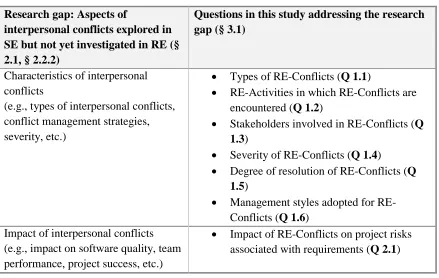
Thus, clearly, conflicts are an important topic for a project’s outcomes. Yet in the field of RE, to our knowledge, there is no scientific study on the characteristics and impact of interpersonal conflicts on project parameters such as risks (e.g., inadequate effort-estimation, inadequately identified requirements, failure to manage end user expectations, etc.), costs (e.g., documentation costs, development costs, rework costs, etc.), RE-Success factors (e.g., the clarity of the business process in the architecture, the extent of user consensus on the recommended solution, the completeness of coverage of the cost/benefits analysis, etc.) (El Emam & Madhavji, 1995), etc. Table 1 enumerates the research gap in RE by giving those aspects of interpersonal conflicts that have been explored in SE but have not yet been investigated in RE. The research questions which are discussed in the next chapter (§ 3.1) have also been specified in the Table 1 to demonstrate their link with the research gap.
Table 1: The research gap on interpersonal conflicts in RE and the research questions addressing the research gap
Research gap: Aspects of
interpersonal conflicts explored in SE but not yet investigated in RE (§ 2.1, § 2.2.2)
Questions in this study addressing the research gap (§ 3.1)
Characteristics of interpersonal conflicts
(e.g., types of interpersonal conflicts, conflict management strategies, severity, etc.)
Types of RE-Conflicts (Q 1.1)
RE-Activities in which RE-Conflicts are
encountered (Q 1.2)
Stakeholders involved in RE-Conflicts (Q
1.3)
Severity of RE-Conflicts (Q 1.4)
Degree of resolution of RE-Conflicts (Q
1.5)
Management styles adopted for
RE-Conflicts (Q 1.6) Impact of interpersonal conflicts
(e.g., impact on software quality, team performance, project success, etc.)
Impact of RE-Conflicts on project risks
associated with requirements (Q 2.1)
Sadana & Liu, 2007), compliance requirements (Maxwell et al., 2011), requirements in AORE (Sardinha et al., 2009), and others.
Little consideration has been given to the interpersonal conflicts in RE. In Section 2.2.2, we discussed the studies that have been conducted so far on the interpersonal conflicts in RE. It was found that there have been no studies conducted on the characteristics and impact of RE-Conflicts on project parameters.
Also, as mentioned above, the impact of RE-Conflicts on other project parameters such as costs, product quality, RE-Success factors, resource consumption, product release, etc. has not yet been explored in RE. Thus, these are the research gaps in RE on the interpersonal conflicts. However, the scope of this thesis is to determine the characteristics of conflicts rooted in RE and their impact on project risks due to the resource and time constraints.
As discussed earlier in Section 1.1, Sage (2003) had mentioned a “close” relationship between conflicts and risks in downstream software development, yet no scientific studies appear to exist on the “conflict-risk” relationship in RE. This is important to investigate because Amber et al. (2012) have reported that 24% of the overall project risks are “high level risks” and they are rooted in the early phases of software development. Investigating this relationship might help in contributing towards the project success as both lack of conflict management (Gobeli et al. 1998; Robey et al., 1993; Sherif et al., 2006) as well as risks management (e.g., Cerpa & Verner, 2009; Svensson & Aurum, 2006) have been independently stated as major factors leading to project failures. Thus, by having knowledge about the RE-conflicts’ generating risks, risk-management may be initiated in the RE phase by managing those RE-conflicts.
change (Wallace & Keil, 2004), etc. Table 16 in Appendix C gives the risks associated with various dimensions.
For this thesis, the “requirements” dimension of risk has been chosen since this study focuses on RE. Examples of the risks associated with the ‘requirements’ dimension include misunderstanding of requirements (Schmidt et al., 2001), development of wrong user interface (Boehm, 1991), inadequately identified requirements (Wallace & Keil, 2004), etc. Table 6 in Section 3.1 gives the risks associated with the requirements dimension.
Arnuphaptrairong (2011) compiled seven major project risks of which the following two fall under the RE dimension: (i) changes to requirements and (ii) misunderstanding of requirements. It was observed by Bell and Thayer (1976) that the project risks associated with requirements such as inadequate requirements, incomplete requirements, inconsistent requirements, etc. have critical impact on software’s quality. Thus, clearly, it is important to investigate the impact of RE-Conflicts on requirements risks.
Chapter 3
3 The Case StudyThe literature survey of project conflicts (e.g., Karn & Cowling, 2008; Liang et al., 2010) has shown that deeper understanding of conflicts in a field can be gained by characterizing them and investigating their impact. We have taken a similar approach in the study involving characterizing and investigating the impact of interpersonal conflicts in RE. This chapter describes the core parts of the case study which includes the research goals, questions and metrics (§ 3.1), the context of the project under case study (§ 3.2), the participants in the case study (§ 3.3), the research procedures followed (§ 3.4) and the threats to the study (§ 3.5).
3.1 Goal, Questions and Metrics
Recall from Section 1.4 that the generalized question for this study was the following:
“What are the characteristics and impact of interpersonal conflicts, rooted in
requirements engineering, on the project risks associated with requirements?”
We have followed the Goal Question Metric (GQM) paradigm (Basili et al., 1994), a well-known SE research approach used in a top-down manner to formulate the overall goal, research questions required to achieve the goal and the metrics associated with the questions to gather appropriate data. The overall goal for the research, which is a more formalized representation of the generalized question stated above, is formulated as:
Research Goal
Purpose To determine
Issue(s) the (i) characteristics and (ii) impact on project risks (particularly those associated with requirements) of
Object RE- Conflicts
Viewpoint from the viewpoint of stakeholders (project manager and requirement analysts)
The goal stated above has two dimensions: (i) characteristics and (ii) impact of RE-Conflicts on the risks associated with requirements. This goal led to the formulation of following specific research questions:
Q 1.1: What are the different types of RE-Conflicts?
Q 1.2: What are the different types of RE-Activities in which RE-Conflicts are encountered?
Q 1.3: What are the different types of stakeholder groups involved in RE-Conflicts?
Q 1.4: What is the severity levels of RE-conflicts? Q 1.5: What is the degree of resolution of RE-Conflicts?
Q 1.6: What are the different types of management styles adopted for resolving RE-Conflicts?
Q 2.1: What types of project risks associated with requirements are affected by RE-conflicts?
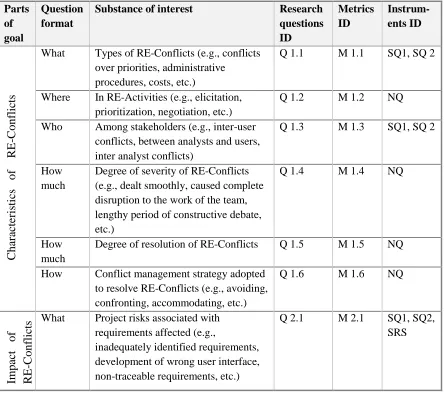
The questions stated above were formulated by mapping different question formats mentioned in Yin (2009) and the possible substances of interest from these two dimensions. This was done to ensure that research questions comply with the goal of our study. Table 2 shows the possible substances of interest and their corresponding form of questions. We have also given the IDs of research questions and their associated metrics in Table 2 to demonstrate that the research questions satisfy the goal. The instrument IDs used to investigate specific questions have also been given in Table 2.
Table 2: Possible substances of interest to satisfy the goal and their corresponding research questions, metrics and instruments used
Parts of goal
Question format
Substance of interest Research
questions ID Metrics ID Instrum-ents ID C ha ra cte risti cs of RE -C onflic ts
What Types of RE-Conflicts (e.g., conflicts over priorities, administrative
procedures, costs, etc.)
Q 1.1 M 1.1 SQ1, SQ 2
Where In RE-Activities (e.g., elicitation, prioritization, negotiation, etc.)
Q 1.2 M 1.2 NQ
Who Among stakeholders (e.g., inter-user conflicts, between analysts and users, inter analyst conflicts)
Q 1.3 M 1.3 SQ1, SQ 2
How much
Degree of severity of RE-Conflicts (e.g., dealt smoothly, caused complete disruption to the work of the team, lengthy period of constructive debate, etc.)
Q 1.4 M 1.4 NQ
How much
Degree of resolution of RE-Conflicts Q 1.5 M 1.5 NQ
How Conflict management strategy adopted to resolve RE-Conflicts (e.g., avoiding, confronting, accommodating, etc.)
Q 1.6 M 1.6 NQ
Impa ct of RE -C onflic
ts What Project risks associated with requirements affected (e.g.,
inadequately identified requirements, development of wrong user interface, non-traceable requirements, etc.)
Q 2.1 M 2.1 SQ1, SQ2, SRS
To determine the characteristics of RE-Conflicts, the specific questions examined were:
Question, Q 1.1: What are the different types of RE-Conflicts?
Metric, M 1.1: Frequency count of different types (e.g. conflicts over priorities, technical
issues, costs, etc.) of RE-Conflicts.
Table 3 : Types of interpersonal conflicts
S. No. Types of conflicts
1 Conflicts over project priorities
2 Conflicts over administrative procedures
3 Conflicts over technical subjects
4 Conflicts over costs
5 Conflicts over schedules
6 Personality conflicts
7 Conflicts over responsibilities
8 Conflicts over human resources
9 Conflicts over equipments and facilities
Question, Q 1.2: What are the different types of RE-Activities in which RE-Conflicts are
encountered?
Table 10 in Section 3.4.2 gives the list of RE-Activities extracted from literature review. Answers to this question were obtained by using the Nominal Group Technique (NGT)7. The metric for this question is:
Metric, M 1.2: Frequency Count of different types of RE-Activities (e.g., elicitation,
prioritization, negotiation, etc.) in which RE-conflicts are encountered.
Question, Q 1.3: What are the different types of stakeholder groups involved in RE-Conflicts?
Due to the focus of our study on RE, the participants of our case study were the Requirement Analysts (RAs) and the Project Manager (PM) of the project under case study. We termed these stakeholders as ‘analysts’. The clients of the project have been
7
termed as ‘users’. Based on this terminology, we created three categories of stakeholder groups in which RE-Conflicts could take place:
(i) Conflicts in the user’s team (User-User) (ii) Inter-analysts conflicts (Analyst-Analyst)
(iii) Conflicts between users and analysts (User-Analyst)
The data from interviews was used to investigate this question. The metric associated with this question is:
Metric, M 1.3: Frequency count of occurrence of RE-Conflicts among specific group of
stakeholders (users-users, analysts-analysts, users-analysts).
Question, Q 1.4: What is the severity levels of RE-conflicts?
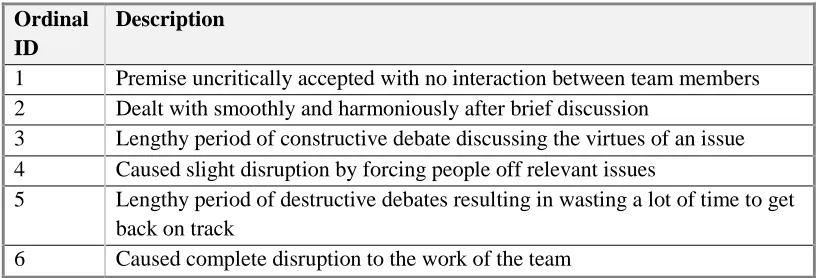
Gobeli et al. (1998) found that the higher conflict intensities substantially decrease the satisfaction of project team members. Therefore, we determined the severity level of RE-conflicts in the project under case study through NGT, by using an ordinal scale of conflict severities (Table 4) given in (Karn, 2008). M1.4 gives the metric for this question.
Metric, M 1.4: Frequency count of severity levels associated with RE-Conflicts.
Table 4: Ordinal scale for severity levels of conflicts (Karn, 2008)
‘1’ represents the lowest severity level and ‘6’ represents the highest severity level of a conflict
Ordinal ID
Description
1 Premise uncritically accepted with no interaction between team members 2 Dealt with smoothly and harmoniously after brief discussion
3 Lengthy period of constructive debate discussing the virtues of an issue 4 Caused slight disruption by forcing people off relevant issues
5 Lengthy period of destructive debates resulting in wasting a lot of time to get back on track
Question, Q 1.5: What is the degree of resolution of RE-Conflicts?
As reported by Gobeli et al. (1988), the unresolved conflicts have a strong negative effect on the project success. Hence, it was important to determine the frequency of resolved and unresolved conflicts in the project under case study. This was achieved by using NGT. The metric for this question is:
Metric, M 1.5: Percentage of RE-Conflicts resolved in the project under case study.
Degree of resolution= (Number of RE-Conflict resolved/ Total RE-Conflicts)* 100
Question, Q 1.6: What are the different types of management styles adopted for resolving
RE-Conflicts?
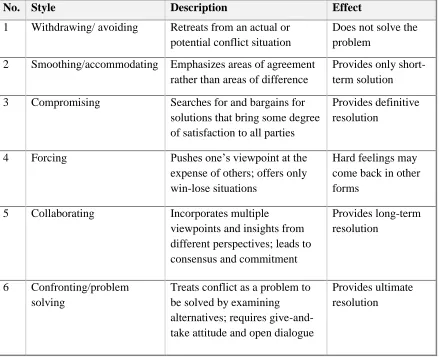
There is an abundance of research conducted in SE that demonstrates the significance of conflict management (Barki & Hartwick, 2001; Gobeli et al., 1998; Laurindo & Moraes, 2006; Sawyer, 2001; Sherif et al., 2006; Robey et al., 1989; Robey & Farrow, 1982). However, this aspect of conflict was not yet explored in RE. Therefore, we investigated the different types of management styles adopted for resolving RE-Conflicts in the project under case study by using NGT. Table 5 (adapted from Verma, 1998) gives the list of conflict management strategies that were first given by Blake and Mouton in 1964. This table was provided to the participants during NGT. The metric for this question is given as follows:
Metric, M 1.6: Frequency count of different types of conflict management styles adopted
for resolving RE-Conflicts.
To determine the impact of RE-Conflicts, the specific question investigated was:
Question, Q 2.1: What types of project risks associated with requirements are affected by
In Table 6, we have given a list of risks associated with requirements that were obtained from the literature on project risks (e.g., Pare, G.C., Sicotte, C., Jaana, M., & Girouard, D., 2008; Wallace & Keil, 2004). A combined analysis of the interview data and the Software Requirements Specification (SRS) document was used to identify the risks affected due to the RE-Conflicts. The associated metric (Mi,j) for this question is given below:
Metric, M 2.1: Frequency of risks associated with requirements (e.g., inadequately
identified requirements, development of wrong user interface, etc.) affected by a specific
type of RE-Conflict.
Table 5: Conflict management styles (Verma, 1998)
No. Style Description Effect
1 Withdrawing/ avoiding Retreats from an actual or
potential conflict situation
Does not solve the problem
2 Smoothing/accommodating Emphasizes areas of agreement
rather than areas of difference
Provides only short-term solution
3 Compromising Searches for and bargains for
solutions that bring some degree of satisfaction to all parties
Provides definitive resolution
4 Forcing Pushes one’s viewpoint at the
expense of others; offers only win-lose situations
Hard feelings may come back in other forms
5 Collaborating Incorporates multiple
viewpoints and insights from different perspectives; leads to consensus and commitment
Provides long-term resolution
6 Confronting/problem
solving
Treats conflict as a problem to be solved by examining alternatives; requires give-and- take attitude and open dialogue
Table 6: Types of risks associated with requirements
3.2 Study Context: Packaging and Printing Project
To explore the characteristics and impact of RE-Conflicts, we conducted a case study of an industrial software project. Section 3.2.1 describes the structure of the organization and the members of the clients and development teams of the project. The core features and components of the project are discussed in Section 3.2.2. The prototypical development process and the requirements process followed for the development of project are described in Sections 3.2.3 and 3.2.4 respectively.
3.2.1 Organizational Structure and Team members
A case study of the software project involving automation of a Packaging and Printing project (henceforth termed as P&P project) was conducted. We collaborated with a small-sized software development organization in India which developed the P&P project. The clients of the P&P project dealt with “Packaging and Printing Services”. The organizational structure and the team members of the developers and clients are discussed below.
No. Types of Risks
1 Continually changing requirements
2 Requirements not adequately identified
3 Redundant requirements
4 Late changes to requirements
5 Non-testable requirements
6 Non-traceable requirements
7 Unrealistic requirements
8 Development of wrong software functions
9 Unnecessary requirements
10 Misunderstanding of requirements
11 Requirements non-conforming to business goals
12 Development of wrong user interface
13 Incorrect requirements
The Development Team
The participating organization is a small software development organization, having 26 employees. It was established in 2003. The project durations of the organization usually range from nine months to three years and the budget ranges equivalent to approximately from US$ 300,000 to US$ 60,00,000 .Typically, the Agile8 software development model (Beck, 2003) is followed by the organization. Usually four to eight people are assigned for the development of a project depending on various factors such as complexity, budget, deadlines, etc.
The development of the P&P project started in February, 2009 with a budget of equivalent to approximately US$ 400,000. The initial deadline for the completion of the project given by the clients was July, 2009. However, the development of the project continued until four months after the initial deadline had passed. “At the end of November, 2009, we decided to abandon the project due to the presence of excess
unresolved conflicts”, emphasized the PM.
The developing team of the P&P project consisted of seven members having varying roles (e.g., PM, RA, coder, etc.) and experiences. Table 7 gives the roles and experiences of the development team members.
Table 7: Development team members of project under case study: Role and Experience
No. Role in project Experience
in years
1 Project Manager, Quality Assurance Engineer 15
2 Requirement Analyst, Software Architect 12
3 Requirement Analyst 8
4 Requirement Analyst, Programmer 3
5 Requirement Analyst, Programmer 2
6 Programmer 7
7 Tester 2
8
The Client’s Team
The clients of the project under case study dealt in packaging and printing services. They offered commercial packaging and printing services in gift boxes, danglers, paper bags, posters, magazines, catalogues, etc. An extensive range of specialized options were provided such as spot lamination, thermal lamination or any type of coating. The goal of the project was to automate the business process of packaging and printing system by developing an Enterprise Resource Planning (ERP)9 (Dredden & Bergdolt, 2007) system.
The client’s organization had a two level hierarchy, (i) senior employees and (ii) junior employees. Figure 1 shows the hierarchy of client’s organization which comprises of the chairman and the manager as senior employees and all other employees as junior employees. There were thirteen departments, one for each task (e.g., printing, binding, creasing, stitching, etc.). Each department had a Departmental Head (HOD).
The client’s organization had a 2 level hierarchy: (i) seniors (chairman and manager) (ii) juniors (head of the departments
and technical staff). There were 13 departments (e.g., printing, binding, stitching, etc.).
Figure 1: Hierarchy of the participating organization in the case study
9
Enterprise resource planning (ERP): ERP systems automate business functions of organizations to facilitate the flow of information between all business functions inside the boundaries of the organization and manage the connections to outside stakeholders by providing an integrated software application that considers the internal and external management
3.2.2 Features and Components
The development team was assigned the task of automating the designing, costing and sales processes of the organization. There were 13 business functions to be automated in total such as binding, coating, printing, creasing, etc. Some of the processes were performed in parallel and some in a specific sequence to achieve the final packaging. Figure 2 depicts a high level architecture of the P&P project demonstrating the key dependencies between the 13 business functions. The client’s business was organized in such a way that all the 13 business functions, further consisted of 4 modules each: types, properties, transactions, and costs. Hence, in total, there were 52 modules to be automated.
The dependencies among the 13 business functions (e.g., pasting, lamination, foiling, etc.) of the
P&P project are shown. Each business function further consisted of 4 modules (types,
properties, transactions, and costs), which have not been shown.
Figure 2: High Level Architecture of the project under case study
3.2.3 Prototypical Development Process
and evaluation phases iteratively until the final product was ready for the deployment. The prototype release period of the P&P project was 2 weeks. i.e., after every 2 weeks, a prototype was released to the clients for evaluation. Based on the feedback from clients, the SRS was updated and corresponding modifications were done to the next version of the prototype. The development team followed evolutionary prototyping (Hekmatpour, 1987) due to the continually changing environment of the client’s organization. For example, some processes such as outsourcing of jobs, calculating costs of materials, etc. varied depending on external factors such as climate, market competition, etc. The clients were also expanding their business which led to the introduction of new requirements.
Figure 3: Agile prototypical development process followed for the development of the project under case study (Miyachi, 2011)
3.2.4 Requirements Engineering Process
The core set of features in the P&P project came from the senior members of the staff. The requirements were elicited from the junior members during the feedback session after the demonstration of prototype to them. However, the requirements elicited from the junior members had to be approved from the senior members before implementing them in the next versions of prototypes.
elicitation of requirements, importance of elicited requirements to the clients, etc., was logged in the SRS.
3.3 Participants
Considering the focus of the study on RE, only the RAs and the PM, from the development team of the P&P project were interviewed. They were interviewed extensively over a span of approximately 10 months. Additionally, the participants also aided in analyzing the SRS and validating the emergent findings from the study. Further details of the PM and RAs are given in the table 8.
Table 8: Summary of the case study participants
ID Participant’s Role
Experience in the field
Experience in the Ecologic Corporation
Number of prior ERP projects developed
Business functions assigned for
requirements elicitation (Total=13)
1 RA 2 2 0 Pasting
2 RA 3 4 0 Fabrication, Foiling,
Creasing
3 RA 8 8 1 Folding, Di-creation,
Binding, Stitching
4 RA 12 9 4 Lamination, Corrugation,
Printing, Coating, Artwork
5 PM 15 9 6 Not Applicable
3.4 Research Procedures
A knowledge seeking interpretive case study (Klein & Myers, 1999) was conducted to understand the characteristics and impact of conflicts originating during RE on the project risks associated with requirements through the participant’s interpretation of their context. The unit of analysis (Yin, 2009) of the single case embedded study (Yin, 2009) was a project which was not successfully completed (cancelled).
The following sections discuss the research procedures followed for conducting the case study. Section 3.4.1 describes the design of the study. Section 3.4.2 and Section 3.4.3 discuss the design of the instruments used in the case study and data collection procedures. Section 3.4.4 concludes this section by describing the procedures followed for analyzing the research data.
3.4.1 Study Design
This section describes the design of the study, i.e., the phases of the research, methodologies used to conduct the research, the outcomes of each phase of the research and the validations performed in the study. The research was conducted in two phases. Phase1 had four outcomes and phase 2 had three outcomes. Mixed research methodologies such as SLR, interviews, NGT, and analysis of a project artifact (SRS) were used in the study. The research methodologies adopted and their outcomes were validated by several relevant experts (Table 9).
Phase 1
SLR was used as a research methodology for this phase. Firstly, the research gap regarding the interpersonal conflicts in RE was identified. As explained in Section 2.3, on performing SLR, it was found that the characteristics and impact of interpersonal conflicts in RE were not yet explored. Therefore, the subsequent stages of this phase focused on gathering the following data required to investigate the identified research gap:
Types of interpersonal conflicts in projects
Attributes of conflicts relevant to the research goal Types of project risks.
unrealistic cost and time estimates, etc.) was created. Figure 4 shows the phase 1 of the study design.
Systematic Literature Review (SLR) was used to produce the 4 outcomes of phase 1 of the
study. The methodology and the outcomes were validated by the experts.
Figure 4: Phase 1 of the study design
Phase 2
of attributes of conflicts were used for designing the instruments (interview and NGT based questionnaires). Another outcome of the phase 1 (data set of project risks) was used for the combined analysis of the SRS and the interview data in the phase 2, to identify the types of risks affected due to RE-Conflicts. The study design of the phase 2 is depicted in Figure 5.
Phase 2 of the study involved conducting preliminary discussions and filling of closed questionnaires (see Appendix B) by the participants in order to gain background information of the organization and participants. To examine the types of RE-Conflicts and the stakeholders involved in them (see Q 1.1 and Q1.3, § 3.1), semi-structured interviews were conducted (see Appendix B). Their analysis led to the identification of 13 RE-Conflict incidences (see table 17, Appendix C) that took place in the P&P project along with the stakeholders groups (users-users, analysts-analysts and users-analysts) involved in them. To identify the risks associated with requirements affected due to the RE-Conflicts (see Q 2.1, § 3.1), a combined analysis of the interview data and SRS was performed.
The P&P project was not an on-going project; therefore, to capture the attributes of the RE-Conflicts (see Q 1.2, Q 1.4, Q 1.5 and Q 1.6, § 3.1), we could not use observational techniques such as ethnographic study. Since we wanted the opinions of all the RAs and the PM on the attributes of the 13 RE-Conflicts, therefore, we had the option of selecting either the NGT10 (Harvey & Holmes, 2012) or Delphi11 method (Ven & Delbecq, 1974). Both of them have proved to be more effective than the conventional interacting groups to obtain the views of experts on a given topic and bring about group consensus (Harvey & Holmes, 2012, Ven & Delbecq, 1974). We chose NGT over Delphi because NGT is
10 Nominal Group Technique (NGT) is an established, qualitative research tool that aids in developing a prioritized list of responses to a specific question by taking into account the opinions of all the participants when the participants are in close proximity. The answers of the participants are not anonymous and the inconsistent answers are brainstormed in a group (Harvey & Holmes, 2012).
11