CDMA SIGNALING TECHNIQUE USING MATLAB
Ambica Yadav
1, Jagriti Arora
2, Neha Dewan
3, Maleeha Khan
4,
Surendra Gangwar
51,2,3,4
Student, Electronics and Communication Engineering
5
Assistant Professor, Electronics and Communication Engineering
Shri Ram Murti Smarak Women’s College of Engineering and Technology, Bareilly.243001 (India)
ABSTRACT
This paper evaluates the Code Division Multiple Access (CDMA) signaling techniques using MATLAB. Various
codes used to employ this technique are PN Sequence codes, Walsh-Hadamard codes and Gold codes. At the time of
transmission, signal undergoes fading. Further the Bit Error Rate (BER) performance of the system is also affected
by the number of users as well as different types of spreading codes. In this project, we have analyzed the signal
reception and different detection techniques are simulated using different MATLAB functions and different MATLAB
program segments to minimize the BER and to overcome fading.
Keywords
:
BER, CDMA System, Gold Sequence, PN Sequence, Rayleigh Channel, SNR,
Walsh-Hadamard Code.
I INTRODUCTION
Code Division Multiple Access (CDMA)[1] is a promising technique for radio access in cellular mobile and
personal communication system. CDMA in cellular system offers attractive features such as the potential spectrum
efficiency, soft capacity, soft handover and for high macro diversity. In CDMA communication system, a unique
binary code is assigned for each call to every user. The user’s signal is multiplied by the assigned code and spread
onto a bandwidth much wider. All active users share the same frequency spectrum at the same time. CDMA
employs spread-spectrum technology. Spread Spectrum is defined as a means of transmission in which the signal
occupies bandwidth much in excess of the minimum necessary to send the information. The advantage of spread
spectrum is that many users can simultaneously use the same bandwidth without significantly interfering with one
2.1
Pseudo Noise Sequence
The code used for spreading the signal is a pseudorandom code that is mixed with the data to spread the signal in a
statistically random matter. Thus for the spread signal to appear noiselike, the code needs to be random but
reproducible. These codes are considered fast codes as they run many times the information bandwidth or data rate.
These special "Spreading" codes are called "Pseudo Random" or "Pseudo Noise" codes. They are called "Pseudo"
because they are not real Gaussian noise. Periodic binary sequences can be conveniently generated using linear
feedback shift registers (LFSR).
Fig.2. PN Sequence Generator
Fig.3. Simulation Result
2.2
Walsh-Hadamard Codes
Walsh codes are the most common orthogonal codes used in CDMA applications. It provides zero cross correlation
among all users. A set of Walsh codes of length n consists of n rows of an n X n Walsh matrix. Orthogonal
spreading codes such as the Walsh sequences can only be used if all the users in the same CDMA channel are
synchronized to the accuracy of a small fraction of one chip.Walsh-sequences have the advantage to be orthogonal,
Fig.4. Simulation Result
2.3
Gold Code
For CDMA, we need to construct a family of spreading sequences, one for each which, in which the codes have
well-defined cross-correlation properties. In general, m-sequences do not satisfy the criterion. One popular set of
sequences that does are the Gold sequences. Gold sequences help generate more sequences out of a pair of
m-sequences giving many more different m-sequences to have multiple users. A Gold sequence is constructed by the
XOR of two m-sequences with the same clocking.
Fig.5. Gold Code Generator
Fig.6. Simulation Result
III DIRECT SEQUENCE SPREAD SPECTRUM
The use of DSSS techniques in communication systems has grown considerably over the past decades. This is
Fig.8. Simulation Result
IV PERFORMANCE MEASUREMENT
The criteria to measure the performance of DS-CDMA is to evaluate the bit error rate (BER) of the system over the
Rayleigh channel.
Bit Error Rate:
In digital transmission, the number of the bit errors is the number of the received bits of a data stream over
a communication channel that have been altered due to noise, interference, distortion or bit synchronization errors.
The bit error rate or bit error ratio (BER) is the number of bit errors divided by the total number of transferred bits
during a studied time interval
.
Fading:
Fading [2] is the rapid fluctuations of the amplitudes, phases or multipath delays of a radio signal over a short period
of time or travel distance. It is caused by interference between two or more versions of the transmitted signal which
arrive at the receiver at slightly different times. Rayleigh fading models assume that the magnitude of a signal that
Fig.9. Rayleigh Fading
V DIVERSITY TECHNIQUES [3]
The short term multipath fading can severely reduce transmission accuracy. Diversity is an effective way to combat
channel fading. Diversity improves transmission performance by making use of more than one independently faded
version of the transmitted signal. If several replicas of the signal, carrying the same information, are received over
multiple channels that exhibit independent fading with comparable strengths, the chances that all the independently
faded signal components experience deep fading simultaneously are greatly reduced. This will significantly improve
transmission accuracy as transmission errors are most likely to happen when the instantaneous SNR is low during a
deep fading period. Different detection techniques employed in the proposed complementary codes (CC) based
CDMA system used to detect the received signal. Detection techniques are as:
5.1
Selection Diversity Technique
In selection diversity, the branch with the largest signal magnitude is selected. The receiver monitors the SNR value
of each diversity channel and chooses the one with the maximum SNR value for signal detection. This technique is
much easier to implement without much performance degradation, especially for the reverse link transmission where
the diversity branches can be physically located at different base stations.
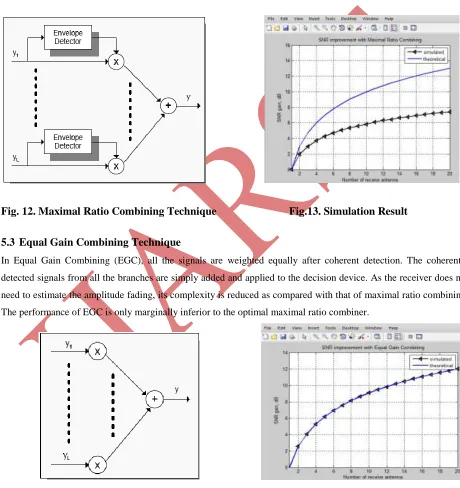
Fig. 12. Maximal Ratio Combining Technique
Fig.13. Simulation Result
5.3
Equal Gain Combining Technique
In Equal Gain Combining (EGC), all the signals are weighted equally after coherent detection. The coherently
detected signals from all the branches are simply added and applied to the decision device. As the receiver does not
need to estimate the amplitude fading, its complexity is reduced as compared with that of maximal ratio combining.
The performance of EGC is only marginally inferior to the optimal maximal ratio combiner.
Among the three combining schemes, maximal ratio combining achieves the best performance followed by equal
gain combining. Thus the transmitter, channel and complementary code design must be constant. The only
difference is between their receivers that employs the different detection techniques.
VI FREQUENCY HOPPED SPREAD SPECTRUM
Frequency hopping[4] involves a periodic change of transmission frequency. FHSS is one of the most common
forms of spread spectrum, in which frequency is not remained fixed to the specified band of the frequency. Here the
carrier frequency changes from one frequency to the other at every instant of time.
Fig.16. FHSS Block Diagram
Fig.17. Simulation Result
In FHSS, synchronization of transmitter and receiver is necessary. In case, if the receiver is not synchronized with
the transmitter due to any reason, the recovery of the original information from its spread spectrum is merely
Further this would be extended to evaluate comparison of the performance of DSSS and FHSS in CDMA system.
VIII FUTURE SCOPE
In future there is a scope of various new implementations like Slow frequency and Fast frequency hopping which
can be extended in the performance of FHSS
.
It can be further extended to the implementation of OFDMTechnique
.
REFERENCES
[1] Ajay Kumar Tandi, Manoj Kumar Beuria, CDMA Technology, Department of Electronics and Communication,
National Institute of Technology, Rourkela, Orissa, 2010
[2] Ghanim Abd Al-Kareem Al-Rubyai, Diversity Combining for DS CDMA System in a Rayleigh Fading Channel
with Three Spreading Codes,Journal of Engineering and Development, Vol. 11, No. 1, March (2007)
[3] S. Loyka, Wireless Communication Fundamentals, ELG4179
[4] P. Olšovský, P. Podhoranský, Design and Simulation of Frequency Hopping Technique in MATLAB, Slovak
University of Technology, Faculty of Electrical Engineering and Information Technology, Institute of Electronics