Variations of
210Pb concentrations in
surface air at Thessaloniki, Greece (40
◦N)
A. Ioannidou∗, E. Kotsopoulou, A. Karanatsiou and C. Papastefanou
Aristotle University of Thessaloniki, Physics Department Nuclear Physics & Elementary Particle Physics Division
Thessaloniki 54124, Greece
Abstract
Atmospheric concentrations of 210Pb were measured over the year 2009 in ground level air at Thessaloniki, Northern Greece (40◦62 N, 22◦95E). The mean activity concentrations of210Pb in surface air have
been found to be 671±213μBq m−3. The highest values of monthly
atmospheric concentrations of210Pb were observed in the autumn and
the lowest in the spring period. The higher values of 210Pb during
autumn were attributed to frequent inversion conditions of the surface layers, resulting in an enrichment of radon and its decay products in surface air. The lower values during the winter months might be due to the low emanation of radon from the frozen or snow-covered soil. The minima of 210Pb concentrations during spring might reflect on
higher washout during this period, which results in less emanation of radon from saturated with water soil, resulting in less production of
210Pb near ground-level air. The relative high values during summer
are probably due to the higher222Rn exhalation from the ground and due to the higher air mixing within the troposphere, which has as a result to carry down to the surface layer 210Pb whose origin is older
air masses which entered into the free troposphere.
∗E-mail: [email protected]
1.
Introduction
Lead-210 is the first long-lived (t1/2 = 22.6 y) decay product of222Rn, the first gas in the238U decay chain. Because222Rn is mainly exhaled from land surfaces and has a half-time t1/2 = 3.82 d, 210Pb is primarily produced in the lower troposphere over continents.
Since atmospheric 222Rn is a chemically inert and unscavenged and as a result is not removed from the atmosphere by physical or chemical mean, and its half-life is much less than the mixing time of the atmosphere, its concentrations are greatest near the land surface and decrease with both altitude and distance from land. As a result the main source of 210Pb in the free troposphere is a quiescent ascent of its gaseous 222Rn parent from the ground and upward transport of subspecies mobilized by resuspension and motion with the atmospheric masses. Advective transport of radon-rich air from the boundary layer can reach the upper troposphere or even the stratosphere creating a significant stratospheric 210Pb reservoir above the tropopause. Most of210Pb in the stratosphere is due to the decay of222Rn injector convectively mainly in the tropics [1] while, other sources are the vol-canic eruptions, which may introduce the210Pb to the stratospheric level [2]. The unique features of this radionuclide with altitudinal distinct sources, makes it ideal tool to depict transport processes in the whole atmo-sphere [3–5], suggesting that improved understanding of their atmospheric distributions obtained from detailed measurements will facilitate refinement and validation of global circulation models.
Lead-210 provides a useful tool for the study of the behavior of aerosols because, soon after the formation of 210Pb atoms, the atoms become irre-versibly attached to submicron aerosol particles. [6] estimated the (AMAD) of 210Pb of 0.53μm and [7] 0.56μm. 210Pb has been extensively used to determine the mean residence time of atmospheric aerosols [8], to trace chemical compound that may have broadly similar source distributions, for example sulphur [9], and to study the transport of continental aerosols across the sea or into Polar Regions [10, 11].
The concentrations of 210Pb in the air decrease with elevation from the ground, due to its higher production rate in the lower troposphere. The vertical distribution of 210Pb in the atmosphere has been studied by [12]. The distribution of210Pb in the atmosphere shows both spatial and temporal variations, depending on the geographical location, atmospheric circulation and scavenging processes.
(40◦62 N, 22◦95E). The results of a one year period are presented and analyzed in combination of meteorological parameters.
2.
Instrumentation
Lead-210 concentrations were measured by air sampling; using Staplex high-volume air samplers with Staplex type TFAGF 810 glass-fiber filters 8×10 and having 99.28% collection efficiency for particles as small as 0.3μm. This design involves a regulated air-flow rate of 1.7–1.92 m3min−1 (60– 68 ft3min−1). The length of each collection period was 24 h. Air samplings were carried out once a week on the roof (20 m above the ground, and 52 m a.s.l.), at the Faculty of Science building in the center of the city of Thessa-loniki, Greece.
After the collection procedure, the filters are folded and compressed by means of hydraulic press at up to 3 tons to give a cylinder 5.8 cm diam-eter and 2 mm height. All the samples were measured for 210Pb activ-ity (Eγ = 46.50 keV) using a Ge planar detector, active area 2000 mm2,
thickness 20 mm, energy resolution (FWHM) 400 eV at 5.9 keV or 700 eV at 122 keV, Be window 0.5 mm thin. Blank filters were regularly checked. The average total uncertainty for 210Pb is almost 10%.
3.
Results and discussion
3.1. 210Pb concentration levels in surface air
Weekly measurements of 210Pb activity concentration on aerosol particles were performed at ground level in outdoor air in Thessaloniki, Greece dur-ing the year 2009. Aerosol sampling started on January 2009. Mean activity concentrations of 210Pb in surface air have been found to be 671±213μBq m−3, while the values range between 55–2063μBq m−3.
Jan Feb Mar Apr May Jun Jul Aug Sep Oct Nov Dec 300
400 500 600 700 800 900 1000 1100 1200
210
P
b ac
ti
vi
ty
c
onc
en
tr
tati
on
s,
ȝ
Bq m
-3
Month
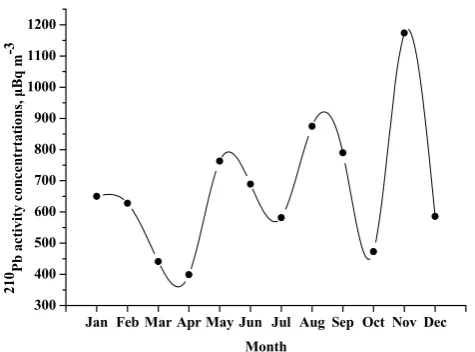
Figure 1: Mean monthly atmospheric concentrations of210Pb over year 2009.
30◦45E), [16] reported a mean value of 284±150 at Islamabad, Pakistan (33.38◦N, 73.10◦E). While a 30-year long series of airborne210Pb in Finland gave a mean value of 282±257μBq m−3 and 237±226μBq m−3 for southern and northern Finland respectively [11].
Time variations of 210Pb surface air concentrations were studied. At-mospheric processes and meteorological parameters that may contribute to these variations are discussed below.
3.2. Variability of 210Pb concentrations in surface air
The concentration of 210Pb in surface air fluctuate considerably. 210Pb weekly concentration values showed a great variability ranging from 55 to 2063μBq m−3. The variability is mainly due to local prevailing meteoro-logical conditions of the atmosphere during the sampling period. Since the day-by-day concentrations of210Pb in surface air show strong variations due to interactions on daily or even shorter time scales, considering the mean monthly concentrations these variations are minimized. Averaging the data of 210Pb atmospheric concentrations on a monthly basis the mean monthly concentrations of210Pb over a year are calculated.
observed in the autumn months (up to 1173.5μBq m−3 during November) and the lowest in the spring period (399μBq m−3 during April). Also high values were observed during summer.
The higher values of 210Pb during autumn might be attributed to fre-quent inversion conditions of the surface layers, resulting in an enrichment of radon and its decay products in ground-level air. The lower values dur-ing the winter months might be due to the low emanation of radon from the frozen or snow-covered soil [17]. The minima of 210Pb concentrations during March and April might reflect on higher washout, since the higher precipitation amount took place during these months, which has as a result to remove 210Pb aerosols efficiently. Moreover, the emanation of radon is strongly diminished when the soil is saturated with water, resulting in less production of 210Pb near ground level air. The relatively high value during May of the year 2009 might attributed both to the lapse of any rain during sampling period and to the relative high temperatures during this month of the year 2009. The relatively high observed values of 210Pb during the summer period is probably due to higher air mixing within the troposphere which has as a result to carry down to the surface layer210Pb whose origin is older air masses which entered into the free troposphere in combination with higher emanation of222Rn from local soil. These high observed values of210Pb concentrations in surface air during summer are in agreement with results reported [18], which observed that if the height of the tropopause is higher than 12 km (summer period), the concentrations of 210Pb near the ground and in the middle troposphere are increased. [14] reported higher values of210Pb during summer in the region of Malaga, Spain.
Local meteorological parameters such as wind speed, air temperature, relative humidity, and rainfall were also monitored at the same site. No cor-relation between weekly 210Pb concentration values and wind speed in the same period was found. Relative Humidity, RH (%), though it may slightly affect radionuclide concentrations in surface air, particularly through re-moval of atmospheric dust with associated radionuclides, does not seem to control the concentration of210Pb in surface air. No correlation was observed between the mean monthly210Pb activity concentrations and Relative Hu-midity, RH (%). Also, mean monthly210Pb activity concentrations were not correlated with temperature,T (◦C).
Jan Feb Mar Apr May Jun Jul Aug Sep Oct Nov Dec 4
6 8 10 12 14 16
7 Be/
21
0 Pb a
cti
vi
ty
r
ati
o
Month
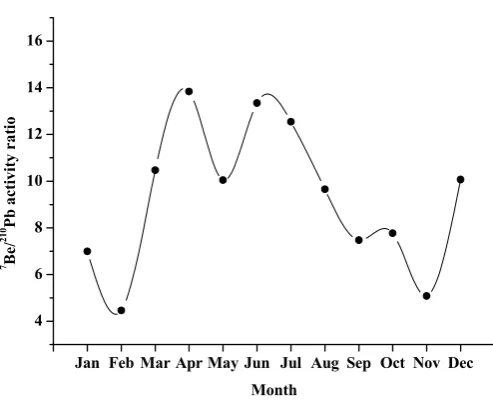
Figure 2: Mean monthly 7Be/210Pb activity ratio over year 2009.
periods. The very low value of 55μBq m−3that was observed during Novem-ber 2009 was coincident with rainfall during the whole sampling period. However, the removal of210Pb from the atmosphere by rainfall events seems to be invalidated immediately after the event and the 210Pb concentration in air to be reestablished rapidly. No correlation was observed between the mean monthly210Pb activity concentrations and rainfall.
3.3. 7Be/210Pb activity ratio
210Pb data have been combined with data of 7Be during year 2009.
Si-multaneous measurements of these two nuclides provide a powerful tool in atmospheric studies. The 7Be/210Pb ratio can provide information on the atmospheric removal behavior of these nuclides as well as information on whether these two radionuclides can be used as independent racers. Changes in 7Be/210Pb ratio would serve as an indicator of vertical transport in the atmosphere. These changes are presented and clarified below.
The different mechanisms that govern the levels of concentrations of7Be and210Pb in surface air for geomagnetic latitude over 40◦N result in different 7Be/210Pb activity ratios. The observed monthly average7Be/210Pb activity
low value during May, probably due to the abnormal high value of 210Pb during May. The lowest activity ratio values were observed from September to February, with a high value during December, explained by the relative high7Be observed values during this month.
The lowest during the autumn – winter periods were attributed to the almost steady state conditions during those seasons. Frequent inversion con-dition during these months reflects on both radionuclides, since the winter stability tends to isolate surface air from the 7Be sources in the upper tro-posphere and the opposite for the 210Pb, to isolate the upper troposphere from its near ground level sources, resulting in lower concentrations for7Be and higher concentrations for 210Pb. On the other hand, the high activity ratio values during the summer months were attributed to the increased dry convective mixing. Finally, since the stratospheric intrusions in situations of tropopause folding events during spring period result in a significant increase of7Be in the troposphere during this period, while have negligible reflection on 210Pb concentration, we may conclude that the ratio 7Be/210Pb during spring period it could be an index of stratospheric contribution.
4.
Conclusions
The highest values of monthly atmospheric concentrations of210Pb were ob-served in the autumn and the lowest in the spring period. The higher values of 210Pb during autumn were attributed to frequent inversion conditions of the surface layers, resulting in an enrichment of radon and its decay prod-ucts in ground-level air. The lower values during the winter months might be due to the low emanation of radon from the frozen or snow-covered soil. The minima of 210Pb concentrations during spring might reflect on higher washout. The relative high values during the summer period were attributed to the maximum observed 222Rn exhalation from the ground surface and to the higher air mixing within the troposphere
The high variability of 210Pb concentration on a weekly scale and its seasonal variation points at the importance of long-term measurements for a reliable210Pb activity concentration assessment in outdoor air.
References
[1] Kritz M. A., Rosner S. W., Kelly K. K., Loewenstein M. and Chan K. R.,J. Geophys. Res.,98(1993) 8725.
[2] Lambert G., Polian G., Sanak J., Ardouin B., Buisson A., Jegou A. and Le Roulley J. C.,Ann. Geophys.,38(1982) 497.
[3] Feichter J., Brost R. A. and Heimann M., J. Geophys. Res.,
96(D12)(1991) 22447.
[4] Dibb J. E., Talbot R. W. and Gregory G. L.,J. Geophys. Res.,
97(D15)(1992) 16709.
[5] Koch D. M., Jacob D. J.and Graustein W. C.,J. Geophys. Res.,
101(D13)(1996) 18651.
[6] Winkler R., Dietl F., Frank G. and Tschietsch J., Atmosph.
Environ.,32(6)(1998) 983.
[7] Gr¨undel M.and Porstend¨orfer J.,Atmosph. Environ.,38(2004) 3723.
[8] Papastefanou C. and Bondietti E., J. Aerosol Science, 22(7) (1991) 927.
[9] Tsunogai S., Shinagawa T.andKurata T.,Geochem. J.,19(1988) 77.
[10] Todd J. F., Wong G. T. F., OLSEN C. R. and Larsen I. L.,J.
Geophys. Res.,94(1989) 11106.
[11] Paatero J., Hatakka J., Mattsson R. and Viisanen Y.,Radiat.
Protec. Dosim.,77(3) (1998) 191.
[12] Kownacka L., Jaworowski Z. and Suplinska M.,Sci. Total
Env-iron.,91 (1992) 199.
[14] Duenas C., Fernadez M. C., Canete S.and Perez M.,Atmosph.
Research.,92(2009) 49.
[15] El-Hussein A., Mohamed A., Adb El-Hady M., Ahmed A. A., Ali A. E. and Barakat A.,Atmosph. Environ.,35(2001) 4305.
[16] Ali N., Khan E. U., Akhter P., Khattak N. U., Khan F. and Rana M. A.,J. Environ. Radioactivity,102(2011) 35.
[17] H¨otzl H. and Winkler R.,J. Environ. Radioactivity,5 (1987) 445.
[18] Kownacka L.,Nucleonica,47(2)(2002) 79.