ISSN(Online): 2319-8753 ISSN (Print): 2347-6710
International Journal of Innovative Research in Science,
Engineering and Technology
(A High Impact Factor & UGC Approved Journal) Website: www.ijirset.com
Vol. 6, Issue 8, August 2017
Diseases Identification by GA-SVMs
Dr. M Raja Sekar1
Professor, Department of Computer Science and Engineering, VNR Vignana Jyothi Institute of Engineering and
Technology, Hyderabad, Telangana, India1
ABSTRACT:Agricultural yield is mainly affected by differences in climatic conditions and seasonal diseases. There is a strong need of modern agricultural systems that identify disease in the crops. The goal of this study to design, develop and evaluate GA-SVM based methodology for automatic classification of pomegranate related diseases. This innovative method would be a boon to many and would have lot of advantages over the traditional method of grading. Presently, plant pathologists follow a tedious technique that mainly relies on naked eye prediction. Manual procedure is not only time consuming but also does not give accurate results. Studies show that relying on pure naked-eye observation of experts to detect and classify pomegranate related diseases can be prohibitively expensive, especially in developing countries. This methodology is fast and accurate in detecting diseases like bacterial blight, cercosporal leaf spot and wilt of pomegranate. Present experimental results indicate that the proposed approach can significantly support an accurate and automatic detection and recognition of leaf diseases. Current paper proposes GA-SVM based methodology to deal with one of the main issues of plant pathology. The results are proved to be accurate and satisfactory in contrast to manual procedure and hopefully take a strong leap forward in establishing itself in the market as one of the most efficient and effective process. In conclusion, the proposed detection models based GA-SVM are very efficient in detecting and classifying bacterial blight, cercosporal leaf spot. The developed Genetic Algorithm based SVM classifier that based on statistical classification perform well in all sample types of leaf diseases and can successfully detect and classify the examined diseases with accuracy 94%.
KEYWORDS: Leaf diseases, cercospral leaf spot, bacterial blight and texture attributes.
I. INTRODUCTION
Plant diseases have turned into a night mare as it can cause significant reduction in both quality and quantity of agricultural products (Weizheng et al., 2008), thus negatively influence the countries that primarily depend on agriculture in its economy. Consequently, detection of plant diseases is an essential research topic as it may prove useful in monitoring large fields of crops and thus automatically detect the symptoms of diseases as soon as they appear on plant leafs [1].
Monitoring crops for to detecting diseases play a key role in successful cultivation [2]. The naked eye observation of experts is the main approach adopted in practice (Weizheng et al., 2014). However, this requires continuous monitoring of experts which might be prohibitively expensive in large farms [3]. Further, in some developing countries, farmers may have to go long distance to contact experts, this makes consulting experts to very expensive and time consuming. Therefore; looking for a fast, automatic, less expensive and accurate method to detect plant disease cases is of great realistic significance [4, 5, 6, 7].
Studies show that image processing can successfully be used as a disease detection mechanism [8]. Since, the late 1970s, computer-based image processing technology applied in the agricultural engineering research became a common (Weizheng et al., 2008; Moshashai et al., 2015). In this study we propose and experimentally validate the significance of using clustering technique and neural networks (Soltanizadeh and Shahriar, 2010) in automatic detection of leaf diseases.
ISSN(Online): 2319-8753 ISSN (Print): 2347-6710
International Journal of Innovative Research in Science,
Engineering and Technology
(A High Impact Factor & UGC Approved Journal) Website: www.ijirset.com
Vol. 6, Issue 8, August 2017
II. PREPROCESSING
Next we describe our proposal with more details. We also compare it to the other solutions already presented in literature. We select from literature the works that have addressed the topic of plant detection and classification. We test our solution on five diseases which effect on the plants. Those diseases are early scorch, cottony mold, ashen mold, late scorch and tiny whiteness.
The concept of automatic plants leave disease detection presented in the following sections was developed on the plant leaves images acquired from Telangana. Detection and recognition of leaves diseases are likely to give better performance and can provide clues to treat the diseases in its early stages. Visual interpretation of plant diseases in its early stages. Visual interpretation of plant diseases manually is both inefficient and difficult; also, it requires the expertise of trained botanist. A closer inspection of the plant diseases images several difficulties for the possible leaves diseases detection [9,10,11 and 12]
Bauer et al. (2015) the authors have worked on the development of methods for the automatic classification of leaf diseases based on high resolution multispectral and stereo images. Leaves of sugar beet are used for evaluating their approach. Sugar beet leaves may get infected by several diseases, such as rusts (Uromycesbetae), powdery mildew (Erysiphebetae). The developed system classifies the leafs at hand into infested and not-infected classes. Compared to the work of Bauer et al. (2014), our system can: 1. Identify disease type in addition to disease detection. 2.Be directly expanded to cover even more diseases. 3. Detect diseases that infect plant leaves and stems. Our proposal can identify and classify diseases that infect the stem part part of plants as well. Figure 1 shows an example of such infection cases.
Fig.1.plant stem is infected by white mold disease
ISSN(Online): 2319-8753 ISSN (Print): 2347-6710
International Journal of Innovative Research in Science,
Engineering and Technology
(A High Impact Factor & UGC Approved Journal) Website: www.ijirset.com
Vol. 6, Issue 8, August 2017
disease spot regions were segmented by using Sobel operator to detect the disease spot edges. Finally, plant diseases are graded by calculating the quotient of disease spot and leaf areas. Our proposal is different as it aims at classifying diseased leafs based on disease type [13,14,15 and 16].
The next step in our proposal is that we apply device–independent color space transformation, which converts the color values in the image to the color space specified in the color transformation structure. The color transformation structure specifies various parameters of the transformation. A device dependent color space is the one where the resultant color depends on the equipment used to produce it. For example the color produced using pixel with a given RGB values will be altered as the brightness and contrast on the display device used. Thus the RGB system is a color space that is dependent. To improve the precision of the diseases detection and classification process, a device independent color space, the coordinates used to specify the color will produce the same color regardless of the device used to draw it.
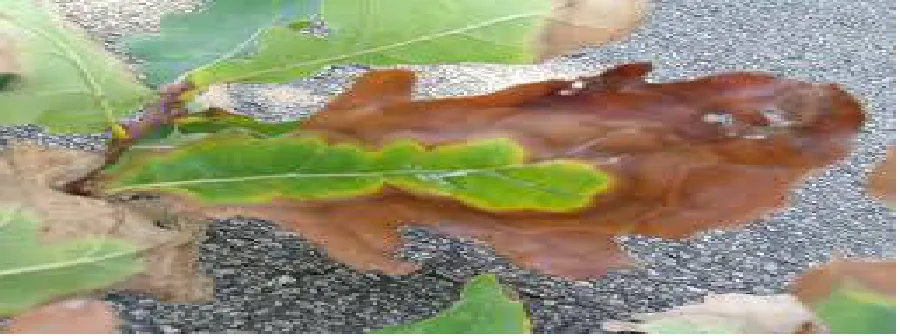
Fig. 2: An example of the output of GA-SVM for leaf that is infected with early scorch disease
Finally, GA-SVM is used to partition the leaf image into four clusters in which one or more clusters contain the disease in case when the leaf is infected by more than one disease. GA-SVM is designed based on different kernels.
The proposed approach starts first by creating device-independent color space transformation structure. Thus, we create the color transformation structure that defines the color space conversion. Then, we apply device-independent color space transformation, which converts the color values in the image to the color space specified in the color transformation structure. The color space specified in the color transformation structure. The color transformation structure specifies various parameters of the transformation. Finally, GA-SVM is used to partition the leaf image into four clusters in which one or more clusters contain the disease in case when the leaf is infected by more than one disease. GA-SVM uses various kernels [17,18, 19].
SVM is used to partition the leaf image into four clusters in which one or more clusters contain the disease. GA-SVM algorithm tries to classify objects based on a set of features into clusters. The classification is done by minimizing the sum of squares of distances between the objects and the corresponding cluster or class centroid [20].
The method followed for extracting the feature set is called the the color co-occurrence method in short. It is a method, in which both the color and texture of an image are taken into account, to arrive at unique features, which represent that image. Next we explain this method is more detailed.
ISSN(Online): 2319-8753 ISSN (Print): 2347-6710
International Journal of Innovative Research in Science,
Engineering and Technology
(A High Impact Factor & UGC Approved Journal) Website: www.ijirset.com
Vol. 6, Issue 8, August 2017
The GA-SVM methodology consists of three major mathematical processes. First, the RGB images of leaves are converted into HSI color space representation. Once this process is completed, each pixel map is used to generate a color co-occurrence matrix, resulting in three GCM matrices, one for each of the H, S and I pixel maps. Hue Saturation Intensity (HIS) space is also a popular color space because it is based on human color perception. Electromagnetic radiation in the range of wavelength of about 400 to 700 nanometer is called visible light because the human visual system is sensitive to this range. Hue is generally related to the wavelength of a light and intensity shows the amplitude of a light.
III.PROPOSED METHODOLOGY
The underlying approach for all of the existing techniques of image classification is almost the same. First, digital images are acquired from environment around the sensor using a digital camera. Then image-processing techniques are applied to extract useful features that are necessary for further analysis of these images. After that, several analytical discriminating methods are used to classify the images according to the specific problem at hand. This constitutes the overall concept that is the frame work for any vision related algorithm.
The first phase is the image acquisition phase. In this step, the images of the various leaves that are to be classifiers are taken using digital camera. In the second phase image pre-processing is completed. In the third phase, segmentation using GA-SVM is performed to discover the actual segments of the leaf in the image. Later on, feature extraction for the infected part of the leaf is completed based on specific properties among pixels in the image or their texture. After this step, certain statistical analysis tasks are completed to choose the best features that represent the given image, thus minimizing feature redundancy. Finally, classification is completed using GA-SVM.
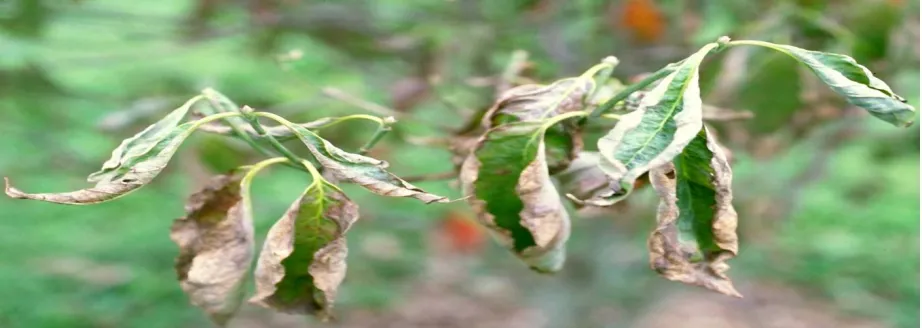
Fig. 3: Early scorch image
ISSN(Online): 2319-8753 ISSN (Print): 2347-6710
International Journal of Innovative Research in Science,
Engineering and Technology
(A High Impact Factor & UGC Approved Journal) Website: www.ijirset.com
Vol. 6, Issue 8, August 2017
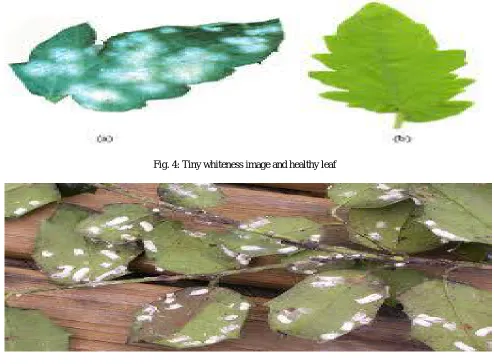
Fig. 4: Tiny whiteness image and healthy leaf
Fig 5: Cotton mold image
ISSN(Online): 2319-8753 ISSN (Print): 2347-6710
International Journal of Innovative Research in Science,
Engineering and Technology
(A High Impact Factor & UGC Approved Journal) Website: www.ijirset.com
Vol. 6, Issue 8, August 2017
The leaves belonging to these three classes had minute differences as discernable to the human eye, which may justify the misclassifications. For each image in the data set the subsequent steps were repeated. Image segmentation of the leaf is done on each image of the leaf sample using GA-SVM algorithm. Once the infected object was determined. The image was then converted from RGB format to HIS format. The SGDM matrices were then generated for each pixel map of the image for only H and S images. The SGDM is a measure of the probability that a given pixel at one particular gray-level will occur at a distinct distance and orientation angle from another pixel, given that pixel has a second particular gray-level. From the SGDM matrices, the texture statistics for each image were generated.
IV.EXPERIMENTAL RESULTS
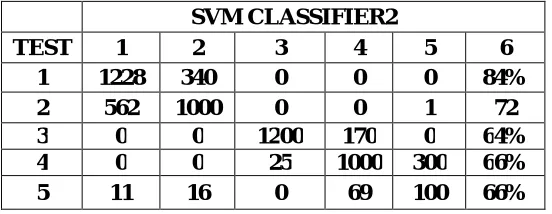
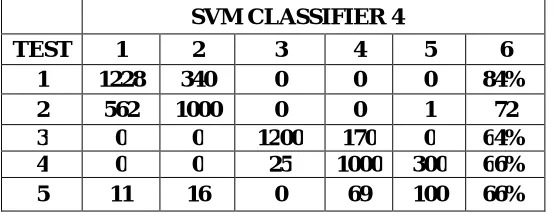
With these parameters, the GA-SVM trained. Once the training was complete, the test data for each class of leaves was tested. The results for GA-SVM classification strategy that were used are given in Table 1.
The results shown in Table 1, 2, 3 and 4 were obtained using a GA-SVM classifier for five different diseases. The results reported better classification accuracies for all the data models. In particular, model M1achieved the highest overall classification accuracy. Model M1 achieved an overall accuracy of 85%, model M2 achieved an overall accuracy of 86.0% accuracy and model M3 achieved an overall accuracy of 87%.
However, it should be noted that model M4 and M5 involve calculation of intensity texture features, which is disadvantageous in terms of computational complexity. Therefore, it is deciphered that model M1 is the overall best model in this classifier. One more advantage of using M1 is the decrease in computational time for training and classification. This is because of the elimination of intensity texture features and because of the less number of features present in the model. The recognition rate for GA-SVM classification strategy of GA-SVM classification strategy of HS and HIS models for early scorch, cottony mold and normal leaf images were shown in Table 2.It is evident from Table 1 and Table 2 that, for models M4 and M5, the classification accuracies for
SVM CLASSIFIER1
TEST 1 2 3 4 5 6
1 1228 340 0 0 0 84%
2 562 1000 0 0 1 72
3 0 0 1200 170 0 64%
4 0 0 25 1000 300 66%
5 11 16 0 69 100 66%
Table 1. Classification results per class for GA- SVM with others
SVM CLASSIFIER2
TEST 1 2 3 4 5 6
1 1228 340 0 0 0 84%
2 562 1000 0 0 1 72
3 0 0 1200 170 0 64%
4 0 0 25 1000 300 66%
5 11 16 0 69 100 66%
ISSN(Online): 2319-8753 ISSN (Print): 2347-6710
International Journal of Innovative Research in Science,
Engineering and Technology
(A High Impact Factor & UGC Approved Journal) Website: www.ijirset.com
Vol. 6, Issue 8, August 2017
SVM CLASSIFIER3
TEST 1 2 3 4 5 6
1 1348 450 0 0 0 74%
2 662 1100 0 0 1 73%
3 0 0 1300 1170 0 74%
4 0 0 25 1100 320 76%
5 136 165 0 609 100 76%
Table 3. Classification results per class for GA- SVM with others
1-Early scorch, 2-Cottony mold, 3-Aahen mold, 4-Later scorch and 5-Tiny Whiteness.
SVM CLASSIFIER 4
TEST 1 2 3 4 5 6
1 1228 340 0 0 0 84%
2 562 1000 0 0 1 72
3 0 0 1200 170 0 64%
4 0 0 25 1000 300 66%
5 11 16 0 69 100 66%
Table 4. Classification results per class for GA- SVM with others
1-Early scorch, 2-Cottony mold, 3-Aahen mold, 4-Later scorch and 5-Tiny Whiteness.
Model M1 emerged as the best model among various models because of elimination of intensity texture features. Elimination of intensity is advantageous in this study because it nullifies the effect of intensity variations. Moreover, it reduces the computational complexity by foregoing the need to calculate the GA matrices and texture statistics for the intensity pixel map. However, in out door application, elimination of intensity altogether may have an effect on the classification, since the ambient variability in outdoor lighting is not taken into consideration.
ISSN(Online): 2319-8753 ISSN (Print): 2347-6710
International Journal of Innovative Research in Science,
Engineering and Technology
(A High Impact Factor & UGC Approved Journal) Website: www.ijirset.com
Vol. 6, Issue 8, August 2017
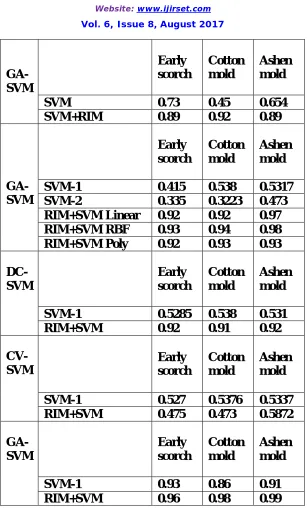
Table 5. Classification results per class for GA- SVM with other SVM
V. CONCLUSION
In this study an image-processing-based approach is proposed and used for leaf diseases detection. We test our program on five diseases which effect in the plants; they are: Early scorch, cottony mold, ashen mold, late scorch, tiny whiteness.
The proposed approach is image-processing-based and is highly based on GA-SVM. Present experimental results indicate that the proposed approach is valuable approach and can significantly support accurate and automatic detection of leaf diseases. Based on our experiments, the developed GA-SVM classifier that is based on statistical classification
GA-SVM
Early
scorch
Cotton
mold
Ashen
mold
SVM
0.73
0.45
0.654
SVM+RIM
0.89
0.92
0.89
GA-SVM
Early
scorch
Cotton
mold
Ashen
mold
SVM-1
0.415
0.538
0.5317
SVM-2
0.335
0.3223
0.473
RIM+SVM Linear
0.92
0.92
0.97
RIM+SVM RBF
0.93
0.94
0.98
RIM+SVM Poly
0.92
0.93
0.93
DC-SVM
Early
scorch
Cotton
mold
Ashen
mold
SVM-1
0.5285
0.538
0.531
RIM+SVM
0.92
0.91
0.92
CV-SVM
Early
scorch
Cotton
mold
Ashen
mold
SVM-1
0.527
0.5376
0.5337
RIM+SVM
0.475
0.473
0.5872
GA-SVM
Early
scorch
Cotton
mold
Ashen
mold
SVM-1
0.93
0.86
0.91
ISSN(Online): 2319-8753 ISSN (Print): 2347-6710
International Journal of Innovative Research in Science,
Engineering and Technology
(A High Impact Factor & UGC Approved Journal) Website: www.ijirset.com
Vol. 6, Issue 8, August 2017
perform well and can successfully detect and classify the tested diseases with a precision of around 94%.For future research, they have been some directions, such as, developing better segmentation technique; selecting better feature extraction and culling classification algorithms.
REFERENCES
[1] Wiskott, L., Fellous, J. M., Kruger, N., von der Malsburg, C., A statistical method for 3d object detection applied to faces and cars. In Proc. IEEE International Conference on Image Processing, pages 129–132, 2016.A. Criminisi, P. Perez, and K. Toyama, “Region filling and object removal by exemplar-based image inpainting.”, IEEE Transactions on Image Processing, vol. 13, no.9, pp. 1200–1212, 2004.
[2] Wiskott, L., Fellous, J.M., Kruger, N., Malsburg, C.V., “Face recognition by elastic bunch graph matching”, IEEE Trans. Pattern Anal. Mach. Intell., Vol. 19, No. 7, 1997, pp. 775–779.
[3] Wren, C., Azarbayejani, A., Darrell, T., Pentland, A., “Pfinder: Real-Time Tracking of the Human Body,” IEEE Trans. Pattern Analysis and Machine Intelligence vol. 19, no. 7, July 1997.
[4] Bellaire, G.,Schluns, K., Oppermann, K., Schimke, W., "Matching Using Object Models Generated from Photometric Stereo Images", Proc. Machine Vision Applications in Industrial Inspection IV, SPIE Vol. 2665, San Jose, Califomia, pp. 70-81, 2015.
[5] M.RajaSekar, “Region classification using SVMs”, Journal of Geomatics, pp 87-89, 2007.
[6] M.RajaSekar, “Automatic Vehicle Identification”Journal of Advanced Research in Computer Engineering, pp 0974-4320, 2015. [7] M.RajaSekar “FER from Image sequence using SVMs “, Journal of Data Engineering and computer science, pp 80-89, 2016.
[8] Burges, C. J. C., A tutorial on support vector machines for pattern recognition. Data Mining and Knowledge Discovery, 2(2):pp 121–167, 2015.
[9] BehroozKamgar-Parsi, BehzadKamgar-Parsi, Jain, A., Dayhoff, J., “Aircraft Detection: A Case Study in Using Human Similarity Measure”, IEEE Trans. Pattern Analysis and Machine Intelligence, Vol. 23, No. 12, 2001, pp. 1404-1414,2016.
[10] Beymer, D. J., Face recognition under varying pose. AI Memo 1461, Center for Biological and Computational Learning, M.I.T., Cambridge, MA, 2016.
[11] 11. Brunelli, R., Poggio, T., Face recognition: Features versus templates. IEEE Transactions on Pattern Analysis and Machine Intelligence, 15(10):1042–1052, 2015.
[12] CHAPELLE, O., HAFFNE,R, P., AND VAPNIK, V. N. Support vector machines for histogram-based image classification. IEEE Transactions on Neural Networks 10, 5, 1055–1064, 2016.
[13] Cohen, I., Sebe, N., Garg, A., Lew, M.S., Huang, T.S., Facial Expression Recogni- tionFrom Video Sequences. In IEEE Intl Conf. on Multimedia and Expo (ICME), volume 2, pages 121 – 124, 2014.
[14] DORK ´O, G., AND SCHMID, C. Selection of scale-invariant parts for object class recognition. In IEEE International Conference on Computer Vision, vol. 1, pp. 634–639,2016.
[15] Daugman, J.G., “Uncertainty Relation for Resolution in Space, Spatial Frequency, and Orientation Optimized by Two-Dimensional Visual Cortical Filters”, Journal of Optical Society America A, Vol. 2, No. 7, 1985, pp. 1160 – 1169, 2016.
[16] M.RajaSekar, “ Classification of SAR images using Fuzzy SVMs”, International journal of research science and applied engineering technology” August , 2017.
[17] M.RajaSekar, “ Image Authentication using SVMs”, Journal of Advanced Research in computer Engineering, p367-p374, 2015.
[18] M.RajaSekar, “Classification of images using SVMs”, International Journal of Mathematics, Computer Sciences and Information Technology, p25-29,2014.
[19] . M.RajaSekar, “Analysis of Images Using SVMS” International Journal of Mathematics, Computer Sciences and Information, p 197-201,2015.