© 2013, IJCSMC All Rights Reserved 18 Available Online at www.ijcsmc.com
International Journal of Computer Science and Mobile Computing
A Monthly Journal of Computer Science and Information Technology
ISSN 2320–088X
IJCSMC, Vol. 2, Issue. 11, November 2013, pg.18 – 24
RESEARCH ARTICLE
Abstraction for Asymmetric Mobile Ad Hoc
Network Using Bidirectional Routing Protocols
V. Vivekanandhan
1, M. Shenbagam
21,2
Department of Computer Science and Engineering 1,2
Annamalai University, Chidambaram, Tamil Nadu 1
[email protected], 2 [email protected]
Abstract- Wireless links are often asymmetric due to heterogeneity in the transmission power of devices, non-uniform environmental
noise, and other signal propagation phenomenon’s. Unfortunately, routing protocols for mobile ad hoc networks typically work well only in bidirectional networks. This project first presents a simulation study quantifying the impact of asymmetric links on network connectivity and routing performance. It then presents a framework called BRA that provides a bidirectional abstraction of the asymmetric network to the routing protocols. BRA works by maintaining multi-hop reverse routes for unidirectional links and provides three new abilities: Improved connectivity by taking advantage of the unidirectional links, reverse route forwarding of control packets to enable off-the-shelf routing protocols, and detecting packet loss on unidirectional links. Extensive simulations of AODV layered on BRA shows that packet delivery increases substantially (two-fold in some instances) in asymmetric networks compared to regular AODV, which only routes on bidirectional links.
Index Terms- Ad hoc network; asymmetry; routing; unidirectional links
I. INTRODUCTION
A Mobile Adhoc network is an infrastructure less wireless network, in which nodes are autonomously self organized. In a mobile Adhoc network nodes move arbitrarily and causes frequent topology changes. In contrast to a stable linked wired network, wireless link capacity continuously varies because of the inputs from transmission power, receiver sensitivity, noise, fading and interference. Additionally because the nodes in the Mobile Adhoc network limited transmission ranges, some nodes cannot communicate directly with each other.
The presence of unidirectional links impacts the following in the network protocol stack 1) Data Link Layer, 2) Network Layer. At the data link layer, error and flow control protocols
© 2013, IJCSMC All Rights Reserved 19
The rest of this paper is organized as follows. Section II deals with Literature survey, where the previous routing algorithms are looked into. Section III deals with the new framework which is used to provide a bidirectional abstraction for the unidirectional links by finding out a reverse route where routing algorithms consider it as bidirectional link and transfers the control packets through it, and also deal with Reverse route maintenance protocol and Dynamic Bidirectional Routing. Section IV the implementation details are exposed. Section V, gives the conclusion and the scope for future work.
II. BACKGROUND AND RELATED WORK
One of the major challenges in designing routing protocols for the Mobile Adhoc networks stems from the fact that, to determine a packet route, a node needs to know at least the reachability information to its neighbors, and also in a Mobile Adhoc network, the network topology can change quite often. So, mobile Adhoc networks rely on special routing protocols that have to adapt to frequent topology changes.
A. Routing protocols and network asymmetry
Routing protocols are typically designed for efficient operation on bidirectional networks, efficient operation on bidirectional networks. Consequently, they either totally fail on asymmetric networks or operate with high overhead and low throughput. This section describes how the well-known routing protocols deal with network asymmetry.
1) Destination Sequenced Distance Vector Protocol
DSDV is the variant of distance vector routing suitable for mobile ad hoc networks. It addresses the drawbacks of poor loping properties in conventional distance vector routing. Each node maintains a routing table listing the “next hop” for each reachable destination as common in table-driven routing method. Each node advertises a sequence number which is recorded in the table. A higher sequence number is a more favorable route. Equal sequence number resorts to favoring lower metrics. Each node periodically broadcasts routing updates and the routing table along with a table to keep track of incremental updates. Periodic updates is of two kinds full Dump and Incremental updates [9]. DSDV Guarantees loop free path to each destination. The major drawback of this protocol is that periodic updates are regardless of the number of changes in the topology.
2) OLSR-Optimal Link State Routing Protocol
Normally when a node broadcast, all the neighbor nodes retransmit the message to other node and so on. So message overhead occurs. The key concept used here is the Multipoint Relays. MPRS is selected nodes which forward broadcast messages during the flooding process. In OLSR mechanism [3] nodes which are selected as MPRS alone broadcasts messages during flooding process. Thus number of control messages flow in the network is minimized. MPR nodes report only the links between itself and its MPR selector [3]. This information is used for route calculation. One of the optimization of OLSR routing is (1) Each node caches a new route it learns by any means (2) when node S finds a route it also finds other routes. The major advantages of this algorithm are: It provides optimal routes and suitable for large dense networks. The drawback of this protocol is the Message complexity which is O(n2) and is case of asymmetric network condition it works partially.
3) Dynamic source routing
DSR in an on demand protocol [9]. When a node S wants to send a packet node D but does not know the route to it, S initiates route discovery process. Assume Source node be S, it flood S Route Request (RREQ). Each node appends own identifier when forwarding RREQ.D does not broadcasts anymore because it is the destination node. Now D on receiving RREQ, sends a Route Reply (RREP). RREP is sent on the route obtained by reversing the route appended to receive RREQ.RREP includes route from S to D on which REQ was first received by D.S. on receiving RREP caches the route When S sends a data packet entire route is included in the packet header’s if route is long packet header size will grow. In case of asymmetric condition, when asymmetry increases, this protocol gives a limited throughput.
4) AODV-Adhoc on Demand Distance Routing
© 2013, IJCSMC All Rights Reserved 20
problem with AODV is that it avoids unidirectional links when routing.
5) ZRP-Zone Routing Protocol
Hybrid protocols such as ZRP [7] combine both proactive and on-demand routing methods. ZRP uses a proactive routing technique for nodes in a small region called zone around each node and an on-demand routing technique for inter-zone routing. Sinha et al. extend ZRP to handle unidirectional links by discovering reverse routes for links inside a inter-zone. The resulting protocol has a higher control overhead as it needs to perform proactive routing in an extended zone of twice the earlier size. The following table shows the protocols and their reaction towards asymmetry.
TABLE1
COMPARISON of ROUTING PROTOCOLS TOWARDS ASYMMETRY
Protocols Reaction towards asymmetry
LSR Fails to react when topology
DVR Fails to react when topology changes
DSDV Fails in unidirectional links
DSR Overhead when asymmetry increases, limited throughput
AODV Avoids unidirectional links in its path
ZRP Overhead when it has extended zones
III. BIDIRECTIONAL ROUTING FRAMEWORK
Bidirectional routing framework, is a framework that provides improved connectivity and routing performance in asymmetric networks. BRF seeks to improve the efficiency of off-the-shelf routing protocols typically designed for bidirectional networks to function efficiently on asymmetric networks. To that end, Bidirectional routing sublayer provides a bidirectional abstraction of the underlying unidirectional links. The central feature of BRF is an adaptive and scalable technique to maintain reverse routes for unidirectional links [2]. The rest of this section describes this central technique and explains how Bidirectional routing framework provides the necessary functionality to enable routing protocols to operate on asymmetric networks.
Distributed Bellman-Ford algorithm [2] is a well-known distance-vector algorithm to obtain the shortest routes between pairs of nodes in a bidirectional network. However, the above algorithm fails in the presence of unidirectional links. For instance, if but not, then A would never receive the distance-vector message from B and thus will never be able to discover the shortest hop path to C through B. this protocol converges eventually if the network not partitioned and remains stable but fails in unidirectional links.
A. Reverse Distributed Bellman-Ford Algorithm
Finding revere routes for unidirectional links in an asymmetric network is non-trivial. While it may appear that a straightforward application of a standard distance-vector or link-state algorithm will provide the necessary reverse route information, several problems arise while applying them in an asymmetric network. For instance, the Distributed Bellman-Ford algorithm is a well-known distance-vector algorithm to obtain the shortest routes between pairs of nodes in a bidirectional network.
© 2013, IJCSMC All Rights Reserved 21 A
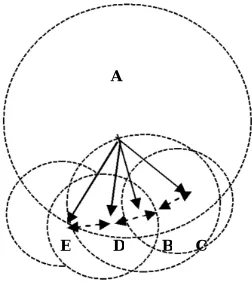
E D B C
Fig.3.1 A unidirectional adhoc network A B is a
unidirectional link, and B C A is its reverse route.
As the name implies, RDBFA operates by reversing the direction of route discovery; that is, each node aims to find the shortest distance from other nodes to itself rather than from itself to other nodes. In the previous example, node B tries to learn the shortest path through which other nodes can reach it. B achieves this when it hears A’s reverse distance vector broadcast saying that C can reach A in hops; B discovers that C can reach B through A in hops. If, at B, the previous known route from C is longer than hops, B can now record the new hop route from C, about this new reverse route to B from B’s next reverse-distance-vector broadcast. Each entry in the distance vector includes two values: the length of the shortest route from a node and the address of the first hop in the shortest route from that node. Including the first-hop information provides two benefits1) it enables a node to compute the reverse route to its in-neighbors based on local state even though the node cannot always compute the reverse route for other nodes’ in neighbors due to the reversed direction of routing state. 2) it enables RDBFA to avoid routing loop and prevent the counting-to-infinity problem that affects classical distance vector algorithms; each node uses the first-hop information to detect routing loops and invalidates such routes from its computations.
At periodic intervals, each node broadcasts to all its out-neighbors a distance-vector message containing the shortest paths of its knowledge from other nodes to itself. A node B receiving a distance vector from one of its in-neighbors A extracts the following information:- The reverse route from B to A; B obtains this information from the entry for the route from B to A if the distance vector includes such an entry:- If the currently known route from node C to B is linger than the route from C to A followed then B sets the newly found shorter route from C to B through A. Fig. 3.2 illustrates the RDBFA algorithm with empty initial state at each node. First, B learns that from the first message it receives from A. However, B does not yet know the reverse route to A. In the second round, B broadcasts a distance- vector message, which indicates to C that A can reach B in one hop. The message from C in the third round carries two distance updates: B~>1 C; A~>2 C.
Reverse route B C A
A; 1; B
B Round 2
Round 4
B; 2 ; C
C C; 1 ; A
Round 3
A; 2 ; B B; 1 ; C
Fig. 3.2 Reverse Distributed Bellman-Ford algorithm
Finally, A; broadcasts the following distance updates: C~>1 A; B~>2 A. When B hears this distance update from A, the
© 2013, IJCSMC All Rights Reserved 22
B. Reverse Route Maintenance Protocol
Bidirectional routing abstraction uses the above distance-vector algorithm RDBFA for reverse route maintenance. Distance-vector algorithms are more efficient as they exchange an order of magnitude less information than link-state algorithms.
Bidirectional routing abstraction further reduces the overhead of reverse route maintenance by restricting the spread of distance vectors to a bounded region around each node called locality. The locality, defined by a radius, includes all nodes that A can reach in hops or fewer. For instance, locality radius 1 means the reverse routes found are all of one-hop length and only include bidirectional links. The radius also helps to control the maximum length of reverse routes discovered. Reverse route maintenance in Bidirectional routing abstraction is proactive. It proceeds through periodic exchanges of distance-vectors between nodes, once every update interval. A full distance vector update from node A as described earlier contains an entry for each node in whose locality A exists. But, unchanged entries are redundant across consecutive updates. BRA optimizes the protocol by letting each node broadcast only the changes in the route information rather than the complete information in each round.
C. Dynamic Bidirectional Routing
The performance and overhead of bidirectional routing hinges on the value of the locality radius, because nodes use the radius to prune the size of their updates. If a node A with radius has a path of length to node B, then node B need not store or broadcast any distance information about A. the analytical study suggests that a small value of 2 to 3 hops is a reasonable choice for the locality radius. However, the heavy-tailed nature of connectivity suggests that there may be occasions when reverse routes of even longer length might be required to obtain good connectivity. Moreover, using a single global value for the radius entails two high overheads: (a) the size of update packets typically increases polynomially with the radius (in a two dimensional topology), and (b) choosing a single global value for the locality radius in a dynamic manner would be quite expensive. Picking an independent value for each node keeps the overhead low because asymmetry that affects a local region is taken are of through local reverse route maintenance activity without a global Increase in the protocol overhead. DBR determines a suitable value for a node A’s radius periodically based on two criterions namely.
1) Local Criterion
It takes into account the existence and length of reverse routes to the node’s in –neighbors. If a node does not have revere routes to more than asymmetry-tolerance-threshold percentage of in neighbors, it chooses the max_ radius. Otherwise, it chooses a radius of the maximum reverse route length of A’s in-neighbors. The tolerance threshold serves as a heuristic to ignore a few asymmetric links from consideration since there may be asymmetric links with no reverse routes in the network.
2) Global Criterion
DBR also takes into account the radius of other nodes in a node’s locality in order to make sure that nodes help other nodes succeed in reverse route discovery. The radius of a node A must be at least for each node B with radius and path of length to A. this condition is necessary for B to obtain reverse routes for its in-neighbors; otherwise, node A might ignore some distance updates crucial to B. The final chosen radius of the node is the maximum of the values determined based on local and global criteria. Nodes broadcast their current radius as part of the distance-vector messages.
IV EVALUATION
Bidirectional routing abstraction can be done in existing AODV algorithm making it work in reverse route forwarding method. It has been implemented in Network Simulator (ns2)
A. Topology Models
First we experimented AODV’s performance under unidirectional link conditions through the following scenarios.
P-model (probabilistic model): This model simulates unidirectional links created by random irregularities in signal
propagation due to ambient conditions. This model takes a basic, bidirectional topology with a transmission range of 220 m for each node and then probabilistically converts links to become unidirectional.
N-model (Noise model): This model simulates unidirectional topologies created by external radio sources that increase
noise and congest some nodes. In this model, the noise sources are randomly distributed throughout the network with uniform probability.
© 2013, IJCSMC All Rights Reserved 23
transmission power of nodes. We define the diversity D of a topology as the difference between the maximum and the minimum transmission ranges of the nodes in the network. We then assign each node a transmission range picked randomly from a set of transmission ranges in the interval, where is the nominal transmission range.
We then evaluated the routing performance of AODV layered on BRF (BRF-AODV) and DBR (DBR-AODV). This section reports the observed performance in terms of the number of routes established, percentage of successful packet delivery, latency, and the control overhead for routing data packets and for maintaining reverse routes in various network conditions.
1) Protocol Parameters: We used the parameters for BRF and DBRF and standard parameters [14] for AODV.
2) Physical and MAC layers: We set the simulated radio to correspond to the Wavel LAN radio hardware with a transmission range of 220m, bandwidth of 2 MHz, and the two-ray signal propagation model. For the MAC layer, we used IEEE 802.11 for AODV and CSMA for BRFAODV. Our choice for the MAC protocols is restricted by the functionalities provided by the protocols; IEEE 802.11 is unsuitable for unidirectional routing in BRF-AODV where as CSMA does not provide the necessary collision avoidance or recovery for AODV.
3) Topology and Asymmetry: We simulated topologies similar to those used by the network asymmetry analysis and presented results for the topology of 80 nodes distributed uniformly at random in an area of 1300 m 1300m. the transmission range of each node was based on the D-model, that is, drawn randomly from the set for a nominal range m and diversity D.
4) Application: We used a Constant Bit-Rate Generator (CBR) application to initiate data transfers. We set up data transfers between 20 randomly chosen sources and destinations, where each data transfer started randomly between 50 sand 150 s, periodically sent 200 data packets of a size randomly chosen between 64 B and 1024B, and terminated after 200 a. That is, we simulated at most 100 seconds.
5) Mobility: we used the usual random-waypoint model to simulate nodes in motion, where nodes repeatedly move using the following algorithm. A node chooses a random destination point and a random speed (between a maximum and a minimum value), moves towards that destination with the chosen speed, and , after reaching the destination, waits for a specified pause time before repeating this random motion. We simulated two mobility scenarios: A low-speed or pedestrian-walking scenario and high speed.
V. CONCLUSION AND FUTURE SCOPE
This paper presented a bidirectional routing framework to handle unidirectional links that arise frequently in mobile ad hoc networks. BRF provides routing protocols with the familiar bidirectional abstraction that they are typically designed for and thus enables them to operate efficiently on asymmetric networks. Internally, however, it actively uses both unidirectional and bidirectional links to 1) find symmetric routes more effectively than conventional techniques; 2) find new, asymmetric routes substantially increasing the reach ability of the network; and 3) find alternate routes with shorter path length. This paper made three overall contributions: First, it presented a quantitative analysis of how network asymmetry caused by alien radio sources, heterogeneity in transmission power, and random fluctuations in signal propagation that affect conventional MANET routing protocols. Second it presented the design of BRF, based on a novel protocol to maintain reverse routes for unidirectional links in an efficient and scalable manner. Finally, it showed through extensive evaluation how a typical routing protocol, such as the well-known AODV, layered on BRF achieves superior connectivity in asymmetric networks.
The future work of this paper is to compare the performance of DSR and proactive protocol DSDV with Bidirectional Routing Framework. One of the advantage of Bidirectional routing framework is that it can adopt to both unidirectional and bidirectional link conditions according to the study given in Section III. Because DSR works with little overhead under asymmetric condition and also it does not avoid unidirectional links, this framework can be easily used to enhance the performance of the existing protocols. In future, this framework can be used as a general purpose framework for all the routing protocols used in Mobile Adhoc networks.
REFERENCES
[1] Venugopalan Ramasubramanian and Daniel Mosse, “BRA: A Bidirectional Routing abstraction for Asymmetric Mobile Ad Hoc Networks”, IEEE/ACM Transaction on Networking, Vol. 16, No. 1, February 2008.
[2] C. Cheng, R. Riley, S. Kumar, and J. Garcia- Lunes_ Aceves, “ A Loopfree extended Bellman-Ford routing protocol without bouncing effect,” in proc. ACM SIGCOMM, Aug.1989.
[3]T. Clausen and P. Jacquet, “Optimal link-state routing” RFC 3626, Oct. 2003.
[4]D.D. Couto, D. Aguayo, B. Chambers, and R, Morris, “Performance of multihop wireless network: Shortest path is not enough,” Presented at the workshop on Hot Topics in Networking (HotNets), Princeton, NJ, Oct. 2002.
© 2013, IJCSMC All Rights Reserved 24 Network Working Group, 1999.
[6] D. Ganesan, B. Krishnamachari, A. Woo, D. Culler, D. Estrin, and S. Wicker, “An empirical study of epidemic algorithms in large scale multihop wireless networks,” Intel Research, Tech. Rep. IRB-TR-02-003, 2002.
[7]Z.J.Hass and M.R. Pearlman, “the Zone Routing Protocol (ZRP) for ad hoc networks, “IETF Internet draft, MANET Working group, 2001.
[8] J.G. Jetcheva, “Adaptive demand-driven multicast routing in multi-hop wireless adhoc networks,” Ph.D. dissertation, Carnegie Mellon Univ., Pittsburgh, PA, 2004.
[9]D.B. Johnson and D.A. Maltz, “Dynamic source routing in ad hoc wireless networks,” in Mobile computing. Norwell, MA: Kluwer, 1996,pp.153-181. [10]M.K. Marina and S.R. Das, “Routing performance in the presence of unidirectional links in multihop wireless computing (MobiHOc), Lausanne, Switzerland, Jun.2002.
[11]S. Murthy and J. Garcia-Luna-Aceves, “An efficient routing protocol for wireless networks,” Mobile Networks and Applications Journal, Special Issue on routing in Mobile Communication Networks, vol. 1, no. 2, 1996.