Supporting Integrated Services
In a Cellular Packet Switched
Network
Min Seok Kang
A dissertation submitted in partial fulfilment
of the requirements for the degree of
Doctor of Philosophy
of the
University of London
Department of Computer Science University College London
ProQuest Number: 10609119
All rights reserved
INFORMATION TO ALL USERS
The qu ality of this repro d u ctio n is d e p e n d e n t upon the q u ality of the copy subm itted.
In the unlikely e v e n t that the a u th o r did not send a c o m p le te m anuscript and there are missing pages, these will be note d . Also, if m aterial had to be rem oved,
a n o te will in d ica te the deletion.
uest
ProQuest 10609119
Published by ProQuest LLC(2017). C op yrig ht of the Dissertation is held by the Author.
All rights reserved.
This work is protected against unauthorized copying under Title 17, United States C o d e M icroform Edition © ProQuest LLC.
ProQuest LLC.
789 East Eisenhower Parkway P.O. Box 1346
Abstract
The third-generation cellular network should be capable of accommodating the integration of data sources with various QoS requirements, along with voice service. There has been no lack of research effort on the integrated services for fixed networks, but these methods cannot be directly applied to a cellular packet network since it has different characteristics such as the handovers and varying available bandwidth due to mobile hosts. This thesis presents an integrated service architecture for the cellular packet switched network and deals with its design issues. It provides uplink and downlink connections with diverse QoS keeping an identical link service for both link directions whilst maintaining fairness among connections regardless of handovers.
The service architecture we propose in this thesis can accommodate multiple scheduling disciplines to serve various traffic according to their traffic characteristics. For the service architecture, we developed two scheduling disciplines, PEDQ (Packet Endurable Delay Queuing) and PCAWFQ (Packet-by-Packet Combined Absolute and Weighted Fair Queuing). The PEDQ is designed for delay-intolerant traffic and schedules packets according to the remaining lifetime of a packet to minimise packet drops. The PCAWFQ is a general packet scheduling discipline designed for scheduling delay-tolerant traffic in a variable-rate link and can simultaneously schedule three different kinds of flow classes according to their class service policies. For handling uplink traffic, we propose a multiple access protocol called FQMA (Fair Queuing Multiple Access) which is a slot-based protocol to manage delay-intolerant and delay-tolerant traffics simultaneously using the proposed two scheduling disciplines, whilst performing a decoupling between both traffic to prevent delay-tolerant traffic from degrading the service performance for delay-intolerant traffic. We also propose the proxy packet-scheduling concept to serve distributed packets in mobile hosts as if they are queued in a single queue. It enables a scheduling scheme designed for downlink service to serve uplink traffic.
We also investigate and analyse the proposed system in the handover environment. We identified that unfairness occurs in some types of schedulers during handovers due to packet forwarding. We also identified that misordered packet delivery might occur during handovers if a handover protocol does not take account of the packet level service. We propose a compensation scheme and a packet forwarding-aware handover protocol to remedy both problems respectively.
Acknowledgements
I would like to express my sincerest gratitude and appreciation for my supervisor, Prof. Steve Wilbur, for his guidance, support and patience. The successful completion of this thesis is in a large part due to his encouragement, probing criticisms and judicious advice. I feel fortunate that I had the chance to work with such an excellent supervisor. I would also like to thank Dr. Soren-Aksel Sorensen for a fruitful collaboration. He supplied simulation ideas and sharp critical thinking at various stages in obtaining some of the result reported herein. Prof. Jon Crowcroft provided both encouragement and analytical expertise relating to my research. He also took the time to carefully read my several papers relating this thesis. Bhrat Patel was always available as a helpful and encouraging friend throughout my years of research. He also took time from his own research to read portions of my thesis. I am also very grateful to Paul White for reading my thesis and making useful suggestions. I have benefited greatly from the social and professional environment of my laboratory. I will forever remember as fond memories my daily contact with Richard Akester, Mazlisa Othman, Joe Chappell, Ian Brown, Ashok Gupta, Jungwon Kim, Hugh Mallinson and Ben Southall.
I wish to thank also to Prof. David Hutchison and Prof. Laurie Cuthbert for reading my thesis and recommend me as a PhD. Their critical comments helped me greatly to improve the final product.
I am eternally grateful to my deceased father during my studying period and my mother for their priceless gift of love throughout my whole life. My strength and determination is but a product of their unflagging efforts. There is no doubt that their love made it possible for me to fulfil my research. My debt to my loving wife for her selfless support and dedication is profound and incalculable. Through the years of my graduate study, she supported me patiently and unconditionally. I would like to thank or at least apologise to my son who has not been properly looked after by me due to my research. I am deeply grateful to all of them.
Declaration
Except where otherwise stated in the text, this dissertation is the result of my own work and is not the outcome of work done in collaboration. This dissertation is not substantially the same as any I have submitted for a degree or diploma or any other qualification at any other University. No part of this dissertation has already been, or is being currently submitted for any such degree, diploma or other qualification
Publications
Materials presented in several parts of this dissertation also appear in the following publications.
M. Kang and S. Wilbur, "A Handover Compensation Scheme for Weighed Fair Queuing in Cellular Packet Switched Networks," IEE Electronics Letters, Vol. 33, No. 12, pp. 1015-1017, June, 1997
M. Kang and S. Wilbur, "A Fair Guaranteed Down-link Sharing for Cellular Packet Switched Networks," In Proc. of IEEE GLOBECOMW, pp. 1006-1010, Nov., 1997
Contents
ABSTRACT ... 2
ACKNOW LEDGEM ENTS... 3
DECLARATION... 4
LIST O F F IG U R E S ... 10
LIST O F TA B LES... 13
GLOSSARY OF TE R M S...14
CHAPTER 1 - IN TRODUCTION...17
1.1 Integ ratedservicesinacellulard a t an et w o r k...17
1.2 Thebarriersinacellularpacketsw itchedn e t w o r k...18
1.3 Co n t r ib u t io n s...19
1.3.1 Scheduling Algorithm... 19
1.3.2 Multiple access protocol... 20
1.3.3 Handover...21
1.4 Dissertationo u tlin e...22
CHAPTER 2 - BA CKG RO UN D ...23
2.1 Cellulard a t an et w o r k s... 23
2.1.1 Macro-cellular data network... 23
2.1.1.1 HSCSD (High Speed Circuit Switched Data) - GSM... 24
2.1.1.2 GPRS (Global Packet Radio Service)... 24
2.1.1.3 CDPD (Cellular Digital Packet Data)... 25
2.1.2 Micro/Pico-cellular data network... 25
2.1.2.1 Wireless LAN... 26
2.1.2.2 PHS (Personal Handyphone System )... 27
2.1.3 Hierarchical cellular network...28
2.1.3.1 UMTS/IMT2000... 28
2.1.3.2 BARWAN (Bay Area Research Wireless Access Network)...29
2.2 QOS PROVISION IN AN INTEGRATED SERVICES PACKET NETWORK... 30
2.2.1 Two procedures for the first approach... 31
2.2.2 Resource reservation protocol - R S V P ... 31
2.2.3 Resource distribution and Packet scheduling schem e... 32
2.2.4 Adaptive applications...33
2.2.4.1 Playback application... 33
2.2.4.2 Inter-active application...33
2.3 QOS PROVISION IN A CELLULAR PACKET SWITCHED NETWORK...34
2.3.1 Bottlenecks and scheduling d iscip lin e... 35
2.3.2 Uplink traffic service and multiple access protocol...35
2.3.3 M obility related is s u e s... 36
2.3.3.1 Efficient handover protocol for seam less d eliv ery ... 36
2.3.3.2 Reservation protocol supporting m o b ility ...37
2.3.3.3 Addressing... 37
2.3.3.4 Improving End-to-End performance... 38
2.3.3.5 Call control issues... 38
2.4 Research Motivationa n d Sc o p e... 39
CHAPTER 3 - RELATED W O R K ...43
3.1 Sch edulingd isc ip l in e s... 43
3.1.1 Fair Q ueuin g... 43
3.1.2 GPS (Generalised Processor Sharing)... 44
3.1.3 PGPS (Packetised G P S )... 45
3.1.4 W F2Q (Worst-case Fair W eighted Fair Q ueuing)... 46
3.1.5 SCFQ (S elf Clocked Fair Q ueuing)...46
3.1.6 SFQ (Start-time Fair Q u eu in g)... 47
3.1.7 Virtual C lock... 48
3.1.8 CBQ (Class Based Queuing)...49
3.1.9 Comparisons o f CBQ and Rate-based Scheduling... 51
3.1.10 Sum mary...51
3.2 Multiplea ccessp r o t o c o l s...51
3.2.1 PRM A (Packet Reservation Multiple A c c e ss)... 52
3.2.2 Improved versions o f P R M A ...52
3.2.4 C-PRMA (Centralised Packet Reservation Multiple Access)...53
3.2.5 C-CRA (Centralised-Collision Resolution Access)...54
3.2.6 LAP (Low-power Access Protocol)... 54
3.2.7 Packet CDMA (Code Division Multiple Access)... 55
3.2.8 Summary...56
3.3 Ha n d o v e r pr o t o c o l s... 56
3.3.1 IP based handover protocol... 57
3.3.2 Caceres’s handover protocol... 57
3.3.3 Summary...58
CHAPTER 4 - SERVICES ARCHITECTURE... 60
4.1 Application An a l y s is... 60
4.1.1 D elays... 61
4.1.2 Delay-tolerant vs. Delay-intolerant... 61
4.1.3 Delay-tolerant application classification... 62
4.2 Service Cla ssesa n d All o c a tio n...65
4.2.1 Service class types... 65
4.2.2 Service Allocation... 66
4.3 System De sc r ipt io n... 68
4.3.1 Traffic Scheduling... 68
4.3.1.1 Downlink traffic scheduling... 69
4.3.1.2 Uplink traffic scheduling...70
4.3.2 Uplink/downlink Sharing and Partitioning...71
CHAPTER 5 - PACKET-BY-PACKET COMBINED ABSOLUTE & WEIGHTED FAIR QUEUING (PCAWFQ)... 75
5.1 In f l u e n c e so fv a r i a b l e-r a t e l i n k s...75
5.2 V-WFQ ( Va r i a b l e-b a n d w i d t hW FQ )... 78
5.3 Co m b i n e d Ab s o l u t e & We ig h t e d Fa ir Qu e u i n g... 81
5.3.1 Definition of terms... 81
5.3.2 Definition of CAW FQ...82
5.3.3 Formal expression... 83
5.4 PACKET-BY-PACKET CAWFQ (PCAWFQ)... 85
5.4.1 Reference virtual tim e... 86
5.5 Delayb o u n dof PCAW FQ... 93
5.5.1 Leaky bucket traffic...93
5.5.2 Delay guarantee...93
5.6 De m o n st r a t io n...97
5.7 Dis c u s s io n...102
5.7.1 Functionality...102
5.7.2 Com plexity... 103
5.8 Su m m a r y... 103
CHAPTER 6 - FA IR QUEUING M ULTIPLE ACCESS (FQ M A )... 105
6.1 FQMA PROTOCOL DESCRIPTION... 105
6.1.1 Issues to be considered... 105
6.1.2 Uplink slot form ats... 106
6.2 Reservatio n Ph a s e... 108
6.2.1 Reservation request o f periodic traffic flo w s ... 108
6.2.2 Control o f the RP slot issuing rate... 109
6.2.3 Reservation request o f random traffic flo w s ... 109
6.3 Pro x y Packet Gen era to r... 110
6.4 Uplinksc h ed ul er...110
6.4.1 PEDQ (Packet Endurable Delay Q ueuing)... 110
6.4.2 Re-queuing to P E D Q ...112
6.4.3 PCAWFQ' (Packet-by-packet Combined Absolute & W eighed Fair Queuing')... 113
6.4.4 Slot Type Selector (S T S )...114
6.5 Theeffectofm axim ising R S T ... 118
6.6 Ev a lu at io ns t u d y...120
6.6.1 The performance results o f speech traffic service... 122
6.6.2 The performance results o f random traffic ser v ic e...126
6.7 Su m m a r y... 137
CHAPTER 7 - HANDOVER M AN A G EM EN T... 138
7.1 Theeffectsofh a n d o v eronsch edulingper fo r m a n c e...138
7.1.1 Service distortion in the old B S ...138
7.1.1.1 Parameter errors in a downlink sch ed u ler... 138
7.1.1.2 Parameter errors in uplink serv ice...139
7.1.2.1 The arrival time changes of forwarded packets...140
7.1.2.2 Out-of-order packet delivery...140
7.2 Se r v ic e d is t o r t io no fW FQ...140
7.2.1 Virtual time lag by packet forwarding...140
7.2.2 Unbounded fairness... 143
7.2.3 Identification by simulation... 144
7.3 Ap p r o a c h e st o r e m e d yt h ep a r a m e t e r se r r o r s inPFD d i s c i p l i n e s... 147
7.3.1 Three approaches... 147
7.3.2 Compensation scheme for W FQ ... 148
7.3.3 Simulation results of the “Re-computing” method and the proposed compensation scheme for W FQ ... 149
7.4 Pr o t e c t in g t h es e r v i c ed is t o r t io no fPCAWFQ a n d PCAWFQ'...150
7.4.1 “Consuming” approach for PCAWFQ...151
7.4.2 “Consuming” approach for PCAWFQ'... 152
7.5 A HANDOVER PROTOCOL WITHOUT OUT-OF-ORDER PACKET DELIVERY...152
7.5.1 Caceres’s handover protocol... 152
7.5.2 The effect of out-of-order packet delivery... 153
7.5.3 A forwarding-aware handover protocol... 154
7.5.4 Simulation results... 155
7.6 Su m m a r y...157
CHAPTER 8 - CONCLUSIONS... 158
8.1 Th e s iss u m m a r y... 158
8.2 Re s e a r c h Co n t r i b u t i o n s... 159
8.2.1 Comparison with the previous w ork...159
8.2.1 Contributions...161
8.3 Fu t u r ew o r k... 163
8.3.1 A clustered scheduling system... 163
8.3.2 Reservation request sharing...163
8.3.3 Interface with a reservation protocol...164
8.4 Lim it a t io na n d Co n c l u d i n g Re m a r k s...164
APPENDIX ...166
List of Figures
2.1 Micro-cellular Network... 25
2.2 Pico-cellular network...26
3.1 Graphical comparison between CBQ and Rate-based scheduling...50
4.1 Five groups of Delay tolerant-applications...64
4.2 The hierarchy of applications...64
4.3 An example of a wireless link share tre e ...67
4.4 The proposed traffic scheduling system for a base station... 69
4.5 Common channel usage... 72
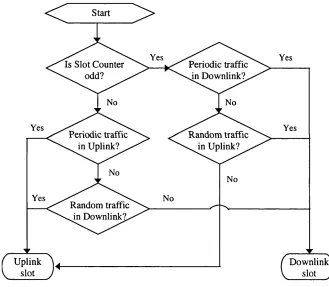
4.6 Slot allocation flow chart for uplink/downlink sharing schem e...73
5.1 The guaranteed bandwidth effect of rate-based scheduling disciplines over a fixed and variable-rate link... 77
5.2 The guaranteed bandwidth effect of the proposed scheduling discipline (CAWFQ) over a fixed and variable bandwidth link ... 78
5.3 Left: The virtual time and virtual finish time of served packet in WFQ, Right: the difference of the two times... 79
5.4 Left: The virtual time and virtual finish time of served packet in V-WFQ, Right: the difference of the two tim es... 80
5.5 The packet service order Top: WFQ, Bottom: V-WFQ... 80
5.6 An example of a backlogged and idle period...82
5.7 CAWFQ service and service sequential orders... 85
5.8 Relationship between the packet departure times and the reference virtual times... 90
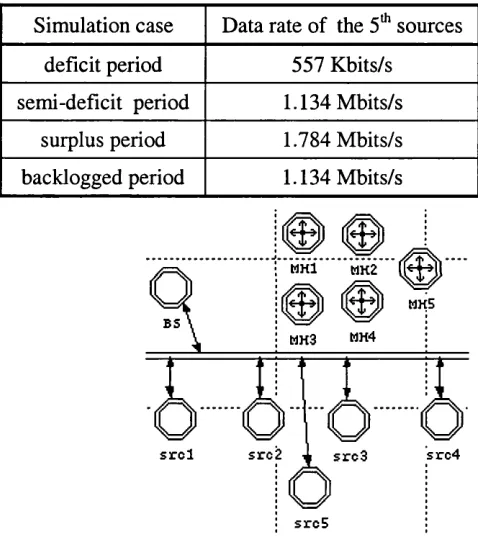
5.9 The network configuration for the simulation... 98
5.10 Simulation results for a semi-deficit period...100
5.11 Simulation results in a deficit period... 100
5.12 Simulation results in a surplus period... 101
5.13 Simulation results for a backlogged period... 101
5.14 Comparison of end-to-end delay between PCAWFQ and V-WFQ under a semi-deficit period... 102
6.1 Examples of uplink slot assignments...106
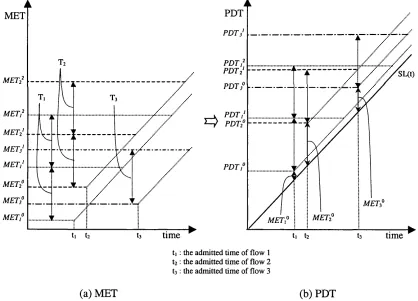
6.3 Comparison between MET (Maximum Endurable Time) and PDT (Packet Drop Time) .... I l l
6.4 Slot type decision flowchart... 116
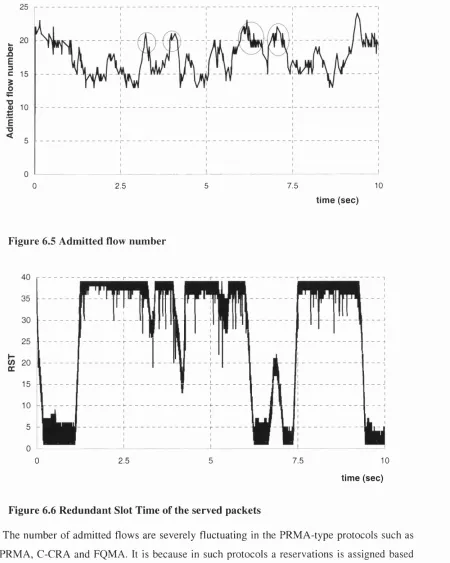
6.5 Admitted flow number...119
6.6 Redundant Slot Time of the served packets... 120
6.7 The wireless network topology used in the simulation...121
6.8 The speech source model implemented in OPNET simulator... 121
6.9 Packet Drop Probability in the uplink/downlink partitioning schem e... 122
6.10 Bandwidth allocated to random traffic in the uplink/downlink partitioning scheme...124
6.11 Used bandwidth rate for RP slot issuing... 125
6.12 Comparison of packet drop probability between the uplink/downlink partitioning and sharing scheme... 125
6.13 Comparison of the total bandwidth allocated to random traffic between uplink/downlink partitioning and sharing scheme... 126
6.14 Simulation results for uplink random traffic service with various allocation rates in a surplus period - 4 speech uplink flows are connected... 130
6.15 Simulation results for uplink random traffic service with various allocation rates in a semi-deficit period -18 speech uplink flows are connected... 131
6.16 Simulation results for uplink random traffic service with various allocation rates in a deficit period - 34 speech uplink flows are connected... 132
6.17 Simulation results for uplink random traffic service with the same allocation rate in a surplus period - 3 speech uplink flows are connected... 133
6.18 Simulation results for uplink random traffic service with the same allocation rate in a semi-deficit period -1 9 speech uplink flows are connected... 134
6.19 Simulation results for uplink random traffic service with the same allocation rate in a deficit period - 35 speech uplink flows are connected... 135
6.20 Simulation results for uplink random traffic service with greedy AC flows in a semi- deficit period -1 8 speech uplink flows are connected... 136
7.1 Service distortion due to the virtual time la g ... 143
7.2 Simulation configuration...144
7.3 The F(t) and V(t) in WFQ of BS1... 146
7.4 The gap between F(t) and V(t) ( F(t) - V (t)) in WFQ of BS1... 147
7.5 Service order of flow 8 and 9 in WFQ of BS1...147
7.6 Estimation of correct virtual time at a handover...148
7.8 Service order of flow 8 and 9 in corrected WFQs in BS1... 150
7.9 Out-of-order packet delivery case example occurring in the Caceres’s handover protocol upon a handover... 153
7.10 The proposed handover protocol... 155
7.11 The packet numbers of flow 1 and 2 arrived at corresponding M H s... 156
List of Tables
2.1 Comparison of PHS, wireless LAN, GSM, and CD PD ...30
2.2 Encoding schemes of D AA T... 34
6.1 System Parameters...122
6.2 Random traffic flows used in the rate-based service simulation... 127
6.3 Random traffic flows used in the local fairness simulation...128
6.4 Random traffic flows used in the global fairness simulation... 129
7.1 The parameters for flows used in the simulation...145
7.2 Assignment priority for PCAWFQ and PCAW FQ'... 151
Glossary of Terms
AAF Application Adaptation Function
AC Absolute Class
AMPS Advanced Mobile Phone Service
ATM Asynchronous Transfer Mode
BA Bounded Adaptive
BARWAN Bay Area Research Wireless Access Network
BC Best-effort Class
BS Base Station
CAW FQ Combined Absolute and Weighted Fair Queuing
CBQ Classed Based Queuing
C-CRA Centralised-Collision Resolution Access CDMA Code Division Multiple Access
CDPD Cellular Digital Packet Data
C-PRM A Centralised Packet Reservation Multiple Access
CSMA/CA Carrier Sense Multiple Access with Collision Avoidance CSMA/CD Carrier Sense Multiple Access with Collision Detection DAAT Dynamically Adaptable Audio Tool
DFW M AC Distributed Foundation Wireless Media Access Control DP Data transmission slot for Periodic Traffic
DR Data transmission slot for Random Traffic
DSMA/CD Digital Sense Multiple Access with Collision Detect ETSI European Telecommunications Standards Institute FCFS First Come First Served
FDMA Frequency Division Multiple Access FQM A Fair Queuing Multiple Access FT P File Transfer Protocol
GPRS Global Packet Radio Service GPS Generalised Processor Sharing
IE E E Institute of Electrical and Electronics Engineers IE T F Internet Engineering Task Force
I-ISMA Idle Signal Multiple Access for Integrated services
IMT2000 International Mobile Telecommunication by the year 2000 IP Internet Protocol
ISDN Integrated Services Digital Network ISPN Integrated Service Packet Network ITU International Telecommunication Union
LAN Local Area Network
LA P Low-power Access Protocol
LBA Lower-Bounded Adaptive
M AC Multiple Access Control M ET Maximum Endurable Time
M H Mobile Host
MRS VP Mobile ReSerVation Protocol M SC Mobile Switching Centre
M TSO Mobile Telephone Switching Office
NA Non-Adaptive
NBA Non-Bounded Adaptive
PC Periodic Class
PCAW FQ Packet-by-Packet Combined Absolute and Weighted Fair Queuing PCM Pulse Code Modulation
PDA Personal Digital Assistant
PDT Packet Drop Time
PEDQ Packet Endurable Delay Queuing PFD Packet Forwarding Dependent P F I Packet Forwarding Independent
PGPS Packetised Generalised Processor Sharing PHS Personal Handyphone System
P PG Proxy Packet Generator PR Polling Register
PRM A Packet Reservation Multiple Access QoA Quality of Application
RP Reservation request slot for Periodic traffic RPS Rate-Proportional Server
RR Reservation request slot for Random traffic
RS Request Subslot
RST Redundant Slot Time
RSVP ReSerVation Protocol RTP Real-time Transport Protocol SAC Slot Allocation Controller SCFQ Self Clocked Fair Queuing
SFQ Start Fair Queuing
STII+ Stream Protocol, Version 2+
STS Slot Type Selector
SVC State Confidence Value TC P Transmission Control Protocol TDM Time Division Multiplexed TDMA Time Division Multiple Access TELNET Telnet protocol and options
UBA Upper-Bounded Adaptive
UDP User Datagram Protocol
UMTS Universal Mobile Telecommunication System USB Uplink-slot Start Beacon
VT Virtual Time
V-WFQ Variable-Weighted Fair Queuing
WC Weighted Class
W FQ Weighted Fair Queuing
W LL Wireless Local Loop
W RR Weighted Round-Robin
Chapter 1
Introduction
1.1 Integrated services in a cellular data network
With rapid development being made in the area of wireless communications, a mobile user is able to access data communication networks transparently from anywhere at any time through a mobile network. A mobile user typically uses a powerful PDA (Personal Digital Assistant) or a notebook computer that is equipped with wireless communication capability to connect mobile networks. The mobile network environment allows a mobile user to receive a wide variety of services such as video-telephony, FTP, TELNET and WWW (World Wide Web) along with voice telephony over a wireless medium while he or she is on the move. To enable a user to access such services freely, a mobile network should provide the user with not only a single service at a time but also with integrated services that can supply multiple services simultaneously.
The IETF (Internet Engineering Task Force) defined the term integrated services [15] as an Internet services model that includes best-effort service, real-time service and controlled link- sharing service. The traffic managed by the controlled link-sharing service can be divided into a few administrative classes, and each of which may represent different user groups or different protocol families and can receive a certain allocation of bandwidth which is guaranteed even during overload periods, while allowing "unused" bandwidth to be made available to other classes. We use the term integrated services as defined by the IETF.
Two straightforward approaches are deployed as an infrastructure for a cellular data network: a cellular circuit switched network based on an assigned channel scheme and a cellular packet switched network based on a random access scheme. The two types of network provide quite different QoS for a user because of their nature. A cellular circuit switched network has rigid service boundaries, in which, however, bandwidth may be wasted when an allocated channel is not used. In contrast, a cellular packet switched network can maximize channel utilisation by sharing available bandwidth among active users. Considering the relatively lower bandwidth of a wireless link, a cellular packet switched network is more appropriate for accommodating integrated services in terms of service flexibility and economic channel usage than a cellular circuit switched network. However, it is not easy for the cellular packet switched network to guarantee QoS to a connection owing to the channel sharing with other connections.
1.2 The barriers in a cellular packet switched network
In a cellular packet switched network, bottlenecks arise due to quality discrepancies between a wired and a wireless link. For instance, the throughput of current wireless LANs [47] is one or two orders lower than the widespread 10 Mbits/s or 100 Mbits/s Ethernet. For a higher bandwidth wireless network, some research projects such as ACTS Magic WAND [62] and CITR ATM LAN [31] have been aiming at 20 Mbits/s in the 17 GHz frequency range and 160 Mbits/s in 20- 60 GHz range each. However, shifting to microwaves brings about two problems besides technological difficulties. Firstly, the attenuation characteristic of 201og / and its similarity to optical transmission restrict transmission to within a room [3] - where / is the operating frequency. Secondly, silicon elements do not operate at such high frequencies, so expensive Gallium Arsenide (GaAs) must be used - which makes it difficult to produce low cost mobile terminals. Even if such research is successful, they will still be lower bandwidth than the wired Gigabit research networks. After all, because of the restriction of available radio spectrum for wireless data communication, we cannot avoid the quality and quantity discrepancy between a wireless and wired network.
An admission control may solve the problem, limiting the number of connections to provide enough resources for admitted connections. However, it cannot guarantee a fair bandwidth distribution as connections require if the available bandwidth is fluctuating. The bandwidth fluctuation arises for various reasons: channel contention among mobile hosts, transmission errors due to physical environment, and an overlay network where the unused channels of an existing cellular phone system are used for data connection (e.g. CDPD [21], GPRS [20] and PRMA [42]). In such an available bandwidth fluctuating system, unfair services may occur in a downlink channel - which conveys data to mobile hosts from a base station - unless a packet scheduler provides fairness. In an uplink channel, a multiple access protocol may allocate channels to connections unfairly. Therefore, we should furnish fair bandwidth sharing schemes for both uplink and downlink to provide a connection with its required QoS.
In addition, a connection in a cellular data network may experience handovers during its lifetime. With respect to fair bandwidth distribution, two problems occur during a handover [51], [52] - unbounded fairness among connections in the old base station and out-of-order packet delivery. The problems should be tackled to provide seamless delivery of integrated traffic over a cellular packet switched network with integrated services.
1.3 Contributions
There has been no lack of research effort on integrated services for wired packet networks. However, these methods cannot be directly applied to a cellular packet switched network which has different characteristics compared to a wired network (eg. limited bandwidth, longer delay and mobility). This thesis contributes to an integrated service architecture and its design issues for a cellular packet switched network in which QoS for uplink/downlink of diverse traffic connections can be reserved and QoS of a connection is guaranteed in the mobile environment, while maintaining fairness among connections.
1.3.1 Scheduling Algorithm
To schedule various delay-tolerant traffic in a downlink, we proposed a novel scheduling scheme, called CAWFQ (Combined Absolute and Weighted Fair Queuing). CAWFQ is a general packet scheduler designed for a variable-rate link, so it can be exploited in any switch with varying bandwidth on the output link. It can simultaneously schedule three kinds of flow classes1 - Absolute, Weighted and Best-effort class - according to the policy for each class in a
rate link. The absolute class flows are guaranteed a minimum bit rate service even when the available bandwidth fluctuates, provided that available bandwidth is higher than the total bandwidth allocated to the absolute class flows. The weighted class flows can receive a rate-based scheduling service within the range of residual bandwidth after serving the absolute class flows. The best-effort class can exploit any remaining bandwidth following servicing of absolute and weighted class flows.
We adopt two kinds of virtual time - absolute and weighted virtual time - in order to track the bandwidth usage of the absolute and weighted classes respectively. The virtual times enable the bandwidth for the absolute class to be guaranteed even under conditions of fluctuating available bandwidth. Since CAWFQ is designed for a fluid-flow network [71], a packet by packet version of this scheme called PCAWFQ (Packet-by-Packet CAWFQ) is also presented. The performance is analyzed and evaluated empirically using the OPNET simulator. The simulation results show that absolute class served by PCAWFQ can receive a committed constant bit rate service even during link bandwidth fluctuations, while the received bandwidth of the weighted class are fluctuated as link bandwidth varies. Therefore, it is especially suitable for providing a guaranteed bandwidth service in a varying rate link such as a cellular packet switched network.
1.3.2 Multiple access protocol
We propose a reservation multiple access protocol called FQMA (Fair Queuing Multiple Access) to provide integrated services in an uplink. As a slot-based protocol, FQMA handles integrated traffic, decoupling delay-tolerant and delay-intolerant traffic. Frame-based reservation access protocols [4] can support easily the decoupling, since it can determine empty slots in each frame that are not used by delay-intolerant traffic. Thus, delay-tolerant traffic can use the empty slot without degrading the service quality for delay-intolerant traffic. In contrast, a slot-based (non-framed) protocol has no definitive frame, so it needs a more complicated scheme to protect delay-intolerant traffic against the interference of delay-tolerant traffic. FQMA is a slot-based protocol to perform this decoupling.
served even during transient overload periods. In addition, this technique is capable of servicing more active delay-intolerant flows than the channel capacity for a short period without packet drops since the maximised remaining lifetime functions as a bandwidth buffer in the face of traffic congestion.
For scheduling delay-tolerant traffic in FQMA, we propose PCAWFQ' which performs during the slots allocated to delay-intolerant traffic by FQMA. PCAWFQ' is a modified version for multiple queues of PCAWFQ. Because PCAWFQ is a scheduling discipline for a single queue, it cannot be directly exploited as a scheduler for a multiple access protocol where real packets are distributed in the mobile host queues. To deal with the distributed queue problem, we introduce proxy packets, which represent their corresponding real packets, to serve distributed packets. A proxy packet is generated when an uplink flow is admitted and queues into the PCAWFQ' in place of the real packet. PCAWFQ' serves the proxy packets with the same scheduling policy as PCAWFQ. After being served, a proxy packet re-queues to the PCAWFQ' representing the next real packet.
With regard to channel efficiency and load balancing, an uplink/downlink-partitioning scheme is inefficient for the integrated services network where uplink and downlink traffic are asymmetric. To enhance efficiency, an uplink/downlink-sharing scheme for a cellular packet switched network is adopted in designing FQMA. In the scheme, the uplink and downlink share a common channel and exploit channel slots in proportion to their demands. We simulate FQMA under both the uplink/downlink sharing and partitioning schemes. The simulation results with partitioning show that FQMA has lower packet drop probability than frame based protocols [4], while it keeps a similar channel allocation rate for delay-tolerant traffic compared with the frame- based protocols. FQMA with the sharing scheme shows better performance than FQMA with the partitioning scheme. If we consider the uplink/downlink pairs serving a mobile end system in the sharing scheme, unused slots of one link can be exploited by the other link. Thus, it reduces packet drop probability of delay-intolerant traffic dramatically at the cost of reducing delay- tolerant traffic bandwidth at high loads. The bandwidth reduction is at most 1%. These results show that FQMA has better performance than the frame based protocols and performs even better in the uplink/downlink-sharing scheme, as well as its comprehensive services based on 4 classes using dual scheduling disciplines which is not the case in the framed based protocols.
1.3.3 Handover
schedulers such as [9],[30],[71] including PCAWFQ. A compensation scheme is suggested to fix the problem. We also identified that out-of-order packet delivery may occur during handovers when a handover protocol operates without considering the packet forwarding. We propose a new handover protocol which take into account the packet forwarding to remedy the out-of-order packet delivery phenomenon. The simulation results show that the unfairness occurring due to a handover is cumulative and the out-of-order packet delivery occurs during a handover. Finally, the simulation results also show that our proposed scheme can solve those observed problems.
1.4 Dissertation outline
Chapter 2
Background
In this chapter, we first introduce various types of cellular data networks and describe the advantages and disadvantages of each network in terms of integrated services. Following that, we review a set of published approaches from link layers up to application layers to provide QoS for integrated traffic in a cellular data network comparing to those in a fixed network. Finally, we derive our research motivation of this thesis from the procedure and confine our research scope.
2.1 Cellular data networks
There are many different types of cellular data networks, and many different approaches have been tried over the last ten years. Cell size determines various features of a cellular network. For instance, a large cell network several km in diameter cannot exploit the frequencies in the microwaves band to support high bandwidth service because of limited propagation distance of high frequency waves. However, as a counterbalance, a large cell network encounters less frequent handovers than a smaller cell network, which reduce handover management burden. Here, we describe commercial or research cellular data networks classifying them into 2 groups according to a cell size - macro (> 1 km) and micro/pico (< 1 km) cellular data networks, considering their advantage and disadvantage for integrated services.
2.1.1 Macro-cellular data network
2.1.1.1 HSCSD (High Speed Circuit Switched Data) - GSM
GSM (Global System for Mobile Communications) [76] is a cellular circuit switched network, and is currently available commercially including many European countries. The GSM can support a variety of data transmission services including the connection of ISDN and packet switched public data networks, along with a voice connection. GSM users are currently limited to 9.6 kbits/s access to data communications services. However, two new service classes under development for GSM will expand the current data rate. In the extended GSM specification called GSM Phase 2+, which is currently being standardised, data over GSM can be transmitted in two ways: by circuit switching as in today’s voice technology, using HSCSD [81], or by packet switching, using GPRS (Global Packet Radio Service) [20]. Whereas HSCSD is based on the same physical layer as today’s GSM services, GPRS requires new nodes to handle packet switched data.
HSCSD uses the compression techniques of the V.42bis protocol allowing data rates to be increased to 19.2 kbits/s and in the optimum case 28.8 kbits/s. Even more radical changes are anticipated using multiple TDMA time slots for data connections. Multi-slot operation could even allow 64 kbits/s ISDN connections. Such high data rates would pave the way for integrated services. However, HSCSD is a service based on a connection-oriented network, exploiting FDMA and TDMA for its multiple access protocol. Though the scheme guarantees a continuous connection to an entity once admitted, its constant bit rate service does not efficiently handle bursty traffic streams, which are typical of most data sources.
2.1.1.2 GPRS (Global Packet Radio Service)
2.1.1.3 CDPD (Cellular Digital Packet Data)
CDPD [21] was developed by IBM and released by a consortium of the major United States cellular telephone carriers. It is implemented under the existing infrastructure of the analogue AMPS (Advanced Mobile Phone Service) cellular telephone network that is the analogue standard in the USA. To support a connectionless data packet service, it utilises idle channels in the AMPS system. CDPD assigns unused voice channels to data connections, charging for the number of packets to be sent [47]. The service operates at a raw data bit rate of 19.2 kbits/s, but the actual available bandwidth is further reduced by contention in gaining access to channels since it adopts a DSMA/CD (Digital Sense Multiple Access with Collision Detect) [79] as a multiple access protocol. Although CDPD has smaller cell size than GSM, the channel sharing with voice connections, in which voice service always has higher priority than CDPD, results in CDPD having higher latency than GSM. Since all users are served based on a best effort basis, it does not guarantee a constant bit rate all the time and cannot provide demand based QoS. Therefore, it is not a suitable model for the integrated services that we are pursuing.
2.1.2 Micro/Pico-cellular data network
A micro-cellular network consists of microcells that divide a large geographical area into small sub-regions. Each microcell has a diameter of the order of several hundred metres, and contains a base station that provides a connection point for mobile users in the microcell as depicted in Figure 2.1. This smaller cell size yields several advantages. Firstly, reducing the cell size increases system capacity proportional to 1/r2 (r = cell radius) [80]. Secondly, a higher frequency band can be utilised to accommodate higher bandwidth service unlike a macro one. Finally, data can be transmitted with lower power, which promises a longer battery life.
BS BS
High
Speed
Network
BS MH
[jjffl J H
MH MH
MH BS: Base Station
MH: Mobile Host BS
A pico-cellular network is similar to a micro-cellular network except that its cell size is now of the order of 10 metres [36] and is typically a room in a building as depicted in Figure 2.2. The smaller cell size causes very rapid movement between cells, so it produces more problems of tracking and maintaining communication between mobile users and a pico-cellular network. For instance, assuming that an user moves with a speed of 2 to 3 metres/sec in a corridor and the cell diameter is 10 metres, the cell latency of a mobile user (the time an user stays in a cell) is of the order of 4 - 5 seconds. Another characteristic of a pico-cellular network is the very rapid changing population of mobile users per cell depending on the locations (e.g. conference room, classroom or private room).
fixed network
BS BS
MH
MH
MH
Figure 2.2 Pico-cellular network
Since the available radio spectrum is limited, a micro/pico cellular architecture is likely to be the basis of future cellular data systems to support high capacity integrated services even though it has innate faster inter-cell node mobility of mobile hosts, which requires different approaches in routing, tracking and handovers compared to those in macro one.
2.1.2.1 Wireless LAN
reason that wireless MAC cannot use CSMA/CD is that it is difficult to listen while sending with a single antenna. Even if two antennas are installed, it is difficult and expensive to implement it since the transmitted signal is much stronger than the received one.
The IEEE project 802.11 is establishing a recommended international standard for wireless LANs. The final version of its MAC protocol has yet to be finalised, but it is expected that CSMA/CA will be chosen as the basis for the protocol. The 802.11 standard supports two primary network topologies: infrastructural and ad-hoc network. The former is efficient for mobile hosts accessing the backbone network via base stations. The latter is designed for groups of mobile hosts communicating directly each other independently of existed networks. Supporting the infrastructural network in the wireless LAN standard is a sub function of contention based communication; i.e. basically it is not designed for an infrastructural network. Thus, it is not suitable for providing a connection accessing a backbone network with guaranteed QoS, which can be efficiently achieved in an infrastructural network.
2.7.2.2 PHS (Personal Handyphone System)
PHS [99] is a micro-cellular network developed in Japan to support very-high density pedestrian traffic and WLL (Wireless Local Loop), targeting several million subscribers in an urban setting. This is one of first commercialised micro-cellular networks covering a whole urban area and serving a large number of subscribers. To achieve the system economically and quickly, the existing network is utilised rather than building a separate network afresh, as has been done for cellular services such as GSM. It has been quite successful in Japan since its commercial service was launched in 1995. The PHS market has over 7 million subscribers in Japan in 1997 and is expanding to other countries.
Although PHS has several beneficial features, it cannot assign bandwidth to a data connection based on demand as it is not a packet switched network. Therefore, it is not suitable for the third generation network that should support the demand-based services.
2.1.3 Hierarchical cellular network
Current cellular technology varies widely in bandwidth, latency, coverage, and media access methods. A macro-cellular data network provides a low-bandwidth service with high latency over a wide geographic area while a micro/pico-cellular network provides a high bandwidth service with low latency over a narrow geographic area. No single network simultaneously supports a high bandwidth service with a low-latency over a wide-area to a large number of users. Therefore, any future cellular network will be built upon heterogeneous overlay networks with hierarchical structure combining various wireless networks to accommodate a wide range of services, performing efficient resource allocation.
2.1.3.1 UMTS/IMT2000
2.1.3.2 BARW AN (Bay Area Research Wireless Access Network)
BARWAN [56], which is a research network being developed in University of California, Berkeley, integrates and inter-operates across wide-area, metropolitan-area, campus-area, in building, and in-room wireless networks. The overlay inter-network management allows mobile applications to operate across a wide range of network performance, and to choose a most suitable network among alternative overlays for best performance given the current network state and application requirements. The network is being researched in a wireless overlay network testbed being created in the San Francisco Bay Area by collaboration with various wireless network providers. The research includes diverse aspects that should be handled properly in a hierarchical network such as rough user tracking, vertical handovers [84], overlay cooperation, continuous connectivity, low-latency handovers within and between overlays, network load sharing between overlays, and dynamic reallocation of network resources to the areas of high user density. Since a handover across overlays changes an application’s network bandwidth and latency, they are designing a new applications interface to the network management layers to allow them to initiate handovers, to determine changes in their current network capabilities, and to gracefully adapt to their communications demands.
2.1.4 Summary
voice quality [41]. However, they include the circuit sw itched service because of backward
com patibility and service diversity.
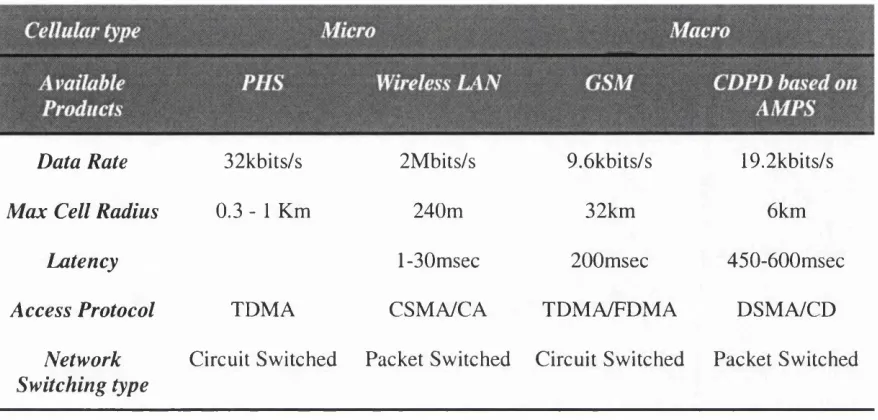
Table 2.1 Comparison of PHS, wireless LAN, GSM, and CDPD
■
Data Rate 32kbits/s 2M bits/s 9.6kbits/s 19.2kbits/s
M ax Cell Radius 0.3 - 1 Km 240m 32km 6km
Latency 1-30m sec 200m sec 450-600m sec
Access Protocol TD M A C SM A /C A T D M A /F D M A D SM A /C D
Network C ircuit Sw itched Packet Sw itched C ircuit Sw itched Packet Switched
Sw itching type
F or conveying packets of burst streams, a packet sw itched system adopts a random multiple
access protocol, such as C SM A /C A , D FW M A C (D istributed Foundation W ireless M edia Access
C ontrol) [95], PRM A [42] and D SM A /C D (Digital Sense M ultiple A ccess with C ollision Detect)
[47]. Those protocols exploit a contention algorithm to share a channel am ong m obile hosts. A
m acro-cellular data network has sim ple base stations that do little processing. M ost functions,
including a handover decision, are executed in the central service centre (M TSO in the case of
AM PS and M SC in the case of GSM ). In contrast, the base stations in a m icro/pico-cellular
netw ork have the ability to control all kinds o f functions by them selves in a distributed fashion
w ithout any help of a central service centre. It is natural for a base station to have such heavy
control functions to m anage the high volum e o f handovers efficiently.
2.2 QoS provision in an integrated services packet network
One o f the im portant issues in an ISPN 2(Integrated Services Packet N etw ork) is to provide a
variety o f traffic classes with the wide range QoS that they require. The traditional data service
architecture underlying com puter networks has no facilities for pre-scheduling resources or
denying service on overload. Thus, it is unable to guarantee QoS. R ecently, research into
2 Clark [ F I 3] defin ed an integrated services packet netw ork (IS P N ) as a packet netw ork that can support
providing guaranteed QoS has actively been done. Three approaches are suggested. One is to develop a new network architecture [37] which guarantees QoS, and applications simply request their requirements. Another approach is to make applications [14], [12] adapt to current network conditions to maximise the quality of the data delivered to the destinations. The other approach is the predicted service [23] that combines above two approaches, in which the network can roughly commit QoS through estimation of what kind of service it can deliver based on recent measurement on the traffic load and an application can also adapt to violations of the QoS commitment. Each approach has its advantages and disadvantages. In this section, we will present several important elements in those approaches, especially laying stress on the first approach since, as indicated in Chapter 1, this research focuses on the service architecture to provide guaranteed QoS for integrated traffic.
2.2.1 Two procedures for the first approach
QoS provision by the first approach is achieved via two procedures. The first procedure is performed by a signaling protocol such as RSVP (ReSerVation Protocol) [102] or STII+[28], which enables an application to negotiate with each router along the possible data path so as to set up a connection with its required QoS. Although the signaling protocol passes around the QoS message to the routers along the path above a network layer, it does not practically distribute resources to the flows at lower layers. Therefore, we need a second procedure, which performs the resource distribution according to the QoS messages forwarded from the signaling protocol. It usually consists of admission control, resource allocation and packet scheduling. The resource distribution can be divided into two categories - statistical guarantee [100] and deterministic guarantee [26], [27]. The statistical guarantee achieves higher network utilisation than the latter, but it promises less reliable QoS due to probabilistic nature, whereas the latter can provide a deterministic guaranteed QoS by considering worst-case behavior. Packet scheduling and admission control play important roles in achieving the deterministic guaranteed QoS and statistical guaranteed QoS respectively.
2.2.2 Resource reservation protocol - RSVP
routing protocols. A host uses the RSVP protocol to request a specific QoS to the network for a particular application’s data stream. Routers use it to deliver QoS requests to all nodes along the path of the flow and to establish and maintain state to provide the requested service. For accommodating heterogeneous receiver requirements efficiently, receivers are responsible for requesting a specific QoS [102]: i.e. RSVP is receiver-oriented. The receiver of a data flow initiates and maintains the resource reservation for the incoming flow to the receiver. Therefore, both ends of a connection request the QoS for its incoming flow separately.
A receiver host application passes a QoS request to the local RSVP process. The RSVP protocol then carries the request to all the nodes along the reverse data path(s) to the data source, consulting the local routing database(s) to obtain routes. During the reservation setup, a RSVP QoS request is passed to two local decision modules: "admission control" and "policy control". Admission control determines whether the node has sufficient available resources to supply the requested QoS. Policy control determines whether the user has an administrative permission to make the reservation. If both the checks succeed, parameters are set in the packet classifier and in the link layer interface (e.g., in the packet scheduler) to produce the desired QoS. RSVP establishes "soft" state: i.e. RSVP sends periodic refresh messages to maintain the state along the reserved path(s). In the absence of refresh messages, the state automatically times out and is deleted. It provides graceful support for dynamic membership changes and automatic adaptation to routing changes.
2.2.3 Resource distribution and Packet scheduling scheme
While a reservation protocol is a signaling protocol to set up a resource reservation for a data connection in above IP layer, a packet scheduling discipline is a practical device to distribute bandwidth to the flows based on their requested QoS in below network layer. Current packet switched networks (such as the Internet) use FCFS (First Come First Served) queuing as a scheduling discipline. It is very simple and works well where the bandwidth is large enough to support all flows without congestion. However, a sophisticated scheduling scheme is needed to provide deterministic guaranteed services at the switch level where congestion frequently occurs. Thus a packet scheduling discipline at a switch node is one of the most important issues in supporting deterministic guaranteed QoS in an ISPN, and many packet-scheduling disciplines [71], [30], [43], [39], [9], [85], [101], [55] have been developed.
connection independently of all other traffic. A packet scheduling discipline can control the service order of each connection to achieve the QoS committed to the connections. It also prevents mis-behaving or malicious flows from using more than their reservation so that well- behaving flows can receive the committed QoS.
2.2.4 Adaptive applications
For a non-adaptive application which cannot tolerate any delay bound and/or committed bandwidth violation, QoS provision by a network service commitment is necessary. However, an adaptive application which can tolerate or adapt to packet delay and bandwidth reduction can keep yielding a certain quality against such service degradation. The adaptive applications are needed not only in the network without QoS provision but also in a measurement based QoS provided network. Normally, non-real time applications can adapt to the network congestion, while real-time applications cannot. Contrary to the popular view regarding real time applications, some are more flexible and can adapt to network conditions to maintain a certain quality. There are two kinds of real time applications: playback application and inter-active application.
2.2.4.1 Playback application
A playback application plays received data from a remote source. The application adapts to network jitter by buffering the incoming data, and can often tolerate the loss of a certain fraction of packets with only a minimal distortion of the signal. In such applications, only the packets arriving before their associated playback points can be used to reconstruct the source signal, so one of crucial factors is the individual packet delay to decide the playback point such that all packets can arrive before their associated playback points. As long as the network passes the delay information to the playback application, it can adapt to the network jitter. Clark [23] defines an adaptive application as an application that can measure the network delay experienced by arriving packets and then adaptively move the playback point to the minimal delay that still produces a sufficiently low loss rate. Thus, it will suffer less performance degradation caused by delay. He also suggests a predicted service architecture, which measures the network delay bound and informs it to the application to adapt to the current condition.
2.2.4.2 Inter-active application
audio/video coding and decoding processes based on the characteristics of the channel to
m axim ise the quality o f the audio and video delivered to the destinations. B olot [14] developed a
set o f m echanism s that attem pts to elim inate or at least m inim ise the im pact o f packet loss and
delay jitter. In the scheme, the coding rate at which packets are sent over a connection is
controlled to m atch the current transm itting capacity o f the connection, which m inim ises packet
loss eventually. It also adds redundancy inform ation for error control into the audio packets to
m inim ise the im pact o f packet error.
Table 2.2 Encoding schemes of D AAT
PCM 64 1
ADM6 48 13
ADM 4 32 11
ADM2 16 9
GSM 13 1200
LPC 4.8 110
Bhatti [12] m odels a DAAT (D ynam ically A daptable A udio Tool) for the audio tool, rat
(Robust Audio-Tool) [45] developed at UCL. The D AAT is capable o f handling six voice-
encoding schem es that have various rates as shown in Table 2.2, considering pow er consum ption
cost. He also proposes a netw ork model called Q oSSpace to support the adaptive applications.
The Q oSSpace issues reports that contain a SCV (State C onfidence V alue) for each flow o f an
application. The application then com bines the SCVs with other application specific inform ation
to make adaptation decision using the A A F (A pplication A daptation Function). The AAF
incorporates user preferences and application requirem ents into an autom atically controlled
adaptation policy for controlling the operation of the D AAT application. It allow s an application
to m ake adaptation decisions in response to fluctuations in QoS seen by a flow.
2.3 QoS provision in a cellular packet switched network
C om pared to a fixed network, a cellular packet sw itched netw ork has additional features
such as handover and slow wireless link. Since those features affect the service perform ance, they
reservation protocol for supporting QoS guaranteed integrated services. In this section, we will discuss some important issues relating those features in terms of QoS provision.
2.3.1 Bottlenecks and scheduling discipline
Bandwidth discrepancy between wireless and wired link causes a bottleneck at a BS (Base Station), which degrades the performance of transport protocols. A reliable transport protocol, such as TCP may properly deal with the bottleneck situation by means of activating the slow start and congestion avoidance algorithm that diminish the data transport rate at the source to reduce data influx into a BS. Recently Manzoni [63] and Caceres [18] reported that packet loss caused by wireless transmission errors and communication pause during handovers may falsely trigger the congestion control procedure of TCP, which results in significant reductions in throughput and unacceptable interactive delays. While proposing a solution to settle the false trigger problem in an under-loaded network, they did not show the mixed case where real and false congestion exists together. It is still questionable how well TCP congestion control adapts to the mixed cases.
Meanwhile, connectionless transport protocols without congestion control like RTP or UDP are mainly exploited for transmitting delay intolerant streams such as voice and video packets. These packets must arrive at the destination within bounded time to be valid. Many packets of a UDP flow may be discarded at the BS buffer before passing through a wireless link due to insufficient wireless bandwidth, if the transmission rate of the flow is not calibrated for a low speed wireless link - it could occur in multicasting flows that include mixed destinations of a wired and wireless network. Even though the low speed link is considered, the variable bandwidth caused by dynamic topology of a cellular network - for instance, a handover to a new congested cell can produce unexpected congestion to the flow - prevents a flow from persistently transmitting packets with low loss rate.
Accordingly, in order to control congestion and allocate bandwidth properly to various protocol flows, a solution for the bandwidth discrepancy between the wireless and wired network must be made. Moreover, in the context of a cellular network, there is another big issue, namely mobility, that complicates the problem further. A packet scheduling discipline for a BS can support fair sharing of a wireless link to provide a guaranteed QoS for a flow.
2.3.2 Uplink traffic service and multiple access protocol
cellular packet switched network allocates channels dynamically according to connection’s demands. There is much literature regarding resource assignment methods [89], [57], [67] for a cellular circuit switched network which basically exploits an assigned channel access scheme to commit a secure connection to a mobile entity. In the context of the assigned channel scheme, the main performance measures are new call blocking probability and a dropping probability upon handover as it provides a secure connection in a cell once admitted.
In a cellular packet switched network, the bandwidth distribution for a downlink is rather simple, as mobile hosts can listen to the broadcast channel simultaneously. The broadcast channel simply conveys base-to-mobile data via TDM (Time Division Multiplexed) mode using various scheduling schemes. However, packets for an uplink are placed in distributed mobile hosts not in a single queue, so the uplink bandwidth distribution is not as simple as that due to the channel contention among mobile hosts. Thus, in a cellular packet switched network, a multiple access protocol is the essential technology to provide uplink flows with their QoS requirements. Many multiple access protocols [42], [69], [64], [97], [13], [54], [4], [83], [68] have been studied to support integrated services in cellular packet switched networks. We will describe the protocols in detail in the Chapter 3.
2.3.3 Mobility related issues
The fixed data network solutions for addressing, routing and flow-control are not applicable in a cellular data network due to user mobility. In particular, handover events occur at a much higher rate in a micro/pico cellular network owing to the smaller coverage area compared to a macro-cellular network. Many research challenges have been raised regarding it. In this section, we introduce mobility issues to be solved related to QoS.
2.3.3.1 Efficient handover protocol fo r seamless delivery
2.3.3.2 Reservation protocol supporting mobility
In a cellular data network, the path of a connection changes frequently due to the handovers, so a reservation protocol should manage the mobility. In the point of view, RSVP designed for a fixed network is inadequate to accommodate the mobile hosts, which frequently change their attachment points to the fixed network. MRSVP [87] is an extension of RSVP to accommodate host mobility in a mobile network, introducing several new features. A noticeable new feature is the concept of active and passive reservations. While an active reservation is the real reservation that is being used by a mobile host at the present, a passive reservation is a virtual reservation allocated in the surrounding cells. MRSVP provides two reservation services: mobility independent service and mobility dependent service. The mobility independent service guarantees a reservation path regardless of handovers, allocating active and passive reservation to a mobile host. When a mobile host moves to one of the surrounding cell, the passive reservation converts into active reservation. In contrast, the mobile dependent service allows a mobile host to have only an active reservation. In this case, the mobile host should obtain a new active reservation whenever it moves to another cell. The information of active and passive reservations is carried by the RSVP messages, but they are opaque to RSVP.
MRSVP uses proxy agents to make reservations along the paths. To obtain the IP address of the proxy agent, a mobile host uses a proxy discovery protocol [87]. There are two types of proxy agents: remote and local. The remote proxy agents make passive reservations on behalf of the mobile host, while the local proxy agent of a mobile host acts as a normal router for the mobile host and sets up an active reservation. MRSVP has four new messages to handle mobility. These messages are handled only by the proxy agents while other fixed nodes of a path need not to be aware of these messages. The messages are tunneled using RSVP encapsulation [87].
2.3.3.3 Addressing
this area, the routing optimisation problem still remains. Some research [22], [50] resolves the problem by tunneling between the source and the destination using encapsulation. However this method does not fit standard networking models and requires large storage for caching the redirection list. Meanwhile, Mobile IP [74] has been suggested as a standard for the mobile IP network by the IETF and many companies are backing it.
2.3.3.4 Improving End-to-End performance
The reliable transport protocols such as TCP have been tuned for networks composed of wired links and stationary hosts. They interpret unexpected increases in delay as packet losses caused by congestion. In the response to perceived packet loss, TCP aggressively slows transmissions to allow the network to recover. This congestion control policy has been proven beneficial in improving the overall performance of networks like the Internet. In a wireless network, however, frequent handovers or transmission errors in a wireless link disconnect the communication link for a moment. It may falsely trigger congestion control mechanism of TCP, which result in degraded end-to-end performance. Recently, several reliable transport-layer protocols for wireless networks have been proposed [98], [18], [7], [5]. The Indirect-TCP protocol [5] splits a TCP connection into two separate connections: a wireless and a wired part. The advantage is to achieve the separation of the flow control and congestion control of a wireless link from those of a fixed network. While it results in the sender keeping sending data at good bandwidth, there are some drawbacks such as semantics, application relinking and software over-head. The fast-retransmit approach [18] addresses the issue of TCP performance when communication resumes after a handover. This approach reduces unacceptably long pauses during a handover using end-to-end fast retransmission, but it addresses only handover problems of TCP connections without considering the error characteristics of the wireless link. As another approach, the caching method [7] is proposed. The bottom line of the idea is to cache packets toward a mobile host at the base station and to perform local retransmissions across the wireless link. This protocol needs the network-layered software at the base station to be modified. The performance is improved up to 20 times over normal TCP/IP for data transfer, but it requires large caching storage.
2.3.3.5 Call control issues