The Effect of Talocrural Joint Manipulation
on Range of Motion at the Ankle
Gary A. Fryer B.App.Sc.(Osteo)
Jacob M. Mudge B.Sc., M.H.Sc.(Osteo)
Patrick A. McLaughlin B.App.Sc., M.App.Sc.
School of Health Sciences, City Campus, Victoria University, Melbourne,
Australia
Journal of Manipulative and Physiological Therapeutics.
2002;25(384-90)
Address correspondence to Gary Fryer, Osteopathic Medicine, School of Health
Sciences, Victoria University, PO Box 14428 MCMC, Melbourne Australia, 8001
ABSTRACT
Objective: To determine whether a single high velocity, low amplitude thrust manipulation to the talocrural joint altered ankle range of motion.
Design: A randomized, controlled and blinded study.
Subjects: Asymptomatic male and female volunteers (N=41).
Methods: Subjects were randomly assigned into either an experimental group (N=20) or a control group (N=21). Both ankles of subjects in the experimental group were
manipulated using a single high velocity, low amplitude thrust to the talocrural joint. Pre and post measurements of passive dorsiflexion range of motion were collected.
Results: No significant changes in dorsiflexion range of motion were detected between manipulated ankles and controls. A significantly greater pre-test dorsiflexion range of motion existed in those ankles where manipulation produced an audible cavitation.
Conclusion: Manipulation of the ankle does not increase dorsiflexion range of motion in asymptomatic subjects. Ankles that displayed a greater pre-test range of dorsiflexion were more likely to cavitate, raising the possibility that ligament laxity may be associated with the tendency for ankles to cavitate.
INTRODUCTION
Manipulation (high velocity, low amplitude thrust technique) is a manual technique used extensively in the chiropractic and osteopathic professions, and is gaining popularity with physiotherapists, medical practitioners and podiatrists. This increase in popularity has produced a greater need to determine the physiological and therapeutic effects of joint manipulation.
While many studies have attempted to document the effects of spinal manipulation on range of motion (ROM),1,2 pain,2,3 and sympathetic nervous system activity,4 there is very little literature documenting the effects on peripheral joints.5,6
"Manipulation", in this article, refers to a high velocity, low amplitude thrust (HVLA) directed at a synovial joint. An audible "pop" is often associated with the manipulation and is thought to be a result of joint separation and cavitation, the formation of a gas bubble within the joint and possibly the "snapping back" of joint capsule and ligaments.7 Many manual therapy texts cite an increase in joint ROM as the principle aim of
manipulation.8,9
Most studies that have examined the effects of manipulation on ROM have been
conducted on spinal joints. While many studies claiming an increase in ROM following spinal manipulation have lacked blinding and a controlled design,10,11 some trials have been randomized and controlled and have demonstrated a temporary increase in spinal ROM.1,2
Manual therapy texts advocating peripheral manipulation assume that peripheral joints, like spinal articulations, respond to manipulation with an increased ROM.8,12 However, very few studies have attempted to substantiate this proposition. Nield et al13 were the first to publish a study on ankle manipulation and dorsiflexion range of motion (DFR). Their controlled study with asymptomatic subjects (N=21) used a single HVLA
manipulation with a torque-controlled method to conduct pre and post-testing of DFR. Photographic stills were used to record data and the opposite foot was used as the control. Nield et al concluded that there was no statistically significant alteration in DFR
following a single manipulation. The incidence of joint cavitation as a result of manipulation was not reported.
Recently, Dananberg et al14 studied the effects of two HVLA techniques on the ankles of patients (N=22) selected on the basis of limited DFR on initial physical examination. This study found a substantial increase in DFR. However, weaknesses in the
methodology for the measurement of DFR, as discussed later, limit the strength of this study.
This present study used a reliable and objective method to examine DFR changes
following manipulation. It differed from the study by Nield et al13 as it aimed to examine whether an ankle with restricted DFR (relative to the other ankle) would respond with greater ROM change, as well as to assess the importance of audible cavitation and palpable gapping on changes to ROM.
METHODOLOGY
Participants
sprains were excluded from participation. All subjects completed consent forms for participation and also a medical history questionnaire that was aimed at identifying possible contraindications to manipulation.15
Study Design
Volunteers (N=41)
PRE-TEST Tester 1
Tester 2
Tester 3 HVLA (N=20) Control
Tester 2
POST-TEST Tester 1
Figure 1. Experimental design.
Procedure
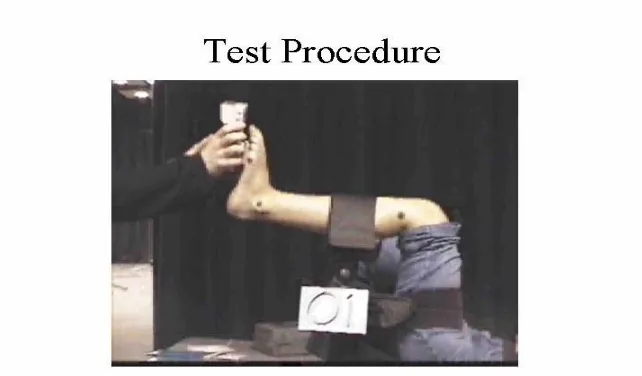
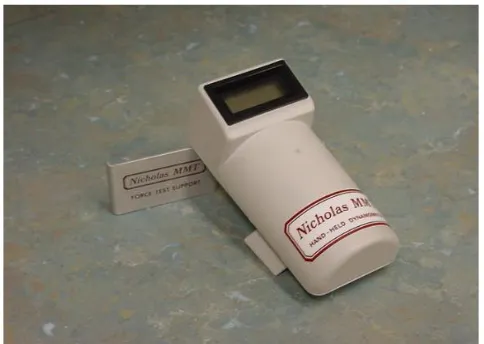
completed by Tester 1 applying DFR three consecutive times prior to measurement. A Nicholas® hand-held dynamometer (Fig 3), which accurately measures torque and has been shown to have high inter-rater and repeated measures reliability,16-18 was used to maintain equal passive torque for the pre and post measurements of DFR (Fig 2).
Tester 1 engaged passive DFR and noted the exact torque engaged to achieve this pretest value. This torque was reproduced for the post-test measurement. Images were
simultaneously recorded on a tripod mounted Canon Digital Video Camera located perpendicular to the subject approximately 5m to the side of the Biodex testing table.
Figure 2. DFR measuring procedure.
they were instructed to simply lie on a treatment table for an equivalent period of time. Tester 2 guided all subjects back to the original testing room. Post-testing of DFR was then immediately carried out by Tester 1 in the equivalent manner to that of pre-testing using the same amount of torque as the pre-test measurement. Tester 1 was blinded to subject’s allocation as either an EG or CG participant throughout testing.
Figure 3. Nicholas dynamometer
Digital video camera footage of pre and post-tests was then analysed with Swinger® motion analysis software (Version 1.26). The software was used to calculate the internal angle formed by the three bony landmarks. A simple 3 point digitisation model was incorporated (Fig 2).
measurement or visual estimation. A pilot reliability study was conducted to investigate the test-retest capacity and reliability of the video DFR measurement system used in this design. Twenty repeated measures of DFR were assessed by twenty separate testers, and the reliability of the system was found to be high (r2=0.95; range across testers was 86.4 – 91.8 degrees).
Manipulative Intervention
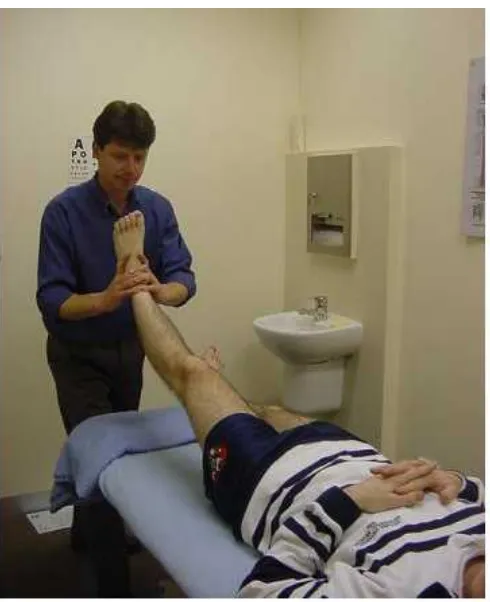
An experienced, registered osteopath applied a single, short lever, high velocity, low-amplitude distractive (caudal) thrust directed at the talocrural joint. The procedure was performed with the patient in the supine position. The practitioner interlaced both hands over the tibia and talus with thumbs over the posterior aspect of the calcaneus. Tension was taken up in a caudal direction until focused at the talocrural joint. A short, high velocity, low-amplitude distractive thrust was applied with slight accentuation of the dorsiflexion vector (FIG 4). The procedure for this technique was consistent with that described by Hartman.15
The talocrural joint was manipulated only once. On the basis of Tester 3 hearing an obvious loud cracking noise, or a subjective “give” or “gap” at the ankle without an audible crack, or neither of these, the outcome was recorded as either:
(3) no palpable joint gap and no audible joint pop (NG&NP).
Figure 4. Talocrural HVLA manipulation
RESULTS
Data Analysis
Group N Mean DF
angle
Mean DF
angle
Change
Pre-test Post-test
Gap & pop 13 90.4 (8.1) 92.2 (7) 1.8 (3.4)
Gap & no pop 15 94.8 (7.4) 95.5 (8) 0.7 (4)
No gap & no
pop
12 97.8 (5.2) 99.7 (7.1) 1.5 (4.7)
Control 41 94 (6.6) 95.7 (6.2) 1.7 (2.3)
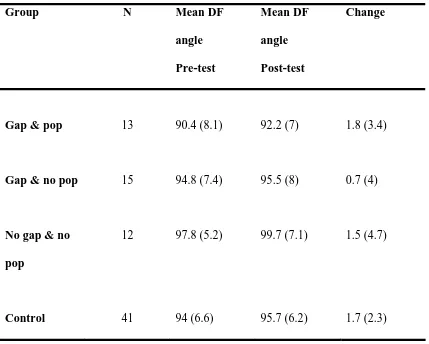
Table 1: Group mean dorsiflexion angle data in degrees pre and post manipulation
(±SD); change in DFR achieved
Similar mean scores were recorded pre and post test. The DF angle was calculated from the three marked landmarks (Fig 2); a smaller angle indicates a greater DFR. Small DFR changes were achieved by all groups. This indicates a decrease in DFR post
manipulation.
-2.171, p = 0.036). This indicates that a small (1.4°) but significant change in DFR was produced by the manipulation (regardless of outcome). However, a significant change
(1.7°) also occurred in the control group (t = -4.748, p = .000). All results indicate a
decrease in DFR post testing.
Two independent samples t-tests were used to compare the difference in DFR between the experimental group (as a whole) and the control group pre and post. These tests revealed a non-significant result (t = -0.154, p = 0.878; t = 0.027, p = 0.979). No significant differences were found between the control and experimental group or between any of the experimental sub-groups and the control.
The DFR change expressed by the EG was then analysed according to the outcome of the manipulative intervention. This was done to determine whether one particular outcome produced a more significant increase in ROM in the EG. Such outcome variables are within-sample characteristics and therefore a one way ANOVA was used to compare P+G, P+NG and NP+NG outcomes.
DISCUSSION
This study found that HVLA talocrural manipulation to an asymptomatic ankle does not produce an increase in dorsiflexion range of motion (DFR). No additional change in DFR resulted when a pre-existing discrepancy of DFR (limitation relative to the other ankle) was manipulated. The results of this study are consistent with the previous study by Nield et al.13
A small significant decrease in DFR was observed in both manipulated ankles (mean = 1.40) and control ankles (mean = 1.70). This unexpected result may be due to our experimental methodology. During pre-testing, ankles were ‘pre-conditioned’ as recommended by Nield et al13 by applying dorsiflexion three consecutive times before measurement. However, no pre-conditioning of the ankle was performed during post-test measurement as it was believed this would not be necessary. It is possible that this pre-conditioning produced a small short-term visco-elastic change in either the triceps surae musculature or ankle ligaments that allowed for slightly greater ROM in the pre-test measurement.
established, these subjects may have a greater likelihood of presenting with ankles with a functional disturbance and so respond better to manipulation.
Secondly, this present study used a single talocrural HVLA whereas Danaberg et al used several techniques. They performed a HVLA on the proximal fibula, followed by traction of the talocrural joint for 30 - 45 seconds, and then a HVLA to the talocrural joint. It is possible that this treatment regime, with the sustained traction possibly producing viscoelastic changes in the ankle ligaments and triceps surae musculature, is more effective than a single manipulation in producing increased DFR.
Lastly, the measuring procedures differed. Our study used a torque-controlled method with digital video images analyzed with motion analysis computer software. Previous studies have demonstrated that torque-controlled DFR measuring systems are reliable19 and our own pilot study demonstrated high test-retest reliability (r2=0.95). Data on "normal" values for DFR is conflicting.20-22 Recent literature suggests that disagreement is a result of a wide variety of measuring protocols and therefore emphasis should not be placed on expected normal values but rather reliable measurement of DFR throughout a trial23. The examiner was blinded as to whether the subjects had received manipulation or were controls.
DFR and neither examiner nor "actively assisting" subjects were blinded to the treatment intervention. Controls were not used. It is possible that enthusiastic post-test stretching or changes in pain tolerance to stretch, as has been documented with hamstring stretching,24 may account for ROM changes. These findings must be viewed with caution until reproduced with a more accurate and objective measuring procedure.
Spinal and peripheral joints
It is interesting to speculate why spinal joints appear to respond to manipulation with an increase in ROM but the talocrural joint does not. Differences in structure between the cervical and ankle joints may be the reason for their differing behavior. Limitation of cervical rotation relies primarily on the integrity of the capsule and ligaments. A change in the internal pressure of the joint (the normal negative pressure keeps the capsule slightly invaginated), such as a volume increase due to gas bubble formation following cavitation, may alter these structures' ability to limit spinal ROM.7 Alternatively, a change in the viscoelastic properties of the capsule and ligaments following stretching may also afford a greater ROM.
In the ankle, DFR is limited by the stiffness of the triceps surae muscle-tendon unit with the end-range largely determined by bony architecture and ligaments resisting the spread of the ankle mortice. The manipulated ankle may therefore not readily express an
It was hoped that when one ankle displayed reduced DFR relative to the other ankle this might represent functional disturbance and so respond to manipulation with a greater increase in DFR. This was not the case. It suggests that such a discrepancy in an asymptomatic individual is ‘normal’ and should not be assumed by therapists to be necessarily ‘dysfunctional’. This is consistent with other studies that have indicated asymmetries of joint geometry and ROM in other regions, such as the atlas-axis articulation27 and sacroiliac joint28,29, are commonly found in normal populations.
Cavitation is associated with increased pre-test DFR
Approximately one third of the manipulated ankles produced an audible cavitation. Interestingly, the mean pre-test DFR for the ankles that "gapped and popped" was significantly greater (P=0.044) than those where only a palpable gap was felt or "no gap or pop".
Limitations and Recommendations
The changes in DFR found in this study were very small (mean EG difference: 1.3 degrees) and it is possible that our measuring procedures may not detect very small changes with great accuracy.
This study did not attempt to examine the effect of ankle manipulation on variables other than ROM such as pain. Several studies suggest spinal manipulation may act on pain mechanisms2,3 and it is feasible that peripheral manipulation may also have hypoalgesic effects. This study attempted to accurately measure total DFR to end range. It may be possible that manipulation of the ankle does not effect total ROM but instead the quality
of motion, such as reduced resistance to dorsiflexion within the range or the "end feel" at the end of range.
As restriction of DFR (relative to the other ankle, when present, in asymptomatic
subjects) did not respond to ankle manipulation with increased ROM, it would be prudent for future trials to examine subjects with symptomatic or previously injured ankles. Researchers should also attempt to reproduce the findings of Dananberg et al14 using control subjects and a more accurate and objective DFR measuring procedure.
CONCLUSION
This study found that a single HVLA manipulative intervention to the talocrural joint did not significantly alter dorsiflexion range of motion compared to non-manipulated ankles. It was found that those ankles that produced an audible cavitation had a significantly greater pre-test dorsiflexion range. This study also suggests that talocrural joints and spinal joints may respond differently to manipulative intervention.
A greater interest in peripheral and foot manipulative techniques by therapists from a range of disciplines suggests that the use of manual peripheral techniques is increasing, creating a need to substantiate the physiological and therapeutic basis of peripheral joint manipulative therapy.
Acknowledgments
The authors would like to thank Patrick Mudge for his assistance with collection of data.
References
1. Surkitt D, Gibbons P, McLaughlin P. High Velocity, Low Amplitude Manipulation of the Atlanto-Axial Joint: Effect on Atlanto-Axial and Cervical Spine Rotation
2. Cassidy JD, Lopes AA, Yong-Hing K. The immediate effect of manipulation versus mobilisation on pain and range of motion in the cervical spine: a randomised,
controlled trial. Journal of Manipulative and Physiological Therapeutics 1992;15:570-5
3. Vernon H. Qualitative review of studies of manipulation-induced hypoalgesia. Journal of Manipulative and Physiological Therapeutics 2000;23:134-8
4. Gibbons PF, Gosling CM, Holmes M. Short-term effects of cervical manipulation on edge light pupil cycle time: a pilot study. Journal of Manipulative and Physiological Therapeutics 2000;23:465-69
5. Di Fabio RP. Passion and manipulation (editorial). Journal of Orthopaedic & Sports Physical Therapy 2000;30:442-3
6. Menz HB. Manipulative Therapy of The Foot and Ankle: Science of mesmerism? The Foot 1998;8: 68-74.
7. Brodeur R. The audible release associated with joint manipulation. Journal of Manipulative and Physiological Therapeutics 1995;18:155-164
8. Greenman PE. Principles of Manual Medicine, 2nd Edition. William & Wilkins; 1997 9. Corrigan B, Maitland GD. Vertebral Musculoskeletal Disorders.
Butterworth-Heinemann, UK; 1998
10.Cassidy JD, Quon JA, Lafrance LJ, Yong-Hing K. The Effect of Manipulation on Pain and Range of Motion in the Cervical Spine: A Pilot Study. Journal of
Manipulative and Physiological Therapeutics 1992;15:495-500
Pressure, Heart Rate and Plasma Catecholamine Levels. Journal of Physiological and Manipulative Therapeutics 1991;14:450-456.
12.Corrigan B, Maitland GD. Practical Orthopaedic Medicine. Butterworths;1983 13.Nield S, Davis K, Latimer J, Maher C, Adams R. The Effects of Manipulation on
Range of Motion at the Ankle Joint. Scandinavian Journal of Rehabilitative Medicine 1993;25:161-166.
14.Dananberg HJ, Shearstone J, Guilliano M. Manipulation for the treatment of ankle equinus. Journal of the American Podiatric Medical Association 2000;90:385-389 15.Hartman L. Handbook of Osteopathic Technique, 3rd ed. Chapman and Hall; 1995 16.Horvat M. Croce R. Roswal G. Intratester Reliability of the Nicholas Manual Muscle
Tester on Individuals With intellectual Disabilities by a Tester Having Minimal Experience. Arch Phys Med Rehabil. 1994;75(7):808-11.
17.Surburg PR, Suomi R, Poppy WK. Validity and Reliability of a Hand-held
Dynamometer Applied to Adults With Mental Retardation. Arch Phys Med Rehabil. 1992 73(6):535-9.
18.Marino M, Nicholas JA, Gleim GW, Rosenthal P, Nicholas SJ. The Efficacy of Manual Assessment of Muscle Strength Using a New Device. Am J Sports Med.1992;10(6):360-4.
19.Moseley A, Adams R. Measurement of Passive Ankle Dorsiflexion: Procedure and Reliability. Australian Physiotherapy.1991;37(3):175-181.
20.Donatelli R. The Biomechanics of the Foot and Ankle. F.A. Davis Co. USA; 1992
21.Norkin CC, Levangie PK. Joint Structure & Function −A Comprehensive Analysis,
22.Magee DJ. Orthopaedic Physical Assessment, 3rd Ed. USA: W.B. Saunders; 1997 23.Baggett BD, Young G. Ankle Joint dorsiflexion: Establishment of a Normal Range.
Journal of The American Podiatric Medicine Association. 1993;83(9):542-4. 24.Magnusson SP, Simonsen EB, Aagaard P, Sorensen H, Kjaer M. A mechanism for
altered flexibility in human skeletal muscle. J Physiol (Lond) 1996;497(Pt 1):291-8 25.Mitchell FL Jr. The muscle energy manual, Vol 1. MET Press; 1995
26.Condon SM, Hutton RS. Soleus muscle electromyographic activity and ankle
dorsiflexion range of movement during four stretching procedures. Physical Therapy. 1987;67(1):24-30
27.Ross JK, Bereznick DE, McGill SM. Atlas-axis asymmetry. Spine 1999;24:1203-9 28.Jacob HAC, Kissling RO. The mobility of the sacroiliac joints in healthy volunteers
between 20 and 50 years of age. Clinical Biomechanics. 1995;10:352-361 29.Harrison DE, Harrison DD, Troyanovich SJ. The Sacroiliac Joint: a Review of