REVIEW ON WDM AND TDM PON USING
DIFFERENT CODING SCHEMES FOR EXTENDED
REACH
Pallavi Katna
1, Anu Sheetal
2 1,2Guru Nanak Dev University, Regional Campus, Gurdaspur (Punjab)
ABSTRACT
Telecommunication’s technology is exponentially increasing day by day with high speed of reliable data
transmission. Optical network play an important role in meeting these demands. The performance of time division multiplexing (TDM) and wavelength division multiplexing (WDM) passive optical networks (PON) using different coding schemes are estimated. For these schemes 16 users are used in the receiver section. So in order to analyze the system performance based on various parameters i.e. BER and Eye pattern. The main purpose is to design a hybrid WDM/TDM PON using reach extender. In this paper, a brief description about the recent challenges and current technology existing in WDM and TDM PON has been reviewed.
Keywords: Passive optical networks (PON), Optical networks unit (ONU), Wavelength division
multiplexing (WDM), Time division multiplexing (TDM)
I. INTRODUCTION
Optical fiber has been playing a vital role in communication system. This has led to various applications such as
Fiber to the Desk (FTTD), Fiber to the Building (FTTB), and Fiber to the Premises (FTTP) and even Fiber to
the Home (FTTH) system largely, because the technology exists, but the cost effectiveness still holds them in
abeyance [1-3]. PON are considered to be a method for implementation of FTTH. FTTH provide many services
such as peer to peer transmission, video file swapping, internet protocol, video on demand. The PON candidates
are Ethernet, WDM and ATM. To fulfill all these demands passive optical networks are required using increase
reach, high bandwidth, greater density, security etc. There are different multiplexing schemes such as TDM,
WDM and hybrid TDM/WDM [4-5]. The PON delivers the services by means of different multiplexing
techniques. Coding techniques are described in section II. Section III describes about the current PON and
recent challenges existing in TDM/WDM PON. This is followed by section IV which describes the simulation
setup and literature survey and finally section conclusion.
II. CODING TECHNIQUES
1 Non return to zero:
Line coding defines the symbols which are arranged in a particular pattern fortransmission that represent binary data. NRZ encoding is commonly used in both synchronous and
Basically two types of coding is possible. In unipolar NRZ coding „1‟ is represented by positive voltage (+ve) and „0‟ is represented by DC line. In bipolar NRZ coding „1‟ is represented by one physical layer while „0‟ is
represented by another level.
2 Return to zero:
In this case „1‟ is represented by first half of the bit duration. Absence of a pulserepresented a binary „0‟, during the entire bit duration and second half of the level returns to zero. Bandwidth
requires for the RZ coding is twice, because for transmission of data it takes only half bit duration and other half
returns to zero.
3 Manchester coding:
Manchester coding is also known as phase encoding. In this encoding, each bit hasone transition either low then high, or high then low of equal time. Manchester code is widely used for various
practical applications, because it consumes less bandwidth to achieve the original transmitted data rate.
Fig.1 Various coding techniques
III. OPTICAL ACCESS NETWORKS
PON were developed during the year 1980‟s. It is a cheapest way to implement. PON architecture use only
passive components since it is a point to multipoint transport network which reduces the cost and maintenance.
PON has several advantages; no need for installing multiplexer and de-multiplexer in the splitter, longer
distance between central office and customers, easy upgrades to higher bit rates. PON consists of a Optical line
termination (OLT), Optical network unit (ONU), Optical distribution network (ODN) etc. An OLT is a central
office node that is connected to a backbone networks. In case of ONUs or ONTs multiple users are present that
connects to the OLT by a single channel, and the fibers and splitters between them, called the ODN. There are
various architectures of PON using different modulation schemes like Hybrid TDM/WDM, TDM and WDM.
1 TDM PON:
Fig.2 shows the tree topology of TDM PON network [2]. At the Central Office the Optical LineTermination transmits the data in the downstream traffic. An optical fiber connects the OLT to the multiple
ONU users which is connected through an optical Combiner/ Splitter which combines or divides the signal from
OLT to ONU. The TDM PON is a single point to multipoint architecture. In the downstream direction the data
were transmit by the OLT to ONU. It is passed through a 1: N splitter and it is extracted by the ONU. In the
Fig. 2 TDM PON Model
2 WDM PON:
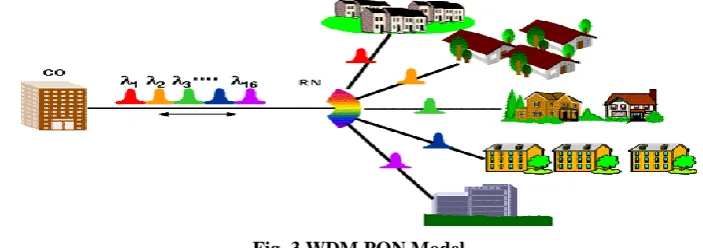
WDM PON uses multiple wavelengths in a single fiber to enhance the capacity withoutincreasing the data rate. Fig 3 represents WDM-PON architecture [3]. The OLT housed in Central Office has a
set of tunable or fixed wavelength laser sources which is used to transmit the downstream traffic to ONU. Each
user at the transmitter side has been assigned a frequency at which it operates. The frequency allotment can be
based on the requirement of bandwidth demanded or it can be permanent. The data is sent to a multiplexer that
combines all the data together and transfer it through the optical fiber of lengths varying from 20 km to 100km.
Fig. 3 WDM PON Model
IV. LITERATURE REVIEW
U. Ibrahim, Hassan Abbas et al. (2010) Compares performance gains achieved by using PIN and APD at the
ONU side in a 32 users WDM-PON. By Simulation performance gains of around 5Gbps in terms of data
carrying capacity and 15km in terms of system reach is attained if Avalanche Photo Diode is used at the ONU in
downstream direction.
J. H. Lee, et al.(2010) [1] Colorless Gb hybrid WDM/TDM PON using a protocol terminator is experimentally
demonstrated. It consists of a legacy TDM-PON, reflective semiconductor optical amplifier based on
WDM-PON, combined with a efficient and simple node structure in order to provide high-speed FTTH service to a
large area with a high population density. This system can support 512 subscribers with a single fiber. The
performance of the system was analyzed by transmitting Gb/s data including Rayleigh backscattering and 20 km
attenuation.
C.Michie et al. (2009) [2] EDFA have a limited use in PONs because the wavelengths typically include 1.3 μm.
SOA offer a cost-effective solution. Theoretical treatments analyze operational requirements and verify this
proposed into the receiver section as a result the filter widths are 20 nm or greater for the amplified spontaneous
emission powers which was present in amplified PONs.
H.Song et al. (2009) .Reviews the evolutionary path of optical access networks and shows the perspectives for
high bandwidth and low cost. This paper discuss the requisites for optical technique sources, and optical
amplifier when used in networks with large power attenuation, high transmission rate and the topological
structures that allow for physical protection (tree-and-branch). Then, demonstrations of Long-Reach OAN
developed worldwide by research institutes. Finally, DBA algorithms that allow to modify the effect of the
increased control-plane delay in an extended-reach network.
J.Zhang, N, Ansari (2009) Describes the capacity of WDM PON and Introduces the definition of achievable
rate region by analyzes the achievable rate region for a network architecture from the wavelength. Finally
comparison of various WDM PON architectures and design an access control scheme.
V. METHODOLOGY
The performance is analyzed using the simulation done in the OptiSystem.7 simulation tool of Opti-Wave
software. To compare the performance of various networks various factor are analyzed fiber length, different
data rates and BER performance, The PON support 16 users with the main objective to determine the BER and
Q factor .It is attain at different data rates and different fiber lengths. Then next step is to compare the BER with
the distinct SMF lengths. In case of TDM-PON simulation 16 transmitters, a CW laser with a particular
frequency of 193.1 Hz and a time delay circuit for each transmitter at the OLT side.
VI. CONCLUSION
TDM/WDM-PON architecture was designed using 16 users has been successfully evaluated in this
paper. Results simulated using Opti-system software has confirmed that WDM PON network
performance is superior architecture. This has been estimated for different coding for both TDM and
WDM PON. When compared with RZ and NRZ coding techniques simulation Manchester coding
shows better performance through Max Q factor, Min BER, and Eye Diagram. Data rates are
compared using 1Gbps, 2.5Gbps, 4Gpbs and 10Gbps in the long reach enhanced system. It is also
estimated that if power consumption is increased at the OLT, it can transmit high data rates with min
BER, and it also shows that if power consumption is lowered in the CO, it works for lower data rates
with optimum BER.
REFERENCES
[1] J. H. Lee, et al., “First Commercial Deployment of a Colorless Gigabit WDM/TDM Hybrid PON
System Using Remote Protocol Terminator,” J. Light wave Technol. 28, 344-351 (2010).
[2] C.Michie, J. McGeough, S.karagiannopopulos, and I. Andonovis, “optically amplified passive optical
[3] H.Song, B.W.Kim, and Mukherjee, ” Long- Reach Optical Access Networks: A survey of research
Challenges ,Demonstrations, and bandwidth, Assignment Mechanisms”, IEEE Communications Survey
and Tutorials, accepted, 2009.
[4] K.Tanaka, A Agatan, and Y. Horiuchi, IEEE 802.3av 10G-EPON standardization and its Research and
Development Status,” J.lightwave Tech. 28, 651-661(2010).
[5] U. Ibrahim, Hassan Abbas, Raja faizan, S. F. Shaukat “Performance Evaluation of Photo Receivers in
WDM Passive Optical Networks” IEEE JOURNAL 2010.
[6] A. Sierra and S. V. Kartalopoulos, “Evaluation of two prevalent EPON networks using simulation
methods,” in Proceedings of the Advanced International Conference on Telecommunications and
International Conference on Internet and Web Applications and Services.
[7] U. Ibrahim, S. Nazir, S F Shaukat, M. I. Shehzad, and M. Faisal, “Monte Carlo Analysis of Broadband
Passive Optical Networks”, unpublished Jingjing Zhang and Nirwan Ansari, New Jersey Institute of Technology Yuanqiu Luo, Frank Effenberger, and Fei Ye.