DESIGN OF FAULT TOLERANCE PROTOCOL FOR
MOBILE DISTRIBUTED SYSTEMS
Ajay Kumar
1, Tejinder Thind,
21
School of Computer Science and Engineering, Lovely Professional University
Phagwara (India)
2
Asst. proff. at School of Computer Science and Engineering, Lovely Professional University
Phagwara (India)
ABSTRACT
Distributed mobile systems are ubiquitous now-a-days. These systems are important building blocks and are
useful for constructing efficient protocols for client-server systems, transaction processing, web applications, and
scientific computing. Distributed mobile systems are not fault tolerant computing. The vast computing potential
of these systems is often hampered by their susceptibility to failures. Mobile computing highlights many issues,
such as lower throughput and latency, low bandwidth of wireless channels, lack of stable storage on mobile
hosts, connection breakdowns and inadequate battery life that make the classical checkpointing protocols
incongruous. Many techniques like group communication, transaction and rollback recovery have been
developed to add reliability to such systems.
Reliability can be roll backed using the methods of distributed mobile systems. Proposed methods are used to
make system fault tolerant and works error free. The proposed methods justifies the objectives of my research
work, which are Increase the reliability (Focuses on a regular service without any fault), Increases the
availability (focuses with willingness of the system), Security (Stops any unwanted access). So I conclude that the
objectives defined can be met with the proposed methods.
I. INTRODUCTION
1.1 Distributed system
Distributed system is a collection of n number of systems that are connected to each other over a network but for
user it looks to be only one system. All the systems interact with each other to give the required output. All the
1.2 Distributed Mobile System
Distributed mobile System is global now days. These systems are plays important roles in generating blocks and are used for developing effective protocol for client-server systems, online transactions, websites, and scientific computing.
1.3 Fault Tolerance
Fault tolerance helps the system to come back in a error free state whenever a failure is occurred in its components.
If the system stops functioning properly, then the fault has occurred in the system and if the fault is not removed
then the system may breakdown. The skill of continue functioning as soon as parts of a system stops performing is
referred like skilled indignity. A error tolerance plan helps a scheme to carry on its deliberate work, may be at a
lower level, apart from stops
completely. The terminology is generally used to define systems planned to carry on additional or fewer entirely working through, possibly, a subtraction in throughput otherwise an boost in reply occasion in the incident of various small failure. The complete scheme has not congested due to faults whichever in the hardware otherwise in the software. A system is capable of maintaining its virtue in the incidence of error owing to reasons such as exhaustion, rust, developed error or collision.
1.4 Checkpoints
Check-pointing is a method that assists to tolerate faults which would force long-running process to restart. The
most common way to apply check-pointing, is to copy all the data of an process from the memory to reliable
storage and then go on with the execution.Check-pointing utilization should retain system consistency. There are
two main approaches for check-pointing: coordinated check-pointing and uncoordinated check-pointing. In
coordinated check-pointing approach, processes must make sure that regular checkpoints are made. This is
generally applied by two-phase commit protocol algorithm. In uncoordinated check-pointing, each process has to
checkpoints itself environment individually. It must make sure that command processes to checkpoint their state
at regular time intervals is not enough to certify consistency. The requirement for achieving a continues state (i.e.,
no lost messages or replica messages) might cause other processes to roll back to last checkpoint.
II. PROPOSED WORK
In this paper we have focused on Increase the throughput: units of information a system can process in a given
amount of time, Reduce the Packet drop: one or additional package of information travelling crosswise a
computer set-up fall short of reaching their objective, Reduce end to end delay: time taken for a packet to be
transmitted across a network from source to destination.
2.1 Ad hoc On Demand Distance Vector Protocol (AODV)
2.2 Flower Pollination Algorithm (FPA)
Optimization is largely old to pick up the capability and direct and to decrease the charge. The tiny belongings similar to instance and changes are to be implementing accurately and efficiently in genuine world programme like built-up, design, setting up software evolution. So it is important to come up with explanation to model use of these imperative property under different constraint precisely, Optimization is the considerate of ideal development and functioning out the design effort using mathematical apparatus. benchmark optimization method set many log jam while conniving the mathematical and functioning study replica. Replica answers in benchmark optimization algorithms are chiefly pass on the kind of purpose and imperfect function. The efficacy of conventional algorithms relay on the bulk of the explanation, figure of variables and constraint used for deception the effort. Moreover the touchstone algorithms do not propose all-purpose explanation scheme which will be used for deception the trouble having various variables and limitation]
2.3 Four Rules of FPA
Biotic and irritable pollination be able to be measured development of universal pollination, and these can be delivered pollen travel in a way that substantiate to Levy running away
Limited pollination, a biotic pollination and nature pollination are used.
Pollinators, same as creature build up flower allegiance, which is analogous to the duplicate opportunity comparative of alike of two flowers concerned.
Control or contact of international pollination and limited pollination can be twisted by a key probability p [0, 1], to some extent unfair on the way to local pollination.
min or max objective f(x), x = (x1, x2 ,. . . , xd )
Initialize n flowers population with arbitrary key. Classify the top result (g*) in preliminary inhabitants.
State a control chance p [0, 1]
While ( Max Generation > t)for i = 1 : n (all n flowers in the residents) if p > rand, Draw a dimensional (d) step vector L from a Levy sharing universal pollination via
xit+1 = xit + L(g* - xit ) ....(i) else
Draw a homogeneous sharing in [0,1] make an local pollination using xi
t+1
= xi t
+ (xj t
- xk t
) ....(ii) end if
Estimate new results.
If fresh result is enhanced, make them up to date in population end for Discover existing top explanation conclusion as Output the best solution obtained.
III. COMPRESSION WITH EXISTING TECHNIQUE AND RESULTS
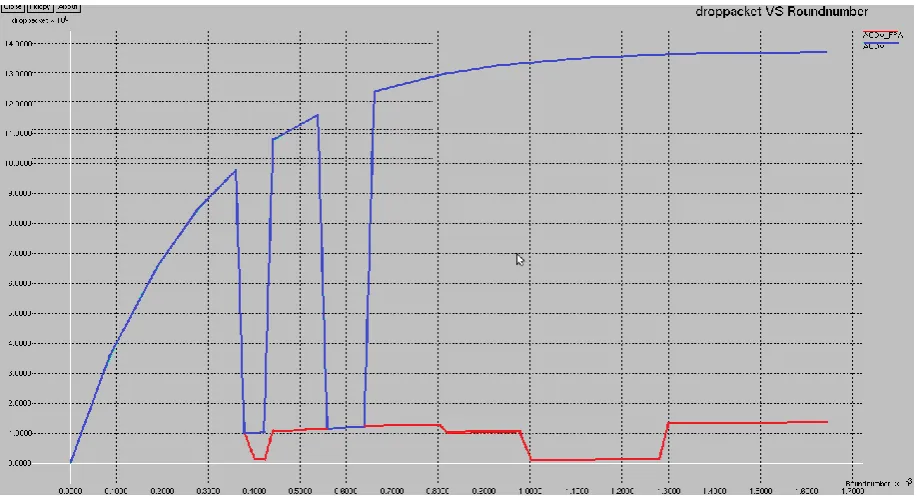
3.1 Drop packet VS Round Number
Figure 3.1: Comparison of Drop packet VS Round numbers
Table 3.1: Comparison of Drop packet VS Round numbers
Table 3.1 gives an clear indication of the fact that the dropping packet is reduced after applying FPA in AODV protocol. Initially when the no. of rounds were increasing more no. of packets were lost and when the FPA is applied to the protocol than the less no. of packets are lost while transmitting the data.
Rounds AODV_FPA drop AODV drop
40 2 4
60 3 5
90 4 19
110 7 29
140 10 42
3.2 End to End Delay VS Time
Figure 3.2: Comparison of End-to-End delay VS Time
Table 3.2: Comparison of End-to-End delay VS Time
Table 3.2 give an clear indication that when we use FPA less time is taken by the packet to reach the destination and as the no. of packets sent in time is increased time take by those packets to reach the destination is quit less as compared to initial protocol.
Packets AODV_FPA_timedelay AODV timedelay
15 60 ms 110ms
30 10 ms 50ms
45 5 ms 10ms
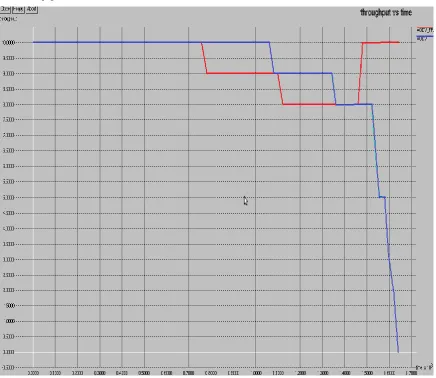
3.3 Throughput VS Time
Figure 3.3: Comparison of Throughput VS Time
Table 3.3: Comparison of Throughput VS Time
Table 3.3 gives an indication that after applying FPA more no. of packets are transferred in the desired time allotted to the packet. We can say the success rate of transmitting data in a give time has increased after applying FPA.
Time (ms) AODV_FPAthroughput AODVthroughput
10 9 8.5
40 9.5 8.7
80 8.5 9
100 8.7 8.2
140 10 7
IV.
CONCLUSION AND FUTURE SCOPEStudy states so as to FPA is straightforward, elastic plus enhanced towards determining optimization concern. FPA can be capable of be old for trade with equally lone purpose and multipurpose optimization concern. Study point out that FPA diminish packet loss, end-to-end delay, throughput, develop the marks and the routine is enhanced contrast to former optimization process FPA appear extremely shows potential and still in its original period and be capable of using in medicinal ground as well.
V. REFERENCES
[1] Bhajantri, L. B., & Nalini, N. (2012, August). A fault tolerance approach to topology control in Distributed Sensor Networks. In Advanced Communication Control and Computing Technologies (ICACCCT), 2012 IEEE International Conference on (pp. 208-212). IEEE.
[2] Boukerche, A., & Al-Shaikh, R. (2006, April). Towards building a fault tolerant and conflict-free distributed file system for mobile clients. In 20th International Conference on Advanced Information Networking and Applications-Volume 1 (AINA'06) (Vol. 2, pp. 6-pp). IEEE.
[3] Zhang, D. G., Zhu, Y. N., Zhao, C. P., & Dai, W. B. (2012). A new constructing approach for a we ighted topology of wireless sensor networks based on local-world theory for the Internet of Things (IOT). Computers & Mathematics with Applications, 64(5), 1044-1055.
[4] Li, M., Li, Z., & Vasilakos, A. V. (2013). A survey on topology control in wireless sensor networks: Taxonomy, comparative study, and open issues. Proceedings of the IEEE, 101(12), 2538-2557.
[5] Aziz, A. A., Sekercioglu, Y. A., Fitzpatrick, P., & Ivanovich, M. (2013). A survey on distributed topology control techniques for extending the lifetime of battery powered wireless sensor networks. IEEE communications surveys & tutorials, 15(1), 121-144.
[6] Gao, Z., Cecati, C., & Ding, S. X. (2015). A survey of fault diagnosis and fault-tolerant techniques—Part I: Fault diagnosis with model-based and signal-based approaches. IEEE Transactions on Industrial Electronics, 62(6), 3757-3767.
[7] Rault, T., Bouabdallah, A., & Challal, Y. (2014). Energy efficiency in wireless sensor networks: A top-down survey. Computer Networks, 67, 104-122.
[8] Peng, H., Si, S., Awad, M. K., Cheng, N., Zhou, H., Shen, X., & Zhao, H. (2015, December). Energy-Efficient and Fault-Tolerant Evolution Models for Large-Scale Wireless Sensor Networks: A Complex Networks-Based Approach. In 2015 IEEE Global Communications Conference (GLOBECOM) (pp. 1-6). IEEE.
[9] Demigha, O., Hidouci, W. K., & Ahmed, T. (2013). On energy efficiency in collaborative target tracking in wireless sensor network: a review. IEEE Communications Surveys & Tutorials, 15(3), 1210-1222.
[11] Beheshti, S., & Movaghar, A. (2006). Fault tolerance in mobile agent systems by cooperating the witness agents. In 2006 2nd International Conference on Information & Communication Technologies (Vol. 2, pp. 3018-3021). IEEE.
[12] Mihaela Cardei, Shuhui Yang, and Jie Wu "Fault-Tolerant Topology Control For Heterogeneous Wireless Sensor Networks". Proceedings of the IEEE International conference on Mobile Adhoc and Sensor Systems,
pp 1-9,2007.
[13] Eric C. Cooper, 'Analysis of Distributed Commit Protocols', Computer Science Division-EECS, University of California, Berkeley, CA-94720. 1982 ACM 0-89791-
073-7/82/006/0175
[14] Indranil Saha, Lokesh Kumar Sambasivan, Ranjeet Kumar Patro, Subhas Kumar Ghosh, "Distributed Fault Tolerant Topology Control in Static and Mobile Wireless Sensor Networks ". Proceedings of the Second
International Conference on Communication System software and Middleware,2007.
[15] Santos N, Ferreira P. Making Distributed Transactions Resilient to Intermittent Network Connections. In: Proceedings of the 2006 International Symposium on on World of Wireless, Mobile and Multimedia
Networks. IEEE Computer Society, Washington; 2006. p. 598 – 602.
[16] Ayari B, Khelil A, Suri N. FT-PPTC: An efficient and fault-tolerant commit protocol for mobile environments. In: Proc. of SRDS; 2006. p. 96–105.
[17] Moiz S.A, Nizamudin M.K. Concurrency Control without Locking in Mobile Environments. In: First International Conference on Emerging Trends in Engineering and Technology; Nagpur, Maharashtra;
2008. p. 1336-1339.
[18] Madria S.K. A Transaction Model to Improve Data Availability in Mobile Computing. In: Distributed Parallel Databases; 2001. p. 127 – 160.
[19] H. Zou and E Jahanian. Real-time Primary-Backup (RTPB) Replication with Temporal Consistency Guarantees. Proceedings of IEEE International Conference on Distributed Computing Systems, pages 48-56, May 1998
[20] G. Cao and M. Singhal. “Mutable Checkpoints: A New Checkpointing Approach for Mobile Computing Systems”. IEEE Trans. Parallel and Distributed System pp. 9-20, 2003
[21] F.M.Assis Silva, R.A.Macedo, Reliable Communication for Mobile Agents with Mobile Groups, 2000. [22] F.M. Assis Silva, R. Popescu-zeletin, An Approach for Providing Mobile Agent Fualt Tolerance, In
Proceeding of the Second International Workshop, pages 14-25, Springer Verlag, Sept. 1998.
[23] S. Pears, J. Xu, C. Boldyreff, Mobile Agent Fault Tolerance for Information Retrieval Application: An Exception Handling Approach, In proceeding of the Sixth IEEE International Symposium on Autunomous
Decentralized systems (ISADS 03), 2003
[24] S. Pleisch, A. Schiper, Fault-Tolerant Mobile Agent Execution, IEEE Transaction Computer, pages 209-222, Feb. 2003.
[25] L. Silva, V. Batista, J. Silva, Fault-Tolerant Execution of Mobile Agents, In Proceeding of the International Conference on Dependable Systems and networks, pages 135-143, June 2000.
[27] Nedal. Ababneh, Anastasios. Viglas, "ECTC: Energy efficient Topology Control Algorithm for WSN". Proceedings of the IEEE international Symposium on a World of Wireless Mobile and Multimedia
Networks (WoWMoM'09), June 2009
[28] Jianhui. Zhang, Jiming. Chen, Jialu. Fan, Weiqiang. Xu,Youxian. Sun, "OMNeT++ based Simulation for TopologyControl in Wireless Sensor Network: A Case Study".Proceedings of the International conference
on Wireless Communications and Mobile Computing, pp 1130 - 1134,2008