International Journal of COPD 2018:13 451–463
International Journal of COPD
Dove
press
submit your manuscript | www.dovepress.com 451
O r I g I n a l r e s e a r C h
open access to scientific and medical research
Open access Full Text article
Do not do in COPD: consensus statement on
overuse
Felipe Villar-Álvarez,1
raúl Moreno-Zabaleta,2
Jose Joaquin Mira-solves,3
eduardo Calvo-Corbella,4
salvador Díaz-lobato,5
Fernando gonzález-Torralba,6
ascensión hernando-sanz,7
sara núñez-Palomo,8 sergio
salgado-aranda,9 Beatriz
simón-rodríguez,10 Paz
Vaquero-lozano,11 Isabel
María navarro-soler12
On behalf of “Do not do in COPD” Working group of the Madrid society of Pulmonology and Thoracic surgery (neumomadrid)
1Department of Pulmonology, IIs–Fundación Jiménez Díaz, CIBeres, UaM, 2Pulmonology, Inpatient and noninvasive Mechanical Ventilation, hospital Universitario Infanta sofía, Madrid, 3alicante-sant Joan health District, alicante/Universidad Miguel hernández elche/reDIseC, 4Family and Community Medicine, CsU Pozuelo estación, school of Medicine, UaM, 5Department of Pulmonology, hospital ramón y Cajal, Madrid, 6Pulmonology section, hospital Universitario del Tajo, aranjuez, 7Department of Pulmonology, hospital Universitario 12 de Octubre, 8C.s. Torrelaguna, 9Pulmonology section, hospital del sureste, 10 Fisiorespiración-respiratory Physiotherapy Unit, escuela Universitaria gimbernat Cantabria, 11s. Pulmonology, CeP hnos. sangro hgU gregorio Marañón, Madrid, 12Calitè research group, Universidad Miguel hernández de elche, elche, spain
Background: To identify practices that do not add value, cause harm, or subject patients with chronic obstructive pulmonary disease (COPD) to a level of risk that outweighs possible benefits (overuse).
Methods: A qualitative approach was applied. First, a multidisciplinary group of healthcare professionals used the Metaplan technique to draft and rank a list of overused procedures as well as self-care practices in patients with stable and exacerbated COPD. Second, in successive consensus-building rounds, description files were created for each “do not do” (DND) recommendation, consisting of a definition, description, quality of supporting evidence for the recommendation, and the indicator used to measure the degree of overuse. The consensus group comprised 6 pulmonologists, 2 general practitioners, 1 nurse, and 1 physiotherapist.
Results: In total, 16 DND recommendations were made for patients with COPD: 6 for stable COPD, 6 for exacerbated COPD, and 4 concerning self-care.
Conclusion: Overuse poses a risk for patients and jeopardizes care quality. These 16 DND recommendations for COPD will lower care risks and improve disease management, facilitate communication between physicians and patients, and bolster patient ability to provide self-care.
Keywords: COPD, consensus, patient safety, quality assurance
Introduction
Overuse of resources for diagnosis and therapy puts patients at risk without providing sufficient clinical benefit. Moreover, overuse has cost implications and has been linked to errors in clinical treatment.1,2 We must seek to eliminate practices that run contrary
to existing evidence; these include carrying out procedures that do not add value for the patient and/or subject patients to unnecessary risk and failing to take actions that have been shown to produce favorable patient outcomes.
Reports in the literature have described this phenomenon using the terms “overuse,” “overdiagnosis,” “overmedicalization,” and “low-value care.”2,3 According to the
definition of the Institute of Medicine, overuse consists of providing healthcare when there is no evidence in support of such decisions or when the benefit of the treatment fails to outweigh its risk.1,2
Overuse has been linked to unsafe, inappropriate, and/or inefficient care.1,2
To counter this trend, the movement called “Less is more medicine” has taken hold in recent years.3 Driven by scientific societies, medical associations and institutions, and
healthcare authorities across different countries, in recent years there has been a grow-ing effort to eliminate certain aspects of medical practice that have been broadly shown to be inappropriate.4–6 Examples of this include initiatives by scientific institutions and
Correspondence: Felipe Villar-Álvarez Department of Pulmonology, IIs–Fundación Jiménez Díaz, CIBeres, UaM, av reyes Católicos 2, Madrid 28049, spain email [email protected]
Journal name: International Journal of COPD Article Designation: Original Research Year: 2018
Volume: 13
Running head verso: Villar-Álvarez et al Running head recto: Do not do in COPD DOI: 151939
International Journal of Chronic Obstructive Pulmonary Disease downloaded from https://www.dovepress.com/ by 118.70.13.36 on 22-Aug-2020
For personal use only.
Dovepress
Villar-Álvarez et al
societies to issue “do not do” (DND) guidelines and infor-mational and educational campaigns urging practitioners to “choose wisely.”6
In an attempt to encourage patient participation in these measures, the foundation Advancing Medical Professionalism to Improve Health Care (ABIM)6 conducted an
awareness-raising campaign among patients and care professionals to prevent improper use of resources within diagnosis and therapy. There is a well-known body of improper health-related beliefs and behaviors among patients, and these habits lead to harmful practices that must be eradicated if health outcomes are to be improved.4–6
Chronic obstructive pulmonary disease (COPD) varies in prevalence from country to country;7 in Spain, the
preva-lence of COPD is 10.2% among adults between the ages of 40 and 80.8 Of all the most prevalent illnesses, COPD
is the only one that is on the rise.9 COPD is currently the
third leading cause of death, behind ischemic heart disease and stroke.9 One of the main problems with this disease is
underdiagnosis.10 The burden the disease poses for healthcare
resources is substantial: the European Union estimates that the direct cost of COPD totals 38.6 billion euros in Europe, whereas the disease burden in the United States is also high, at 29.5 billion dollars.11,12
Major clinical guidelines for management of COPD, such as the Global Initiative for Chronic Obstructive Lung Disease (GOLD), an international standard,13 or the Spanish COPD
guidelines (GesEPOC),14 establish a series of
recommenda-tions on preventing, diagnosing, and treating this disease, both for stable as well as exacerbated cases, including indi-cations adapted for different care levels.
Clinical guidelines advise healthcare professionals on appropriate procedures for diagnosis, treatment, and follow-up in step with evolving knowledge of the disease.13,14
Despite this information, guides are not always applied cor-rectly and a number of inappropriate practices persist with a certain degree of frequency.15–17 Overuse continues in practice
(defensive medicine or pressure from patients or relatives are common causes).18,19 Moreover, the patient’s health beliefs,
customs, or misinterpretation could be causes of harm dur-ing self-care. These suboptimal measures can be ineffec-tive, inefficient, or even deleterious for patients.19 Making
changes to routine clinical practice is less than simple, and requires sustained effort in the benefit of effective care. For this reason, a DND approach like the one presented here is useful in that it calls attention to certain aspects of clinical practice that were once widespread but are now known to be inappropriate – because there is no proof of their efficacy,
due to scant or doubtful effectiveness, or because they are not cost-effective.1
This study aims to identify practices in diagnosis, therapy, and self-care of stable and exacerbated COPD that are inap-propriate, have doubtful effectiveness, or are scarcely cost-effective, and develop a list of DND recommendations for COPD health professionals and patients.
Materials and methods
A qualitative research approach was applied. Qualitative research methods analyze phenomena from an overall per-spective, attempting to describe reality without formulating hypotheses or setting concrete measures, thereby distinguish-ing them from quantitative approaches.20
This study was carried out in two phases. The first phase comprised an exploratory analysis (using the Metaplan technique), in which we created a list of overused practices, whereas in the second phase we aimed to reach a consensus definition of DND guidelines pertaining to practices that are still relatively common despite the fact that evidence makes a clear case that they have a poor risk–benefit ratio (using a consensus conference technique).
The Spanish health system is mainly a public system in which COPD patients are evaluated, at first, by general practitioners, who initiate the treatment and send the patient to a pulmonologist to complete the evaluation. If there is a problem in the evaluation of the patient, the general practi-tioner begins the treatment. Some COPD patients are treated by physiotherapists and most of them are evaluated by nurses. Therefore, a panel with several pulmonologists, general prac-titioners, physiotherapists, and nurses is adequate to make a correct evaluation. Ten healthcare professionals participated in this study, each with .10 years’ experience in treating COPD patients and involved in research and committees in their professional groups and healthcare levels. This group of collaborators was chosen to include a variety of perspec-tives drawn from different experiences with clinical practice and by balancing primary and in-hospital care. To do this, six pulmonologists (with experience in hospitalization, con-sultation, emergencies, home care, mechanical ventilation, and healthcare administration), two general practitioners, one nurse, and one physiotherapist were recruited by the Board of Neumomadrid (Madrid Society of Pulmonology and Thoracic Surgery). Two of the expert pulmonologists and a researcher with expertise in qualitative approaches acted as coordinators.
Once the working group had been formed, both the pul-monologist coordinators and the expert in qualitative research
International Journal of Chronic Obstructive Pulmonary Disease downloaded from https://www.dovepress.com/ by 118.70.13.36 on 22-Aug-2020
Dovepress Do not do in COPD
designed an action plan that called for an initial meeting to be attended by all specialists involved, so as to brainstorm care or self-care practices used in COPD having benefits that do not outweigh their risks. Poor risk–benefit ratio was understood as doubtful effectiveness or deleterious patient outcomes, thus indicating that they were not cost-effective. During this first meeting, the group debated the frequency with which these practices are employed and the strength of the evidence used to deter continued use of these practices. The Metaplan technique21,22 was used to identify such practices,
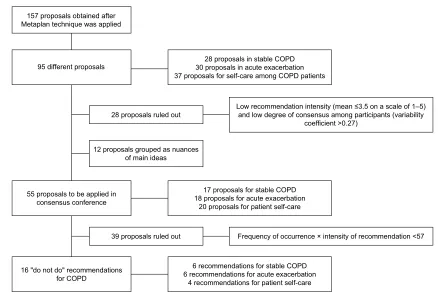
to elaborate on them, and to rank them based on frequency. All members of the group began the analysis by noting down the practices they considered to be ill-advised. Based on the results of this method, a decision was made to ask three questions to be answered consecutively (Figure 1):
1) Indicate which practices you consider to be both widely used in the management of patients with stable COPD and also inappropriate because of their poor risk–benefit ratio.
2) Indicate which practices you consider to be both widely used in the management of patients with exacerbated COPD and also inappropriate because of their poor risk–benefit ratio.
3) Indicate which self-care practices you believe are wide-spread among COPD patients and are inappropriate because of their poor risk–benefit ratio.
Responses to these questions were gathered individually, and each collaborator was able to present as many practices as they saw fit. Similar questions were grouped together. Subsequently, an open, unmoderated debate was held to dis-cuss each of the examples of overuse that had been proposed in the previous phase so that the participants could assess the pertinence, degree of consensus, and sources of evidence for each one. Lastly, each individual coauthor evaluated the different proposed inappropriate practices according to the degree of prevalence in routine clinical practice. For this, a scale of 1–5 was employed, with 1 indicating scarce fre-quency of use and 5 representing practices that are relatively frequent despite being inadvisable or not cost-effective – that is, those practices discouraged by scientific evidence or professional consensus. In addition, the analysis took into account proposals referring to the same practice which were made by more than one study participant (spontaneity) and the level of agreement between participants (coefficient of variation). During this initial phase, scores around the 75th percentile were considered the cutoff; therefore, practices
Figure 1 Summary of the methodology used in the study, including the number of ideas identified, selection criteria, and procedure used to screen “do not do” recommendations in COPD.
Abbreviation: COPD, chronic obstructive pulmonary disease.
/RZUHFRPPHQGDWLRQLQWHQVLW\PHDQRQDVFDOHRI± DQGORZGHJUHHRIFRQVHQVXVDPRQJSDUWLFLSDQWVYDULDELOLW\
FRHIILFLHQW! SURSRVDOVLQVWDEOH&23'
SURSRVDOVLQDFXWHH[DFHUEDWLRQ SURSRVDOVIRUVHOIFDUHDPRQJ&23'SDWLHQWV
SURSRVDOVJURXSHGDVQXDQFHV RIPDLQLGHDV
GRQRWGRUHFRPPHQGDWLRQV IRU&23'
SURSRVDOVWREHDSSOLHGLQ FRQVHQVXVFRQIHUHQFH SURSRVDOVREWDLQHGDIWHU 0HWDSODQWHFKQLTXHZDVDSSOLHG
GLIIHUHQWSURSRVDOV
SURSRVDOVUXOHGRXW SURSRVDOVUXOHGRXW
SURSRVDOVIRUVWDEOH&23' SURSRVDOVIRUDFXWHH[DFHUEDWLRQ
SURSRVDOVIRUSDWLHQWVHOIFDUH
UHFRPPHQGDWLRQVIRUVWDEOH&23' UHFRPPHQGDWLRQVIRUDFXWHH[DFHUEDWLRQ
UHFRPPHQGDWLRQVIRUSDWLHQWVHOIFDUH
)UHTXHQF\RIRFFXUUHQFHîLQWHQVLW\RIUHFRPPHQGDWLRQ
International Journal of Chronic Obstructive Pulmonary Disease downloaded from https://www.dovepress.com/ by 118.70.13.36 on 22-Aug-2020
Dovepress
Villar-Álvarez et al
that had been given an average score of 3.5 points or lower, as it was believed that there was no consensus opinion indicating that these were in widespread use (variability coef-ficient .0.27; Figure 1), were proposed as inappropriate.
The methodology used in the second phase was the con-sensus conference.23 For this, a web application was used
to select DND recommendations that were most widely chosen. Each inappropriate practice was assigned a DND recommendation.
To assign each DND recommendation, all inappropriate practices were individually assessed (a scale from 1 to 10 was used) again by the group of experts to establish their perceived frequency of use, the degree to which the prac-tice was considered useless, deleterious, or failed to add value, and, lastly, whether the practice was more prevalent among specialists in pulmonology, primary care, or nursing. Moreover, this phase included an opportunity for the col-laborators to propose modifications and clarifications to the language used in the originally proposed description of these inappropriate practices. The expert participants had been given information on the degree of consensus reached in the previous phase for each practice perceived to be inappropriate (ie, mean, spontaneity, and coefficient of variation). These recommendations were ranked according to the result obtained by applying the formula frequency ×
intensity (range 1–100) once they were grouped according to COPD into stable, exacerbated, or related to self-care. We set a data-driven cutoff point of 57 points, meaning that scores below this value indicated a lower level of con-sensus (Figure 1).
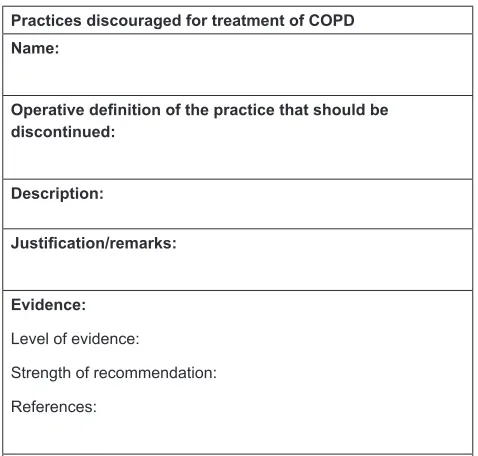
An operational description was created for each of the recommendations processed according to this method, and we evaluated the level of evidence justifying the proposed inappropriateness of the measure. For proposals made for patient self-care, we based these assessments on literature concerning patient education and clinical experience. The resulting recommendations were distributed among the participants, and a descriptive file was created for each one, including the following fields: recommendation title, opera-tive definition of the practice to be eradicated, description of the practice to be eradicated, justification given for the eradi-cation proposal, level of evidence and recommendation grade according to the Scottish Intercollegiate Guidelines Network (SIGN),24 bibliographical sources, and recommended indices
to assess whether a change has taken place in the practice and to enable follow-up of the level of uptake of these DND recommendations (Figure 2).
Results
When the Metaplan technique was applied, a total of 157 proposals were made concerning overuse practices in the treatment of patients with COPD, and 95 of these were intrin-sically different from each other. Practices were eliminated if they received an average score of 3.5 points or lower, as it was believed that there was no consensus opinion sur-rounding them. This resulted in a total of 28 practices in stable COPD, 30 in exacerbated disease, and 37 self-care practices. Finally, we eliminated 40 examples of inappro-priate practices for which there was insufficient consensus among the members of the research group or because they overlapped with others.
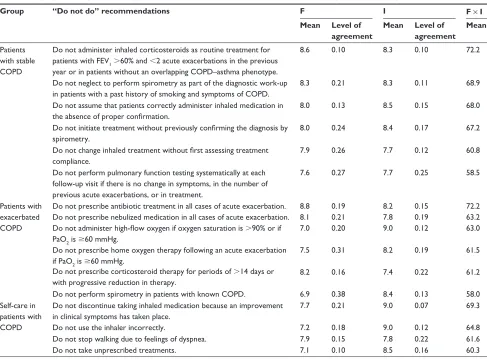
During the final phase, which consisted of a consensus conference, 55 proposals were assessed for possible inappro-priateness or cost-ineffectiveness, and each one was assigned a DND recommendation: 17 for stable COPD, 18 for exacerbated COPD, and 20 concerning self-care among this population of patients. After the list was reviewed by the group of experts taking part in the study, the number of recommendations was reduced to 16 (after applying the formula frequency × intensity, and eliminating those recommendations with ,57 points): six for stable dis-ease, six for exacerbated COPD, and four for patient self-care (Table 1).
Practices discouraged for treatment of COPD Name:
Operative definition of the practice that should be discontinued:
Description:
Justification/remarks:
Evidence:
Level of evidence:
Strength of recommendation: References:
Indicator proposed for follow-up of changes in the practice:
Figure 2 Description file for each “do not do” recommendation in COPD. Abbreviation: COPD, chronic obstructive pulmonary disease.
International Journal of Chronic Obstructive Pulmonary Disease downloaded from https://www.dovepress.com/ by 118.70.13.36 on 22-Aug-2020
Dovepress Do not do in COPD
The definitive list of six DND recommendations for stable COPD was as follows:
• Do not administer inhaled corticosteroids as routine treatment in patients with forced expiratory volume in 1 second (FEV1) .60% and ,2 acute exacerbations in the previous year or in patients without an overlapping COPD–asthma phenotype.
• Do not neglect to perform spirometry as part of the diag-nostic work-up in patients with a past history of smoking and symptoms of COPD.
• Do not assume that patients correctly administer inhaled medication in the absence of proper confirmation.
• Do not initiate treatment without previously confirming the diagnosis by spirometry.
• Do not change inhaled treatment without first assessing treatment compliance.
• Do not perform pulmonary function testing systematically at each follow-up visit if there is no change in symptoms, in the number of previous acute exacerbations, or in treatment. Six other DND recommendations, which concerned acute exacerbations of COPD, were as follows:
• Do not prescribe antibiotic treatment in all cases of acute exacerbation.
• Do not prescribe nebulized medication in all cases of acute exacerbation.
• Do not administer high-flow oxygen if oxygen satura-tion is .90% or if partial pressure of oxygen (PaO2) is $60 mmHg.
• Do not prescribe home oxygen therapy following an acute exacerbation if PaO2 is $60 mmHg.
• Do not prescribe corticosteroid therapy for periods of .14 days or with progressive reduction in therapy. Table 1 Practices in diagnosis, therapy, and self-care determined to be ill-advised for COPD patients following a consensus conference
Group “Do not do” recommendations F I F × I
Mean Level of
agreement
Mean Level of
agreement Mean
Patients with stable COPD
Do not administer inhaled corticosteroids as routine treatment for patients with FeV1 .60% and ,2 acute exacerbations in the previous year or in patients without an overlapping COPD–asthma phenotype.
8.6 0.10 8.3 0.10 72.2
Do not neglect to perform spirometry as part of the diagnostic work-up in patients with a past history of smoking and symptoms of COPD.
8.3 0.21 8.3 0.11 68.9
Do not assume that patients correctly administer inhaled medication in the absence of proper confirmation.
8.0 0.13 8.5 0.15 68.0
Do not initiate treatment without previously confirming the diagnosis by spirometry.
8.0 0.24 8.4 0.17 67.2
Do not change inhaled treatment without first assessing treatment compliance.
7.9 0.26 7.7 0.12 60.8
Do not perform pulmonary function testing systematically at each follow-up visit if there is no change in symptoms, in the number of previous acute exacerbations, or in treatment.
7.6 0.27 7.7 0.25 58.5
Patients with exacerbated COPD
Do not prescribe antibiotic treatment in all cases of acute exacerbation. Do not prescribe nebulized medication in all cases of acute exacerbation. Do not administer high-flow oxygen if oxygen saturation is .90% or if PaO2 is $60 mmhg.
Do not prescribe home oxygen therapy following an acute exacerbation if PaO2 is $60 mmhg.
Do not prescribe corticosteroid therapy for periods of .14 days or with progressive reduction in therapy.
Do not perform spirometry in patients with known COPD.
8.8 8.1 7.0
7.5
8.2
6.9
0.19 0.21 0.20
0.31
0.16
0.38
8.2 7.8 9.0
8.2
7.4
8.4
0.15 0.19 0.12
0.19
0.22
0.13
72.2 63.2 63.0
61.5
61.2
58.0 self-care in
patients with COPD
Do not discontinue taking inhaled medication because an improvement in clinical symptoms has taken place.
Do not use the inhaler incorrectly.
7.7
7.2
0.21
0.18
9.0
9.0
0.07
0.12
69.3
64.8
Do not stop walking due to feelings of dyspnea. 7.9 0.15 7.8 0.22 61.6
Do not take unprescribed treatments. 7.1 0.10 8.5 0.16 60.3
Notes: F, frequency of occurrence of the discouraged practice; I, degree of inappropriateness of the discouraged practice; F × I, frequency of occurrence of the practice multiplied by its degree of inappropriateness. Mean, average value from 0 to 10. This is estimated using the coefficient of variation obtained when each recommendation is evaluated. Lower coefficients of variation indicate greater degrees of homogeneity of assessments and thus greater degrees of consensus.
Abbreviations: COPD, chronic obstructive pulmonary disease; FeV1, forced expiratory volume in 1 second; PaO2, partial pressure of oxygen.
International Journal of Chronic Obstructive Pulmonary Disease downloaded from https://www.dovepress.com/ by 118.70.13.36 on 22-Aug-2020
Dovepress
Villar-Álvarez et al
• Do not perform spirometry in patients with known COPD.
Lastly, the four DND recommendations for self-care among patients with COPD were as follows:
• Do not discontinue taking inhaled medication because an improvement in clinical symptoms has taken place.
• Do not use the inhaler incorrectly.
• Do not stop walking due to feelings of dyspnea.
• Do not take unprescribed treatments.
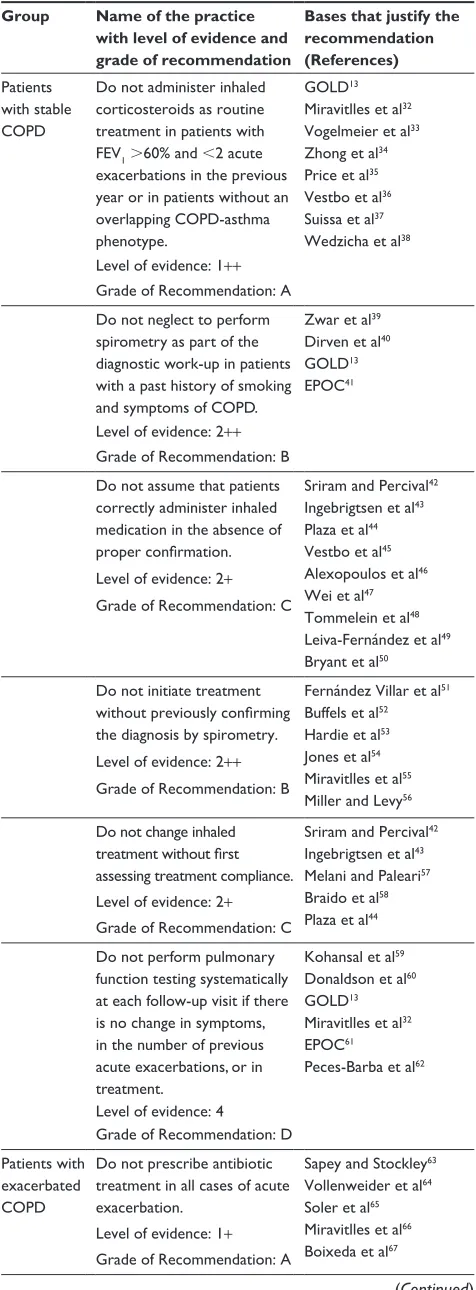
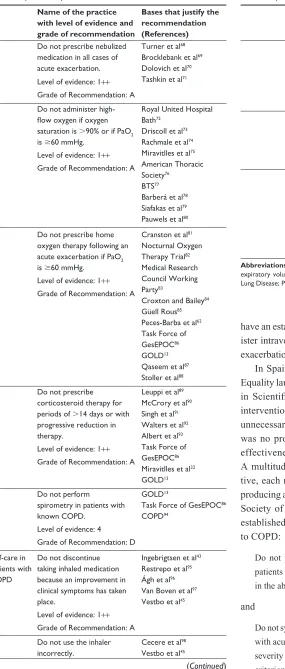
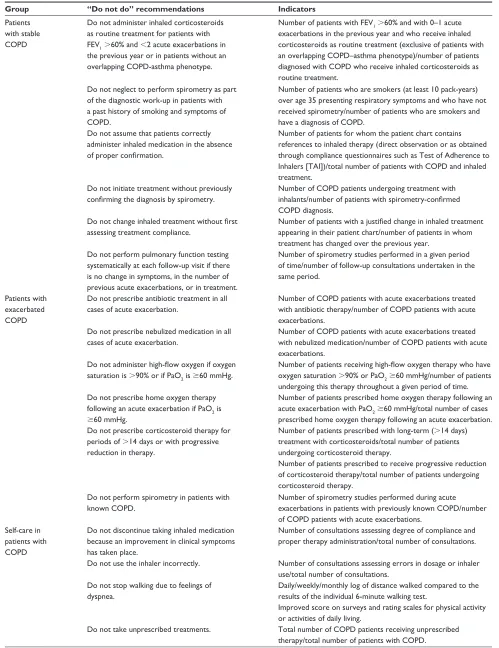
Subsequently, descriptive files containing technical speci-fications of each recommendation were created (Figure 2). This file included the level of evidence and grade of recom-mendation – bases that justify DND recomrecom-mendations – as well as indicators that allow for an assessment of the data collected (Tables 2 and 3). Clinical guidelines, such as GOLD13 or GesEPOC,14 have been evaluated in the level of
evidence and in the analysis of data collected.
Discussion
Using a multi-phase methodology we identified a number of practices used in diagnosis, therapy, and other care – including the self-care procedures that are the responsibility of patients – that are inappropriate, have doubtful effective-ness, or are not cost-effective for COPD patients. The results of this study should bring about an increase in care quality by reducing the frequency of practices that add no value or are harmful for patients, as well as by increasing patient safety, improving physician–patient communication, and better enabling patients to undertake self-care.
The National Physicians Alliance, a medical organization operating in the United States, set in motion a project called “Choosing Wisely,” which called on a variety of medical societies – initially, those concerned with primary care, internal medicine, and pediatrics – to propose a list of five rec-ommendations for medical practices with the aim of optimiz-ing healthcare resources used to diagnose and treat different illnesses.6 In the United Kingdom, the National Institute for
Health and Care Excellence (NICE) has also published a set of DND recommendations, highlighting care practices that do not benefit patients or for which there is insufficient evidence upon which to base suggestions for use.25
Along these same lines, the American Thoracic Society (ATS), in partnership with the American College of Chest Physicians, created a list of five practices that are widely used to treat respiratory diseases in adults but that, nonetheless, should be avoided.26 Although none of these concern COPD,
the previous list of ten practices contained two that are relevant to COPD – that is, “Do not perform frequent spirometry in patients with COPD in patients who are clinically stable and
Table 2 level of evidence and grade of recommendation as indicated in sIgn24 including bases that justify the “do not do”
recommendations
Group Name of the practice
with level of evidence and grade of recommendation
Bases that justify the recommendation (References)
Patients with stable COPD
Do not administer inhaled corticosteroids as routine treatment in patients with FeV1.60%and,2acute exacerbations in the previous year or in patients without an overlapping COPD-asthma phenotype.
gOlD13
Miravitlles et al32
Vogelmeier et al33
Zhong et al34
Price et al35
Vestbo et al36
suissa et al37
Wedzicha et al38
level of evidence: 1++
grade of recommendation: a Do not neglect to perform spirometry as part of the diagnostic work-up in patients with a past history of smoking and symptoms of COPD.
Zwar et al39
Dirven et al40
gOlD13
ePOC41
level of evidence: 2++
grade of recommendation: B Do not assume that patients correctly administer inhaled medication in the absence of proper confirmation. level of evidence: 2+
grade of recommendation: C
sriram and Percival42
Ingebrigtsen et al43
Plaza et al44
Vestbo et al45
alexopoulos et al46
Wei et al47
Tommelein et al48
leiva-Fernández et al49
Bryant et al50
Do not initiate treatment without previously confirming the diagnosis by spirometry. level of evidence: 2++
grade of recommendation: B
Fernández Villar et al51
Buffels et al52
hardie et al53
Jones et al54
Miravitlles et al55
Miller and levy56
Do not change inhaled treatment without first assessing treatment compliance. level of evidence: 2+
grade of recommendation: C
sriram and Percival42
Ingebrigtsen et al43
Melani and Paleari57
Braido et al58
Plaza et al44
Do not perform pulmonary function testing systematically at each follow-up visit if there is no change in symptoms, in the number of previous acute exacerbations, or in treatment.
Kohansal et al59
Donaldson et al60
gOlD13
Miravitlles et al32
ePOC61
Peces-Barba et al62
level of evidence: 4
grade of recommendation: D Patients with
exacerbated COPD
Do not prescribe antibiotic treatment in all cases of acute exacerbation.
level of evidence: 1+
grade of recommendation: a
sapey and stockley63
Vollenweider et al64
soler et al65
Miravitlles et al66
Boixeda et al67
(Continued)
International Journal of Chronic Obstructive Pulmonary Disease downloaded from https://www.dovepress.com/ by 118.70.13.36 on 22-Aug-2020
Dovepress Do not do in COPD
have an established diagnosis” and “Do not routinely admin-ister intravenous steroids for patients hospitalized for acute exacerbations of asthma and COPD.”
In Spain, the Ministry of Health, Social Services, and Equality launched the project titled “Commitment to Quality in Scientific Societies”27 in order to reduce unnecessary
interventions. As in the present study, the initiative took unnecessary interventions to mean those for which there was no proven efficacy, practices with scant or doubtful effectiveness, or procedures that are not cost-effective. A multitude of scientific societies took part in the initia-tive, each represented by a panel of experts charged with producing a list of five DND recommendations. The Spanish Society of Pulmonology and Thoracic Surgery (SEPAR) established five recommendations, two of which are linked to COPD:
Do not prescribe ambulatory oxygen therapy in COPD patients where PaO2 in arterial blood is over 55 mmHg and in the absence of exercise-related desaturation
and
Do not systematically use antibiotic therapy to treat patients with acute COPD exacerbations when there are no data on severity and when the patient only meets one Anthonisen criterion (other than sputum purulence).27
Table 2 (Continued)
Name of the practice with level of evidence and grade of recommendation
Bases that justify the recommendation (References)
Do not prescribe nebulized medication in all cases of acute exacerbation. level of evidence: 1++
grade of recommendation: a
Turner et al68
Brocklebank et al69
Dolovich et al70
Tashkin et al71
Do not administer high-flow oxygen if oxygen saturation is.90% or if PaO2 is$60 mmhg.
level of evidence: 1++
grade of recommendation: a
royal United hospital Bath72
Driscoll et al73
rachmale et al74
Miravitlles et al75
american Thoracic society76
BTs77
Barberá et al78
siafakas et al79
Pauwels et al80
Do not prescribe home oxygen therapy following an acute exacerbation if PaO2 is$60 mmhg.
level of evidence: 1++
grade of recommendation: a
Cranston et al81
nocturnal Oxygen Therapy Trial82
Medical research Council Working Party83
Croxton and Bailey84
güell rous85
Peces-Barba et al62
Task Force of gesePOC86
gOlD13
Qaseem et al87
stoller et al88
Do not prescribe corticosteroid therapy for periods of.14 days or with progressive reduction in therapy.
level of evidence: 1++
grade of recommendation: a
leuppi et al89
McCrory et al90
singh et al91
Walters et al92
albert et al93
Task Force of gesePOC86
Miravitlles et al32
gOlD13
Do not perform
spirometry in patients with known COPD.
level of evidence: 4
grade of recommendation: D gOlD13
Task Force of gesePOC86
COPD94
self-care in patients with COPD
Do not discontinue taking inhaled medication because an improvement in clinical symptoms has taken place.
level of evidence: 1++
grade of recommendation: a
Ingebrigtsen et al43
restrepo et al95
Ágh et al96
Van Boven et al97
Vestbo et al45
Do not use the inhaler incorrectly.
Cecere et al98
Vestbo et al45
(Continued)
Table 2 (Continued)
Name of the practice with level of evidence and grade of recommendation
Bases that justify the recommendation (References)
level of evidence: 4
grade of recommendation: D sePar99
Plaza et al100
Calle rubio et al101
giner et al102
sánchez103
Plaza et al44
Do not stop walking due to feelings of dyspnea. level of evidence: 2++
grade of recommendation: B
Álvarez-gutiérrez et al104
garcía-río105
gOlD13
Miravitlles et al32
Watz et al106
Do not take unprescribed treatments.
level of evidence: 1++
grade of recommendation: a gOlD13
Miravitlles et al32
Tashkin et al107
Vogelmeier et al108
Wise et al109
Decramer et al110
Celli et al111
Vestbo et al45
Abbreviations: COPD, chronic obstructive pulmonary disease; FeV1, forced expiratory volume in 1 second; gOlD, global Initiative for Chronic Obstructive lung Disease; PaO2, partial pressure of oxygen.
International Journal of Chronic Obstructive Pulmonary Disease downloaded from https://www.dovepress.com/ by 118.70.13.36 on 22-Aug-2020
Dovepress
Villar-Álvarez et al
Table 3 Indicators used for assessment of “do not do” recommendations
Group “Do not do” recommendations Indicators
Patients with stable COPD
Do not administer inhaled corticosteroids as routine treatment for patients with FeV1 .60% and ,2 acute exacerbations in
the previous year or in patients without an overlapping COPD-asthma phenotype.
number of patients with FeV1 .60% and with 0–1 acute
exacerbations in the previous year and who receive inhaled corticosteroids as routine treatment (exclusive of patients with an overlapping COPD–asthma phenotype)/number of patients diagnosed with COPD who receive inhaled corticosteroids as routine treatment.
Do not neglect to perform spirometry as part of the diagnostic work-up in patients with a past history of smoking and symptoms of COPD.
number of patients who are smokers (at least 10 pack-years) over age 35 presenting respiratory symptoms and who have not received spirometry/number of patients who are smokers and have a diagnosis of COPD.
Do not assume that patients correctly administer inhaled medication in the absence of proper confirmation.
number of patients for whom the patient chart contains references to inhaled therapy (direct observation or as obtained through compliance questionnaires such as Test of adherence to Inhalers [TaI])/total number of patients with COPD and inhaled treatment.
Do not initiate treatment without previously confirming the diagnosis by spirometry.
number of COPD patients undergoing treatment with inhalants/number of patients with spirometry-confirmed COPD diagnosis.
Do not change inhaled treatment without first assessing treatment compliance.
Number of patients with a justified change in inhaled treatment appearing in their patient chart/number of patients in whom treatment has changed over the previous year.
Do not perform pulmonary function testing systematically at each follow-up visit if there is no change in symptoms, in the number of previous acute exacerbations, or in treatment.
number of spirometry studies performed in a given period of time/number of follow-up consultations undertaken in the same period.
Patients with exacerbated COPD
Do not prescribe antibiotic treatment in all cases of acute exacerbation.
number of COPD patients with acute exacerbations treated with antibiotic therapy/number of COPD patients with acute exacerbations.
Do not prescribe nebulized medication in all cases of acute exacerbation.
number of COPD patients with acute exacerbations treated with nebulized medication/number of COPD patients with acute exacerbations.
Do not administer high-flow oxygen if oxygen saturation is .90% or if PaO2 is $60 mmhg.
Number of patients receiving high-flow oxygen therapy who have oxygen saturation .90% or PaO2 $60 mmhg/number of patients undergoing this therapy throughout a given period of time. Do not prescribe home oxygen therapy
following an acute exacerbation if PaO2 is
$60 mmhg.
number of patients prescribed home oxygen therapy following an acute exacerbation with PaO2 $60 mmhg/total number of cases
prescribed home oxygen therapy following an acute exacerbation. Do not prescribe corticosteroid therapy for
periods of .14 days or with progressive reduction in therapy.
number of patients prescribed with long-term (.14 days) treatment with corticosteroids/total number of patients undergoing corticosteroid therapy.
number of patients prescribed to receive progressive reduction of corticosteroid therapy/total number of patients undergoing corticosteroid therapy.
Do not perform spirometry in patients with known COPD.
number of spirometry studies performed during acute exacerbations in patients with previously known COPD/number of COPD patients with acute exacerbations.
self-care in patients with COPD
Do not discontinue taking inhaled medication because an improvement in clinical symptoms has taken place.
number of consultations assessing degree of compliance and proper therapy administration/total number of consultations.
Do not use the inhaler incorrectly. number of consultations assessing errors in dosage or inhaler use/total number of consultations.
Do not stop walking due to feelings of dyspnea.
Daily/weekly/monthly log of distance walked compared to the results of the individual 6-minute walking test.
Improved score on surveys and rating scales for physical activity or activities of daily living.
Do not take unprescribed treatments. Total number of COPD patients receiving unprescribed therapy/total number of patients with COPD.
Abbreviations: COPD, chronic obstructive pulmonary disease; FeV1, forced expiratory volume in 1 second; PaO2, partial pressure of oxygen.
International Journal of Chronic Obstructive Pulmonary Disease downloaded from https://www.dovepress.com/ by 118.70.13.36 on 22-Aug-2020
Dovepress Do not do in COPD
These working groups base their recommendations on the views of a group of subject-matter experts, selecting those practices that should not be subjected to assessment using qualitative methods. Each group works with a preliminary list of possible recommendations appearing in clinical practice guidelines, using these guidelines as a primary source. Use of this method allows for high levels of consensus on DND recommendations, although this method is limited in that, sometimes, discouraged practices are seldom used. We have taken measures to adjust for this by including recommendations that are commonly made in the context of routine practice.
In addition to the study’s focus on a single disease such as COPD, one novel aspect of our article is the inclusion of DND recommendations concerning patient self-care. Specifically, we identified practices that are prevalent in COPD patient self-care despite their lack of effectiveness or even deleteri-ousness for these patients. Self-care in patients with COPD can improve health-related quality of life and reduce hospi-tal admissions.28,29 Clari et al has provided evidence on the
self-care behaviors and strategies that people with COPD undertake to prevent, control, and manage the physical, psychological, and social consequences of this pathology.30
Our four recommendations for self-care in patients with COPD and the proposed indicators for their evaluation could enable COPD patients to reduce the physical, psychological, and social effects of COPD, and help healthcare professionals to tailor self-care educational programs to the experiences and priorities of these patients.30,31
Another strength of this study is its use of level of evi-dence and grade of recommendation in accordance with SIGN24 and citations from the literature that support these
recommendations.
Our study, furthermore, includes a series of proposals for follow-up of the frequency with which the cases of overuse included in the DND guidelines continue to be employed. These are COPD-related care-quality indicators that could be used by health authorities to assess outcomes. Additionally, these could be incorporated into the balanced scorecards used in care units or form part of the yearly targets set by manage-ment agreemanage-ments. Proper deploymanage-ment of recommendations enables appropriate oversight of the degree to which targets are being met and aids in target setting. These aspects have been scarcely used in other studies,26,27 although we believe
them to be necessary to address the problem of overuse. Due to its local setting in Spain and the implications that this setting had for the design of the study, one limitation of this research is this local nature, as results may vary in
other locations. Moreover, we did not include an analysis of the frequency with which the practices selected as inadvis-able are employed in current clinical practice or in patient home care. Despite this, the study focuses on clinical and self-care practices that become evident in the clinical context due to their prolonged time of use.
In addition, the study is limited by the fact that, to date, no DND indicators have been included in quality assessments and, as a result, data concerning the efficacy of these recommendations are scarce. We do, however, make a proposal which would allow for a follow-up to be conducted on the degree of uptake of these recommenda-tions. The DND included in this study as examples of overuse were chosen because of their cost-ineffectiveness, but they are not based on empirical evidence. Moreover, the list of inappropriate practices is not supported by any investigation of real prevalence, and is based on level of agreement for opinion and experience of a small panel of experts. No quantitative study has been undertaken to measure the degree of agreement with these DND recom-mendations among professional groups or patient repre-sentatives, and further research should examine data on the implementation of these recommendations as well as continuous follow-up.
We can conclude from this study that DND recom-mendations in COPD are likely to improve management of patients with the disease by reducing the rate with which improper or scarcely cost-effective practices are used in clini-cal care and patient self-care. Furthermore, the use of these recommendations will lower care risks, improve physician– patient communication, and empower patients to undertake in-home self-care.
Acknowledgments
This study was carried out under the auspices of the Madrid Society of Pulmonology and Thoracic Surgery (Neumo-madrid). The work was supported by the Spanish Society of Family and Community Medicine (semFYC) and was funded without restriction by a grant from the AstraZeneca pharmaceutical company. We are grateful to Oliver Shaw (IIS-FJD) for his valuable assistance in preparing the manu-script in English.
Disclosures
F Villar-Álvarez, R Moreno-Zabaleta, JJ Mira-Solves, E Calvo-Corbella, S Díaz-Lobato, F González-Torralba, A Hernando-Sanz, S Salgado-Aranda, B Simón-Rodríguez, and IM Navarro-Soler report no conflicts of interest in this work.
International Journal of Chronic Obstructive Pulmonary Disease downloaded from https://www.dovepress.com/ by 118.70.13.36 on 22-Aug-2020
Dovepress
Villar-Álvarez et al
S Núñez-Palomo declares that she has written mono-graphs or participated in courses and conferences sponsored by Boehringher, Pfizer, Astra Zéneca, GSK, and Rovi, and has no other conflicts of interest in this work.
P Vaquero-Lozano declares that in the last 5 years he has received payments for participating in meetings or congresses organized by the following pharmaceutical companies: Chiesi, AstraZeneca, Boehringer-Ingelheim, Almirall, Novartis, Sandoz, Pfizer, and Linde (Carburos Médica), and has no other conflicts of interest in this work.
References
1. University of Colorado School of Medicine. Do No Harm Project. Available from: http://www.ucdenver.edu/academics/colleges/medi-calschool/departments/medicine/GIM/education/DoNoHarmProject/ Pages/Welcome.aspx. Accessed September 13, 2017.
2. Morgan DJ, Brownlee S, Leppin AL, et al. Setting a research agenda for medical overuse. BMJ. 2015;351(1):h4534.
3. Bishop TF, Cea M, Miranda Y, et al. Academic physicians’ views on low-value services and the choosing wisely campaign: a qualitative study. Healthc (Amst). 2017;5(1–2):17–22.
4. Wise J. Choosing Wisely: how the UK intends to reduce harmful medi-cal overuse. BMJ. 2017;356:j370.
5. Less is More Medicine. Available from: http://www.lessismoremedi-cine.com/. Accessed September 13, 2017.
6. Choosing Wisely. Clinician Lists. Philadelphia. Available from: http:// www.choosingwisely.org/clinician-lists/. Accessed September 1, 2017. 7. Chapman KR, Mannino DM, Soriano JB, et al. Epidemiology and
costs of chronic obstructive pulmonary disease. Eur Respir J. 2006; 27(1):188–207.
8. Miravitlles M, Soriano JB, García-Río F, et al. Prevalence of COPD in Spain: impact of undiagnosed COPD on quality of life and daily life activities. Thorax. 2009;64(10):863–868.
9. Lozano R, Naghavi M, Foreman K, et al. Global and regional mortality from 235 causes of death for 20 age groups in 1990 and 2010: a sys-tematic analysis for the Global Burden of Disease Study 2010. Lancet. 2012;380(9859):2095–2128.
10. Bernd L, Joan BS, Michael S, et al; BOLD Collaborative Research Group, the EPI-SCAN Team, the PLATINO Team, and the PREPOCOL Study Group. Determinants of underdiagnosis of COPD in national and international surveys. Chest. 2015;148(4):971–985.
11. European Respiratory Society. European Lung White Book. Hudders-field: European Respiratory Society Journals Ltd; 2003.
12. National Heart, Lung, and Blood Institute. Morbidity and Mortality: 2009 Chartbook on Cardiovascular, Lung and Blood Diseases. Bethesda, MD: US Department of Health and Human Services. Public Health Service, National Institutes of Health. Available from: http:// www.nhlbi.nih.gov/resources/docs/cht-book.htm; 2009. Accessed September 1, 2017.
13. Global Initiative for Chronic Obstructive Lung Disease. GOLD 2017: Global Strategy for the Diagnosis, Management and Prevention of COPD. 2017. Available from: http://goldcopd.org/gold-2017-global-strategy-diagnosis-management-prevention-copd/. Accessed September 9, 2017.
14. Working group of the GesEPOC. Clinical practice guideline for the diagnosis and treatment of patients with chronic obstructive pulmonary disease (COPD) – the Spanish COPD Guideline (GesEPOC). 2017 Version. Arch Bronconeumol. 2017;53(Suppl 1):2–64.
15. Calle Rubio M, Alcázar Navarrete B, Soriano JB, et al. Clinical audit of COPD in outpatient respiratory clinics in Spain: the EPOCONSUL study. Int J Chron Obstruct Pulmon Dis. 2017;12:417–426.
16. López-Campos JL, Hartl S, Pozo-Rodriguez F, Roberts CM; European COPD Audit team. Variability of hospital resources for acute care of COPD patients: the European COPD Audit. Eur Respir J. 2014;43(3): 754–762.
17. Fan VS, Gylys-Colwell I, Locke E, et al. Overuse of short-acting beta-agonist bronchodilators in COPD during periods of clinical stability. Respir Med. 2016;116:100–106.
18. Panella M, Leigheb F, Rinaldi C, Donnarumma C, Tozzi Q, Di Stanislao F. La medicina difensiva: una revisione della letteratura [Defensive Medicine: Overview of the literature]. Ig Sanita Pubbl. 2015;71(3):335–351. Italian [with English abstract].
19. Kaul S, Kirchhoff AC, Morden NE, Vogeli CS, Campbell EG. Physician response to patient request for unnecessary care. Am J Manag Care. 2015;21(11):823–832.
20. Mira JJ, Pérez-Jover V, Lorenzo S, Aranaz J, Vitaller J. La investigación cualitativa: una alternativa también válida [Qualitative research: a valid alternative.] Aten Primaria. 2004;34(4):161–169. Spanish [with English abstract].
21. Gil F, Barrasa A, Roda R. Grupos de discusión. In: Gil F, y Barassa A, Alcover CM. Técnicas grupales en contextos organizacionales [Group Techniques in Organizational Contexts]. Madrid: Pirámide; 2004: 171–188. Spanish.
22. Weiner BJ, Amick HR, Lund JL, Lee SY, Hoff TJ. Use of qualita-tive methods in published health services and management research: a 10-year review. Med Care Res Rev. 2011;68(1):3–33.
23. Martínez-Sahuquillo Amuedo ME, Echevarría Ruiz De Vargas MC. Métodos de consenso. Uso adecuado de la evidencia en la toma de decisiones. Método RAND/UCLA. [Consensus methods. Adequate use of evidence in decision making. RAND/UCLA method.] Rehabilitación (Madr). 2001;35(6):388–392. Spanish.
24. Scottish Intercollegiate Guidelines Network. A guideline developers’ hand-book. Edinburgh: SIGN. 2001. Available from: http://www.sign.ac.uk/ guidelines/fulltext/50/section6.html. Accessed September 1, 2017. 25. National Institute for Health and Care Excellence. NICE do not do
prompts. Available from: https://www.nice.org.uk/sharedlearning/ nice-do-not-do-prompts. Accessed September 9, 2017.
26. Wiener RS, Ouellette DR, Diamond E, et al. An official American Thoracic Society/American College of Chest Physicians policy state-ment: the Choosing Wisely top five list in adult pulmonary medicine. Chest. 2014;145(6):1383–1391.
27. Ministerio de Sanidad, Servicios Sociales e Igualdad. Compromiso por la Calidad de las Sociedades Científicas en España [Commitment to the quality of the scientific societies in Spain]. Available from: http:// www.msssi.gob.es/organizacion/sns/planCalidadSNS/cal_sscc.htm. Accessed September 9, 2017. Spanish.
28. Lomundal BK, Steinsbekk A. Five-year follow-up of a one-year self-management program for patients with COPD. Int J Chron Obstruct Pulmon Dis. 2012;7:87–93.
29. Gadoury MA, Schwartzman K, Rouleau M, et al; Chronic Obstructive Pulmonary Disease Axis of the Respiratory Health Network, Fonds de la recherche en santé du Québec (FRSQ). Self-management reduces both short- and long-term hospitalisation in COPD. Eur Respir J. 2005;26(5): 853–857.
30. Clari M, Matarese M, Ivziku D, De Marinis MG. Self-care of people with chronic obstructive pulmonary disease: a meta-synthesis. Patient. 2017;10(4):407–427.
31. Effing TW, Bourbeau J, Vercoulen J, et al. Self-management programmes for COPD: moving forward. Chron Respir Dis. 2012;9(1):27–35. 32. Miravitlles M, Soler-Cataluña JJ, Calle M, et al. Spanish guideline
for COPD (GesEPOC). Update 2014. Arch Bronconeumol. 2014; 50(Suppl 1):1–16.
33. Vogelmeier CF, Bateman ED, Pallante J, et al. Efficacy and safety of once-daily QVA149 compared with twice daily salmeterol-fluticasone in patients with chronic obstructive pulmonary disease (ILLUMINATE): a randomised, double-blind, parallel group study. Lancet Respir Med. 2013;1(1):51–60.
International Journal of Chronic Obstructive Pulmonary Disease downloaded from https://www.dovepress.com/ by 118.70.13.36 on 22-Aug-2020
Dovepress Do not do in COPD
34. Zhong N, Wang C, Zhou X, et al; LANTERN Investigators. LANTERN: a randomized study of QVA149 versus salmeterol/fluticasone combina-tion in patients with COPD. Int J Chron Obstruct Pulmon Dis. 2015: 10:1015–1026.
35. Price D, West D, Brusselle G, et al. Management of COPD in the UK primary-care setting: an analysis of real-life prescribing patterns. Int J Chron Obstruct Pulmon Dis. 2014;9:889–905.
36. Vestbo J, Vogelmeier C, Small M, Higgins V. Understanding the GOLD 2011 strategy as applied to a real world COPD population. Respir Med. 2014;108(5):729–736.
37. Suissa S, Patenaude V, Lapi F, Ernst P. Inhaled corticosteroids in COPD and the risk of serious pneumonia. Thorax. 2013;68(11):1029–1036. 38. Wedzicha JA, Banerji D, Chapman KR, et al; FLAME Investigators.
Indacaterol-Glycopyrronium versus Salmeterol-Fluticasone for COPD. N Engl J Med. 2016;374(23):2222–2234.
39. Zwar NA, Marks GB, Hermiz O, et al. Predictors of accuracy of diag-nosis of chronic obstructive pulmonary disease in general practice. Med J Aust. 2011;195(4):168–171.
40. Dirven JA, Tange HJ, Muris JW, van Haaren KM, Vink G, van Schayck OC. Early detection of COPD in general practice: imple-mentation, workload and socioeconomic status. A mixed methods observational study. Prim Care Respir J. 2013;22(3):338–343. 41. Atención Integral al paciente con Enfermedad Pulmonar Obstructiva
Crónica (EPOC). Desde la Atención Primaria a la Especializada. Guía de práctica clínica. Sociedad Española de Medicina de Familia (semFYC) y Sociedad Española de Neumología y Cirugía Torácica (SEPAR) [Comprehensive care to the patient with pulmonary obstructive chronic disease (COPD. From primary care to specialization. Clinical practice guide. Spanish society of family medicine (semFYC) and Spanish society of pneumology and thoracic surgery (SEPAR)]; 2010. Available from: http://www.guiasalud.es/GPC/GPC_468_EPOC_AP_AE.pdf. Accessed September 9, 2017. Spanish.
42. Sriram KB, Percival M. Suboptimal inhaler medication adherence and incorrect technique are common among chronic obstructive pulmonary disease patients. Chron Respir Dis. 2016;13(1):13–22.
43. Ingebrigtsen TS, Marott JL, Nordestgaard BG, et al. Low use and adher-ence to maintenance medication in chronic obstructive pulmonary dis-ease in the general population. J Gen Intern Med. 2015;30(1):51–59. 44. Plaza V, Fernández-Rodríguez C, Melero C, et al; TAI Study Group.
Validation of the “Test of the Adherence to Inhalers” (TAI) for asthma and COPD patients. J Aerosol Med Pulm Drug Deliv. 2016;29(2): 142–152.
45. Vestbo J, Anderson JA, Calverley PM, et al. Adherence to inhaled therapy, mortality and hospital admission in COPD. Thorax. 2009; 64(11):939–943.
46. Alexopoulos EC, Malli F, Mitsiki E, Bania EG, Varounis C, Gourgoulianis KI. Frequency and risk factors of COPD exacerbations and hospitalizations: a nationwide study in Greece (Greek obstructive lung disease epidemiology and health ecoNomics: GOLDEN study). Int J Chron Obstruct Pulmon Dis. 2015;10:2665–2674.
47. Wei L, Yang X, Li J, et al. Effect of pharmaceutical care on medication adherence and hospital admission in patients with chronic obstructive pulmonary disease (COPD): a randomized controlled study. J Thorac Dis. 2014;6(6):656–662.
48. Tommelein E, Mehuys E, Van Hees T, et al. Effectiveness of pharma-ceutical care for patients with chronic obstructive pulmonary disease (PHARMACOP): a randomized controlled trial. Br J Clin Pharmacol. 2014;77(5):756–766.
49. Leiva-Fernández J, Leiva-Fernández F, García-Ruiz A, Prados-Torres D, Barnestein-Fonseca P. Efficacy of a multifactorial intervention on therapeutic adherence in patients with chronic obstructive pulmonary disease (COPD): a randomized controlled trial. BMC Pulm Med. 2014; 14:70.
50. Bryant J, McDonald VM, Boyes A, Sanson-Fisher R, Paul C, Melville J. Improving medication adherence in chronic obstructive pulmonary disease: a systematic review. Respir Res. 2013;14:109.
51. Fernández Villar A, López Campos JL, Represas Represas C, et al. Factors associated with inadequate diagnosis of COPD: On-Sint cohort analysis. Int J Chron Obstruct Pulmon Dis. 2015;10:961–967. 52. Buffels J, Degryse J, Liistro G. Diagnostic certainty, co-morbidity
and medication in a primary care population with presumed airway obstruction: the DIDASCO2 study. Prim Care Respir J. 2009;18(1): 34–40.
53. Hardie JA, Buist AS, Vollmer WM, Ellingsen I, Bakke PS, Morkve O. Risk of over-diagnosis of COPD in asymptomatic elderly never-smokers. Eur Respir J. 2002;20(5):1117–1122.
54. Jones RC, Dickson-Spillmann M, Mather MJ, Marks D, Shackell BS. Accuracy of diagnostic registers and management of chronic obstruc-tive pulmonary disease: the Devon primary care audit. Respir Res. 2008;9:62–71.
55. Miravitlles M, Andreu I, Romero Y, Sitjar S, Altés A, Anton E. Difficulties in differential diagnosis of COPD and asthma in primary care. Br J Gen Pract. 2012;62(595):68–75.
56. Miller MR, Levy ML. Chronic obstructive pulmonary disease: missed diagnosis versus misdiagnosis. BMJ. 2015;351:h3021–h3026. 57. Melani AS, Paleari D. Maintaining control of chronic obstructive airway
disease: adherence to inhaled therapy and risks and benefits of switching devices. COPD. 2016;13(2):241–250.
58. Braido F, Lavorini F, Blasi F, Baiardini I, Canonica GW. Switching treatments in COPD: implications for costs and treatment adherence. Int J Chron Obstruct Pulmon Dis. 2015;10:2601–2608.
59. Kohansal R, Martinez-Camblor P, Agusti A, Buist AS, Mannino DM, Soriano JB. The natural history of chronic airflow obstruction revisited: an analysis of the Framingham off spring cohort. Am J Respir Crit Care Med. 2009;180:3–10.
60. Donaldson GC, Seemugal TAR, Bhowmik A, Wedzicha JA. Relationship between exacerbation frequency and lung function decline in chronic obstructive pulmonary disease. Thorax. 2002;57: 847–852.
61. Estrategia en EPOC del Sistema Nacional de Salud. Plan de Calidad para el Sistema Nacional de Salud. Madrid: Ministerio de Sanidad y Política Social; 2009. [COPD Strategy of the National Health System. Quality Plan for the National Health System. Madrid: Ministry of Health and Social Policy; 2009]. Spanish.
62. Peces-Barba G, Barberà JA, Agustí A, et al. Diagnosis and management of chronic obstructive pulmonary disease: joint guidelines of the Spanish Society of Pulmonology and Thoracic Surgery (SEPAR) and the Latin American Thoracic Society (ALAT). Arch Bronconeumol. 2008;44(5): 271–281.
63. Sapey E, Stockley RA. COPD exacerbations. 2: aetiology. Thorax. 2006;61(3):250–258.
64. Vollenweider DJ, Jarrett H, Steurer-Stey CA, Garcia-Aymerich J, Puhan MA. Antibiotics for exacerbations of chronic obstructive pul-monary disease. Cochrane Database Syst Rev. 2012;12:CD010257. 65. Soler N, Agustí C, Angrill J, Puig de la Bellacasa J, Torres A.
Bron-choscopic validation of the significance of sputum purulence in severe exacerbations of chronic obstructive pulmonary disease. Thorax. 2007; 62:29–35.
66. Miravitlles M, Monsó E, Mensa J, et al. [Antimicrobial treatment of exacerbation in chronic obstructive pulmonary disease: 2007 consensus statement.] Arch Bronconeumol. 2008;44(2):100–108. Spanish [with English abstract].
67. Boixeda R, Almagro P, Díez-Manglano J, et al. Bacterial flora in the sputum and comorbidity in patients with acute exacerbations of COPD Int J Chron Obstruct Pulmon Dis. 2015;10:2581–2591.
68. Turner MO, Patel A, Ginsburg S, FitzGerald JM. Bronchodilator delivery in acute airflow obstruction. A meta-analysis. Arch Intern Med. 1997;157(15):1736–1744.
69. Brocklebank D, Ram F, Wright J, et al. Comparison of the effectiveness of inhaler devices in asthma and chronic obstructive airways disease: a systematic review of the literature. Health Technol Assess. 2001; 5(26):1–149.
International Journal of Chronic Obstructive Pulmonary Disease downloaded from https://www.dovepress.com/ by 118.70.13.36 on 22-Aug-2020
Dovepress
Villar-Álvarez et al
70. Dolovich MB, Ahrens RC, Hess DR, et al; American College of Chest Phy-sicians; American College of Asthma, Allergy, and Immunology. Device selection and outcomes of aerosol therapy: evidence-based guidelines: American College of Chest Physicians/American College of Asthma, Allergy, and Immunology. Chest. 2005;127(1): 335–371.
71. Tashkin DP, Klein GL, Colman SS, Zayed H, Schonfeld WH. Comparing COPD treatment: nebulizer, metered dose inhaler, and concomitant therapy. Am J Med. 2007;120:435–441.
72. Royal United Hospital Bath. NHS. Oxygen therapy administra-tion Policy and Guidelines: the administraadministra-tion of short burst, sus-tained (medium term) and emergency oxygen to adults in hospital. London; 2008.
73. Driscoll R, Howard L, Davison A. British Thoracic Society: Guideline for emergency oxygen use in the adult patients. Thorax. 2008;63(s6): vi1–vi68.
74. Rachmale S, Li G, Wilson G, Malinchoc M, Gajic O. Practice of excessive FIO2 and effect on pulmonary outcomes in mechanically ventilated patients with acute lung injury. Respir Care. 2012;57: 1887–1893.
75. Miravitlles M, Soler-Cataluña J, Calle M, et al; Spanish Society of Pulmonology and Thoracic Surgery. Spanish COPD Guidelines (GesEPOC): pharmacological treatment of stable COPD. Spanish Society of Pulmonology and Thoracic Surgery. Arch Bronconeumol. 2012;48(7):247–257.
76. American Thoracic Society. Standards for the diagnosis and care of patients with chronic obstructive pulmonary disease. Am J Respir Crit Care Med. 1995;152(5 Pt 2):S77–S121.
77. BTS guidelines for the management of chronic obstructive pulmonary disease. Thorax. 1997;52(Suppl 5):1–28.
78. Barberá J, Peces-Barba G, Agustí A, et al. Clinical guidelines for the diagnosis and treatment of chronic obstructive pulmonary disease. Arch Bronconeumol. 2001;37:297–316.
79. Siafakas NM, Vermeire P, Pride NB, et al. Optimal assessment and man-agement of chronic obstructive pulmonary disease (COPD). European Respiratory Society consensus statement. Eur Respir J. 1995;8(8): 1398–1420.
80. Pauwels RA, Buist AS, Calverley PM, Jenkins CR, Hurd SS; GOLD Scientific Committee. Global strategy for the diagnosis, management, and prevention of chronic obstructive pulmonary disease. NHLBI/WHO Global Initiative for Chronic Obstructive Lung Disease (GOLD) Work-shop summary. Am J Respir Crit Care Med. 2001;163(5):1256–1276. 81. Cranston JM, Crockett AJ, Moss JR, Alpers JH. Domiciliary oxygen
for chronic obstructive pulmonary disease. Cochrane Database Syst Rev. 2005;4:CD001744.
82. Nocturnal Oxygen Therapy Trial group. Continuous or nocturnal oxygen therapy in hypoxemic chronic obstructive lung disease. Ann Intern Med. 1980;93:391–398.
83. Report of the Medical Research Council Working Party. Long-term domiciliary oxygen therapy in chronic hypoxic cor pulmonale complicating chronic bronchitis and emphysema. Lancet. 1981;1(8222): 681–685. 84. Croxton TL, Bailey WC. Long-term oxygen treatment in chronic
obstructive pulmonary disease: recommendations for future research: an NHLBI workshop report. Am J Respir Crit Care Med. 2006;174(4): 373–378.
85. Güell Rous R. Long-term oxygen therapy: are we prescribing appro-priately? Int J Chron Obstruct Pulmon Dis. 2008;3(2):231–237. 86. Task Force of GesEPOC. Clinical Practice Guideline for the
Diagno-sis and Treatment of Patients with Chronic Obstructive Pulmonary Disease (COPD) – Spanish Guideline for COPD (GesEPOC). Arch Bronconeumol. 2012;48:2–58.
87. Qaseem A, Wilt TJ, Weinberger SE, et al; American College of Phy-sicians; American College of Chest PhyPhy-sicians; American Thoracic Society; European Respiratory Society. Diagnosis and management of stable chronic obstructive pulmonary disease: a clinical practice guideline update from the American College of Physicians, American College of Chest Physicians, American Thoracic Society, and Euro-pean Respiratory Society. Ann Intern Med. 2011;155(3):179–191.
88. Stoller JK, Panos RJ, Krachman S, Doherty DE, Make B; Long-Term Oxygen Treatment Trial Research Group. Oxygen therapy for patients with COPD: current evidence and the long-term oxygen treatment trial. Chest. 2010;138(1):179–187.
89. Leuppi JD, Schuetz P, Bingisser R, et al. Short-term vs conventional glucocorticoid therapy in acute exacerbations of chronic obstructive pulmonary disease: the REDUCE randomized clinical trial. JAMA. 2013;309(21):2223–2231.
90. McCrory DC, Brown C, Gelfand SE, Bach PB. Management of acute exacerbations of COPD: a summary and appraisal of published evidence. Chest. 2001;119(4):1190–1209.
91. Singh JM, Palda VA, Stanbrook MB, Chapman KR. Corticosteroid therapy for patients with acute exacerbations of chronic obstructive pulmonary disease: a systematic review. Arch Intern Med. 2002;162: 2527–2536.
92. Walters JA, Gibson PG, Wood-Baker R, Hannay M, Walters EH. Systemic corticosteroids for acute exacerbations of chronic obstruc-tive pulmonary disease. Cochrane Database Syst Rev. 2009;1: CD001288.
93. Albert RK, Martin TR, Lewis SW. Controlled clinical trial of methyl-prednisolone in patients with chronic bronchitis and acute respiratory insufficiency. Ann Intern Med. 1980;92:753–758.
94. Chronic Obstructive Pulmonary Disease in Pulmonary Disease in Over 16s: Diagnosis and Management. Available from: https://www.nice. org.uk/guidance/cg101. Accessed January 9, 2017.
95. Restrepo RD, Alvarez MT, Wittnebel LD, et al. Medication adherence issues in patients treated for COPD. Int J Chron Obstruct Pulmon Dis. 2008;3(3):371–384.
96. Ágh T, Dömötör P, Bártfai Z, Inotai A, Fujsz E, Mészáros Á. Relation-ship between medication adherence and health-related quality of life in subjects with COPD: a systematic review. Respir Care. 2015;60: 297–303.
97. Van Boven JF, Chavannes NH, van der Molen T, Rutten-van Mölken MP, Postma MJ, Vegter S. Clinical and economic impact of non-adherence in COPD: a systematic review. Respir Med. 2014;108:103–113. 98. Cecere LM, Slatore CG, Uman JE, et al. Adherence to long-acting
inhaled therapies among patients with chronic obstructive pulmonary disease (COPD). COPD. 2012;9(3):251–258.
99. López Viña A, Clarà PC, Moral VP, et al. [SEPAR-ALAT consensus for inhaled therapies]. Arh Bronconeumol. 2013;49(Suppl 1):2–14. Spanish [with English abstract].
100. Plaza V, Calle M, Molina J, et al. Validación externa de las recomen-daciones del consenso multidisciplinar sobre terapia inhalada [External validation of the recommendations of the multidisciplinary consensus about inhaled therapies.] Arch Bronconeumol. 2012;48(6):189–196. Spanish [with English abstract].
101. Calle Rubio M, Molina París J, Plaza Moral V, Quirce Gancedo S, Sanchís Aldás J, Viejo Bañuelos JL, editors. Terapia inhalada. Teoría y práctica [Inhaled therapy. Theory and practice]. Madrid: Editorial Luzán 5; 2010:132–138. Spanish.
102. Giner J, Basualdo LV, Casan P, et al. Guideline for the use of inhaled drugs. The Working Group of SEPAR: the Nursing Area of the Socie-dad Española de Neumología y Cirugía Torácica. Arch Bronconeumol. 2000;36(1):34–43.
103. Sánchez E. Inhalando sonrisas, Algo más sobre inhaladores [Inhaling smiles, something more on inhalers]. Sociedad Española de Neu-mología y Cirugía Torácica (SEPAR). Editorial Respira. Barcelona; 2012. Spanish.
104. Álvarez-Gutiérrez FJ, Miravitlles M, Calle M, Gobartt E, López F, Martín A; Grupo de Estudio EIME. Impact of chronic obstructive pulmonary disease on activities of daily living: results of the EIME multicenter study. Arch Bronconeumol. 2007;43(2):64–72. 105. García-Río F. Daily living activity in COPD: a new parameter to be
evaluated? Med Clin. 2007;129:337–338.
106. Watz H, Pitta F, Rochester CL, et al. An official European Respiratory Society statement on physical activity in COPD. Eur Respir J. 2014; 44(6):1521–1537.
International Journal of Chronic Obstructive Pulmonary Disease downloaded from https://www.dovepress.com/ by 118.70.13.36 on 22-Aug-2020
International Journal of COPD
Publish your work in this journal
Submit your manuscript here: http://www.dovepress.com/international-journal-of-chronic-obstructive-pulmonary-disease-journal
The International Journal of COPD is an international, peer-reviewed journal of therapeutics and pharmacology focusing on concise rapid reporting of clinical studies and reviews in COPD. Special focus is given to the pathophysiological processes underlying the disease, intervention programs, patient focused education, and self management protocols.
This journal is indexed on PubMed Central, MedLine and CAS. The manuscript management system is completely online and includes a very quick and fair peer-review system, which is all easy to use. Visit http://www.dovepress.com/testimonials.php to read real quotes from published authors.
Dovepress
Dove
press
Do not do in COPD
107. Tashkin DP, Celli B, Senn S, et al; UPLIFT Study Investigators. A 4-year trial of tiotropium in chronic obstructive pulmonary disease. N Engl J Med. 2008;359(15):1543–1554.
108. Vogelmeier C, Hederer B, Glabb T, et al; POET-COPD Investiga-tors. Tiotropium vs salmeterol for the prevention of exacerbations of COPD. N Engl J Med. 2011;364(12):1093–1110.
109. Wise RA, Anzueto A, Cotton D, et al; TIOSPIR Investigators. Tiotro-pium respimat inhaler and the risk of death in COPD. N Engl J Med. 2013;369(16):1491–1501.
110. Decramer M, Celli B, Kesten S, Lystig T, Mehra S, Tashkin DP; UPLIFT Investigators. Effect of tiotropium on outcomes in patients with moderate chronic obstructive pulmonary disease (UPLIFT): a prespecified subgroup analysis of a randomised controlled trial. Lancet. 2009;374(9696):1171–1178.
111. Celli B, Decramer M, Kesten S, Liu D, Mehra S, Tashkin DP; UPLIFT Study Investigators. Mortality in the 4-year trial of tiotropium (UPLIFT) in patients with chronic obstructive pulmonary disease. Am J Respir Crit Care Med. 2009;180(10):948–955.
International Journal of Chronic Obstructive Pulmonary Disease downloaded from https://www.dovepress.com/ by 118.70.13.36 on 22-Aug-2020