Exclusive studies on short range correlations in nuclei
MariaPatsyuk1,∗,OrHen1,, andEliezerPiasetzky2,
1Massachusetts Institute for Technology, Cambridge, MA, USA 2Tel-Aviv University, Tel-Aviv, Israel
Abstract.Short Range Correlations (SRC) are brief fluctuations of high rela-tive momentum nucleon pairs. Properties of SRC have important consequences for nuclear physics, high energy physics, atomic physics, and astrophysics. SRC pairs form some of the densest states of cold matter achievable on Earth, making them an ideal system to study the partonic and nucleonic degrees of freedom in nuclear systems. Hard exclusive breakup reactions, where high-energy probes scatter on SRC pairs, are used to study such properties of SRC pairs as isospin decomposition, nuclear mass and asymmetry dependence, c.m. momentum dis-tribution. Thomas Jefferson National Accelerator Facility (JLab) plays a key role in the SRC program. CLAS (CEBAF Large Acceptance Spectrometer), located in Hall B at JLab, has almost 4πcoverage and is capable of measuring exclusive reactions of the type A(e, e’pp). We will discuss the recent experi-mental results from JLab and future experiments planned at JLab as well as at JINR.
1 Basics of short range correlations
Short Range Correlations are brief fluctuations of two nucleons with high and opposite mo-menta, where each of them is higher than the Fermi momentum for the given nucleus, and the center of mass momentum is lower than the Fermi momentum. The fraction of high momen-tum nucleon in nuclei is about 20-25%. It was shown experimentally, that almost all high momentum nucleons belong to SRC pairs. The presence of SRC pairs within any nucleus and their properties are important for understanding the nucleon-nucleon interaction and the interplay between partonic and nucleonic degrees of freedom in nuclear systems.
2 SRC in exclusive hard scattering reactions
The study of SRCs using exclusive reactions has a long history, but here we focus only on exclusive measurements performed with high energy probes and large momentum transfer (hard reactions). The kinematics of the reaction of interest assuming a fixed nuclear target is the following: the beam probe interacts with a single nucleon in the target nucleus, so that both the scattered particle and the struck nucleon leave the nucleus and get detected. In case an SRC nucleon was hit, the correlated partner emerges as well. This type of experiments were done at BNL (a proton beam on a carbon target), followed by a series of experiments at JLab (an electron beam on nuclear targets). This year we started a second generation of hard
exclusive SRC experiments in Dubna, where inverse kinematics is used: an ion beam hits a liquid hydrogen target. In this case the residual nuclear system is accessible for identification for the first time.
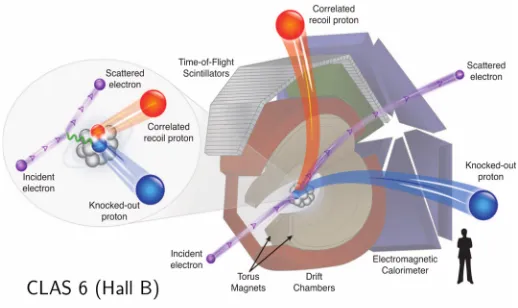
Exclusive hard scattering reactions are a perfect tool to study SRC properties. Modern detector systems with large angular coverage and ability to register both charged and neutral particles, such as CLAS 6 in Fig.1, allow detection of all particles in the final state. The open electron trigger of CLAS 6 allowed search for particular signatures in the stored data.
Figure 1. The CLAS spectrometer. The reaction of hard knockout of two nucleons from the target nucleus by an electron probe is shown. All three final state particles are detected by the spectrometer, which ensures the exclusiveness of the measurement
The resolving power of the measurement is determined by its momentum transfer, and the interpretation relies on the theoretical modeling of the interaction that should account for all possible mechanisms that lead to the same measured final state. In addition to quasi-elastic (QE) scattering from a single nucleon, the full reaction mechanism could include contributions from Meson-Exchange Current, Isobar Currents, and elastic and inelastic nu-cleon rescattering (final state interactions, FSI). In the case of high initial momentum of the struck nucleon, elastic FSI include re-scattering between the nucleons of the pair and/or with the residual system. The relative contribution of these reaction mechanisms, as com-pared to the QE reaction of interest, strongly depends on the reaction kinematics. Mini-mizing non-QE reaction mechanisms also reduces their interference with the QE reaction. The events, where the knocked-out nucleon predominantly belonged to an SRC pair can be selected by requiring a large Bjorken scaling parameter xB = Q2/2mpω ≥ 1.2 (where
Q2 = ~q2−ω2, ~q andω are the three-momentum and energy, respectively, transferred to the nucleus, and mp is the proton mass) and large momentum transfer Q2 > 1.8 GeV2. The events of interest have limited reconstructed missing mass of the two-nucleon system mmiss = [(ω+2mp+Ep)2−p2miss]1/2 ≤ 1.1 GeV, hereEp is the total energy of the lead-ing proton,~pmiss =~pp−~q, where~ppis the measured proton momentum. The events where the leading proton absorbed transferred momentum can be identified by requiring that its momentum~ppis within 25◦of~q.
3 Highlights from the modern SRC picture
scattered 5-9 GeV/c protons (BNL) and electrons (JLab) off high initial momentum (300
≤ pmiss≤600 MeV/c) protons in12Cand looked for a correlated recoil nucleon. The JLab
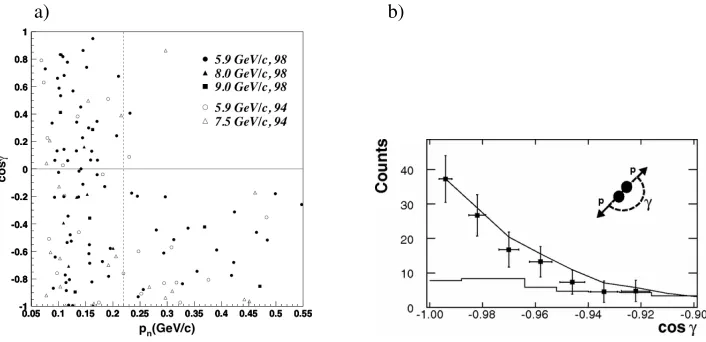
experiment measured both proton and neutron recoils, whereas the BNL experiment mea-sured only recoiling neutrons. The BNL measurement showed that 92% of high momentum leading protons have a recoil neutron emitted in the opposite direction (see Fig. 2a). The shape of the recoil nucleon opening angle distribution, shown in Fig.2b, allowed extracting the pair c.m. motion. This motion can be described by a Gaussian distribution in each di-rection, withσ =143±17 MeV/c(BNL) andσ =136±20 MeV/c(JLab). These values are in overall agreement with theoretical calculations [15,16]. The electron and proton reac-tions are characterized by completely different operators and FSI mechanisms, therefore, the agreement of their c.m. momentum distributions validated the consistent treatment of FSI in these measurements.
a) b)
Figure 2. Distribution of the relative angle (γ) between the reconstructed initial momentum of the knockout proton and the recoil neutron as a function of the recoil neutron momentum pn (a). The vertical dashed line atkF =225 MeV/cmarks the border between the regions with isotropic (pn <kF) and correlated (pn > kF) distributions. (b) projection on cos(γ) axis for scattering off∼500 MeV/c
initial momentum protons. Pictures are adapted from [2,3]
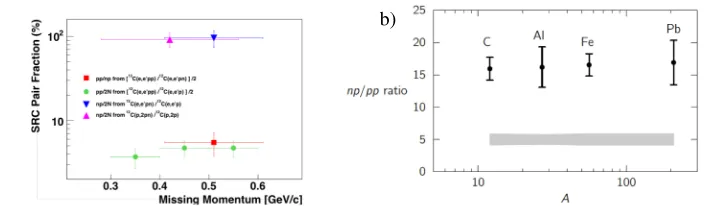
Fig.3a shows the extracted ratio of two-nucleon knockout (neutron and proton-proton) to single proton knockout events (circles and triangles) and the ratio of proton-proton to proton-neutron two-nucleon knockout events (the red square). The ratios are corrected for finite acceptance of the detectors and are shown as a function of the reconstructed initial momentum of knocked-out protonspmiss. The ratio of two-nucleon knockout to single proton knockout is directly related to the fraction of high-momentum protons that are in SRC pairs. Within statistical uncertainties of about 10% all events with a single knocked out proton with initial momentum of 300≤ pmiss ≤600 MeV/chave a recoil nucleon. The ratio between recoil protons and neutrons was found to be approximately 1:10, which corresponds to 20 times morenp-SRC pairs than pp-SRC pairs in12C. The observed dominance of
neutron-proton pairs over neutron-proton-neutron-proton and neutron-neutron ones was associated with the dominance of the tensor part of the nucleon-nucleon interaction at these initial momenta. Recent CLAS-6 data helped to establish np-dominance for a wide range of nuclei (see Fig.3b).
a) b)
Figure 3. a): The ratio of12C(e,e0
pN) events to12C(e,e0
p) events as a function of the reconstructed initial momentum of the knockout proton from the12C(e,e0
p) reaction. The triangles mark knock out of a proton and a neutron by the proton (4, BNL result) and electron (5) probes. The circles mark the knockout of two protons. The square shows the12C(e,e0
pp)/12C(e,e0
p) ratio. Picture is adapted from [4] b) Recent CLAS-6 data analysis established the np-dominance for large range ofA
• SRC exist in nuclei and account for about 20% of nucleons and almost all high momentum (pmiss>kF) nucleons;
• Nucleons within the pair have high momentum (pmiss >kF), and the c.m. momentum of the pair is low (pc.m.<kF);
• np-pairs are about 10 times more likely thanpp- ornn-pairs (np-dominance effect);
• Tensor, spin-dependent interaction within SRC pair.
The areas of immediate interest at this point may include a detailed study of np-dominance for asymmetric and neutron-rich nuclei, investigation of the nucleon structure modifications inside the nucleus. Also, the SRC-formation process is of particular interest, as it might provide valuable insights about the nucleon-nucleon repulsive interaction at short distances. The next section describes the recent analysis results, providing some insights to these aspects of SRC.
4 Recent results from the CLAS-6 data analysis
The work presented in below is collected using a 5.014 GeV electron beam incident on deu-terium, carbon, aluminum, iron, and lead targets. The CLAS spectrometer was used to detect the scattered electron and any associated hadrons knocked out in the interaction (see Fig.1). CLAS uses a toroidal magnetic field and six independent sets of drift chambers, time-of-flight scintillator counters, Cherenkov counters, and electromagnetic calorimeters, covering scattering angles from about 8◦ to 140◦ for charged particle identification and track recon-struction. The neutrons were identified by observing interactions in the forward electromag-netic calorimeters (covering about 8◦ to 45◦) with no associated charged particle tracks in the drift chambers. The neutron detection efficiency as a function of angle and momentum was measured at the same time using thed(e,e0pπ+π−n) reaction. All events with a scattered electron detected in both the electromagnetic calorimeter and the Cherenkov counter, along with any other particles, were recorded.
4.1 High momentum protons and neutrons in asymmetric nuclei
momen-tum (pmiss<kF). The nucleons, which had high momentum before the interaction, presum-ably belong to SRC pairs. And the low initial momentum nucleons likely form shell model states. The ratio between A(e,e’n) and A(e,e’p) events for both samples is shown in Fig.4a. The ratio of knocked out neutrons to protons for low initial momenta grows as N/Z with nu-clei mass number, as expected from simple nucleon counting. However, the (e,e’n)/(e,e’p) high momentum ratios are consistent with unity for all measured nuclei. Therefore, there are equal numbers of high-initial-momentum protons and neutrons in asymmetric nuclei, even though they contain up to 50% more neutrons than protons. This observation is consistent with the idea, that almost all high momentum nucleons within nucleus belong to SRC pairs, even in neutron rich nuclei. Another interesting conclusion is that in neutron rich nuclei the fraction of high-momentum protons is larger, than the fraction of high-momentum neutrons. Fig.4b shows the relative fraction of high momentum protons and neutrons in different nuclei. The double ratios of A(e,e’N) to carbon minimize the experimental and theoretical uncertain-ties for both N: protons and neutrons. The fraction of high momentum protons increases by about 50% from carbon to lead, whereas the corresponding fraction of high momentum neutrons decreases by about 10%±5%. The prediction of a simple phenomenological np-dominance model, which uses a mean-field momentum distribution for low momenta nucle-ons (pmiss<kF) and a scaled deuteron-like tail for nucleons with high momenta (pmiss>kF), is shown in Fig.4b as well. This model agrees with the results. Further details on this analysis can be found in [5].
a) b)
Figure 4.a) The ratios between neutrons and protons with high and low momenta for different nuclei are shown as [A(e,e’n)/σn]/[A(e,e’p)/σp] reduced cross-section ratios. Green circles and magenta
triangles correspond to the samples with low and high initial momentum of the struck nucleon (see inset). b) Red circles show the double ratio of number of (e,e’p) events with proton high and low initial momentum for nucleus A relative to carbon. Red bands show the prediction of the phenomenological
np-dominance model. Blue squares and bands show the same for neutron knock out events. The inset demonstrates how adding neutrons increases the fraction of protons in the high momentum tail. For both plots the inner error bars are statistical, whereas the outer error bars include both statistical and systematic uncertainties. The lines show the simple N/Z expectation and a constant of 1. Pictures are adapted from [5]
4.2 The center-of-mass motion of SRC pairs
momentum distribution of the SRC nucleons can be factorized into the c.m. and relative mo-mentum distributions. This approach is used for effective calculations with scale separation, which agree with many-body calculations. Such scale separation implies, that the relative momentum distribution is a universal function of the short range part of the NN interaction. The nucleus-specific c.m. momentum distribution is then a direct probe for the nuclear many-body dynamics from which SRC pairs are formed.
The reaction of interest is A(e,e’pp), where events of type A(e,e’p) have a second, recoil proton with momentum|~precoil≤|350 MeV/c. The recoil proton was emitted opposite to the leading one. The extracted width (σc.m.) of the center of mass momentum distribution shown in Fig.5is smaller than the Fermi momentum ranging from 140 MeV/cto 170 MeV/cfor the measured nuclei. The extracted width is much smaller than the value of|~pmiss|or|~precoil|, indicating that the nucleons within the pp-SRC pairs have large and opposite momentum. Further details on this analysis can be found in [6].
Figure 5.The width of the c.m. momentum distribution for SRC pairs as a function of nuclear mass. The red full circles show data points obtained in this work. These data agree with the previous mea-surements [12–14] (blue full squares and triangles). Theoretical calculations by Ciofi degli Atti and Simula [16] are shown as open stars, Colle et al. [15] considering all nucleon pairs as a dashed line, and only1S
0pairs as a solid line. Calculations for SRC formation from the Fermi-gas is shown as a semi-dashed line. Figure is adapted from [6]
The measurement is in overall agreement with theoretical calculations [15,16], which are based on the mean-field approach for the c.m. motion of the parent nucleons that create the SRC pairs. This supports the theoretical description, where SRC pairs are formed from temporal fluctuations of mean-field nucleons [17]. Theoretical models can form SRC pairs from nucleons in different states: all nucleon pairs are considered in [16] and [15], nucleons in relative1S0states form SRC in Ref. [15]. The data points lie somewhat inbetween of the
two cases indicating some selectivity for nucleonic states, which can form SRC pairs.
4.3 Modified structure of protons and neutrons in SRC pairs
linear correlation between the number of SRC pairs and the size of the EMC effect [22,23]. Simultaneous measurement of the SRC cross sections and the EMC effect on deuterium and heavier nuclei were done using CLAS 6 data. This allowed determination of observables with better precision.
The EMC effect is characterized by the modification of the per-nucleon Deep Inelastic Scattering (DIS) cross-section or modification of the per-nucleon nuclear structure function, which is believed to be the same [20,21]. The DIS data was selected based on Q2 >1.5 GeV2 and invariant mass of the proton plus virtual photon, W>1.8 GeV. The measured EMC effect, characterized as the approximately linear deviation from unity for 0.3≤ xB ≤
0.7, for different nuclei together with previous data is shown in Fig. 6a. This is the first measurement of EMC effect on lead.
We can model the modification of the nuclear structure function FA2 as entirely due to modification ofnp-SRC pairs:
FA2 =nAS RC(F2p∗+F2n∗)+(Z−nS RC)F2p+(N−nAS RC)Fn2
=ZF2p+NFn2+nS RCA (∆F2p+ ∆F2n), (1) wherenA
S RC is the number of SRC pairs in nucleus A, F p
2 andF
n
2 are the free proton and
neutron structure functions, F2p∗ and Fn∗
2 are the average modified structure functions for
protons and neutrons in SRC pairs, and∆F2p =F2p∗−F2p∗(and the same for∆F2p). F2p∗and Fn∗
2 are assumed to be the same for all nuclei. We use the same parametrization for deuteron
to extractFn
2andF
p
2/F
d
2 [26]. Fig.6b shows the nucleus-independent part expressed in terms
of nucleus-dependent variables from Eq. (1). Although the slope of EMC effect for different nuclei varies with A, the ratio of SRC-modified structure functions is the same for all nuclei within uncertainties. Thus, we conclude, that the magnitude of the EMC effect in different nuclei can be described by the abundance ofnp-SRC pairs and that the proposed SRC-pair modification is, in fact, universal. Further details on this analysis can be found in [7].
a) b)
Figure 6.The EMC effect for different nuclei as ratios of structure functionsFA
2/F
d
2(a) and the modifi-cation of SRC pairs (b) as a function of Bjorken variablexB. Color marks the mass of the nucleus. The open circles are the SLAC data [24] and the open circles are the JLab data [25]. The gray bands show the median normalization uncertainty. Pictures are adapted from [7]
5 Future experiments are designed for high precision
measurements
The new experiments are designed to add order of magnitude more data for better precision and sensitivity for various effects.
There is a number of upcoming SRC experiments planned at JLab, including a number of inclusive scattering measurements. These experiments aim on study how pair production change by adding protons or neutrons to the nucleus (electron scattering on40Ca and46Ca, and56Fe), and studying the structure functions of protons and neutrons by tagging them with high momentum nucleon recoiling from a deuteron target. The hard exclusive scattering SRC program includes the CLAS-12 proposal, which will focus on simultaneous measurements of SRC and EMC effect and tag the recoil. It will use an 11 GeV electron beam incident on a set of targets including liquid deuterium, helium, carbon, silicon, calcium, tin, and lead. The hard exclusive scattering on two isotopes of calcium:40Ca and46Ca will help to disentangle
mass and asymmetry aspects ofnp-dominance. The CLAS spectrometer will detect at the order of 10k events of bothnpandpppairs on each target.
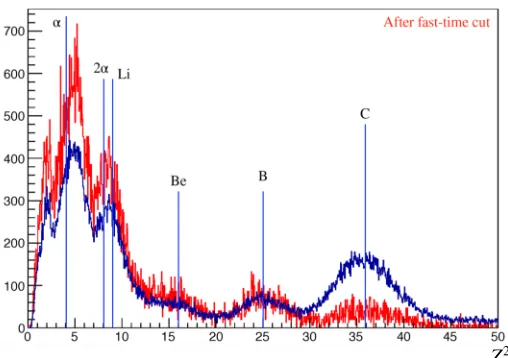
The new SRC experiment at BM@N/Nuclotron setup (JINR) uses inverse kinematics, where a 4 GeV/c carbon beam hits the liquid hydrogen target. This makes it possible to study the properties of the nucleus after interaction. The BM@N spectrometer allows measuring four particles in the final state: both the scattered and the knocked out protons, the recoil and the residual nucleus. The data collected in March 2018 indicates, that we can identify diff er-ent charge states of the residual nucleus, as shown in Fig7. This measurement is expected to be the first in a series of SRC experiments at BM@N in inverse kinematics.
Z2
Figure 7.The squared charge of the residual nucleus. Vertical lines mark squared charge for particular nuclei. The blue spectrum shows all events, whereas the red line corresponds to the rough time cut for the leading and the scattered protons
6 Conclusions
caused by strongly modified SRC nucleons. The upcoming experiments based on hard exclu-sive reactions are designed to perform high-statistics precise measurements of SRC aiming among other things at disentangling mass and asymmetry aspects of thenp-dominance and studying the properties of the residual nucleus after interaction.
References
[1] A. Tang et al., Phys. Rev. Lett.90, 042301 (2003) [2] E. Piasetzky et al., Phys. Rev. Lett.97, 162504 (2006) [3] Shneor et al.,Phys. Rev. Lett.99, 072501 (2007) [4] Subedi et al., Science320, (2008)
[5] M. Duer et al., Nature560, 617 (2018)
[6] E. O. Cohen et al., Phys. Rev. Lett.121, 092501 (2018) [7] B. Schmookler, submitted for publication
[8] R. Weiss, et al., Phys. Lett. B780, 211 (2018) [9] R. B. Wiringa et al., Phys. Rev. C89, 024305 (2014) [10] J. Carlson et al., Rev. Mod. Phys.87, 1067 (2015) [11] T. Neffet al., Phys. Ref. C92, 024003 (2015) [12] A. Tang et al., Phys. Rev. Lett.90, 042301 (2003) [13] R. Schneor et al., Phys. Rev. Lett.99, 072501 (2007) [14] I. Korover et al., Phys. Rev. Lett.113, 022501 (2014) [15] C. Colle et al., Phys. Rev. C89, 024603 (2014)
[16] C. Ciofi degli Atti and S. Simula, Phys. Rev. C53, 1689 (1996) [17] O. Hen et al., Rev. Mod. Phys,89, 045002 (2017)
[18] J. Aubert et al., Phys. Lett. B123, 275 (1983) [19] O. Hen et al., Rev. Mod. Phys.89, 045002 (2017) [20] P. R. Norton, Rep. Prog. Phys.66, 1253 (2003)
[21] S. Malace et al., Int. J. Mod. Phys. E23, 1430013 (2014). [arXiv:1405.1270] [22] L. Weinstein et al., Phys. Rev. Lett.106, 052301 (2011)
[23] O. Hen et al., Phys. Rev. C85, 047301 (2012) [24] J. Gomez et al., Phys. Rev. D49, 4348 (1994) [25] J. Seely et al., Phys. Rev. Lett.103, 202301 (2009)