Scholarship@Western
Scholarship@Western
Electronic Thesis and Dissertation Repository
12-4-2015 12:00 AM
Spectrally-Accurate Algorithm for Flows in 3-Dimensional Rough
Spectrally-Accurate Algorithm for Flows in 3-Dimensional Rough
Channels
Channels
Md Nazmus SakibThe University of Western Ontario
Supervisor J M Floryan
The University of Western Ontario
Graduate Program in Mechanical and Materials Engineering
A thesis submitted in partial fulfillment of the requirements for the degree in Master of Engineering Science
© Md Nazmus Sakib 2015
Follow this and additional works at: https://ir.lib.uwo.ca/etd
Part of the Mechanical Engineering Commons
Recommended Citation Recommended Citation
Sakib, Md Nazmus, "Spectrally-Accurate Algorithm for Flows in 3-Dimensional Rough Channels" (2015). Electronic Thesis and Dissertation Repository. 3366.
https://ir.lib.uwo.ca/etd/3366
This Dissertation/Thesis is brought to you for free and open access by Scholarship@Western. It has been accepted for inclusion in Electronic Thesis and Dissertation Repository by an authorized administrator of
(Thesis format: Monograph)
by
Md Nazmus Sakib
Graduate Program in Mechanical and Materials Engineering
A thesis submitted in partial fulfillment of the requirements for the degree of
Masters of Engineering Science
The School of Graduate and Postdoctoral Studies The University of Western Ontario
London, Ontario, Canada
ii
Abstract
In this work a spectrally accurate algorithm has been developed for the simulation of
three-dimensional flows bounded by rough walls. The algorithm is based on the velocity-vorticity
formulation and uses the concept of Immersed Boundary Conditions (IBC) for the
enforcement of the boundary conditions. The flow domain is immersed inside a fixed
computational domain. The geometry of the boundaries is expressed in terms of double
Fourier expansions and boundary conditions enter the algorithm in the form of constraints.
The spatial discretization uses Fourier expansions in the stream-wise and span-wise
directions and Chebyshev expansions in the wall-normal direction. The algorithm can use
either the fixed flow rate constraint or the fixed pressure gradient constraint; a direct
implementation of the former constraint is described. An efficient solver which takes
advantage of the structure of the coefficient matrix has been developed. Taking the advantage
of the reality conditions enhances the efficiency of the solver both in terms of memory and
computational speed. It is demonstrated that the applicability of the algorithm can be
extended to more extreme geometries using the over-determined formulation. Various tests
confirm the spectral accuracy of the algorithm.
Keywords
iii
Co-Authorship Statement
This dissertation is prepared in monograph format and is based on a manuscript that has been
submitted for publication.
N. Sakib, A. Mohammadi and J. M. Floryan, “Spectrally Accurate Immersed Boundary
Conditions Method for Three-Dimensional Flows”, submitted for publication in the Journal
iv
Dedication
v
Acknowledgments
I am grateful to my supervisor Prof. J. M. Floryan for his assistance and encouragement. This
work would not have been possible without his continual support and guidance.
I would like to express my gratitude to the members of my advisory committee, Prof. A. G.
Straatman and Prof. E. Savory for their invaluable suggestions and insightful comments.
I would also like to thank my colleagues Alireza Mohammadi, Hadi Vafadar Moradi,
Mohammad Zakir Hossain, Sahab Zandi, Amirreza Seddighi and Seyed Arman Abtahi for
their friendship, support and motivation. I am particularly indebted to Alireza Mohammadi
for his guidance throughout this whole work.
Finally, I would like to mention that this work has been carried out with support from the
vi
Table of Contents
Abstract ... ii
Co-Authorship Statement ... iii
Dedication ... iv
Acknowledgments ... v
Table of Contents ... vi
List of Figures ... viii
List of Appendices ... xi
List of Abbreviations, Symbols and nomenclature ... xii
Section 1 ... 1
1 Introduction ... 1
Section 2 ... 5
2 Problem Formulation... 5
2.1 Geometry of the Flow Domain ... 5
2.2 Governing Equations ... 6
2.3 Flow in a Smooth Channel ... 7
2.4 Flow between Rough Walls ... 7
Section 3 ... 10
3 Numerical Solution of the Problem ... 10
3.1 Forms of the Governing Equations Suitable for the Numerical Solution ... 10
3.2 Discretization Method ... 12
3.2.1 Discretization of the Field Equations ... 14
3.2.2 Discretization of the Boundary Conditions ... 21
3.2.3 Discretization of the Flow Rate Constraint ... 24
vii
4.1 Specialized Direct Solver ... 32
4.2 Implementation of the Reality Conditions ... 36
Section 5 ... 39
5 Evaluation of the Pressure Field ... 39
Section 6 ... 41
6 Performance of the Algorithm ... 41
Section 7 ... 53
7 Over-determined Formulation ... 53
Section 8 ... 59
8 Limitations of the Algorithm... 59
Section 9 ... 60
9 Conclusion ... 60
References ... 62
Appendices ... 66
Appendix A ... 66
Appendix B ... 67
Appendix C ... 67
viii
List of Figures
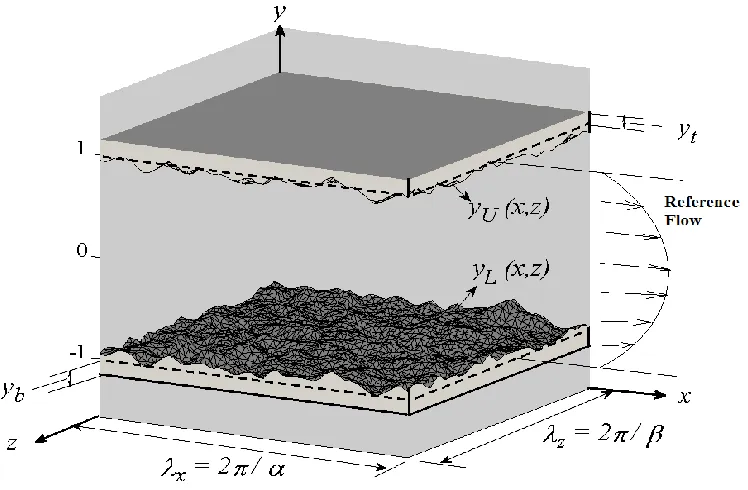
Figure 1: Sketch of the flow and computational domain. ... 6
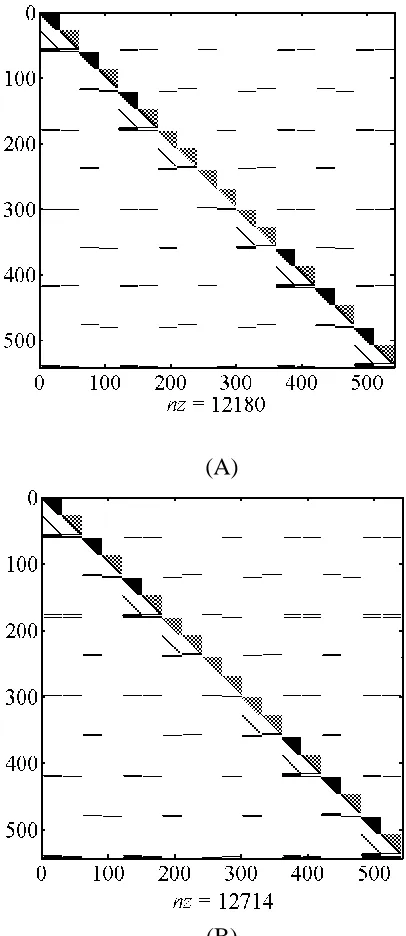
Figure 2: Structure of the coefficient matrix for , For the fixed
pressure gradient constraint (Fig. 2A) ( )( ) and for the fixed flow
rate constraint (Fig. 2B) ( )( ) . The black color identifies the
non-zero elements with giving their total number. The blocks assume various shades of
grey depending on the density of the non-zero elements. ... 33
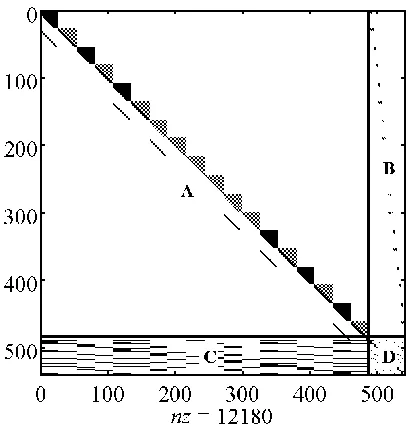
Figure 3: The structure of the re-arranged coefficient matrix for ,
The black color identifies the non-zero elements with giving their total number. The
blocks assume various shades of grey depending on the density of the non-zero elements. .. 35
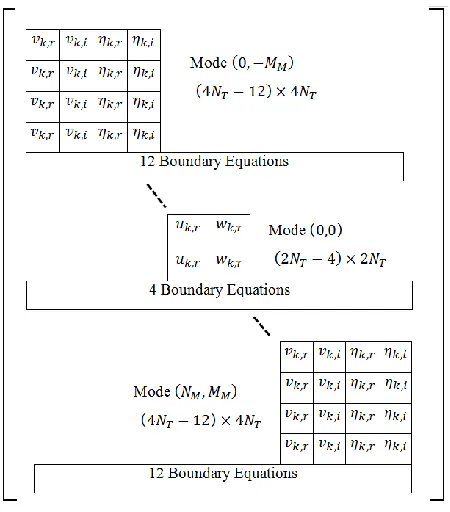
Figure 4: Schematic diagram of the coefficient matrix for the fixed pressure gradient
constraint with all unknowns separated into real and imaginary parts. Each small block
contains coefficients of the unknowns written in the block. ... 37
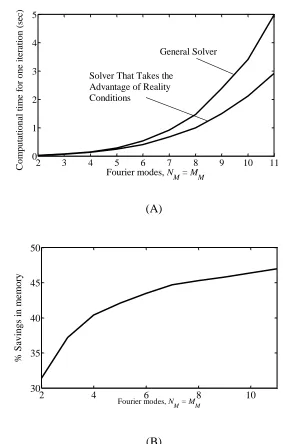
Figure 5: Variations of the computational time per iteration (Fig. 5A) with and without taking
advantage of the complex conjugate property and variations of the memory savings when
taking advantage of the complex conjugate property (Fig. 5B) as functions of the number of
Fourier modes used in the solution. Chebyshev polynomials have been used in the
tests. ... 38
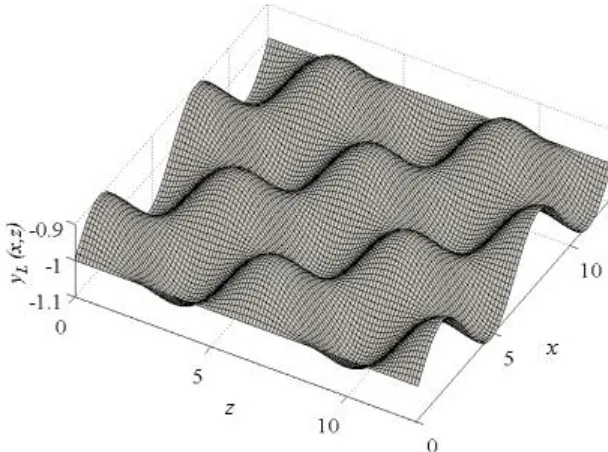
Figure 6: Geometry of the lower wall described by (6.1) with , for two
periods in the x- and z-directions. ... 41
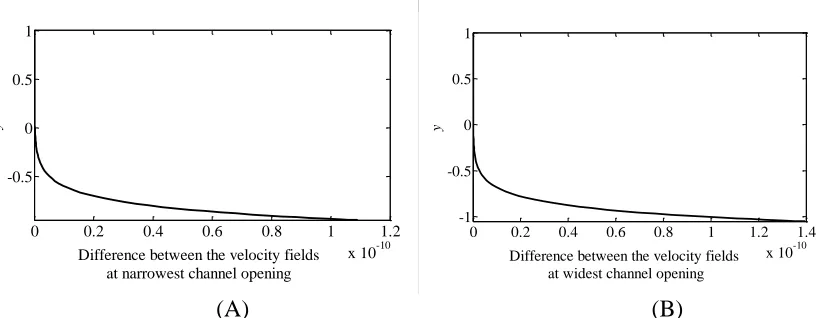
Figure 7: Difference between the velocity fields obtained by current algorithm and algorithm
described by [14] for transverse grooves at narrowest channel opening (Fig.7A) and widest
channel opening (Fig.7B). Calculations have been carried out with and for
ix
described by [14, 15, 35] for transverse grooves at narrowest channel opening (Fig.8A) and
widest channel opening (Fig.8B). Calculations have been carried out with and
for . ... 42
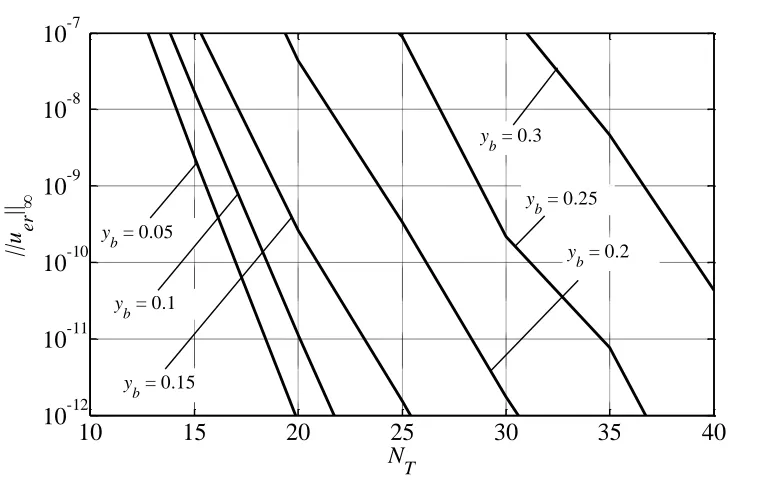
Figure 9: Variation of as a function of the number of Chebyshev polynomials NT
used in the solution. Calculations have been carried out with for the
roughness geometry described by (6.1) with for . ... 44
Figure 10: Variation of the modal functions close to the rough boundary. Calculations have
been carried out with for the roughness geometry described by (5.1) ,
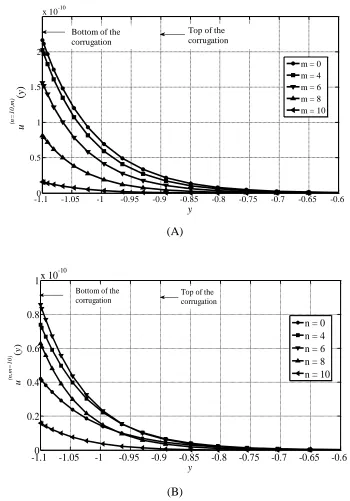
for . In Fig. 8A, m changes while n = 10 and in Fig.8B n changes while m =
10. Formation of boundary layers near the rough wall and rapid growth of modal functions
across these layers are clearly visible. ... 45
Figure 11: Variation of the Chebyshev norm of the modal function ( ) as a function of
the Fourier mode index for the roughness geometry described by (6.1) with
for . Computations have been carried out with Fourier modes and
Chebyshev polynomials. ... 46
Figure 12: Variation of ‖ ‖ and ‖ ‖ as a function of the number of Fourier modes
used in the computations for the roughness geometry described by (5.1) with for
Re = 5. Calculations have been carried out using , and (Fig. 10A) and
(Fig. 10B). ... 47
Figure 13: Distributions of the boundary errors ( ) (Fig. 11A), ( ) (Fig.
11B) and ( ) (Fig.11 C) for the roughness geometry described by (5.1) with
for Re = 5 over one period in the x- and z-directions. ... 49
Figure 14: Spectral decomposition of ( ) for the roughness geometry described by
(6.1) with , for Re = 5. Results displayed in Fig. 12A have been obtained
using computational box with , and Fourier modes and those
x
were used. ... 50
Figure 15: Variations of the error norm ‖ ‖ as a function of the roughness amplitude
(Fig.13 A) and as a function of the roughness wave number with (Fig.13 B) for the
roughness geometry described by (6.1). Calculations have been carried out using
Chebyshev polynomials and (solid lines) and (dash lines)
Fourier modes. ... 51
Figure 16: Variation of the error norm ‖ ‖ as a function of the Reynolds number Re
for the roughness geometry described by (6.1) with and different values of .
Computations have been carried out using Chebyshev polynomials and
Fourier modes. ... 52
Figure 17: Structure of the coefficient matrix for the over-determined formulation with
, and . Black color represents the non-zero
elements with denoting their number. Figure 15A displays the initial form of the matrix
while Fig. 15B shows the form after extractions of the largest diagonal matrix A from H. The
blocks assume various shades of grey depending on the density of the non-zero elements. .. 56
Figure 18: Spectral decomposition of ( ) at the rough wall for the roughness
geometry described by (6.1) with , for Re =10. Computations have
been carried out using Chebyshev polynomials, Fourier modes for
the field equations, and Fourier modes for the boundary conditions. .... 57
Figure 19: Variations of the error norm ‖ ‖ as a function of the roughness amplitude
(Fig.17 A) for the roughness geometry described by (6.1) with for Re = 10 and
as a function of the roughness wave number (Fig.17 B) for the roughness amplitude
= 0.08. Calculations have been carried out using Chebyshev polynomials and
Fourier modes for the field equations. ... 58
xi
List of Appendices
Appendix A: Analysis of Mode (0,0)... 64
Appendix B: Determination of Chebyshev Expansion Coefficient for a Known Modal
Function ………..65
Appendix C: Evaluation of Fourier expansions representing periodic functions formed by
the values of the Chebyshev polynomials, its derivatives and the reference flow velocity
xii
List of Abbreviations, Symbols and nomenclature
Abbreviations
IB Immersed boundary
IBC Immersed boundary conditions
RF Relaxation factor
FFT Singular value decomposition
SVD Singular value decomposition
Nomenclatures used in Section 2
( ) Physical coordinate system
, Shape of the upper wall in the physical coordinate system
, Wave numbers in the x- and z-directions
, Wave lengths in x- and z-directions
, Number of Fourier modes used in the x- and z-direction to
describe the roughness geometry
( )
, ( ) Fourier expansion coefficients of the upper and lower wall in the physical coordinate system.
Mean channel opening
Maximum velocity of the reference flow in the direction of total
pressure gradient
Reynolds number
xiii
⃗ , ⃗ Reference velocity vector and total velocity vector
, , Components of total velocity in the x-, y- and z-directions
Components of reference velocity in the x-, y- and z-directions
Modification velocity components in the x-, y- and z-directions
, , Total pressure, reference pressure and pressure modification
, Mean pressure gradient components in the x- and z-directions
, Modifications of the mean pressure gradient components in the
x- and z-directions
( ) Mean flow rate in the x- and z-directions
, Reference flow rate and flow rate modification in the x-direction
, Reference flow rate and flow rate modification in the z-direction
Mean Pressure gradient in the x-direction
Nomenclatures used in Section 3
⃗⃗ , ⃗⃗ , ⃗⃗ Vorticity vector for total flow, reference flow and flow
modification
, , Components of total vorticity in the x-, y- and z-directions
Components of modification vorticity in the x-, y- and z
-directions
xiv
, , Nonlinear terms associated with x-, y- and z-momentum
equations
( ̂ ) Computational coordinate system
Constant for coordinate transformation
, Locations of extremities for the upper and lower wall
̂ , ̂ Shape of the upper and lower wall in the transformed coordinate
system
( )
, ( ) Fourier expansion coefficients of the upper and lower wall in the transformed coordinate system.
( ) ( ) ( ),
( )
Modal functions for wall-normal vorticity, and the modification
velocity components in the x-, y- and z-directions
Derivative with respect to the transverse direction
〈 〉( ), 〈 〉( )
〈 〉( ), 〈 〉( )
〈 〉( ), 〈 〉( )
Modal functions of the velocity products
( )
, ( ), ( ),
( )
Chebyshev expansion coefficients of the modal functions
representing the vorticity and velocity components
th Chebyshev polynomial of first kind
Order of Chebyshev polynomials used for discretization of the
xv
( )( ) ( )( )
( )( ) ( )( )
( )( ) ( )( )
Chebyshev expansion coefficients of the modal functions of the
velocity products
Weight function
( ), ( ) Coefficient of Fourier expansions for ( ̂ ( )) and
( ̂ ( ))
( )( ), ( )( ) Coefficients of Fourier expansions for the Chebyshev polynomials at the upper and lower wall.
( )( ), ( )( ) Coefficients of Fourier expansions for the first derivative of the Chebyshev polynomials at the upper and lower wall.
( ) Flow rate in the x-direction
( )
Fourier expansion coefficient of the flow rate in the x-direction
Nomenclatures used in Section 4
, , Coefficient matrix vector of unknowns and right-hand side
vector
, , , Sections of rearranged coefficient matrix
, Vector of unknowns for the rearranged system of equations
, Right-hand side vectors for the rearranged system of
equations
( )
xvi ( )
( )
, ( ) , ( )
( )
Imaginary part of the modal functions for wall-normal
vorticity and the three velocity components.
Nomenclatures used in Section 6
Error norm for the whole physical domain
Error norm for the boundary
( ) Error for whole physical domain
( ) Error at the rough boundary
( ) Computed solution for the whole physical domain
( ) Reference solution for the whole physical domain
( ( ) ) Solution computed at the rough boundary
Nomenclatures used in Section 7
, Number of Fourier modes used for boundary constraints in
the x- and z-directions for the over-determined formulation
, , Coefficient matrix, vector of unknowns and right-hand side
vector for the over-determined system
, Sections of rearranged coefficient for the over-determined
xvii
Generalized inverse of
, , Matrices used in QR factorization
, , , Matrices used in SVD method
, , , Sections of the rearranged coefficient matrix
Section 1
1
Introduction
Roughness can be found in almost every type of flow systems. They have the ability to
enhance or deteriorate the functionality of a flow system. The history of the study of the
effect of surface roughness on fluid flow dates back to the works of Hagen and Darcy [1,
2] who concluded that roughness always increases flow resistance. The quantification of
average drag in terms of friction factor was accomplished by Nikuradse and Moody [3, 4]
who also demonstrated that the drag in laminar flow regime is independent of surface
roughness.
The prevailing belief of surface roughness always increasing drag was first contradicted
by Walsh [5, 6]. His experiments on flows over stream-wise grooves in the form of
riblets demonstrated that surface roughness can reduce turbulent drag. In their works on
drag reducing longitudinal grooves (riblets), Choi, Moin and Kim [7] and Chu and
Karniadakis [8] concluded that though these kinds of grooves have the capability to
reduce turbulent drag, they always increase laminar drag.
The pressure losses for laminar flows over rough surfaces regained the focus because of
the growing interest on the flows in micro-channels and the deviation from the classical
theory found in the works of Papautsky et al, Sobhan and Garimella, Morini, Sharp and
Adrian, and Gamrat et al [9-13]. Mohammadi and Floryan [14] investigated the pressure
losses in grooved channels for laminar flows and found the potential to obtain laminar
drag reducing grooves by proper shaping of the grooves. Mohammadi and Floryan [15]
also studied the drag reducing longitudinal grooves and determined the optimal shape for
such kind of grooves.
The main difficulty associated with the numerical solution of flow problems bounded by
rough walls is modeling the effect of surface roughness. Methods based on the mapping
of the irregular boundary into a rectangular domain can provide very high accuracy.
However, these methods suffer from two main disadvantages. The coefficient matrix
computational cost [16]. This draw back becomes prominent for unsteady problems as
the coefficient matrix is reconstructed at each time step. Moreover, these algorithms have
limitations in terms of geometry as they cannot handle singularity in the mapping.
The immersed boundary (IB) method provides a general conceptual basis for developing
efficient computational tools to solve flow problems involving complex boundary
geometries. The original concept was proposed by Peskin [17] in the context of cardiac
mechanics problems. The method works by discretizing the governing equations within a
regular computational domain that surrounds the complex flow domain. Special
procedures are then used to enforce the boundary conditions along the physical
boundaries, immersed within the computational domain. The computational efficiency of
this class of methods stems from the elimination of the cost of generating boundary
conforming grids.
The essence of the IB method is to impose forcing at the edge of the computational
domain so that the flow quantities evaluated along the edge of the physical domain
assume values specified by the boundary conditions. Various implementations have been
developed over the past few decades [18, 19] with the forcing applied in either a
continuous or discrete manner. The majority of implementations apply low-order
finite-difference, finite-volume or finite-element techniques for the spatial discretization
[20-22] resulting in limited spatial accuracy. Some recent implementations employ spectral
discretization to improve the solution accuracy although the complete solutions are
nevertheless not spectrally accurate [23, 24].
A fully, spectrally-accurate version of the IB method, referred to as the Immersed
Boundary Conditions (IBC) method was proposed in [25] for two-dimensional flow
problems. The geometry of the physical boundaries is described by Fourier expansions
which limits the applicability of the method to periodic domains. The method is
nevertheless applicable to a very wide class of problems of physical interest. The
discretization relies on two types of Fourier expansions, one for the field variables and
one for the boundary conditions. The boundary relations responsible for the enforcement
conditions with spectral accuracy. Use of the Chebyshev expansions in the non-periodic
direction makes the algorithm effectively gridless and, thus, allows quick adaptation to
different geometries. The IBC method has been extended to unsteady problems involving
both fixed [16] and time-dependent boundary shapes [26-29]. It has also been extended to
three-dimensional problems described by the Laplace operator [30]. From an application
perspective, the method has been instrumental in the search for drag reducing grooves
[14, 15 and 31] as well as in the analysis of instabilities of shear layers bounded by
grooved surfaces [32-38].
The construction of the boundary relations yields a number of constraints in the IBC
method in excess of what is required to form a closed system of algebraic equations [39].
The “classical” formulation retains enough of these constraints corresponding to the
lowest Fourier modes to form a closed system. Although spatial discretizations using
Fourier and Chebyshev expansions lead to the coveted spectral convergence properties,
the computational cost of the method increases very rapidly with increasing boundary
complexities. This cost may be lowered by using the over-determined formulation where
the number of boundary relations is in excess of the field equations [39]. The cost can
also be lowered by using specialized linear solvers [40, 41].
The above discussion shows that most of the existing efforts, with the exception of [30],
have been focused on two-dimensional problems. There is therefore a need to develop an
extension of the IBC method suitable for the analysis of three-dimensional flows. One
needs to pay attention to the memory and computational cost as both of them increase
rapidly with increased geometric complexity. This is so because the modal equations
resulting from the discretization of the field equation are coupled through boundary
properties, unlike the case of a smooth channel [42].
The present work deals with the development of the three-dimensional version of the IBC
method with applications focused on the analysis of flows in domains bounded by rough
walls. Section 2 introduces the model problem. Section 3 describes the numerical
formulation of the problem. In particular, Section 3.1 discusses the velocity-vorticity
presents the discretization of the field equations, Section 3.2.2 discusses the discretization
of the boundary conditions and Section 3.2.3 presents the discretization of the flow
constraints. Section 4 is focused on the solution process. In particular, Section 4.1
describes the specialized linear solver used repeatedly during the iterative solution
process while Section 4.2 discusses efficiencies resulting from taking advantage of the
complex conjugate property of the unknowns. Section 5 discusses the evaluation of the
pressure field. Section 6 discusses testing of the algorithm. Section 7 presents the
over-determined formulation of this algorithm and discusses the range of its applicability.
Section 2
2
Problem Formulation
The mathematical formulation of the problem has been presented in this section. Section
2.1 describes the geometry of flow domain, section 2.2 provides the governing equations,
the reference flow has been introduced in section 2.3 and section 2.4 presents the flow
between rough walls.
2.1
Geometry of the Flow Domain
Consider a channel formed by rough walls extending to in the x- and z-directions.
The upper and lower walls are located at ( ) and ( ), respectively. It is
assumed that the roughness is periodic in the x- and z-directions with wavelengths
and where and stand for the wave numbers in the x- and z
-directions, respectively (Figure 1). The channel geometry can be described using Fourier
expansions of the form
( ) ∑ ∑ ( ) ( )
(2.1a)
( ) ∑ ∑ ( ) ( )
(2.1b)
where half of the mean channel opening has been used as the length scale
and and denote the number of Fourier modes required for the description of the
roughness geometry in the x- and z-directions. The expansion coefficients satisfy the
reality conditions of the form ( ) ( ) , ( ) ( ) , ( )
( )
and ( ) ( ) where star denotes the complex conjugates. As we
are interested in the effect of flow modulations, we assume that the mean openings of the
rough channel and the reference smooth channel are the same and, thus,
( )
Figure 1: Sketch of the flow and computational domain.
2.2
Governing Equations
Flow in the channel is driven by a pressure gradient parallel to the ( )-plane. The
velocity and pressure fields are described by the continuity and Navier-Stokes equations
of the form
⃗ (2.3a)
( ⃗ ) ⃗ ⃗⃗⃗ (2.3b)
where . /, ⃗ ( ) is the velocity vector with , , denoting
components in the x-, y-, and z-directions, respectively, ⃗ .
/, and
p stands for the pressure. In the above, and have been used at the velocity
discussed in Section 2.3. The Reynolds number is defined as ⁄ where
denotes the kinematic viscosity.
The flow is subject to the no-slip and no-penetration conditions at the walls of the form
⃗ at ( ) and ( ). (2.4)
2.3
Flow in a Smooth Channel
Flow in the smooth channel represents the reference case and the corresponding velocity
and pressure field have the form
⃗ ( ) 0 ( ) ( )1 (2.5a)
(2.5b)
where ⃗ ( , , ) is the reference velocity vector, stands for the reference
pressure and and denote the pressure gradient components in the x- and z
-directions, respectively. The total pressure gradient and its components are related
according to the following relation
√ . (2.6)
As the fluid flows in the direction of the total pressure gradient, one can choose either the
x- or z-axis to coincide with this direction without loss of generality. The velocity scale
is chosen as the maximum of the velocity of the reference flow in the direction of
the total pressure gradient.
2.4
Flow between Rough Walls
We shall represent flow between the rough walls as a sum of the reference flow and flow
⃗ ( ) ( ( ) ( ) ( ))
( ( ) ( ) ( ) ( ) ( )), (2.7a)
( ) ( ) ( ) ( ) (2.7b)
where subscripts 0 and 1 refer to the reference flow and the flow modification,
respectively, and denote the modifications of the mean pressure gradient in the x-
and z-directions, respectively, and ( ) denotes the periodic part of the pressure
modifications.
Substitution of (2.7) into (2.3) yields the following form of the field equations
(2.8a) . /
. / (2.8b)
. /
. / (2.8c)
. /
. / (2.8d)
The boundary conditions (2.4) can be expressed in the form
( ( )) ( ( )) (2.9a)
( ( )) ( ( )) (2.9b)
( ( )) (2.9c)
( ( )) ( ( )) (2.9e)
( ( )) ( ( )) (2.9f)
The above system needs two closing conditions. We shall consider either the fixed flow
rate constraint or the fixed pressure gradient constraint in both the x- and z-directions. To
apply the fixed flow rate constraint we assume that the mean flow rates in x- and z
-directions are known. This constraint in the x-direction takes the form of
( ) ⁄ ∫ ⁄ ∫ ( )( ) ( )
⁄ ∫ ⁄ ∫ ( )( ), ( ) ( )-
(2.10)
where and are the reference flow rate and the flow rate modification due to
roughness, respectively. can be specified arbitrarily with = 0 implying that the
flow rates in the smooth and rough channels are the same. The flow rate constraint in the
z-direction can be specified in a similar manner and involves and .
The fixed pressure gradient constraints correspond to the specification of the mean
pressure gradients in both the x- and z-directions. The mean pressure gradient in the x
-direction can be expressed as
(2.11)
where and refers to the pressure gradient of the reference flow and the roughness
induced modification, respectively. can be selected arbitrarily with = 0 implying
that flows in the smooth and rough channels are driven by the same pressure gradient.
The pressure gradient constraint in the z-direction can be specified in a similar manner
Section 3
3
Numerical Solution of the Problem
This section contains the numerical solution of the flow problem. Section 3.1 provides
the suitable form of the governing equations for numerical solution. Section 3.1 deals
with the numerical discretization of the problem where, 3.2.1 presents the discretization
of the field equations, section 3.2.2 discusses the discretization of the boundary
conditions and section 3.2.3 presents the discretization of the fixed flow rate constraint.
3.1
Forms of the Governing Equations Suitable for the
Numerical Solution
We shall use the velocity-vorticity formulation. The vorticity vector is defined as
⃗⃗ ( ) ⃗ . ( ) ( ) ( )/ ⃗⃗ ( ) ⃗⃗ ( ) (3.1)
where
⃗⃗ ( ) (3.2a)
⃗⃗ ( ) . / (3.2b)
In the above, ⃗⃗ stands for the vorticity of the reference flow and ⃗⃗ denotes the vorticity modifications. The field equations can be reduced to a system of two equations for the wall-normal vorticity and velocity components, i.e. for and , in the form of
( ) . / ( ) (3.3a) (3.3b) where (3.4a) .
( ) ( ) ( ) (3.4c)
( ) ( ) ( ) (3.4d)
( ) ( ) ( ) (3.4e)
The nonlinear terms have been placed on the right hand sides as these terms are
considered known during the iterative solution process. The solution of (3.3) provides
and while and are determined from the continuity equation and the definition of
the wall-normal vorticity by solving the following system
. / , (3.5a)
. / . /. (3.5b)
The appropriate form of the boundary conditions expressed in terms of and will be
presented later in the text.
The above formulation has two limiting cases. Surface roughness in the form of
transverse grooves results in two-dimensional flow modifications. In this case the
vorticity equation (3.3b) is identically satisfied and the wall normal vorticity becomes
zero. The velocity equation (3.3a) reduces to
( ) ( )
.
/ (3.6)
which is equivalent to the equation studied in [42].When the roughness has the form of
longitudinal grooves, the flow modifications are independent of the direction of the
reference flow, the normal and spanwise velocity modifications disappear, the velocity
equation (3.3a) is identically satisfied and the vorticity equation reduces to the form
which is equivalent to the x-momentum equation simplified for such flow configurations
and studied in [14].
In the present case, the wall-normal velocity and vorticity equations are solved as a
system in both special cases and the properties of the limiting solutions are used for
verification of the consistency of the algorithm.
3.2
Discretization Method
We wish to determine the solution of the flow problem presented in the previous section
with spectral accuracy. We shall use the Immersed Boundary Conditions (IBC) concept
in order to deal with the irregularity of the solution domain. We select a fixed rectangular
computational domain extending over one period in the x- and z-directions and extending
in the y-direction in such a way that the rough boundaries are completely submerged
inside the computational domain and replace the flow boundary conditions with the
equivalent boundary constraints. Figure 1 illustrates the form of the computational
domain. We shall use Chebyshev polynomials for discretization in the transverse
direction and, in order to use their standard definition, the y-extent of the computational
domain needs to be mapped into , -. A mapping of the form
̂ , ( )- (3.8)
is used where ̂ , -, ( ), and and stand for the locations of
extremities of the upper and lower walls (see Fig.1), respectively.
The wall geometries are expressed in the new coordinate system in the form of
̂ ∑ ∑ ( ) ( ) (3.9a)
̂ ∑ ∑ ( ) ( ) (3.9b)
where
( ) 0 ( )1
( ) 0 ( ) ( )1 ( ) ( )
for ( ) ( ) (3.10b)
The governing equations transform to the following form
.
̂ / . / .
̂ /
̂ ̂ (3.11a)
. ̂ /
̂
̂ (3.11b)
where
(3.12a)
.
/ . / (3.12b)
( ) ̂( ) ( ) (3.12c)
( ) ̂( ) ( ) (3.12d)
( ) ̂( ) ( ) (3.12e)
The fixed flow rate constraint in the new coordinate system is expressed as follows
( ) ⁄ ∫ ⁄ ∫ ̂ ̂( )( )0 ( ̂) ( ̂ )1 ̂ (3.13)
while the form of the fixed pressure gradient constraint remains unchanged, i.e. it is given
3.2.1
Discretization of the Field Equations
The unknowns are represented as Fourier expansions in the periodic directions of the
form
( ̂ ) ∑ ∑ ( )( ̂) ( )
∑ ∑ ( )( ̂) ( ) (3.14a)
( ̂ ) ∑ ∑ ( )( ̂) ( )
∑ ∑ ( )( ̂) ( ) (3.14b)
( ̂ ) ∑ ∑ ( )( ̂) ( )
∑ ∑ ( )( ̂) ( ) (3.14c)
( ̂ ) ∑ ∑ ( )( ̂) ( )
∑ ∑ ( )( ̂) ( ) (3.14d)
where and represent truncations in the x- and z-directions, respectively, and
( ) ( ) ( ), ( ) are the modal functions for the wall-normal vorticity and
the streamwise, wall-normal and spanwise velocity components, respectively. The modal
functions satisfy the reality conditions of the form ( ) ( ) ( )
( ) ( ) ( ) ( ) ( ) , ( ) ( ) , ( ) ( ) , ( ) ( ) , ( ) ( ) where star denotes the complex
conjugates.
Substitution of (3.14) into (3.11) and separation of Fourier modes lead to a system of
ordinary differential equations for the modal function of the form
0
( ) ( )1 ( )( ̂)
.
/ ( )( ̂) ( ) ( )( ̂)
( ) (3.15b)
for and where
(3.16a)
(3.16b)
(3.16c)
( ) [ ( ) ( )]
( ) (3.16d)
( ) ( ) ( )
(3.16e)
( ) 〈 〉( ) 〈 〉( ) 〈 〉( ) (3.16f)
( ) 〈 〉( ) 〈 〉( ) 〈 〉( ) (3.16g)
( ) 〈 〉( ) 〈 〉( ) 〈 〉( ) (3.16h)
In the above, 〈 〉( ) denotes the Fourier coefficients of the product ( ), i.e.
( ) ∑ ∑ 〈 〉( )( ̂) ( )
. (3.17)
Similar notation is used for the other products, i.e. ( ) ( ) ( ) ( ),
( ). Functions , , , , , which are treated as known during the solution
process, are replaced by their Fourier expansionswith ( ), ( ), ( ), ( ),
( ) representing the relevant modal functions. Equation (3.15) represents a
sixth-order sub-system for each modal function and requires six boundary conditions. Solution
of the complete system results in the determination of the modal functions for and .
The modal form of (3.5) provides expressions for the evaluation of the modal function for
( )( ̂)
[
( ) ( )] , (3.18a)
( )( ̂)
[
( ) ( )]. (3.18b)
System (3.15) written for n = m = 0 leads to ( ) and ( ) (see Appendix A)
and, thus, it does not provide a basis for the evaluation of both ( ) and ( ). As these
two components contribute to the nonlinear terms, it is necessary to provide other means
for their determination. Here we return to the primitive variables, substitute
(3.14b)-(3.14d) into the x- and z-components of the momentum equation (2.3b) and extract
modes ( ) ( ) to arrive at
( ) 〈 〉( ) (3.19a)
( ) 〈 〉( ) (3.19b)
The above system is fourth-order, requires four boundary conditions and involves two
unknown constants, i.e. and . For the fixed pressure gradient constraints, both and
are specified. For the fixed flow rate constraint, the specified flow rate corrections
and provide conditions required for the determination of and . We shall discuss
the numerical implementation of these conditions later in this presentation.
The solution of the modal equations (3.15) and (3.19) begins with expressing the modal
functions in terms of Chebyshev expansions of the form
( )( ̂) ∑ ( ) ( ̂) ∑ ( ) ( ̂)
(3.20a)
( )( ̂) ∑ ( ) ( ̂) ∑ ( ) ( ̂)
(3.20b)
( )( ̂) ∑ ( ) ( ̂) ∑ ( ) ( ̂)
(3.20c)
( )( ̂) ∑ ( ) ( ̂) ∑ ( ) ( ̂)
where ( ), ( ), ( ) and ( ) are the Chebyshev expansion coefficients for the
modal functions of ( ), ( ), ( )and ( ), denotes the kth-order Chebyshev
polynomial of the first kind and is the number of Chebyshev polynomials retained in
the solution.
Algebraic equations for the Chebyshev expansion coefficients are constructed using the
Galerkin projection method. Equations (3.20) are substituted into (3.15) and (3.19), and
projections of residua onto the base functions are set to zero. This process is explained
using equation (3.15a) as an example and similar processes are used with the remaining
equations.
Substitution of (3.20) into (3.15a) provides the following expression
∑ 0
( )
( ) 1 ( )
[ 〈 〉( ) 〈 〉( )]
[( ) 〈 〉( ) 〈 〉( ) ( ) 〈 〉( )
〈 〉( )] [ 〈 〉( ) 〈 〉( )] (3.21)
where ( ) on the right hand side is written in an explicit manner. All terms on the
right hand side are considered to be known and need to be expressed in terms of
Chebyshev expansions as follows
[〈 〉( ) 〈 〉( ) 〈 〉( ) 〈 〉( ) 〈 〉( ) 〈 〉( )]( ̂)
∑ 0( )( ) ( )( ) ( )( ) ( )( ) ( )( ) ( )( )1 ( ̂)
(3.22)
where ( )( ) ( )( ) ( )( ) ( )( ) ( )( ) ( )( ) are
the k-th expansion coefficient for the modal function (m,n) of the product (u1u1). These
coefficients need to be recomputed at the beginning of each iteration with the relevant
method described in Appendix B.
Substitution of (3.22) into (3.21) provides the following expression for the residue
function
∑ 0
( )
( ) 1 ( ) ∑ 20 ( )( )
( )( )1 0 ( )( ) ( )( ) ( )( )
( )( )1 0 ( )( ) ( )( )1 3 ( ̂)
(3.23)
Its projections onto the base functions are expressed in terms of the inner product defined
as
〈 ( ̂) ( ̂)〉 ∫ ̂ ̂ ( ̂) ( ̂) ( ̂) ̂ (3.24)
where √ ̂⁄ is the weight function. Equation (3.24) can be written explicitly
as
∑ 0 〈 〉
〈 〉
〈 〉 〈 〉
〈 〉 〈 〉 〈 〉 〈 〉
〈 〉1 ( ) ∑ 20 ( )( ) ( )( )1〈 〉
0 ( )( ) ( )( ) ( )( ) ( )( )1〈 〉
0 ( )( ) ( )( )1〈 〉3 (3.25a)
where , with ( ) ( ). This process results in
equations for each modal function, however, we shall retain only the first –
A similar process applied to (3.15b) results in
∑ 0. 〈 〉
〈 〉 〈 〉 〈 〉/
( )
( 〈 〉 〈 〉) ( )1
∑ 20 ( )( ) ( )( )1〈 〉 0( )( )( )
( )( ) ( )( )13 (3.25b)
where we retain only – leading equations, and applied to (3.19) leads to
∑
( )〈 〉
〈 〉 ∑ ( )( )〈 〉
(3.26a)
∑
( )〈 〉
〈 〉 ∑ ( )( )〈 〉
(3.26b)
where we also retain only – of the leading equations. The inner products of the
Chebyshev polynomials found in (3.25)-(3.26) are given analytically in the form of
〈 〉 {
⁄ (3.27)
The inner products involving the derivatives of the Chebyshev polynomials can be
expressed analytically with the help of the following relations
( ̂) , ( ̂) ̂, ( ̂) ̂ ( ̂) ( ̂) (3.28)
( ̂) , ( ̂) , ( ̂) (3.29)
Evaluation of the inner products involving the reference flow quantities is explained
using 〈 〉 as an example. ( ̂) is expressed in terms of the Chebyshev expansion
of the form
( ̂) ∑ ( ̂), (3.31)
where stands for the expansion coefficients. According to (2.5) and (3.8), ( ̂) can
also be expressed as
( ̂) ( ̂ ̂ ) (3.32)
where, and . Comparison of (3.31) and (3.32) results in
. /,
, . (3.33)
The inner product 〈 〉 can be written as
〈 〉 ∫ ̂ ̂ ∑ ̂ ∑ ∫ ̂ ̂ ̂ (3.34)
Since a product of two Chebyshev polynomials can be expressed as a sum of the form
( ), (3.35)
(3.34) can be expressed as
〈 〉 ∑ 0∫ ̂ ̂ ̂ ∫ ̂ ̂ ̂1
∑ [〈 〉 〈 〉] (3.36)
where the inner products of the individual Chebyshev polynomials are expressed by
(3.27). The other inner products involving the reference flow quantities are evaluated in a
3.2.2
Discretization of the Boundary Conditions
Substitution of (3.14) into (2.9) provides the modal form of the boundary conditions, i.e.
∑ ∑ ( )( ̂ ( )) ( )
( ̂ ) (3.37a)
∑ ∑ ( )( ̂ ( )) ( ) ( ̂ ) (3.37b) ∑ ∑ ( )( ̂ ( )) ( ) (3.37c) ∑ ∑ ( )( ̂ ( )) ( ) (3.37d) ∑ ∑ ( )( ̂ ( )) ( )
( ̂ ) (3.37e)
∑ ∑ ( )( ̂ ( )) ( ) ( ̂ )
(3.37f)
The form of these conditions expressed in terms of and is obtained by substituting
(3.18) into (3.37), i.e.
∑ ∑ [ ( )( ̂ ( )) ( )( ̂ ( ))] ( ) ( ) ( )
( )( ̂ ( )) ( ̂ ) (3.38a)
∑ ∑ [ ( )( ̂ ( )) ( )( ̂ ( ))] ( ) ( ) ( )
( )( ̂ ( )) ( ̂ ) (3.38b)
∑ ∑ ( )( ̂ ( )) ( ) (3.38c) ∑ ∑ ( )( ̂ ( )) ( ) (3.38d) ∑ ∑ [ ( )( ̂ ( )) ( )( ̂ ( ))] ( ) ( ) ( )
∑ ∑ [ ( )( ̂ ( )) ( )( ̂ ( ))] ( ) ( ) ( )
( )( ̂ ( )) ( ̂ ) (3.38f)
The above relations involve all modal functions due to the irregularity of the rough walls;
they can be separated into boundary conditions for the individual modal functions in the
case of smooth walls.
We shall now discuss the numerical implementation of the above conditions. The
discussion is limited to the condition for u1 at the upper wall as the remaining conditions
can be treated in a similar manner.
Substituting (3.20) into (3.38a) we obtain
∑ ∑ 0∑ ( ) ( ̂ ( )) ( ) ( )
∑ ( ) ( ̂ ( ))1 ( )
∑ ( ) ( ̂ ( )) ( ̂ ( )) (3.39)
Values of Chebyshev polynomials, their first derivative as well as and evaluated at
the rough wall represent periodic functions which can be expressed in terms of Fourier
expansions of the form
( ̂ ( )) ∑ ∑(( ) ) ( )( ) ( )
(( ) ) (( ) )
(( ) ) (3.40a)
( ̂ ( )) ∑ ∑(( ) ) ( )( ) ( )
(( ) ) (( ) )
(( ) ) (3.40b)
In the above, ( )( ), ( )( ), ( )( ) and ( )( ) are the known Fourier
expansion coefficients for ( ̂ ), ( ̂ ), ( ̂ ) and ( ̂ ), respectively. The
process leading to the evaluation of these coefficients is explained in Appendix C. When
the shape of the rough wall is described using Fourier coefficients in the x-direction,
the Fourier expansion describing values of the Chebyshev polynomial of order ( )
evaluated at this wall involves ( ) terms, which explains the summation limit
in the x-direction in (3.40). Since velocity components of the reference flow are quadratic
functions of ̂ , their values evaluated at the rough wall involve Fourier coefficients.
Similar arguments explain the limits of expansions in the z-direction.
Substitution of (3.40) into (3.39) and separation of Fourier modes result in
∑ ∑ ∑
0
( )( )( ) ( )( )( )1 ( ) ( )
∑ ( )( )( ) ( )( ) (3.41)
In the above, , where ( ) and
( ) . Equation (3.41) provides ( )( ) boundary
relations. Their enforcement guarantees the enforcement of the physical boundary
condition at the rough wall. As the discretization of the field equations resulted in only
( )( ) equations, one can either retain only the leading (
)( ) of the boundary relations or enforce more boundary relations resulting in
the over-determined system.
The final form of all boundary relations can be written as follows
∑ ∑ ∑
0
( )( )( ) ( )( )( )1 ( ) ( )
∑ ( )( )( ) ( )( ) (3.42a)
∑ ∑ ∑
0
∑ ( )( )( ) ( )( ) (3.42b)
∑ ∑ ∑ ( )( )( ) (3.42c)
∑ ∑ ∑ ( )( )( ) (3.42d)
∑ ∑ ∑
0
( )( )( ) ( )( )( )1
( ) ( )
∑ ( )( )( ) ( )( ) (3.42e)
∑ ∑ ∑
0
( )( )( ) ( )( )( )1
( ) ( )
∑ ( )( )( ) ( )( ) (3.42f)
where , The reader may note that boundary relations
for ( ) ( ) come naturally from (3.42a)-(3.42b) and (3.42e)-(3.42f).
3.2.3
Discretization of the Flow Rate Constraint
In the case of the fixed pressure gradient constraints, and in (3.19) are known and
the discretization process is complete. In the case of the fixed flow rate constraints, one
needs to discretize these constraints in order to construct conditions required for the
determination of and . We shall now discuss the discretization of the flow rate
constraint in the x-direction as discretization in the z-direction follows the same path.
The flow rate in the x-direction can be expressed as
( ) ⁄ ∫ ⁄ ∫ ( )( ) ( )
⁄ ∫ ⁄ ∫ ( )( ), ( ) ( )-
⁄ ( ) ⁄ ( ) (3.43)
The first integral on the right had side of (3.43) involves only the reference flow
quantities and can be evaluated as follows
( ) ∫ ⁄ ( )
∫ ⁄ ∫ ( )( )( )
∫ ⁄ 0 ( ) ( ) ( ) ( )1 (3.44)
where
̂ , , . (3.45)
Substituting (3.45) into (3.44) results in
( ) ∫ ⁄ [ ⁄ ( ̂ ( ) ̂ ( )) ( ̂ ( ) ̂ ( ))
( )( ̂ ( ) ̂ ( ))] (3.46)
to be followed by expressing ̂, ̂ and ̂ in terms of Chebyshev polynomials, i.e.
̂ ( ̂), ̂ ( ( ̂) ( ̂)) ⁄ , ̂ ( ( ̂) ( ̂)) ⁄ . (3.47)
The resulting expression has the form of
( ) ∫ 0∑ ∑ 2 ⁄ .( )( ) ( )( )/
⁄
.( )⁄ ( ) ( )( )/ ( ⁄ ( )).( )( ) ( )( )/ .( )( ) ( )( )/3 1 (3.48)
where advantage has been taken of (3.40a) and ( ) and
( ) . Since
the final expression for ( ) has the following form
( ) . / ∑ 2 ⁄ .( )( ) ( )( )/
.( )⁄ ( ) ( )( )/ ( ⁄ ( )).( )( ) ( )( )/
.( )( ) ( )( )/3 . (3.50)
The evaluation of the second integral begins by using in discretized form and
expressing its modal functions in terms of the wall-normal velocity and vorticity for all
modes except mode ( ). This process leads to
∫ ⁄ ∫ ( )( ) ( ) ∫ ∫ ̂ ( ) ( ̂ ) ̂ ̂ ( ) ⁄ ∫ ⁄ ∫ ̂ ̂( )( )∑ ( ) ( ̂) ̂ ∫ ∫ ∑ ∑ ∑ 0 ( ) ( ̂) ( ) ( ) ̂ ( ) ̂ ( ) ⁄
( ) ( ̂)1 ( ) ̂
∑ 2 ( )∫ ⁄ ( ) 3
∑ ∑ ∑ 2
.
( ) / ∫ ⁄ ( ) 3 ( ) ( )
∑ ∑ ∑ 2
.
( ) / ∫ ⁄ ( ) 3 ( ) ( ) ,(3.51) where
( ) 0∫ ̂ ̂( )( ) ( ̂) ̂1, (3.52a)
( ) 0∫ ̂ ̂( )( ) ( ̂) ̂1 ( ̂ ) ( ̂ ). (3.52b)
The analytical evaluation of the integral ( ) results in
( ) 0 ( ̂ ) ( ̂ )
( ̂ ) ( ̂ )
1, . (3.53b)
Since the geometry is periodic, functions formed by values of the Chebyshev
polynomials evaluated at the upper wall are periodic and, thus, one can write expressions
for ( ) and ( ), with the help of (3.40a) in the form of
( ) ∑ ∑ ( ) ( )
, (3.54a)
( ) ∑ ∑ ( ) ( )
, (3.54b)
where
( ) ( )( ) ( )( )
, ( ) .( )( ) ( )( )/ (3.55a)
( ) [( ) ( ) ( ) ( )
( ) ( ) ( ) ( )
], , (3.55b)
( ) ( )( ) ( )( )
. (3.56)
Substituting (3.54) into (3.51) results in
( ) ∑ ∑ ∑ 2 ( ) ( ) ∫ ⁄ 3
∑ ∑ ∑ ∑ ∑ 2
( ) ( ) ( ) ∫ ⁄ ( ) 3 ( ) ( )
∑ ∑ ∑ ∑ ∑ 2
( ) ( ) ( ) ∫ ⁄ ( ) 3 ( ) ( ) (3.57) Since ∫ ⁄ ( ) {
, (3.58)
( ) 2∑ ∑ ( ) ( ) ∑ ∑ ∑ ∑ ( ) ( ) ( ) ( ) ( ) ( )
( ) }, (3.59)
Re-naming the indices results in
( ) 2∑ ∑ ( )
( ) ∑ ∑ ∑ ∑ ( ) ( ) ( ) ( ) ( ) ( )
} (3.60)
where .
Substituting the expressions for ( ) and ( ) into (3.43) and replacing the index m
with q results in the discretized expression for the flow rate of the form
( ) . / ∑ 2 ⁄ .( )( ) ( )( )/
.( )⁄ ( ) ( )( )/ ( ⁄ ( )).( )( ) ( )( )/
.( )( ) ( )( )/3
2∑ ∑ ( ) ( )
∑ ∑ ∑ ∑ ( ) ( ) ( ) ( ) ( ) ( )
} (3.61)
which demonstrates that the flow rate is a periodic function of x. This expression can be
written in a simpler form of
( ) ∑ ( )
In the case of the fixed volume flow rate constraint, mode zero of the above expression
represents the mean flow and has to be specified. The mean flow rate has two
components, i.e.
( )
(3.63)
where stands for the flow rate of the reference flow and represents the flow rate
modification due to the presence of the roughness. Extracting mode zero from (3.61)
results in
( )
. / 2 ⁄ .( )( ) ( )( )/
.( )⁄ ( ) ( )( )/ ( ⁄ ( )).( )( ) ( )( )/
.( )( ) ( )( )/3
{∑ ( ) ( ) ∑ ∑ ∑ ( ) ( ) ( ) ( ) ( ) ( )
} (3.64)
Substitution of (3.64) into (3.63) results in the following form of the flow rate constraint
∑ ∑ ∑ ( ) ( ) ( ) ( ) ( ) ( ) ∑ ( ) ( )
2 ⁄ .( )( ) ( )( )/
.( )⁄ ( ) ( )( )/ ( ⁄ ( )).( )( ) ( )( )/
.( )( ) ( )( )/3 = (3.65)
where all unknowns are on the left hand side. A similar procedure applied to the fixed
flow rate constraint in the z-direction results in
∑ ∑ ∑ ( ) ( ) ( )( ) ( ) ( ) ∑ ( ) ( )
2 ⁄ .( )( ) ( )( )/
.( )⁄ ( ) ( )( )/ ( ⁄ ( )).( )( ) ( )( )/
Section 4
4
Solution Process
The system (3.25) - (3.26) together with the boundary relations (3.42) and the flow rate
constraints (3.65) - (3.66) represents a coupled nonlinear system of algebraic equations.
This system is solved using the first-order fixed-point iterative method whose details are
described later in this Section. The solution results in the determination of the Chebyshev
expansion coefficients of the wall normal velocity, the wall normal vorticity, modes (0, 0)
for u1 and w1 as well as the pressure gradient corrections in the case of the fixed flow rate
constraints. The remaining modal functions for u1 and w1 are evaluated using (3.19).
Considering that all the nonlinear terms are placed at the right hand side and are treated
as known, one needs to solve a linear system at each iteration step and, subsequently,
determine the new approximation for the nonlinear terms. The process of constructing
the new approximation for the unknowns can be summarized as follows
* + * + [* +( ) * + ] (4.1)
where X is the vector of unknowns, the superscripts j and j+1 identify the current and
next approximations, and the superscript denotes the solution computed at the new
iteration. The iteration process is controlled using the under-relaxation parameter .
At each iteration step, the nonlinear terms are computed using the information available
from the previous iteration. These terms involve velocity products (i.e. , , ….)
which are evaluated in the physical space on a grid involving Chebyshev points in the ̂-
direction and a uniformly distributed grid in the x- and z-directions. The modal functions
for these velocity products (i.e. 〈 〉( ), 〈 〉( ),…) are computed using
two-dimensional Fast Fourier Transform (FFT) for each Chebyshev point using the 3/2 rule to