Supersingular Isogeny Graphs
Javad Doliskani, Geovandro C. C. F. Pereira and
Paulo S. L. M. Barreto
Abstract. We propose a variant of the CGL hash [5] that is significantly faster than the original algorithm, and prove that it is preimage and collision resistant. For n= logp wherepis the characteristic of the finite field, the performance ratio between CGL and the new proposal is(5.7n+110)/(13.5 logn+46.4). This gives an exponential speed up as the size ofpincreases. Assuming the best quantum preimage attack on the hash has complexityO(p14), we attain a concrete speed-up for a 256-bit quantum preimage security level by a factor 33.5. For a 384-bit quantum preimage security level, the speed-up is by a factor 47.8.
Keywords. Cryptographic hash functions, Supersingular elliptic curves, Isogeny graphs, Expander graphs.
2010 Mathematics Subject Classification. 94A60, 14K02, 11Y16.
1
Introduction
A provably secure hash function is a hash function in which finding collisions is efficiently reducible from a computationally hard problem. The first proposals for provably secure hash functions were based on number theoretic problems such as integer factorization and discrete logarithm which are widely believed to be hard. The Very Smooth Hash (VSH) proposed by Contini et al. [8] is a provably secure hash algorithm based on an assumption related to integer factorization. The idea behind VSH is similar to the one introduced in the earlier work of Chaum [6] on undeniable signatures. A variant of VSH, called VSH-DL, is based on a problem related to the discrete logarithm problem. VSH is very fast and can be used in schemes like the Cramer-Shoup signature [11] to improve the performance without sacrificing any security.
Security of the schemes based on these classical number theoretic problems, however, is threatened by the emergence of quantum computers. A quantum
puter can perform theFourier Transformon an exponential number of amplitudes in polynomial time [7, 24]. This leads to polynomial time quantum algorithms for phase estimation and order-finding, and consequently factoring and computing discrete logarithms [29, 31].
Modern provably secure hash functions are based on less standard assumptions but are believed to resist quantum attacks. Inspired by Ajtai’s seminal work [1] on average-case to worst-case reduction of standard lattice problems, Micciancio [21] proposed an efficient hash function whose security is based on certain approxima-tion problems on ideal lattices. A more efficient variant of Micciancio’s hash func-tion, called SWIFFT, was later proposed by Lyubashevsky et al. [18,19]. SWIFFT is very efficient, with performance comparable to SHA-256 and has good statis-tical properties. It, however, cannot be used as a pseudorandom function since it preserves addition [19, §4.3].
A class of provably secure hash functions are based on expander graphs. An expander graph is, informally, a graph with low degree and high connectivity. The use of expander graphs for hashing started with the works of Zémor and Tillich [35, 40, 41] on particular expander graphs called Cayley graphs. In 2009, Charles et al. [5] proposed an expander hash, called CGL, which is based on the isogeny graph of supersingular elliptic curves over finite fields. Supersingular isogeny graphs are excellent expander graphs with asymptotically optimal expansion con-stant [26]. The security of CGL is based on the hardness of computing isogenies of large degree between supersingular elliptic curves. Since the introduction of CGL, supersingular isogeny problems have attracted considerable attention in cryptog-raphy, and the best known attacks on them have exponential complexity. The main drawback of CGL is efficiency. For a finite field of characteristicp, the algorithm requires roughly 2 logpmodular multiplications per bit of the input. This makes CGL far less efficient than other provably secure hash algorithms.
Our contributions. We exploit primes of the formp=2nf±1, wheref >0 is
a small integer, as the characteristic of the finite field. Instead of consuming a bit of the input at a time, we use a block of lengthn≈logpbits at once to generate the kernel of a cyclic smooth isogeny of degree 2n. The isogeny is then computed efficiently using the technique of [13] to get the next curve in the graph. We show that this does not sacrifice any security and reduces the complexity of the original CGL hash from 5.7 logp+110 to 13.5 log logp+46.4 modular multiplications per bit of the input. As the size of the primepincreases, this gives an exponential speed up.
Organization of the paper. In Section 2 we review some background on elliptic
preimage and collision resistance are given in Section 3. In Section 4 we perform a detailed operation count on CGL and the new hash algorithm, and compare the runtime complexities.
2
Preliminaries
LetFq be a finite field ofq elements whereq = pn for some primep > 3 and integern≥1. An elliptic curveE/Fq is an abelian variety of dimension 1 which also has genus 1; that is, a nonsingular projective curve of genus 1 which is also an abelian group. A morphismE1 →E2of elliptic curves that preserves the group
structure is called an isogeny. An isogeny from an elliptic curve E to itself is called an endomorphism. The set of all such endomorphisms, denoted by End(E), form a ring under addition and composition.
Any isogeny φ : E1 → E2induces an inclusionφ∗ : Fq(E2) ,→ Fq(E1) of
function fields. We say thatφis separable ifφ∗is separable. Also the degree of
φ, denoted by deg(φ), is defined to be the degree ofφ∗. We will call an isogeny of degreemanm-isogeny. For a separable isogenyφwe have deg(φ) =|kerφ|
[37]. For any integerm, the multiplication-by-mendomorphism[m]:E→Eis separable. The kernel of[m], denoted byE[m], is them-torsion subgroup ofE. It can be shown that E[m] ∼= Z/mZ⊕Z/mZ for anymsuch that p - m. We
have E[p] = 0 orZ/pZ. The curveEis called ordinary if E[p] = Z/pZ, and supersingular otherwise. This is equivalent to saying that End(E)is an order in an imaginary quadratic extension or a quaternion algebra overQ[30, §V.3].
Two curvesE1/Fq andE2/Fq are called isogenous if there exists an isogeny between them. For any isogenyφ : E1 →E2there exists an isogeny ˆφ : E2 →
E1 such thatφ◦φˆ = [m] where m = deg(φ). Therefore, being isogenous is
an equivalence relation between curves defined over Fq. Two isogenous curves
are either both ordinary or both supersingular. This means the isogeny classes of ordinary and supersingular curves are disjoint. As a consequence of Tate’s isogeny theorem [34],E1andE2areFq-isogenous if and only if|E1(K)| =|E2(K)|for
any finite extensionK/Fq. This implies that all curves in the same isogeny class have the same number ofFq-rational points.
2.1 Isogeny graphs
It can be shown that every supersingular elliptic curve can be defined overFp2,
that is itsj-invariant is inFp2. For a prime`6= p, the set of isomorphism classes
of elliptic curves overFp2 and the degree-`isogenies between them form a graph
components that, according to above remarks, are disconnected. The ordinary components, which we will not discuss here, are called isogeny volcanoes [32].
There is only one supersingular component in the isogeny graph, which we denote byG`[17]. The nodes inG`are usually represented by thej-invariants. In this paper, we interchangeably use curves andj-invariants to refer to the vertices ofG`. Forp= 3 we have|G`| = 1 and forp≥ 5 we have |G`| ≈ [p/12]. We consider the edges ofG`to be isomorphism classes of`-isogenies: two`-isogenies
φ : E1 → E2 and ψ : E10 → E20 are isomorphic if there are isomorphisms
θ1 : E1 → E10 andθ2 : E2 →E20 such thatθ2φ = ψθ1. Another way to look at
the edges inG`is through the modular polynomialΦ`(x, y) ∈Z[x, y][38, §69].
The modular polynomial is symmetric in the sense thatΦ`(x, y) =Φ`(y, x), and is of degree`+1 in bothx, y. It is well known that there is an`-isogeny between two curvesE1, E2withj-invariantsj1, j2if and only ifΦ`(j1, j2) =0. Therefore,
the neighbors of eachE∈G`are exactly the curves withj-invariants a root of the univariate polynomialΦ`(x, j(E)). Since all thej-invariants are inFp2, we see
thatG`is an(`+1)-regular graph.
2.2 Computational problems
In this subsection, we review the hard problems [5] that the security of our hash will be based on. Letn, which is the main security parameter, be a positive integer and letpbe a prime of size≈nbits. For a prime`6=p, denote byG`the graph of supersingular elliptic curves overFp2.
Problem 2.1.Given a curveE ∈ G`, find an endomorphismφ ∈ End(E)\Zof
degree`rnfor some integerr >0. Byφnot being inZwe mean whenrnis even,
φis notψ◦[`rn/2]for some automorphismψofE.
Problem 2.2.Given curvesE1, E2∈G`, find an isogenyφ:E1 →E2of degree
`rnfor some integerr >0.
Problem 2.1 can be reduced to Problem 2.2 by taking a random walkφof length
rnfrom a curveE1to a curveE2inG`, and using the solver for Problem 2.2 to find another pathψ:E1→E2of lengthsn. These two paths will be distinct with
high probability. So the composition ˆψ◦φis an endomorphism ofE1.
Attacks. Problem 2.2 is known as theSupersingular Isogeny Problem, and was
first introduced in [16]. As noted in [5], a variation of the Pollard-rho attack would give an algorithm of complexityO(√plog2p)for this problem.
an oracle, find at least one pair(x, y) ∈ X×Zsuch thatf(x) =g(z). A naive algorithm can solve this in timeO(|X|+|Z|). Therefore, settingXandZto be all the isogenies of lengthn/2 starting fromE1 andE2, respectively, we get an
attack of complexityO(√p)on Problem 2.2. Using a quantum computer, the claw finding problem can be solved in timeO(p3
|X||Z|)which is optimal for black-box claw algorithm [33, 42]. This gives a quantum attack of complexityO(√3p).
The best known attack on Problem 2.2 is due to Biasse et al. [4]. Given curves
E1, E2overFp2, the idea is to generate random isogeniesE1→E10 andE2→E20
untilE10 andE20 are both defined overFp. Using Grover’s algorithm, this can be done inO(p1/4)quantum operations. Computing an isogeny betweenE0
1andE20
can then be done in subexponential time. The total complexity of the algorithm is thusO(p1/4). However, this attack does not compute an isogeny of degree`nrfor some integerr. So it is unclear that this algorithm actually solves Problem 2.2.
Another computational problem related to supersingular isogeny graphs is the endomorphism ring problem which is: given E ∈ G`, compute the endomor-phism ring End(E). In a recent work by Petit and Lauter [25], it is shown that the endomorphism ring problem is polynomially equivalent to Problem 2.2 under some plausible heuristic assumptions. Petit and Lauter also give an algorithm that can efficiently compute an endomorphism for a specialj-invariant in the isogeny graph. This leads to a backdoor attack on the CGL hash which can easily be de-tected if a collision is produced. Later, Eisentraeger et al. [15] showed that the endomorphism ring problem reduces to Problem 2.2 if in addition to a chain of
`-isogenies, the representation of the`-power isogeny by a left ideal in a maximal order is given.
2.3 The CGL hash
In this subsection, we review the original hash construction proposed in [5]. Let us first recall some definitions. For a family of hash functionsH={h:{0,1}L(n)→
S}, whereL(n) =poly(n), we always assume that
• 2L(n) >|S|, and
• anyh∈ His efficiently computable.
A hash function is called collision resistant if it is computationally infeasible to find two messages that hash to the same value for any memberh∈ H.
Definition 2.3.A hash functionhis calledprovable collision resistantif there
A hash function is called preimage resistant if given an outputyof the hash, it is computationally infeasible to find a message that hashes toy.
Definition 2.4.A hash functionhis calledprovable preimage resistantif there
ex-ists a computational hard problem that is polynomially reducible to any algorithm that can find preimages ofh.
Let G` = G`(Fp2) be the graph of `-isogenies over Fp2. For simplicity we
only consider the case` = 2, i.e., the graph of 2-isogenies. The whole scheme can be easily generalized for any prime`. LetE ∈ G`be a fixed starting curve. SinceG`is 3-regular, there are three isogenies fromEto the neighboring curves. One of these isogenies is ignored once and for all. Given an n-bit messageM = b1b2. . . bn, the process starts by choosing an isogeny fromEaccording to the bit
b1 to arrive at a curve E1. If we don’t allow backtracking, then there are two
isogenies out ofE1, one of which can be chosen according tob2. Continuing the
same process, the messageM determines a unique path of lengthninG`. Note that it is required to make a convention for the ordering of the isogenies at each curve so that the hash is well defined. That is, the same output is produced for the same messages.
The output of the hash is the j-invariant of the curve at the end of the path. The j-invariants are of the formax+bwherexis a generator of the extension
Fp2/Fp. As suggested in [5], the output of the hash can be represented in logpbits
by applying a linear congruential operator to the resultingj-invariant.
From this scheme, we see that selecting a different starting curve E ∈ G` gives a different hash function. This way, we get a family of hash functionsH =
{hj}j∈G` indexed by the supersingularj-invariants. Assume the hashes accept
inputs of length a multiple ofn. Then the above hash family is provable collision and preimage resistant.
Theorem 2.5([5, Theorem 1]).If there is polynomial-time algorithm for finding
collisions in the hash familyH={hj}j∈G`, then there is a polynomial-time algo-rithm for Problem2.1when`=2.
Theorem 2.6([5, Theorem 2]).If there is a polynomial-time algorithm for finding
preimages in the hash family H = {hj}j∈G`, then there is a polynomial-time algorithm for Problem2.2when`=2.
By a polynomial-time algorithm we mean an algorithm that runs inO(poly(logp))
Algorithm 1h(E, m, T)
Input:
- Ann-bit messagem,
- A supersingular curveE∈G`as the starting vertex, - The generatorT of the backtrack 2-isogeny fromE
Output:
- E0 ∈G`
- The generatorT0of the kernel of the backtrack 2-isogeny fromE0 1: Obtain generatorsP, QofE[2n]deterministically (e.g., Alg. 3.1 of [39])
2: IfT =NULL then go to Step 8
3: if2n−1P =T then
4: SwapP andQ
5: else if2n−1Q6=T then
6: Q:=P +Q
7: end if .Now the basisP, Qnever leads to backtrack
8: ComputeR=P +mQ
9: Compute an isogenyφ:E→E0with kernelhRi 10: Obtain the 2-torsion pointT0onE0that backtracks onφ
11: return(E0, T0)
3
The new hash algorithm
In this section, we propose a new hash algorithm based on supersingular isogeny graphsG`. For simplicity, we assume`=2, but the scheme can easily be gener-alized for any prime`≥ 2. To be able to compute smooth degree isogenies, i.e. isogenies of degree 2n, using the optimal strategy technique of [13], we choose
p = 2nf ±1 wheref is small. Then we can assume that the curves inG` have order(p∓1)2= (2nf)2. This follows from the fact that the group ofFp2-rational
points on a supersingular elliptic curve over Fp2 is of the form(Z/(p∓1)Z)2.
From this group structure we see that for eachE∈G`, the whole 2n-torsion sub-groupE[2n]is contained inE(Fp2). LetP, Q∈ E[2n]denote a set of generators
of the 2n-torsion. Given anyn-bit messagem, we obtain a hash ofmas follows. First, we computeR = P +mQ which determines a cyclic subgroupH =
hRi ⊂ E of order 2n. Then we compute an isogenyE → E0 with kernelH, which is also of degree 2n, and return the j-invariant of E0 as the hash. This way, takingEas the starting vertex, we have mapped ann-bit message to a vertex
E0∈G`.
Algorithm 2H(E, m)
Input: A messagem, a supersingular curveE∈G`as the starting vertex
Output: A supersingular curveE0∈G`
1: Pad the messagemto getm = m1km2k. . .kmk where each blockmi isn bits
2: T1=NULL
3: E1:=E
4: fori=1 tokdo
5: (E1, T1):=h(E1, mi, T1)
6: end for
7: returnE0
can apply the Merkle-Damgård construction [12, 20] to hash messages of arbitrary length usingh.
Remark 3.1.In Step 1 of Algorithm 1, the generators P, Q of the 2n-torsion
should be obtained canonically so that the hash is well-defined. For example, one could use a predefined initial value as the starting index of the tableT1(orT2)
in the entangled basis algorithm of [39].
Since the starting vertex can be anyE ∈G`, Algorithm 2 gives a hash family
H = {Hj}j∈G` indexed by the curves inG`. So a hash can be selected from the
family by providing a curveE∈ G`. Note that as in the original CGL algorithm, we need to prevent backtracking.
Proposition 3.2.For any given input messagem, the isogeny path computed by
Algorithm2contains no backtracks. In particular, the isogeny computed by Algo-rithm2is cyclic.
Proof. We have the following:
An`-power isogeny is cyclic if and only if there is no backtracking in the isogeny path.
This is essentially proved by Proposition 1 in [5]. More precisely, they prove that if an isogeny is not cyclic then it contains a backtrack. The other direction is easy to prove.
enough to select the current kernel in a way that the first 2-isogeny of the current block is not dual to the last 2-isogeny of the previous block.
The construction of the basis points P, Qthrough Steps 1 - 7 ensures that the newP, Qare also a basis, and we always have 2n−1Q = T. This implies that 2n−1R =2n−1P +m2n−1Q = 2n−1P +mT 6= T, where the last inequality is because 2n−1P is linearly independent fromT. This proves the proposition.
Note that backtrack prevention eliminates the possibility of simple attacks such as the following : compute two random isogeniesφ1:E→E1andφ2:E→E2
using two random message blocks m1andm2. Then compute the duals ˆφ1,φˆ2
corresponding to some message blockst1, t2respectively. This gives a collision
h(E, m1kt1) =h(E, m2kt2).
3.1 Preimage and Collision resistance
We assumep= 2nf±1 as above, and assume that the length of the input iskn
for some integerk ≥1. LetH = {Hj}j∈G` be the hash family computed using
Algorithm 2. Following the notation of [5], given an isogeny φ : E → E0 of degree 2n, we say that the two factorizations
E=E0
φ1 −→E1
φ2 −→E2
φ3
−→ · · ·−→φn En=E0,
E=E0
φ0
1 −→E01 φ
0
2 −→E20 φ
0
3 −→ · · · φ
0
n
−→En=E0
are isomorphic if there exist isomorphismsi : Ei ∼
−→Ei0 such thatφ0i◦i−1 =
i◦φifor all 1≤i≤n. In [5] it is proved that isomorphic isogenies correspond to the same input messages. That is indeed easy to see in their construction, since the decomposition of a long isogeny into 2-isogenies is directly determined by the bits of the message. Proving the same statement in our settings requires a bit of extra work.
Claim 3.3.Algorithm2never produces isomorphic isogenies for inputs with
dif-ferent number of blocks.
Proof. Since the isogenies are cyclic, they have unique decompositions into se-quences of 2-isogenies. Since the degrees are different, the kernels have different sizes and the isogenies will not be isomorphic.
Lemma 3.4.Letφ, φ0be two isogenies generated by Algorithm2on inputsm, m0,
Proof. By Claim 3.3mandm0must have the same number of blocks. We proceed by induction on the number of blocks. Since there is a one-to-one correspondence betweenn-bit integersm∈ {0,1}nand kernelsP+mQconstructed in Algorithm 1, the lemma is true for a single block. Suppose m, m0 have k blocks. Write
φ =ψk◦ψandφ0 =ψk0 ◦ψ0 whereψ, ψ0 are the isogenies corresponding to the firstk−1 blocks ofm, m0, andψk, ψk0 are the isogenies corresponding to the last blocksmk, m0kofm, m0, respectively.
By the induction hypothesisψandψ0correspond to the samek−1 blocks. Since
φ, φ0are isomorphic, they must have the same cyclic kernels, that is ker(ψk◦ψ) = ker(ψk0◦ψ0). From this we have ker(ψk) =ker(ψ0k), or equivalentlyhP+mkQi=
hP +m0kQi which impliesmk = m0k by the above correspondence for single blocks.
Theorem 3.5(Preimage Resistance).If there is a polynomial-time algorithm for
finding preimages for the hash familyH, then there is a polynomial-time algorithm for Problem2.2.
Proof. Let H ∈ Hbe a hash function corresponding to an initial vertex E ∈
G`. Given an output E1 ∈ G` of H, a preimage for E1 is a message m =
m1km2k. . .kmk, where eachmiisnbits. By construction, the messagem cor-responds to an isogenyE→E1of degree 2kn. This means finding a preimage for
His equivalent to finding a 2kn-isogeny between the two given curvesE, E1.
Remark 3.6.By Merkle-Damgård Theorem, collision resistance of the
sion function implies the collision resistance of the hash function. A compres-sion functionh(a, b)is said to be collision resistant if it is hard to find two pairs
(a1, b1) 6= (a2, b2) such thath(a1, b1) = h(a2, b2). Therefore, we only need to
prove that the compression function h(E, m) of Algorithm 1 is collision resis-tant. But h(E, m)is not collision resistant. In fact, we can easily find curves
E1, E2 ∈ G` andn-bit messagesm1, m2 such thath(E1, m1) = h(E2, m2) as
follows. LetE ∈ G` be any curve and let P, Q ∈ E[2n] be a basis generated by Algorithm 1. For any integer 0 ≤ t1 < 2n we can construct an isogeny
φ1 : E → E1 with kernelhP +t1Qi. Now, the kernel of ˆφ1 : E1 → E is of
the form hP1+m1Q1ifor a basisP1, Q1 ∈ E1[2n]. We can efficiently find m1
fromφ. Repeating the process for anothert26=t1, we get an isogeny ˆφ2:E2→E
with kernelhP2+m2Q2i. Clearly, the pairs(E1, m1)and(E2, m2)give a collision
inh.
on the compression function might not be required in some concrete instantiations of the Merkle-Damgård paradigm. In other words, the condition is sufficient but not necessary.
Theorem 3.7 (Collision Resistance).If there is a polynomial-time algorithm for
finding collisions in the hash familyH, then there is a polynomial-time algorithm for Problem2.1.
Proof. LetH ∈ Hbe a hash function corresponding to an initial vertexE ∈ G` and letH(E, m) =j(E0) =H(E, m0)for two distinct messagesm, m0. Letφ, φ0
be the isogenies computed by Algorithm 2 on inputsmandm0, respectively. Since
mandm0are distinct, the isogeniesφandφ0 are not isomorphic by Lemma 3.4. Therefore, ˆφ◦φ0is a valid solution to Problem 2.1.
4
Complexity
In this section, we compare the running time complexity of the original CGL hash with the one proposed in Section 3. We will count the number of operations inFp, and denote multiplication, squaring, and inversion bym,s, andi, respectively. As the size ofpincreases, addition becomes negligible compared to multiplication, so we shall ignore addition in the subsequent complexity estimations. The costs of multiplication, squaring, and inversion inFp2 are 3m, 2m, 1i+2m+2s,
respec-tively. To get a more precise operation count we fix the following parameters:
• The primep=2nf−1, wheref is a small positive integer,
• The prime`=2 so that we work on the 2-isogeny graphG`,
• The lengthknof the input message, wherekis a positive integer.
We assume the curves inG`have order(p+1)2 = (2nf)2. The assumption on the length of the input message means we have already padded the input message so that it iskblocks of sizenbits.
The special shapep=2nf−1 of our prime leads to a more precise operation count for exponentiations. This is because most of the bits in the binary represen-tation ofpare 1’s. Leta∈ Fp2 be any given element. We shall use the following
operation counts in the next subsections:
• Testing ifa is a quadratic residue amounts to raising the norm ofa to the
• Taking a square root ofausing the method of [28], requires 1 inversion inFp, and raising to(p+1)/4 twice inFp, respectively. Therefore,√ais computed
using≈2 logps+1i.
4.1 Moving around the isogeny graph
The complexities of both hash algorithms clearly depend on the cost of walking around in G`. The standard approach is to use the Vélu formulas [36]. This in-volves operations such as point addition and scalar multiplication, and small de-gree isogeny computation and evaluation. So we need to choose a curve model that is most optimized for these operations. The three well-known models that are widely used for computations are the Weierstrass model, the Montgomery model [22], and the twisted Edwards model [2, 14].
The short Weierstrass model is written asy2= x3+ax+b. Using projective coordinates, one point addition in this model takes 40mand one doubling takes 27m[3]. If we assume one of the points is scaled to haveZ = 1, then addition and doubling are done using 22mand 19m, respectively.
The Montgomery model is written as by2 = x3+ax2+x. Using theX, Z
coordinates, which is called the Kummer line, one differential addition in this model costs 12m, and one doubling costs 10m. If one of the points is scaled to haveZ=1, then a differential addition costs 13m, and a doubling costs 7m.
The twisted Edwards model is written asax2+y2=1+dx2y2. Using projective
coordinates, one addition in this model costs 32m, and one doubling costs 17m. If one of the points is scaled to haveZ=1, then an addition and doubling cost 20m
and 14m.
Unfortunately, there is not much literature on efficient computation and eval-uation of small degree isogenies. Analogues of the Vélu formulas for twisted Edwards curves are given in [23], and the ones for Montgomery curves are given in [13]. Note that since the order of curves inG`is(2nf)2, all curves have points of order 2, so any of the above models can be used for our algorithm. However, based on the above operation counts and the advice of [13], we choose to work with the Montgomery model in this paper.
Montgomery curves. As mentioned above, a Montgomery curve overFp2 has
equation
Ea,b:by2=x3+ax2+x
wherea, b∈Fp2. The projective equation ofEa,bisbY2Z=X3+aX2Z+XZ2. The projectionx:Ea,b\ {0} →P1defined by(X :Y :Z)7→(X :Z)is a
efficient arithmetic inEa,b/h1,−1i, done entirely in theX, Z coordinates. The lineP1can be considered as the Kummer variety ofEa,b, and is called the
Kum-mer line ofEa,b. Since the mapxtakes bothP and−P tox(P)for allP ∈Ea,b, we cannot add two distinct pointsP, Qon the Kummer line unless the difference
P −Qis already known. This particular addition, that takesP−Qas an input, is called differential addition.
Efficient formulas for the following operations on the Kummer line were given in [22].
• Doubling:{x(P), a} 7→x(2P),
• Differential addition:{x(P), x(Q), x(P −Q)} 7→x(P +Q),
• Double and add:{x(P), x(Q), x(P−Q), a} 7→ {x(2P), x(P +Q)},
• Ladder:{x(P), a, m} 7→x(mP).
The last operation, known as the Montgomery ladder, is done using doubling and differential addition.
Isogenies of Montgomery curves. Computing 2-isogenies between Montgomery
curves can also be done entirely on the Kummer line. Efficient formulas for 2 and 4-isogenies were derived in [13]. Later, it was observed by Costello et al. [9] that computing an isogeny of degree 2nis more efficiently done using 4-isogenies. To avoid many inversions in computing small degree isogenies, it was proposed in [10] to consider “projective” coefficients for the curveEa,bas well. That is to writeEa,basE(A:B:C):By2=Cx3+Ax2+Cxfor someC6=0, withb=B/C
anda= A/C. Like the arithmetic on the Kummer line, this leads to an isogeny arithmetic in which curves and their quadratic twists are identified by working only with the coefficients(A:C)∈P1. Following [9] we also use(A
24:C24)to
denote the Montgomery curve constant(a−2)/4.
The projective versions of the 4-isogeny formulas in [13] can be written as follows [9]. LetP = (X4 : Z4) ∈ E(A:C) be a point of order 4 and denote by
φ : E(A24:C24) →E(A024:C240) the 4-isogeny with kernelhPi. The target curve ofφ
is given by
(A024:C240 ) = (X44−Z44:Z44),
and an evaluation(X0:Z0) =φ(X:Z)is given by
(X0:Z0) = (X(2X4Z4Z−X(X42+Z42))(X4X−Z4Z)2:
Z(2X4Z4X−Z(X42+Z 2
We shall also need computing and evaluating 2-isogenies for backtrack prevention, see Algorithm 1. For a pointP = (X2, Z2)of order 2, using the formulas in [27]
the target curve of the isogenyφwith kernelhPiis given
(A0+2 : 4) = (−X22:Z22).
An evaluation(X0:Z0) =φ(X:Z)is given by
(X0:Z0) = (X(XX2−ZZ2):Z(XZ2−ZX2)).
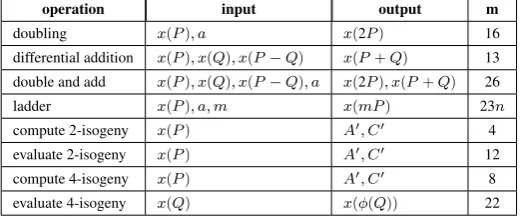
The costs of point and isogeny arithmetics on Montgomery curves, taken from [10, 27], are summarized in Table 1.
operation input output m
doubling x(P), a x(2P) 16 differential addition x(P), x(Q), x(P−Q) x(P+Q) 13 double and add x(P), x(Q), x(P−Q), a x(2P), x(P+Q) 26 ladder x(P), a, m x(mP) 23n
compute 2-isogeny x(P) A0, C0 4
evaluate 2-isogeny x(P) A0, C0 12 compute 4-isogeny x(P) A0, C0 8 evaluate 4-isogeny x(Q) x(φ(Q)) 22
Table 1.Costs of different operations for Montgomery curves
4.2 Complexity of CGL
For hashing a message in the original CGL algorithm, 2-torsion points and the Vélu formulas are used. This requires obtaining two 2-torsion points at each curve by eliminating the point corresponding to the arriving isogeny, and using Vélu to compute the next curve. The 2-torsion can be computed using f(x)from the equation y2 = f(x) of the curve. The polynomial f(x) is cubic, but a linear factor corresponding to one of the 2-torsion points is eliminated. This means we always have a quadratic equation to factor. Therefore, hashing each bit of the message needs: 1 isogeny computation, 1 isogeny evaluation, and 1 square root computation.
Modular polynomials. Since we only need to work withj-invariants, a more
efficient approach is to use the modular polynomialΦ2(x, y). For any curveE∈
G`, the univariate polynomialΦ2(x, j(E))is a cubic with roots thej-invariants of
computing a square root gives thej-invariant of the next curve. This way, isogeny computation and evaluation is avoided altogether. For each bit of the input we need to do the following:
• Evaluate the modular polynomial for the current curve. The modular
poly-nomial is
Φ2(x, y) =x3+y3−x2y2+1488(x2y+y2x)−162000(x2+y2)
40773375xy+8748000000(x+y)−157464000000000.
The evaluationΦ2(x, j(E))requires 5mand a few scalar multiplications.
• Obtain a quadratic equationg(x)fromΦ
2(x, j(E))by factoring out a linear
factor. This needs only 3m.
• Solve the quadratic equation. This needs 2mand 1 square root computation.
The square root computation takes 5 logpm+logps+1i.
In summary, we need(5 logp+10)m+logps+1ifor each bit, and hence
kn((5 logp+10)m+logps+1i) (4.1)
for a message of lengthknbits.
4.3 Complexity of the new hash
For eachn-bit blockmof the input message Algorithm 2 performs the following:
• Obtain generatorsP, Qof the groupE[2n]of the current curveE. This can be efficiently done using theentangled basistechnique of [39]. An entangled basis computation takes, on average, 2 quadratic residuosity tests, 1 square root finalization and 24m. A quadratic residuosity test inFp2 takes logps,
and the square root finalization can be done in logps+1i. The total cost of basis generation is thus 24m+3 logps+1i.
• Compute 2n−1P,2n−1Q. The value 2n−1Pis always computed, but the value 2n−1Qis computed 2/3 of the time on average. The total cost on average is
then≈1.67npoint doublings which is 26.7nm.
• Compute R = P +mQ. For this, we first compute mQ using the usual Montgomery ladder which takes 23nm, and then addP at the cost of a few multiplications.
above, we can use 4-isogenies instead of 2-isogenies. Using this strategy, obtaining the target curve E0 takes n2 4-isogeny computations and n4logn2 point quadrupling and 4-isogeny evaluations. According to Table 1, all these together take
27
2 nlogn− 19
2 n
m.
• Compute the backtrack 2-torsion point. For this we only need to compute
the last 4-isogeny as 2-isogenies, and then compute the image of a 2-torsion point that is not in the kernel of the last 2-isogeny. If the kernel is noth(0,0)i
then we can simply use(0,0)as the desired point. Otherwise, we need to take a square root to obtain a 2-torsion that is not in the kernel. The latter case happens with probability≈ 1/3. The total cost of this is step is then
≈(2 logps+1i)/3.
Replacing logpbyn, the total complexity of Algorithm 2 for an input of length
knbits is then
27
2nlogn+40.2n
km+ 10
3 nks+ 4
3ki. (4.2)
Performance comparison. Comparing the complexity of the new hash
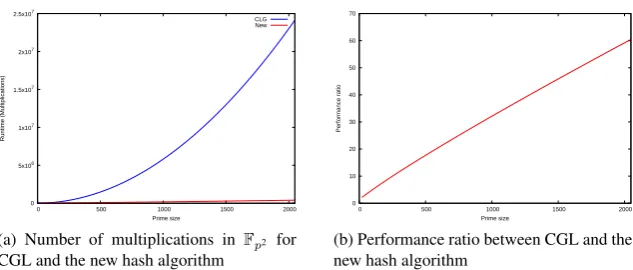
algo-rithm, Eq. (4.2), with CGL, Eq. (4.1), we immediately see that the new algorithm is significantly faster. Asymptotically, the runtime of the new hash is quasi-linear innwhile the runtime of CGL is quadratic inn. For a concrete performance com-parison, we can replace the squaring and inversion operationssandiby a factor of multiplicationm. A frequently used convention is to sets= 0.67mandi= 100m. From this, we get the estimations
kn(5.7n+110)m
for complexity of the CGL hash algorithm, and
kn(13.5 logn+42.4)m
for complexity of the new hash algorithm. This leads to the performance ratio
5.7n+110
13.5 logn+42.4 (4.3)
0 5x10⁶
1x10⁷
1.5x10⁷
2x10⁷
2.5x10⁷
0 500 1000 1500 2000
Runtime (Multiplications)
Prime size
CLG New
(a) Number of multiplications in Fp2 for CGL and the new hash algorithm
0 10 20 30 40 50 60 70
0 500 1000 1500 2000
Performance ratio
Prime size
(b) Performance ratio between CGL and the new hash algorithm
Figure 1a shows the quadratic versus quasi-linear behaviors of the algorithms. From Figure 1b and Eq (4.3) we see that forn=1024, i.e., a prime of size≈1024 bits, the new algorithm is 33.5 times faster than the original CGL algorithm. Given that the best attack on the isogeny problem, and hence on both hash algorithms, has quantum complexity O(p1/4), this corresponds to 256-bit quantum security level. For a 384-bit quantum security level, we get a performance ratio of 47.8.
Remark 4.1.Although our hash is significantly faster asymptotically, for short
messages, it suffers from the computational overhead of the extra block of padding. For example, in the extreme case of hashing only one block of sizen=1024, the performance ratio drops to(5.7×1024+110)/(2×(13.5×10+42.5))≈16.8.
Bibliography
[1] Miklós Ajtai, Generating hard instances of lattice problems, in:Proceedings of the twenty-eighth annual ACM symposium on Theory of computing, ACM, pp. 99–108, 1996.
[2] Daniel J Bernstein, Peter Birkner, Marc Joye, Tanja Lange and Christiane Peters, Twisted edwards curves, in: International Conference on Cryptology in Africa, Springer, pp. 389–405, 2008.
[3] Daniel J Bernstein and Tanja Lange,Explicit Formulas Database, 2007,http:// www.hyperelliptic.org/EFD/index.html.
[4] Jean-François Biasse, David Jao and Anirudh Sankar, A quantum algorithm for com-puting isogenies between supersingular elliptic curves, in:International Conference in Cryptology in India, Springer, pp. 428–442, 2014.
[6] David Chaum, Eugène van Heijst and Birgit Pfitzmann, Cryptographically strong un-deniable signatures, unconditionally secure for the signer, in: Annual International Cryptology Conference, Springer, pp. 470–484, 1991.
[7] Richard Cleve, Artur Ekert, Chiara Macchiavello and Michele Mosca, Quantum al-gorithms revisited, in:Proceedings of the Royal Society of London A: Mathematical, Physical and Engineering Sciences, 454, The Royal Society, pp. 339–354, 1998.
[8] Scott Contini, Arjen K Lenstra and Ron Steinfeld, VSH, an Efficient and Provable Collision-Resistant Hash Function., in: Eurocrypt, 4004, Springer, pp. 165–182, 2006.
[9] Craig Costello and Huseyin Hisil, A simple and compact algorithm for SIDH with arbitrary degree isogenies, in:International Conference on the Theory and Applica-tion of Cryptology and InformaApplica-tion Security, Springer, pp. 303–329, 2017.
[10] Craig Costello, Patrick Longa and Michael Naehrig, Efficient algorithms for su-persingular isogeny Diffie-Hellman, in: Annual Cryptology Conference, Springer, pp. 572–601, 2016.
[11] Ronald Cramer and Victor Shoup, Signature schemes based on the strong RSA assumption, ACM Transactions on Information and System Security (TISSEC) 3 (2000), 161–185.
[12] Ivan Bjerre Damgård, A design principle for hash functions, in: Conference on the Theory and Application of Cryptology, Springer, pp. 416–427, 1989.
[13] Luca De Feo, David Jao and Jérôme Plût, Towards quantum-resistant cryptosystems from supersingular elliptic curve isogenies,Journal of Mathematical Cryptology8 (2014), 209–247.
[14] Harold Edwards, A normal form for elliptic curves,Bulletin of the American Math-ematical Society44(2007), 393–422.
[15] Kirsten Eisentraeger, Sean Hallgren and Travis Morrison,On the Hardness of Com-puting Endomorphism Rings of Supersingular Elliptic Curves, Cryptology ePrint Archive, Report 2017/986, 2017,https://eprint.iacr.org/2017/986. [16] Steven D Galbraith, Constructing isogenies between elliptic curves over finite fields,
LMS Journal of Computation and Mathematics2(1999), 118–138.
[17] David R. Kohel,Endomorphism rings of elliptic curves over finite fields, Ph.D. thesis, University of California, Berkeley, 1996.
[18] Vadim Lyubashevsky and Daniele Micciancio, Generalized compact knapsacks are collision resistant,Automata, Languages and Programming(2006), 144–155. [19] Vadim Lyubashevsky, Daniele Micciancio, Chris Peikert and Alon Rosen, SWIFFT:
A modest proposal for FFT hashing, Lecture Notes in Computer Science 5086 (2008), 54–72.
[21] Daniele Micciancio, Generalized compact knapsacks, cyclic lattices, and efficient one-way functions,Computational Complexity16(2007), 365–411.
[22] Peter L Montgomery, Speeding the Pollard and elliptic curve methods of factoriza-tion,Mathematics of computation48(1987), 243–264.
[23] Dustin Moody and Daniel Shumow, Analogues of Vélu’s formulas for isogenies on alternate models of elliptic curves,Mathematics of Computation85(2016), 1929– 1951.
[24] Michael A Nielsen and Isaac Chuang,Quantum computation and quantum informa-tion, AAPT, 2002.
[25] Christophe Petit and Kristin Lauter, Hard and easy problems for supersingular isogeny graphs, Cryptology ePrint Archive, Report 2017/962, 2017, https:// eprint.iacr.org/2017/962.
[26] Arnold K Pizer, Ramanujan graphs and Hecke operators,Bulletin of the American Mathematical Society23(1990), 127–137.
[27] Joost Renes, Computing isogenies between Montgomery curves using the action of (0, 0), in: International Conference on Post-Quantum Cryptography, Springer, pp. 229–247, 2018.
[28] Michael Scott, Implementing cryptographic pairings, Lecture Notes in Computer Science4575(2007), 177.
[29] Peter W Shor, Polynomial-time algorithms for prime factorization and discrete log-arithms on a quantum computer,SIAM review41(1999), 303–332.
[30] Joseph H Silverman,The arithmetic of elliptic curves, 106, Springer Science & Busi-ness Media, 2009.
[31] Daniel R Simon, On the power of quantum computation,SIAM journal on computing 26(1997), 1474–1483.
[32] Andrew Sutherland, Isogeny volcanoes,The Open Book Series1(2013), 507–530. [33] Seiichiro Tani, Claw finding algorithms using quantum walk,Theoretical Computer
Science410(2009), 5285–5297.
[34] John Tate, Endomorphisms of abelian varieties over finite fields,Inventiones mathe-maticae2(1966), 134–144.
[35] Jean-Pierre Tillich and Gilles Zémor, Group-theoretic hash functions, in:Workshop on Algebraic Coding, Springer, pp. 90–110, 1993.
[36] Jacques Vélu, Isogénies entre courbes elliptiques,Comptes-Rendus de l’Académie des Sciences273(1971), 238–241.
[38] Heinrich Weber, Lehrbuch der Algebra, vol. 3,III, third edition (Chelsea, New York, 1961)(1908).
[39] Gustavo H. M. Zanon, Marcos A. Simplicio Jr., Geovandro C. C. F. Pereira, Javad Doliskani and Paulo S. L. M. Barreto,Faster isogeny-based compressed key agree-ment, Cryptology ePrint Archive, Report 2017/1143, 2017, https://eprint. iacr.org/2017/1143.
[40] Gilles Zémor, Hash functions and graphs with large girths, in: Advances in Cryptology-EUROCRYPT’91, Springer, pp. 508–511, 1991.
[41] Gilles Zémor, Hash functions and Cayley graphs,Designs, Codes and Cryptography 4(1994), 381–394.
[42] Shengyu Zhang, Promised and distributed quantum search, in: International Com-puting and Combinatorics Conference, Springer, pp. 430–439, 2005.
Author information
Javad Doliskani, Institute for Quantum Computing, University of Waterloo, Canada. E-mail:[email protected]
Geovandro C. C. F. Pereira, Institute for Quantum Computing, University of Waterloo, Canada.
E-mail:[email protected]