Article
1
A Case Study on Increasing Microgrid Resiliency
2
using Reserve Power Procurement Method
3
Halim LEE 1,*, Gil-Seong BYEON 2, Jin-Hong JEON 3, Akhtar HUSSAIN 4, Hak-Man KIM 5,
4
Anastasios OULIS ROUSIS 6and Goran Strbac 7
5
1 Korea Electrotechnology Research Institute, bulmosan-ro 10beon-gil, Seongsan-gu, Changwonsi,
6
Gueongsangnam-do, Korea; [email protected]
7
2 Korea Electrotechnology Research Institute, bulmosan-ro 10beon-gil, Seongsan-gu, Changwonsi,
8
Gueongsangnam-do, Korea; [email protected]
9
3 Korea Electrotechnology Research Institute, bulmosan-ro 10beon-gil, Seongsan-gu, Changwonsi,
10
Gueongsangnam-do, Korea; [email protected]
11
4 Incheon National University, Academy-ro 119, Yeonsu-gu, Incheon, Korea; [email protected]
12
5 Incheon National University, Academy-ro 119, Yeonsu-gu, Incheon, Korea; [email protected]
13
6 Imperial College London, South Kensington Campus London SW7 2AZ, UK; [email protected]
14
7 Imperial College London, South Kensington Campus London SW7 2AZ, UK; [email protected]
15
* Correspondence: [email protected]; Tel.: +82-10-9632-2894
16
17
Abstract: Power system decentralization has been an emerging topic for the past decade in an effort
18
to improve power quality and environment protection via increased integration of renewable
19
energy sources. Towards these objectives, decentralized microgrids have been proposed and
20
thoroughly investigated in terms of technical capabilities and economic performance. In fact, the
21
planning and actual operation of small-scale, decentralized microgrids has started in countries such
22
as Canada, Japan, USA, UK and other countries. It is expected that the research in this area will
23
progress and eventually take over the existing paradigm of large-scale power generation in the
24
future. These small-size decentralized microgrids could be connected with nearby microgrids under
25
normal operating conditions, but under special events, such as natural or man-made disasters, they
26
would be disconnected and run in islanded mode. Under such high impact – low probability events,
27
the microgrid must have resiliency to successfully re-connect with other microgrids and the main
28
grid. In this paper, an Energy Management System (EMS) for a microgrid having a resiliency
29
function, allowing to operate under islanded mode after an accident, is proposed. The proposed
30
tool, called Resilient Energy Management System (ResEMS), aims at procuring reserve power into
31
the microgrid’s Battery Energy Storage System (BESS) effectively, by importing it from the nearby
32
connected power system. The accident is assumed to be a predictable natural disaster, which means
33
that the accident occurrence time, duration and level of damage can be estimated. The proposed
34
ResEMS has been applied to a microgrid comprising of a BESS, a diesel generator and several
35
photovoltaic devices. The simulation results verify its beneficial operation.
36
Keywords: energy management system; reserve power; resiliency; battery energy storage system.
37
38
1. Introduction
39
To reduce carbon emissions produced during the electric power generation process, the
40
integration of renewable energy sources (RES) shall be increased. However, if their integration
41
increases excessively in a bulk power system, the power system operation may be adversely affected
42
by the abrupt power flow changes. Therefore, significant research has been focused in the effort to
43
increase RES integration, while maintaining a stable electric power system. A way of doing so is the
44
utilization of decentralized microgrids. Charlottetown, Hamilton, Winnipeg, Revelstoke of Canada,
45
Shenzhen of China, Woking Borough Council of UK, Wildpoldsried, Sonnen Community of
46
Germany, Santa Ana of USA, Higashida of Japan are some examples of places integrating small-scale
47
microgrids that operate in a stable manner [1], [2], [3], [4], [5], [6], [7]. These microgrids have the
48
ability to self-produce power from their embedded resources and utilize this power to cover their
49
loads. The excess of energy produced is typically traded with the nearby connected microgrids or the
50
bulk power system, which eventually facilitates the power balancing amongst the various connected
51
grids.
52
While the microgrid is operating in grid-connected mode, a natural disaster (e.g. typhoons,
53
tsunamis), or man-made accidents can cause disconnection of the microgrid from others and lead to
54
islanded operation. The disconnected or islanded microgrid must be able to withstand, and operate
55
under emergency mode, until the accident that caused this disconnection is cleared, for successful
re-56
connection and normal operation. When a microgrid changes its operation mode from connected to
57
islanded, but still has the ability to deliver electric power to the loads consistently, and also has the
58
ability to recover back to the connected mode, is characterized as resilient [8]. Significant research has
59
investigated ways of increasing the resiliency of microgrids.
60
Research reported in [9], [10] and [11] proposed an electric power supply strategy using load
61
shedding with renewable energy devices and battery energy storage systems (BESS). References [12],
62
[13], [14] and [15] have introduced research utilizing diverse methods such as multi-agents, tabu
63
search, genetic algorithms and graphical approach, in order to concentrate on restoration. At [16],
64
using an electric vehicle as an electric power source has been studied. For preparation purposes
65
against a resilient situation, [17], [18], [19] and [20] are suggesting several precautions such as line
66
and microgrid cluster, and infrastructure hardening using a programmable network. The
67
aforementioned research work has concentrated on hardening the infrastructure, and introducing
68
control schemes that increase the resiliency of a microgrid.
69
For a bulk power system, when the electric power supply is less than its demand, there is a
70
power imbalance, which if not dealt with might lead to a black out. To be prepared for such a
71
situation, it is important to procure reserve power. This theory could also be applied to a small-size
72
decentralized microgrid. When the microgrid changes its operation strategy from connected mode to
73
islanded mode after an accident, the proposals from the aforementioned research could be a possible
74
solution. In this case, heavy investments would be necessary, in order to have ordinary resilience.
75
However, for predictable accidents, such as a natural disaster that can be forecasted, procuring
76
reserve power to the BESS just before the accident occurrence expected time, would be a cheaper and
77
more efficient solution.
78
In this paper, a reserve power procurement method has been proposed using ResEMS, assuming
79
that an accident, which causes the microgrid to operate in islanded mode, is predictable. If the amount
80
of procured reserve power is more than the one actually needed, the usage of generated power from
81
renewable energy will be limited, when the SOC of BESS reaches the maximum value of capacity (i.e.
82
after the microgrid returns back to connected mode). If not enough reserve power is procured, the
83
microgrid will not be able to operate in islanded mode until it recovers back to connected mode,
84
which would decrease its resiliency. Therefore, in order to increase the efficiency of electric power
85
provided to microgrid’s loads, an algorithm that calculates reasonable reserve power to be procured
86
is proposed. The proposed algorithm is verified and analyzed by comparing the microgrid operation
87
schedule calculated by a normal EMS, introduced in [10] and [11], and ResEMS, having a resilient
88
function concentrating on reserve power procurement. After an accident occurs that changes the
89
microgrid’s operation mode from connected to islanded, the microgrid’s loads are classified into
90
critical and non-critical, and the power is supplied only to critical loads, as per [10] and [11]. Note
91
that if the electric power is provided both to critical and non-critical loads, the necessary reserve
92
power will be excessively large, which is not an optimal solution.
93
The paper is structured as follows: In chapter 2, the resiliency of a microgrid is explained. In
94
chapter 3, the proposed ResEMS algorithm and optimization formulation is introduced and in
95
chapter 4 a case study is presented to verify the proposed ResEMS algorithm. Finally, chapter 5 draws
96
conclusions and future work.
97
98
2. Overall Outline of Resiliency
99
Resiliency from the perspective of a microgrid, is to have the ability to adapt to the grid’s situation
100
alteration, maintain the power supply after a disruption occurrence, and recover as soon as possible
101
from the disruption [8]. Additionally, it has to be prepared for a disruption, even though it has low
102
probability to occur but it comes with a high risk of damage to the microgrid. By summarizing all of
103
this, the definition of a resilient microgrid is to have an ability to prepare, withstand, adapt to and
104
recover from a disruption [21]. These capabilities are essential to increase the resiliency of a microgrid.
105
If any of these capabilities do not exist in the microgrid EMS, it will be impossible for the microgrid to
106
recover. In this paper the main concern is the ability to prepare before a disruption occurs.
107
According to [22], 44.4% of the blackouts in USA are caused by natural disasters. A natural disaster
108
can be an earthquake, a tornado, a hurricane, a tropical storm, an ice storm, a lightning, a strong wind,
109
heavy rain, intense cold weather and fire. Among these, predictable natural disasters are tornados,
110
hurricanes, tropical storms, ice storms, strong winds, heavy rain and intense cold weather, which
111
account for 43.6% of the reasons leading to blackouts. In other words, 43.6% of a disruption causing
112
blackout can be predicted and it is possible to be prepared against these. If a microgrid had the ability
113
to predict such a natural disaster, the proposed reserve power procurement algorithm, or ResEMS,
114
could lead to a microgrid with stronger resiliency before an accident occurred, which would cause the
115
microgrid disconnection. As explained earlier, procuring reasonable amount of reserve power is the
116
key factor of ResEMS.
117
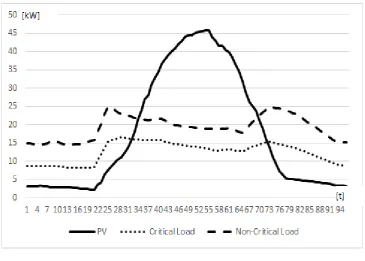
3. Algorithm and Mathematical Modelling
118
3.1. Proposed ResEMS Algorithm
119
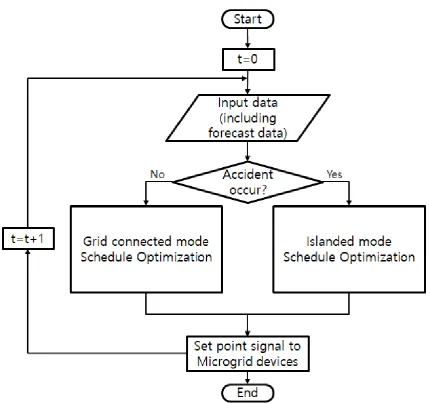
In this paper, a ResEMS having reserve power procurement function, for increasing the microgrid
120
resiliency, is proposed. A flowchart of the algorithm is illustrated in Figure 1. First, the input data
121
including prediction data of critical load, non-critical load and photovoltaic device output is obtained
122
together with microgrid status and device specific data. Then, in order to optimize the microgrid
123
schedule using the exact operation mode, the algorithm examines whether an accident has occurred in
124
the microgrid. Initially it is assumed that the accident did not occur, but predicted, which leads the
125
microgrid to operate in grid-connected mode, or the proposed ResEMS algorithm. If the predicted
126
accident occurs, the microgrid operation schedule is optimized for islanded operation. Each controllable
127
device of the microgrid needs a set point to operate. Therefore, at the ‘schedule optimization’ step, the
128
optimal set point of each device is calculated on a day-ahead basis. The set point for each time step is
129
delivered to the respective device. The optimized day-ahead schedule is calculated for a 15-minute time
130
132
Figure 1. Overall ResEMS Algorithm.
133
134
The reserve power procurement algorithm, is applied and considered when the optimal schedule
135
is calculated under connected mode through the ResEMS, right after an accident that causes
136
disconnection between microgrids is predicted. By assuming that it is possible to predict a natural
137
disaster, the proposed algorithm calculates the amount of the reserve power to be procured. Using the
138
procured reserve power, the microgrid could survive and operate in islanded mode until it recovers
139
back to connected mode. If the exact duration of recovery and re-connection is known, the reserve
140
power will be calculated with less mismatch. However, in some cases, the expected duration time could
141
last longer. Additionally, even when the duration time is as expected, it is possible that there is no sun
142
light, causing the photovoltaic device prediction to have significant mismatch in the actual electric
143
power generation. To prevent such a situation, this paper proposes to procure the reserve power as
144
much to provide electric power to the microgrid until the next day’s photovoltaic device energy
145
production exceeds the critical load.
146
147
148
Figure 2. Reserve Power Procurement Concept.
149
150
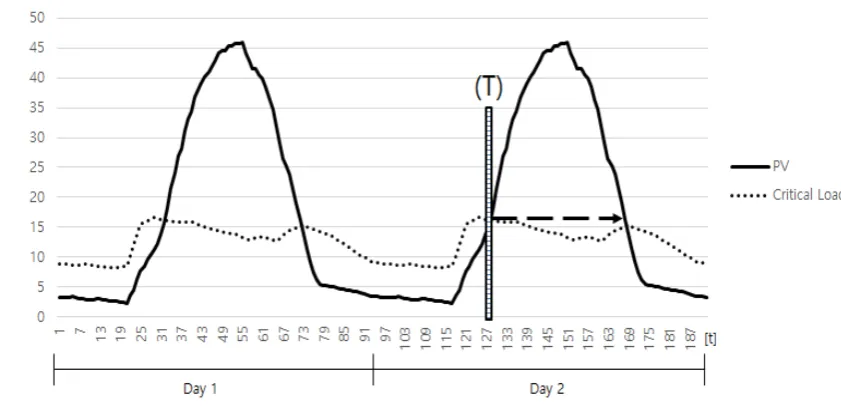
Figure 2 illustrates the prediction data of photovoltaic device generation and critical load for
151
two days, assuming a natural disaster will affect the microgrid only for day 1. It shows the proposed
152
reserve power procurement concept. Looking at day 2, starting from time step 129, the predicted output
153
of photovoltaic device exceeds the critical load. Despite the time the accident occurs (or the microgrid
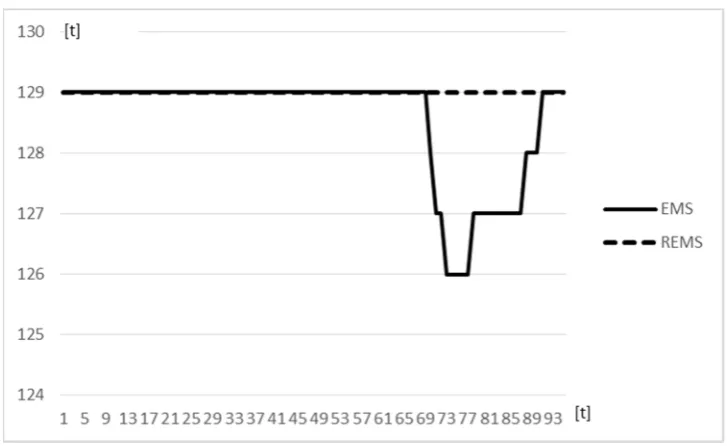
154
disconnection actually occurring on day 1) the reserve power must be procured to provide electric
155
power to the critical load until time period 129 of day 2 in order to secure the resiliency of the micro
156
grid. If the accident is cleared and the microgrid recovers back to connected mode before time step 129,
157
the micro grid will operate normally with high resiliency. If the accident is not cleared until time period
158
129 of day 2, the critical load could also be supplied for some period of time, by using the energy
159
production from the photovoltaic device. During this time, the BESS has an opportunity to store energy,
160
until the photovoltaic device output is lower than the critical load, as in time period 169 of day 2. This
161
stored energy makes it possible to provide the critical load for even longer time duration than expected,
162
which allows more time for full recovery of microgrid connection. According to [23] and [24], the
163
longest time for accident recovery was 1100 minutes. Which means in worst case scenario, the blackout
164
could last for approximately 18 hours, and this must also be considered while calculating the amount
165
of reserve power procurement.
166
The reserve power could be procured by purchasing power from the connected power system or
167
by operating the diesel generator. However, since the optimization will be done by minimizing the total
168
operating cost (i.e. explained in the following chapter) and also the cost for diesel generation is higher,
169
importing electric power from the connected power system is more reasonable.
170
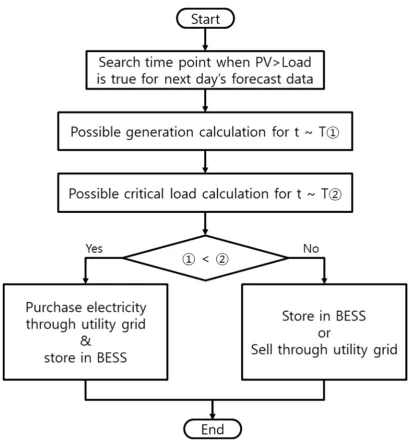
Figure 3 illustrates the flowchart of the reserve power procurement algorithm. Firstly, the
171
algorithm searches for the time period of next day when the photovoltaic device output exceeds the
172
critical load, and defines the time period as T. Then, the total amount of possible generation, sourced
173
by both photovoltaic device and diesel generator, is calculated from the present time ①, or islanded
174
mode start time t, until T. Also for the same time period, it calculates the amount of the critical load ②.
175
For each time step, it compares ① and ②, and procures reserve power, by purchasing the lack of
176
electric power from the connected power system, and storing it in BESS.
177
179
Figure 3. ReservePower Procurement Algorithm.
180
181
3.2. MILP Optimization Formulation
182
In order to optimize the microgrid day-ahead scheduling, the objective function is set to
183
minimize the generation cost, while maintaining the microgrid under stable condition. The critical
184
load must be provided until the next day using the procured reserve power, stored in the BESS. The
185
generation cost comprises of fuel cost and start-up cost of diesel generator and electric power
186
purchase/sell fee from/to the connected power system.
187
A set of equalities and inequalities constitute the constraints of the optimization problem. An
188
inequality is included for limiting the amount of the electric power that could be purchased from (2)
189
or sold to (3) the connected power system. The amount of electric power produced by the diesel
190
generator (4), amount of charge (5) and discharge (6) from the BESS’s power conversion system (PCS),
191
and the state of charge for BESS (7) are included as well. Additionally, inequality (8) is introduced to
192
account for the total generation limit of the diesel generator considering a given amount of diesel fuel.
193
Also, the total amount of electric power supplied to the microgrid must be greater than the amount
194
of power charged/discharged from the PCS (i.e. represented by equality (9)). Finally, the energy
195
difference between load and generation from photovoltaic should match the output from diesel
196
generator, power purchased/sold from/to connected grid, charge/discharge power from PCS (10), for
197
every time section t. When the microgrid operates in islanded mode, terms related to the connected
198
power system, such as electric power purchase/sell fee, are ignored, since they should have no effect
199
on the optimization process for the duration of time that no connection to another power system
200
exists.
201
min
(𝐶𝑜𝑠𝑡
∙ 𝑃
+ 𝐶𝑜𝑠𝑡
∙ 𝑃 + 𝐶𝑜𝑠𝑡
∙ 𝑃
+ 𝐶𝑜𝑠𝑡
∙ 𝑢 )
(1)
202
Subject to:
203
0 ≤ 𝑃
≤ 𝑃
(2)
𝑃
≤ 𝑃
≤ 0
(3)
0 ≤ 𝑃
≤ 𝑃
(4)
−𝑃
≤ 𝑃
≤ 0
(5)
0 ≤ 𝑃
≤ 𝑃
(6)
𝑆𝑂𝐶
≤ 𝑆𝑂𝐶 ≤ 𝑆𝑂𝐶
(7)
𝑃
≤ 𝑃
(8)
𝑆𝑂𝐶
+ 𝑅
≤ 𝑆𝑂𝐶
− 𝑃
− 𝑃
(9)
𝑃 + 𝑃
− 𝑃
= 𝑃
+ 𝑃
+ 𝑃
+ 𝑃 + 𝑃
(10)
204
In order to solve the optimization problem shown in the above mathematical formulation, a
205
mixed-integer-linear program has been coded in Matlab environment [25]. By solving the
206
optimization, the total day-ahead schedule data for the electric power import/export from/to the
207
connected power system, input/output of the PCS and diesel generator, charge/discharge amount of
208
BESS, and the electric power that critical and non-critical loads have absorbed, are obtained.
209
4. Simulation and Result
210
4.1. Simulation Assumption
211
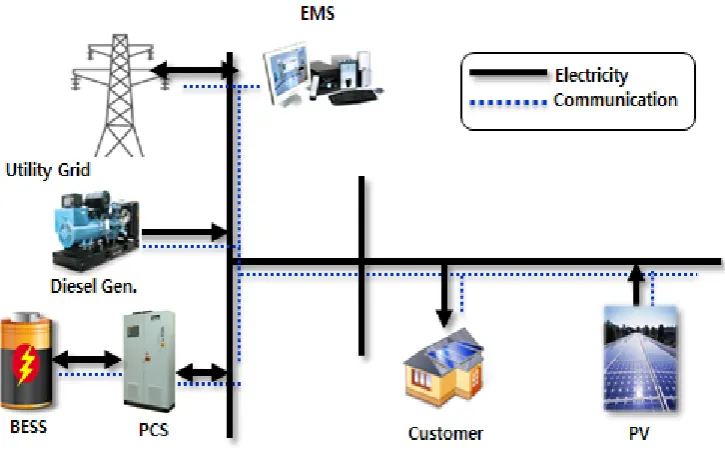
The small-scale decentralized microgrid configuration shown in Figure 4 has been adopted for
212
the simulations presented in this chapter. The critical and non-critical loads are mainly provided by
213
the power generation from the photovoltaic device. When the power generation from the
214
photovoltaic device exceeds the load, the remaining energy is stored in the BESS through the PCS.
215
Otherwise, if power generation from photovoltaic device does not cover the load, the power balance
216
will be achieved by importing power from the connected utility grid or by operating the diesel
217
generator. However, the diesel generator will mainly be used when the microgrid is operating under
218
island mode, as generally its generation cost is higher than the price of power imported from the
219
221
Figure 4. Example of Micro Grid Configuration.
222
223
The capacity of the photovoltaic device is 75 kW, peak value of critical and non-critical loads is
224
16.65 kW and 25kW respectively. The generation capacity of the diesel generator is 100 kW and there
225
is sufficient amount of fuel to generate 250 kWh for the microgrid. The electric power import/export
226
from/to the grid is limited to 80 kW. The BESS has the storage capacity of 400 kWh, and the maximum
227
charge/discharge power for PCS is 100 kW. The specific data for the BESS is shown in Table 1.
228
229
Table 1. Specific Data for BESS.
230
Parameters Specific Ability
Capacity (kWh) 400 Efficiency (%) 95 Initial SOC (%) 50 SOC Range (%) 0 ~ 100
231
Figure 5 is the assumed prediction data that has been used for the simulation. The simulation
232
time step is considered to be 15 minutes, which has 96 time steps for the calculated day-ahead
233
schedule. When an accident is predicted to occur within the microgrid, leading to islanded mode, the
234
reserve data must be procured in advance, for the microgrid to maintain resilient operation. In this
235
case, the next day prediction data is assumed to be the same as the first day prediction data, since it
236
is always possible that under severe circumstances (such as the natural disasters investigated here)
237
the prediction device could have been damaged or the prediction system could struggle to provide
238
an accurate forecast.
239
240
241
Figure 5. Prediction Data.
242
243
Two different simulation cases have been assumed in order to verify the proposed resilient EMS
244
algorithm.
245
- EMS case (base case): EMS without resiliency function. Calculate the day-ahead schedule for
246
the microgrid regardless of accident occurrence.
247
- ResEMS case: EMS with resiliency function. Calculate the day-ahead schedule considering
248
the reserve power procurement when an accident is predicted.
249
250
Both cases have been simulated and compared in order to verify the effect of the resiliency
251
function. Through the simulations, day-ahead schedule for the following decision variables will be
252
obtained:
253
- Import/export electric power from/to the connected power system.
254
- Power output of diesel generator.
255
- Charge/discharge power from PCS.
256
- SOC of BESS.
257
258
Using the calculated values of the variables, the effect of resiliency function will be verified by
259
comparing whether the reserve power is sufficient to supply the critical load until the designated
260
time period of next day, T. The process follows the steps mentioned below:
261
- Calculate the reserve power stored in the BESS for every time step.
262
- Calculate the critical load provision time, from t to T, using the stored energy in BESS, diesel
263
generator’s possible generation amount (i.e. in kWh) and prediction data of critical loads
264
and photovoltaic device for day 1 and 2.
265
266
As it can be observed in Figure 5, at time step 33, the predicted value of photovoltaic device
267
exceeds the critical load. Therefore, for the EMS base case, it is expected that electric power will not
268
be provided to the critical loads until time step 33 of the next day, when the accident occurs. In
269
contrast with the base case, when using the ResEMS strategy, it is expected that the microgrid has
270
sufficient reserve power to cover the critical loads until time step 33 of next day, regardless of the
271
accident.
272
4.2. Result
274
The results of the simulation are as shown in Figures 6-(a), 6-(b) and 6-(c). The calculated
day-275
ahead schedule of the import/export electric power from/to the bulk power system, charge/discharge
276
value of the BESS and the SOC of the BESS optimized by both the EMS and ResEMS algorithms are
277
depicted. It can be observed in Figure 6-(a) that, at the early part of ResEMS scheduling, the electric
278
power import value is larger than the scheduling result calculated by EMS. It is obvious that ResEMS
279
has to import more electric power from the bulk power system, since additional reserve power must
280
be procured. The specific reason for importing power early within the day relates to the electric power
281
price, which is cheaper during this period. The difference between the EMS and the ResEMS schedule
282
for the charge/discharge output and the SOC value of BESS is also affected by this fact, as illustrated
283
in Figures 6-(b) and 6-(c).
284
285
286
(a)
287
288
289
( b)
290
291
292
(c)
293
Figure 6. Optimized schedule of EMS and ResEMS for: (a) Electric energy import/export value; (b)
294
Charge/discharge value of BESS; (c) SOC of BESS.
295
296
4.3. Analysis
297
Figure 7 indicates the total time period the electric power from the main grid could supply the
298
critical loads after the accident occurrence. At time step 33 of day 2, from Figure 5, the photovoltaic
299
device power output exceeds the critical loads. This means that the microgrid should procure reserve
300
power to supply critical loads until time step 33 of day 2 (i.e. time step 129 if 96 time steps are added
301
from day 1). Looking at Figure 7, the optimized schedule calculated by the ResEMS enables the
302
microgrid, while in islanded mode, to survive until time period 129, regardless of the accident
303
occurrence time. Therefore, when the accident occurs at day 1, the critical loads will be covered
304
successfully until time step 129 according to the schedule of the ResEMS. However, when the base
305
case EMS is utilized and an accident occurs in specific time steps 71 to 91, the critical loads cannot be
306
supplied until time step 129. In simpler words, this means that the EMS scheduling algorithm leads
307
to a less resilient microgrid.
308
309
310
Figure 7.Critical load supply time duration after accident occurrence.
311
312
It should also be noted that if the critical loads could be supplied until time step 129 (i.e. by using
313
the reserve power procured by the resilience function of ResEMS), then the critical load could also be
314
supplied after time step 129 by using the power generated from the photovoltaic device. In this case,
315
while the photovoltaic device output exceeds the critical loads for day 2, or after time step 129, the
316
surplus power will be stored in the BESS. This energy stored will conversely be used, when the
317
photovoltaic device power output does not exceed anymore the critical loads.
318
319
5. Conclusion and Future Study
320
5.1. Conclusion
321
In this paper, a resilient EMS or ResEMS algorithm has been proposed, whose main goal is to
322
increase the resiliency of a small-scale, decentralized microgrid by procuring reserve power
323
effectively. If a predictable accident, such as natural disaster, occurs in the microgrid, the connection
324
between other microgrids could fail or be damaged causing malfunction. In this situation, the
325
microgrid must operate in islanded mode. While operating in islanded mode, the microgrid should
326
be able to provide electric power to critical loads, until the microgrid can recover back to connected
327
mode. To enable this, the proposed ResEMS procures reserve power stored in a BESS. It has been
328
demonstrated through the case studies that by using the optimized schedule calculated by the
329
ResEMS, the microgrid’s resiliency is strengthened.
330
331
5.2. Future Study
332
To improve the proposed algorithm, additional constraints are necessary to reflect an actual
333
accident occurrence time is not between time steps 71 to 91, additional reserve power does not need
335
to be procured. Therefore, it is not necessary to import any electric power from the connected bulk
336
power system. The resilient function of the ResEMS determines the additional procurement of reserve
337
power at every time slot, which may not be necessary at certain time steps and leads to increased
338
costs. Additionally, the prediction data for the day after the microgrid disconnection must be
339
improved, since during any natural disaster the weather conditions would change considerably and
340
the forecast precision would be low.
341
342
Author Contributions:Conceptualization, Data curation, Software, Writing original draft, Halim LEE;
343
Conceptualization, Gil-Seong BYEON; Supervision, Jin-Hong JEON; Software, Akhtar HUSSAIN; Project
344
Administration, Hak-Man KIM; Writing-Review & Editing, Anastasios OULIS ROUSIS and Goran Strbac;
345
Funding: This work was supported by the Korea Institute of Energy Technology Evaluation and Planning
346
(KETEP) and the Ministry of Trade, Industry & Energy (MOTIE) of the Republic of Korea (No.
347
20168530050030).
348
Acknowledgments: Administrative and technical support by Akhtar HUSSAIN and Hak-man KIM. Technical
349
support by Anastasios OULIS ROUSIS and Goran Strbac.
350
Conflicts of Interest: The authors declare no conflict of interest.
351
352
Nomenclature
353
𝐶𝑜𝑠𝑡
: Electric power purchase fee at time
t
[$]
354
𝐶𝑜𝑠𝑡
: Electric power sell fee at time
t
[$]
355
𝑃
: Purchased amount of electric power from connected power system at time
t
[kW]
356
𝑃
: Sold amount of electric power from connected power system at time
t
[kW]
357
𝐶𝑜𝑠𝑡
: Fuel cost for diesel generator at time
t
[$]
358
𝑃
: Generated electric power from diesel generator at time
t
[kW]
359
𝐶𝑜𝑠𝑡
: Start-up cost of diesel generator [$]
360
𝑢
: Diesel generator status variable {0, 1}
361
𝑃
: Maximum value of electric power that could be purchased from connected power
362
system [kW]
363
𝑃
: Maximum value of electric power that could be sold from connected power system
364
[kW]
365
𝑃
: Maximum value of electric power that could be generated from diesel generator
366
[kW]
367
𝑃
: Amount of power discharged from BESS at time
t
[kW]
368
𝑃
: Amount of power charged from BESS at time
t
[kW]
369
𝑃
: Maximum value of power that could be discharged or charged from BESS [kW]
370
𝑆𝑂𝐶
: State of charge at time
t
[%]
371
𝑆𝑂𝐶
: Maximum value of state of charge [%]
372
𝑆𝑂𝐶
: Minimum value of state of charge [%]
373
𝑅
: Total amount of reserve power that has to be procured [kWh]
374
𝑆𝑂𝐶
: Initial value of state of charge [%]
375
𝑃
: Value of critical load at time
t
[kW]
376
𝑃
: Value of non-critical load at time t [kW]
377
𝑃
: Value of photovoltaic device generation at time
t
[kW]
378
𝑃
: Total amount of diesel generation production [kWh]
379
𝑃
: Possible amount of diesel generation production [kWh]
380
381
References382
1. www.nrcan.gc.ca383
2. Steward, D.; Zuboy, J. Community Energy: Analysis of Hydrogen Distributed Energy Systems with Photovoltaics
384
for Load Levelling and Vehicle Refueling. National Renewable Energy Laboratory; U.S. Department of energy
385
office; USA, October 2014.
386
3. Japanese Smart Energy Products & Technologies; Japanese Business Alliance for Smart Energy Worldwide;
387
Japan, 2018.
388
4. SCE’s Preferred Resources Pilot: Forging a new approach to using clean energy; Southern California Edison; USA,
389
2016.
390
5. Nakanishi, Y. Kitakyushu Smart Community & Technologies: Environmental Future City. IEEE ISGT,
391
Washington DC, USA, 2014.
392
6. Woking Borough Council’s joint venture project; Energy Saving Trust; London, England, January 2005.
393
7.
https://www.greentechmedia.com/articles/read/sonnens-new-virtual-power-plant-model-differs-by-394
country#gs.3g1eyLk
395
8. Critical Infrastructure Security and Resilience; Office of the Press Security; The White House, USA, 12
396
February 2013.
397
9. Garba, M.; Abdou Tankari, M.; Lefebvre, G. Using of distributed energy ressources for microgrid resilience
398
achieving. IEEE 6th ICRERA2017, 5-8.
399
10. Hussain, A.; Bui, V.H.; Kim, H.M. Resilience-Oriented Optimal Operation of Networked Hybrid
400
Microgrids. IEEE Transactions on Smart Grid2017, DOI: 10.1109/TSG.2017.2737024.
401
11. Hussain, A.; Bui, V.H.; Kim, H.M. Optimal operation of hybrid microgrids for enhancing resiliency
402
considering feasible islanding and survivability. IET Renewable Power Generation2017, 11, 6, 846-857.
403
12. Nagata, T.; Tao, Y.; Sasaki, H.; Fujita, H. A multi-agent approach to distribution system restoration. Proc.
404
IEEE/Power Eng Soc General Meeting2003.
405
13. Toune, S.; Fudo, H.; Genji, T.; Fukuyama, Y.; Nakanishi, Y. A reactive tabu search for service restoration in
406
electric power distribution systems. IEEE World Congr Computational Intelligence—Evolutionary Computation
407
1998, 763-768W.
408
14. Luan, P.; Irving, M.R.; Daniel, J.S. Genetic algorithm for supply restoration and optimal load shedding in
409
power system distribution networks. Proc Inst Elect Eng Gen Transm Distrib2002, 149, 2, 145-151.
410
15. Mathew, R. K.; Ashok, S.; Kumaravel, S. Resilience assessment using microgrids in radial distribution
411
network. IEEE 7th PIICON2016, 1-4.
412
16. Maharjan, S.; Zhang, Y.; Gjessing, S.; Ulleberg, O.; Eliassen, F. Providing Microgrid Resilience during
413
Emergencies Using Distributed Energy Resources. IEEE GC Wkshps2015, 1-6.
414
17. Wang, X.; Li, Z.; Shahidehpour, M.; Jiang, C. Robust Line Hardening Strategies for Improving the Resilience
415
of Distribution Systems with Variable Renewable Resources. IEEE Transactions on Sustainable Energy2017,
416
DOI: 10.1109/TSTE.2017.2788041.
417
18. Saleh, M.S.; Althaibani, A.; Esa, Y.; Mhandi, Y.; Mohamed, A. A. Impact of clustering microgrids on their
418
stability and resilience during blackouts. ICSGCE2015, 195-200.
419
19. Eskandarpour, R.; Lotfi, H.; Khodaei, A. Optimal microgrid placement for enhancing power system
420
resilience in response to weather events. NAPS2016, 1-6.
421
20. Ren, L.; Qin, Y.; Wang, B.; Zhang, P.; Luh, P.B.; Jin, R. Enabling resilient microgrid through programmable
422
network. IEEE Power & Energy Society General Meeting2017, 1-1.
423
21. Ellis, A. Microgrids and Resilience Framework. IRED Symposium on Microgrids, CA, USA, 24 November
424
2016.
425
22. http://www.uvm.edu/-phines/publications/2008/Hines_2008_blackouts.pdf
23. https://microgridknowledge.com/microgrid-resilience/
427
24. http://insideenergy.org/2015/03/20/ie-questions-how-long-is-your-blackout/
428
25. https://kr.mathworks.com/products/matlab.html