Boolean Functions with Multiplicative Complexity 3
and 4
C¸ a˘gda¸s C¸ alık · Meltem S¨onmez Turan ·
Ren´e Peralta
Abstract Multiplicative complexity (MC) is defined as the minimum number of AND gates required to implement a function with a circuit over the basis (AND, XOR, NOT). Boolean functions with MC 1 and 2 have been character-ized in [1] and [2], respectively. In this work, we identify the affine equivalence classes for functions with MC 3 and 4. In order to achieve this, we utilize the notion of the dimensiondim(f) of a Boolean function in relation to its linear-ity dimension, and provide a new lower bound suggesting that multiplicative complexity off is at leastddim(f)/2e. For MC 3, this implies that there are no equivalence classes other than those 24 identified in [3]. Using the tech-niques from [3] and the new relation between dimension and MC, we identify the 1277 equivalence classes having MC 4. We also provide a closed formula for the number ofn-variable functions with MC 3 and 4. The techniques allow us to construct MC-optimal circuits for Boolean functions that have MC 4 or less, independent of the number of variables they are defined on.
Keywords Affine equivalence·Boolean functions·Multiplicative complexity.
1 Introduction
In cryptographic protocols such as fully-homomorphic encryption (e.g., [4]), zero-knowledge proofs (e.g., [5]), and secure multi-party computation (e.g. [6]), Boolean circuits using fewer nonlinear gates are preferred for efficiency. This promoted the design of symmetric primitives (e.g., Rasta [7], LowMC [8]), which are inherently designed to use only a small number of AND gates.
Multiplicative Complexity(MC) is defined as the minimum number of AND gates required to implement a given function by a circuit over the basis (AND, XOR, NOT). The MC of a random n-variable Boolean function f, denoted
National Institute of Standards and Technology
C∧(f), is at least 2n/2− O(n) with high probability [9]. The MC of a random Boolean function is hard to calculate even for a small number of variables. For up to 6 variables, the multiplicative complexity of each Boolean function has been established [10, 3]. For general n, it is known that under standard cryptographic assumptions it is not possible to compute the MC in polynomial time in the length of the truth table [11]. There are, however, results for special classes of Boolean functions. In [12], Mirwald and Schnorr studied the MC of quadratic functions and showed that C∧(f) = k, iff f is isomorphic to the canonical formLk
i=1x2i−1x2i. In [13], Brand˜ao et al. studied the MC of
symmetric Boolean functions and constructed circuits for all such functions with up to 25 variables.
A particular value of interest is the number ofn-variable Boolean functions with MCk, denotedλ(n, k). In [9], it is shown thatλ(n, k)≤2k2+2k+2kn+n+1. In 2002, Fischer and Peralta [1] showed thatλ(n,1) is equal to 2 23n. In 2017, Find et al. [2] characterized the Boolean functions with MC 2 by using the fact that MC is invariant with respect to affine transformations and showed that
λ(n,2) = 2n(2n−1)(2n−2)(2n−4)
2
21+ 2n−8
12 +
2n−8
360
. (1)
In this work, we focus on Boolean functions with MC 3 and 4. We uti-lize the notion of the dimension dim(f) of a Boolean function in relation to its linearity dimension [14], and provide a new lower bound suggesting that
C∧(f)≥ ddim(f)/2e. For MC 3, this implies that there are no other equiva-lence classes other than those 24 identified in [3]. For MC 4, using the tech-niques from [3] and the new relation between dimension and MC, we identify 1277 equivalence classes. We also provide a closed formula for the number of
n-variable functions with MC 3 and 4, i.e.,λ(n,3) and λ(n,4).
The techniques allow us to construct MC-optimal circuits for Boolean func-tions that have MC 4 or less, independent of the number of variables they are defined on. The method can also be used to determine that a function has MC greater than 4, if it does not belong to any of the equivalence classes.
The organization of the paper is as follows. Section 2 gives definitions and preliminary information about Boolean functions and Boolean circuits. Section 3 explains the relation between dimension and MC, and presents the new lower bound. Section 4 provides the affine equivalence classes of Boolean functions with MC 3 and 4. Section 5 concludes the paper with discussion of future research directions.
2 Preliminaries
2.1 Boolean Functions
Fn2 and the integers modulo 2
n so that a= (an
−1, . . . , a0)∈Fn2 maps to the integerPn−1
i=0 ai2i. For simplicity, we will occasionally use an integer when an
element of Fn
2 is expected. The unit vectorsei ∈Fn2 are defined to be vectors whoseithentry is 1 and the remaining entries are zeros.
Ann-variable Boolean functionf is a mapping fromFn2 toF2. Let Bn be the set ofn-variable Boolean functions. Thetruth tableTf of a functionf ∈ Bn
is the ordered list of output values:
Tf = (f(0), f(1), . . . , f(2n−1)). (2)
Thealgebraic normal form (ANF) off is the multivariate polynomial
f(x1, . . . , xn) =
X
u∈Fn2
auxu, (3)
whereau∈F2andxu=xu11x
u2
2 · · ·xunn is amonomial containing the variables xi where ui = 1. The degree of the monomialxu is the number of variables
appearing in xu. The degree of a Boolean function, denoted deg(f), is the
highest degree among the monomials appearing in its ANF.
The Walsh-Hadamard transform of a Boolean function f is the integer-valued function defined as
Wf(α) =
X
x∈Fn2
(−1)f(x)+α·x, α∈Fn2. (4)
The vector [Wf(0), . . . , Wf(2n−1)] is called the Walsh spectrum of f. The
autocorrelation function of a Boolean functionf is defined as
Cf(α) =
X
x∈Fn2
(−1)f(x)+f(x+α), α∈Fn2. (5)
The vector [Cf(0), . . . , Cf(2n−1)] is called theautocorrelation spectrum off. The vectorα∈Fn2 is alinear structure off, iff(x) +f(x+α) is a constant function [14]. In this case, the autocorrelation valueCf(α) becomes either−2n
or 2n. The set of linear structures of a Boolean function forms a vector space,
whose dimension dl(f) is called the linearity dimension of f. The linearity
dimension can be computed from the autocorrelation function as follows:
dl(f) = log2#{|Cf(α)|= 2n, α∈Fn2}. (6)
Two functionsf, g∈ Bn areaffine equivalent iff can be written as
f(x) =g(Ax+a) +b>x+c, for allx, (7)
where A is a non-singular n×n matrix over F2; a,bare column vectors in Fn2 and c ∈ F2. The parameters T = (A, a, b, c) above constitute an affine
transformation that mapsg tof. We use [f] to denote the affine equivalence class of the functionf.
absolute values in the Walsh spectrum and in the autocorrelation spectrum are invariant under affine transformations. A method for determining whether two functions are affine equivalent is given in [15].
It was shown in 1972 by Berlekamp and Welch thatB5has 48 equivalence classes [16]. Forn= 6, Maiorana [17] proved that there are 150 357 equivalence classes. This was independently verified by Fuller [15] and by Braeken et al. [18]. It was shown by Hou [19] thatB7has approximately 265.78 classes.
The effect of an affine transformation on a Boolean functions autocorrela-tion spectrum is known and explained in the following proposiautocorrela-tion.
Proposition 1 [20] If g∈ Bn can be transformed tof ∈ Bn using the trans-formation T = (A, a, b, c), then their autocorrelation spectrums are related in the following way:
Cf(α) = (−1)α(A−1)>bCg(Aα).
2.2 Boolean Circuits
A Boolean circuit C with n inputs and m outputs is a directed acyclic graph, where the inputs and the gates are the nodes, and the edges correspond to the Boolean-valued wires. The fanin and fanout of a node is the number of wires going in and out of the node, respectively. The nodes with fanin zero are called the input nodes and are labeled with an input variable from
{x1, . . . ,xn}. The circuits considered in this study only contain gates from the complete basis (AND, XOR, NOT) and have exactly one node with fanout zero (i.e., m = 1), which is called the output node. AN D gates must have fan-in two, butXORgates have arbitrary fan-in>0.
Boolean functions can be partitioned into those f for whichf(0) = 0 and thosef for whichf(0) = 1. One set can be mapped bijectively into the other by the transformationg(x) =f(x) + 1. A functionf(x) for whichf(0) = 0 can be computed by a circuit which is both optimal with respect to multiplicative complexity and has no negations. Thus, without loss of generality, we will only consider circuits that do not have the constant 1 as input.
Each Boolean circuit C with ninput nodes computes a Boolean function
f ∈ Bn. When a Boolean vector x ∈ {0,1}n is fed to the input nodes, the
logic gates compute the function where the output node gets the valuef(x). We use the following notation from [3]:
A: the set of AND gates
B: the set of XOR gates
ai: ith AND gate of the circuit, 1≤i≤k bi: ith XOR gate of the circuit, 1≤i≤2k+ 1
Si: the set of AND gates that are inputs to the bi Li the set of input nodes tobi
Thecanonical form of a circuit [3] has the following properties:
1. The circuit output is always an XOR gate.
3. The two inputs of an AND gate are outputs of XOR gates.
4. The inputs of XOR gates are either inputs to the circuit or outputs of AND gates.
5. There are no negation gates.
6. The AND gates are numbered topologically, with no gate being an ancestor of a lower-numbered gate.
7. XOR gates have fanout 1 or zero (for the output gate). 8. The AND gateai has inputs b2i−1 andb2i.
It is easy to verify that any Boolean circuit withkAND gates can be converted into the canonical form withkAND gates and 2k+ 1 XOR gates.
Given a setV of nodes, letXV denote the Boolean function computed as
L
v∈V v.
1The output of thei-th XOR gate isF
bi=XLi⊕XSi, and the output of thei-th AND gate is
Fai = (XL2i−1⊕ XS2i−1)∧(XL2i⊕ XS2i). (8)
Given a circuit, the ordered list (L1, . . . , L2k+1, S1, . . . , S2k+1) is called the
trace of the circuit. The ordered list [(S1, S2),(S3, S4). . . ,(S2k−1, S2k)] shows
the relations between the AND gates, and is called thetopologyof the circuit. The ordered list (L1, . . . , L2k+1) shows the linear inputs to the XOR gates,
and is called the input to the topology. For readability, we will be depicting topologies through diagrams rather than as lists of sets.
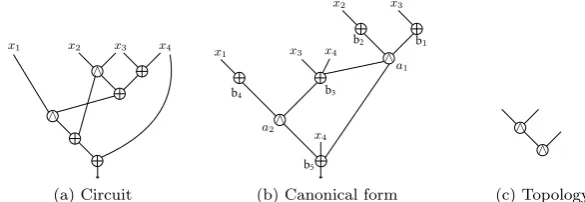
Example 1 Letf ∈B4 be f =x1x2x3+x1x3+x1x4+x2x3+x4. A circuit computingf, with its canonical form and topology is shown in Figure 1. The trace for that circuit is ({x3},{x2},{x3, x4},{x1},{x4},∅,∅,{a1},∅,{a1, a2}). The topology of the circuit is [(∅,∅),({a1},∅)]. The input to the topology is ({x3},{x2},{x3, x4},{x1},{x4}).
∧
x2 x3 x4
x1
∧
(a) Circuit
x2 x3
∧
∧
x1 x3 x4
x4
a1
a2
b1 b2
b3 b4
b5
(b) Canonical form
∧
∧
(c) Topology
Fig. 1: Circuit and topology computingf.
An iterative method to construct and evaluate topologies with a given number of AND gates was presented in [3].
3 A New Lower Bound on Multiplicative Complexity
A general lower bound on the multiplicative complexity of Boolean func-tions is the degree bound, which states that the multiplicative complexity of a Boolean functionf is at leastdeg(f)−1 [21]. In this section, we provide a new lower bound on the multiplicative complexity based on the dimension of the Boolean function.
Definition 1 [2] Let Nf be the number of distinct input variables appearing
in the ANF off ∈Bn. The dimension off, denoteddim(f) is defined as the
smallest number of variables that appear in the ANFs of functions that are affine equivalent tof;
dim(f) = min
g∈[f]Ng. (9)
We can now relate the dimension of a function to its linearity dimension, at the same time providing an efficient way to compute it.
Theorem 1 Let f ∈ Bn. If dim(f) =n,dl(f) = 0.
Proof Letdim(f) =n. Assumedl(f)>0, then by definition,f has a non-zero linear structureα. Let f0∈Bn bef0 =T(f), where the affine transformation
T = (A, a, b, c) satisfies Aα=ei. Then, by Proposition 1, Cf0(en) =±2n. If en is an invariant linear structure of f0,f0 is independent ofxn or xn only
appears linearly in the ANF of f0, and cannot have full dimension. Since f
and f0 are affine equivalent, hence have the same dimensiondl(f) cannot be
greater than zero. Then, the linearity dimension is equal to zero.
Theorem 2 Let f ∈ Bn.dim(f) +dl(f) =n.
Proof Using Theorem 1, when dim(f) = n, dl(f) is zero. Hence, dim(f) +
dl(f) = n holds. Assume dim(f) < n. Then, by definition, there exists a Boolean functiong∈Bn in the same affine equivalence class off with exactly
dim(f) variables appearing in its ANF. Without loss of generality, assume the variablesx1, . . . andxdim(f) appear in the ANF of f. Then, the output of
g is independent of the values of the variables xdim(f)+1, xdim(f)+2, . . . , and
xn. Ifg is independent ofxi, then g(x) =g(x+ei), and Cg(ei) = 2n, which implies thatei is a linear structure ofg. It is easy to see thated+1, . . . , en and
all of their linear combinations are linear structures of g. Let g0 ∈ B
dim(f)
be defined as g0(x1, x2, . . . , xdim(f) = g(x1, x2, . . . , xn) for all inputs. Since g0 has full dimension, using Theorem 1, we can say that g0 has no linear structure. Hence, g has no other linear structures. Then, the total number of linear structures for f is 2n−d, and the linearity dimension is n−d. Then, dim(f) +dl(f) =nholds.
Theorem 3 The MC of a functionf is at leastddim(f)/2e.
circuit with k AND gates has2k linear inputs. The rank of this set of inputs can be at most 2k, and any set of 2k linear functions on n > 2k variables can be affine transformed to functions having at most2kvariables. Therefore,
dim(f)≤2k, which implies that the multiplicative complexity off is greater than or equal toddim(f)/2e.
Note that the dimension bound is tighter than the degree bound when
deg(f)≤ ddim(f)/2e.
Example 2 Letf be the symmetric Boolean functionΣ8
4, i.e.,f =x1x2x3x4+
. . .+x5x6x7x8. According to the degree bound, the C∧(f)≥3. By Theorem 3,C∧(f)≥4.
4 Boolean Functions with Multiplicative Complexityk
The MC of Boolean functions can be characterized by using affine equiva-lence classes, since MC is affine invariant. In this section, we propose a general method to construct the list of affine equivalence classes of Boolean functions with a given MC, independent of the number of input variables.
The method iteratively constructs topologies with k AND gates, as de-scribed in [3]. Next, the method evaluates the topologies by supplying linear function inputs X = (L1, . . . , L2k), with dimension at most 2k as given in
Theorem 3. Then, one representative from each equivalence class is selected from the functions that are generated after evaluating the topologies. This method generalizes the approach presented in [3], which constructs the MC distribution of Boolean functions of given number of variables.
4.1 Equivalence Classes with MC 1 and 2
As previously shown in [1, 2], Boolean functions with MC 1 are affine equiv-alent tox1x2 and can be generated using the topology given in Fig 2.
∧
Fig. 2: Topology with 1 AND gate
There are two topologies with 2 AND gates as illustrated in Figure 3. Using Theorem 3, the dimension of Boolean functions with MC 2 is at most 4. Find et al. [2] also showed that a Boolean function with MC 2 is affine equivalent to exactly one of these following three functions x1x2x3, x1x2x3+x1x4 and
∧ ∧ (a) Topology 1
∧
∧ (b) Topology 2
Fig. 3: Topologies with 2 AND gates.
4.2 Equivalence Classes with MC 3
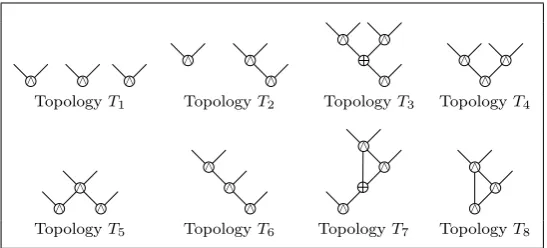
According to Theorem 3, Boolean functions with MC 3 can have up to 6 independent inputs. The MC distribution of all 150 357 affine equivalence classes is given in [3]. Figure 4 provides graphical representations of topologies with 3 AND gates.
∧ ∧ ∧
∧ ∧
∧
∧ ∧
∧
∧ ∧
∧ TopologyT1 TopologyT2 TopologyT3 TopologyT4
∧ ∧
∧
∧ ∧
∧
∧
∧
∧
∧ ∧
∧
TopologyT5 TopologyT6 TopologyT7 TopologyT8
Fig. 4: Topologies with 3 AND gates
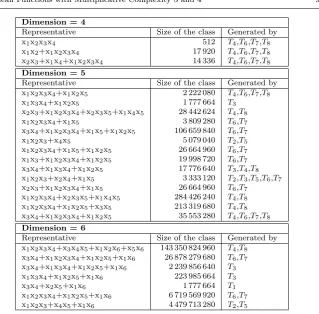
Evaluating topologies with linear inputs having dimension up to 6 gives the exhaustive list of equivalence classes having MC 3 as shown in Table 1. There are three equivalence classes with dimension 4, and all of these classes can be generated by either of the topologiesT4, T6, T7andT8. For dimension 5 and 6, there are 14 and 7 classes, respectively. We observe that there are three pairs of topologies that generate exactly the same set of equivalence classes: (T2, T5), (T4, T8), and (T6, T7).
4.3 Equivalence Classes with MC 4
According to Theorem 3, Boolean functions with MC 4 can have up to 8 independent inputs. Different from the MC 3 case, the exhaustive list of equivalence classes for Boolean functions with 7 and 8 inputs are not known. This makes it harder to have optimizations on efficiently calculating whether two functions are affine equivalent or not.
Dimension = 4
Representative Size of the class Generated by x1x2x3x4 512 T4,T6,T7,T8
x1x2+x1x2x3x4 17 920 T4,T6,T7,T8
x2x3+x1x4+x1x2x3x4 14 336 T4,T6,T7,T8 Dimension = 5
Representative Size of the class Generated by x1x2x3x4+x1x2x5 2 222 080 T4,T6,T7,T8
x1x3x4+x1x2x5 1 777 664 T3
x2x3+x1x2x3x4+x2x3x5+x1x4x5 28 442 624 T4,T8
x1x2x3x4+x1x5 3 809 280 T6,T7
x3x4+x1x2x3x4+x1x5+x1x2x5 106 659 840 T6,T7
x1x2x3+x4x5 5 079 040 T2,T5
x1x2x3x4+x1x5+x1x2x5 26 664 960 T6,T7
x1x3+x1x2x3x4+x1x2x5 19 998 720 T6,T7
x3x4+x1x3x4+x1x2x5 17 776 640 T3,T4,T8
x1x2x3+x2x4+x1x5 3 333 120 T2,T3,T5,T6,T7
x2x3+x1x2x3x4+x1x5 26 664 960 T6,T7
x1x2x3x4+x2x3x5+x1x4x5 284 426 240 T4,T8
x1x2x3x4+x1x2x5+x3x5 213 319 680 T4,T8
x3x4+x1x2x3x4+x1x2x5 35 553 280 T4,T6,T7,T8 Dimension = 6
Representative Size of the class Generated by x1x2x3x4+x3x4x5+x1x2x6+x5x6 143 350 824 960 T4,T8
x3x4+x1x2x3x4+x1x2x5+x1x6 26 878 279 680 T6,T7
x3x4+x1x3x4+x1x2x5+x1x6 2 239 856 640 T3
x1x3x4+x1x2x5+x1x6 223 985 664 T3
x3x4+x2x5+x1x6 1 777 664 T1
x1x2x3x4+x1x2x5+x1x6 6 719 569 920 T6,T7
x1x2x3+x4x5+x1x6 4 479 713 280 T2,T5
Table 1: The list of affine equivalence classes with MC 3. The size of each class (i.e., the number of functions in the class) is given for the dimension it belongs to.
with dimension 8 were obtained. A complete list of affine equivalence classes with MC 4 is available in [22].
4.4 Number of Boolean functions with MC≤4
Let λ(n, k) be the number of n-variable Boolean functions with MC k . Boyar et al. [9] showed thatλ(n, k)≤2k2+2k+2kn+n+1
. The exact formulas for
k= 1,2 are given in [1] and [2], respectively.
Definition 2 Let f ∈ B`. The embedding of f in Bn, n ≥ ` is defined as the n-variable Boolean function that satisfies fn(x1, . . . , x`, x`+1, . . . , xn) =
f(x1, . . . , x`).
The following theorem proved in [2] determines the size of equivalence classes when a Boolean function is embedded in higher number of variables.
Theorem 4 [2] Let f ∈ B`, withdim(f) =`. Let fn be the embedding of f
inBn,n≥`. The size of the equivalence class [fn] is
|[fn]|= 2n−`|[f`]| `−1
Y
i=0 2n−2i
2`−2i. (10)
Let β(d, k) be the sum of sizes of equivalence classes with multiplica-tive complexity k and dimension d. For example, β(3,4) = 32 768 is the total of the size of the equivalence classes [x1x2x3x4], [x1x2+x1x2x3x4] and [x2x3+x1x4+x1x2x3x4]. Then, using the Theorem 4, the number of Boolean functions with MC 3 inBn is equal to the sum of the sizes of each equivalence class embedded inBn. This number can be calculated as
λ(n,3) = 6
X
d=4 2n−d
d−1
Y
i=0
2n−2i
2d−2iβ(d,3)
!
(11)
where
β(4,3) = 32 768, β(5,3) = 775 728 128, β(6,3) = 183 894 007 808.
Similarly, the number of Boolean functions with MC 4 can be calculated as
λ(n,4) = 8
X
d=5 2n−d
d−1
Y
i=0
2n−2i
2d−2iβ(d,3)
!
(12)
where
5 Constructing circuits for Boolean functions with MC 4 or less
The techniques defined in [3] and the exhaustive list of affine equivalence classes having MC up to 4 allow us to construct MC-optimal circuits for Boolean functions that have MC up to 4, independent of the number of vari-ables they are defined on.
Given a Boolean functionf ∈Bn, we first computedim(f). Ifdim(f)>8, we conclude that f does not belong to any of the equivalence classes with MC less than or equal to 4, hence C∧(f) ≥4. Otherwise, we determine the equivalence class that it belongs to among the 1305 equivalence classes having MC up to 4. Once we determine the equivalence class off, we find the affine transformation between the representative of the class andf. After applying this affine transformation to the linear inputs of the topology implementing the representative, the optimal circuit forf is found.
To increase efficiency, as an intermediate step, instead of working onBn, the number of variables inf can be reduced todim(f) by an affine transforma-tion. Then, the affine transformation search betweenf and the representative of each class can be doneBdim(f).
6 Conclusion and Future Work
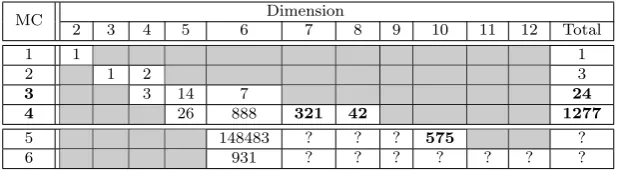
The relation between dimension and multiplicative complexity of Boolean functions allowed us to exhaustively find the list of affine equivalence classes with MC 3 and 4. The MC distribution of Boolean functions with dimension up to 6 were provided in [3]. In this work, we showed that there are exactly 24 equivalence classes for MC 3. For MC 4, in addition to the classes found in [3], we determined the equivalences classes having dimension 7 and 8, which makes the total of 1277 equivalence classes. Table 2 provides the number of affine equivalence classes with respect to MC and dimension. The contributions of this paper were written in bold. Note that it is easy to see that for the shaded cells the number of affine equivalence classes is zero. We also provide a closed formula for the number ofn-variable functions with MC 3 and 4.
MC Dimension
2 3 4 5 6 7 8 9 10 11 12 Total
1 1 1
2 1 2 3
3 3 14 7 24
4 26 888 321 42 1277
5 148483 ? ? ? 575 ?
6 931 ? ? ? ? ? ? ?
For each equivalence class representative, an MC-optimal circuit has been constructed. This allows us to construct optimal circuits for any Boolean func-tion with MC up to 4 independent of the number of variables the funcfunc-tions defined on. The method can also be used to determine that a function has MC greater than 4, if it does not belong to any of the equivalence classes.The method can also be used to determine that a function has MC greater than 4, if it does not belong to any of the equivalence classes.
The table also includes the known cases forn= 5,6. The identification of classes with MC 5 is still in progress. The techniques becomes inefficient as the dimension and MC increase. Different techniques or optimizations may be necessary to find the missing figures of the table.
References
1. M. J. Fischer and R. Peralta. Counting Predicates of Conjunctive Complexity One. Yale Technical Report 1222, February 2002.
2. Magnus Gausdal Find, Daniel Smith-Tone, and Meltem S¨onmez Turan. The Number of Boolean Functions with Multiplicative Complexity 2.IJICoT, 4(4):222–236, 2017. 3. C¸ a˘gda¸s C¸ alık, Meltem S¨onmez Turan, and Ren´e Peralta. The Multiplicative Complexity
of 6-variable Boolean Functions.Cryptogr. Commun., 2018.
4. Zvika Brakerski, Craig Gentry, and Vinod Vaikuntanathan. (Leveled) Fully Homomor-phic Encryption without Bootstrapping. In Shafi Goldwasser, editor,Innovations in Theoretical Computer Science 2012, Cambridge, MA, USA, January 8-10, 2012, pages 309–325. ACM, 2012.
5. Joan Boyar, Ivan Damg˚ard, and Ren´e Peralta. Short Non-Interactive Cryptographic Proofs.J. Cryptology, 13(4):449–472, 2000.
6. Vladimir Kolesnikov and Thomas Schneider. Improved Garbled Circuit: Free XOR Gates and Applications. In Luca Aceto, Ivan Damg˚ard, Leslie Ann Goldberg, Magn´us M. Halld´orsson, Anna Ing´olfsd´ottir, and Igor Walukiewicz, editors,Automata, Languages and Programming, 35th International Colloquium, ICALP 2008, Reykjavik, Iceland, July 7-11, 2008, Proceedings, Part II - Track B: Logic, Semantics, and Theory of Pro-gramming & Track C: Security and Cryptography Foundations, volume 5126 ofLecture Notes in Computer Science, pages 486–498. Springer, 2008.
7. Christoph Dobraunig, Maria Eichlseder, Lorenzo Grassi, Virginie Lallemand, Gregor Leander, Eik List, Florian Mendel, and Christian Rechberger. Rasta: A Cipher with Low ANDdepth and Few ANDs per Bit. InCRYPTO (1), volume 10991 of Lecture Notes in Computer Science, pages 662–692. Springer, 2018.
8. Martin R. Albrecht, Christian Rechberger, Thomas Schneider, Tyge Tiessen, and Michael Zohner. Ciphers for MPC and FHE. In Elisabeth Oswald and Marc Fischlin, editors,Advances in Cryptology - EUROCRYPT 2015 - 34th Annual International Con-ference on the Theory and Applications of Cryptographic Techniques, Sofia, Bulgaria, April 26-30, 2015, Proceedings, Part I, volume 9056 of Lecture Notes in Computer Science, pages 430–454. Springer, 2015.
9. Joan Boyar, Ren´e Peralta, and Denis Pochuev. On the Multiplicative Complexity of Boolean Functions over the Basis (∧,⊕, 1).Theor. Comput. Sci., 235(1):43–57, 2000. 10. Meltem S¨onmez Turan and Ren´e Peralta. The Multiplicative Complexity of Boolean
Functions on Four and Five Variables, pages 21–33. Springer International Publishing, Cham, 2015.
11. Magnus Gausdal Find. On the Complexity of Computing Two Nonlinearity Measures. InComputer Science - Theory and Applications - 9th International Computer Science Symposium in Russia, CSR 2014, Moscow, Russia, June 7-11, 2014. Proceedings, pages 167–175, 2014.
13. Lu´ıs T. A. N. Brand˜ao, C¸ a˘gda¸s C¸ alık, Meltem S¨onmez Turan, and Ren´e Peralta. Upper Bounds on the Multiplicative Complexity of Symmetric Boolean Functions. Cryptogra-phy and Communications, Aug 2019.
14. Kaisa Nyberg. On the Construction of Highly Nonlinear Permutations. In Rainer A. Rueppel, editor,Advances in Cryptology - EUROCRYPT ’92, Workshop on the Theory and Application of of Cryptographic Techniques, Balatonf¨ured, Hungary, May 24-28, 1992, Proceedings, volume 658 of Lecture Notes in Computer Science, pages 92–98. Springer, 1992.
15. Joanne Elizabeth Fuller.Analysis of Sffine Equivalent Boolean Functions for Cryptog-raphy. PhD thesis, Queensland University of Technology, 2003.
16. Elwyn R. Berlekamp and Lloyd R. Welch. Weight Distributions of the Cosets of the (32, 6) Reed-Muller Code.IEEE Transactions on Information Theory, 18(1):203–207, 1972.
17. James A. Maiorana. A classification of the cosets of the Reed-Muller code R(1,6). Mathematics of Computation, 57(195):403–414, 1991.
18. An Braeken, Yuri L. Borissov, Svetla Nikova, and Bart Preneel. Classification of Boolean Functions of 6 Variables or Less with Respect to Some Cryptographic Properties. In Lu´ıs Caires, Giuseppe F. Italiano, Lu´ıs Monteiro, Catuscia Palamidessi, and Moti Yung, editors,ICALP, volume 3580 ofLecture Notes in Computer Science, pages 324–334. Springer, 2005.
19. Xiang-Dong Hou. AGL(m,2) acting on R(r,m)/R(s,m).Journal of Algebra, 171(3):927– 938, 1995.
20. Bart Preneel. Analysis and Design of Cryptographic Hash Functions. PhD thesis, Katholieke Universiteit Leuven, 1993.
21. Claus-Peter Schnorr. The Multiplicative Complexity of Boolean Functions. InAAECC, pages 45–58, 1988.
22. NIST Computer Security Division. Circuit Complexity Project Repository,
https://github.com/usnistgov/Circuits/.