ISSN(Online): 2319-8753 ISSN (Print): 2347-6710
I
nternational
J
ournal of
I
nnovative
R
esearch in
S
cience,
E
ngineering and
T
echnology
(A High Impact Factor, Monthly, Peer Reviewed Journal) Visit: www.ijirset.com
Vol. 8, Issue 8, August 2019
Channel State Information Based Robust
Relay Selection for Large-Scale
Energy-Harvesting IOT Applications
Vijay laxmi rao, Mr. Pankaj Rathi
Research Scholar (D.C), SITE, Nathdwara, Rajasthan, India
Associate professor, SITE, Nathdwara, Rajasthan, India
ABSTRACT: We consider the relay selection problem in large-scale energy harvesting (EH) networks. It is known that if channel state information (CSI) is available at EH relays, a diversity order equal to the number of relays can be obtained, however, at the penalty of a feedback overhead (necessary to obtain accurate CSI) which is not suitable for energy-limited devices intended, e.g., for Internet-of-Things applications. In this paper, we therefore propose a new EH relay selection scheme which is based on the residual energy at each relay's battery, and on information on the distribution of the channels between relays and the destination.
I. INTRODUCTION
Typical wireless channels, however, suffer from multipath fading and shadowing, which significantly reduce communication capacity for a given average transmission power and hinder reliable transmission.[3]Although an effective option is to use multiple antennas to obtain spatial diversity gain, in practice, it is difficult equip small IoT devices with multiple antennas due to their size, complexity, and cost. Hence, another concept has been proposed: when the source cannot reliably communicate directly with its destination, other nodes temporarily serve as relays in order to support the communication.[3]
This cooperative diversity approach allows devices to enjoy spatial diversity gain without the need to equip them with additional antennas, and it has been shown that if sufficiently many relays are available, opportunistic relying can attain a diversity order equal to the number of relays itself[4]. In opportunistic relaying, the best relay among those available is chosen based on the perfect knowledge of the instantaneous channel state information (CSI), where best is defined in terms of the corresponding instantaneous signal-to-noise ratio (SNR) at the destination. However, in a cooperative diversity system, relays consume their own battery order to support other nodes’ communication, so that if multiple nodes drain their batteries at the same time, the network life-time or its topology may quickly deteriorate.[7]
II. EXISTING SYSTEM
Symbol error rate (SER) of a cooperative network with EH relays was derived theoretically, and the advantages of opportunistic relaying was shown for the case in which the selection is based on the current available energy and the CSI[8]
Drawbacks
ISSN(Online): 2319-8753 ISSN (Print): 2347-6710
I
nternational
J
ournal of
I
nnovative
R
esearch in
S
cience,
E
ngineering and
T
echnology
(A High Impact Factor, Monthly, Peer Reviewed Journal) Visit: www.ijirset.com
Vol. 8, Issue 8, August 2019
A scheme based on the relative throughput gain of each relay and its Energy State Information (ESI) was proposed.[5]This method of relay selection was shown to improve short-term performance, since the harvested energy can be efficiently utilized.
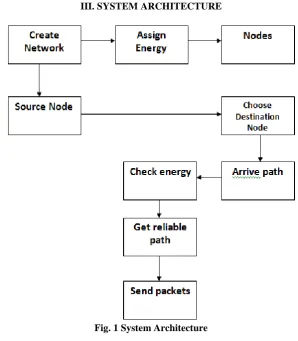
III. SYSTEM ARCHITECTURE
Fig. 1 System Architecture Modules
Node deployment
Neighbor discovery
Energy aware routing
Energy harvest
ISSN(Online): 2319-8753 ISSN (Print): 2347-6710
I
nternational
J
ournal of
I
nnovative
R
esearch in
S
cience,
E
ngineering and
T
echnology
(A High Impact Factor, Monthly, Peer Reviewed Journal) Visit: www.ijirset.com
Vol. 8, Issue 8, August 2019
IV. RESULT AND DISCUSSIONS
Packet Delivery Ratio
The above graph defines the throughput in the initialization phase. The experiment was running 10 seconds of time. Throughput is the rate at which a network sends receives data. It is a good channel capacity of net connections and rated in terms bits per second (bit/s). The proposed system has high packet delivery ratio in the overall distributed time simulation than the existing system.
Packet Loss
ISSN(Online): 2319-8753 ISSN (Print): 2347-6710
I
nternational
J
ournal of
I
nnovative
R
esearch in
S
cience,
E
ngineering and
T
echnology
(A High Impact Factor, Monthly, Peer Reviewed Journal) Visit: www.ijirset.com
Vol. 8, Issue 8, August 2019
End to End Delay
The above graph defines the delay in network. The experiment was running 10 seconds of time. End to End Delay refers to the time taken for a packet to be transmitted across a network from source to destination. End to end delay of
ISSN(Online): 2319-8753 ISSN (Print): 2347-6710
I
nternational
J
ournal of
I
nnovative
R
esearch in
S
cience,
E
ngineering and
T
echnology
(A High Impact Factor, Monthly, Peer Reviewed Journal) Visit: www.ijirset.com
Vol. 8, Issue 8, August 2019
V. CONCLUSION
A new EH relay selection scheme that is based on a residual battery of relays and the CDI of both small-scale
and large-scale fading. Furthermore, we derived a simple selection rule and a closed solution for the end-to-end outage probability.
Proposed system can achieve a diversity order of one, even though each relay can exploit knowledge of the
entire distribution between the destination and itself.
These results show that if we wish to enhance the spatial diversity, it is important to obtain the instantaneous
CSI.
On the other hand, considering the practical limitations of IoT devices, proposed approach is still an attractive
option that realizes low-power consumption and highly reliable communications.
REFERENCES
[1] Dave Evans, “The Internet of Things: How the Next Evolution of the Internet is ChangingEverything,”April2011.Available:
http://www.cisco.com/web/about/ac79/docs/innov/IoT IBSG 0411FINAL.pdf
[2] V. Tarokh, N. Seshadri, and A. R. Calderbank, “Space-time codes for high data rate wireless communication: Performance criterion and
code construction,” IEEE Trans. Inform. Theory, vol. 44, no. 2, pp. 744–765, Mar. 1998.
[3] J. N. Laneman, D. N. C. Tse, and G. W. Wornell, “Cooperative diversity in wireless networks: Efficient protocols and outage behavior,”
IEEE Trans. Inform. Theory, vol. 50, no. 12, pp. 3062–3080, Dec. 2004.
[4] A. Bletsas, H. Shin and M. Z. Win “Cooperative communications with outage-optimal opportunistic relaying,” IEEE Trans. Wireless
Commun., vol. 6, no. 9, pp.3450–3460, Sep. 2007.
[5] J. A. Paradiso and T. Starner, “Energy scavenging for mobile and wireless electronics,” IEEE Perv. Comput., vol. 4, pp. 18–27, Jan-Mar.
2005.
[6] B. Medepally and N. B. Mehta, “Voluntary energy harvesting relays and selection in cooperative wireless networks,” IEEE Trans.
Wireless Commun., vol. 9, no. 11, pp. 3543–3553, Sep. 2010.
[7] Y. Luo, J. Zhang, and K. Letaief, “Relay selection for energy harvesting cooperative communication systems,” in IEEE Global Commun.
Conf. (GLOBECOM), pp. 2514–2519, Dec. 2013.
[8] A. Tukmanov, S. Boussakta, Z. Ding and A. Jamalipour, ”On the impact of relay-side channel state information on opportunistic
relaying,” Proc. IEEE ICC WCS, pp.4071–4075, June 2013.
[9] Z. Fang, X. Zhou, X. Bao and Zongxin, ”Outage minimized relay selection with partial channel information,” Proc. IEEE ICASSP,
pp.2617– 2620, Apr. 2009.
[10] H. Jiang, S. Zhang and W. Zhou, ”Outage analysis of distributed scheme on opportunistic relaying with limited CSI”, IEEE Commun.
Lett., vol. 15, no. 9, pp.935–937, July 2011.
[11] Google Scholar
[12] V. Tarokh, N. Seshadri, A. R. Calderbank, "Space-time codes for high data rate wireless communication: Performance criterion and code
construction", IEEE Trans. Inf. Theory, vol. 44, no. 2, pp. 744-765, Mar. 1998.
[13] Show Context View Article Full Text: PDF (766KB) Google Scholar
[14] J. N. Laneman, D. N. C. Tse, G. W. Wornell, "Cooperative diversity in wireless networks: Efficient protocols and outage behavior", IEEE
Trans. Inf. Theory, vol. 50, no. 12, pp. 3062-3080, Dec. 2004.
[15] Show Context View Article Full Text: PDF (573KB) Google Scholar
[16] A. Bletsas, H. Shin, M. Z. Win, "Cooperative communications with outage-optimal opportunistic relaying", IEEE Trans. Wireless