Investigation of Bidirectional Passive Optical
Network with 128 Optical Network Units
Ravneet Kaur
1, Sanjeev Dewra
2M.Tech Student, Department of Electronics & Communication Engineering, Shaheed Bhagat Singh State Technical
Campus, Ferozepur, India1
Associate Professor, Department of Electronics & Communication Engineering, Shaheed Bhagat Singh State Technical
Campus, Ferozepur, India2
ABSTRACT: In this paper, the performance of bidirectional passive optical network with 128 users has been evaluated. The signal is transmitted at 10 Gbps for downstream and upstream transmission up to a distance of 60 km. The splitter is used as a PON element which distributes the data signal and creates a communication between central office and users. The system is investigated at different input power for different number of users and performance is evaluated in terms of Q-factor and BER. In downstream transmission, the quality factor of 5.94 and bit error rate of 1.33e-9 is achieved whereas in upstream transmission the quality factor of 6.30 and bit error rate of 1.44e-10 is achieved at an input power of -15 dBm with bit rate of 10 Gbps up to a distance of 60 km.
KEYWORDS: Optical line terminal, Optical network units, Bidirectional passive optical network, Fiber to the home.
I.INTRODUCTION
Fiber-based passive optical networks are presently being deployed by operators in several countries, offering much higher bandwidths than traditional copper- based access networks [1]. Recently, the PON has become an attractive solution for broadband access taking its advantages of reduced fiber consumption, low cost, large coverage area and broadcast facility. For next generation optical access networks Wavelength Division Multiplexed Passive Optical Networks are a capable approach. Two fixed upstream and downstream wavelengths are allocated to each user. The Wavelength Division Multiplexed Passive Optical Network architecture can offer more elasticity for network movement and more bandwidth per user than conventional passive optical network based on TDM [2, 3]. Bidirectional single fiber PON can reduce the use of fiber links, as well as the number of network equipments, and hence reduce energy consumption and the cost. Additionally, the demand for bandwidth from the individual access network user is being encouraged by novel bandwidth- exhaustive network services like peer-to-peer file allocation, high-definition video on demand and remote access services [4]. Such trends have also driven increases in the data rates supported by wireless data access networks as well, with emerging wireless access technologies, such as Worldwide Interoperability for Microwave access offering higher data access speeds and supporting more users [5]. Wavelength division multiplexing has become the favoured transmission technology in transport network of long distance operators. Wavelength division multiplexing was initially deployed in point-to-point configurations to provide capacity relief on crowded links suffering from fiber collapse. The combination of a huge number of wavelengths on a single fiber allows for distribution of network elements such as amplifiers, resulting in significant cost savings [6]. A passive optical network technology is now considered to be an efficient solution to the last-mile difficulty and passive optical network access architecture is the accepted choice of triple-play service delivery from service providers to the receivers in FTTH access networks [7].
ISSN (Print) : 2320 – 3765 ISSN (Online): 2278 – 8875
I
nternational
J
ournal of
A
dvanced
R
esearch in
E
lectrical,
E
lectronics and
I
nstrumentation
E
ngineering
(An ISO 3297: 2007 Certified Organization) Vol. 4, Issue 8, August 2015
network using optical carrier suppression and separation technique to generate both upstream and downstream wavelength channels from a single laser. They generated 32 DWDM channels and demonstrated error-free symmetric 10 Gbps data transmission over 20 km of single mode fibre using a wavelength pair.
In this paper, we propose a bidirectional WDM-PON scheme. Till now, the investigation presented in [8] was restricted for 64 users at a transmission distance of 50 km. We have extended the previous work to 128 users with optical transmission distance of 60 km. So, there is an improvement of transmission distance by 10 km.
This paper is structured into four sections: In section I, Introduction is presented to passive optical network. Section II, describes the schematic set-up of bidirectional WDM-PON. In section III, results have been reported for the proposed system. Finally, conclusion is presented in section IV.
II.SIMULATION SETUP
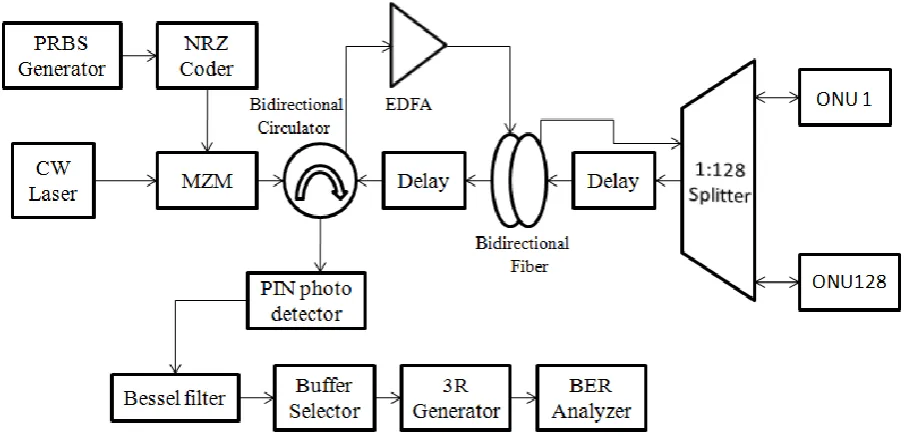
The simulation setup of bidirectional PON is shown in fig. 1. In the system setup 128 users can access data signal up to 60 km transmission distance. The system consists of three sections, mainly the transmitter, fiber and the receiver. In this architecture the central office is equipped with OLT devices and ONU is installed on subscriber end. The OLT is connected to ONUs through an optical splitter.
Fig. 1. System setup of bidirectional PON
Fig. 2. Internal architecture for optical network unit
The internal structural design of ONU is shown in Fig. 2. The ONU receiver section comprises a PIN photo diode with 1A/W responsivity and 10 nA dark current and Bessel filter having 0.75× bit rate as a center frequency to detect a downlink signal. To analyze the eye diagram the optical signal is converted into electrical signal using a PIN photo diode. To generate an uplink signal, the optical network unit transmitter section consists of CW laser which is tuned at a wavelength of 1310 as an uplink wavelength. PRBS generate a bit pattern then this sequence is converted into electrical signal using NRZ electrical coder and machzender modulator is used to spread a data over a bidirectional fiber as a upstream data.
III. RESULTS AND DISCUSSION
In bidirectional PON system, signal is transmitted over the fiber at different input power for different number of users and different waveforms will be observed. The Q-factor and bit error rate are most frequently used parameters for measuring the system performance. The graph for quality factor versus number of users at different input power is shown in fig. 3. for downlink. The acceptable Qfactor of 9.85, 8.58 and 5.94 is observed at 5dBm, 10dBm and -15dBm input power respectively at 60km transmission distance for 128 users. The value of Q-factor increases with increase in input power and decreases as the number of user increases. As we increase the input power it accommodates a more number of users and if we decrease an input power it accommodates a less number of users.
ISSN (Print) : 2320 – 3765 ISSN (Online): 2278 – 8875
I
nternational
J
ournal of
A
dvanced
R
esearch in
E
lectrical,
E
lectronics and
I
nstrumentation
E
ngineering
(An ISO 3297: 2007 Certified Organization) Vol. 4, Issue 8, August 2015
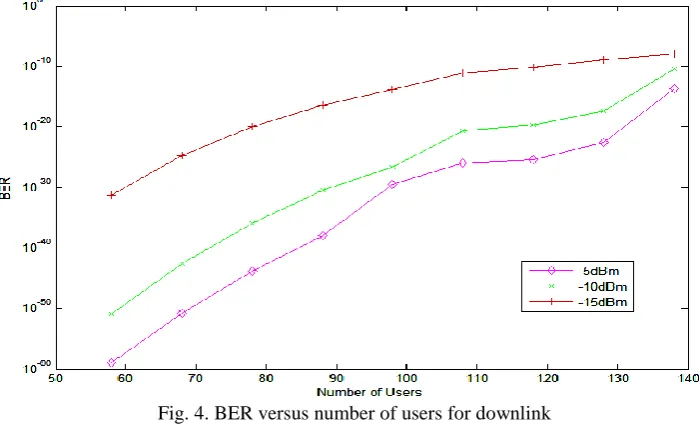
The graph for BER and number of users at different input power is revealed in fig. 4. for downstream transmission. The acceptable bit error rate of 3.12e-23, 4.45e-18 and 1.33e-9 is observed at -5dBm, -10dBm, and -15dBm input power respectively at a 60 transmission distance for 128 users. The BER gets increased with increase in number of users and decreased with increase in input power.
Fig. 4. BER versus number of users for downlink
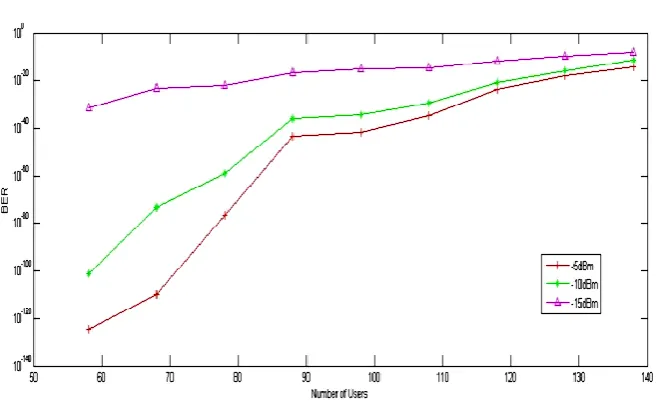
Similarly, the graph of quality factor and number of users at different input power is revealed in fig. 5. for upstream transmission. The system provides acceptable Q-factor of 8.73, 8.20, 6.30 at -5dBm, -10dBm, -15dBm input power respectively for 128 users at a 60 km transmission distance. The Q-factor decreases with increment of number of users and increases with increase in input power. The Q-factor gets decreased due to fiber non- linearities and interference.
Fig. 5. Q-factor versus number of users for uplink
Fig. 6. BER versus number of users for uplink
The above graphs show that the quality of signal decreases as the number of user and transmission distance increases. If we want to support more number of users we have to increases an input power. If we increase an input power system supports a more number of users and if we decrease an input power it supports a less number of users. The value of BER increases with decreases an input power and increases as the number of users increases. Our results are in coincides with the results of [8] where they transmitted data at 10 Gb/s over 50 km bidirectional fiber for 64 users. Here in this paper, at the same bit rate, the data can be transmitted over 60 km for 128 users. So, there is an improvement of transmission distance by 10 km.
IV.CONCLUSION
The performance of bidirectional WDM-PON is investigated at different input power for different number of users. Data signal is transmitted at 10Gbps for 128 users at 60 km distance. We investigated the Q-factor and BER for different number of users at a different input power for downlink and uplink transmission. The acceptable Q-factor of 9.85, 8.58 and 5.94 at -5dBm, -10dBm, -15dBm input power is observed in downstream direction. In upstream direction an acceptable value achieved with Q-factor of 8.73, 8.20, 6.30 at an input power of -5dBm, -10dBm, -15dBm respectively. The Q-factor decreases as we decreases the input power and increases the number of users.
REFERENCES
[1] S. Lambert, B. Lannoo, A. Dixit, D. Colle, M. Pickavet, J. Montalvo, J.A. Torrijos and P. Vetter, “Energy efficient analysis of high speed
triple-play services in next-generation PON deployments”, Computer Networks, vol.78, pp.68-82, 2014.
[2] Yue Tian, Tong Ye and Yikai Su, “Demonstration and Scalability Analysis of All-Optical Virtual Private Network in Multiple Passive Optical
Networks Using ASK/FSK Format”, IEEE photonics technology letters, vol. 19, no. 20, pp. 1595-1597, 2007.
[3] J. Briand, F. Payoux, P. Chanclou and M. Joindot, “Forward error correction in WDM PON using spectrum slicing”, Optical Switching and Networking, vol.4, no.2, pp. 131–136, 2007.
[4] Alexey V. Osadchiy, Kamau Prince and Idelfonso Tafur Monroy, “Converged delivery of WiMAX and wireline services over an extended
reach passive optical access network”, Optical Fiber Technology, vol.16, no.3, pp.182–186, 2010.
[5] S.J. Vaughan-Nichols, “Achieving wireless broadband with WiMAX”, Computer, vol.37, no.6, pp. 10–13, 2004.
[6] Sanjeev Dewra and R. S. Kaler, “Performance evaluation of an optical network based on optical cross add drop multiplexer”, OSA: Journal of Optical Technology, vol. 80, pp. 46–50, 2013.
[7] Simranjit Singh, “Performance evaluation of bi-directional passive optical networks in the scenario of triple plays service”, Optik, vol. 125, pp. 5837–5841, 2014.
[8] Deeksha Kocher, R.S. Kaler and Rajneesh Randhawa, “50 km bidirectional FTTH transmission comparing different PON standards”, International journal for light and electron optics, vol. 124, no.21, pp.5075– 5078, 2013.