Event Argument Identification on Dependency Graphs
with Bidirectional LSTMs
Alex Judea and Michael Strube
Heidelberg Institute for Theoretical Studies gGmbH Schloss-Wolfsbrunnenweg 35
69118 Heidelberg, Germany (alex.judea|michael.strube)@h-its.org
Abstract
In this paper we investigate the perfor-mance of event argument identification. We show that the performance is tied to syntactic complexity. Based on this find-ing, we propose a novel and effective sys-tem for event argument identification. Re-current Neural Networks learn to produce meaningful representations of long and short dependency paths. Convolutional Neural Networks learn to decompose the lexical context of argument candidates. They are combined into a simple system which outperforms a feature-based, state-of-the-art event argument identifier with-out any manual feature engineering.
1 Introduction
Event extraction is a difficult information extrac-tion task. The 2005 Automatic Content Extrac-tion evaluaExtrac-tion (ACE 2005) defines three challeng-ing sub-tasks: Entity mention detection, the task of finding mentions of predefined entity types like persons and organizations;event trigger detection, the task of finding words, mostly verbs or nomi-nalizations, indicating an event from a set of pre-defined event types; and event argument identifi-cation, the identification of entity mentions1
play-ing a role in the events, as well as the identification of the roles they play.
When we look at the evaluations in three of the most influential recent event extraction papers (Li et al., 2013, 2014; Chen et al., 2015; Nguyen et al., 2016) we note that argument identification performance is low, ranging from 52.7 to 55.4 F1. There are multiple reasons for the low perfor-mance. First, argument identification suffers from
1In this work we make no distinction between ‘entity’,
‘time’, and ‘place’ for the sake of simplicity.
error propagation. Missed or spurious event trig-gers or entity mentions may lead to missed or spu-rious event arguments. Second, event structure is complex. Multiple entities can play the same role in the same event. Additionally, one entity can play different roles across events (and thus cause multiple event arguments). Consider the following example.
A Palestinianboyas well as hisbrother
and asisterwerewoundedlate Wednes-day by Israeligunfire.
Here, the three entity mentions (in bold) are all Victims of the INJURE event triggered by
‘wounded’ as well as Targets of the ATTACK
event triggered by ‘gunfire’. Such structures can become even more complex when more events and more entities are involved.
The third reason for low argument identification performance is syntactic complexity. Many argu-ments are syntactically far away from their trig-gers, making it hard to construct meaningful syn-tactic features. Section 3 shows that performance is tied to the length of the shortest dependency path connecting trigger and argument.
Error sources one and two were already targeted by systems which jointly infer triggers and their arguments. To the best of our knowledge, no pre-vious work identified syntactic complexity as the third key problem for argument identification per-formance, and no previous system aimed to de-compose syntactic structure in order to learn better classifiers for the task. The contributions of this paper are the following.
1. We observe that syntactic complexity is a cru-cial factor for argument identification. Argu-ment identification performance highly cor-relates with dependency path length (Section 3.1).
2. We propose to represent dependency paths with bidirectional Long Short-term Mem-ory networks (biLSTMs) in order to account for their sequential and compositional na-ture. Using LSTMs to learn dependency path representations proved effective in other ar-eas like relation extraction (Xu et al., 2015) and semantic role labeling (Roth and Lapata, 2016). We investigate their use for argument identification.
3. We propose to represent lexical contexts of event arguments with Convolutional Neural Networks. Together with LSTMs, they form an effective and simple argument identifier which beats a state-of-the-art, feature-based system without any manual feature engineer-ing, especially for long dependency paths.
2 Baseline
2.1 Baseline Argument Extraction
Our baseline is a re-implementation of Li et al. (2013). It is a state-of-the-art event extractor that predicts event triggers and arguments jointly. Be-cause of this joint inference, it avoids error propa-gation and can draw features based on joint event extraction decisions, e.g., how many arguments of a specific type does a specific trigger have?
The system uses a structured perceptron with beam search. It processes a sentence from left to right and token by token. With each position it advances, it constructs new hypotheses containing event trigger and argument assignments. Then, it prunes the hypotheses spaces to thenbest alterna-tives and processes the next token position. After the last token was processed, the hypothesis with highest score is selected as the final prediction. This hypothesis contains trigger and argument as-signments for the entire sentence.
2.2 Baseline Argument Extraction Features
Our baseline system uses a rich, hand-engineered feature set. Feature templates can be divided into
local templatesandglobal templates. Local tem-plates characterize single arguments, and they in-volve only the mentions and triggers of this argu-ment. They capture, e.g., the trigger and entity types, the mention context, and the dependency path between trigger and mention.
Global templates on the other hand characterize multiple arguments, either in terms of shared men-tions, or in terms of shared roles. Global templates
Argument type Supporttrain F1dev
Victim 578 79.0
Instrument 256 77.1
Artifact 605 75.6
Attacker 574 47.3
Target 438 42.6
Giver 94 32.9
Table 1: Training set support and development set baseline F1 for the three best and three worst per-forming argument types.
can be divided into segment level templates and
sentence level templates. Segment level templates capture characteristics of the mentions within one event, e.g., the words between two mentions shar-ing a role in one event, or the head and modifier of nominal modifications like ‘IBM CEO’. Sentence level templates capture characteristics of events sharing mentions, e.g., the roles such a mention fills, or the dependency path connecting the two triggers. The system uses two dozen feature tem-plates, resulting in 150,000 features for argument identification.
3 Performance Analysis
3.1 Analysis of Baseline Performance
We start the analysis of argument identification performance with the observation that despite the low overall performance, some argument types perform reasonably well. Table 1 reports deve-lopment set precision, recall, and F1 of our base-line for the three best and the three worst perform-ing argument types in the development set.2 As
we can see, the difference between the best type (Victim) and the worst type (Giver) is 46.1 F1 points. What is the reason for this big difference? Our first assumption is that the best perform-ing types have more trainperform-ing samples. Indeed, Victim has considerably more samples than Giver.Attackerhowever has nearly the same amount of training samples but a much lower performance (-31.7 F1). Instrument on the other hand has only half the training samples of Attacker, but a better performance (+29.8 F1).
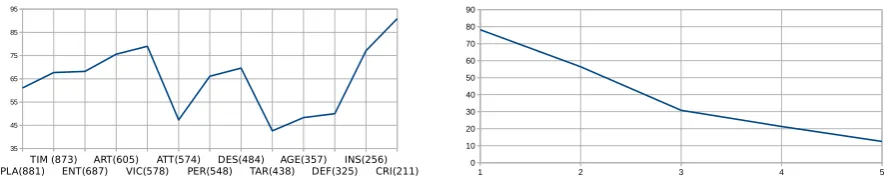
To further investigate this, Figure 1a plots train-ing set support in decreastrain-ing magnitude against development set F1 for the 12 most frequent ar-gument types. The plot is not conclusive: More
2We excluded types with less than 20 samples in the
PLA(881)TIM (873)ENT(687)ART(605)VIC(578)ATT(574)PER(548)DES(484)TAR(438)AGE(357)DEF(325)INS(256)CRI(211)
35 45 55 65 75 85 95
(a) Training set support in decreasing magnitude plotted against baseline devset F1.
1 2 3 4 5
0 10 20 30 40 50 60 70 80 90
(b) Increasing dependency path length plotted against baseline devset F1.
1 2 3 4 5 6 7 8 9 10 11 12
0 10 20 30 40 50 60 70 80 90
(c) Increasing lexical distance plotted against baseline devset F1.
Figure 1: Training set support, lexical distance of trigger and argument, and dependency path length plotted against development set performance.
training data does not automatically lead to better performance. The most frequent argument type Place with 881 training samples has an F1 of 61.1, whereas Victim with 34% less training samples has an F1 of 79.0. Instrument has about 70% less training samples and an F1of 77.1. If the number of training samples is not an impor-tant factor for performance, what else could be?
One important factor is semantic variety: Some roles can only be filled by one or two entity types, and most of their mentions are role fillers. This is especially true for Instrument which can only be filled by vehicles and weapons in ACE 2005; in turn, most weapons areInstruments. This is reflected in the good performance of Instrumentin Table 1 and Figure 1a.
However, most roles can be filled by more than two entity types, and their potential fillers are more frequent than vehicles and weapons: Entityfor example can be filled by persons, organizations, and geopolitical entities. At the same time, most of the respective mentions are not Entities. Even if a role can only be filled by one entity type, it may be that most occurrences are not role fillers, making the task to correctly fill those roles harder. Consider Time for example, which can only be filled bytimementions, yet it has only a mediocre performance of 67.7 F1points on the development set. Semantic variety alone cannot explain the big performance differences between argument types.
Another important factor is syntactic complex-ity: How long and diverse are dependency paths connecting arguments and triggers? To inves-tigate the effect of syntactic complexity, Figure 1b depicts length of dependency paths connecting triggers and arguments in decreasing magnitude against development set F1. In this plot, we see a much clearer trend: Shorter syntactic distance leads to better performance. Length-1 paths (di-rect trigger-argument dependency) have an F1 of 78.2. Length-2 path F1drops to 56.4, and to 30.8 for length-3 paths. Length-4 and length-5 paths have an F1of 21.3 and 12.5, respectively.
This trend is also reflected in the performance of individual argument types. The most frequent typePlacehas a high average path length of 2.2 and a low F1 of 61.1. Victimon the other hand has considerably less training data, but an average path length of 1.5 and an F1 of 79.0. For the three best performing types, the average path length is 1.7 vs. 2.3 for the three worst performing types.
considerable increase between distances 4 and 5, and a performance plateau between 8 and 11. Word sequences are much more diverse than dependency paths. A dependency path like returning−−−−−−−→nmod:from summit−−−−−→nmod:in Ireland abstracts from actual word sequences and ignores many words which are less relevant for argument identification, like adjectives and adverbs. This in turn alleviates data sparsity.
Syntactic complexity is a crucial factor for argu-ment identification, both in terms of overall per-formance as well as and in terms of individual argument type performance. Therefore, it is in-evitable to reduce or better handle syntactic com-plexity. Most systems incorporate dependency paths merely as strings, or rely on direct depen-dencies of triggers and arguments. They do not decompose or further analyze dependency paths in order to find relevant substructures, or to deal with data sparsity of long paths. In Section 4, we present a simple but efficient system which di-rectly addresses syntactic complexity.
3.2 Dependency Paths
We now illustrate the benefits and difficulties of using dependency paths for argument identifica-tion. Our dependency paths are lexicalized; they always start with the trigger word and end with a mention word.3 We say that a path has length 1 if
trigger and argument are directly related, length 2 if the path includes one intermediate dependency, etc.
Often, short dependency paths directly reflect event argument structure:
killed−−−→nsubj father-in-law killed−−→dobj him
The trigger (‘killed’, a DIE event) has two
de-pendencies, ‘father-in-law’ being the subject and ‘him’ being the object. Even without looking at more context we can say with confidence that the subject must be the Agent of the event and the object must be the Victim. Even longer paths may be quite clear:
returning−−−−−−−→nmod:from summit−−−−−→nmod:in Ireland Here, ‘returning’ indicates aTRANSPORTevent.
The path conveys the information that some entity
3For multiword expressions, the path connects trigger and
entity mention head.
returns from a summit in Ireland, making ‘Ireland’ theOriginof the event.
Of course, not all dependency paths are as easy to interpret. The following examples show the ne-cessity to decompose dependency paths in order to catch similarities between them.
war←−−dobj fight−−−→nsubj U.S.
war←−−−−−nmod:to go−−−→nsubj we
These paths are more complex than previous ones because trigger and argument are governed by other words, namely by ‘fight’ and ‘go’. In both cases, ‘war’ triggers anATTACKevent and the
subject is anAttackerargument. Humans can easily spot similarities in the two paths. The argu-ments are in both cases the subjects of the govern-ing verbs: ‘U.S.’ is the entity fightgovern-ing a war and ‘we’ is the entity going to war. However, the left sides of the paths look quite different: In one case, ‘war’ is the direct object of the governing verb, in the other it is the nominal modifier. Addition-ally, the governing verbs do not share meaning. In order to catch the similarities, a system needs the ability to decompose the paths and to learn the meaning of sequences of words and dependencies.
4 Approach
4.1 Problem Encoding
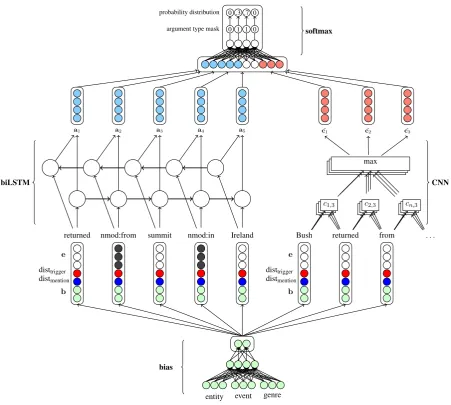
We cast argument identification as a classification task. For a trigger-mention pair (t, m) we make one instance for training/testing consisting of (a) event type, mention type, and text genre, (b) the shortest lexicalized dependency patht → m and (c) the sentence. Figure 2 depicts the pair (‘return-ing’, ‘Ireland’). Event type (TRANSPORT), entity
type (loc) and genre (newswire, not depicted) con-stitute the first information layer. The second In-formation layer is the lexicalized dependency path (returning−−−−−−→nmod:from summit−−−−→nmod:in Ireland). The third information layer is the sentence.
Bush returning to the United States from his summit in Ireland .
TRANSPORT loc
nmod:from→ nmod:in→
event argument type?
Figure 2: A training/test instance. Depicted in red is given information, depicted in blue is requested information. The trigger is underlined, the entity mention is bold.
4.2 biLSTM/CNN: Architecture
Input to our system (called biLSTM/CNN) are in-stances as described in Section 4.1. Each instance has three information layers, each layer is pro-cessed by a separate component. Figure 3 depicts the system architecture. The figure is split in four (bottom, middle left/right, and top), each part vi-sualizing one component, plus the final classifica-tion. We will now describe each part. In the fol-lowing,⊕means the concatenation of vectors.
Bias
The bias vectorbprovides a representation of the event type, entity type, and genre. The intuition behind the bias vector is that arguments are ex-pressed differently across event types, entity types, and genres.bis input to the other two components and helps to learn better representations.
More formally, b is the last layer of a fully-connected three layer neural network whose input is defined as follows: b1 =en⊕ev⊕ge, where en, ev, and ge are representations of the entity type, event type, and genre. They are randomly initialized and will receive standard backpropaga-tion updates during training.
biLSTMs
Representing dependency paths with Long Short-term Memory networks (LSTMs, Hochreiter and Schmidhuber 1997) shows good results in fields like relation extraction (Xu et al., 2015) and se-mantic role labeling (Roth and Lapata, 2016). We investigate their use for argument identification.
Our LSTMs produce a representation of lexi-calized dependency paths, such that similar paths have similar representations. LSTMs automati-cally learn meaningful patterns in arbitrarily long paths. For example, they learn that the paths attacked−−−→nsubj US and attacked−−−→nsubj Iraq have sim-ilar representations given that both indicate an Attacker and only differ in two closely re-lated words. They also learn that attacked−−→dobj Iraq has a different representation because the change
from nsubj to dobj often distinguishes between TargetandAttacker.
Input to our LSTM is a lexicalized dependency path P= (w1, d1:2, w2, . . . , dn−1:n, wn) where w1 is the trigger word, wn is the argument word, and da:b is the dependency between wa and wb. The element at position i in P is resolved by a vector vi = ei ⊕disttrigger ⊕distmention ⊕ b.
ei is either a pre-trained word embedding or a randomly-initialized dependency embedding, ac-cording to the element type at positioni. disttrigger
and distmention refer to the lexical distance of a
word to the trigger or the argument word, re-spectively.4 Finally, b is our bias vector as
de-fined above. We keep word embeddings fixed, but dependency embeddings receive backpropagation updates during training.
P is processed by a bidirectional LSTM (biLSTM). For a path element i, the biLSTM produces two (so-called) hidden states hfi (from the forward LSTM) and hb
i (from the backward LSTM). These vectors contain information about the respective input, i.e., vi, as well as the hid-den states of previously processed elements, i.e. elements to the left of i for hfi and elements to the right forhb
i. We average the hidden states be-longing to the same input vector: ai = 1/2(hfi + hb
n−i+1). Instead of averaging one could com-bine the vectors differently, e.g., by concatenat-ing them. However, none of the other possibilities worked better in our case.
Using biLSTMs has the advantage that eachai contains information from the entire sequence; us-ing only a forward LSTM limits the representa-tions at each position to the left context.
The middle-left part of Figure 3 depicts the biL-STM and its final output, the average vectorsa.
Convolutional Neural Networks
In contrast to LSTMs, which are designed to capture the meaning of sequences, Convolutional Neural Networks (CNNs) are often used to
a1 a2 a3 a4 a5
e
disttrigger
distmention b
returned nmod:from summit nmod:in Ireland Bush returned from . . .
e
disttrigger
distmention b
cc1,1c1,21,3 cc2,1c2,22,3 ccn,1cn,2n,3
maxmaxmax
ˆ
c1 cˆ2 cˆ3
0 1 1 0
0 .7 .3 0
argument type mask probability distribution
entity event genre
biLSTM CNN
bias
softmax
Figure 3: biLSTM/CNN architecture. Process flow is depicted from bottom to top. Embeddings e depicted in white are fixed, every other node receives backpropagation updates during training. Section 4.2 describes each component in detail.
duce bag-of-words-like representations. They were successfully applied to many NLP problems (Kim, 2014; Johnson and Zhang, 2015, inter alia). Input to our CNN is a tokenized sentence where each word at positioniis replaced by a vectorxi which is almost identical to the definition of vi above. The only difference is thatxicontains only word embeddings.
CNNs apply filters (also called kernels) to a fixed number of consecutive input vectors. Fil-ters are then moved by a certain offset (also called a stride) and re-applied. In our case, one filter produces one feature for one position i: ci = σ(W ·xi:i+h−1 +s) where σ is a non-linearity (tanh in our case),Wis a weight matrix,s∈Ris
a bias, andxi:i+h−1 is a concatenation of vectors
[xi ⊕xi+1⊕. . .⊕xi+h−1]. his the filter width. Wandsreceive backpropagation updates during training, word embeddings are fixed.
Final Classification
Finally, the averaged biLSTM hidden vectors for the dependency path and the max values for all CNN filters applied to the entire sentence serve as input to a softmax layer which produces a prob-ability distribution over all argument types. We pick the class with the highest probability as our fi-nal result. However, choosing betweenallclasses is unnecessary because not all combinations of event type, entity type and argument type are pos-sible. For example, the argument typeVehicle can only be assigned to TRANSPORT events, and
only mentions with entity typeveh can be possible fillers. We modify softmax to assign zero proba-bility to classes which are disallowed:
yi = Pmiexi jmjexj
The above equation gives the probability for a particular argument type,yi, wherexis the input vector to softmax, andm is a binary vector indi-cating allowed types. Note thatyi >0only if the respective argument type is allowed.
The top part of Figure 3 visualizes the softmax component. The input vector is first reduced to 29 dimensions (28 argument types and one ‘null’ type), multiplied with the restriction mask, and forwarded to our modified softmax.
Parameter Averaging
Inspired by the Averaged Perceptron (Freund and Shapire, 1999; Collins, 2002) we do not use the learned parameters directly for prediction. In-stead, in each epoch we keep a moving average of the parameters:
θV =αθT + (1−α)θV−1
Here,θT is the current weight vector after train-ing epochT, θV−1 is the averaged weight vector before the new update, andαis the fraction of how much θT influences θV. We set α = 0.1. θV is then used during testing. Note that this procedure does not change the training in any way.
With the formulation above, older weight vec-tors have less influence on θV than more recent vectors. After every training epoch, we evaluate θV on the development set and keep the version with highest F1for the final evaluation.
Parameter averaging leads to better generaliza-tion of our system. Furthermore, performance fluctuation for different training runs is reduced.
5 Experiments
5.1 Data, Evaluation Metrics and Parameters
We evaluate on ACE 2005 and use the same data split as most previous approaches (Ji and Grish-man, 2008; Nguyen et al., 2016, inter alia). We follow standard evaluation procedures: An event argument is correct, if its span and role match a reference argument (Ji and Grishman, 2008). Sec-tion 1 gives an overview over the annotaSec-tions pro-vided in ACE 2005.
Because we want to measure argument iden-tification performance by itself, we must ensure that compared systems use the same entity mtion and trigger predicmtions; the best way to en-sure this is to set both to gold. Using gold entity mentions is a common setting in event extraction (Li et al., 2013; Chen et al., 2015; Nguyen et al., 2016, inter alia). Since we have evaluation num-bers only for biLSTM/CNN and our baseline in this setting,there is no direct comparabilitywith previous work other than Li et al. (2013).
Both systems were trained on the same training set, and hyperparameters were optimized on the same development set. We trained both systems usingenhanced++ dependencies (Schuster and Manning, 2016).
We optimize hyper parameters for
biLSTM/CNN using Random Search (Bergstra and Bengio, 2012). We use a batch size of 450, 20 CNN filters, 150 LSTM dimensions, and 130 bias dimensions. In order to deal with class imbalance, we set the weight of non-null training samples to 2; this value is used to scale the loss accordingly. We used Keras (Chollet et al., 2015) version 2.0.2 with the TensorFlow backend as the learning framework. Training the network on an NVIDIA P40 GPU takes about 20 seconds per epoch.
5.2 Experiments and Results
We report the results of four main experiments, namely measuring argument identification perfor-mance in general, grouped by argument type, grouped by dependency path length, and using only a dependency path biLSTM. We report pre-cision, recall, and F1.
Baseline biLSTM/CNN
P R F1 P R F1 Support ∆F1
1 Micro 67.7 58.7 62.9 63.1 68.3 65.5† 916 2.6±0.5
2 dep-path biLSTM - - - 64.9 64.0 64.4 916 1.5
3 Time 69.9 70.9 70.4 70.9 80.1 75.2 134 4.8
4 Entity 63.7 56.7 60.0 57.7 65.2 61.2 127 1.2
5 Place 64.0 41.7 50.5 52.1 48.0 49.9 115 -0.6
6 Person 74.6 61.7 67.6 69.1 78.3 73.4 81 5.8
7 Artifact 78.5 71.8 75.0 70.3 77.2 73.5 71 -1.5
8 Destination 63.4 66.7 65.0 65.6 80.0 72.1 39 7.1
9 Crime 84.4 100.0 91.6 82.5 99.5 90.2 38 -1.4
10 Attacker 60.7 47.2 53.1 52.4 66.6 58.6 36 5.5
11 Defendant 70.0 63.6 66.7 67.6 75.2 71.1 33 4.4
12 Agent 64.7 34.3 44.9 55.9 40.6 46.8 32 1.9
Table 2: Test set precision, recall, and F1for the baseline and biLSTM/CNN, ordered by frequency. Reported are argument
types with more than 30 instances. Mircoreports micro-averaged numbers, averaged across 5 training and testing rounds, ‘dep-path biLSTM’ reports numbers using only a dependency path biLSTM, the other rows report numbers per argument type. ‘Support’ reports the number of instances for the respective type. ‘∆F1’ reports the difference in F1between biLSTM/CNN
and the baseline, as well as the standard deviation of biLSTM/CNN F1.†means statistically significant for every training and
testing round at thep <0.05level.
1 2 3 4 5
10 20 30 40 50 60 70 80 90
(a) Test set F1 performance plotted against dependency path
length. The red curve depicts baseline F1, the blue curve
de-picts biLSTM/CNN F1.
Baseline biLSTM/CNN
Length F1 F1 Support ∆F1
1 80.2 83.5 432 3.3
2 53.9 59.5 248 5.6
3 27.8 36.9 123 9.1
4 31.5 35.4 59 3.9
5 29.3 14.3 26 -15.0
(b) Test set F1 by dependency path length for the baseline
and biLSTM/CNN. ‘Support’ reports the number of instances, ‘∆F1’ reports the difference in F1between biLSTM/CNN and
the baseline.
Figure 4: Test set F1by dependency path length for the baseline and biLSTM/CNN.
Table 2 reports micro-averaged evaluation num-bers for the baseline and biLSTM/CNN (Line 1), a variant which uses only a dependency path biL-STM (without context CNNs, Line 2) as well as numbers per argument type (Lines 3-12). The column ‘Support’ gives the number of instances for the respective evaluation. Finally, the col-umn ‘∆F1’ reports the difference in F1 between biLSTM/CNN and the baseline, positive num-bers meaning better biLSTM/CNN performance, as well as the standard deviation of the biL-STM/CNN F1score.
As we can see in Table 2, Line 1, biLSTM/CNN has a lower precision and a considerably higher recall than the baseline, resulting in an increase of 2.6 points in micro-averaged F1 (with a stan-dard deviation of 0.5 F1 points). This is statis-tically significant at the p <0.05 level.5 Note
5We measured significance using approximate
random-ization (Noreen, 1989). Each of the 5 models we trained per-formed significantly better than the baseline.
that biLSTM/CNN does not use any manually en-gineered features, whereas the baseline uses two dozen feature templates, resulting in 150,000 fea-tures. Furthermore, biLSTM/CNN is a simple trigger-argument-pair classifier, whereas the base-line jointly predicts all arguments of all triggers in a sentence.
When we compare the performance using de-pendency paths alone (Line 2), recall drops by 4.3 points, while increasing precision slightly by 1.8 points, resulting in a decrease of 1.1 F1 points. The main advantage of the CNN is that it makes the lexical context outside of the shortest depen-dency path available to the system, which reflects itself in the increased recall.
Time as the most frequent type in the test data has a high improvement of 4.8 F1points.
Figure 4 reports micro-averaged numbers for the baseline and biLSTM/CNN per dependency path length. Figure 4a is a visualization of Ta-ble 4b. In total, 888 arguments (out of the 916 in the test set) were connected to their triggers by de-pendency paths of length 5 or less. biLSTM/CNN performs considerably better for lengths 1-4, es-pecially for paths of length 2 (+5.6 F1) and 4 (+9.1 F1). Length-1 paths, which are nearly as frequent as all other path lenghts together, have an increased performance of 3.3 F1 points. Only length-5 paths (with a test set support of 26) lose 15 F1 points, mainly because biLSTM/CNN pro-duced some false positives for this class.
Most of biLSTM/CNN’s errors are either false positives (wrongly classified as an argument) or false negatives (missed an argument). When it confuses argument types, it usually confuses op-posing types likeSellerandBuyer.
6 Related Work
To the best of our knowledge, no other paper is tar-geting event argument identification directly. For this reason, we first summarize ‘neural’ event ex-tractors, for which argument identification is one necessary step. Then, we report work on repre-senting dependency paths with neural networks.
Chen et al. (2015) use a pipelined event extrac-tor based on CNNs. The input is a sentence, and the output is, in phase one, all triggers in the sen-tence and, in phase two, a classification of the ar-gument type of a trigger-arar-gument candidate pair. The second phase is similar to the setting we ana-lyze in this paper.
Nguyen et al. (2016) propose a joint and hybrid approach using a Gated Recurrent Unit network (Cho et al., 2014), a variant of an LSTM. Input to their network is the word embedding matrix of a sentence. In contrast to Chen et al. (2015), they predict triggers and arguments jointly. They con-catenate a one-hot representation of dependencies to each word embedding. In contrast to this paper, they do not attempt to directly operate on syntactic structure. Instead, the GRU goes over the sentence and passes its hidden states on to higher levels of the network, which dynamically output triggers and arguments for the entire sentence. Their ap-proach is hybrid because they additionally use the features from Li et al. (2013) We did not choose
this system as our baseline because it is consider-ably more complex and would heavily rely on the same features as our baseline in the setting we in-vestigate in this paper.
Xu et al. (2015) use LSTMs for relation extrac-tion. Similar to our work, they use LSTMs to com-pute a representation of the shortest dependency path connecting two related entities. While the general learning scheme is similar to our biLSTM component, they represent dependency paths dif-ferently. Instead of one lexicalized path, they con-struct four different representations, using only de-pendency labels, only words, only part-of-speech tags, and only WordNet categories. This results in four LSTMs whose output is concatenated.
Roth and Lapata (2016) use dependency path-encoding LSTMs for semantic role labeling (SRL). Event extraction and SRL are similar in terms of structures: SRL also involves finding ‘triggers’ and ‘arguments’. They differ however in the nature of these structures. For example, potential arguments in SRL may be assigned to every verb in a sentence, while in event extrac-tion, potential arguments must be assigned only to event triggers. Similar to our work, Roth and Lapata (2016) use an LSTM which processes a dependency path connecting predicate and argu-ment. Their dependency paths mix words, part-of-speech tags and dependency relations.
7 Conclusions
In this paper, we show that argument identification performance is tied to the length of dependency paths connecting triggers and arguments. We pro-pose a novel and efficient neural network that tar-gets syntactic complexity. Without manual feature engineering, it learns to produce meaningful repre-sentations of dependency paths and to extract rel-evant lexical context of arguments. We show that our system outperforms a state-of-the-art baseline which uses manually engineered features and pre-dicts arguments jointly.
Acknowledgments
References
James Bergstra and Yoshua Bengio. 2012. Random search for hyper-parameter optimization. Journal of Machine Learning Research, 13(Feb):281–305. Yubo Chen, Liheng Xu, Kang Liu, Daojian Zeng,
and Jun Zhao. 2015. Event extraction via dynamic multi-pooling convolutional neural networks. In
Proceedings of the 53rd Annual Meeting of the As-sociation for Computational Linguistics (Volume 1: Long Papers), Beijing, China, 26–31 July 2015, pages 167–176.
Kyunghyun Cho, Bart van Merri¨enboer Caglar Gul-cehre, Dzmitry Bahdanau, Fethi Bougares Holger Schwenk, and Yoshua Bengio. 2014. Learning phrase representations using rnn encoder–decoder for statistical machine translation. InProceedings of the 2014 Conference on Empirical Methods in Nat-ural Language Processing,Doha, Qatar, 25–29 Oc-tober 2014, pages 1724–1734.
Franc¸ois Chollet et al. 2015. Keras. https:// github.com/fchollet/keras.
Michael Collins. 2002. Discriminative training meth-ods for Hidden Markov Models: Theory and experi-ments with perceptron algorithms. InProceedings of the 2002 Conference on Empirical Methods in Natural Language Processing,Philadelphia, Penn., 6–7 July 2002, pages 1–8.
Yoav Freund and Robert Shapire. 1999. A short intro-duction to boosting. Journal of the Japanese Society for Artificial Intelligence, 14:771–780.
Sepp Hochreiter and J¨urgen Schmidhuber. 1997. Long short-term memory. Neural computation, 9(8):1735–1780.
Heng Ji and Ralph Grishman. 2008. Refining event ex-traction through cross-document inference. In Pro-ceedings of the 46th Annual Meeting of the Associ-ation for ComputAssoci-ational Linguistics: Human Lan-guage Technologies, Columbus, Ohio, 15–20 June 2008, pages 254–262.
Rie Johnson and Tong Zhang. 2015. Effective use of word order for text categorization with Convolu-tional Neural Networks. InProceedings of the 2015 Conference of the North American Chapter of the Association for Computational Linguistics: Human Language Technologies, Denver, Col., 31 May – 5 June 2015, pages 103–112.
Yoon Kim. 2014. Convolutional Neural Networks for sentence classification. In Proceedings of the 2014 Conference on Empirical Methods in Natural Language Processing,Doha, Qatar, 25–29 October 2014, pages 1746–1751.
Qi Li, Heng Ji, Yu Heng, and Sujian Li. 2014. Con-structing information networks using one single model. In Proceedings of the 2014 Conference on
Empirical Methods in Natural Language Process-ing,Doha, Qatar, 25–29 October 2014, pages 1846– 1851.
Qi Li, Heng Ji, and Liang Huang. 2013. Joint event extraction via structured prediction with global fea-tures. InProceedings of the 51st Annual Meeting of the Association for Computational Linguistics (Vol-ume 1: Long Papers), Sofia, Bulgaria, 4–9 August 2013, pages 73–82.
Thien Huu Nguyen, Kyunghyun Cho, and Ralph Gr-ishman. 2016. Joint event extraction via recurrent neural networks. In Proceedings of the 2016 Con-ference of the North American Chapter of the Asso-ciation for Computational Linguistics: Human Lan-guage Technologies, San Diego, Cal., 12–17 June 2016, pages 300–309.
Eric W. Noreen. 1989. Computer Intensive Methods for Hypothesis Testing: An Introduction. Wiley, New York, N.Y.
Michael Roth and Mirella Lapata. 2016. Neural se-mantic role labeling with dependency path embed-dings. InProceedings of the 54th Annual Meeting of the Association for Computational Linguistics (Vol-ume 1: Long Papers), Berlin, Germany, 7–12 Au-gust 2016, pages 1192–1202.
Sebastian Schuster and Christopher D. Manning. 2016. Enhanced english universal dependencies: An im-proved representation for natural language under-standing tasks. InProceedings of the 10th Interna-tional Conference on Language Resources and Eval-uation,Portoroˇz, Slovenia, 23–28 May 2016. Yan Xu, Lili Mou, Ge Li, Yunchuan Chen, Hao Peng,