What information is helpful
for dependency based Semantic Role Labeling
Yanyan Luo Kevin Duh Yuji Matsumoto
Computational Linguistics, Nara Institute of Science and Technology Takayama, Ikoma, Nara 630-0192, Japan
{yanyan-l; kevinduh; matsu}@is.naist.jp
Abstract
Semantic Role Labeling (SRL) is an im-portant task since it benefits a wide range of natural language processing applica-tions. Given a sentence, the task of SRL is to identify arguments for a pred-icate (target verb or noun) and assign semantically meaningful labels to them. Dependency parsing based methods have achieved much success in SRL. How-ever, due to errors in dependency pars-ing, there remains a large performance gap between SRL based on oracle parses and SRL based on automatic parses in prac-tice. In light of this, this paper investi-gates what additional information is nec-essary to close this gap. Is it worthwhile to introduce additional dependency informa-tion in the form of N-best parse features, or is it better to incorporate orthogonal non-dependency information (base chunk con-stituents)? We compare the above features in a SRL system that achieves state-of-the-art results on the CoNLL 2009 Chinese task corpus. Our findings suggest that or-thogonal information in the form of con-stituents is much more helpful in improv-ing dependency based SRL in practice.
1 Introduction
In recent years, SRL has become an impor-tant component in many kinds of deep natural language processing applications, such as ques-tion answering (Narayanan and Harabagiu, 2004), event extraction (Riedel and McCallum, 2011), document categorization (Persson et al., 2009). SRL aims at identifying the semantic relations be-tween predicates in a sentence and their associ-ated arguments, with these relations drawn from a pre-specific list of possible semantic roles for
corresponding predicates. Syntax information is essential in SRL systems. To date, both con-stituent parsing and dependency parsing based SRL have been investigated (Xue, 2008; Johans-son and Nugues, 2008), with dependency based systems giving superior results in CoNLL 2008 (Surdeanu et al., 2008) and CoNLL 2009 shared tasks ( Hajiˇc et al., 2009).
However, the performance gap is still quite large between SRL systems using oracle ”perfect” dependency parses and SRL systems using auto-matic dependency parses. We observe as much as 10% F-score difference in our experiments. Clearly, errors in the 1-best dependency parse af-fects SRL prediction. This leaves an open ques-tion: in order to improve dependency based SRL, is it more worthwhile to incorporate more depen-dency information (in the form of N-best parse), or to incorporate an entirely separate source of infor-mation, such as base phrase chunks? We perform such an analysis in this paper, using a state-of-the-art Chinese SRL system.
Our findings suggest that constituent informa-tion such as chunking nicely complements depen-dency based SRL, achieving more improvements compared to N-best dependency information. Fi-nally, we also report the best results to date on the CoNLL 2009 Chinese shared task.
2 Related Work
The bulk of previous work on automatic SRL has primarily focused on using full constituent parse of sentences to define argument boundaries and to extract relevant information for training clas-sifiers. However, there have been some attempts at relaxing the necessity of using syntactic infor-mation derived from full parse trees. Sun et. al (2009) and Hacioglu et. al (2004) addressed the SRL problem on the basis of shallow syntactic in-formation at the level of phrase chunks. In their approach, SRL is formulated as a sequence
ing problem, performing IOB2 decisions on the syntactic chunks of a sentence. However, this method ignores the full syntactic parsing informa-tion entirely, and we believe that even the accu-racy of full syntactic parsing is not ideal, it is still helpful for SRL. Moreover, their method is inap-plicable to dependency based SRL since a chunk usually consists of successive words.
A substantial amount of research has focused on dependency-based SRL (Meza-Ruiz and Riedel, 2009; Luo et al., 2012) since the CoNLL-2009 shared task and rich linguistic features (Zhao et al., 2009) are applied. For dependency related features, most studies focused on extracting them from the best dependency result. Johansson and Nugues (2008) tried to use N-best dependency parsing results. In their work, they applied 16-best dependency trees to generate predicate-argument structures and applied both syntactic trees and predicate-argument structures to a linear model. This model reranks the predicate-argument struc-tures and the top 16 dependency trees at the same time. Though their work suggests that N-best de-pendency parsing can enhance the SRL, little is known about how the N-best dependency parsing related features perform on SRL.
3 Dependency based SRL Model
First, we define an instance as a predicate word and its corresponding argument words. If there are m predicates in a sentence, then there will be m instances. Given an instance X = {x1, . . . , xp, . . . , xn} with the predicate position
p, we want to find the corresponding sequence of argument labels and predicate sense S =
a1, ap−1, P, ap+1, . . . , an = ⟨P, A⟩. Eachai for
thei-th word in the instanceXis drawn from a set of tagsT(A)which contains all the semantic role labels in the corpus and which follows the defini-tion criteria in Chinese PropBank. In addidefini-tion, the special labelN ON Eis added toT(A). Words, la-beled asN ON E, are not arguments for the pred-icate. As for P, this is a member of a sense set
T(xp)which contains all possible senses of
pred-icate wordxp. We propose two sorts of label
as-signment models P rlocal and P rglobal. The
for-mer can incorporate local features only; the latter can incorporate also global features. We use three types of local feature sets: FP,FA,FP Aand one
global feature set FG. These type definitions are
the same as those in Watanabe et. al (2010).
3.1 Predicate Sense Disambiguation and SRL with a Local Model
Since the predicate cannot be an argument of itself for Chinese, we define the following local prob-abilistic model for argument classification and predicate sense disambiguation.
mated according to the following equation:
P r(ai|P, X, i, p) = 1
where ZA and ZP are normalization functions, i.e.,
fare the features with associated weightλlearned via training.
3.2 Predicate Sense Disambiguation and SRL with the Global Model
Global information is known to be useful in SRL (Nakagawa, 2007). We propose a global proba-bilistic modelP rglobalhere for SRL as follows:
P rglobal(S|X) =
where Z is a normalizing factor over all candi-date sequencesS(X, p)(set of possible configura-tions of semantic tags and predicate senses given
Type %Error #Error/#Occurrence C 49.4% 7,162/14,497
G 88.62% 109/123
O 80.71% 3,175/3,934
Table 1: The distribution of SRL errors on devel-opment corpus by the joint model.
n-best relaxation. Unlike the P rlocal(S|X), the
product of probability distributions of each word, the probability distribution P rglobal(S|X) is
cal-culated by feature functionsfG defined on an
in-stanceXwith assignmentS. Thereby, we can use any information in an instance without the inde-pendence assumption for assignments of words in it.
3.3 Error Analysis for Dependency-based SRL
Using the gold parse of dependency relations be-tween a predicate and its arguments and accord-ing to these relations, we classified SRL errors into following three types.
• C: children of a predicate should be argu-ments but they are tagged incorrectly.
• G: grand children of a predicate should be ar-guments but they are tagged incorrectly.
• O: others
Table 1 shows the distribution of three errors observed in the development corpus after tagging by our joint model. For example, there are a total of 14,497 arguments that are children of predicates and among them, and 7,162(49.4%) are errors.
4 Results and Discussion
4.1 Experimental Setting
We used the Chinese dataset provided by CoNLL-2009 shared task for experiments. For compari-son, two kinds of dependency parsing results are provided, the first is from MALT parser, the sec-ond is from secsec-ond-order MST parser.
As for chunking information, we used the chunk definition presented in (Chen et al., 2006) to ex-tract chunks from Chinese Tree Bank as training corpus. The lineCH in Figure 1 shows the defi-nition of chunks. In this example, ” ”(fi-nance work) is a noun phrase and is composed by two nouns.
With the Inside/Outside representation for proper chunks and the following feature templates, wherex0is the current word, a CRF++1is trained
for Chinese chunking task.
• Uni-gram word/POS tag features: x−2,x−1,
x0,x+1andx+2.
• Bi-gram word/POS tag features: x−2x−1,
x−1x0,x0x+1andx+1x+2.
4.2 Features
Most of features templates are ”standard” which have been widely used in previous dependency-based SRL research (Johansson and Nugues, 2008; Luo et al., 2012). We do not explain ”stan-dard” features, however, we give a detailed de-scription of the features used in this work.
4.2.1 Base Phrase Chunking Related Features
In Figure 1, obviously, words in chunks do not have equal importance for SRL. Headwords rep-resent the main meaning of the chunks. The base phrase chunking related features shown in Ta-ble 2 are only applied to these headwords. For other words in chunks, only lemma and POS in-formation is used. The rules described in Sun and Jurafsky (2004) are used to extract head-words. Verb class in Table 2 is represented sim-ilarly asV erb.C1C2, which means this verbhas two senses. For its first sense, it has one core ar-gument and for its second sense, it has two core arguments. These verb classes are extracted from Chinese PropBank (Xue, 2008).
4.2.2 Features from N-best Dependency Parsing
According to the statistics of development corpus, it is found that about 78.13% arguments are chil-dren of predicates. Even if its error percentage shown in Table 1 is less than 10%, the total er-ror number is also considerable. If we can reduce the head errors for dependents, theCerrors caused by dependency parsing errors should be decreased, and SRL tagging results would be improved. Un-der this hypothesis, we simply extracted the fol-lowing features from every parse tree in the N-best list which are generated using second-order MST parser. These features are also included in the ”standard” feature set whenN = 1.
WORD 去年 西藏 金融 工作 取得 显著 成绩
POS NN NR NN NN VV JJ NN
CH [NP] [NP] [ NP ] [VP] [ADJP] [NP]
TAG B-NP B-NP B-NP I-NP B-VP B-ADJP B-NP
SRL TMP NONE NONE A0 取得.01 NONE A1
Figure 1: Chunking information for a predicate-argument structure.
Feature Name Description
Chunk features
chunk tag of headword with IB representation (e.g.B−N P) chunk tag of the chunk where the headword belongs to the number of words in a chunk
the POS sequence of words in a chunk, for example, ” ” (finance work) is ”NN NN”
the position of the chunk with respect to the predicate(Position). There are three possible values: ”before”, ”after” and ”here”.
the conjunctions of Position and headword, predicate and verb class
the conjunctions of Position and POS of headword, predicate and verb class lemma/POS of one word immediately before/after of the chunk
Path features a chain of chunk types between the headword and the predicate. the length of the chunk chain between the headword and the predicate
For example, chain of chunk types between headword ” ” and predicate ” ” is ”NP-VP” and the length of the chunk chain is 2.
Table 2: Chunking related feature template for experiments.
Arguments′heads: lemma/pos; lemma and pos; dependency label; whether they are predi-cates.
P osition: position of the argument candidates with respect to the predicate positions in the tree; position of the heads of the argument candidates with respect to the predicate position in the sen-tence.
Chain: the left-to-right chain of the depen-dency labels of the predicate’s dependents.
4.3 SRL Performance
The overall performance of SRL is calculated us-ing the semantic evaluation metric of the CoNLL-2009 shared task scorer2. Table 3 gives the comparison of SRL performance before and after adding the proposed base phrase chunking related features on the test data. Lines with −/+ show the SRL performance without/with base phrase chunking related features. As seen in this table, without gold dependency parse, the best SRL is up to 80.52 inF1score. To the best of author’s
knowl-edge, there are few Chinese SRL results more than
2http://ufal.mff.cuni.cz/conll2009-st/
eval09.pl
P(%) R(%) F1(%)
Gold parsing− 88.68 86.30 87.47 Gold parsing+ 90.03 87.71 88.86
MALT− 82.64 72.68 77.34 MALT+ 84.17 74.67 79.13
MST-2− 83.01 75.39 79.02 MST-2+ 84.49 76.92 80.52
Table 3: SRL results without/with base phrase chunking information.
80%.
re-中国 已 累计 批准 外商 投资 项目 近 二十五点九万 个
批准.01
A1 EXT
ADV ADV A0
(a) Gold SRL result with gold dependency tree
中国 已 累计 批准 外商 投资 项目 近 二十五点九万 个
批准.01
EXT ADV
ADV A0
(b) Wrong SRL result brought by MALT parse errors
中国 【已 累计 批准】VP 【外商 投资 项目】NP 近 【二十五点九万 个】QP
批准.01
EXT ADV
ADV A0
A1
China has approved nearly 259,000 foreign investment projects.
(c) SRL result corrected by introducing base phrase chunking related features
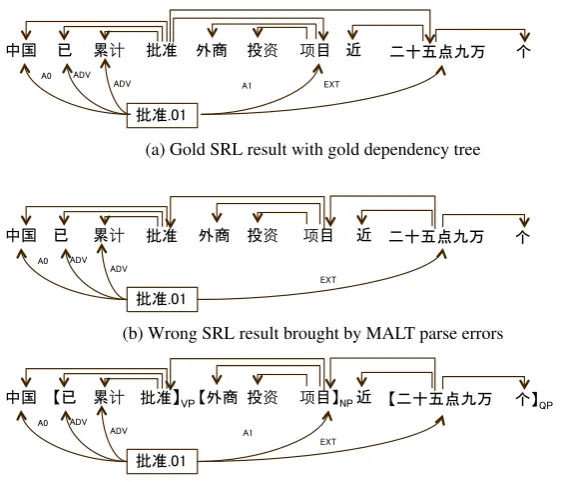
Figure 2: An example that the argument prediction error brought by MALT parse errors is corrected by introducing base phrase chunking related features.
N-best P(%) R (%) F1(%)
MST-2− 1 83.01 75.39 79.02 MST-2− 3 82.52 77.16 79.75 MST-2− 5 82.74 77.10 79.82
MST-2− 10 82.44 76.98 79.62
Table 4: SRL results with N-best dependency parsing related features.
lated features. In Figure 2c, the subscripts stand for chunk types. From Figure 2b, it can be seen that the argument A1 is not identified by the de-pendency based SRL because of dede-pendency er-rors. Comparing Figure 2b and 2c, we can see that after adding the base phrase chunking related features, this SRL error brought by dependency parsing errors is corrected.
Line MALT+and line MST-2−show that even the dependency parsing result from MALT is not better than that from second order MST, with the aid of chunking related features, Chinese SRL can still get comparable results.
Table 4 shows the Chinese SRL results after adding the N-best dependency parsing related fea-tures. It is not surprising that SRL can get better performance whenN >1, because the larger N, a more accurate dependency parsing results can be
N-best Correct (#) Error(#) Noise(#)
1 18,428 3,176
-3 19,071 2,533 4,636
5 19,392 2,212 5,667
10 19,738 1,866 7,699
Table 5: Dependency accuracy and the noise changes with different N.
likely obtained. WhenN = 5, SRL gets the best performance 79.82 inF1 with 0.8 point
improve-ment.
N-best P(%) R (%) F1(%)
[Bj¨orkelund, 2009]
- 82.42 75.12 78.60
[Meza-Ruiz, 2009]
- 82.66 73.36 77.73
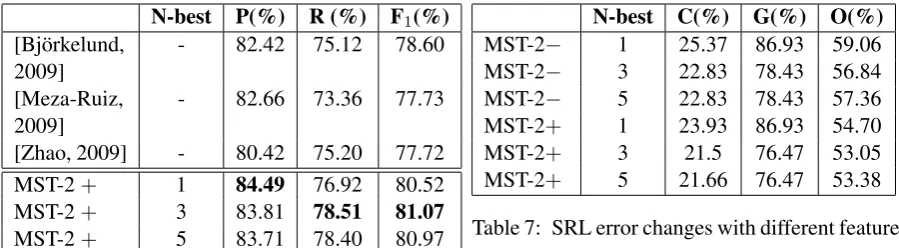
[Zhao, 2009] - 80.42 75.20 77.72 MST-2+ 1 84.49 76.92 80.52 MST-2+ 3 83.81 78.51 81.07
MST-2+ 5 83.71 78.40 80.97
Table 6: SRL results with base phrase chunking information and N-best parsing related features.
a hypothesis: correct dependency relations gener-ate correct SRL results, wrong dependency rela-tions generate incorrect SRL results. It represents the number of wrong dependency relations in Cor-rect case which can cause bad influence on SRL results. For example, if 3 best heads for an ar-gument are top-1, top-2, top-3 respectively, and top-1 is the correct one, then this case is a Cor-rect case and the number of noise are 2; if none of the three results are correct, then this case is an Error case, and no noise. From this table, it ob-viously indicates that the benefit for dependency parsing brought by a larger N is less than the noise brought by the N.
With Tables 3 and 4, it can be seen that SRL benefits more from chunking related features than from N-best parse related features.
Table 6 shows the the results of Chinese SRL after adding base phrase chunking information and N-best parsing related features and gives the com-parison with the previous work. From Tables 4 and 6 we can see that after adding the chunking related features, the impact of N-best parsing re-lated features is a little reduced.
4.4 Discussion
In Section 4.3, we see that both chunking and N-best parsing related features are helpful for Chi-nese SRL to some extent. In order to understand how they affect SRL, we analyze the results from three types of errors introduced in Section 3.3. Ta-ble 7 shows the error changes when different fea-tures are added.
Since accurate dependency information is not always available, the three types of errors should become larger when automatic dependency parsers are used. From Tables 1 and 7, the C
andO errors increased as expected, whileG
de-N-best C(%) G(%) O(%)
MST-2− 1 25.37 86.93 59.06 MST-2− 3 22.83 78.43 56.84 MST-2− 5 22.83 78.43 57.36 MST-2+ 1 23.93 86.93 54.70 MST-2+ 3 21.5 76.47 53.05 MST-2+ 5 21.66 76.47 53.38
Table 7: SRL error changes with different features
creased. The main reason is that arguments, that are grandchildren of predicates, are relocated in the dependency trees because of dependency er-rors, and these locations make them easier to be tagged. From the first and fourth rows, they sug-gest that shallow parsing information are helpful to reduce the C and O errors. Comparing the fourth line with second and third rows, they ex-plain why SRL achieves more improvements from chunking than from N-best dependency. WhenN
changed from 1 to 3, the errors decreased obvi-ously, however, when the N = 5, there are no obviously different changes.
5 Conclusions and Future Work
In this paper, we introduce additional informa-tion: base phrase chunking and N-best depen-dency parsing related features to a dependepen-dency based SRL system and investigate the benefit that our Chinese SRL model can get from them. Eval-uations on the CoNLL 2009 Chinese corpus show that chunking information well complements de-pendency based SRL, achieving more improve-ments compared to N-best dependency informa-tion. With those additional features, our depen-dency based SRL achieves the best result on the same Chinese corpus to our knowledge. Further-more, while all our experiments are for Chinese, it is possible to design experiments for other lan-guages with our models.
References
Anders Bj¨orkelund, Love Hafdell and Pierre Nugues.
2009. Multilingual Semantic Role Labeling.
Pro-ceedings of the Thirteenth Conference on Computa-tional Natural Language Learning(CoNLL), pp. 43-48.
Wenliang Chen, Yujie Zhang and Hitoshi Isahara. 2006. An Empirical Study of Chinese Chunking. Proceedings of the COLING/ACL on Main confer-ence poster sessions, pp. 97-104.
Kadri Hacioglu, Sameer Pradhan, Wayne Ward, James H.Martin and Daniel Jurafsky. 2004. Semantic Role
Labeling by Tagging Syntactic Chunks.
Proceed-ings of the 8th Conference on CoNLL-2004, Shared Task.
Jan Hajiˇc, Massimiliano Ciaramita, Richard Johans-son, Daisuke Kawahara, Maria Ant`oia Mart´ı, Llu´ıs M`arquez, Adam Meyers, Joakim Nivre, Sebastian Pad´o, Jan ˇStˇep´anek, Pavel Straˇn´ak, Mihai Surdeanu, Nianwen Xue and Yi Zhang. 2009. The CoNLL-2009 Shared Task: Syntactic and Semantic
Depen-dencies in Multiple Languages. Proceedings of the
Thirteenth Conference on Computational Natural
Language Learning, pp. 1-18.
Richard Johansson and Pierre Nugues. 2008.
Dependency-based Semantic Role Labeling of
Prop-Bank. In Proceedings of the Conference on
Empir-ical Methods in Natural Language Processing, pp. 69-78.
Luo Yanyan, Asahara Masayuki and Matsumoto Yuji.
2012. Robust Integrated Models for Chinese
Predicate-Argument Structure Analysis. China
Communications, 9(3): pp. 10-18.
Ryan McDonald, Koby Crammer and Fernando
Pereira. 2005. Online Large-margin Training of
De-pendency Parsers. Proceeding of the 43th Annual
Meeting on Association for Computational Linguis-tics, pp.91-98.
Ivan Meza-Ruiz and Sebastian Riedel. 2009. Jointly Identifying Predicates, Arguments and Senses
Us-ing Markov Logic. Proceedings of Human
Language Technology Conference/North American Chapter of the Association for Computational Linguistics(HLT/NAACL-2009), pp. 155-163.
Tetsuji Nakagawa. 2007. Multilingual Dependency
Parsing Using Global Features. Proceedings of
the CoNLL Shared Task Session of EMNLP-CoNLL 2007, 34(2): pp. 952-956.
Srini Narayanan and Sanda Harabagiu. 2004.
Ques-tion Answering Based on Semantic Structures.
Pro-ceeding of the 20th International Conference on Computer Linguistics, pp. 693-701.
Jacob Persson, Richard Johansson and Pierre Nugues. 2009. Fast and Robust Joint Models for
Biomedi-cal Event Extraction. NODALIDA 2009 Conference
Proceedings, pp.142-149.
Lance A. Ramshaw and Mitchell P. Marcus. 1995.
Text Chunking using Transformation-Based
Learn-ing. Proceedings of the 3rd Workshop on Very Large
Corpora, pp. 88-94.
Sebastian Riedel and Andrew McCallum. 2011. Fast and Robust Joint Models for Biomedical Event
Ex-traction. Proceeding of the 2011 Joint
Confer-ence on Empirical Methods in Natural Language Processing and Computational Natural Languages Learning, pp. 1-12.
Honglin Sun and Daniel Jurafsky. 2004. Shallow
Semantic Parsing of Chinese. Proceedings of
Hu-man Language Technology Conference/North Amer-ican Chapter of the Association for Computational
Linguistics(HLT/NAACL-2004), pp. 1249-256.
Weiwei Sun, Zhifang Sui, Meng Wang and Xin Wang. 2009. Chinese Semantic Role Labeling with
Shal-low Parsing. Proceedings of the 2009 Conference on
Empirical Methods in Natural Language Processing , pp. 1475-1483.
Mihai Surdeanu, Richard Johansson, Adam Meyers,
Llu´ıs M`arquez and Joakim Nivre. 2008. The
CoNLL-2008 Shared Task on Joint Parsing of
Syn-tactic and Semantic dependencies. Proceedings of
the 12th Conference on Computational Natural
Lan-guage Learning, pp. 157-177.
Kristina Toutanova, Aria Haghighi and Christoper D. Manning. 2008. A Global Joint Model for Semantic
Role Labeling. Computational Linguistics , 34(2):
pp.161-191.
Yotaro Watanabe, Masayuki Asahara and Yuji Mat-sumoto. 2010. A Structured Model for Joint
Learn-ing of Argument Roles and Predicate Senses.
PPro-ceedings of the ACL 2010 Conference Short Papers , pp. 98-102.
Nianwen Xue. 2008. Labeling Chinese Predicates
with Semantic Roles. Computational Linguistics,
34(2): pp. 225-255.
Hai Zhao, Wenliang Chen, Chunyu Kit and Guodong
Zhou. 2009. Multilingual Dependency
Learn-ing:A Huge Feature Engineering Method to
Seman-tic Dependency Parsing. Proceedings of the
Thir-teenth Conference on Computational Natural