Measuring the Effect of Conversational Aspects
on Machine Translation Quality
Marlies van der Wees Arianna Bisazza Christof Monz
Informatics Institute, University of Amsterdam
{m.e.vanderwees,a.bisazza,c.monz}@uva.nl
Abstract
Research in statistical machine translation (SMT) is largely driven by formal translation tasks, while translating informal text is much more challenging. In this paper we focus on SMT for the informal genre of dialogues, which has rarely been addressed to date. Concretely, we investigate the effect of dialogue acts, speakers, gender, and text register on SMT quality when translating fictional dialogues. We first create and release a corpus of multilingual movie dialogues annotated with these four dialogue-specific aspects. When measuring translation performance for each of these variables, we find that BLEU fluctuations between their categories are often significantly larger than randomly expected. Following this finding, we hypothesize and show that SMT of fictional dialogues benefits from adaptation towards dialogue acts and registers. Finally, we find that male speakers are harder to translate and use more vulgar language than female speakers, and that vulgarity is often not preserved during translation.
1 Introduction
Research in statistical machine translation (SMT) has mostly been driven by formal translation tasks. These are, however, not representative for the abundance of informal data emerging on the Internet, for which state-of-the-art SMT systems perform markedly worse (van der Wees et al., 2015a). Recent years have therefore shown an increasing effort in improving SMT for informal text, for example by normalizing noisy text to more formal text (Bertoldi et al., 2010; Banerjee et al., 2012; Ling et al., 2013a), or by enhancing formal training data with user-generated data (Banerjee et al., 2011; Jehl et al., 2012; Ling et al., 2013b).
In this paper we focus on SMT for dialogues, an informal genre that involves, by definition, multiple speakers, and is thus noticeably different from formal text (Fern´andez, 2014). Formal text is typically written by a single writer with a clear intention (e.g., informing or persuading), and moreover has been editorially controlled according to standards of language use. In dialogues, on the other hand, different speakershave different intentions and language use, affected, for example, by theirgender. Such vari-ations are reflected byregister, a term referring to socio-situational language variation (Lee, 2001), and dialogue acts, functional actions such as questions or answers (Bunt, 1979).
While these and other dialogue-specific aspects have been analyzed in dialogue research (Schlangen, 2005; Fern´andez, 2014), their impact on SMT has hardly been studied. A likely explanation is the lack of adequate evaluation data, i.e., parallel conversations annotated with dialogue-specific variabels. In this paper, we take a first step towards investigating the effect of dialogue acts, speakers, gender, and register on SMT performance by measuring their respective impact on annotated dialogues from movie subtitles. Since movie dialogues are fictional, we can only consider them as an approximation of real face-to-face conversation. However, several corpus-based studies have shown that, while movie dialogues differ from natural spoken dialogues in terms of spontaneity—they exhibit fewer incomplete utterances, hesitations, and repetitions—, they do not differ to a great extent in terms of linguistic features and main
This work is licensed under a Creative Commons Attribution 4.0 International License. License details: http:// creativecommons.org/licenses/by/4.0/
messages (Forchini, 2009; Forchini, 2012; Dose, 2013). In fact, movie dialogues approximate real face-to-face conversation more than for example SMS and chat, in which media constraints influence the flow of a conversation (Whittaker, 2003; Brennan and Lockridge, 2006). Finally, Danescu-Niculescu-Mizil and Lee (2011) have shown that certain psycholinguistic and gender-specific aspects of language are also observed in fictional dialogues, indicating that conclusions drawn from experiments on fictional dialogues generalize at least partially to real spoken conversations.
The structure and contributions of this paper are as follows: First, in Section 2 we annotate multilingual movie dialogues with four dialogue-specific variables; dialogue acts, speakers, gender, and register level, and we release these annotated corpora. In Section 3 we describe our approach to measure how SMT quality is affected by each of the four dialogue-specific aspects. Next, in Section 4 we use our annotated benchmarks to show that (i) performance fluctuations among the studied dialogue dimensions are larger than randomly expected, (ii) male speakers are harder to translate than female speakers and use more vulgar language, and (iii) vulgarity is often not preserved during translation. Finally, in Section 5 we investigate and confirm the hypothesis that SMT of fictional dialogues benefits from adaptation towards various dialogue acts and registers, indicating that apart from domain adaptation, adaptation to other variables should be considered to improve SMT quality for fictional, and potentially real, dialogues.
2 Corpus construction and annotation
To measure the effect of dialogue acts, speakers, gender, and register on SMT performance we need a multilingual dialogue corpus in which utterances are annotated with each of these dialogue aspects. Unfortunately, existing corpora are limited to the English language (Janin et al., 2003; McCowan et al., 2005; Danescu-Niculescu-Mizil and Lee, 2011; Banchs, 2012; Walker et al., 2012) or contain only some of the required annotations (Wang et al., 2016). We therefore first automatically annotate multilingual movie dialogues with the above dialogue dimensions for five language pairs: Arabic-English, Chinese-English, Dutch-Chinese-English, German-Chinese-English, and Spanish-English.
For this annotation process we build on two main resources: (i) the OpenSubtitles corpus (Li-son and Tiedemann, 2016), containing non-professionally translated subtitles, collected from www. opensubtitles.org and cross-lingually aligned using time information, bilingual lexicons, and cognates (Tiedemann, 2008); and (ii) the Internet Movie Script Database (IMSDb)1, containing English
movie scripts with speakers, utterances, and context (e.g., change of scenes). Using these and a number of additional resources we create our annotated corpora as follows:
1. First we collectspeaker-utterance pairsfrom IMSDb scripts, based on their respective indentation sizes. We then use the Champollion sentence aligner (Ma, 2006) monolingually to align English subtitles to the English script, and follow the OpenSubtitles alignment links to align foreign subtitles to the English subtitles-script bitext. Finally, we discard the script text from the resulting ‘tritext’, yielding multilingual speaker-annotated dialogue corpora. Table 1a shows statistics on the average number of speakers and main characters (i.e., speakers with at least 20 utterances) per movie. 2. We learn each speaker’s gender based on their name’s occurrence in a number of online name
databases and a list of gender-revealing tags such as ‘aunt’, ‘boy’, or ‘grandma’. Annotations are available for∼58% of the utterances, and the average female-to-male ratio is 1:1.7, see Table 1b. 3. We heuristically detect thedialogue actof each source-language utterance, consideringquestions,
exclamationsanddeclaratives. Distributions of these dialogue acts differ between language pairs, see Table 1c, but make up on average 28%, 9%, and 63% of the corpora, respectively.
4. We define aregisterlabel, based on the fraction of colloquial and vulgar expressions in an utter-ance, according to meta-information from an online dictionary2. We consider three register levels:
vulgar,colloquial, andneutral, comprising circa 10%, 68%, and 22% of the corpora, respectively. Distribution statistics per language pair are shown in Table 1d.
a) Avg. speaker statistics b) Gender statistics c) Dialogue act statistics d) Register statistics Lang. pair #Speakers #Main chars %M %F %Unk. %Ques. %Excl. %Decl. %Vulg. %Coll. %Neut. AR→EN 44.6 5.6 36.2 20.4 43.4 29.8 6.0 64.2 10.8 67.1 22.1 DE↔EN 47.3 5.9 36.1 19.8 44.1 27.2 12.2 60.6 10.3 67.7 22.0 ES ↔EN 42.5 6.0 37.2 22.9 39.9 28.4 11.2 60.4 10.6 67.7 21.7 NL↔EN 43.8 6.0 36.5 22.3 41.2 29.0 4.2 66.8 10.1 68.3 21.6 ZH→EN 42.3 5.6 36.9 21.1 42.0 28.1 10.6 61.3 10.7 68.9 20.4
Table 1: Annotation distributions of the dialogue benchmarks. a) Main characters are speakers with 20 or more utterances. b) Uncertain gender annotations are labeled ‘unknown’. c) Annotated dialogue acts: questions, exclamations, declaratives. d) Annotated register levels: vulgar, colloquial, neutral.
Post-processing and annotation quality. The above described alignment and annotation process is done fully automatically, making it prone to errors. We therefore increase the alignment and annotation quality of our corpus by taking a number of measures: First,beforerunning the Champollion aligner, we remove context information such as ‘[moaning]’, ‘[clapping]’ or ‘[chuckles]’, which is most prevalent in, but not limited to, subtitles created for hearing-impaired people. In addition, we remove subtitle-specific tokens indicating continuation of a sentence on the next screen or switches in speaker turns, yielding more fluent and less fragmented utterances.
Next,afterrunning the alignment process, we favor high-quality alignments by selecting only movies or movie versions (OpenSubtitles typically contains several alternative versions for a single movie (Tiedemann, 2016)) that meet the following criteria; (i) sentence lengths between both language pairs are sufficiently close, (ii) the number of sentences for which ambiguous speakers have been aligned does not exceed a given threshold, (iii) the letter distribution is sufficiently similar to the average distribution of the language. By enforcing these quality standards, we respectively reduce the number of OpenSubtitles alignment errors, Champollion alignment errors, and OCR errors. Finally, we remove utterances with ambiguous speaker labels as these are caused by erroneous Champollion alignments.
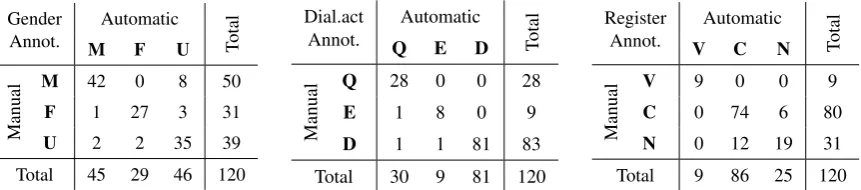
Despite efforts to improve alignment quality, our corpus still contains some incorrect alignments. To quantify these, and to verify the correctness of the automatic annotations, we manually inspect randomly selected fragments across different language pairs and movies. Based on evaluation of a sample of 120 utterances, we estimate a final alignment accuracy of 92.5%. In addition, Table 2 shows confusion ma-trices for manual versus automatic annotation of gender, dialogue acts, and register for the 120 selected utterances. With the overall annotation agreement per variable ranging from 85% to 97.5%, we find that our automatic annotation strategies are very accurate. Disagreement between manual and automatic annotations occurs mostly for speakers labeled with unknown gender, and between the register levels colloquial and neutral, indicating that these categories can benefit from more advanced annotation meth-ods. For example, to better distinguish colloquial and neutral register levels, one could exploit sentence length or language model perplexity.
Gender Automatic
Total
Annot. M F U
Manual
M 42 0 8 50
F 1 27 3 31
U 2 2 35 39
Total 45 29 46 120
Dial.act Automatic
Total
Annot. Q E D
Manual
Q 28 0 0 28 E 1 8 0 9 D 1 1 81 83 Total 30 9 81 120
Register Automatic
Total
Annot. V C N
Manual
V 9 0 0 9 C 0 74 6 80 N 0 12 19 31 Total 9 86 25 120
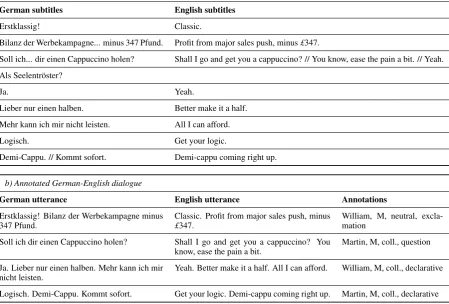
[image:3.595.85.516.619.714.2]a) Original German-English OpenSubtitles alignment
German subtitles English subtitles
Erstklassig! Classic.
Bilanz der Werbekampagne... minus 347 Pfund. Profit from major sales push, minus£347.
Soll ich... dir einen Cappuccino holen? Shall I go and get you a cappuccino? // You know, ease the pain a bit. // Yeah. Als Seelentr¨oster?
Ja. Yeah.
Lieber nur einen halben. Better make it a half. Mehr kann ich mir nicht leisten. All I can afford. Logisch. Get your logic.
Demi-Cappu. // Kommt sofort. Demi-cappu coming right up.
b) Annotated German-English dialogue
German utterance English utterance Annotations
Erstklassig! Bilanz der Werbekampagne minus
347 Pfund. Classic. Profit from major sales push, minus£347. William, M, neutral, excla-mation Soll ich dir einen Cappuccino holen? Shall I go and get you a cappuccino? You
know, ease the pain a bit. Martin, M, coll., question Ja. Lieber nur einen halben. Mehr kann ich mir
[image:4.595.75.525.78.382.2]nicht leisten. Yeah. Better make it a half. All I can afford. William, M, coll., declarative Logisch. Demi-Cappu. Kommt sofort. Get your logic. Demi-cappu coming right up. Martin, M, coll., declarative
Table 3: Example dialogue from Notting Hill; a) original sentences in the OpenSubtitles corpus, where // indicates a sentence boundary in many-to-one or one-to-many alignments, and b) final annotated utter-ances generated in our annotation pipeline, annotated with speaker (William, Martin), gender (M=male, F=female), register level (neutral, colloquial, vulgar) and dialogue act (declarative, exclamation, ques-tion). Note that sentences pairs from the original corpus are often merged in the Champollion alignment process, and that erroneous OpenSubtitles alignments are not corrected.
Table 3 shows an example dialogue with annotations and its original form in the OpenSubtitles corpus. Note that our annotated corpora differ from OpenSubtitles since only actual dialogues are included (i.e., no context), many erroneously aligned sentence pairs have been removed, and utterances are longer and less fragmented. The latter is a result of the Champollion alignment process. Since sentences in the IMSDb scripts are typically longer than those in OpenSubtitles, Champollion regularly enforces one-to-many alignments. Following the OpenSubtitles-internal alignment links then yields a large number of many-to-many alignments in which subtitles get merged into longer utterances.
Finally, table 4a lists the statistics of the benchmarks which we use in this paper and make available for download3. While the remainder of this paper uses the annotated fictional dialogues to analyze
the impact of dialogue-specific aspects on SMT, we believe that our data set may also help to advance dialogue research—today largely confined to the English language—in a multilingual scenario.
3 Measuring dialogue effects on SMT
In this section we measure the effect of dialogue dimensions on SMT performance of fictional dialogues. To this end, we quantify BLEU (Papineni et al., 2002) fluctuations between differences in dialogue acts, speakers, gender, and register, and we determine whether the observed fluctuations are larger than randomly expected.
a) Evaluation data b) Training data Languages #Movies #Utterances #Lines #EN tokens
AR→EN 187 94K 12.3M 122M
DE↔EN 220 123K 9.7M 85M
ES ↔EN 161 87K 16.3M 156M
NL↔EN 238 129K 17.9M 171M
ZH→EN 211 107K 6.3M 59M
Table 4: Specifications of parallel training and evaluation data. Training data consists of OpenSubtitles corpora, evaluation data consists of speaker-annotated dialogues.
3.1 Basic experimental setup
We run our experiments using an in-house phrase-based SMT system similar to Moses (Koehn et al., 2007), with features including lexicalized reordering, linear distortion with limit 5, and lexical weight-ing. Our systems are trained on 59M–171M tokens (depending on the language pair, see Table 4b) of unannotated OpenSubtitles corpora. We use Kneser-Ney smoothed 5-gram language models (500M– 1.7B tokens, depending on the language pair) that linearly interpolate OpenSubtitles with various LDC and WMT corpora using weights optimized on a held-out set of OpenSubtitles data. Systems are tuned using pairwise ranking optimization (PRO) (Hopkins and May, 2011) on a different held-out OpenSubti-tles set. The resulting systems are thus at all levels adapted to the movie dialogues translation task rather than the general domain.
3.2 Approximate randomization testing
When translating dialogues, we naturally observesomeBLEU variations across categories such as dif-ferent dialogue acts or speakers. An important question is whether the observed differences are to be expected (the null hypothesis), or whether they are indicators that one category is truly harder to trans-late than another (the alternative hypothesis). We test this hypothesis with an approximate randomization approach (Edgington, 1969; Noreen, 1989).
While approximate randomization (also known as approximate permutation) is often used to compare the mean and variance oftwogroups, it can be adapted to our setting with multiple categories. To this end, we compute BLEU for each of the categories in a dialogue variable (e.g., vulgar, colloquial, and neutral utterances for the dialogue variable of register level). Next, we randomly permute category labels over utterances, following the original distribution of utterances per category, and we recompute BLEU for the randomized labels.
As our test statistic of interest, we define and measure the mean absolute BLEU difference, which captures BLEU fluctuations between categories:
MBD= 2
|S|2− |S| |S|
X
i=1 |S|
X
j=i+1
|BLEUi−BLEUj | (1)
HereSis the set of categories for a given dialogue variable (e.g., Sregister ={vulgar,colloquial,neutral}),
and BLEUi the BLEU score for categoryi. Each pair of categories(i, j) is compared exactly once in terms of BLEU scores. Note that MBD is a specific instance ofmean absolute difference(MD) orGini mean absolute difference(GMD), a measure of statistical dispersion which has shown to be superior to other common statistical dispersion measures such as variance, standard deviation and interquartile range (Yitzhaki, 2003).
For dialogue acts, gender and register we permute labels over the entire benchmark. For speakers we only permute labels within each movie since inter-movie variations in BLEU are affected by many other factors (e.g., script writers, translators, movie genre) which distract from the impact of speakers. In addition, when computing speaker-specific BLEU, we only include main characters (i.e., speakers with at least 20 utterances) to avoid BLEU’s instability on small documents .
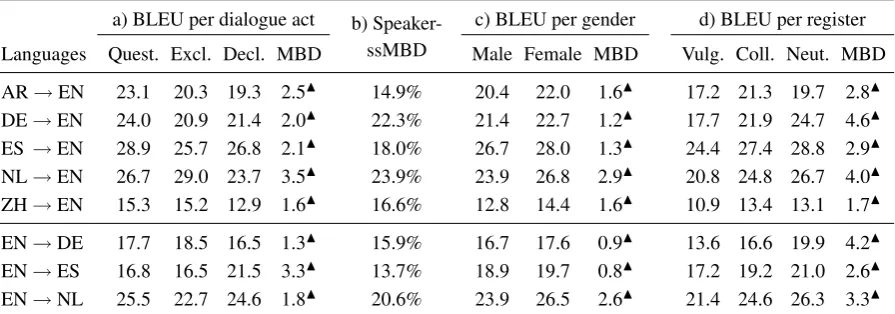
a) BLEU per dialogue act b) Speaker- c) BLEU per gender d) BLEU per register Languages Quest. Excl. Decl. MBD ssMBD Male Female MBD Vulg. Coll. Neut. MBD AR→EN 23.1 20.3 19.3 2.5N 14.9% 20.4 22.0 1.6N 17.2 21.3 19.7 2.8N
DE→EN 24.0 20.9 21.4 2.0N 22.3% 21.4 22.7 1.2N 17.7 21.9 24.7 4.6N
ES →EN 28.9 25.7 26.8 2.1N 18.0% 26.7 28.0 1.3N 24.4 27.4 28.8 2.9N
NL→EN 26.7 29.0 23.7 3.5N 23.9% 23.9 26.8 2.9N 20.8 24.8 26.7 4.0N
ZH→EN 15.3 15.2 12.9 1.6N 16.6% 12.8 14.4 1.6N 10.9 13.4 13.1 1.7N
EN→DE 17.7 18.5 16.5 1.3N 15.9% 16.7 17.6 0.9N 13.6 16.6 19.9 4.2N
EN→ES 16.8 16.5 21.5 3.3N 13.7% 18.9 19.7 0.8N 17.2 19.2 21.0 2.6N
[image:6.595.78.526.144.301.2]EN→NL 25.5 22.7 24.6 1.8N 20.6% 23.9 26.5 2.6N 21.4 24.6 26.3 3.3N
Table 5: BLEU for dialogue acts, speakers, gender, and register, translated using baseline SMT trained and tuned on OpenSubtitles corpora. MBD: mean absolute BLEU difference, see Equation (1), all statis-tically significant atp ≤0.01(N). ssMBD: percentage of movies with statistically significant speaker-MBD atp≤0.05.
4 Results
In this section we discuss the observed BLEU fluctuations (see Table 5) for our four dialogue variables of interest, guided by Spanish-to-English and English-to-German examples in Table 6, to which we provide pointers(EX#)in the text.
4.1 The effect of dialogue acts on SMT quality
As shown in Table 5a, there are substantial performance fluctuations between dialogue acts for all lan-guage pairs. However, there is no consistent pattern between different lanlan-guages. For instance, we observe punctuation errors (EX1) for ES↔EN, and verb drop (EX2) and wrong word order(EX3) for
EN→DE. This makes it particularly interesting to further investigate how dialogue acts can be exploited to improve translation quality of (fictional) dialogues. Improving SMT for the dialogue acts under con-sideration resembles cross-lingual question answering (Tiedemann, 2009). However, when considering finer dialogue act granularities, it may be profitable to exploit context information, which is not used in our current SMT setup.
4.2 The effect of speakers on SMT quality
In Table 5b we report the percentage of movies per language pair for which the observed MBD is statis-tically significant atp ≤0.05, which is 18.6% on average. Since there are too many speakers to report individual BLEU scores, we randomly select 100 German-English movies, and compute for each of these
∆MBD as the difference between MBD for real speakers and the average MBD for randomized labels:
Annotations ES source ES→EN SMT output EN reference S1, M, neutral,
declarative se acabaron los d´ıas deolvidar, han empezado los de recordar.
the days are over, have begun
to forget them to remember. the days of forgetting are over. thedays of remembering have begun.
S2, F, colloquial,
question ¿sabes qu´e parecescuando hablas as´ı? you know what you look likewhen you talk like that? know when you go on what yousound like? S1, M, vulgar,
declarative unsensato.j***do(EX4)hombre a sensible man.(EX6) i sound like a sensiblef***ingman. S2, F, colloquial, excl. un pato. ¡cuac, cuac! a duck. [quack, quack!(EX1) you sound like a duck. quack, quack
Annotations EN source EN→DE SMT output DE reference
S1, M, neutral,
declarative the days of forgettin’are over. the days of re-membering have begun.
die tage von vergisst sind vorbei. die tage von an(EX2)
haben begonnen.
ja, aber jetzt kommen die tage des erinnerns.
S2, F, colloquial,
question know when you go onwhat you sound like? weiß, wenn du aufwas du klingst wie?((EX2EX3))
weißt du, wie du klingst?
S1, M, vulgar,
declarative i sound like a sensiblef***ingman. ich klinge wie ein ver-n¨unftigverd***termann. wie ein vern¨unftiger(EX5)mann. S2, F, colloquial,
[image:7.595.73.524.63.331.2]declarative you sound like a duck.quack, quack du klingst wie eine ente.quak, quak nein, wie eine ente! quak, quak,quak!
Table 6: Censored ES→EN (top) and EN→DE (bottom) translation examples of an annotated dialogue, originating from Pulp Fiction and involving two speakers: Pumpkin (S1, M=male) and Honeybunny (S2, F=female). Examples of phenomena marked with(EX#)are discussed in Sections 4.1–4.4.
Movies
2
0
2
4
6
8
∆
MB
[image:7.595.71.533.391.489.2]D
Figure 1: ∆MBD (see Section 4.2) for 100 randomly selected German-English benchmark movies. Black bars indicate movies with statistical significant positive∆MBD atp≤0.05.
level, as proven successful in speech recognition research (Shinoda, 2011), and related to recent work on personalizing machine translation (Mirkin et al., 2015; Mirkin and Meunier, 2015).
Finally, since our analysis is carried out on fictional dialogues, it may be worth investigating to what extent BLEU scores fluctuate between actors or script writers rather than only characters, however this requires additional annotation.
4.3 The effect of gender on SMT quality
However, we have to be careful drawing conclusions about the impact of gender on real spoken dia-logues from our observations on fictional diadia-logues. Since the vast majority of movie scripts are written by men (Lauzen, 2016), our findings reflect differences between language of male and female characters as perceived by male writers. The observed BLEU differences might therefore be based on stereotypes rather than real gender differences. On the other hand, a tremendously large body of work has studied gender and language or discourse (Tannen, 1994; Wodak, 1997; Holmes and Meyerhoff, 2008, among others), indicating that these concepts are closely intertwined. To the best of our knowledge, our work is the first to study the impact of gender on SMT, albeit for scripted dialogues, and we believe that meta-information about a speaker’s gender is also a potential source to customize SMT for real dialogues.
4.4 The effect of register on SMT quality
The results per register (Table 5d) show that SMT quality is worst for vulgar utterances and generally best for neutral sentences. While consistent with previous findings that informal language is hard to translate (van der Wees et al., 2015a), this observation cannot solely be attributed to poor model coverage, since colloquial and vulgar language are well-covered in our OpenSubtitles-trained systems.
When manually inspecting human translations for vulgar expressions, we find that these vary from literal (EX4) to very nuanced (EX5)translations, yielding inconsistent SMT output. We also observe
that vulgarity is often not preserved in (both human and machine) translation (EX6): A comparison of
vulgarity scores shows that, while vulgarity sometimes increases, the number of vulgar utterances in the SMT output is on average 35% lower than in the reference set.
Finally, since poor SMT quality is observed for both male characters and vulgar language, we hypoth-esize that the two might co-occur. Indeed, the average vulgarity scores for males are 64% higher than for females, which may in part explain the observed SMT quality between genders.
5 Preliminary adaptation towards dialogue variables
We observed that BLEU scores significantly fluctuate between differences along dialogue dimensions. This finding suggests that SMT for fictional dialogues may benefit from adaptation towards different categories along these dimensions. To verify this hypothesis we run a number of adaptation experiments, in which we adapt our baseline SMT systems towards different dialogue acts and different registers—two dialogue aspects which can be computed straightforwardly for the unannotated training corpora.
We adapt our systems at two levels: First, we create category-specific language models by interpolat-ing our general movie dialogue language model with a language model trained on only the most relevant subset of the bitext’s target side. We determine relevant sentences by applying the same annotation guidelines that were used for annotation of the benchmarks (Section 2). Second, we tune our systems on held-out sets selected according to the same criteria, thus comprising category-specific data.
We run adaptation experiments for the language pairs with the largest observed MBD; Dutch-English, English-Spanish, and Arabic-English for dialogue acts, and German-English, English-German, and Dutch-English for register. Note that the aim of our adaptation experiments is to verify whether SMT performance can benefit from a simple adaptation approach at the fine-grained level of different dialogue-specific aspects, rather than presenting a novel SMT adaptation approach.
MBD Questions Exclamations Declaratives Language pair Base. Adapt. Base. Adapt. Diff. Base. Adapt. Diff. Base. Adapt. Diff.
NL→EN 3.5 3.2 26.7 26.5 –0.2O 29.0 28.9 –0.1 23.7 24.1 +0.4N
EN→ES 3.3 2.8 16.8 17.5 +0.7N 16.5 17.3 +0.8N 21.5 21.5 0.0
AR→EN 2.5 2.6 23.1 24.3 +1.2N 20.3 20.4 +0.1 19.3 20.9 +1.6N
MBD Vulgar Colloquial Neutral
Language pair Base. Adapt. Base. Adapt. Diff. Base. Adapt. Diff. Base. Adapt. Diff.
DE→EN 4.6 4.2 17.7 18.4 +0.7N 21.9 22.7 +0.8N 24.7 24.7 0.0
EN→DE 4.2 3.8 13.6 14.6 +1.0N 16.6 17.8 +1.2N 19.9 20.3 +0.4N
NL→EN 4.0 2.8 20.8 23.1 +2.3N 24.8 25.6 +0.8N 26.7 27.3 +0.6N
Table 7: Results of adaptation experiments. Top: adaptation towards dialogue acts for the 3 language pairs with the largest mean absolute BLEU difference (MBD, see Equation (1)) between dialogue acts. Bottom: adaptation towards registers for the 3 language pairs with the largest MBD between register levels. Statistical significance against the baseline atp ≤ 0.05(M/O) andp ≤ 0.01(N/H) is measured using approximate randomization (Riezler and Maxwell, 2005).
for dialogue-specific phenomena, but rather that already a simple adaptation approach can benefit from our dialogue-specific annotations.
6 Conclusions and implications
While SMT research has mostly been driven by formal translation tasks, very little work has been re-ported on SMT for informal genres such as dialogues, a genre that differs substantially from formal text and thus poses different translation challenges. Following the previous finding that genre and topic affect SMT differently (van der Wees et al., 2015b), we have in this paper analyzed the impact of dialogue-specific aspects in SMT for fictional dialogues. We created and released a movie-dialogue benchmark in which utterances are annotated with dialogue acts, speakers, gender, and register, and we studied the effect of these four variables on SMT performance.
Our analysis shows that BLEU fluctuations for all variables are often significantly larger than randomly expected. When looking at specific dialogue aspects, we found that the register level has a significant im-pact on translation quality, with translations of vulgar utterances being of substantially lower quality than neutral or even colloquial utterances for all language pairs under consideration. Similarly we found large variations in translation quality between different dialogue acts, although we did not detect a consistent pattern between different languages; e.g., questions can be more difficult to translate than exclamations for one language pair, while the reverse is true for another language pair.
These findings suggest that conversational SMT may benefit from adaptation at fine-grained levels. We tested and confirmed this hypothesis in a series of simple adaptation experiments.
Finally, we found that male speakers are harder to translate and use more vulgar language than female speakers, and that vulgarity is often not preserved during translation. While our analyses are carried out on fictional dialogues, we believe that our findings generalize at least partially to other types of dialogues, and are thus valuable for advancing conversational SMT.
Acknowledgements
References
Rafael E. Banchs. 2012. Movie-DiC: a movie dialogue corpus for research and development. InProceedings of
the 50th Annual Meeting of the Association for Computational Linguistics (Short Papers), pages 203–207.
Pratyush Banerjee, Sudip Kumar Naskar, Johann Roturier, Andy Way, and Josef van Genabith. 2011. Domain adaptation in statistical machine translation of user-forum data using component level mixture modelling. In
Proceedings of the XIII Machine Translation Summit, pages 285–292.
Pratyush Banerjee, Sudip Kumar Naskar, Johann Roturier, Andy Way, and Josef van Genabith. 2012. Domain adaptation in SMT of user-generated forum content guided by OOV word reduction: Normalization and/or sup-plementary data. InProceedings of the 16th Conference of the European Association for Machine Translation, pages 169–176.
Nicola Bertoldi, Mauro Cettolo, and Marcello Federico. 2010. Statistical machine translation of texts with mis-spelled words. InHuman Language Technologies: The 2010 Annual Conference of the North American Chapter
of the Association for Computational Linguistics, pages 412–419.
S.E. Brennan and Calion B. Lockridge. 2006. Computer-mediated communication: A cognitive science approach.
InEncyclopedia of language and linguistics,, pages 775–780. Elsevier Ltd., Oxford, UK.
Harry Bunt. 1979. Conversational principles in question-answer dialogues. InZur Theorie der Frage, pages 119–141. Narr Verlag.
Cristian Danescu-Niculescu-Mizil and Lillian Lee. 2011. Chameleons in imagined conversations: A new approach to understanding coordination of linguistic style in dialogs. InProceedings of the 2nd Workshop on Cognitive
Modeling and Computational Linguistics, pages 76–87.
Stefanie Dose. 2013. Flipping the script: A corpus of american television series (CATS) for corpus-based language learning and teaching. Corpus Linguistics and Variation in English: Focus on Non-native English, 13.
Eugene S. Edgington. 1969. Approximate randomization tests.The Journal of Psychology, 72(2):143–149. Raquel Fern´andez. 2014. Dialogue. InThe Oxford Handbook of Computational Linguistics (2 ed.). Oxford
University Press.
Pierfranca Forchini. 2009. Spontaneity reloaded: American face-to-face and movie conversation compared. In
Corpus Linguistics.
Pierfranca Forchini. 2012. Movie language revisited. Evidence from multi-dimensional analysis and corpora. Peter Lang, Internationaler Verlag der Wissenschaften.
Janet Holmes and Miriam Meyerhoff. 2008. The handbook of language and gender, volume 25. John Wiley & Sons.
Mark Hopkins and Jonathan May. 2011. Tuning as ranking. InProceedings of the 2011 Conference on Empirical
Methods in Natural Language Processing, pages 1352–1362.
Adam Janin, Don Baron, Jane Edwards, Dan Ellis, David Gelbart, Nelson Morgan, Barbara Peskin, Thilo Pfau, Elizabeth Shriberg, Andreas Stolcke, et al. 2003. The ICSI meeting corpus. InInternational Conference on
Acoustics, Speech, and Signal Processing (ICASSP’03), pages I–364. IEEE.
Laura Jehl, Felix Hieber, and Stefan Riezler. 2012. Twitter translation using translation-based cross-lingual re-trieval. InProceedings of the Seventh Workshop on Statistical Machine Translation, pages 410–421.
Philipp Koehn, Hieu Hoang, Alexandra Birch, Chris Callison-Burch, Marcello Federico, Nicola Bertoldi, Brooke Cowan, Wade Shen, Christine Moran, Richard Zens, Chris Dyer, Ondrej Bojar, Alexandra Constantin, and Evan Herbst. 2007. Moses: Open source toolkit for statistical machine translation. InProceedings of the 45th Annual
Meeting of the Association for Computational Linguistics, pages 177–180.
Martha M. Lauzen. 2016. The celluloid ceiling: Behind-the-scenes employment of women on the top 100, 250, and 500 films of 2015. Technical report, Center for the study of women in television and film.
David Y.W. Lee. 2001. Genres, registers, text types, domains and styles: Clarifying the concepts and navigating a path through the BNC jungle. Language Learning & Technology, 5(3):37–72, September.
Wang Ling, Chris Dyer, Alan W Black, and Isabel Trancoso. 2013a. Paraphrasing 4 microblog normalization. In
Wang Ling, Guang Xiang, Chris Dyer, Alan Black, and Isabel Trancoso. 2013b. Microblogs as parallel corpora.
InProceedings of the 51st Annual Meeting of the Association for Computational Linguistics, pages 176–186.
Pierre Lison and J¨org Tiedemann. 2016. Opensubtitles2016: Extracting large parallel corpora from movie and tv subtitles. InProceedings of the 10th International Conference on Language Resources and Evaluation. Xiaoyi Ma. 2006. Champollion: A robust parallel text sentence aligner. In LREC 2006: Fifth International
Conference on Language Resources and Evaluation, pages 489–492.
Iain McCowan, Jean Carletta, W Kraaij, S Ashby, S Bourban, M Flynn, M Guillemot, T Hain, J Kadlec, V Karaiskos, et al. 2005. The AMI meeting corpus. In Proceedings of the 5th International Conference
on Methods and Techniques in Behavioral Research, volume 88.
Shachar Mirkin and Jean-Luc Meunier. 2015. Personalized machine translation: Predicting translational pref-erences. In Proceedings of the Conference on Empirical Methods in Natural Language Processing, pages 2019–2025.
Shachar Mirkin, Scott Nowson, Caroline Brun, and Julien Perez. 2015. Motivating personality-aware machine translation. InIn Proceedings of the Conference on Empirical Methods in Natural Language Processing, pages 1102–1108.
Eric W. Noreen. 1989. Computer-Intensive Methods for Testing Hypotheses: An Introduction. Wiley-Interscience. Kishore Papineni, Salim Roukos, Todd Ward, and Wei-Jing Zhu. 2002. Bleu: a method for automatic evaluation of machine translation. InProceedings of 40th Annual Meeting of the Association for Computational Linguistics, pages 311–318.
Stefan Riezler and John T. Maxwell. 2005. On some pitfalls in automatic evaluation and significance testing for MT. In Proceedings of the ACL Workshop on Intrinsic and Extrinsic Evaluation Measures for Machine
Translation and/or Summarization, pages 57–64.
David Schlangen. 2005. Modelling dialogue: Challenges and approaches.K¨unstliche Intelligenz, 3/05:23–28. Koichi Shinoda. 2011. Speaker adaptation techniques for automatic speech recognition. InProceedings of APSIPA
ASC.
Deborah Tannen. 1994.Gender and discourse. Oxford University Press.
J¨org Tiedemann. 2008. Synchronizing translated movie subtitles. In Proceedings of the Sixth International
Conference on Language Resources and Evaluation, pages 1902–1906.
J¨org Tiedemann. 2009. Translating questions for cross-lingual QA. InProceedings of the 13th Annual Conference
of the European Association for Machine Translation, pages 112–119.
J¨org Tiedemann. 2016. Finding alternative translations in a large corpus of movie subtitles. InProceedings of the
10th International Conference on Language Resources and Evaluation, pages 3518–3522.
Marlies van der Wees, Arianna Bisazza, and Christof Monz. 2015a. Five shades of noise: Analyzing machine translation errors in user-generated text. InProceedings of the Workshop on Noisy User-generated Text, pages 28–37.
Marlies van der Wees, Arianna Bisazza, Wouter Weerkamp, and Christof Monz. 2015b. What’s in a domain? Analyzing genre and topic differences in statistical machine translation. In Proceedings of the 53rd Annual
Meeting of the Association for Computational Linguistics, pages 560–566.
Marilyn A Walker, Grace I Lin, and Jennifer Sawyer. 2012. An annotated corpus of film dialogue for learning and characterizing character style. InProceedings of the 8th International Conference on Language Resources and
Evaluation, pages 1373–1378.
Longyue Wang, Xiaojun Zhang, Zhaopeng Tuy, Andy Way, and Qun Liu. 2016. Automatic construction of discourse corpora for dialogue translation. InProceedings of the 10th International Conference on Language
Resources and Evaluation, pages 2748–2754.
Steve Whittaker. 2003. Theories and methods in mediated communication. In The Handbook of Discourse
Processes, pages 243–286. Erlbaum.
Ruth Wodak. 1997.Gender and discourse. Sage.
Shlomo Yitzhaki. 2003. Gini’s mean difference: A superior measure of variability for non-normal distributions.