Proceedings of the 3rd Workshop on Scalable Natural Language Understanding, pages 17–24,
Understanding Complex Natural Language Explanations in Tutorial
Applications
∗Pamela W. Jordan, Maxim Makatchev and Umarani Pappuswamy
Learning Research and Development Center University of Pittsburgh
Pittsburgh PA, 15260
{pjordan,maxim,umarani}@pitt.edu
Abstract
We describe theWHY2-ATLASintelligent
tutoring system for qualitative physics that interacts with students via natural
lan-guage dialogue. We focus on the
is-sue of analyzing and responding to multi-sentential explanations. We explore an ap-proach that combines a statistical classi-fier, multiple semantic parsers and a for-mal reasoner for achieving a deeper under-standing of these explanations in order to provide appropriate feedback on them.
1 Introduction
Most natural language tutorial applications have fo-cused on coaching either problem solving or proce-dural knowledge (e.g. Steve (Johnson and Rickel, 1997), Circsim-tutor (Evens and Michael, 2006), Atlas (Ros´e et al., 2001), BEETLE (Zinn et al., 2002), SCoT (Peters et al., 2004), inter alia). When coaching problem solving, simple short answer anal-ysis techniques are frequently sufficient because the primary goal is to lead a trainee step-by-step through problem solving. There is a narrow range of possi-ble responses and the context of the previous dia-logue and questions invite short answers. But when the instructional objectives shift and a tutorial sys-tem atsys-tempts to explore a student’s chain of reason-ing behind an answer or decision, deeper analysis techniques can begin to pay off. Having the student
∗
This research was supported by ONR Grant No. N00014-00-1-0600 and by NSF Grant No. 9720359.
construct more on his own is important for learning perhaps in part because it reveals what the student does and does not understand (Chi et al., 2001).
When the student is invited to provide a longer chain of reasoning, the explanations become multi-sentential. Compare the short explanation in Fig-ure 1 to the longer ones in FigFig-ures 2 and 3. The ex-planation in Figure 2 is part of an actual initial stu-dent response and Figure 3 shows the explanation from the same student after a follow-up dialogue
with the WHY2-ATLAStutoring system.
WHY2-ATLAS: Fine. Using this principle, what is the value of the horizontal component of the acceleration of the egg? Please explain your reasoning.
Student: zero because there is no horizontal force acting on the egg [3 propositions expressed]
Figure 1: Eliciting a one sentence explanation from a student.
WHY2-ATLAS: Suppose a man is in an elevator that is
falling without anything touching it (ignore the air, too). He holds his keys motionless right in front of his face and then just releases his grip on them. What will happen to them? Explain.
Student: [omitted 15 correct propositions]... Yet the gravita-tional pull on the man and the elevator is greater because they are of a greater weight and therefore they will fall faster then the keys. I believe that the keys will float up to the cieling as the elevator continues falling.
Figure 2: An initial elicitation of a multi-sentence explanation from a student.
The only previous tutoring system that has
at-tempted to address longer explanations is AUTOTU
-TOR(Graesser et al., 2004). It uses a latent semantic
[omitted 16 correct propositions]... Since <Net force = mass * acceleration> and <F= mass*g> therefore <mass*acceleration= mass*g>and acceleration and grav-itational force end up being equal. So mass does not ef-fect anything in this problem and the acceleration of both the keys and the man are the same. [omitted 46 correct proposi-tions]...we can say that the keys will remain right in front of the man’s face.
Figure 3: A subsequent response from the same
stu-dent in Figure 2 after some interaction withWHY
2-ATLAS.
analysis (LSA) approach where the structure of sen-tences is not considered. Thus the degree to which details of the explanation are understood is limited.
As can be seen from the examples, a student’s ex-planation about a formal domain such as qualitative physics may involve a number of phenomena: al-gebraic formulas, NL renderings of formulas, vari-ous degrees of formality, and conveying the logical structure of an argument (Makatchev et al., 2005).
Tutoring goals involve eliciting correct statements of the appropriate degree of formality and their jus-tifications to address possible gaps and errors in the explanation. To achieve these goals the NL under-standing is required to answer the following ques-tions:
• Does the student explanation contain errors? If
yes, what are the likely buggy assumptions that have led the student to these errors?
• What required statements have not been
cov-ered by the student? Does the explanation con-tain statements that are logically close to the required statements?
These requirements imply that a logical structure needs to be imposed on the space of possible do-main statements. Considering such a structure to be a model of the student’s reasoning about the do-main, the two requirements correspond to a solution of a model-based diagnosis problem (Forbus and de Kleer, 1993).
How does one build such a model? A desire to make the process scalable and feasible necessitates an automated procedure. The difficulty is that this automated reasoner has to deal with the NL phe-nomena that are relevant for our application. In turn, this means that the knowledge representation (KR)
would have to be able to express these phenomena (e.g. NL renderings of formulas, various degrees of formality). The reasoner has to account for common reasoning fallacies, have flexible consistency con-straints and perform within the tight requirements of a real-time dialogue application.
In this paper, we present a hybrid of symbolic and statistical approaches that attempts to robustly provide a model-based diagnosis of a student’s ex-planation. In the next section, we provide a brief
sketch of the KR used in WHY2-ATLAS. Section 3
describes our hybrid approach for analyzing student explanations while section 4 covers our most recent evaluations of the system and its explanation analy-sis components. Section 5 presents our conclusions along with future directions.
2 Knowledge representation
We selected an order-sorted first-order predicate logic (FOPL) as a base KR for our domain since it is expressive enough to reflect the hierarchy of concepts from the qualitative mechanics ontology (Ploetzner and VanLehn, 1997) and has a
straight-forward proof theory (Walther, 1987).
Follow-ing the representation used in the abductive rea-soner Tacitus-lite (Thomason et al., 1996), our KR is function-free, does not have quantifiers, Skolem constants or explicit negation. Instead all variables in facts or goals are assumed to be existentially quantified, and all variables in rules are either uni-versally quantified (if they appear in premises) or ex-istentially quantified (if they appear in conclusions only).
Although our KR has no explicit negation, some types of negative statements are represented by
us-ing (a) complimentary sorts, for exampleconstant
andnonconstant; (b) the valuenonequalas a filler of the respective argument of comparison predicates. Instead of parsing arbitrary algebraic expressions, an equation identifier module attempts shallow pars-ing of equation candidates and maps them into a fi-nite set of anticipated equation labels (Makatchev et al., 2005).
be described informally, for example “speed up” in-stead of “accelerate” and “push” inin-stead of “apply a force.” The relevant informal expressions fall into the following categories:
• relative position: “keys are behind (in front of,
above, under, close, far from, etc.) man”
• motion: “move slower,” “slow down,” “moves
along a straight line”
• dependency: “horizontal speed will not depend
on the force”
• direction: “the force is downward”
• interaction: “the man pushes the keys,” “the
gravity pulls the keys”
Each of these categories (except for the last one)
has a dedicated representation. While
represent-ing push and pull expressions via a dedicated predi-cate seems straightforward, we are still assessing the utility of distinguishing “man pushes the keys” and “man applies a force on the keys” for our tutoring application and currently represent both expressions as a nonzero force applied by the man to the keys.
One of the tutoring objectives of WHY2-ATLAS
is to encourage students to provide argumentative support for their conclusions. This requires recog-nizing and representing the justification-conclusion clauses in student explanations. Recognizing such clauses is a challenging NLP problem due to the is-sue of quantifier and causality scoping. It is also dif-ficult to achieve a compromise between two compet-ing requirements for a suitable representation. First, the KR should be flexible enough to account for a variable number of justifications. Second, reasoning with the KR should be computationally feasible. We leave representing the logical structure of explana-tions for future work.
3 Analyzing Student Explanations
When analyzing a student explanation, first an equa-tion identifier tags any physics equaequa-tions in the stu-dent’s response and then the explanation is classified to complete the assessment. Explanation classifica-tion is done by using either (a) a statistical classi-fier that maps the explanation directly into a set of known facts, principles and misconceptions, or (b) two competing semantic parsers that each generate an FOPL representation that is then matched against
known facts, principles or misconceptions, as well as against pre-computed correct and buggy chains of reasoning. We present the approaches at a high-level in order to focus on how the approaches work when combined and our evaluation results.
3.1 Statistical classifier
RAINBOW is a tool for developing bag of words
(BOW) text classifiers (McCallum and Nigam, 1998). The classes of interest must first be identified and then a text corpus annotated for example sen-tences for each class. From this training data a bag of words representation is derived for each class and a number of algorithms can be tried for measuring similarity of a new input segment’s BOW represen-tation to each class.
For WHY2-ATLAS, the classes are a subset of nodes in the correct and buggy chains of reason-ing. Limiting the number of classes allows us to alleviate the problem of sparseness of training data, but the side-effect is that there are many misclassi-fications of sentences due to overlap in the classes; that is, words that discriminate between classes are shared by many other classes (Pappuswamy et al., 2005). We alleviate this problem some by aggre-gating classes and building three tiers of BOW text classifiers that use a kNN measure. By doing so, we obtain a 13% improvement in classification accuracy over a single classifier approach (Pappuswamy et al., 2005). The upper two tiers of classification describe the topic of discussion and the lower tier describes the specific principle or misconception related to the topic and subtopic. The first tier classifier identifies which second tier classifier to use and so on. The third tier then identifies which node (if any) in the chain of reasoning a sentence expresses.
erroneously classified. We use a post-classification heuristic to try to filter out the latter cases. The filter-ing heuristic depends on the system’s representation language and not on the classification technique. Given a classification of which node in the chain of reasoning the sentence represents, the heuris-tic estimates whether the node’s FOPL representa-tion either over- or under-represents the sentence by matching the root forms of the words in the natural language sentence to the constants in the system’s representation language.
For those statements BOW cannot classify or that the heuristic filters out, we attempt classification us-ing an FOPL representation derived from semantic parsing, as described in the next two subsections.
3.2 Converting NL to FOPL
Two competing methods of sentence analysis each
generate a FOPL candidate. The two candidates
are then passed to a heuristic selection process that chooses the best one (Jordan et al., 2004). The ra-tionale for using competing approaches is that the techniques available vary considerably in accuracy, processing time and whether they tend to be brittle and produce no analysis vs. a partial one. There is also a trade-off between these performance mea-sures and the amount of domain specific setup re-quired for each technique.
The first method, CARMEL, provides combined
syntactic and semantic analysis using the LCFlex syntactic parser along with semantic constructor functions (Ros´e, 2000). Given a specification of the desired representation language, it then maps the analysis to this language. Then discourse level pro-cessing attempts to resolve nominal and temporal anaphora and ellipsis to produce the candidate FOPL representation for a sentence (Jordan and VanLehn, 2002).
The second method, RAPPEL, uses MINIPAR(Lin
and Pantel, 2001) to parse the sentence. It then ex-tracts syntactic dependency features from the parse to use in mapping the sentence to its FOPL repre-sentation (Jordan et al., 2004). Each predicate in the KR language is assigned a predicate template and a separate classifier is trained for each predicate template. For example, there is a classifier that spe-cializes in predicate instantiations (atoms) involving the velocity predicate and another for instantiations
of the acceleration predicate. Classes for each tem-plate represent combinations of constants that can fill a predicate template’s slots to cover all possible instantiations of that predicate. Each predicate tem-plate classifier returns either a nil which indicates that there is no instantiation involving that predicate or a class label that corresponds to an instantiation of that predicate. The candidate FOPL representa-tion for a statement is the union of the output of all the predicate template classifiers.
Finally, either the CARMELor RAPPELcandidate
FOPL output is selected using the same heuristic as for the BOW filtering. The surviving FOPL repre-sentation is then assessed for correctness and com-pleteness, as described next.
3.3 Analyzing correctness and completeness
As the final step in analyzing a student’s explana-tion, an assessment of correctness and complete-ness is performed by matching the FOPL represen-tations of the student’s response to nodes of an aug-mented assumption-based truth maintenance system (ATMS) (Makatchev and VanLehn, 2005).
An ATMS for each physics problem is generated off-line. The ATMS compactly represents the de-ductive closure of a problem’s givens with respect to a set of both good and buggy physics rules. That is, each node in the ATMS corresponds to a propo-sition that follows from a problem statement. Each anticipated student misconception is treated as an as-sumption (in the ATMS sense), and all conclusions that follow from it are tagged with a label that in-cludes it as well as any other assumptions needed to derive that conclusion. This labeling allows the ATMS to represent many interwoven deductive clo-sures, each depending on different misconceptions, without inconsistency. The labels allow recovery of how a conclusion was reached. Thus a match with a node containing a buggy assumption indicates the student has a common error or misconception and which error or misconception it is.
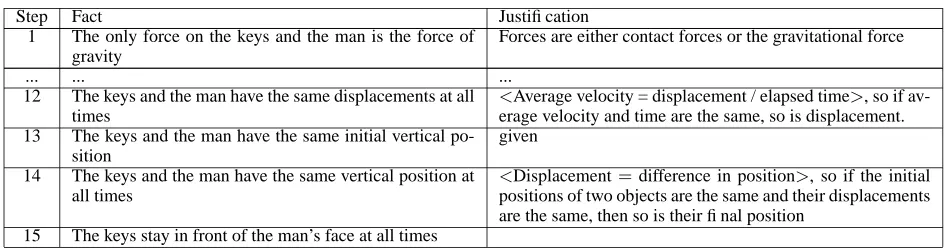
Step Fact Justification 1 The only force on the keys and the man is the force of
gravity
Forces are either contact forces or the gravitational force
... ... ...
12 The keys and the man have the same displacements at all times
<Average velocity = displacement / elapsed time>, so if av-erage velocity and time are the same, so is displacement. 13 The keys and the man have the same initial vertical
po-sition
given 14 The keys and the man have the same vertical position at
all times
<Displacement=difference in position>, so if the initial positions of two objects are the same and their displacements are the same, then so is their final position
15 The keys stay in front of the man’s face at all times
Figure 4: Part of the proof used inWHY2-ATLASfor the Elevator problem in Figure 2.
appear in the left column and justifications that are physics principles appear in the right column. Justi-fications are further categorized as vector equations
(e.g. <Average velocity = displacement / elapsed
time>, in step (12) of the proof), or qualitative rules
(e.g. “so if average velocity and time are the same, so is displacement” in step (12)). A two-column proof is represented in the system as a directed graph in which nodes are facts, vector equations, or qual-itative rules that have been translated to the FOPL representation language off-line. The edges of the graph represent the inference relations between the premise and conclusion of modus ponens.
Matches of an FOPL input against the ATMS and the two-column proof (we collectively referred to these earlier as the correct and buggy chains of rea-soning) do not have to be exact. In addition, fur-ther flexibility in the matching process is provided
by examining a neighborhood of radiusN (in terms
of graph distance) from matched nodes in the ATMS to determine whether it contains any of the nodes of the two-column proof. This provides an estimate of the proximity of a student’s utterance to the facts that are of interest.
Although matching against the ATMS deductive closure has been implemented, the current version of the system does not yet fully utilize this capability. Instead, the correctness and completeness of expla-nations is evaluated by flexibly matching the FOPL input against targeted relevant facts, principles and misconceptions in the chains of reasoning, using a radius of 0. This kind of matching is referred to as direct matching in Section 4.2.
4 Evaluations
WHY2-ATLAS, as we’ve just described it, has been
fully implemented and was evaluated in the context of testing the hypothesis that even when content is equivalent, students who engage in more interac-tive forms of instruction learn more. To test this hypothesis we compared students who received hu-man tutoring with students who read a short text.
WHY2-ATLAS and WHY2-AUTOTUTOR provided a third type of condition that served as an interactive form of instruction where the content is better con-trolled than with human tutoring in that only some subset of the content covered in the text condition can be presented. In all conditions the students had to solve four problems that require multi-sentential explanations, one of which is shown in Figure 2.
In earlier evaluations, we found that overall stu-dents learn and learn equally well in all three types of conditions when the content is appropriate to the level of the student (VanLehn et al., 2005), i.e. the learning gains for human tutoring and the content controlled text were the same. For the latest
eval-uation of WHY2-ATLAS, which excluded a human
tutoring condition, the learning gains on multiple-choice and essay post-tests were the same as for the other conditions. However, on fill-in-the-blank
post-tests, theWHY2-ATLASstudents scored higher
than the text students (p=0.010; F(1,74)=6.33), and this advantage persisted when the scores were ad-justed by factoring out pre-test scores in an AN-COVA (p=0.018; F(1,72)=5.83). Although this dif-ference was in the expected direction, it was not ac-companied by similar differences for the other two post-tests.
text, the two systems’ overall performance at se-lecting content is good. A system could perform worse than the text condition if it too frequently misinterprets multi-sentential answers and skips ma-terial covered in the text that a student may need. But since the dialogue strategies in the two systems are different and selected relative to the understand-ing techniques used, we next need to do a detailed corpus analysis of the language data collected to track successes and failures of understanding and di-alogue strategy selection relative to knowledge com-ponents in the post-test. Next we will describe some component-level evaluations that focus on the parts of the system we just described.
4.1 Evaluating the Benefit of Combining Single Sentence Approaches
This first component-level evaluation focuses on the benefits of heuristically choosing between the
re-sults of BOW, CARMELand RAPPEL. This
partic-ular evaluation used a prior version of the system which used BOW without tiers and hand-crafted pattern-matching rules instead of the ATMS ap-proach to assessment. But this evaluation still re-flects the potential benefits of combining single sen-tence approaches.
We used a test suite of 35 held-out multi-sentence student explanations (235 sentences total) that are annotated for the elicitation topics that are to be dis-cussed with the student. We computed recall (R), precision (P) and false alarm rate (FAR) against the full corpus instead of averaging these measures for each explanation. Since F-measure does not allow error skewing as can be done with ROC areas (Flach, 2003) we instead look for cases of high recall with a low false alarm rate.
The top part of Table 1 compares the baseline of tutoring all possible topics and the individual perfor-mances of the three approaches when each is used in isolation from the others. We see that only the statistical approach lowers the false alarm rate but does so by sacrificing recall. The rest are not signif-icantly different from tutoring all topics. The poor
performances of CARMELand RAPPELis not totally
unexpected because there are three potential failure points for these classification approaches; the syn-tactic analysis, the semantic mapping and the hand-crafted pattern matching rules for assessing
correct-ness and completecorrect-ness. While the syntactic anal-ysis results for both approaches are good, the se-mantic mapping and assessment of correctness and completeness are still big challenges. The results of BOW, while better than that of the other two ap-proaches, are clearly not good enough.
Table 1: Performance of NL to FOPL for actions
taken inWHY2-ATLASsystem.
Approach R P FAR
tutor all topics 1.0 .61 1.0
CARMEL 1.0 .61 1.0
BOW without tiers .60 .93 .07
RAPPEL .94 .59 1.0
satisficing heuristic .67 .80 .26
highest ranked heuristic .73 .76 .36
The bottom part of Table 1, shows the results of combining the approaches and choosing one output
heuristically. The satisficing1 version of the
heuris-tic checks each output in the order 1) CARMEL 2)
BOW 3) RAPPEL, and stops with the first
repre-sentation that is acceptable according to the filtering heuristic. This heuristic selection process modestly improves recall but at the sacrifice of a higher false alarm rate. The highest ranking heuristic scores each output and selects the best one. It provides the most balanced results of the combined or individual ap-proaches. It provides the largest increase in recall and the false alarm rate is still modest compared to the baseline of tutoring all possible topics. It is clear, that a combined approach has a positive impact.
4.2 Completeness and Correctness Evaluation
The component-level evaluation for completeness and correctness was completed after the student learning evaluation. It focuses on the performance
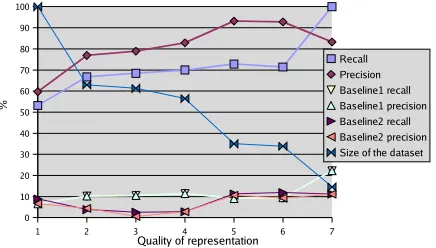
of just the direct matching procedure. Figure 5
shows the results of classifying 62 student utterances for one physics problem with respect to 46 stored statement representations using only direct match-ing. To generate these results, the data is manually divided into 7 groups based on the quality of the NL
1
1 2 3 4 5 6 7 Size of the dataset
Quality of representation
%
Figure 5: Average recall and precision of utterance classification. The size of a group of entries is shown relative to the size of the overall data set. Average processing time is 0.011 seconds per entry on a 1.8 GHz Pentium 4 machine with 2Gb of RAM.
to FOPL conversion, such that group 7 consists only
of perfectly formalized entries, and for1 ≤ n ≤ 6
groupnincludes entries of groupn+1and
addition-ally entries of somewhat lesser representation qual-ity, so that group 1 includes all the entries of the data set. The flexibility of the direct matching al-gorithm even allows classification of utterances that have mediocre representations, resulting in 70% av-erage recall and 82.9% avav-erage precision for 56.5% of all entries (group 4). However, large numbers of inadequately represented utterances (38.7% of all entries did not make it into group 3 of the data set) result in 53.2% average recall and 59.7% average precision for the whole data set (group 1). These results are still significantly better compared to the two baseline classifiers the best of which peaks at 22.2% average recall and precision. The first base-line classifier always assigns the single label that is dominant in the training set (average number of la-bels per entry of the training set is 1.36). The sec-ond baseline classifier independently and randomly picks labels according to their distributions in the training set. The most frequent label in the training set corresponds to the answer to the problem. Since in the test set the answer always appears as a sepa-rate utterance (sentence), recall and precision sepa-rates for the first baseline classifier are the same.
Although the current evaluation did not involve matching against the ATMS, we did evaluate the time required for such a match in order to make a rough comparison with our earlier approach.
Match-ing a 12 atom input representation against a 128 node ATMS that covers 55% of relevant problem facts takes around 30 seconds, which is a consid-erable improvement over the 170 seconds required for the on-the-fly analysis performed by the Tacitus-lite+ abductive reasoner (Makatchev et al., 2004)—
the technique used in the previous version ofWHY
2-ATLAS. The matching is done by a version of a largest common subgraph-based graph-matching algorithm (due to the need to account for cross-referencing atoms via shared variables) proposed in (Shearer et al., 2001), that has a time
complex-ityO(2n
n3), wherenis the size of an input graph.
The efficiency can be further improved by using an approximation of the largest common subgraph in order to evaluate the match.
5 Conclusion
In this paper, we discussed an application that in-tegrates a hybrid of semantic parsers and a sym-bolic reasoner with a statistical classifier to analyze student explanations. We attempted to address the problem that the leap made by statistical classifiers from NL to a feasible classification is too big since too many details of what was actually said by the
student are lost. On the other hand, we showed
References
Michelene T. H. Chi, Stephanie A. Siler, Heisawn Jeong, Takashi Yamauchi, and Robert G. Hausmann. 2001. Learning from human tutoring. Cognitive Science,
25(4):471–533.
M. Evens and J. Michael. 2006. One-on-One Tutoring
by Humans and Computers. Lawrence Erlbaum
Asso-ciates, Inc.
P. Flach. 2003. The geometry of ROC space: Under-standing machine learning metrics through ROC iso-metrics. In Proceedings of 20th International
Confer-ence on Machine Learning.
Kenneth D. Forbus and Johan de Kleer. 1993.
Build-ing Problem Solvers. MIT Press, Cambridge,
Mas-sachusetts; London, England.
A.C. Graesser, S. Lu, G.T. Jackson, H. Mitchell, M. Ven-tura, A. Olney, and M.M. Louwerse. 2004. Autotu-tor: A tutor with dialogue in natural language.
Behav-ioral Research Methods, Instruments, and Computers,
36:180–193.
W. Lewis Johnson and Jeff Rickel. 1997. Steve: An animated pedagogical agent for procedural training in virtual environments. SIGART Bulletin, pages 16–21, Fall.
Pamela Jordan and Kurt VanLehn. 2002. Discourse pro-cessing for explanatory essays in tutorial applications. In Proceedings of the 3rd SIGdial Workshop on
Dis-course and Dialogue, July.
Pamela W. Jordan, Maxim Makatchev, and Kurt Van-Lehn. 2004. Combining competing language un-derstanding approaches in an intelligent tutoring sys-tem. In Proceedings of the Intelligent Tutoring
Sys-tems Conference.
D. Lin and P. Pantel. 2001. Discovery of inference rules for question answering. Journal of Natural Language
Engineering, 7(4):343–360.
Maxim Makatchev and Kurt VanLehn. 2005. Analyzing completeness and correctness of utterances using an ATMS. In Proceedings of Int. Conference on Artificial
Intelligence in Education, AIED2005. IOS Press, July.
Maxim Makatchev, Pamela W. Jordan, and Kurt Van-Lehn. 2004. Abductive theorem proving for analyzing student explanations to guide feedback in intelligent tutoring systems. Journal of Automated Reasoning,
Special issue on Automated Reasoning and Theorem Proving in Education, 32:187–226.
Maxim Makatchev, Brian S. Hall, Pamela W. Jordan, Umarani Pappuswamy, and Kurt VanLehn. 2005. Mixed language processing in the Why2-Atlas tu-toring system. In Proceedings of the Workshop on
Mixed Language Explanations in Learning Environ-ments, AIED2005, pages 35–42, July.
Andrew McCallum and Kamal Nigam. 1998. A compar-ison of event models for naive bayes text classification. In Proceeding of AAAI/ICML-98 Workshop on
Learn-ing for Text Categorization. AAAI Press.
A. Newell and H.A. Simon. 1972. Human Problem
Solv-ing. Prentice-Hall, Englewood Cliffs, NJ.
Umarani Pappuswamy, Dumisizwe Bhembe, Pamela W. Jordan, and Kurt VanLehn. 2005. A multi-tier NL-knowledge clustering for classifying students’ essays. In Proceedings of 18th International FLAIRS
Confer-ence.
S. Peters, E. Bratt, B. Clark, H. Pon-Barry, and K. Schultz. 2004. Intelligent systems for training damage control assistants. In In the Proceedings of
I/ITSEC 2004, Orlando, Florida.
Rolf Ploetzner and Kurt VanLehn. 1997. The acquisi-tion of qualitative physics knowledge during textbook-based physics training. Cognition and Instruction,
15(2):169–205.
Carolyn Ros´e, Pamela Jordan, Michael Ringenberg, Stephanie Siler, Kurt VanLehn, and Anders Weinstein. 2001. Interactive conceptual tutoring in atlas-andes. In Proceedings of AI in Education 2001 Conference.
Carolyn P. Ros´e. 2000. A framework for robust seman-tic interpretation. In Proceedings of the First Meeting
of the North American Chapter of the Association for Computational Linguistics, pages 311–318.
Kim Shearer, Horst Bunke, and Svetha Venkatesh. 2001. Video indexing and similarity retrieval by largest com-mon subgraph detection using decision trees. Pattern
Recognition, 34(5):1075–1091.
Richmond H. Thomason, Jerry Hobbs, and Johanna D. Moore. 1996. Communicative goals. In K. Jokinen, M. Maybury, M. Zock, and I. Zukerman, editors,
Pro-ceedings of the ECAI 96 Workshop Gaps and Bridges: New Directions in Planning and Natural Language Generation.
K. VanLehn, A. Graesser, G. T. Jackson, P. Jordan, A. Ol-ney, and C. P. Ros´e. 2005. When is reading just as ef-fective as one-on-one interactive human tutoring? In
Proceedings of CogSci2005.
Christof Walther. 1987. A many-sorted calculus based
on resolution and paramodulation. Morgan Kauf-mann, Los Altos, California.
Claus Zinn, Johanna D. Moore, and Mark G. Core. 2002. A 3-tier planning architecture for managing tutorial di-alogue. In Proceedings of Intelligent Tutoring Systems