Towards Case-Based Parsing:
Are Chunks Reliable Indicators for Syntax Trees?
Sandra K ¨ubler
SfS-CL, University of T¨ubingen Wilhelmstr. 19
72074 T¨ubingen, Germany
Abstract
This paper presents an approach to the question whether it is possible to construct a parser based on ideas from case-based reasoning. Such a parser would employ a partial analysis of the input sentence to select a (nearly) complete syntax tree and then adapt this tree to the input sen-tence. The experiments performed on Ger-man data from the T ¨uba-D/Z treebank and the KaRoPars partial parser show that a wide range of levels of generality can be reached, depending on which types of in-formation are used to determine the simi-larity between input sentence and training sentences. The results are such that it is possible to construct a case-based parser. The optimal setting out of those presented here need to be determined empirically.
1 Introduction
Linguistic similarity has often been used as a bias in machine learning approaches to Computational
Linguistics problems. The success of applying
memory-based learning to problems such as POS tagging, named-entity recognition, partial parsing, or word sense disambiguation (cf. (Daelemans et al., 1996; Daelemans et al., 1999; Mooney, 1996; Tjong Kim Sang, 2002; Veenstra et al., 2000)) shows that the bias of this similarity-based ap-proach is suitable for processing natural language problems.
In (K ¨ubler, 2004a; K ¨ubler, 2004b), we extended the application of memory-based learning to full scale parsing, a problem which cannot easily be described as a classification problem. In this ap-proach, the most similar sentence is found in the
training data, and the respective syntax tree is then adapted to the input sentence. The parser was de-veloped for parsing German dialog data, and it is based on the observation that dialogs tend to be repetitive in their structure. Thus, there is a higher than normal probability of finding the same or a very similar sentence in the training data.
The present paper examines the possibilities of extending the concepts in (K ¨ubler, 2004a; K ¨ubler, 2004b) to unrestricted newspaper text. Since in newspaper text, the probability of finding the same sentence or a very similar one is rather low, the parser needs to be extended to a more flexible ap-proach which does not rely as much on identity between sentences as the original parser.
The paper is structured as follows: Section 2 ex-plains the original parser in more detail, and sec-tion 3 describes the treebank used in the investi-gation. Section 4 investigates whether the chunk sequences used for selecting the most similar sen-tence in the training data give a reliable estimate of the syntax tree, section 5 investigates properties of tree sets associated with chunk sequences, and section 6 draws conclusions on the architecture of an extended case-based parser.
2 A Memory-Based Parser
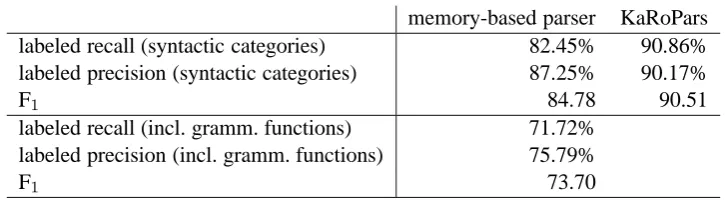
The parser in (K ¨ubler, 2004a; K ¨ubler, 2004b) approaches parsing as the task of finding a com-plete syntax tree rather than incrementally build-ing the tree by rule applications, as in standard PCFGs. Despite this holistic approach to selecting the most similar tree, the parser has a reasonable performance: the first column of Table 1 shows the parser’s evaluation on German spontaneous speech dialog data. This approach profits from the fact that it has a more global view on parsing than a PCFG parser. In this respect, the memory-based
memory-based parser KaRoPars
labeled recall (syntactic categories) 82.45% 90.86%
labeled precision (syntactic categories) 87.25% 90.17%
F 84.78 90.51
labeled recall (incl. gramm. functions) 71.72%
labeled precision (incl. gramm. functions) 75.79%
F 73.70
Table 1: Results for the memory-based parser (K ¨ubler, 2004a; K ¨ubler, 2004b) and KaRoPars (M¨uller and Ule, 2002; M¨uller, 2005). The evaluation of KaRoPars is based on chunk annotations only.
parser employs a similar strategy to the one in
Data-Oriented Parsing (DOP) (Bod, 1998; Scha et
al., 1999). Both parsers use larger tree fragments than the standard trees. The two approaches differ mainly in two respects: 1) DOP allows different tree fragments to be extracted from one tree, thus making different combinations of fragments avail-able for the assembly of a specific tree. Our parser, in contrast, allows only one clearly defined tree fragment for each tree, in which only the phrase-internal structure is variable. 2) Our parser does not use a probabilistic model, but a simple cost function instead. Both factors in combination re-sult in a nearly deterministic, and thus highly effi-cient parsing strategy.
Since the complete tree structure in the memory-based parser is produced in two steps (re-trieval of the syntax tree belonging to the most similar sentence and adaptation of this tree to the input sentence), the parser must rely on more in-formation than the local inin-formation on which a PCFG parser suggests the next constituent. For this reason, we suggested a backing-off architec-ture, in which each modules used different types of easily obtainable linguistic information such as the sequence of words, the sequence of POS tags, and the sequence of chunks. Chunk parsing is a partial parsing approach (Abney, 1991), which is gener-ally implemented as cascade of finite-state trans-ducers. A chunk parser generally gives an anal-ysis on the clause level and on the phrase level. However, it does not make any decisions concern-ing the attachment of locally ambiguous phrases. Thus, the German sentence in (1a) receives the chunk annotation in (1b).
(1) a. In
In der the
bewußten conscious
Wahrnehmung perception
des of the Lebens
life sieht discerns
der the
international internationally angesehene
distinguished K¨unstler artist
den the
Ursprung origin
aller of all
Kreativit¨at. creativity.
’The internationally recognized artist discerns the origin of all creativity in the conscious perception of life.’
b. [PC In der bewußten Wahrnehmung des Lebens] [VCL sieht] [NC der international angesehene K¨unstler] [NC den Ursprung] [NC aller Kreativit¨at].
NCs are noun chunks, PC is a prepositional chunk, and VCL is the finite verb chunk. While for the chunks to the right of the verb chunk, no attachment decision could be made, the genitive noun phrase des Lebens could be grouped with the PC because of German word order regularities, which allow exactly one constituent in front of the finite verb.
It can be hypothesized that the selection of the most similar sentence based on sequences of words or POS tags works best for dialog data be-cause of the repetitive nature of such dialogs. The strategy with the greatest potential for generaliza-tion to newspaper texts is thus the usage of chunk sequences. In the remainder of this paper, we will therefore concentrate on this approach.
The proposed parser is based on the follow-ing architecture: The parser needs a syntactically annotated treebank for training. In the learning phase, the training data are chunk parsed, the chunk sequences are extracted from the chunk parse and fitted to the syntax trees; then the trees are stored in memory. In the annotation phase, the new sentence is chunk parsed. Based on the se-quence of chunks, the group of most similar sen-tences, which all share the same chunk analysis, is retrieved from memory. In a second step, the best sentence from this group needs to be selected, and the corresponding tree needs to be adapted to the input sentence.
se-quences are reliable indicators for the correct syn-tax trees. Basically, there exist two extreme pos-sibilities: 1) most chunk sequences are associated with exactly one sentence, and 2) there is only a small number of different chunk sequences, which are each associated with many sentences. In the first case, the selection of the correct tree based on a chunk sequence is trivial but the coverage
of the parser would be rather low. The parser
would encounter many sentences with chunk se-quences which are not present in the training data. In the second case, in contrast, the coverage of chunk sequences would be good, but then such a chunk sequence would correspond to many dif-ferent trees. As a consequence, the tree selection process would have to be more elaborate. Both extremes would be extremely difficult for a parser to handle, so in the optimal case, we should have a good coverage of chunk sequences combined with a reasonable number of trees associated with a chunk sequence.
The investigation on the usefulness of chunk se-quences was performed on the data of the German treebank T ¨uBa-D/Z (Telljohann et al., 2004) and on output from KaRoPars, a partial parser for Ger-man (M¨uller and Ule, 2002). But in principle, the parsing approach is valid for languages ranging from a fixed to a more flexible word order. The German data will be described in more detail in the following section.
3 The German Data
3.1 The Treebank T ¨uBa-D/Z
The T ¨uBa-D/Z treebank is based on text from the German newspaper ’die tageszeitung’, the present release comprises approx. 22 000 sentences. The treebank uses an annotation framework that is based on phrase structure grammar enhanced by a level of predicate-argument structure. The an-notation scheme uses pure projective tree struc-tures. In order to treat long-distance relationships, T ¨uBa-D/Z utilizes a combination of topological fields (H ¨ohle, 1986) and specific functional labels (cf. the tree in Figure 5, there the extraposed rel-ative clause modifies the subject, which is anno-tated via the label ON-MOD ). Topological fields described the main ordering principles in a Ger-man sentence: In a declarative sentence, the posi-tion of the finite verb as the second constituent and of the remaining verbal elements at the end of the clause is fixed. The finite verb constitutes theleft
sentence bracket (LK), and the remaining verbal elements theright sentence bracket (VC). The left bracket is preceded by the initial field (VF), be-tween the two verbal fields, we have the unstruc-tured middle field (MF). Extraposed constituents are in thefinal field (NF).
The tree for sentence (1a) is shown in Figure 1. The syntactic categories are shown in circular nodes, the function-argument structure as edge la-bels in square boxes. Inside a phrase, the function-argument annotation describes head/non-head re-lations; on the clause level, directly below the topological fields, grammatical functions are an-notated. The prepositional phrase (PX) is marked as a verbal modifier (V-MOD), the noun phrase
der international angesehene K¨unstler as subject
(ON), and the complex noun phrase den Ursprung
aller Kreativit¨at as accusative object (OA). The
topological fields are annotated directly below the clause node (SIMPX): the finite verb is placed in the left bracket, the prepositional phrase consti-tutes the initial field, and the two noun phrases the middle field.
3.2 Partially Parsed Data
KaRoPars (M¨uller and Ule, 2002) is a partial parser for German, based on the finite-state tech-nology of the TTT suite of tools (Grover et al., 1999). It employs a mixed bottom-up top-down routine to parse German. Its actual performance is difficult to determine exactly because it employed manually written rules. The figures presented in Table 1 result from an evaluation (M¨uller, 2005) in which the parser output was compared with tree-bank structures. The figures in the Table are based on an evaluation of chunks only, i.e. the annotation of topological fields and clause boundaries was not taken into account.
0 1 2 3 4 5 6 7 8 9 10 11 12 13 14 15
500 501 502 503 504 505
506 507 508 509
510 511
512 513
514
515
In APPR
der ART
bewußten ADJA
Wahrnehmung NN
des ART
Lebens NN
sieht VVFIN
der ART
international ADJD
angesehene ADJA
Künstler NN
den ART
Ursprung NN
aller PIDAT
Kreativität NN
. $.
HD − HD HD HD − HD − HD
− ADJX
− HD
VXFIN HD
ADJX
− HD
NX HD
NX − NX
HD
NX
− −
ADJX
− HD
−
NX HD
NX ON
NX OA PX
V−MOD VF −
LK −
MF − SIMPX
Figure 1: The T ¨uBa-D/Z tree for sentence (1a).
<s broken="no"> <cl c="V2">
<ch fd="VF" c="PC" prep="in"> <ch c="PC" prep="in">
<t f="In"><P t="APPR"></P></t>
<ch nccat="noun" hdnoun="Wahrnehmung" c="NC"> <t f="der"><P t="ART"></P></t>
<t f="bewußten"><P t="ADJA"></P></t>
<t f="Wahrnehmung"><P t="NN"></P></t></ch></ch> <ch nccat="noun" hdnoun="Leben" c="NC">
<t f="des"><P t="ART"></P></t>
<t f="Lebens"><P t="NN"></P></t></ch></ch> <ch finit="fin" c="VCLVF" mode="akt">
<t f="sieht"><P t="VVFIN"></P></t></ch> <ch nccat="noun" hdnoun="K¨unstler" c="NC">
<t f="der"><P t="ART"></P></t>
<t f="international"><P t="ADJD"></P></t> <t f="angesehene"><P t="ADJA"></P></t> <t f="K¨unstler"><P t="NN"></P></t></ch> <ch nccat="noun" hdnoun="Ur=Sprung" c="NC">
<t f="den"><P t="ART"></P></t>
<t f="Ursprung"><P t="NN"></P></t></ch> <ch nccat="noun" hdnoun="Kreativit¨at" c="NC">
<t f="aller"><P t="PIDAT"></P></t>
<t f="Kreativit¨at"><P t="NN"></P></t></ch></cl></s>
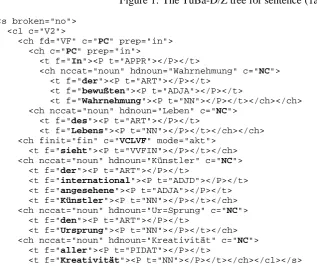
Figure 2: The KaRoPars analysis for sentence (1a). For better readability, the words and the chunk types are displayed in bold.
Lebens needs to be attached to the previous phrase.
In the treebank, it is grouped into a complex noun phrase while in the KaRoPars output, this noun phrase is the sister of the prepositional chunk In
der bewußten Wahrnehmung. Such boundary
mis-matches also occur on the clause level.
4 Chunk Sequences as Indicators for Syntax Trees
The complexity of the proposed parser depends on the proportion of chunk sequences versus syntax trees, as explained in section 2. A first indication of this proportion is given by the ratio of chunk sequence types and tree types. Out of the 22 091 sentences in the treebank, there are 20 340 differ-ent trees (types) and 14 894 differdiffer-ent chunk
could be found in the training data.
’So the team only meets on the day of the game.’
In a second experiment, we added more infor-mation about chunk types, namely the inforinfor-mation from the fields nccat and finit in the XML rep-resentation to the chunk categories. Field nccat contains information about the head of the noun chunk, whether it is a noun, a reflexive pronoun, a relative pronoun, etc. Field finit contains in-formation about the finiteness of a verb chunk. For this experiment, sentence (2) is represented by the chunk sequence “NC:noun VCL NC:refl PC NC:noun PC AVC NC:noun VCR:fin”. When us-ing such chunk sequences, the ratio of sequences found in the training set decreases to 36.59%.
In a third experiment, the chunk sequences were constructed without adverbial phrases, i.e. with-out the one category that functions as adjunct in a majority of the cases. Thus sentence (3) is repre-sented by the chunk sequence “NC VCL NC NC” instead of by the complete sequence: “NC VCL NC AVC AVC AVC NC”. In this case, 54.72% of the chunk sequences can be found. Reducing the information in the chunk sequence even fur-ther seems counterproductive because every type of information that is left out will make the final decision on the correct syntax tree even more dif-ficult. ’Who will give us an order anyhow?’
All the experiments reported above are based on data in which complete sentences were used. One possibility of gaining more generality in the chunk sequences without losing more information con-sists of splitting the sentences on the clause level.
(4) Ganz
’Completely irrespective of the fact that one al-ready knows all the other females with whom one can slander the twerp after the break-up because they already know what a loser he is.’
Thus, the complex sentence in (4) translates into 5 different clauses, i.e. into 5 different chunk se-quences:
1. SubC NC:noun AVC AVC AVC NC:noun
NC:noun VCR:fin
2. PC NC:noun PC PC VCR:fin
3. SubC NC:noun AVC AJVC VCR:fin
4. SubC AJVC NC:noun AVC VCR:fin
5. AVC VCR:fin PC
The last sequence covers the elliptical ma-trix clause ganz abgesehen davon, the first four sequences describe the subordinated clauses; i.e. the first sequence describes the subordi-nate clause daß man dann schon mal alle die
Geschlechtsgenossinnen kennt, the second
se-quence covers the relative clause mit denen man
nach der Trennung ¨uber den Kerl abl¨astern kann.
The third sequence describes the subordinate clause introduced by the conjunction weil, and the fourth sequence covers the subordinate clause in-troduced by the interrogative pronoun wie.
On the one hand, splitting the chunk sequences into clause sequences makes the parsing task more difficult because the clause boundaries annotated during the partial parsing step do not always coin-cide with the clause boundaries in the syntax trees. In those cases where the clause boundaries do not coincide, a deterministic solution must be found, which allows a split that does not violate the paral-lelism constraints between both structures. On the other hand, the split into clauses allows a higher coverage of new sentences without extending the size of the training set. In an experiment, in which the chunk sequences were represented by the main chunk types plus subtypes (cf. experiment two) and were split into clauses, the percentage of un-seen sequences in a tenfold split was reduced from 66.41% to 44.16%. If only the main chunk type is taken into account, the percentage of unseen se-quences decreases from 56.39% to 36.34%.
are represented by the chunk sequences and thus needs to be postponed.
5 Tree Sets
In the previous section, we showed that if we extract chunk sequences based on complete sen-tences and on main chunk types, there are on av-erage 1.37 sentences assigned to one chunk se-quences. At a first glance, this results means that for the majority of chunk sequences, there is ex-actly one sentence which corresponds to the se-quence, which makes the final selection of the cor-rect tree trivial. However, 1261 chunk sequences have more than one corresponding sentence, and there is one chunk sequence which has 802 sen-tences assigned. We will call these collectionstree sets. In these cases, the selection of the correct tree from a tree set may be far from trivial, de-pending on the differences in the trees. A minimal difference constitutes a difference in the words only. If all corresponding words belong to the same POS class, there is no difference in the syn-tax trees. Another type of differences in the trees which does not overly harm the selection process are differences in the internal structure of phrases. In (K ¨ubler, 2004a), we showed that the tree can be cut at the phrase level, and new phrase-internal structures can be inserted into the tree. Thus, the most difficult case occurs when the differences in the trees are located in the higher regions of the trees where attachment information between phrases and grammatical functions are encoded. If such cases are frequent, the parser needs to employ a detailed search procedure.
The question how to determine the similarity of trees in a tree set is an open research question. It is clear that the similarity measure should abstract away from unimportant differences in words and phrase-internal structure. It should rather concen-trate on differences in the attachment of phrases and in grammatical functions. As a first approx-imation for such a similarity measure, we chose a measure based on precision and recall of these parts of the tree. In order to ignore the lower levels of the tree, the comparison is restricted to nodes in the tree which have grammatical functions.
(5) Der
The
Autokonvoi car convoy
mit with
den the
Probenbesuchern rehearsal visitors f¨ahrt
travels eine a
Straße street
entlang, down,
die which
noch still
heute today
Lagerstraße Lagerstraße
heißt. is called.
’The convoy of the rehearsal visitors’ cars travels down a street that is still called Lagerstraße.’
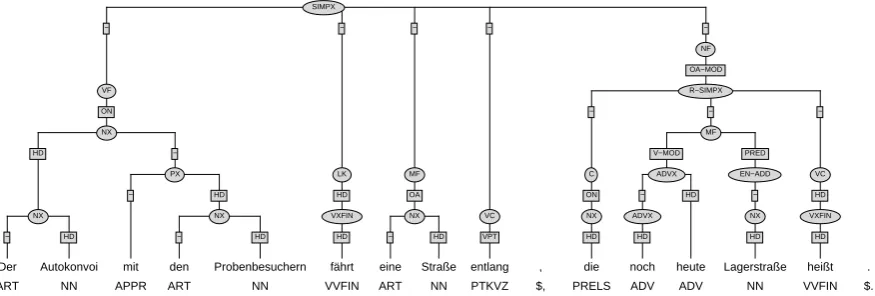
For example, Figure 5 shows the tree for sen-tence (5). The matrix clause consists of a com-plex subject noun phrase (GF: ON), a finite verb phrase, which is the head of the sentence, an accusative noun phrase (GF: OA), a verb parti-cle (GF: VPT), and an extraposed relative clause (GF: ON-MOD). Here the grammatical function indicates a long-distance relationship, the relative clause modifies the subject. The relative clause, in turn, consists of a subject (the relative pro-noun), an adverbial phrase modifying the verb (GF: V-MOD), a named entity predicate (EN-ADD, GF: PRED), and the finite verb phrase. The comparison of this tree to other trees in its tree set will then be based on the following nodes: NX:ON VXFIN:HD NX:OA PTKVC:VPT R-SIMPX:ON-MOD NX:ON ADVX:V-MOD EN-ADD:PRED VXFIN:HD. Precision and recall are generally calculated based on the number of iden-tical constituents between two trees. Two con-stituents are considered identical if they have the same node label and grammatical function and if they cover the same range of words (i.e. have the
same yield). For our comparison, the concrete
length of constituents is irrelevant, as long as the sequential order of the constituents is identical. Thus, in order to abstract from the length of con-stituents, their yield is normalized: All phrases are set to length 1, the yield of a clause is determined by the yields of its daughters. After this step, pre-cision and recall are calculated on all pairs of trees in a tree set. Thus, if a set contains 3 trees, tree 1 is compared to tree 2 and 3, and tree 2 is compared to tree 3. Since all pairs of trees are compared, there is no clear separation of precision and recall, pre-cision being the result of comparing tree A to B in the pair and recall being the result of comparing B to A. As a consequence only the F -measure, a
combination of precision and recall, is used. As mentioned above, the experiment is con-ducted with chunk sequences based on complete sentences and the main chunk types. The average F-measure for the 1261 tree sets is 46.49%, a clear indication that randomly selecting a tree from a tree set is not sufficient. Only a very small number of sets, 62, consists of completely identical trees, and most of these sets contain only two trees.
0 1 2 3 4 5 6 7 8 9 10 11 12 13 14 15
500 501 502 503 504 505 506 507 508
509 510 511 512 513 514 515
516 517
Figure 3: The T ¨uBa-D/Z tree for sentence (5).
by the relatively free word order of German: In contrast to English, the grammatical function of a noun phrase in German cannot be determined by its position in a sentence. Thus, if the partial parser returns the chunk sequence “NC VCL NC NC”, it is impossible to tell which of the noun phrases is the subject, the accusative object, or the dative ob-ject. As a consequence, all trees with these three arguments will appear in the same tree set. Since German additionally displays case syncretism be-tween nominative and accusative, a morphological analysis can also only provide partial disambigua-tion. As a consequence, it is clear that the selec-tion of the correct syntax tree for an input sentence needs to be based on a selection module that uti-lizes lexical information.
Another source of differences in the trees are er-rors in the partial analysis. In the tree set for the chunk sequence “NC VCL AVC PC PC VCR”, there are sentences with rather similar structure, one of them being shown in (6). Most of them only differ in the grammatical functions assigned to the prepositional phrases, which can serve ei-ther as complements or adjuncts. However, the tree set also contains sentence (7).
(6) Die fit for military service
Alter
’Those brothers who are considered fit for military service had already fled into the woods before the police operation.’
’This is also true for the extent to which Montene-gro is being attacked.’
In sentence (7), the relative pronoun was erro-neously POS tagged as a definite determiner, thus allowing an analysis in which the two phrases in
dem and Montenegro are grouped as a
preposi-tional chunk. As a consequence, no relative clause
was found. The corresponding trees, however,
are annotated correctly, and the similarity between those two sentences is consequently low.
The low F-measure should not be taken as a completely negative result. Admittedly, it necessi-tates a rather complex tree selection module. The positive aspect of this one-to-many relation be-tween chunk sequences and trees is its generality. If only very similar trees shared a tree set, then we would need many chunk sequences. In this case, the problem would be moved towards the question how to extract a maximal number of different par-tial parses from a limited number of training sen-tences.
6 Consequences for a Case-Based Parser
The experiments in the previous two sections show that the chunk sequences extracted from a par-tial parse can serve as indicators for syntax trees. While the best definition of chunk sequences can only be determined empirically, the results pre-sented in the previous section allow some conclu-sions on how the parser must be designed.
6.1 Consequences for Matching Chunk
Sequences and Trees
reach the first goal would be to ignore certain types of phrases in the extraction of chunk sequences from the partial parse. However, the experiments show that it is impossible to reduce the informa-tiveness of the chunk sequence to a level where all possible chunk sequences are present in the train-ing data. This means that the procedure which matches the chunk sequence of the input sentence to the chunk sequences in the training data must be more flexible than a strict left-to-right comparison. In (K ¨ubler, 2004a; K ¨ubler, 2004b), we allowed the deletion of chunks in either the input sentence or the training sentence. The latter operation is un-critical because it results in a deletion of some part of the syntax tree. The former operation, however, is more critical, it either leads to a partial syntac-tic analysis in which the deleted chunk is not at-tached to the tree or to the necessity of guessing the node to which the additional constituent needs to be attached and possibly guessing the grammat-ical function of the new constituent. Instead of this deletion, which can be applied anywhere in the sentence, we suggest the use of Levenshtein distance (Levenshtein, 1966). This distance mea-sure is, for example, used for spelling correction: Here the most similar word in the lexicon is found which can be reached via the smallest number of deletion, substitution, and insertion operations on characters. Instead of operating on characters, we suggest to apply Levenshtein distance to chunk quences. In this case, deletions from the input se-quence could be given a much higher weight (i.e. cost) than insertions. We also suggest a modi-fication of the distance to allow an exchange of chunks. This modification would allow a princi-pled treatment of the relative free word order of German. However, if such an operation is not re-stricted to adjacent chunks, the algorithm will gain in complexity but since the resulting parser is still deterministic, it is rather unlikely that this modifi-cation will lead to complexity problems.
6.2 Consequences for the Tree Selection
As explained in section 5, there are chunk se-quences that correspond to more than one syntax tree. Since differences in the trees also pertain to grammatical functions, the module that selects the best tree out of the tree set needs to use more in-formation than the chunk sequences used for se-lecting the tree set. Since the holistic approach to parsing proposed in this paper does not lend
it-self easily to selecting grammatical functions sep-arately for single constituents, we suggest to use lexical co-occurrence information instead to se-lect the best tree out of the tree set for a given sentence. Such an approach generalizes Streiter’s (2001) approach of selecting from a set of possi-ble trees based on word similarity. However, an approach based on lexical information will suffer extremely from data sparseness. For this reason, we suggest a soft clustering approach based on a partial parse, similar to the approach by Wagner (2005) for clustering verb arguments for learning selectional preferences for verbs.
7 Conclusion and Future Work
In this paper, we have approached the question whether it is possible to construct a parser based on ideas from case-based reasoning. Such a parser would employ a partial analysis (chunk analysis) of the sentence to select a (nearly) complete syntax tree and then adapt this tree to the input sentence.
In the experiments reported here, we have shown that it is possible to obtain a wide range of levels of generality in the chunk sequences, depending on the types of information extracted from the partial anaylses and on the decision whether to use sentences or clauses as basic seg-ments for the extraction of chunk sequences. Once a robust method is implemented to split trees into subtrees based on clauses, chunk sequences can be extracted on the clause level rather than from complete sentences. Consequently, the tree sets will also reach a higher cardinality. However, a tree selection method based on lexical information will be indispensable even then. For this tree se-lection, a method for determining the similarity of tree structures needs to be developed. The mea-sure used in the experiments reported here, F , is only a very crude approximation, which serves well for an initial investigation, but which is not good enough for a parser depending on such a similarity measure. The optimal combination of chunk sequences and tree selection methods will have to be determined empirically.
References
Steven Abney. 1991. Parsing by chunks. In Robert Berwick, Steven Abney, and Caroll Tenney, editors,
Principle-Based Parsing, pages 257–278. Kluwer
Rens Bod. 1998. Beyond Grammar: An
Experience-Based Theory of Language. CSLI Publications, Stanford, CA.
Walter Daelemans, Jakub Zavrel, Peter Berck, and Steven Gillis. 1996. MBT: A memory-based part of speech tagger-generator. In Eva Ejerhed and Ido Dagan, editors, Proceedings of the 4th Workshop
on Very Large Corpora, pages 14–27, Copenhagen,
Denmark.
Walter Daelemans, Antal van den Bosch, and Jakub Za-vrel. 1999. Forgetting exceptions is harmful in lan-guage learning. Machine Learning, 34:11–43. Spe-cial Issue on Natural Language Learning.
Claire Grover, Colin Matheson, and Andrei Mikheev. 1999. TTT: Text Tokenization Tool. Language Technology Group, University of Edinburgh.
Tilman H¨ohle. 1986. Der Begriff
”Mit-telfeld”, Anmerkungen ¨uber die Theorie der topo-logischen Felder. In Akten des Siebten
Interna-tionalen Germanistenkongresses 1985, pages 329–
340, G¨ottingen, Germany.
Sandra K¨ubler. 2004a. Memory-Based Parsing. John Benjamins, Amsterdam.
Sandra K¨ubler. 2004b. Parsing without grammar– using complete trees instead. In Nicolas Ni-colov, Ruslan Mitkov, Galia Angelova, and Kalina Boncheva, editors, Recent Advances in Natural
Lan-guage Processing III: Selected Papers from RANLP 2003, Current Issues in Linguistic Theory. John
Benjamins, Amsterdam.
Vladimir I. Levenshtein. 1966. Binary codes capa-ble of correcting deletions, insertions, and reversals.
Cybernetics and Control Theory, 10(8):707–710.
Raymond J. Mooney. 1996. Comparative experiments on disambiguating word senses: An illustration of the role of bias in machine learning. In
Proceed-ings of the 1st Conference on Empirical Methods in Natural Language Processing EMNLP, pages 82–
91, Philadelphia, PA.
Frank Henrik M¨uller and Tylman Ule. 2002. Annotat-ing topological fields and chunks–and revisAnnotat-ing POS tags at the same time. In Proceedings of the 19th
In-ternational Conference on Computational Linguis-tics (COLING 2002), pages 695–701, Taipei,
Tai-wan.
Frank Henrik M¨uller. 2005. A Finite-State Approach
to Shallow Parsing and Grammatical Functions An-notation of German. Ph.D. thesis, Seminar f¨ur Sprachwissenschaft, Universit¨at T¨ubingen. Version of 16th Nov. 2005.
Remko Scha, Rens Bod, and Khalil Sima’an. 1999. Memory-based syntactic analysis. Journal of
Ex-perimental and Theoretical Artificial Intelligence,
11:409–440. Special Issue on Memory-Based Lan-guage Processing.
Oliver Streiter. 2001. Recursive top-down fuzzy match, new perspectives on memory-based pars-ing. In Proceedings of the 15th Pacific Asia
Confer-ence on Language, Information and Computation, PACLIC 2001, Hong Kong.
Heike Telljohann, Erhard Hinrichs, and Sandra K¨ubler. 2004. The T¨uBa-D/Z treebank: Annotating German with a context-free backbone. In Proceedings of the
Fourth International Conference on Language Re-sources and Evaluation (LREC 2004), pages 2229–
2235, Lisbon, Portugal.
Erik F. Tjong Kim Sang. 2002. Memory-based named entity recognition. In Proceedings of CoNLL-2002, pages 203–206. Taipei, Taiwan.
Jorn Veenstra, Antal van den Bosch, Sabine Buch-holz, Walter Daelemans, and Jakub Zavrel. 2000. Memory-based word sense disambiguation.
Com-puters and the Humanities, Special Issue on Sense-val, Word Sense Disambiguation, 34(1/2):171–177.
Andreas Wagner. 2005. Learning Thematic Role
Rela-tions for Lexical Semantic Nets. Ph.D. thesis,