Hypothesis Selection in Machine Transliteration: A Web Mining Approach
Jong-Hoon Oh and Hitoshi Isahara Computational Linguistics Group
National Institute of Information and Communications Technology (NICT) 3-5 Hikaridai,Seika-cho, Soraku-gun, Kyoto, 619-0289, Japan
{rovellia,isahara}@nict.go.jp
Abstract
We propose a new method of selecting hy-potheses for machine transliteration. We generate a set of Chinese, Japanese, and Ko-rean transliteration hypotheses for a given English word. We then use the set of translit-eration hypotheses as a guide to finding rel-evant Web pages and mining contextual in-formation for the transliteration hypotheses from the Web page. Finally, we use the mined information for machine-learning al-gorithms including support vector machines and maximum entropy model designed to select the correct transliteration hypothesis. In our experiments, our proposed method based on Web mining consistently outper-formed systems based on simple Web counts used in previous work, regardless of the lan-guage.
1 Introduction
Machine transliteration has been a great challenge for cross-lingual information retrieval and machine translation systems. Many researchers have devel-oped machine transliteration systems that accept a source language term as input and then output its transliteration in a target language (Al-Onaizan and Knight, 2002; Goto et al., 2003; Grefenstette et al., 2004; Kang and Kim, 2000; Li et al., 2004; Meng et al., 2001; Oh and Choi, 2002; Oh et al., 2006; Qu and Grefenstette, 2004). Some of these have used the Web to select machine-generated transliteration hypotheses and have obtained promising results (Al-Onaizan and Knight, 2002; Grefenstette et al., 2004;
Oh et al., 2006; Qu and Grefenstette, 2004). More precisely, they used simple Web counts, estimated as the number of hits (Web pages) retrieved by a Web search engine.
However, there are several limitations imposed on the ability of Web counts to select a correct translit-eration hypothesis. First, the assumption that hit counts approximate the Web frequency of a given query usually introduces noise (Lapata and Keller, 2005). Moreover, some Web search engines disre-gard punctuation and capitalization when matching search terms (Lapata and Keller, 2005). This can cause errors if such Web counts are relied on to se-lect transliteration hypotheses. Second, it is not easy to consider the contexts of transliteration hypothe-ses with Web counts because Web counts are esti-mated based on the number of retrieved Web pages. However, as our preliminary work showed (Oh et al., 2006), transliteration or translation pairs often appear as parenthetical expressions or tend to be in close proximity in texts; thus context can play an im-portant role in selecting transliteration hypotheses. For example, there are several Chinese, Japanese, and Korean (CJK) transliterations and their counter-parts in a parenthetical expression, as follows.
1) ¸X/W1ÿ=ÿ2(Adrienne1Clarkson2)
2) °ë³–¹1ª·À–¼2(glucose1 oxidase2)
3) n` Zt16¤r]j2(diphenol1oxidase2)
translit-eration hypotheses because it is apparent that they are translation pairs or transliteration pairs. How-ever, we cannot fully use such information with Web counts.
To address these problems, we propose a new method of selecting transliteration hypotheses. We were interested in how to mine information relevant to the selection of hypotheses and how to select cor-rect transliteration hypotheses using the mined in-formation. To do this, we generated a set of CJK transliteration hypotheses for a given English word. We then used the set of transliteration hypotheses as a guide to finding relevant Web page and min-ing contextual information for the transliteration hy-potheses from the Web page. Finally, we used the mined information for machine-learning algo-rithms including support vector machines (SVMs) and maximum entropy model designed to select the correct transliteration hypothesis.
This paper is organized as follows. Section 2 de-scribes previous work based on simple Web counts. Section 3 describes a way of generating transliter-ation hypotheses. Sections 4 and 5 introduce our methods of Web mining and selecting transliteration hypotheses. Sections 6 and 7 deal with our exper-iments and the discussion. Conclusions are drawn and future work is discussed in Section 8.
2 Related work
Web counts have been used for selecting translit-eration hypotheses in several previous work (Al-Onaizan and Knight, 2002; Grefenstette et al., 2004; Oh et al., 2006; Qu and Grefenstette, 2004). Be-cause the Web counts are estimated as the number of hits by a Web search engine, they greatly depend on queries sent to a search engine. Previous work has used three types of queries—monolingual queries (MQs) (Al-Onaizan and Knight, 2002; Grefen-stette et al., 2004; Oh et al., 2006), bilingual simple queries (BSQs) (Oh et al., 2006; Qu and Grefenstette, 2004), and bilingual bigram queries (BBQs) (Oh et al., 2006). If we let S be a source language term and H = {h1,· · ·, hr} be a set of
machine-generated transliteration hypotheses of S, the three types of queries can be defined as
MQ: hi(e.g.,ÿÉ$,כêóÈó, and9þt2;).
BSQ: sandhi without quotations (e.g., Clintonÿ É$, ClintonכêóÈó, and Clinton9þt2;
).
BBQ: Quoted bigrams composed ofSandhi(e.g.,
“ClintonÿÉ$”, “ClintonכêóÈó”, and “Clinton9þt2;”).
MQ is not able to determine whetherhiis a
counter-part ofS, but whetherhiis a frequently used target
term in target-language texts. BSQ retrieves Web pages ifS andhi are present in the same document
but it does not take the distance between S and hi
into consideration. BBQ retrieves Web pages where “S hi” or “hi S” are present as a bigram. The
rel-ative order of Web counts overHmakes it possible to select transliteration hypotheses in the previous work.
3 Generating Transliteration Hypotheses
Let S be an English word, P be a pronuncia-tion of S, and T be a target language translitera-tion corresponding to S. We implement English-to-CJK transliteration systems based on three dif-ferent transliteration models — a grapheme-based model (S → T), a phoneme-based model (S → P and P → T), and a correspondence-based model (S → P and(S, P) → T) — as described in our preliminary work (Oh et al., 2006).PandT are seg-mented into a series of sub-strings, each of which corresponds to a source grapheme. We can thus writeS =s1,· · ·, sn = sn1,P = p1,· · ·, pn =pn1,
andT = t1,· · ·, tn = tn1, where si,pi, and ti
rep-resent theithEnglish grapheme, English phonemes corresponding tosi, and target language graphemes
corresponding to si, respectively. Given S, our
transliteration systems generate a sequence ofti
cor-responding to eithersi (in Eq. (1)) orpi(in Eq. (2))
or both of them (in Eq. (3)).
P rG(T|S) = P r(tn1|sn1) (1)
P rP(T|S) = P r(pn1|sn1)×P r(tn1|pn1) (2)
P rC(T|S) = P r(pn1|sn1)×P r(tn1|sn1, pn1)(3)
then created a set of transliteration hypotheses com-prising then-best transliteration hypotheses.
4 Web Mining
LetSbe an English word andH={h1,· · ·, hr}be
its machine-generated set of transliteration hypothe-ses. We useS andH to generate queries sent to a search engine1 to retrieve the top-100 snippets. A correct transliteration and its counterpart tend to be in close proximity on CJK Web pages. Our goal in Web mining was to find such Web pages and mine information that would help to select transliteration hypotheses from these pages.
To find these Web pages, we used three kinds of queries, Q1=(S andhi),Q2=S, andQ3=hi, where
Q1 is the same as BSQ’s query andQ3 is the same as MQ’s. The three queries usually result in different sets of Web pages. We categorize the retrieved Web pages byQ1,Q2, andQ3intoW1,W2, andW3. We extract three kinds of features from Wl as follows,
wherel= 1,2,3.
• F req(hi, Wl): the number of occurrences ofhi
inWl
• DF reqk(hi, Wl): Co-occurrence ofS and hi
with distancedk ∈ D in the same snippet of
Wl.
• P F reqk(hi, Wl): Co-occurrence of S and hi
as parenthetical expressions with distancedk∈
Din the same snippet ofWl. Parenthetical
ex-pressions are detected when eitherSorhiis in
parentheses.
We define D = {d1, d2, d3} with three ranges of distances between S and hi, where d1(d < 5),
d2(5≤d <10), andd3(10≤d≤15). We counted distance d with the total number of characters (or words)2 betweenS andhi. Here, we can take the
contexts of transliteration hypotheses into account using DF req and P F req; while F req is counted regardless of the contexts of the transliteration hy-potheses.
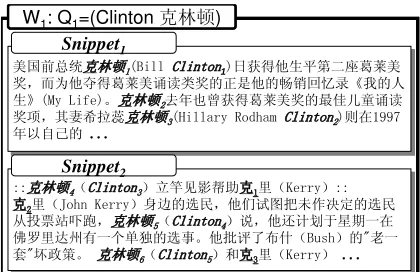
Figure 1 shows examples of how to calculate F req,DF reqk, andP F reqk, whereS =Clinton,
1
We used Google (http://www.google.com) 2
Depending on whether the languages had spacing units, words (for English and Korean) or characters (for Chinese and Japanese) were chosen to calculated.
美国前总统克林顿1(Bill Clinton1)日获得他生平第二座葛莱美
奖,而为他夺得葛莱美诵读类奖的正是他的畅销回忆录《我的人 生》(My Life)。克林顿2去年也曾获得葛莱美奖的最佳儿童诵读
奖项,其妻希拉蕊克林顿3(Hillary Rodham Clinton2)则在1997
年以自己的...
美国前总统克林顿1(Bill Clinton1)日获得他生平第二座葛莱美
奖,而为他夺得葛莱美诵读类奖的正是他的畅销回忆录《我的人 生》(My Life)。克林顿2去年也曾获得葛莱美奖的最佳儿童诵读 奖项,其妻希拉蕊克林顿3(Hillary Rodham Clinton2)则在1997 年以自己的...
W1: Q1=(Clinton克林顿)
::克林顿4(Clinton3)立竿见影帮助克1里(Kerry)::
克2里(John Kerry)身边的选民,他们试图把未作决定的选民
从投票站吓跑,克林顿5(Clinton4)说,他还计划于星期一在
佛罗里达州有一个单独的选事。他批评了布什(Bush)的"老一 套"坏政策。克林顿6(Clinton5)和克3里(Kerry)...
::克林顿4(Clinton3)立竿见影帮助克1里(Kerry)::
克2里(John Kerry)身边的选民,他们试图把未作决定的选民
从投票站吓跑,克林顿5(Clinton4)说,他还计划于星期一在 佛罗里达州有一个单独的选事。他批评了布什(Bush)的"老一 套"坏政策。克林顿6(Clinton5)和克3里(Kerry)...
Snippet1
Snippet2
Figure 1: Web corpora collected by Clinton andÿ
É$
Snippet1 ÿÉ$1 ÿÉ$2 ÿÉ$3
Clinton1 1 41 68
Clinton2 72 29 2
Snippet2 ÿÉ$4 ÿÉ$5 ÿÉ$6
Clinton3 0 36 81
Clinton4 40 0 37
Clinton5 85 41 0
Snippet2 ÿ1 ÿ2 ÿ3
Clinton3 6 9 85
Clinton4 32 29 42
Clinton5 77 74 1
Table 1: Distance between Clinton and Chinese transliteration hypotheses in Fig. 1
hi=ÿÉ$ in W1 collected by Q1=(Clinton ÿÉ $). The subscripted numbers of Clinton andÿÉ
$ were used to indicate how many times they oc-curred in W1. In Fig. 1, ÿÉ$ occurs six times thus F req(hi, W1) = 6. Table 1 lists the
dis-tance between Clinton andÿÉ$within each snip-pet of W1. We can obtain DF req1(hi, W1) =
5. P F req1(hi, Wl) is calculated by detecting
parenthetical expressions between S and hi when
DF req1(hi, Wl) is counted. Because all S in
W1 (Clinton1 to Clinton5) are in parentheses, P F req1(hi, W1) is the same as DF req1(hi, W1).
We ignoreF req,DF reqk, andP F reqkwhenhi
is a substring of other transliteration hypotheses be-cause hi usually has a higher F req, DF reqk, and
set of transliteration hypotheses for S = Clinton be H= {h1 = ÿÉ$, h2 = ÿ}. Here, h2 is a substring of h1. In Fig. 1, h2 appears six times as a substring of h1 and three times independently in Snippet2. Moreover, independently usedh2 (ÿ1,
ÿ2, and ÿ3) and S (Clinton3 andClinton5) are sufficiently close to count DF reqk and P F reqk.
Therefore, theF req, DF reqk, andP F reqk of h1
will be lower than those of h2 if we do not take the substring relation between h1 and h2 into ac-count. Considering the substring relation, we ob-tain F req(h2, W1) = 3, DF req1(h2, W1) = 1, DF req2(h2, W1) = 2, P F req1(h2, W1) = 1, and P F req2(h2, W1) = 2.
5 Hypothesis Selection
We select transliteration hypotheses by ranking them. A set of transliteration hypotheses, H = {h1, h2,· · ·, hr}, is ranked to enable a correct
hy-pothesis to be identified. We devise a rank function, g(hi) in Eq. (4), that ranks a correct transliteration
hypothesis higher and the others lower.
g(hi) :H → {R:Ris ordering of hi∈ H} (4)
Letxi ∈ X be a feature vector ofhi ∈ H,yi =
{+1,−1} be the training label for xi, and T D =
{td1 =< x1, y1 >,· · ·, tdz =< xz, yz >} be the
training data forg(hi). We prepare the training data
forg(hi)as follows.
1. Given each English wordSin the training-set, generate transliteration hypothesesH.
2. Givenhi ∈ H, assignyi by looking forS and
hiin the training-set —yi = +1ifhi is a
cor-rect transliteration hypothesis corresponding to S, otherwiseyi=−1.
3. For each pair (S, hi), generate its feature vector
xi.
4. Construct a training data set,T D:
• T D=T D+T D−
• T D+td
iwhereyi = +1
• T D−tdjwhereyj =−1
We used two machine-learning algorithms, sup-port vector machines (SVMs)3 and maximum en-tropy model4for our implementation ofg(hi). The
SVMs assign a value to each transliteration hypoth-esis (hi) using
gSV M(hi) =w·xi+b (5)
wherewdenotes a weight vector. Here, we use the predicted value of gSV M(hi) rather than the
pre-dicted class ofhi given by SVMs because our
rank-ing function, as represented by Eq. (4), determines the relative ordering between hi and hj in H. A
ranking function based on the maximum entropy model assigns a probability tohiusing
gM EM(hi) =P r(yi = +1|xi) (6)
We can finally obtain a ranked list for the givenH— the higher theg(hi)value, the better thehi.
5.1 Features
We represent the feature vector,xi, with two types
of features. The first is the confidence scores ofhi
given by Eqs. (1)–(3) and the second is Web-based features —F req, DF reqk, andP F reqk. To
nor-malizeF req, DF reqk, and P F reqk, we use their
relative frequency overHas in Eqs. (7)–(9), where k= 1,2,3andl= 1,2,3.
RF(hi, Wl) = F req(hi,Wl)
hj∈HF req(hj,Wl) (7)
RDFk(hi, Wl) = DF reqk(hi,Wl)
hj∈HDF reqk(hj,Wl) (8)
RP Fk(hi, Wl) = P F reqk(hi,Wl)
hj∈HP F reqk(hj,Wl)
(9)
Figure 2 shows how to construct feature vector xi from a given English word, Rachel, and its
Chi-nese hypotheses,H, generated from our translitera-tion systems. We can obtain r Chinese translitera-tion hypotheses and classify them into positive and negative samples according toyi. Note thatyi = +1
if and only if hi is registered as a counterpart of S
in the training data. The bottom of Fig. 2 shows our feature set representing xi. There are three
confi-dence scores inP(hi|S)according to transliteration
models and the three Web-based featuresW eb(W1), W eb(W2), andW eb(W3).
3
SV Mlight(Joachims, 2002) 4
雷奇尔
We evaluated the effectiveness of our system in se-lecting CJK transliteration hypotheses. We used the same test set used in Li et al. (2004) (ECSet) for Chi-nese transliterations (Xinhua News Agency, 1992) and those used in Oh et al. (2006) for Japanese and Korean transliterations — EJSET and EK-SET (Breen, 2003; Nam, 1997). We divided the test
ECSet EJSet EKSet Training Set 31,299 8,335 5,124 Development Set 3,478 1,041 1,024 Blind Test Set 2,896 1,041 1,024
Total 37,694 10,417 7,172
Table 2: Test data sets
data into training, development, and blind test sets as in Table 2. The training set was used to train our three transliteration models to generate the n-best transliteration hypotheses5. The development set was used to train hypothesis selection based on sup-port vector machines and maximum entropy model.
We used the blind test set for evaluation. The eval-uation was done in terms of word accuracy (W A). W A is the proportion of correct transliterations in the best hypothesis by a system to correct transliter-ations in the blind test set.
System ECSet EJSet EKSet
Table 3: W A of individual transliteration systems (%)
6.1 Results: Web counts vs. Web mining
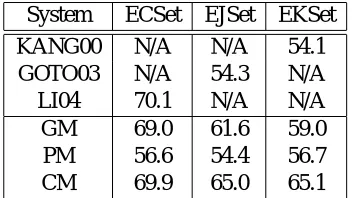
We compared our transliteration system with three previous ones, all of which were based on a grapheme-based model (Goto et al., 2003; Kang and Kim, 2000; Li et al., 2004). LI046 is an English-to-Chinese transliteration system, which simultane-ously takes English and Chinese contexts into con-sideration (Li et al., 2004). KANG00 is an English-to-Korean transliteration system and GOTO03 is an English-to-Japanese one – they segment a chunk of English graphemes and identify the most relevant sequence of target graphemes corresponding to the chunk (Goto et al., 2003; Kang and Kim, 2000)7. GM, PM, and CM, which are respectively based on Eqs. (1)–(3), are the transliteration systems we used for generating transliteration hypotheses. Our transliteration systems showed comparable or better performance than the previous ones regardless of the language.
We compared simple Web counts with our Web mining for hypothesis selection. We used the same set of transliteration hypotheses H then compared their performance in hypothesis selection with two measures, relative frequency andg(hi). Tables 4 and
5 list the results. Here, “Upper bound” is a system that always selects the correct transliteration hypoth-esis if there is a correct one inH. “Upper bound” can
5
We setn= 10for then-best. Thus,n≤r≤3×nwhere H={h1, h2,· · ·, hr}
6
The WA of LI04 was taken from the literature, where the training data were the same as the union of our training set and the development set while the test data were the same as in our test set. In other words, LI04 used more training data than ours did. With the same setting as LI04, our GM, PM, and CM pro-duced respective WAs of 70.0, 57.7, and 71.7.
7
System ECSet EJSet EKSet
Upper bound 94.6 93.5 93.2
Table 4: Web counts (WC) vs. Web mining (WM): hypothesis selection by relative frequency (%)
System ECSet EJSet EKSet
WC M EMW C 74.7 86.1 85.6
SV MW C 74.8 86.9 86.5
WM M EMW M 82.0 88.2 85.8
SV MW M 83.9 88.5 86.7
Upper bound 94.6 93.5 93.2
Table 5: Web counts (WC) vs. Web mining (WM): hypothesis selection byg(hi)(%)
also be regarded as the “Coverage” ofHgenerated by our transliteration systems. MQ, BSQ, and BBQ in the upper section of Table 4, represent hypothesis selection systems based on the relative frequency of Web counts overH, the same measure used in Oh et al. (2006):
W ebCountsx(hi)
hj∈HW ebCountsx(hj)
(10)
where W ebCountsx(hi) is a function returning
Web counts retrieved by x ∈ {M Q, BSQ, BBQ} RF(Wl),RDF(Wl), andRP F(Wl)in Table 4
rep-resent hypothesis selection systems with their rela-tive frequency, whereRDF(Wl)andRP F(Wl)use
3
k=1RDFk(hj, Wl) and 3k=1RP Fk(hj, Wl),
respectively. The comparison in Table 4 shows which is best for selecting transliteration hy-potheses when each relative frequency is used
alone. Table 5 compares Web counts with fea-tures mined from the Web when they are used as features in g(hi) — {P r(hi|S), W eb(Wl)} in
M EMW M andSV MW M (our proposed method),
while{P r(hi|S),W ebCountsx(hi)}inM EMW C
and SV MW C. Here, W eb(Wl) is a set of mined
features fromWlas described in Fig .2.
叫我自己的一个人(a Man To Call My Own) 概要
一本书的概要摘要撰写人- 叫我自己的一个人(a ManTo Call My Own), 故事,在ranchhouse的集合,二个主演,孪生阿曼达, 并且圣母玛丽亚是远离家和舒适。 温暖心主要的浪漫史,传说 也是一个成长,学会和了解,...
叫我自己的一个人(a Man To Call My Own) 概要
一本书的概要摘要撰写人- 叫我自己的一个人(a Man To Call My Own), 故事,在ranchhouse的集合,二个主演,孪生阿曼达, 并且圣母玛丽亚是远离家和舒适。 温暖心主要的浪漫史,传说
Snippet2retrieved by MQ: “阿加” (meaning Agard)
克利夫德扬|Cliff De Young| 生平| 作品| 写真| EO影视频道
UNESCO. General Conference; 32nd; Election of member
阿赫迈德·奥尔德·西迪·巴巴先生. 是. 1987--1991. 穆哈迈德·马赫
穆德·乌尔德·韦达迪先生. 莫桑比克. (1976). 1987--1991. 路易斯·
贝尔纳多·翁瓦纳先生. 2001--2005. 纳米比亚. 1993--1997....
UNESCO. General Conference; 32nd; Election of member 阿赫迈德·奥尔德奥尔德··西西迪·巴巴先生. 是. 1987--1991. 穆哈迈德·马赫 穆德·乌尔德·韦达迪先生. 莫桑比克. (1976). 1987--1991. 路易斯· 贝尔纳多·翁瓦纳先生. 2001--2005. 纳米比亚. 1993--1997....
Snippet3retrieved by MQ: “罗克利夫“罗克利夫””(meaning Rawcliffe(meaning Rawcliffe))
Snippet4retrieved by MQ:“奥尔德西“奥尔德西””(meaning A(meaning Alderseyldersey))
Figure 3: Snippets causing errors in Web counts
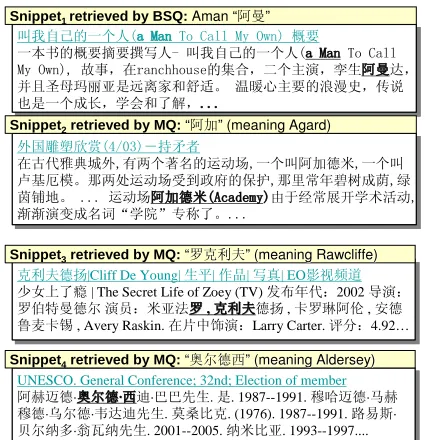
Snippet2contains a super-string of a given Chinese query, which corresponds to “Academy” rather than to “Agard”, which is the English counterpart of the Chinese transliteration¸A. Moreover, Web search engines ignore punctuation marks in Chinese. In Snippet3 and Snippet4, “,” and “·” in the under-lined terms are disregarded, so the Web counts based on such Web documents are noisy. Thus, noise in the Chinese Web counts causes systems based on Web counts to produce more errors than our sys-tems do. Our proposed method can filter out such noise because our systems take punctuation marks and the contexts of transliterations in Web mining into consideration. Thus, our systems based on fea-tures mined from the Web were able to achieve the best performance. The results revealed that our sys-tems based on the Web-mining technique can effec-tively be used to select transliteration hypotheses re-gardless of the language.
6.2 Contribution of Web corpora
ECSet EJSet EKSet
SVM MEM SVM MEM SVM MEM
Base 73.3 73.8 67.0 66.1 66.0 66.4
W1 81.7 79.7 87.6 87.3 86.1 85.1
W2 80.8 79.5 86.9 86.0 83.8 82.1
W3 77.2 76.7 83.0 82.8 79.8 77.3
W1+2 83.8 82.3 88.5 87.9 86.3 85.9
W1+3 81.9 80.1 87.6 87.8 86.1 84.7
W2+3 81.4 79.8 88.0 87.7 85.1 84.3
WAll 83.9 82.0 88.5 88.2 86.7 85.8
Table 6: Contribution of Web corpora
In Web mining, we used W1, W2, andW3, col-lected by respective queriesQ1=(S andhi),Q2=S,
and Q3=hi. To investigate their contribution, we
tested our proposed method with different combina-tions of Web corpora. “Base” is a baseline system that only usesP r(hi|S)as features but does not use
features mined from the Web. We added features mined from different combinations of Web corpora to “Base” fromW1toWAll.
In Table 6, we can see thatW1, a set of Web pages retrieved by Q1, tends to give more relevant infor-mation than W2 and W3, because Q1 can search more Web pages containing bothSandhiin the
top-100 snippets ifSandhiare a correct transliteration
pair. Therefore, its performance tends to be superior in Table 6 ifW1is used, especially for ECSet. How-ever, asW1 occasionally retrieves few snippets, it is not able to provide sufficient information. UsingW2 orW3, we can address the problem. Thus, combina-tions of W1 and others (W1+2, W1+3, WAll)
pro-vided betterW AthanW1.
7 Discussion
Several Web mining techniques for translitera-tion lexicons have been developed in the last few years (Jiang et al., 2007; Oh and Isahara, 2006). The main difference between ours and those previ-ous ones is in the way a set of transliteration hy-potheses (or candidates) is created.
Jiang et al. (2007) generated Chinese transliter-ations for given English words and searched the Web using the transliterations. They generated only the best transliteration hypothesis and focused on Web mining to select transliteration lexicons rather than selecting transliteration hypotheses. The best transliteration hypothesis was used to guide Web searches. Then, transliteration candidates were mined from the retrieved Web pages. Therefore, their performance greatly depended on their abil-ity to mine transliteration candidates from the Web. However, this system might create errors if it can-not find a correct transliteration candidate from the retrieved Web pages. Because of this, their sys-tem’s coverage and W A were relatively poor than ours8. However, our transliteration process was able to generate a set of transliteration hypotheses with excellent coverage and could thus achieve superior W A.
Oh and Isahara (2006) searched the Web using given source words and mined the retrieved Web pages to find target-language transliteration candi-dates. They extracted all possible sequences of target-language characters from the retrieved Web snippets as transliteration candidates for which the beginnings and endings of the given source word
8Since both Jiang et al.’s (2007) and ours used Chinese
and the extracted transliteration candidate were pho-netically similar. However, while this can exponen-tially increase the number of transliteration candi-dates, ours used then-best transliteration hypothe-ses but still achieved excellent coverage.
8 Conclusion
We have described a novel approach to selecting transliteration hypotheses based on Web mining. We first generated CJK transliteration hypotheses for a given English word and retrieved Web pages us-ing the transliteration hypotheses and the given En-glish word as queries for a Web search engine. We then mined features from the retrieved Web pages and trained machine-learning algorithms using the mined features. Finally, we selected transliteration hypotheses by ranking them. Our experiments vealed that our proposed method worked well re-gardless of the language, while simple Web counts were not effective, especially for Chinese.
Because our method was very effective in select-ing transliteration pairs, we expect that it will also be useful for selecting translation pairs. We plan to extend our method in future work to selecting trans-lation pairs.
References
Y. Al-Onaizan and Kevin Knight. 2002. Translating named entities using monolingual and bilingual re-sources. In Proc. of ACL ’02, pages 400–408.
J. Breen. 2003. EDICT Japanese/English dictionary .le. The Electronic Dictionary Research and Development Group, Monash University. http://www.csse.
monash.edu.au/˜jwb/edict.html.
I. Goto, N. Kato, N. Uratani, and T. Ehara. 2003. Transliteration considering context information based on the maximum entropy method. In Proc. of MT-Summit IX, pages 125–132.
Gregory Grefenstette, Yan Qu, and David A. Evans. 2004. Mining the Web to create a language model for mapping between English names and phrases and Japanese. In Proc. of Web Intelligence, pages 110– 116.
Long Jiang, Ming Zhou, Lee-Feng Chien, and Cheng Niu. 2007. Named entity translation with Web min-ing and transliteration. In Proc. of IJCAI, pages 1629– 1634.
Thorsten Joachims. 2002. Learning to Classify Text Us-ing Support Vector Machines: Methods, Theory and Algorithms. Kluwer Academic Publishers.
I. H. Kang and G. C. Kim. 2000. English-to-Korean transliteration using multiple unbounded overlapping phoneme chunks. In Proc. of COLING ’00, pages 418–424.
Mirella Lapata and Frank Keller. 2005. Web-based models for natural language processing. ACM Trans. Speech Lang. Process., 2(1):3.
H. Li, M. Zhang, and J. Su. 2004. A joint source-channel model for machine transliteration. In Proc. of ACL ’04, pages 160–167.
H.M. Meng, Wai-Kit Lo, Berlin Chen, and K. Tang. 2001. Generating phonetic cognates to handle named entities in English-Chinese cross-language spoken document retrieval. In Proc. of Automatic Speech Recognition and Understanding, 2001. ASRU ’01, pages 311–314.
Y. S. Nam. 1997. Foreign dictionary. Sung An Dang.
Jong-Hoon Oh and Key-Sun Choi. 2002. An English-Korean transliteration model using pronunciation and contextual rules. In Proc. of COLING2002, pages 758–764.
Jong-Hoon Oh and Hitoshi Isahara. 2006. Mining the Web for transliteration lexicons: Joint-validation ap-proach. In Web Intelligence, pages 254–261.
Jong-Hoon Oh, Key-Sun Choi, and Hitoshi Isahara. 2006. A comparison of different machine transliter-ation models. Journal of Artificial Intelligence Re-search (JAIR), 27:119–151.
Yan Qu and Gregory Grefenstette. 2004. Finding ideo-graphic representations of Japanese names written in Latin script via language identification and corpus val-idation. In Proc. of ACL ’04, pages 183–190.
Richard Schwartz and Yen-Lu Chow. 1990. The N-best algorithm: An efficient and exact procedure for finding the N most likely sentence hypothesis. In Procs. of ICASSP ’90, pages 81–84.
Xinhua News Agency. 1992. Chinese transliteration of foreign personal names. The Commercial Press.
L. Zhang. 2004. Maximum entropy
model-ing toolkit for python and C++. http:
//homepages.inf.ed.ac.uk/s0450736/