Survey of Distributed Stream Processing for Large
Stream Sources
Supun Kamburugamuve
For the PhD Qualifying Exam
12-‐14-‐2013
Advisory Committee
Prof. Geoffrey Fox
Prof. David Leake
Prof. Judy Qiu
Table of Contents
Survey of Distributed Stream Processing ... 1
1. Introduction ... 3
2. Stream Processing Model ... 4
2.1 Physical Distribution of PEs ... 5
2.2 Stream Processing Engine Requirements ... 6
3. Fault Tolerance ... 6
3.1 GAP Recovery ... 7
3.2 Rollback Recovery ... 7
3.3 Upstream Backup ... 8
3.4 Precise Recovery ... 8
4. Distributed Stream Processing Engines ... 8
4.1 Aurora ... 8
4.2 Borealis ... 9
4.3 Apache Storm ... 10
4.5 Apache S4 ... 12
4.5 Apache Samza ... 13
5. DSPE Comparison ... 14
6. Related Work ... 15
7. Discussion ... 15
8. References ... 15
[image:2.612.78.539.93.411.2]
1. Introduction
There is a class of emerging applications in which, a large amounts of data generated in external environments are pushed to servers for real time processing. These applications include sensor based monitoring, stock trading, web traffic processing, network monitoring and so on. The data generated by these applications can be seen as streams of events or tuples. In stream based applications this data is pushed to the system as unbounded sequence of event tuples. Since large volume of data is coming to these systems, the information can no longer be processed in real time by the traditional centralized solutions. A new class of applications called distributed stream processing systems (DSPS) has emerged to facilitate such large scale real time data analytics. For the past few years batch processing in large commodity clusters has being a focal point in distributed data processing. There has being efforts to make such systems work in an online stream setting [1]. But the stream based distributed processing requirements in large clusters are significantly different from what the batch processing system are designed. People used to run batch jobs for large scale data analytics problems that require real time analysis due to the lack of tools and still people run batch jobs for those applications. The large scale distributed stream processing is still a very young research area with lot of questions than answers. MapReduce [2] has established itself as the programming model for batch processing on large data sets. Such clear processing models are not defined in the distributed stream processing space. As the exponential growth of the devices connected to the Internet, the demand for large scale stream processing can expect to grow significantly in the coming years and it is interesting to know what these sources are.
Stream Sources
According to Cisco [3], there are about 11 billion things connected to the Internet by 2013. Many studies done by different groups have projected that huge numbers of devices will connect to the Internet by 2020 [4] [5]. The number of devices projected by these groups for 2020 is around 25 billion to 50 billion. Traditional PCs and Smartphones will only fill about half of this number and rest of it will come from smart sensors and devices connected to the Internet. The estimated world population by that time will be around 7.5 billion people. Most of these smart devices will have machine-‐to-‐machine communications to enhance the living conditions of the human beings. There are many application areas where data collected by sensor data can be used for various purposes.
Sensors are used often to track the behavior of objects. Insurance companies provide devices to track the driving patterns of the vehicle owners and adjust the insurance prices accordingly are a good example. Also user generated events can be used to track the behavior of users. A good example is Netflix movie recommendations where Netflix tracks the behavior of the user and provides intelligent recommendations based on the user patterns. Another use of sensors is to monitor the environment to gain more situational awareness. A large number of sensors deployed for monitoring an environment can give decision makers real time information to take the best decisions as possible. Best example is a combination of surveillance cameras, motion detection sensors and audio sensors giving security personal the ability to monitor suspicious activity. Also large shipping companies are using sensors to monitor the traffic patterns to constantly re-‐route the vehicles to provide efficient transportation. The information gathered using sensors could be used to take optimized decisions in the longer term. For example information gathered from patients over time using the sensors could help the doctors to diagnose the illnesses accurately and do customized treatments that suits the specific patients.
time to adjust the energy production accordingly. Using sensors to monitor the environment and taking highly important decisions is another key growing area. New cars are equipped with sensors to automatically brake in certain situations to avoid collisions.
These are some of the areas and use cases where sensors and event streams are expected to grow in the future. All the above cases when deployed at mass scale will produce very large amounts of data. Some of the data produced must be processed real time and decisions must be made in real time. Some applications require data to be stored and analyzed by the batch processing systems to get a deeper understanding and discovering of patterns. Also we can envision use cases where the preliminary processing is done in real time and batch processing seeded by the these preliminary analysis of the data.
In this report we first identify a general processing model for distributed stream processing systems and identify key requirements of a DSPE that can be used to evaluate such a system. Next we pay a special attention to the existing techniques for handling failures in a DSPE. Finally we choose few existing stream processing system implementations and critically evaluate their architecture and design based on the requirements we have identified.
2. Stream Processing Model
Definition
-‐
A stream is a sequence of unbounded tuples of the form 𝑎!,𝑎!,…,𝑎!,𝑡 generated continuously in time. Here 𝑎! denotes an attribute and 𝑡 denotes the time.Stream processing involves processing data before storing and Hadoop like batch systems provide processing after storing. A processing unit in a stream engine is generally called a processing element (PE). Each PE receives input from their input queues, does some computation on the input using its local state and produce output to their output queues. Stream processing engine creates a logical network of stream processing elements connected in a directed acyclic graph (DAG). An example can be seen in figure 1. A PE is a node in the graph and inputs to a PE and output of a PE are modeled by edges. Tuples of a stream flow through this graph and PEs consume these tuples and emit tuples. A PE does not necessarily emit tuples in response to an incoming tuple. A PE can choose not to emit a tuple or it can choose to emit a tuple in a periodic manner or it can choose to emit tuples after it saw N input tuples. The communication between PEs can happen according to push based or pull based messaging. Each PE executes independently and only communicates through messaging with other elements. Set of PEs running in parallel are not synchronized in general and can run in any speed depending on the available resources.
Figure 1 Logical Organization of PE DAG
In the DAG in figure 2, there are three processing elements; each one is replicated once to achieve fault tolerance. 𝑃𝐸! has two inputs and one output. 𝑃𝐸! and 𝑃𝐸! have only one input and one output. Inputs and
outputs are connected with a PE using input queues and output queues. If messages flow from 𝑃𝐸!to𝑃𝐸!,
hold 𝑃𝐸! and 𝑃𝐸! don’t have to adjacent vertices in the graph and child of a PE and parents of a PE are qualified for the above relationships. The actual distribution of PEs and queue management can be quite different in different implementations.
Figure 2 PE Distribution
The PEs connected in a DAG is the logical view of the distribution of processing elements in the system. When such DAG is deployed in a distributed system, each PE can be distributed in parallel among the computing nodes to achieve high throughput and redundancy.
2.1 Physical Distribution of PEs
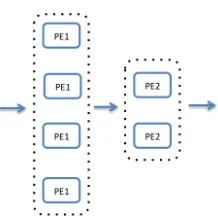
Two types of distributed stream processing engines can be seen in practice. In the first type there is a central server that orchestrates the distribution of the PEs in to physical nodes. This node is responsible for load balancing the tasks amongst the nodes; schedule the tasks to run on different nodes. In the other type of processing engines there is no central server to orchestrate the work among the nodes and nodes work as fully distributed peer-‐to-‐peer system sharing the work equally. In both models a single PE can be running in parallel on different nodes. Now let’s look at a possible physical layout for two nodes logically connected as in the following diagram.
Figure 3 Two Logically Connected PEs
Now assume PE1 involves heavy processing and must be deployed in 4 nodes in parallel and PE2 doesn’t involve as much work as PE1 and must be run in 2 nodes in parallel. The physical distribution of the PEs is shown in figure 3. The parallel execution of PE1 and PE2 can be seen as two separate logical units. These two units can communicate with each other using different communication patterns.
[image:5.612.71.296.120.239.2] [image:5.612.74.183.575.684.2]2.2 Stream Processing Engine Requirements
The requirements of a good stream-‐processing framework are revolving around two important attributes; latency of the system and the high availability of the system. It is important to lower the latency and increase the high availability, but these are competing requirements and one cannot be improved without sacrificing the other. We identify some of the expectations of a distributed stream-‐processing engine [6].
Data mobility – The data mobility is the term used to identify how the data moves through the processing elements of a SPE. High data mobility is a key for maintaining low latency. Blocking operations and passive processing elements can decrease the data mobility.
High Availability & Data processing guarantees – High availability by recovering from failures is critical for a DSPE. Because of the strict requirements on the latency, recovery should be fast and efficient. Processing guarantees like exactly once, at least once or no guarantees are all used by the DSPEs. Processing guarantees are tightly couples with the high availability algorithms and the nature of the data processing operators. Algorithms like active backup, passive backup and upstream backup are used by the DSPEs to provide data processing guarantees amidst the failing components.
Data partitioning – Data should be partitioned and handled in parallel for large volumes of data. The partitioning strategies are a key distinctive feature among the different processing engines. The partitioning algorithms affects how the system handles the data in parallel and how the system can scale.
Data Querying – High-‐level languages and tools for querying stream networks reduce the development cycles required to develop applications on top of stream processing engines. SQL is a widely used standard for developing such queries over data and can be adapted to process time series data in streams. The standard data processing languages promote the wide adoption of the technologies and development of standard algorithms on top of DSPEs.
Deterministic or Non-‐Deterministic processing – Deterministic processing networks provides the same output when presented with the same input independent of the other factors. When processing elements are non-‐deterministic the recovery from failures become difficult. On the other hand deterministic operations limit the scope of processing capabilities.
Data storage – Data can be stored for later reference and these stored data can be sent through the stream processing engines for historical data analysis. The ability to process historical data allows the algorithm designers to run their algorithms on historical data for verification and tuning purposes.
Handling Stream Imperfections – The messages in a stream can be delayed, can come out of order, can be duplicated or lost. DSPEs can provide functionalities to handle such imperfections by using delayed processing, storing the data.
3. Fault Tolerance
recover fast enough so that the normal processing can continue with the minimal effect to the overall system. The recovery methods for stream processing engines range from recovery with no effect to the system without any information loss to recovery with some information loss. Recovery without any information loss and recovery with the minimum latency are at the two extremes of the recovery methods.
These recovery methods have being categorized as Precise Recovery, Rollback Recovery and Gap Recovery [7]. In precise recovery there is no effect of a failure visible except some increase in latency. In Rollback recovery the information flowing through the system is not lost but there can be effects to the system other than increase in latency. For example information may be processed more than once when a failure happens. In Gap recovery the loss of information is expected and it provides the weakest guaranteed processing.
There are several methods of achieving fault tolerance in streaming environments. The more traditional approaches are to use active backup nodes, passive backup nodes, upstream backup or amnesia. Amnesia provides gap recovery with least overhead. Other three approaches can be used to provide both precise recovery and rollback recovery. There is some recent work done on stream processing to provide recovery by keeping lineage information about the data products. All these recovery methods except amnesia assumes that there are parallel nodes running in the system and these can take over the responsibility of a failed task.
We will look at the failures from the task level rather than the node level. Task level is more general than node level because a task can fail without the node failing due to communication link failures, resource limitations etc. In the following discussion a task is equivalent to a PE.
3.1 GAP Recovery
In Gap recovery when a task fails another task takes over the operations of the failed task. The new task starts from an empty state and starts processing the inputs directed to it by the upstream processing tasks. Because the new task starts from an empty state, tuples can be lost during the recovery phase. This type of recovery method is named as amnesia.
3.2 Rollback Recovery
As stated earlier Rollback recovery can be achieved using Active Standby, Passive Standby and Upstream backup.
Passive Standby
In this recovery approach the primary task saves its state periodically (checkpoint) to a permanent shared storage and this information is used to create the state of the secondary when it takes over. The secondary receives information about the state of the primary as well as the output queues of the primary. In this approach secondary is always behind the primary. Also the upstream node stores the tuples in its output queue until the tuples are stored in the secondary. When a tuple is stored in the secondary safely, secondary notifies the upstream node about it and then only upstream node deletes those messages.
Active Standby
At a given time both primary and secondary nodes are given the same input and these two nodes run the same PE in parallel. The primary PE’s output is connected to the downstream nodes and the backup node’s output is not connected. Once a failure occurs the backup take over the operation and its output is connected to the downstream nodes.
The biggest challenge in Active Standby is in managing the output queue of the backup nodes. Active node and backup node both process data on its own speeds. The primary receives ACKs from the downstream nodes when the tuples are safely stored in the downstream nodes. These tuples are deleted from the output queues of the primary and queue trimming message indicating the messages that secondary can safely remove is sent to the secondary. After getting this message secondary deletes messages that are already seen by the downstream nodes from its output queue. Active standby provides repeating recovery for deterministic networks and divergent recovery for non-‐deterministic networks.
3.3 Upstream Backup
In upstream backup nodes store the tuples until the downstream nodes acknowledge them. In upstream backup the handling of output queues become complicated because tuples can be consumed by multiple downstream node and because of the non-‐deterministic nature of the operators. Upstream backup provides repeating recovery for deterministic networks and divergent recovery for non-‐deterministic networks. From the above three approaches the upstream backup provides the weaker guarantee with lower operational costs and lower network overhead.
3.4 Precise Recovery
Precise recovery can be achieved by modifying the algorithms for rollback recovery. In passive backup scheme after a failure occurs the secondary can ask the downstream nodes for the latest tuples they received and trim the output queues accordingly to prevent the duplicates. For Active backup with deterministic operators the same procedure can be applied. In case of non-‐deterministic operators, Active backup is complicated to handle failure. Measures have to be taken to make sure both active node and backup node is at a consistent state.
4. Distributed Stream Processing Engines
4.1 Aurora
Aurora [8] [9] is an early stream processing system developed by Brown University and MIT that has the modern distributed stream processing network structure. At first Aurora was designed as a single site stream-‐processing engine. Later the Aurora functionality is combined with the Medusa [10] system to achieve distributed processing.
Architecture
Aurora employees network queries to process the streams. These queries are called Stream Query Algebra (SQuAl) and is similar to SQL but with additional features like windowed queries. The queries can run continuously on the incoming streams or they can run on stored historical data at the Aurora connection points or by the storage manager. Connection points are the places where Aurora boxes connected together and can be used to add boxes to the processing model dynamically.
Aurora can persist data at the input queues if the data doesn’t fit in the memory or it can persist the data to support queries that require long list of historical data. If the system gets overloaded Aurora can shed the load by randomly dropping tuples or by choosing a semantic dropping strategy where it does some filtering before dropping. For example less important tuples can be dropped.
Fault Tolerance
At first Aurora was not designed to support fault tolerance and later with the addition of Medusa, the model is extended to support fault tolerance by upstream backup method [11].
4.2 Borealis
Borealis [12] is the next version of Aurora stream processing system. Borealis is a distributed stream processing engine which has the core stream-‐processing model of Aurora and distributed functionality of Medusa. As in Aurora the Borealis stream-‐processing network is a DAG with boxes representing processing elements and edges representing streams of messages between the boxes. On top of the Aurora functionality Borealis provides few advanced functionalities.
Dynamic revision of query results – In certain stream applications, corrections or updates to the previously processed data is sent to the stream engines. Also data may arrive late and may miss the processing window. Borealis can use these data that are available after processing to correct the results.
Dynamic Query modifications – The Borealis processing elements have command inputs for modifying the behavior of a query during the runtime.
Architecture
Borealis has a fully distributed architecture consisting of Borealis servers running in different sites and these sites are interconnected to take coordinated actions. There is no central controller for the Borealis sites. Each Borealis server runs a query processor, which executes the actual query diagram. There is an admin module in each server that determines whether the queries should run locally or remotely. Each query processor has a box processor that runs the individual processing elements, a storage manager for storing the streams, load shedder for shedding load in case of overloading situations and a priority scheduler that determines the order of box operations depending on the tuple priorities. Each node has a Neighborhood optimizer that uses the local information and remote site information to balance the load among the sites. The High Availability modules at each site monitor each other and take over in case of node failures.
The data movement between different query processing units is done using a pull-‐based strategy. If the downstream node is overloaded the load can be shredded at the downstream nodes. To avoid load shedding each node tries to offload the work to other nodes if the node is getting overloaded.
High Availability
due to timing. Borealis nodes collect the incoming messages in to buckets until markers are received from upstream nodes, which indicate an end of a data collection. After the markers are received the nodes sort the messages according to timestamp values. This operation is named as SUnion it can keep the replicas at a consistent state sacrificing the data mobility.
When an upstream node failure is detected, the downstream node chooses a replica of the upstream node to get the missing inputs. If it cannot find a suitable replica it can wait, continue processing without the specific failed input.
4.3 Apache Storm
Apache Storm [14] is a real time stream-‐processing framework built by Twitter and now available as an Apache project.
Design Goals of Storm
:
Guaranteed message processing is a key goal in design of Storm. A message cannot be lost due to node failures and at least once processing is a design goal. Robustness of the system is critical to theArchitecture
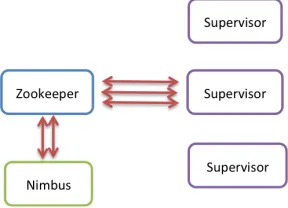
There are three sets of nodes in a Storm cluster and they are Nimbus node, ZooKeeper nodes and Supervisor nodes. Nimbus is the main server where user code has to be uploaded and Nimbus distributes this code among the worker nodes for execution. Also Nimbus keeps track of the progress of the worker nodes so that it can restart the failed computation or move the tasks to other nodes in case of node failures. The set of worker nodes in the Storm cluster runs a daemon called Supervisor. The coordination between supervisor nodes and the Nimbus happens through the ZooKeeper. The message flow in the system is done using ZeroMQ [15] based transport or Netty [16] based transport. The transport layer is pluggable.
Figure 5 Storm Architecture
Programming Model
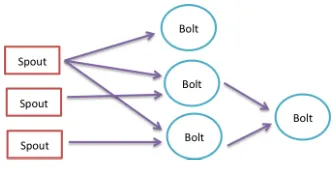
[image:10.612.72.216.411.515.2]Figure 6 Storm Topology
Data Flow
Stream events are injected into a topology from a spout. A spout can be listening to a HTTP port or it may be pulling messages from a queue. When the topology is created it can specify how many tasks to run in parallel for a spout or a bolt. We can view the Spouts and bolts as logical execution units and tasks as the physical instances of the spouts and bolts. The tasks execute the Spout code or Bolt code in parallel in different nodes. A bolt’s input is connecting to the output of a spout or another bolt.
Bolts pull messages from the upstream processing units. This model makes sure that the bolts will never take excess amount of messages that it cannot process. So in Storm only place where messages shredding happens, because the system is running at the full capacity is when they are processed by the spouts which is the beginning of the message origination to the system.
A bolt can have multiple tasks executing the bolt code. This bolt can be connected to another bolt which may be executing with multiple tasks in parallel. When these two bolts are logically connected the messages from the task belonging to the sending bolt can flow to task belonging to the receiving bolt according to some message grouping rules. The simplest of such rules is the Shuffle Grouping. In shuffle grouping the messages between the tasks are delivered such that each task will get an equal number of messages. Another grouping is fields grouping where messages are keyed on an attribute and messages with the same value for the chosen attribute are going to the same task. In all groupings every message is going to the every task of the receiving bolt. There are other groupings like Direct Grouping, Local Shuffle Grouping, Non Grouping and Global Grouping. These groupings can be used based on the application requirements.
Fault Tolerance
Storm employs a variation of upstream backup algorithm for fault tolerance. In Storm spouts keep the messages in their output queues until they are being acknowledged. The acknowledgement happens after the successful processing of an event by the topology. If an acknowledgement comes for a message within a reasonable amount of time spouts clear the message from output queue. If an acknowledgement didn’t come within a predefined period (30 second default) the spouts replay the message again through the topology. This mechanism along with the pull based approach in bolts guarantees that the messages are processed at least once inside Storm.
[image:11.612.70.238.70.155.2]Storm Query Model
Trident [17] is the high level abstraction for creating Storm topologies. Trident provides high-‐level data operators like joins, filters, aggregators, grouping and functions. Trident has a Java programming language based API for user to configure the system. A high level abstraction for Trident is still not developed. At the runtime the Trident jobs are converted to storm topologies and deployed on the cluster.
4.5 Apache S4
S4 [18] stands for Simple Scalable Streaming System and it was developed by Yahoo and donated to Apache Software Foundation in 2011.
S4 is a fully distributed real time stream processing framework. It employs the Actors model for computations. The processing model is inspired by MapReduce and uses key based programming model as in MapReduce.
S4 Architecture
S4 creates a dynamic network of processing elements (PEs) and these are arranged in a DAG at runtime. PEs are the basic computational elements in S4 and it is user defined code specifying how to process events. Instances of PEs are created and arranged in a DAG structure at runtime. A runtime instance of a PE is identified using the PE’s code and configuration, the events consumed by the PE, key attributes for the events, and value of the keyed attributes.
A new instance of a PE is created for different values of the key attribute. PE can output events to other PEs in the system. There are special classes of PEs that are not keyed on any attribute. Such a PE usually take external inputs into the S4 framework. One of the biggest challenges in PE architecture described above is that, for key attributes with very large value domains there can be large number of PEs created in the system at a given time. So there must be intelligent mechanisms to discard the PEs to prevent the system from becoming unusable.
The PEs in the S4 system are assigned to Processing Nodes. Processing nodes are logical hosts to the PEs and run the PEs by accepting input events and dispatching them to PEs running on them. The events in the S4 are routed to Processing Nodes by doing a hashing function on the key attribute values of events. So events with the same value for the key attributes are always routed to the same processing node.
The coordination between the processing nodes and the messaging between nodes happens through a communication layer. This layer provides the functionality to failover the nodes in case of failures. The actual underlying stream messaging is pluggable providing flexibility for user to write their network protocols if required. The coordination between the nodes is done through Apache ZooKeeper.
Fault Tolerance
When a S4 node fails the system detects the failure using ZooKeeper and distribute the tasks assigned to the failed node to other nodes. S4 doesn’t give message delivery guarantees in case of failures and uses Gap recovery for recovering from failures. Snapshots of the state of the processing nodes are saved time to time and these are used to create a new instance of a Processing node when one fails. Also because of the push model of events in the system, S4 can drop events due to high load. Because of these two reasons event lost is possible in the system.
Programming Model
Spring Framework based XML configuration. A job configuration consists of the definition of the included PEs and how they are configured.
4.5 Apache Samza
Apache Samza [19] is a stream-‐processing framework developed by Linkedin and donated to Apache Software Foundation.
Samza Processing Model
Samza message stream is an immutable unbounded collection of messages of same type. A stream can be read by many consumers in the system and messages can be added to a stream or deleted from a stream. Streams are always persisted by the Samza in its brokering layer. A job in Samza is a logical collection of processing units that act on a stream of messages and produce output streams. A job creates the network topology that processes the messages. Streams are partitioned into sub streams and distributed across the processing tasks running in parallel. A partition of a stream is a totally ordered sequence of messages. A task is the processing element in the Samza network. A task act on one partition of a message stream and produce a message stream. A task can consume multiple partitions from different streams.
Samza Architecture
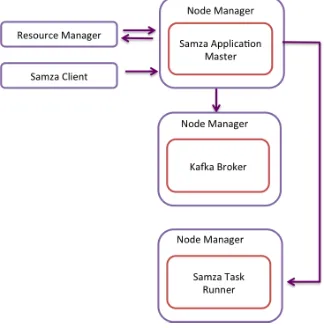
Samza relies on Apache Yarn [20] for the distributed resource allocation and scheduling. It uses Apache Kafka [21] for the distributed message brokering. Samza provides an API for creating and running stream tasks on a cluster managed by Yarn. In this cluster Samza runs Kafka brokers and Stream tasks are consumers and producers for Kafka streams. Kafka provides a distributed brokering system with persistence for message streams. The system is optimized for handling large messages and provides file system persistence for messages. In Kafka a stream is called a Topic and topics are distributed across the brokers using a partitioning scheme. The partitioning of a stream is done based on a key associated with the messages in the stream. The messages with the same key will always belong to the same partition. Samza uses the topic partitioning of Kafka to achieve the distributed partitioning of streams. A Samza task can be producing messages to a Kafka topic or can be consuming messages from a Kafka topic.
Figure 7 Samza Architecture on Apache Yarn [image:13.612.72.234.454.618.2]
Fault Tolerance
Samza provide at least once message delivery guarantees using upstream backup techniques for handling message failures. When a node fails and new node takes over, the new node start reading from the upstream broker topic from the maker that the failed node set. Because of this Samza achieves repeating recovery for deterministic networks and divergent recovery for non-‐deterministic networks. The upstream backup recovery method works only for task level failures in Samza. If a broker node fails, Samza loses messages persisted in the file system and these cannot be recovered. There has been work done to replicate the messages in the file system to avoid such failures.
Programming Model
Samza tasks are written using Java programming language. This code specifies how to process the messages. The actual job is configured through a properties file. The properties files along with the compiled code are submitted to the Yarn Samza cluster.
5. DSPE Comparison
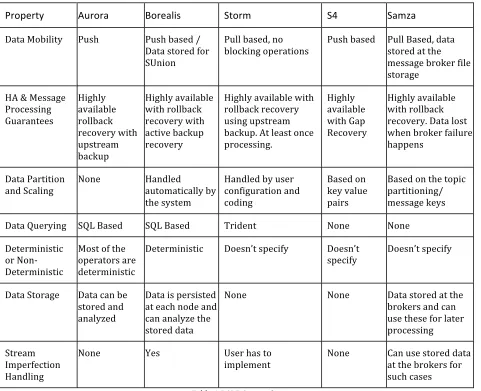
Table 1 gives a summary of the available features in the streaming processing engines considered in this
report.
Property
Aurora
Borealis
Storm
S4
Samza
Data Mobility Push Push based / Data stored for SUnion
Pull based, no blocking operations
Push based Pull Based, data stored at the message broker file storage
HA & Message Processing Guarantees
Highly available rollback recovery with upstream backup
Highly available with rollback recovery with active backup recovery
Highly available with rollback recovery using upstream backup. At least once processing.
Highly available with Gap Recovery
Highly available with rollback recovery. Data lost when broker failure happens
Data Partition
and Scaling None Handled automatically by the system
Handled by user configuration and coding
Based on key value pairs
Based on the topic partitioning/ message keys
Data Querying SQL Based SQL Based Trident None None
Deterministic or Non-‐ Deterministic
Most of the operators are deterministic
Deterministic Doesn’t specify Doesn’t
specify Doesn’t specify
Data Storage Data can be stored and analyzed
Data is persisted at each node and can analyze the stored data
None None Data stored at the
brokers and can use these for later processing
Stream Imperfection Handling
None Yes User has to
implement None Can use stored data at the brokers for such cases
[image:14.612.67.548.311.702.2]6. Related Work
Complex Event processing
Complex event processing [22] is a widely used technique in enterprises to analyze the data. There is an overlap between complex event processing and stream event processing. Both systems work on events and produce results based on the properties of the events. In complex event processing the incoming events are not belonging to a single stream of events. Instead these events belong to an event cloud. An event cloud contains events from different sources and the causal relationships among the individual events are not reflected in the order of the events. It is the responsibility of the CEP engines to figure out the relationships among the events and do the processing accordingly. In Stream processing the events are coming from a single event stream. In an event stream the events are ordered according to time they are produced and they are coming from the same source. Causal relationships between the events are preserved in an event stream. The stream processing is more streamlined and can be done in efficiently. Stream processing engines require very little memory compare to complex event processing engines because the events don’t have to be remembered to discover the causal relationships and ordering.
7. Discussion
In this report we identified key attributes of distributed stream processing systems and evaluated several leading distributed stream-‐processing engines based on those attributes. The early stream processing engines were monolithic systems that run the stream processing DAG as a single entity. The monolithic systems were replicated as a whole to gain the fault tolerance and high availability. The fault tolerance aspects of the systems are handled at the node level rather than the task level. The node failure handling and message guarantees were taken as a single cohesive operation. The new stream processing engines view a job as set of tasks running on different nodes. The tasks run individual stream operations and can be replicated for fault tolerance at task level. The task failures and message failures are taken as two unrelated operations and handled as two separate concerns. The new model favors deployment in large commodity clusters.
There are three different models introduced for stream partitioning, work distribution among nodes and parallelization of tasks in Storm, S4 and Samza. Each model has its drawbacks and advantages. None of these models have taken a clear lead in the stream processing space and it is too early to tell about their success. The query languages for this large scale distributed stream-‐processing engines are almost non-‐existing today and we can expect them to grow as the stream processing engines mature. With the growth of the Internet of Things in the coming years the demand for large scale distributed stream processing will also increase and it is important to find formal stream processing models to lay a foundation to build standard data analytics algorithms on such systems.