R E S E A R C H
Open Access
ZIKV infection effects changes in gene
splicing, isoform composition and lncRNA
expression in human neural progenitor
cells
Benxia Hu
1,2, Yongxia Huo
1, Liping Yang
1, Guijun Chen
1, Minhua Luo
3, Jinlong Yang
4,5and Jumin Zhou
1*Abstract
Background:The Zika virus (ZIKV) is a mosquito-borne flavivirus that causes microcephaly and Guillain-Barré syndrome
in infected individuals. To obtain insights into the mechanism of ZIKV infection and pathogenesis, we analyzed the transcriptome of ZIKV infected human neural progenitor cells (hNPCs) for changes in alternative splicing (AS), gene isoform (ISO) composition and long noncoding RNAs (lncRNAs) expression.
Methods:We analyzed differentially expressed lncRNAs, AS, ISO from RNA-seq data in ZIKV infected hNPCs.
Results:We obtained 149 differentially expressed lncRNAs, including potential viral targets to modulate cellular
processes such as cell cycle, apoptosis and immune response. The infection induced 262 cases of AS occurring in 229 genes, which were enriched in cell death, RNA processing, transport, and neuron development. Among 691 differentially expressed ISOs, upregulated ISOs were enriched in signaling, regulation of transcription, and amino acid biosynthesis, while downregulated ISOs were mostly enriched in cell cycle. Importantly, these analyses revealed specific links between ZIKV induced changes in cellular pathways and the type of changes in the host transcriptome, suggesting important regulatory mechanisms.
Conclusions:Our analyses revealed candidate lncRNAs, AS events and ISOs which may function in ZIKV infection
induced cell cycle disruption, apoptosis and attenuation of neurogenesis, and shed light on the roles of lncRNAs, AS and ISOs in virus-host interactions, and would facilitate future studies of ZIKV infection and pathogenesis.
Keywords:lncRNA, Gene isoform, Alternative splicing, hNPC, ZIKV
Background
Zika virus (ZIKV) is a positive-strand RNA virus with a 10,800 nucleotides genome, belonging to the Flavi-viridae family and the genus Flavivirus [1]. It includes African and Asian lineages, and could be transmitted by Aedes species mosquitoes, sex, blood transfusion, organ transplantation, and potentially through urine or saliva [2]. Individuals with compromised immunity are particularly susceptible to ZIKV infection and subsequent disease development [3], with symptoms
ranging from fever, lethargy, conjunctivitis, rash, and arthralgia [4]. The Guillain-Barré syndrome and con-genital microcephaly are two of the well known conse-quences of ZIKV infection [5]. The recent epidemic of ZIKV infection in South America and parts of Asia has spurred widespread interest in ZIKV infection and patho-genesis, and it is now known that ZIKV infects cells through the entry receptor AXL and causes the activation of Toll-like receptor 3 (TLR3), and consequently, the in-fection causes attenuated neurogenesis, dysregulated cell cycle, and increased cell apoptosis in hNPCs [6–8]. How-ever, the mechanistic details of ZIKV infection and patho-genesis are mostly unknown.
LncRNAs are defined as transcripts longer than 200 nucleotides, and can be 5′capped and 3′polyadenylated, * Correspondence:[email protected]
1Key Laboratory of Animal Models and Human Disease Mechanisms of the Chinese Academy of Sciences/Key Laboratory of Bioactive Peptides of Yunnan Province, Kunming Institute of Zoology, Kunming 650223, China Full list of author information is available at the end of the article
but with limited coding potential [9, 10]. LncRNAs participate in diverse processes, ranging from develop-ment to diseases [11]. For example, lncRNA MyelOid Rna Regulator of Bim-Induced Death (Morrbid) re-presses the expression of its neighboring pro-apoptotic gene, Bcl2l11, by recruiting EZH2 to the Bcl2l11 pro-moter to maintain this gene in a poised state [12]. Nuclear Paraspeckle Assembly Transcript 1 (NEAT1) promotes ATR signaling in response to replication stress and is involved in a negative feedback loop that impairs oncogene-dependent activation of p53 [13]. LncRNAs are also implicated in pathogen-host inte-ractions. For instance, a cellular lncRNA, ncRNA re-pressor of the nuclear factor of activated T cells (NRON), degrades the Tat protein, and then contrib-utes to HIV-1 latency [14].
Alternative splicing or AS is one of the most import-ant processes in RNA co-transcriptional and post-transcriptional processing. AS events include skipped exon (SE), retained intron (RI), alternative to 5′splicing site (AS5), alternative to 3′splicing site (AS3), mutually exclusive exon (MXE), alternative start (altstart), al-ternative end (altend) and skip multiple exons (SME) [15, 16]. Approximately 94% of human genes are alter-natively spliced, producing a much larger number of functional ISOs from a fixed number of genes [15]. AS also participates in a wide range of biological processes including virus-host interactions [17, 18]. Often consid-ered as the consequence of AS, ISOs are mRNAs prod-ucts that are generated from the same gene loci but are different in their transcription start sites (TSSs), protein coding DNA sequences (CDSs), or untranslated regions (UTRs) [15].
To gain deeper insights into the ZIKV-infected transcriptome, we analyzed RNA-seq data of ZIKV-infected hNPCs [6] to determine the expression of lncRNAs, AS and ISO composition changes, and to predict how these changes are related to the mechan-ism ZIKV infection and pathogenesis. We identified 149 differentially expressed (DE) lncRNAs in ZIKV-infected samples, and some of these are likely viral targets to modulate cellular processes including cell cycle, apoptosis and immune response. ZIKV infection induced alternatively spliced genes are enriched in cell death, transport, RNA processing, and neuron devel-opment, while most of DE ISOs belong to cell cycle, amino acid biosynthesis, transcription, and apoptosis. Our analyses also revealed specific links between ZIKV infection induced changes in cellular pathways and type of changes in the host transcriptome. These results indicated that ZIKV infection induced signifi-cant changes in AS, ISOs and lncRNAs expression, which could play key roles in ZIKV infection, virus-host interactions, and pathogenesis.
Methods
Prediction of novel lncRNAs
We used FastQC (http://www.bioinformatics.babraha-m.ac.uk/projects/fastqc/) and FASTX-Toolkit (http:// hannonlab.cshl.edu/fastx_toolkit/) to check and filter low quality reads with default parameter. Based on Hu et al. [19], clean reads were mapped to the Human
reference genome (Homo_sapiens.GRCh38) using
Tophat2 with default parameter [20]. Cufflinks [21] were used to assemble and compare transcripts with reference. Then we extracted candidate novel lncRNAs transcripts with following criteria: the length of tran-script≥200 nucleotides, the expression level (fragments per kilobase of exon per million fragments mapped, FPKM) of transcript≥1, the number of exons of trasn-cript ≥2, and class code “i”, “j”, “o”, “u” and “x”. We used CNCI (score < 0) [22] and CPAT (coding probabil-ity < 0.364) [23] software to predict the coding potential of discovered lncRNAs.
LncRNAs and Isoforms differential expression analysis
We used Cuffdiff [24] to analyze expression level of lncRNAs and ISOs, and used the following criteria to
select DE lncRNAs and ISOs: FDR ≤0.05 and
fold-change≥2.
Functional prediction of lncRNAs
We used unsupervised machine learning algorithm, k-means, to cluster DE lncRNAs with PCGs.
Alternative splicing analysis
The bam files generated by Tophat2 [20] were as input files to analyze changes in AS using ASD (v1.2) [25] with the annotation file Homo_sapiens.GRCh38.83.gtf.
We selected significant AS cases with an adjusted p
value≤0.05.
Gene ontology enrichment and pathway analysis
We uploaded genes with significant ZIKV infection in-duced PCGs, AS and ISO changes into the Database for Annotation, Visualization and Integrated Discovery (DAVID) v6.7 [26] to perform Gene Ontology func-tional enrichment analyses (biological processes) and Kyoto Encyclopedia of Genes and Genomes pathway analyses (KEGG). We selected significant GO terms and pathways with apvalue≤0.05.
Statistical analysis
We usedRrelative packages, such as pheatmap (pheat-map: Pretty Heatmaps, Raivo Kolde, 2015) and
Venn-Diagram (VennDiagram: Generate High-Resolution
Results
Differentially expressed lncRNAs in ZIKV infected hNPCs
To generate a compendium of all annotated and novel lncRNAs that exhibited differential expression in ZIKV infected hNPCs, we analyzed RNA-seq data generated by using a low multiplicity of infection (MOI < 0.1) of MR766 strain of the ZIKV (African lineage) to infect hNPCs for 56 h [6]. First, we aligned clean RNA-seq data onto human reference genome (Table 1), followed by transcripts assembly and comparison. Using the modified method by Hu et al. [19], we extracted the se-quences of candidate novel lncRNAs, and distinguished noncoding RNAs from coding RNAs. As a result, CPAT [23] and CNCI [22] predicted 2269 and 2846 novel lncRNA transcripts, respectively. We discarded 642 lncRNA transcripts predicted by CPAT [23] and 1219 by CNCI [22] with default parameters, respectively, then used 1627 transcripts common to both methods for fur-ther analysis (Fig. 1a). Finally, by comparing to the En-semble database, we obtained 15,275 annotated and 1137 novel lncRNAs, respectively. The novel lncRNAs consist of 1627 transcripts (Fig. 1a).
LncRNAs are shorter in length, have fewer exons, and are expressed at much lower levels than protein
coding genes (PCGs) [27–31]. To determine if the
novel lncRNAs we observed have similar characteristics to the previous studies, we compared these parameters of novel lncRNAs with PCGs, and found that the aver-age exon number in the detected novel lncRNAs was also smaller than that of PCGs (pvalue < 0.05, Welch Two Sample t-test, Fig. 1b). The expression levels of these novel lncRNAs in both control and infected cells were also much lower than that of PCGs (p value < 0.05, Welch Two Sample t-test, Fig. 1c and Additional file 1: Figure S1), and the length of novel lncRNAs was much shorter than that of PCGs (p value < 0.05, Welch Two Sample t-test) (Fig. 1d and Additional file 1: Figure S1). Thus these novel lncRNAs have the characteristics of annotated lncRNAs.
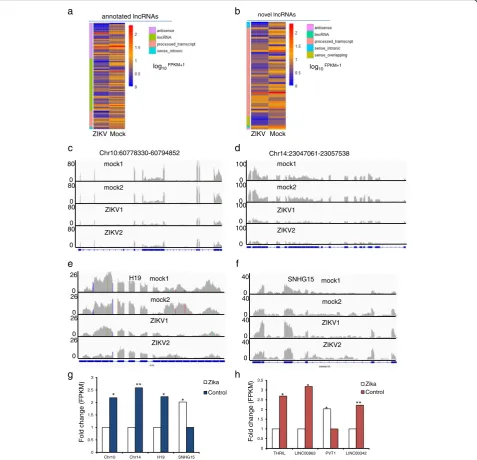
In differentially expressed (DE) lncRNA analysis, we found 92 annotated DE lncRNAs (16 upregulated and 76 downregulated lncRNAs) (Fig. 2a and Additional file 1: Table S1 and Additional file 2) and 57 novel DE
lncRNAs (12 upregulated and 45 downregulated
lncRNAs) (Fig. 2b and Additional file 1: Table S2 and Additional file 2) in ZIKV infected samples compared to mock samples. These DE lncRNAs represented a diverse group in terms of their biotypes and genomic location. Biotypes included antisense RNA, lincRNA, processed transcript, sense intronic transcript and sense overlapping transcript (Additional file 1: Table S1–2). Two examples of the DE novel lncRNAs, located in Chr10:60,778,330– 60,794,852 and Chr14:23,047,061–23,057,538, were down-regulated in infected samples (Fig. 2c–g). Likewise, two examples of annotated DE lncRNAs, H19 and SNHG15, are shown in Fig. 2e-f, with the former being downregu-lated and the latter upregudownregu-lated by the infection (Fig. 2g).
K-means showed that DE lncRNAs and PCGs might be aggregated into 3 clusters, consisted of 106, 361and 429 genes (lncRNAs and PCGs), respectively (Additional file 1: Table S3 and Figure S2). GO ananlyes showed that downregulated genes from cluster 1 and 2 were mainly enriched in DNA replication and cell cycle. We assumed that downregulated lncRNAs in cluster 1 and 2 might be involved in DNA replication and cell cycle. Upregulated genes from cluster 1 might be involved in amino acid transport and response to stimulation.
From the DE lncRNAs, several stood out as poten-tially important regulatory factors during ZIKV infec-tion induced immune response and pathogenesis. For
example, THRIL (TNFα and hnRNPL related
immuno-regulatory lincRNA) is known to activate the expression of many immune-response genes, its depletion leads to dysregulation of immune-response genes during innate activation of THP1 macrophages [32]. In the ZIKV in-fected cells, THRIL, in cluster 2, was downregulated 2.6-fold (Fig. 2h), making it a potential target for ZIKV to modulate host innate immunity.
Apoptosis is an important consequence of ZIKV in-fection and is believed to be the cause of microceph-aly in infected fetus [6]. LINC00963 (long intergenic non coding RNA 963) normally promotes cell survival and plays a role in tumorigenesis [32], its knockdown attenuates C4–2 cell proliferation and induces cell apoptosis [33]. In ZIKV infected hNPC, LINC00963, in cluster 2, was lowered 3-fold (Fig. 2h), making it an important candidate lncRNA mediating ZIKV in-duced apoptosis.
Table 1The number of reads from RNA-seq data
mock-1 mock-2 ZIKV-1 ZIKV-2
Number of reads Left Right Left Right Left Right Left Right
Total reads 7,927,777 7,927,777 7,391,076 7,391,076 7,361,527 7,361,527 7,621,347 7,621,347 Mapped reads 7,606,613 7,476,318 7,069,569 6,803,489 7,019,141 6,899,086 7,231,763 7,121,414 Unique reads 7,339,241 7,215,072 6,816,384 6,562,659 6,771,681 6,657,458 6,980,585 6,875,554
Cell cycle is dysregulated in ZIKV infected hNPCs [6]. We identified an annotated lincRNA PVT1, Pvt1 onco-gene, which was upregulated about 2-fold by the infec-tion and in cluster 1(Fig. 2h). PVT1 knockdown significantly inhibits cell proliferation both in vitro and in vivo, and plays a key role in G1 arrest [34]. Thus, the upregulation of PVT1 could play a role in the disrupted cell cycle due to ZIKV infection. Long intergenic non coding RNA 342, LINC00342 knockdown suppresses proliferation in a lung cancer cell line A549 cells [35]. The downregulation of LINC00342, in cluster 1, in ZIKV infected cells (Fig. 2h) is consistent with its role in ZIKV induced cell cycle effects. Taken together, these analyses suggest that ZIKV infection affected the expression of lncRNAs, and several may serve as targets whereby ZIKV modifies cellular pathways.
Although cluster 3 contained 140 genes, GO analysis showed that these genes were not enriched in any GO terms.
Changes in alternative splicing after ZIKV infection
Changes in AS have been reported in infected cells by sev-eral viruses including HPV, HSV-1 and EBV [16, 36–39]. To determine how host AS was affected by ZIKV
infection, we analyzed transcriptome wide AS changes in ZIKV infected hNPCs. AS events (SE, RI, AS5, AS3, MXE, altstart, altend and SME) are graphically illustrated in Fig. 3a [15, 16]. We obtained 262 AS cases occurred in 229 genes (Fig. 3a). While most AS events (200) happened once per gene, they occurred twice in 25 genes, three times in 4 genes, including HMGN1, HNRNPD, MAP2, and PTPRS. The occurrence of different types of AS is summarized in Fig. 3a, among these, the SE type of AS (115 cases) comprised the largest share, of over 43% of all AS events, followed by RI at 12%.
Gene Ontology (GO) functional enrichment analyses of genes undergone AS revealed top 20 GO terms
ranked by p value, which could be grouped into four
broad categories, cell death (4 GO terms), transport (3 GO terms), neuron development (3 GO terms), and RNA processing (3 GO terms) (Fig. 3b and Additional file 1: Table S5-S8). One interesting example, Fanconi anemia complementation group A (FANCA), a DNA repair protein [40], exhibited progressive apoptosis (pro-gressive aplastic anemia) in knockout mice [41]. The 29th exon of FANCA was skipped after ZIKV infection
(Fig. 3c), while one of FANCA’s isoforms (id:
TCONS_00119591) was downregulated about 2-fold
a
b
c
PCGs LncRNAs Novel LncRNAs 0
0.5 1.0 1.5 2.0 2.5 3.0
Exon number(log)
p <2.2e-16 p <2.2e-16
d
CPAT CNCI
642 1627 1219
1.0
0.5
0 1.5
-2 0 2 4
log10 (FPKM)
Density 0.2
0.3
0 0.1
-5 0 5 10
log2 (length (Kb))
Density
0.5
0.4
after ZIKV infection (Additional file 1: Figure S4). The function of this exon and this splicing has not been re-ported and it would be interesting to determine the function of exon 29, and the role of skipping this exon in ZIKV infection.
In the list of RNA processing and transport GO terms, we found Heterogeneous Nuclear Ribonucleoprotein A2/B1 (HNRNPA2B1), involved in pre-mRNA pro-cessing [42], underwent AS after ZIKV infection, where the second exon of HNRNPA2B1 was skipped (Fig. 3d).
Interestingly, one of HNRNPA2B1’s isoforms (id:
TCONS_00285720) was downregulated 2-fold (Additional file 1: Figure S1), while at whole gene level, HNRNPA2B1 was also downregulated about 1.6-fold (pvalue = 0.00035). Thus, the complex changes in HNRNPA2B1 expression, i.e. AS, ISO and DE, suggest its important roles in pre-mRNA processing and transport in infected cells.
H-Ras, a member of the Ras oncogene family [43], was also subject to AS, as its fourth exon was retained after ZIKV infection (Fig. 3e). One of its isoforms (id: TCONS_00049078) was also upregulated about 2.5-fold in infected samples (Additional file 1: Figure S1). As GO
a b
THRIL LINC00963 PVT1 LINC00342
Zika
Chr10 Chr14 H19 SNHG15
Zika Control
analysis suggested that H-Ras might be involved in both cell death and transport, the upregulation of H-Ras could reflect increased apoptosis and nuclear transport as results of the infection.
Interestingly, several genes underwent exclusively AS were enriched in neuron development. For example, Microtubule Associated Protein 2 (MAP2), participating in determining and stabilizing dendritic shape during neuron development [44], was undergone altend type of AS after ZIKV infection (Additional file 1: Table S6 and Figure S4). On the other hand, DCC Netrin 1 Receptor (DCC), which mediates axon attraction of neuronal growth cones in the developing nervous system upon ligand binding [45], was subject to alt3 type of AS
following the infection (Additional file 1: Table S6 and Figure S4). The functional consequences of the splicing changes to these genes are unknown, but it would be in-teresting to determine whether these changes are related to attenuated neurogenesis.
The 3′ UTRs contain multiple miRNA targets [46]
and other cis elements [47], allowing fine-tuned regu-lation of genes. Paraspeckle Component 1 (PSPC1) controls gene expression via an RNA nuclear reten-tion mechanism [48]. We found that there were less
mapped reads in the 3′ UTR of PSPC1 in ZIKV
in-fected samples than control samples (Fig. 3f ), suggest-ing PSPC1 would be more stable in infected samples than in mock samples. This might partly explain the a response to light stimulus intracellular transport neuron development vesicle-mediated transport negative regulation of apoptosis negative regulation of programmed cell death negative regulation of cell death neuron projection development protein modification by small protein conjugation or removal regulation of microtubule cytoskeleton organization posttranscriptional regulation of gene expression muscle cell differentiation
Alternative to 5` splicing site Alternative to 3` splicing site Mutually exclusive exon
Fig. 3ZIKV infection induced alternative splicing of the cellular transcriptome.a. 262 significant differentially AS cases occurred 229 significant alternative splicing genes were detected, which falls into skipped exon, skipped multiple exon, alternative to 5′splicing site (AS5), alternative to 3′ splicing site (AS3), alternative start (altstart), alternative end (altend), mutually exclusive and retained intron classes [16];b. GO analysis of AS genes, the x-axis is the–log10
p value
, Black, gray, read, and blue denotes cell death, neuron development, transport, and RNA processing, respectively;
extensive alternations in RNA metabolism in infected samples.
ZIKV infection affected gene isoform composition in the host transcriptome
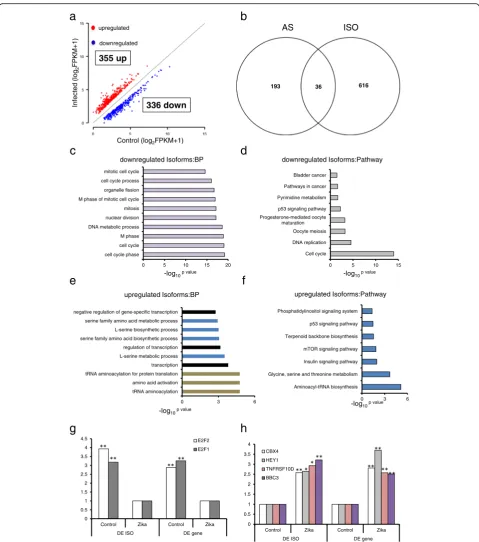
To characterize the changes in ISO composition in ZIKV infected samples, we identified 355 cases of increase and 336 cases of decrease in ISOs expression (Fig. 4a and Additional file 1: Table S4). These changes occurred in 652 genes, with 616 genes containing changes in one ISO, 33 genes showing changes in two ISOs, and 3 genes with three ISO changes. When genes with changes in AS and ISO compositon were compared, we found only 36 genes with AS changes also had changes in ISO compositions (Fig. 4b). This is far fewer than expected, as AS is believed to be the main cause of ISO changes, and is likly due to the sequencing depth, as similar results have been ob-served previously [16, 49, 50].
Interestingly, the top 10 GO terms showed downreg-ulated ISOs were mainly enriched in cell cycle (Fig. 4c), consistent with downregulated DE genes in ZIKV in-fected samples [6], while pathway analysis found down-regulated ISOs were involved in cell cycle, p53 signaling pathway, pathways in cancer, pyrimidine me-tabolism, and progesterone-mediated oocyte maturation (Fig. 4d). This analysis suggests that the dysregulation of cell cycle process could be a direct result of reduced both cell cycle genes and ISOs expression. Notable examples are E2F Transcription Factor 1 (E2F1) and E2F Transcrip-tion Factor 2 (E2F2) from the E2F family of transcripTranscrip-tion factors, which play crucial roles in the control of cell cycle [51, 52]. E2F1 and E2F2 were downregulated about 3-fold both at gene and ISO levels in infected samples (Fig. 4g).
In contrast, upregulated ISOs were enriched in amino acid biosynthesis and transcription (Fig. 4e), which were also consistent with upregulated DE genes [6]. Upre-gulated ISOs were also enriched in mTOR signaling pathway, p53 signaling pathway, Insulin signaling path-way, aminoacyl-tRNA biosynthesis, glycine, serine and threonine metabolism, terpenoid backbone, and phos-phatidylinositol signaling systembiosynthesis (Fig. 4f ). As examples of transcriptional regulation, CBX4, a member of Polycomb group (PcG) multiprotein PRC1-like com-plex and inhibiting expression of many genes [53–55], and HEY1, a transcriptional repressor binding preferen-tially to the canonical E box sequence 5-CACGTG-3 [56], were also upregulated both at gene and ISO expres-sion levels for about 2.5 folds after ZIKV infection (Fig. 4h). Two pro-apoptotic factors, TNFRSF10D [57] and BBC3 [58], were also upregulated about 2-fold at both gene and gene ISO levels by ZIKV infection (Fig. 4h). Taken together, ISO analysis suggests that many genes underwent changes at both expression level and ISO
compisition, thus gene regulation at the level of ISO composition is as important as gene expression in ZIKV infected cells.
Discussion
ZIKV infection and pathogenesis are subjects of intense interest, but the mechanisms are still largely unknown. Analysis of host transcriptomic alternations caused by ZIKV infection could identify genes and pathways that function during ZIKV infection and pathogenesis. To obtain a global view of changes in gene splicing, ISO composition and lncRNAs expression in ZIKV infected hNPCs, we analyzed RNA-seq data and identified 15,275 annotated lncRNAs. However, due to low expression levels and potential for fragmentary gene models, we cannot exclude the possibility that novel lncRNAs encode small peptides in our downstream analyses. From these, we obtained 92 significant DE annotated lncRNAs, and 55 significant DE novel lncRNAs in ZIKV infected samples. Additionally, ZIKV infection induced 262 AS events, and 355 upregulated and 336 downregulated ISOs in the ZIKV infected samples.
Most virus infections elicit strong immune response, which is often modulated by the incoming virus to facili-tate infection. For example, the nonstructural protein NS5 of ZIKV may attenuate Type I Interferon Signaling by binding and inhibiting STAT2 [9]. Interestingly, THRIL, which normally activates many immune response genes [32], was downregulated in ZIKV infected samples, and could be another viral target to modulated host munity. As a result, only a few DE PCGs involved in im-mune response, such as TNFSF13B and RIPK2, were upregulated by ZIKV infection. Consistently, GO analysis of DE PCGs did not obtain any significant immune re-sponse GO terms [6].
a
b
g
ol(
d
et
c
ef
nI
2
)
1
+
M
K
P
F
Control (log2FPKM+1)
355 up
336 down
upregulated
downregulated
0 5 10 15 20
cell cycle phase cell cycle M phase DNA metabolic process nuclear division mitosis M phase of mitotic cell cycle organelle fission cell cycle process mitotic cell cycle
0 5 10 15
Cell cycle DNA replication Oocyte meiosis Progesterone-mediated oocyte
maturation p53 signaling pathway Pyrimidine metabolism Pathways in cancer Bladder cancer
0 3 6
tRNA aminoacylation amino acid activation tRNA aminoacylation for protein translation transcription L-serine metabolic process regulation of transcription serine family amino acid biosynthetic process L-serine biosynthetic process serine family amino acid metabolic process negative regulation of gene-specific transcription
0 3 6
Aminoacyl-tRNA biosynthesis Glycine, serine and threonine metabolism Insulin signaling pathway mTOR signaling pathway Terpenoid backbone biosynthesis p53 signaling pathway Phosphatidylinositol signaling system
c
d
e
f
downregulated Isoforms:BP
upregulated Isoforms:BP
downregulated Isoforms:Pathway
upregulated Isoforms:Pathway -log10 p value
-log10 p value
-log10 p value
-log10 p value
g
h
0 0.5 1 1.5 2 2.5 3 3.5 4 4.5
Control Zika Control Zika DE ISO DE gene
E2F2 E2F1
0 0.5 1 1.5 2 2.5 3 3.5 4
Control Zika Control Zika DE ISO DE gene CBX4
HEY1 TNFRSF10D BBC3
AS ISO
193 36 616
therefore could participate in virus-induced cell cycle dysregulation.
Genes subject to AS are enriched in RNA processing, transport and neuron development, however, several alternatively spliced genes enriched in neuron develop-ment did not show any differential expression at gene and ISO levels (Additional file 1: Table S5–7). For in-stance, MAP2 underwent altend, while DCC was sub-ject to alt3 after ZIKV infection (Additional file 1: Table S6 and Figure S4), even though the expression levels of these two genes remained the same. The mechanism of attenuated neurogenesis in infected individuals is cur-rently unknown. It is possible a direct consequence of cell cycle dysregulation and apoptosis, but splicing changes in neurogenic gene may also play a role and be worthy of further investigation.
In DE ISO analysis, we observed many of the upre-gulated ISOs were enriched in transcription regulation, amino acid biosynthesis and apoptosis. In contrast, downregulated ISO are mostly concentrated in cell cycle. Interestingly, many genes in this category under-went both DE and ISO and they are mostly regulated similarly by ZIKA infection. For instance, HEY1 and CBX4 were upregulated at both gene epxression and gene ISO levels.
Both lineages (African and Asian strains) efficiently target neural stem cells (NSCs). Neurovirulence and neuropathologies might be related to ZIKV African strain which infects and replicates more efficiently in
NSCs and hNPCs than ZIKV Asian strain, and triggers a stronger modulation of cellular homeostasis, including cell cycle progression and anti-viral response [59, 60]. Asian ZIKV strains likely cause chronic infections within the central nervous system (CNS). In addition, there are a lot of differences of the nucleotide and amino acid sequence composition in the genome of African and Asian strains [60], which might indicate MR766 strain specifically alters a limited number of genes expression or AS. Owing to these differences between African and Asian reference strains, we will further compare the changes differences of host transcriptome, such as DE and AS, in African and Asian strains infected samples.
In addition to lncRNA differential expression, changes in AS and ISO composition, we also attempted to analyze changes in alternative polyadenylation (APA), as APA is also an important regulatory mechanism of gene expression [61], however, we did not obtain any signifi-cant APA events in ZIKV infected hNPCs. One possibil-ity is that ZIKV infection induces very few, or very low levels of APA. It could also due to the RNA sample preparation method used, where total RNA from in-fected cells was sequenced, resulting in under represen-tation of 3′end reads.
Conclusion
Importantly, our analyses suggested that ZIKV infection activated cellular responses or pathways are linked to specific types of changes to the host transcriptome
ZIKV
apoptosis
cell cycle Immune
function
PCG (a few)
PCG ISO AS
ISO PCG transcription regulation,
aminoacid biosynthesis
ISO PCG
PCG ISO
neuron development RNA processing,
transport
AS, lncRNA
lncRNA lncRNA
Insulin signaling pathway, Aminoacyl-tRNA biosynthesis, Glycine, serine and threonine metabolism, Phosphatidylinositol signaling systembiosynthesis,
mTOR signaling pathway Terpenoid backbone
cell cycle, Bladder cancer,
Pathways in cancer, Pyrimidine metabolism, Progesterone-mediated oocyte maturation
p53 signaling pathway
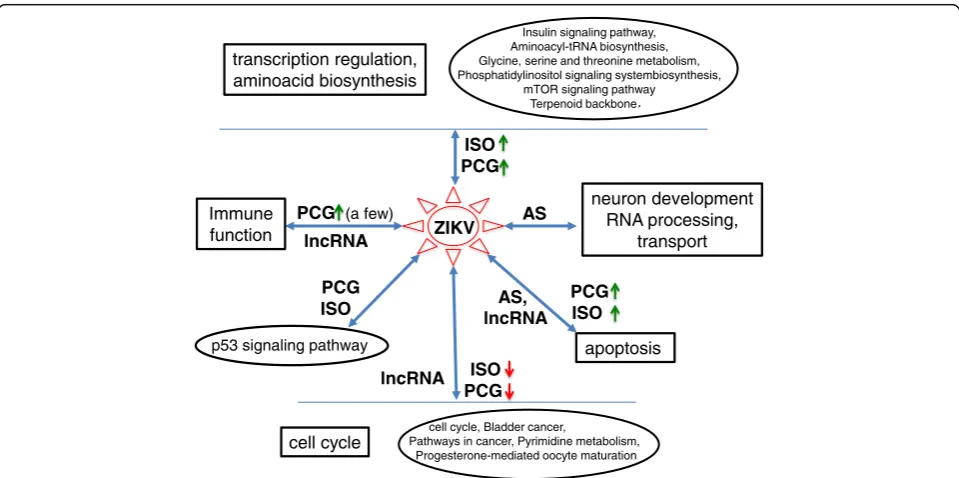
(Fig. 5). For instance, genes enriched in cell cycle, tran-scription regulation, amino acid biosynthesis, mTOR sig-naling pathway, and p53 sigsig-naling pathway are regulated at the level of differential expression and isoform com-position alternations, while neuron development, RNA processing, and transport associated with genes are ex-clusively regulated at the level of AS after infection (Additional file 1: Table S6-S8). In contrast, genes in-volved in apoptosis displayed all four types of changes after the infection. These patterns suggest distinct mech-anisms of pathway induced transcriptomic changes. This, together with identified lncRNAs and AS events, offers important opportunities to investigate the mech-anism of ZIKV infection and pathogenesis.
Additional files
Additional file 1:Supplemental figures and tables. (DOCX 1754 kb)
Additional file 2:Differential gene expression between Zike Virus infection and control. (XLSX 5758 kb)
Abbreviations
AS:Alternative splicing; DE: Differentially expressed; GO: Gene Ontology; hNPCs: Human neural progenitor cells; ISO: Gene isoform; lncRNA: Long noncoding RNA; ZIKV: Zika virus
Acknowledgements
We thank Dongdong Wu for help with analysis methods used in this manuscript and Nigel W. Fraser for suggestions in this manuscript.
Funding
This work was supported by the Ministry of Science and Technology of the People’s Republic of China (2016YFA0100900), by a grant from Chinese Academy of Sciences (KSCXZ-EW-BR-6) and a startup fund from Kunming Institute of Zoology, Chinese Academy of Sciences (Y102421081), by grants from Yunnan Provincial Government (2013FA051; 2011HA005) and by National Science Foundation of China (NSFC 81471966; NSFC 81672040) to JZ.
Availability of data and materials
RNA-seq datasets [6] of ZIKV infected hNPCs with multiplicity of infection (MOI) <0.1 were downloaded from the NCBI Gene Expression Omnibus (GEO) database with accession number GSE78711, which included 2 replicates for each experiment. Each RNA-seq data was paired-end sequencing.
Authors’contributions
BH, YH carried out data analysis, participated in the development of the manuscript and participated in manuscript writing. LY, GC, JY and ML participated in the development of the manuscript and part of the data analysis. JZ guided the analysis and wrote the manuscript. All authors read and approved the final manuscript.
Ethics approval and consent to participate
Not applicable
Consent for publication
Not applicable
Competing interests
The authors declare that they have no competing interests.
Publisher’s Note
Springer Nature remains neutral with regard to jurisdictional claims in published maps and institutional affiliations.
Author details
1Key Laboratory of Animal Models and Human Disease Mechanisms of the Chinese Academy of Sciences/Key Laboratory of Bioactive Peptides of Yunnan Province, Kunming Institute of Zoology, Kunming 650223, China. 2Kunming College of Life Science, University of Chinese Academy of Sciences, Kunming 650204, China.3State Key Laboratory of Virology, CAS Center for Excellence in Brain Science and Intelligence Technology (CEBSIT), Wuhan Institute of Virology, Wuhan 430071, China.4BGI-Yunnan,
BGI-Shenzhen, Kunming 650000, China.5College of Life Sciences, Yunnan University, Kunming 650091, China.
Received: 1 May 2017 Accepted: 30 October 2017
References
1. Wang L, Valderramos SG, Wu A, Ouyang S, Li C, Brasil P, Bonaldo M, Coates T, Nielsen-Saines K, Jiang T, et al. From mosquitos to humans: genetic evolution of Zika virus. Cell Host Microbe. 2016;19(5):561–5.
2. Musso D, Roche C, Robin E, Nhan T, Teissier A, Cao-Lormeau V. Potential sexual transmission of Zika virus. Emerg Infect Dis. 2015;21(2):359–61. 3. Shan C, Xie XP, Barrett ADT, Garcia-Blanco MA, Tesh RB, Vasconcelos PFD,
Vasilakis N, Weaver SC, Shi PY. Zika virus: diagnosis, therapeutics, and vaccine. Acs Infect Dis. 2016;2(3):170–2.
4. Shan C, Xie X, Muruato AE, Rossi SL, Roundy CM, Azar SR, Yang Y, Tesh RB, Bourne N, Barrett AD, et al. An infectious cDNA clone of Zika virus to study viral virulence, mosquito transmission, and antiviral inhibitors. Cell Host Microbe. 2016;19(6):891-00.
5. Fauci AS, Morens DM. Zika virus in the Americas - yet another Arbovirus threat. New Engl J Med. 2016;374(7):601–4.
6. Tang H, Hammack C, Ogden SC, Wen Z, Qian X, Li Y, Yao B, Shin J, Zhang F, Lee EM, et al. Zika virus infects human cortical neural progenitors and attenuates their growth. Cell Stem Cell. 2016;18(5):587–90.
7. Dang J, Tiwari SK, Lichinchi G, Qin Y, Patil VS, Eroshkin AM, Rana TM. Zika virus depletes neural progenitors in human cerebral Organoids through activation of the innate immune receptor TLR3. Cell Stem Cell. 2016;19(2): 258-65.
8. Nowakowski TJ, Pollen AA, Di Lullo E, Sandoval-Espinosa C, Bershteyn M, Kriegstein AR. Expression analysis highlights AXL as a candidate Zika virus entry receptor in neural stem cells. Cell Stem Cell. 2016;18(5):591–6. 9. Wang Y, He L, Du Y, Zhu P, Huang G, Luo J, Yan X, Ye B, Li C, Xia P, et al.
The long noncoding RNA lncTCF7 promotes self-renewal of human liver cancer stem cells through activation of Wnt signaling. Cell Stem Cell. 2015;16(4):413–25.
10. Batista PJ, Chang HY. Long noncoding RNAs: cellular address codes in development and disease. Cell. 2013;152(6):1298–307.
11. Fatica A, Bozzoni I. Long non-coding RNAs: new players in cell differentiation and development. Nat Rev Genet. 2014;15(1):7–21.
12. Kotzin JJ, Spencer SP, McCright SJ, Kumar DBU, Collet MA, Mowel WK, Elliott EN, Uyar A, Makiya MA, Dunagin MC, et al. The long non-coding RNA Morrbid regulates Bim and short-lived myeloid cell lifespan. Nature. 2016; 537(7619):239-43.
13. Adriaens C, Standaert L, Barra J, Latil M, Verfaillie A, Kalev P, Boeckx B, Wijnhoven PW, Radaelli E, Vermi W, et al. p53 induces formation of NEAT1 lncRNA-containing paraspeckles that modulate replication stress response and chemosensitivity. Nat Med. 2016;22(8):861–8.
14. Li J, Chen C, Ma X, Geng G, Liu B, Zhang Y, Zhang S, Zhong F, Liu C, Yin Y, et al. Long noncoding RNA NRON contributes to HIV-1 latency by specifically inducing tat protein degradation. Nat Commun. 2016;7:11730. 15. Wang ET, Sandberg R, Luo S, Khrebtukova I, Zhang L, Mayr C, Kingsmore SF,
Schroth GP, Burge CB. Alternative isoform regulation in human tissue transcriptomes. Nature. 2008;456(7221):470–6.
16. Hu B, Li X, Huo Y, Yu Y, Zhang Q, Chen G, Zhang Y, Fraser NW, Wu D, Zhou J. Cellular responses to HSV-1 infection are linked to specific types of alterations in the host transcriptome. Sci Rep. 2016;6:28075.
17. Wang GS, Cooper TA. Splicing in disease: disruption of the splicing code and the decoding machinery. Nat Rev Genet. 2007;8(10):749–61. 18. Kalsotra A, Cooper TA. Functional consequences of developmentally regulated
alternative splicing. Nat Rev Genet. 2011;12(10):715–29.
20. Trapnell C, Pachter L, Salzberg SL. TopHat: discovering splice junctions with RNA-Seq. Bioinformatics. 2009;25(9):1105–11.
21. Trapnell C, Williams BA, Pertea G, Mortazavi A, Kwan G, van Baren MJ, Salzberg SL, Wold BJ, Pachter L. Transcript assembly and quantification by RNA-Seq reveals unannotated transcripts and isoform switching during cell differentiation. Nat Biotechnol. 2010;28(5):511–5.
22. Sun L, Luo H, Bu D, Zhao G, Yu K, Zhang C, Liu Y, Chen R, Zhao Y. Utilizing sequence intrinsic composition to classify protein-coding and long non-coding transcripts. Nucleic Acids Res. 2013;41(17):e166.
23. Wang L, Park HJ, Dasari S, Wang SQ, Kocher JP, Li W. CPAT: coding-potential assessment tool using an alignment-free logistic regression model. Nucleic Acids Res. 2013;41(6).
24. Trapnell C, Hendrickson DG, Sauvageau M, Goff L, Rinn JL, Pachter L. Differential analysis of gene regulation at transcript resolution with RNA-seq. Nat Biotechnol. 2013;31(1):46–53.
25. Zhou X, Wu W, Li H, Cheng Y, Wei N, Zong J, Feng X, Xie Z, Chen D, Manley JL, et al. Transcriptome analysis of alternative splicing events regulated by SRSF10 reveals position-dependent splicing modulation. Nucleic Acids Res. 2014;42(6):4019–30.
26. Huang d W, Sherman BT, Lempicki RA. Systematic and integrative analysis of large gene lists using DAVID bioinformatics resources. Nat Protoc. 2009;4(1):44–57. 27. Cabili MN, Trapnell C, Goff L, Koziol M, Tazon-Vega B, Regev A, Rinn JL.
Integrative annotation of human large intergenic noncoding RNAs reveals global properties and specific subclasses. Genes Dev. 2011;25(18):1915–27. 28. Guttman M, Garber M, Levin JZ, Donaghey J, Robinson J, Adiconis X, Fan L,
Koziol MJ, Gnirke A, Nusbaum C. Ab initio reconstruction of cell type-specific transcriptomes in mouse reveals the conserved multi-exonic structure of lincRNAs. Nature biotechnology. 2010;28(5):503–10.
29. Pauli A, Valen E, Lin MF, Garber M, Vastenhouw NL, Levin JZ, Fan L, Sandelin A, Rinn JL, Regev A. Systematic identification of long noncoding RNAs expressed during zebrafish embryogenesis. Genome Res. 2012;22(3):577–91. 30. Sun L, Zhang Z, Bailey TL, Perkins AC, Tallack MR, Xu Z, Liu H. Prediction of
novel long non-coding RNAs based on RNA-Seq data of mouse Klf1 knockout study. BMC Bioinformatics. 2012;13:331.
31. II NE, Heward JA, Roux B, Tsitsiou E, Fenwick PS, Lenzi L, Goodhead I, Hertz-Fowler C, Heger A, Hall N, et al. Long non-coding RNAs and enhancer RNAs regulate the lipopolysaccharide-induced inflammatory response in human monocytes. Nat Commun. 2014;5:3979.
32. Li ZH, Chao TC, Chang KY, Lin NW, Patil VS, Shimizu C, Head SR, Burns JC, Rana TM. The long noncoding RNA THRIL regulates TNF alpha expression through its interaction with hnRNPL. Proc Natl Acad Sci U S A. 2014;111(3):1002–7. 33. Wang LJ, Han SX, Jin GH, Zhou X, Li M, Ying X, Wang L, HL W, Zhu Q. Linc00963: a
novel, long non-coding RNA involved in the transition of prostate cancer from androgen-dependence to androgen-independence. Int J Oncol. 2014;44(6):2041–9. 34. Kong R, Zhang EB, Yin DD, You LH, Xu TP, Chen WM, Xia R, Wan L, Sun M,
Wang ZX, et al. Long noncoding RNA PVT1 indicates a poor prognosis of gastric cancer and promotes cell proliferation through epigenetically regulating p15 and p16. Mol Cancer. 2015;14.
35. Wang L, Chen Z, An L, Wang Y, Zhang Z, Guo Y, Liu C. Analysis of long non-coding RNA expression profiles in non-small cell lung cancer. Cell Physiol Biochem. 2016;38(6):2389–400.
36. Nojima T, Oshiro-Ideue T, Nakanoya H, Kawamura H, Morimoto T, Kawaguchi Y, Kataoka N, Hagiwara M. Herpesvirus protein ICP27 switches PML isoform by altering mRNA splicing. Nucleic Acids Res. 2009;37(19):6515–27.
37. Sedlackova L, Perkins KD, Lengyel J, Strain AK, van Santen VL, Rice SA. Herpes simplex virus type 1 ICP27 regulates expression of a variant, secreted form of glycoprotein C by an intron retention mechanism. J Virol. 2008;82(15):7443–55. 38. Accardi R, Fathallah I, Gruffat H, Mariggio G, Le Calvez-Kelm F, Voegele C,
Bartosch B, Hernandez-Vargas H, McKay J, Sylla BS, et al. Epstein - Barr virus transforming protein LMP-1 alters B cells gene expression by promoting accumulation of the oncoprotein DeltaNp73alpha. PLoS Pathog.
2013;9(3):e1003186.
39. Wu L, Zhang X, Zhao Z, Wang L, Li B, Li G, Dean M, Yu Q, Wang Y, Lin X, et al. Full-length single-cell RNA-seq applied to a viral human cancer: applications to HPV expression and splicing analysis in HeLa S3 cells. Gigascience. 2015;4:51. 40. Collins NB, Wilson JB, Bush T, Thomashevski A, Roberts KJ, Jones NJ, Kupfer
GM. ATR-dependent phosphorylation of FANCA on serine 1449 after DNA damage is important for FA pathway function. Blood. 2009;113(10):2181–90. 41. Tamary H, Bar-Yam R, Zemach M, Dgany O, Shalmon L, Yaniv I. The molecular
biology of Fanconi anemia. Israel Med Assoc J. 2002;4(10):819–23.
42. Fahling M, Mrowka R, Steege A, Martinka P, Persson PB, Thiele BJ. Heterogeneous nuclear ribonucleoprotein-A2/B1 modulate collagen prolyl 4-hydroxylase, alpha(I) mRNA stability. J Biol Chem. 2006;281(14):9279–86.
43. Denayer E, Parret A, Chmara M, Schubbert S, Vogels A, Devriendt K, Frijns JP, Rybin V, de Ravel TJ, Shannon K, et al. Mutation analysis in Costello syndrome: functional and structural characterization of the HRAS p.Lys117Arg mutation. Hum Mutat. 2008;29(2):232–9.
44. Kalcheva N, Albala J, O'Guin K, Rubino H, Garner C, Shafit-Zagardo B. Genomic structure of human microtubule-associated protein 2 (MAP-2) and characterization of additional MAP-2 isoforms. Proc Natl Acad Sci U S A. 1995;92(24):10894–8.
45. Finci L, Zhang Y, Meijers R, Wang JH. Signaling mechanism of the netrin-1 receptor DCC in axon guidance. Prog Biophys Mol Biol. 2015;118(3):153–60. 46. Sandberg R, Neilson JR, Sarma A, Sharp PA, Burge CB. Proliferating cells
express mRNAs with shortened 3' untranslated regions and fewer microRNA target sites. Science (80- ). 2008;320(5883):1643–7.
47. Chen C-YA, Shyu A-B. AU-rich elements: characterization and importance in mRNA degradation. Trends Biochem Sci. 1995;20(11):465–70.
48. Myojin R, Kuwahara S, Yasaki T, Matsunaga T, Sakurai T, Kimura M, Uesugi S, Kurihara Y. Expression and functional significance of mouse paraspeckle protein 1 on spermatogenesis. Biol Reprod. 2004;71(3):926–32. 49. Katz Y, Wang ET, Airoldi EM, Burge CB. Analysis and design of RNA
sequencing experiments for identifying isoform regulation. Nat Methods. 2010;7(12):1009–U1101.
50. Wang ET, Cody NA, Jog S, Biancolella M, Wang TT, Treacy DJ, Luo S, Schroth GP, Housman DE, Reddy S, et al. Transcriptome-wide regulation of pre-mRNA splicing and mRNA localization by muscleblind proteins. Cell. 2012;150(4):710–24. 51. Neuman E, Sellers WR, McNeil JA, Lawrence JB, Kaelin WG Jr. Structure and
partial genomic sequence of the human E2F1 gene. Gene. 1996;173(2):163–9. 52. Lees JA, Saito M, Vidal M, Valentine M, Look T, Harlow E, Dyson N, Helin K.
The retinoblastoma protein binds to a family of E2F transcription factors. Mol Cell Biol. 1993;13(12):7813–25.
53. Doerks T, Copley RR, Schultz J, Ponting CP, Bork P. Systematic identification of novel protein domain families associated with nuclear functions. Genome Res. 2002;12(1):47–56.
54. Li J, Xu Y, Long XD, Wang W, Jiao HK, Mei Z, Yin QQ, Ma LN, Zhou AW, Wang LS, et al. Cbx4 governs HIF-1alpha to potentiate angiogenesis of hepatocellular carcinoma by its SUMO E3 ligase activity. Cancer Cell. 2014;25(1):118–31. 55. Luis NM, Morey L, Mejetta S, Pascual G, Janich P, Kuebler B, Cozutto L, Roma
G, Nascimento E, Frye M, et al. Regulation of human epidermal stem cell proliferation and senescence requires polycomb- dependent and -independent functions of Cbx4. Cell Stem Cell. 2011;9(3):233–46.
56. Nakagawa O, McFadden DG, Nakagawa M, Yanagisawa H, Hu T, Srivastava D, Olson EN. Members of the HRT family of basic helix-loop-helix proteins act as transcriptional repressors downstream of notch signaling. Proc Natl Acad Sci U S A. 2000;97(25):13655–60.
57. Pan GH, Ni J, GL Y, Wei YF, Dixit VM. TRUNDD, a new member of the TRAIL receptor family that antagonizes TRAIL signalling. FEBS Lett. 1998;424(1–2):41–5. 58. Han J, Flemington C, Houghton AB, Gu Z, Zambetti GP, Lutz RJ, Zhu L,
Chittenden T. Expression of bbc3, a pro-apoptotic BH3-only gene, is regulated by diverse cell death and survival signals. Proc Natl Acad Sci U S A. 2001;98(20):11318–23.
59. Simonin Y, Loustalot F, Desmetz C, Foulongne V, Constant O, Fournier-Wirth C, Leon F, Moles JP, Goubaud A, Lemaitre JM, et al. Zika virus strains potentially display different infectious profiles in human neural cells. EBioMedicine. 2016;12:161–9.
60. Anfasa F, Siegers JY, van der Kroeg M, Mumtaz N, Raj VS, de Vrij FMS, Widagdo W, Gabriel G, Salinas S, Simonin Y, et al. Phenotypic differences between Asian and African lineage Zika viruses in human neural progenitor cells. Msphere. 2017;2(4).


![Fig. 3 ZIKV infection induced alternative splicing of the cellular transcriptome.infction;genes, the x-axis is thesplicing site (AS3), alternative start (altstart), alternative end (altend), mutually exclusive and retained intron classes [16]; a](https://thumb-us.123doks.com/thumbv2/123dok_us/814854.1096511/6.595.62.538.86.484/infection-alternative-splicing-transcriptome-thesplicing-alternative-alternative-exclusive.webp)