ISSN(Online): 2320-9801
ISSN (Print): 2320-9798
I
nternational
J
ournal of
I
nnovative
R
esearch in
C
omputer
and
C
ommunication
E
ngineering
(An ISO 3297: 2007 Certified Organization)
Vol. 3, Issue 8, August 2015
Implementation of Artificial Neural Network
and Fuzzy Logic for Concurrency Control in
CAD Data Base
Muthu Kumaravel .A
*1, Purushothaman .S
2, Rajeswari .S
3HOD, Department of MCA, Bharath University, Chennai, Tamil Nadu, India
2
Associate Professor, Institute of Technology, Haramaya University, Dire Dawa, Ethiopia
3
Assistant Professor, Department of EEE, Institute of Technology, Haramaya University, Dire Dawa, Ethiopia
1*
Corresponding Author,
ABSTRACT: This research work focuses on implementation of novel Concurrency Control methods using Artificial Neural Networks (ANN) and Fuzzy Logic with applications to Computer Aided Design / Computer Aided Manufacturing (CAD/CAM) database that involves more and unspecified duration of time to complete a transaction. Most of the transactions in the CAD/CAM data base include drawing entities to form a complete manufacturing drawing, with processing and inventory details. In this research work, focus Artificial Neural Network method using Functional Update Back Propagation Algorithm (FUBPA) and Locally Weighted Projection Regression (LWPR) and Fuzzy Logic for implementing Concurrency Control while developing Dial of Fork using Autodesk inventor 9. While implementing concurrency control, this work ensures that associated parts cannot be accessed by more than one person due to locking.During testing performance, metrices are analyzed.
KEYWORDS:Concurrency Control, Functional Back Propagation Network, Locally Weighted Projection Regression,
Fuzzy Logic, Dial of Fork, Transaction Locks, Time Stamping.
I. INTRODUCTION
Concurrency Control (CC) is an important concept for proper transactions on objects to avoid any loss of data or to ensure proper updation of data in the database. It is an important aspect in controlling and coordinating data reading and data modification especially in long time transaction database. In spite of sophisticated algorithms available for proper locking and unlocking of objects during transactions, intelligent methods with knowledgebase information have been proposed and implemented in this research work.
In the absence of information about how and when the data items are accessed, Two Phase Locking (2PL) is both necessary and sufficient to ensure serializability by locking. In advanced applications, it is often the case that the DBMS has prior knowledge about the order of access of data items. The DBMS can use this information to ensure serializability by using locking protocols that are not 2PL.
One of the problems of locking mechanisms is the potential for deadlock. Deadlock occurs when two or more transactions are mutually waiting for each other‟s resources. This problem can be solved by assigning each transaction a unique number, called a timestamp, which increases monotonically. The sequence is a function of the time of the day. In this research work, Functional Update Back Propagation Algorithm, Locally Weighted Projection Regression and Fuzzy Logic have been implemented. All the algorithms are able to train the lock status and provide lock as and when required by the transaction on objects. The perfomance of the algorithm have been compared based on the following criteria.
1. Locking time for each object
2. Releasing time for each object
ISSN(Online): 2320-9801
ISSN (Print): 2320-9798
I
nternational
J
ournal of
I
nnovative
R
esearch in
C
omputer
and
C
ommunication
E
ngineering
(An ISO 3297: 2007 Certified Organization)
Vol. 3, Issue 8, August 2015
5. Computation complexity.
6. Memory space occupied.
II. PROBLEM DEFINITION
There is inability to provide consistency in the database when long transactions are involved. It will not be able to identify if there is any violation of database consistency during the time of commitment [1]. It is not possible to know, if the transaction is with undefined time limit.
There is no serializability when many users work on shared objects [2]. During long transactions, optimistic transactions and two phase locking will result in deadlock. Two phase locking forces to lock resources for long time even after they have finished using them. Other transactions that need to access the same resources are blocked [4]. The problem in optimistic mechanism with Time Stamping is that it causes repeated rollback of transactions when the rate of conflicts increases significantly.
A bearing-type connection is the most common type of Dial of Fork [3]. It is used in most simple-shear connections and in situations when loosening or fatigue due to vibration. A slip-critical connection is one in which loosening due to vibration or load reversals are to be considered. Dial of Fork is easily disassembled. They can be designed to take tension loads [5].
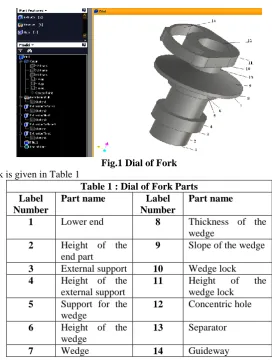
Inbuilt library drawing for the Dial of Fork are available in Autodesk inventor 9. The Dial of Fork is shown in Figure 1 Drawings considered for this research work are:
Fig.1 Dial of Fork The parts for Dial of Fork is given in Table 1
Table 1 : Dial of Fork Parts Label
Number
Part name Label
Number
Part name
1 Lower end 8 Thickness of the
wedge
2 Height of the
end part
9 Slope of the wedge
3 External support 10 Wedge lock
4 Height of the
external support
11 Height of the
wedge lock
5 Support for the
wedge
12 Concentric hole
6 Height of the
wedge
13 Separator
ISSN(Online): 2320-9801
ISSN (Print): 2320-9798
I
nternational
J
ournal of
I
nnovative
R
esearch in
C
omputer
and
C
ommunication
E
ngineering
(An ISO 3297: 2007 Certified Organization)
Vol. 3, Issue 8, August 2015
There are two transactions T1 and T2 involved in accessing and modifying the features [6]. Initially T1 changes O1 followed by modifications of dimension O10 by T2. From Table 2, it can be noted that, when O1 is accessed then O2 have to be write locked [20]. By default, if any transaction access O10 then from Table 2, it can be noticed that O11 O12 O13 O14 have to be write locked. T2 can access O10 O5 O3 as long as T1 has not accessed [7].
Table 2: Fork Shape and dimension consistency management
Group First feature Remaining feature to be locked
G1 1 2
G2 10 11,12,13,14
G3 5 6,7,8,9
G4 3 4
To start with, transaction 1 and transaction 2 have opened the Fork files from the common database [8, 19]. The following steps shows sequence of execution and results
Step 1: T1 access O1 with write mode. Table 3 shows pattern used for the OL training.
Step 2: The transaction manager locks objects mentioned in the third column of Table 2.3. Repeat step 1 with the
additional patterns given in Table 4.
Table 4 T1 Additional patterns used for training OL
Object number
Input pattern Target output
pattern
O1 [ 1 1] [ 0 1 0]
O2 [ 2 1] [ 0 1 0]
Step 3: A new transaction T2 access O2. A pattern is formed to verify if lock has been assigned to O2 and its associated
objects O1. Only when the locks are not assigned to O2 and O1 then T2 is allowed [13-16].
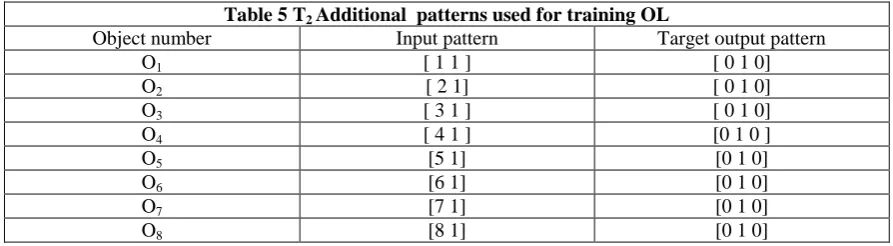
The following input patterns are presented to the testing module to find if the output [0 0 0] is obtained in the output layer. During testing, the final weights obtained during training will be used [17,18]. Otherwise it means that lock has been assigned to either O2. In such case, transaction is denied for T2. Else the following Table 5 is presented in step 3.
Table 5 T2 Additional patterns used for training OL
Object number Input pattern Target output pattern
O1 [ 1 1 ] [ 0 1 0]
O2 [ 2 1] [ 0 1 0]
O3 [ 3 1 ] [ 0 1 0]
O4 [ 4 1 ] [0 1 0 ]
O5 [5 1] [0 1 0]
O6 [6 1] [0 1 0]
O7 [7 1] [0 1 0]
O8 [8 1] [0 1 0]
Step 4: To know the type of lock value assigned to an object, OL testing is used. OL testing uses the final weights
created by OL training [9-12].
III. RESULT COMPARISONS
Table 3 T1First pattern used for training OL
Object number
Input pattern Target output
pattern
ISSN(Online): 2320-9801
ISSN (Print): 2320-9798
I
nternational
J
ournal of
I
nnovative
R
esearch in
C
omputer
and
C
ommunication
E
ngineering
(An ISO 3297: 2007 Certified Organization)
Vol. 3, Issue 8, August 2015
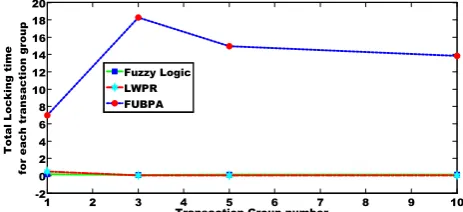
A comparative performance of FUBPA / LWPR /FL for Bearing (Figure 2 - 5) is presented. FUBPA takes more locking time and FL takes least locking time. FUBPA takes more releasing time and FL takes least releasing time. The comparison of the performances of FUBPA, LWPR and FL for locking and unlocking of transactions of objects in Bearing. The FL requires less time in granting locks and unlocking of transactions when compared to that of FUBPA and LWPR. Table 6
FORK DRAWING
1 2 3 4 5 6 7 8
-10 0 10 20
Object number Locked
Locking time f
or each object
Fuzzy Logic LWPR FUBPA
Fig. 2 Locking time for each object in Fork using FUBPA/LWPR/FL
1 2 3 4 5 6 7 8
-10 0 10 15
Object number Released
Releas
ing tim
e f
or eac
h obje
ct Fuzzy Logic
LWPR FUBPA
Fig. 3 Releasing time for each object in Fork using FUBPA/LWPR/FL
1 2 3 4 5 6 7 8 9 10
-2 0 2 4 6 8 10 12 14 16 18 20
Transaction Group number
T
otal Lo
cking
time
for eac
h trans
action
group
Fuzzy Logic LWPR FUBPA
ISSN(Online): 2320-9801
ISSN (Print): 2320-9798
I
nternational
J
ournal of
I
nnovative
R
esearch in
C
omputer
and
C
ommunication
E
ngineering
(An ISO 3297: 2007 Certified Organization)
Vol. 3, Issue 8, August 2015
0 2 4 6 8 10
-5 0 5 10 15 20
Transaction Group number
T
otal Re
leas
ing tim
e
for eac
h trans
action
group
Fuzzy Logic LWPR FUBPA
Fig. 5 Total Releasing time for each transaction group in Fork using FUBPA/LWPR/FL shows overall time consumed for one transaction object.
REFERENCES
1. Purushothaman S., Elango M.K. and Nirmal Kumar S., Application of Hilbert Huang Transform with Locally Weighted Projection Regression Method for Power Quality Problems, International Review on Electrical Engineering, Vol. 5. No. 5, October 2010, pp. 2405-2412.
2. Peter A. Buhr, Ashif S. Harji, Philipp E. Lim and Jiongxiong Chen, 2000, „Object-oriented real-time concurrency‟, In Proceedings of the 15th ACM SIGPLAN conference on Object-oriented programming systems, languages and applications, pp. 29-46.
3. Udayakumar R., Khanaa V., Saravanan T., "Analysis of polarization mode dispersion in fibers and its mitigation using an optical compensation technique", Indian Journal of Science and Technology, ISSN : 0974-6846, 6(S6) (2013) pp. 4767-4771.
4. Raviram P., Wahidabanu R. S. D. and Purushothaman S., “Concurrency Control in CAD with KBMS using Counter Propagation Neural Network”, IEEE International Advance Computing Conference, 6-7 March 2009, pp. 1521-1525.
5. Shi-Ming Huang, Irene Kwan and Chih-He Li, 2002, A Study on the Management of Semantic Transaction for Efficient Data Retrieval, In SIGMOD Record, Vol. 31, No. 3, pp. 28-33.
6. Udayakumar R., Khanaa V., Saravanan T., "Chromatic dispersion compensation in optical fiber communication system and its simulation", Indian Journal of Science and Technology, ISSN : 0974-6846, 6(S6) (2013) pp. 4762-4766.
7. Sibsankar Haldar and Paul Vitanyi, 2002, Bounded Concurrent Timestamp Systems Using Vector Clocks, Journal of the ACM, Vol. 49, No. 1, pp. 101–126.
8. Udayakumar, R., Khanaa, V., Saravanan, T., "Synthesis and structural characterization of thin films of sno2 prepared by spray pyrolysis technique", Indian Journal of Science and Technology, ISSN : 0974-6846, 6(S6) (2013) pp.4754-4757.
9. Vijayakumar S. and Schaal S.. 2000, Locally weighted projection regression: An O(n) algorithm for incremental real time learning in high dimensional spaces. In Proceedings ICML, volume 1, pp 288–293.
10. Cosmin Stoica Spahiu, 2011, “Concurrency Control Techniques for a Multimedia Database System”, Proceedings of The Federated Conference On computer Science And Information Systems, pp. 751–754.
11. Uma Mageswaran, S., Guna Sekhar, N.O., "Reactive power contribution of multiple STATCOM using particle swarm optimization", International Journal of Engineering and Technology, ISSN : 1793-8236, 5(1) (2013) pp. 122-126.
12. J.Lwalter Jeyakumar, R.S.Rajesh, 2011, “An Architecture Model For Managing Transactions In Disconnected Mobile Environment”, J.L.Walter Jeyakumar Et Al, / (IJCSIT) International Journal Of Computer Science And Information Technologies, Vol. 2 No. 1, pp. 545-550.
Table 6 Overall time consumed for one transaction object Performance metric for
concurrency control FUBPA Fuzzy Logic LWPR
Locking time for each object High Low Least
Releasing time for each object High Low Least
Total locking time for each transaction
group High Low Least
Total releasing time for each
transaction group High Low Least
Reason for High / Low / Least Training is based on
convergence criteria
Training is based
similarity between
successive outputs
One time
presentation of all the patterns
Chice of algorithm for implementation in concurrency control
ISSN(Online): 2320-9801
ISSN (Print): 2320-9798
I
nternational
J
ournal of
I
nnovative
R
esearch in
C
omputer
and
C
ommunication
E
ngineering
(An ISO 3297: 2007 Certified Organization)
Vol. 3, Issue 8, August 2015
13. Arun Kumar Yadav & Ajay Agarwal, 2010, “An Approach For Concurrency Control In Distributed Database System”, International Journal Of Computer Science & Communication Vol. 1, No. 1, pp. 137-141.
14. J. Toby Mottram, “Design Guidance for Bolted Connections in Structures of Pultruded Shapes: Gaps in Knowledge”, 17th International Conference on Composite Materials (ICCM17), Edinburgh, 27-31 July 2009.
15. Vidyalakshmi K., Kamalakannan P., Viswanathan S., Ramaswamy S., "Antinociceptive effect of certain dihydroxy flavones in mice", Pharmacology Biochemistry and Behavior, ISSN : 0091-3057, 96(1) (2010) pp. 1-6.
16. Soon-kyu Park, “Seismic performance test of bolted connections between precast-concrete column and H-beam”, 8th Russian-Korean International Symposium 0n Science and Technology 2004 Proceedings, Vol.2, pp. 335–339.
17. Lawrence A. Soltis, P.E.,”Bolted Connection Research: Present and Future”, Wood Design Focus, Vol. 5, No.2. pp. 3-5.
18. Barghouti.N. S.,and Gail E.Kaiser, 1991, Concurrency Control in Advanced Database Applications, ACM Computing Surveys, Vol. 23, No.3, pp. 269-317.
19. Hirose,Y., Yamshita,K., and Hijiya,S., 1991, Back-propagation algorithm which varies the number of hidden units, Neural Networks, Vol.4, No.1, pp-61-66.
20. Purushothaman S., Elango M.K. and Nirmal Kumar S., Application of Hilbert Huang Transform with Locally Weighted Projection Regression Method for Power Quality Problems, International Review on Electrical Engineering, Vol. 5. No. 5, October 2010, pp. 2405-2412.
21. R.Karthikeyan, Dr.S.R.Suresh, An Approach for Real Time Testing Reliability& Usability Testing Process, International Journal of Innovative Research in Computer and Communication Engineering, ISSN (Online): 2320 – 9801,pp 644-651, Vol. 1, Issue 3, May 201
22. P.Ramya, dr.nalini, effective navigation queryresults based on biomedicaldatabase, International Journal of Innovative Research in Computer and Communication Engineering, ISSN: 2249-0183,pp 36-39, volume 1 Issue 3 No4- Dec 2011
23. P.Kavitha, Authentic Learning Activities withPedagogical Stylistics – Enhancing InE-Learning Websites, International Journal of Innovative Research in Computer and Communication Engineering, ISSN(Online): 2320-9801,pp 1211-1215, Volume 1, Issue 6, August 2013
24. N.Priya, VANET Based Adaptive Traffic SignalControl, International Journal of Innovative Research in Computer and Communication Engineering, ISSN(Online): 2320-9801,pp 1201-1208, Vol. 1, Issue 6, August 2014