A Study on Selecting Bidding Decision Using
Multi-Criteria Analysis Methods
Shristi Singh1, Alankar Ashok2, Mohd Azad Shaikh3, Akkineni Rochishnu4, Praful Nayak5
P.G. Student, PGP – ACM, National Institute of Construction Management & Research, Pune, India1,2,3,4,5
ABSTRACT: The bid/no bid decision are one of the first and most important decisions to make by the contractor when seeking a construction contract. In practice, a contractor repeatedly needs to choose one tender from among several announced tenders. The choice is usually decided by the necessity to involve resources to prepare the proposal. The selection of the bid that is the most advantageous for the contractor may be supported by the multi-criteria analysis method. In our paper work we selected three methods that enable the contractor to make the right decision. Their work is illustrated by a case study.
KEYWORDS: bid/no bid decision, multi-criteria analysis method. I. INTRODUCTION
After receiving the tender notice, a building contractor makes a number of important decisions. The first decision is whether to bid for a project or not. Such decision can significantly affect the situation of the company, because the decision not to bid means that possible profits from the project will not materialize. On the other hand, the contractor has to consider the possibilities of implementing the project and related costs. Consequently, this decision is conditioned by numerous factors related to the company itself, its environment and the project. Although it is connected with finances, the decision to bid or not to bid usually must be made in limited time and it is usually based on the experience and intuition of contractors. The ability to choose the right bid influences the company’s general condition and future development, considering the risk involved in any construction project. The efficiency of bidding decisions can be improved by applying decision support models. Many researchers developed various mathematical models. With increasing frequency decisions concerning construction projects employ the mathematical tools. In practice, a contractor repeatedly needs to choose one tender from among several announced tenders. The choice is usually decided by the necessity to involve resources to prepare the proposal.
The submitted proposal can bring a success in the form of contract and potential profits, but if the bid is not successful the losses are incurred in the form of proposal preparation cost. The selection of the bid that is the most advantageous for the contractor may be supported by the multi-criteria analysis method, which has a number of benefits: they allow evaluating a large number of criteria, to rank the best variant, to make expert assessments objective, and their computational algorithms are not difficult to implement. The aim of the Paper is to present a proposal to use three selected methods to solve this decision problem.
II. OBJECTIVE
To analyse different models to be used by the contactors for evaluation of tenders and find the best tender using these evaluation methods.
III.LITERATUREREVIEW
S.L. Liu (2000) in this paper, two general bidding systems are proposed to aid an owner to select one contractor based on attribute decision making models. They are named the general multiple-attribute lower-bidder system and the general multiple-multiple-attribute average e-bid system and are an extension (and refreshment) of the multi parameter bidding system and the average-bid method, respectively. The preference of the owner over the criteria (or attributes) relevant to construction work award is incorporated into the two new systems if necessary and required by the owner. The values of the attributes (excluding the cost) required to be determined by the owner in the multi-parameter bidding system are not necessarily determined in the general multipleattribute lower-bidder system. This reduces the burden to the owner. The two new bidding systems are demonstrated via an example, and are compared with the multi parameter bidding system and the average-bid method. The comparisons show that the preference of the owner in regard to the attributes relevant to selection of contractors has a significant effect on bid evaluation. The two new systems preserve the form of the competitive bidding concept and can easily be applied to practice. Currently, for an owner who has received bids from a number of bidders for a specified project, bid evaluation (or the process of selecting a contractor from the bidders) is generally based on two types of system: single-criterion bidding systems (comprising the lower-bidder system with its variations as well as other non-lower bidder systems, such as averaged-bid methods), and multiple criteria (or attributes) bidding systems (including the multi-parameter bidding system).
J. SEYDEL (2000) in their research paper have work toward developing a workable, usable, construction-oriented system that provides for the integration of contextual factors and decision criteria and which is supported by thorough and reliable data analysis. The ultimate goal is to provide decision makers in the construction industry with effective multi-criteria support for pricing the services of their firms. Working toward that goal, this paper describes, demonstrates, and evaluates a quantitative procedure for multifactor, multi-criteria bidding optimization. This research should be of interest to the many decision makers (DMs) who face these trade-offs regularly. Nearly all public (and a substantial amount of residential) construction projects involve competitive bidding, and construction is a major industry throughout the world.
E. Cagno F, Caron A,Perego (1999) in their paper described a simulation approach based on Saaty’s Analytic Hierarchy Process (AHP) to assess the probability of winning in sealed auctions where competing bids are assessed on a multiple criteria basis. It deals with the uncertainty associated with subjective and multiple assessments. Over the last years, the growing level of competition together with rising customer expectations have increased the number of relevant factors to be considered in preparing bids for standard sealed auctions. In short, bid preparation is a process which can be divided into the following major steps 1. Acquire knowledge and make assumptions about the buyer’s evaluation criteria; 2. Prepare a preliminary bid; 3. Identify competitors and make assumptions about their bids; 4. Appraise the competitive value of the bid with respect to competitors’ bids; 5. Appraise the expected monetary value of the bid for the contractor;
IV.METHODOLOGY
V. EXPERIMENTS &OBSERVATIONS
1. Simple Additive Weighting Method (SAW)
The first method chosen for the calculation is the additive method SAW. Its purpose is to calculate a synthetic indicator of evaluation. The advantages of this method are simple and intuitive modeling of the decision maker's preferences with the additive linear function. The method assigns a normalized rating matrix, followed by the decision choice for which the weighted sum of evaluations is the highest (the so-called adjusted synthetic correction index).
Table 1Ranked Personnel (SAW method)
2. Preference Ranking Organisation Method for Enrichment Evaluations (PROMETHEE II)
Promethee method is proposed by Brans and it is one kind of method based on outranking relation between pairs of alternative. Here a step wise procedure of analysis of bids by promethee method is done.Below is obtained by assumed case study and survey results, where W=normalized values of criteria weights.A, B, C = different contracts available for contractor
Questionnaire survey
evaluate each potential
using 15 defined criteria
weightings of the criteria
Prioritize the Crteria based
on the requirement
and Rank them
Evaluate based on 3
methods
Award the contarct
C1
C2
C3
C4
C5
C6
C7
C8
C9
C10
C11
C12
C13
C14
C15
Contract A 0.0840 0.0840 0.0356 0.0429 0.0321 0.0521 0.0300 0.0389 0.0360 0.0266 0.0429 0.0314 0.0309 0.0420 0.0460
Contract B 0.0720 0.0720 0.0474 0.0536 0.0536 0.0417 0.0400 0.0486 0.0450 0.0354 0.0514 0.0157 0.0463 0.0490 0.0394
Contract C 0.0480 0.0600 0.0711 0.0643 0.0107 0.0626 0.0100 0.0291 0.0180 0.0531 0.0600 0.0471 0.0540 0.0210 0.0329
0.6420
So we choose Contract B
Ranked Personnel
Table 2 - Net flows for analysed tender
tender under analysis net flow
tender for contract A Φ(a) -0.010107
tender for contract B Φ(b) 0.016143
tender for contract C Φ(c) -0.006036
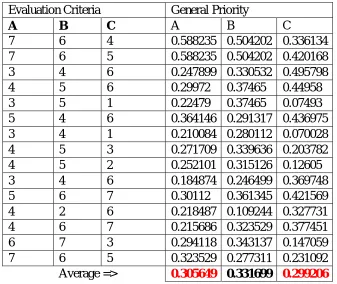
3. Analytical Hierarchy Process (AHP)
Evaluation Criteria
General Priority
A
B
C
A
B
C
7
6
4
0.588235 0.504202 0.336134
7
6
5
0.588235 0.504202 0.420168
3
4
6
0.247899 0.330532 0.495798
4
5
6
0.29972
0.37465
0.44958
3
5
1
0.22479
0.37465
0.07493
5
4
6
0.364146 0.291317 0.436975
3
4
1
0.210084 0.280112 0.070028
4
5
3
0.271709 0.339636 0.203782
4
5
2
0.252101 0.315126 0.12605
3
4
6
0.184874 0.246499 0.369748
5
6
7
0.30112
0.361345 0.421569
4
2
6
0.218487 0.109244 0.327731
4
6
7
0.215686 0.323529 0.377451
6
7
3
0.294118 0.343137 0.147059
7
6
5
0.323529 0.277311 0.231092
Average =>
0.305649
0.331699 0.299206
1) In above table row 1 and column 1 contains the result that we got after conducting the survey.
VI.RESULTS
COMPARISON GRAPH
Comparing the results of the calculations performed under each of the three selected methods, it is evident that the best bid was awarded for contract B.
VII. CONCLUSION
Comparing the results of the calculations performed under each of the three selected methods, it is evident that the best bid was awarded for contract B. The contractor should consider preparing and submitting an offer for this particular tender. The other two tenders seem less advantageous, although the classification here is not uniform in the results obtained for each method. Each of the applied methods has some limitations and disadvantages. Calculations were performed following three different methods to confirm the validity of the right choice. Due to the results, it can be clearly stated that tender B is the best choice for the contractor
REFERENCES
[1] Ch.-T Lin, Y.-T Chen, (2004) Bid/no bid decision-making – a fuzzy linguistic approach, International Journal of Project Management. [2] Agnieszka Leśniaka, Aleksandra Radziejowskab (2017), “Supporting bidding decision using multi-criteria analysis methods”, 2nd
International Joint Conference on Innovative Solutions in Construction Engineering and Management.
[3] G. Ginda, R .Kozik, M. Maślak, (2014),” Application of fuzzy expert opinions to intensity evaluation and direction identification of cause– effect relations between factors organized by influence network”, 12th International Conference on Numerical Analysis and Applied Mathematics.
[4] B. Hola, (2015), ”Identification and evaluation of processes in a construction enterprise”. Archives of Civil and Mechanical Engineering. [5] N. Ibadov, J. Kulejewski, M. Krzemiński, (2013), “ Fuzzy ordering of the factors affecting the implementation of construction projects in
Poland”, 11th International Conference Of Numerical Analysis And Applied Mathematics.
[6] M. Juszczyk, R. Kozik, A. Leśniak, E. Plebankiewicz, K. Zima, (2014) “Errors in the preparation of design documentation in public procurement in Poland”. Creative Construction Conference .
[7] Sun zhaoxu and Han min (2010) , “Multi-Criteria decision making based on PROMETHEE method”, International Conference on Computing, Control and Industrial Engineering.
[8] Patrick Taillandier, Serge Stinckwich,(2012),”Using the PROMETHEE multi-criteria decision making method to define new exploration strategies for rescue robots”, HAL archives.