ISSN(Online): 2320-9801
ISSN (Print): 2320-9798
I
nternational
J
ournal of
I
nnovative
R
esearch in
C
omputer
and
C
ommunication
E
ngineering
(An ISO 3297: 2007 Certified Organization)
Vol. 3, Issue 6, June 2015
Effect of Fuzzification Technique on Accuracy
of Fuzzy Algorithm
S. R. Mulik*, B.T. Jadhav
Assistant Professor, Department of Computer Applications, Bharati Vidyapeeth Deemed University, Pune, India
Associate Professor, Department of Electronics and Computer Science, Shivaji University, Kolhapur, India
ABSTRACT: Fuzzy logic is widely used for medical diagnosis and treatment due to vagueness and fuzzy nature of medical domain. In this paper we have designed fuzzy algorithm to diagnose and treat Hyponatremia disease. Algorithm is designed using Matlab software. The fuzzy system gives satisfactory results. We checked the effect of fuzzification method on the accuracy of algorithm. It is observed that trapezoidal fuzzification has more accuracy than triangular fuzzification.
KEYWORDS: fuzzy logic, hyponatremia, fuzzification, accuracy, diagnosis, treatment
I. INTRODUCTION
Hyponatremia is decrease in Serum Sodium, Na, concentration to a level less than 136 mEq/L caused by an excess of water relative to solute. It can be hypotonic, isotonic or hypertonic [1]. Common causes include Diuretic use, Diarrhea, Heart Failure, and Renal Disease. Clinical manifestations are primarily neurologic (due to an osmotic shift of water into brain cells causing edema), especially in acute hyponatremia, and include headache, confusion, and stupor; seizures and coma may occur. Symptoms can be subtle and consist mainly of changes in Mental Status, including Altered Personality, Lethargy and Confusion. As the serum Na falls to < 115 mEq/L, stupor, neuromuscular hyperexcitability, hyperreflexia, seizures, coma, and death can result [2].Diagnosis is by measuring serum Na. Serum and urine electrolytes and osmolality help determine the cause. Causes of hyponatremia include disorders in which ADH levels are disturbed , hyperglycemia, hyperlipidemia etc. [3].Treatment involves restricting water intake and promoting its loss, replacing any Na deficit, and correcting the underlying cause.
Medical domain is full of vagueness [4]. Symptoms of disease vary significantly as per age, sex and patient specific characteristics. Some patients may not experience any symptom. Thus diagnosis data is inadequate and uncertain. Fuzzy logic may be used to model such uncertainty and find out the severity level and symptom specification set [5]. For laboratory tests and imaging tests different devices and equipment are used. The accuracy of these devices and methods of measurement contribute to vagueness in data. Also different laboratories use different reference ranges. Thus there is vagueness in the interpretation of the test results. This vagueness and inexact boundary can be well modeled using fuzzy logic’s flexibility.
In this paper we have designed fuzzy algorithm to diagnose and treat Hyponatremia. Also we checked the effect of fuzzification method on the accuracy of algorithm.
.
II. DESIGN OF FUZZY ALGORITHM
ISSN(Online): 2320-9801
ISSN (Print): 2320-9798
I
nternational
J
ournal of
I
nnovative
R
esearch in
C
omputer
and
C
ommunication
E
ngineering
(An ISO 3297: 2007 Certified Organization)
Vol. 3, Issue 6, June 2015
Fig. 1 Fuzzy Inference System for Hyponatremia Treatment
A. Input and Output to Algorithm
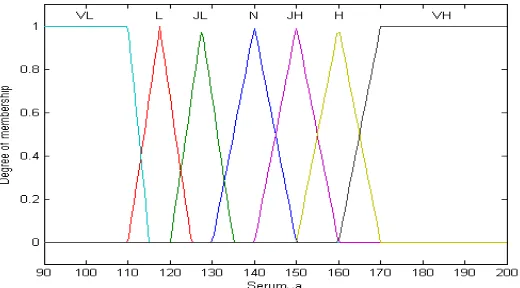
1. Serum_Na: Serum Na is low in hyponatremia. It is measured in mEq/L. Its normal range is 135-145. Seven fuzzy sets VL (Very Low), L (Low), JL (Just Low), N (Normal), JH (Just High), H (High) and VH (Very High) are defined for the severity Serum_Na as given in Table I.
TABLE I FUZZY SETS for SERUM_Na
Sr. No. Serum_Na Fuzzy set
1 µVL [90, 90, 110, 115]
2 µL [ 110, 117.5, 125]
3 µJL [ 120, 127.5, 135]
4 µN [130, 140, 150 ]
5 µJH [140,150,160]
6 µH [150,160,170]
7 µVH [160,170,200,200]
ISSN(Online): 2320-9801
ISSN (Print): 2320-9798
I
nternational
J
ournal of
I
nnovative
R
esearch in
C
omputer
and
C
ommunication
E
ngineering
(An ISO 3297: 2007 Certified Organization)
Vol. 3, Issue 6, June 2015
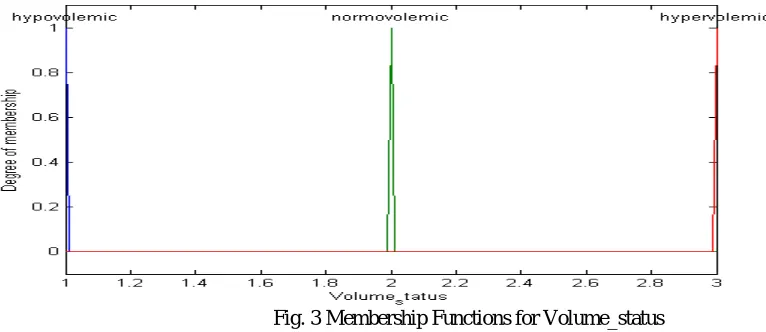
2. Volume_status: Three singleton fuzzy sets hypovolemic (low blood volume), normovolemic (normal blood volume) and hypervolemic (excess blood volume) are defined for the Volume_status as given in Table II.
TABLE II
FUZZY SETS for VOLUME_STATUS
Sr. No. Volume_status Fuzzy set
1 µhypovolemic [1, 1, 1 ]
2 µnormovolemic [ 2, 2, 2]
3 µhypervolemic [ 3, 3, 3]
Singleton membership functions are used for Volume_status as shown in Fig. 3.
Fig. 3 Membership Functions for Volume_status
3. Treatment:This is the output variable of the algorithm. There are total of seven treatment plans considered by researcher by discussing with experts. Fuzzy sets for each treatment are shown in Table III. Fig. 4 shows trapezoidal membership functions used for Treatment.
TABLE III
FUZZY SETS for HYPONATREMIA TREATMENT
Sr. No. Treatment Fuzzy set Sr. No. Treatment Fuzzy set
1 µT1 [0, 0, 0.8, 1.1] 5 µT5 [3.8, 4.2, 4.8, 5.2 ]
2 µT2 [0.8, 1.2, 1.8, 2.2] 6 µT6 [4.8, 5.2, 5.8, 6.2]
3 µT3 [1.8, 2.2, 2.8, 3.2 ] 7 µT7 [5.8, 6.4, 7, 7]
ISSN(Online): 2320-9801
ISSN (Print): 2320-9798
I
nternational
J
ournal of
I
nnovative
R
esearch in
C
omputer
and
C
ommunication
E
ngineering
(An ISO 3297: 2007 Certified Organization)
Vol. 3, Issue 6, June 2015
.
Fig. 4 Membership Functions for Hyponatremia Treatment
B. Fuzzy Rulebase
Fuzzy rule base is developed that consists of 12 fuzzy rules as shown in Table IV.
TABLE IV
FUZZY RULEBASE for HYPONATREMIA
Rule
No. Rule
1 If Na is N And Volume_status is Hypovolemic Then Treatment is T1
2 If Na is N And Volume_status is Normovolemic Then Treatment is T1
3 If Na is N And Volume_status is Hypervolemic Then Treatment is T1
4 If Na is JL And Volume_status is Hypovolemic Then Treatment is T2
5 If Na is JL And Volume_status is Normovolemic Then Treatment is T3
6 If Na is JL And Volume_status is Hypervolemic Then Treatment is T4
7 If Na is L And Volume_status is Hypovolemic Then Treatment is T5
8 If Na is L And Volume_status is Normovolemic Then Treatment is T6
9 If Na is L And Volume_status is Hypervolemic Then Treatment is T6
10 If Na is VL And Volume_status is Hypovolemic Then Treatment is T7
11 If Na is VL And Volume_status is Normovolemic Then Treatment is T7
12 If Na is VL And Volume_status is Hypervolemic Then Treatment is T7
C. Defuzzification
MOM method is used for defuzzification. Min inference and Max aggregation methods have been used.
D. Experimental Results and Discussion
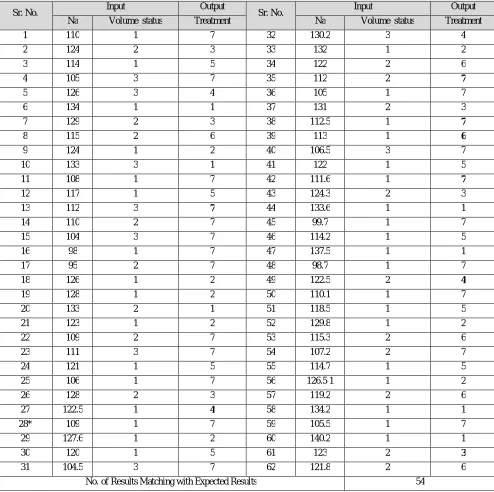
Algorithm is tested on the data set of 62 patients and the results are shown in Table V. Mismatching results are
ISSN(Online): 2320-9801
ISSN (Print): 2320-9798
I
nternational
J
ournal of
I
nnovative
R
esearch in
C
omputer
and
C
ommunication
E
ngineering
(An ISO 3297: 2007 Certified Organization)
Vol. 3, Issue 6, June 2015
TABLE V
EXPERIMENTAL RESULTS of FUZZY ALGORITHM for HYPONATREMIA
Sr. No. Input Output Sr. No. Input Output
Na Volume_status Treatment Na Volume_status Treatment
1 110 1 7 32 130.2 3 4
2 124 2 3 33 132 1 2
3 114 1 5 34 122 2 6
4 105 3 7 35 112 2 7
5 126 3 4 36 105 1 7
6 134 1 1 37 131 2 3
7 129 2 3 38 112.5 1 7
8 115 2 6 39 113 1 6
9 124 1 2 40 106.5 3 7
10 133 3 1 41 122 1 5
11 108 1 7 42 111.6 1 7
12 117 1 5 43 124.3 2 3
13 112 3 7 44 133.6 1 1
14 110 2 7 45 99.7 1 7
15 104 3 7 46 114.2 1 5
16 98 1 7 47 137.5 1 1
17 95 2 7 48 98.7 1 7
18 126 1 2 49 122.5 2 4
19 128 1 2 50 110.1 1 7
20 133 2 1 51 118.5 1 5
21 123 1 2 52 129.8 1 2
22 109 2 7 53 115.3 2 6
23 111 3 7 54 107.2 2 7
24 121 1 5 55 114.7 1 5
25 106 1 7 56 126.5 1 1 2
26 128 2 3 57 119.2 2 6
27 122.5 1 4 58 134.2 1 1
28* 109 1 7 59 105.5 1 7
29 127.6 1 2 60 140.2 1 1
30 120 1 5 61 123 2 3
31 104.5 3 7 62 121.8 2 6
No. of Results Matching with Expected Results 54
ISSN(Online): 2320-9801
ISSN (Print): 2320-9798
I
nternational
J
ournal of
I
nnovative
R
esearch in
C
omputer
and
C
ommunication
E
ngineering
(An ISO 3297: 2007 Certified Organization)
Vol. 3, Issue 6, June 2015
Fig. 5 Surface Diagram
III. FUZZY TUNING
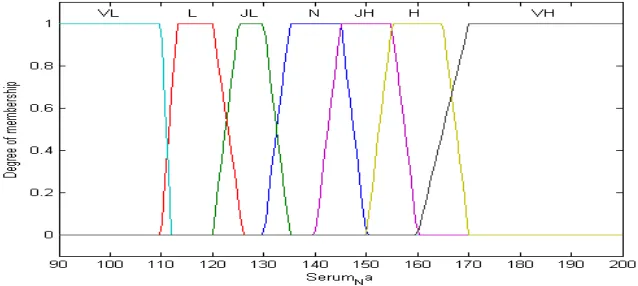
We checked the effect of fuzzification process on the accuracy of algorithm. Fuzzification for Serum_Na is changed from triangular to trapezoidal membership function. New membership functions for Serum_Na are shown in Fig. 6.
Fig. 6 Trapezoidal Membership Functions for Serum_Na
ISSN(Online): 2320-9801
ISSN (Print): 2320-9798
I
nternational
J
ournal of
I
nnovative
R
esearch in
C
omputer
and
C
ommunication
E
ngineering
(An ISO 3297: 2007 Certified Organization)
Vol. 3, Issue 6, June 2015
Fig. 7 Defuzzified Output for Serum_Na=112 and Volume_status=3
It is seen that trapezoidal fuzzification has more accuracy than triangular fuzzification. Table VI shows the result comparison for the two fuzzification methods.
TABLE VI
RESULT COMPARISON of FUZZIFICATION METHODS: HYPONATREMIA
Fuzzification Method
No. Of Accurate Results Obtained
Total No. of Patient Records
% increase in Accuracy 100*(59-54)/54
Triangular 54
62 9.26%
Trapezoidal 59
IV.CONCLUSIONS
Fuzzy system is developed for diagnosis and treatment of Hyponatremia disease. The results are satisfactory and prove that fuzzy logic is best suitable for vague medical domain. Present algorithm suggests treatment for only hyponatremia. It does not treat its complications. The work can further be extended to treat the complications by adding more symptoms and rules. Also, the effect of fuzzification technique on accuracy of algorithm is checked. It is observed that trapezoidal fuzzification has more accuracy than triangular fuzzification.
REFERENCES
[1] A. Muruganathan,“Approach To A Patient With Hyponatremia”, Medicine Update 2011,196-202 [2] J.M.Stachnik, Contemporary Management of Hyponatremia, Pharmacy Practice News Oct.13
[3] Milionis H. J., Liamis G. L., Elisaf M.S., The Hyponatremic Patient: A Systemis Approach to Laboratory Diagnosis, Canadian Medical Association Journal(CMAJ) April 16,2002, 166(8) :1056-1062
[4] M. Black, Vagueness: An Exercise in Logical Analysis, Philosphy of Science, 4, pp. 427- 455,1937
[5] S.R.Mulik, B.T. Jadhav, Fuzziness in Diagnosis and Treatment of Urinary Tract Infections, IJCA Proceedings on International Conference on Recent Trends in Information Technology and Computer Science 2012 ICRTITCS(10):pp. 20-23, February 2013