ISSN(Online): 2320-9801
ISSN (Print): 2320-9798
I
nternational
J
ournal of
I
nnovative
R
esearch in
C
omputer
and
C
ommunication
E
ngineering
(An ISO 3297: 2007 Certified Organization)
Vol. 3, Issue 7, July 2015
Equalization Model Technique for Image
Enhancement Scheme Along with Error
Modeling
P.Susmitha, K. Amarendra Prasad
M.Tech Student, Department of E.C.E, Shree Institute of Technical Education, Tirupathi, India
Assistant Professor, Department of E.C.E, Shree Institute of Technical Education, Tirupathi, India
ABSTRACT: In this paper, we propose a generalized equalization model for image enhancement. Based on our analysis on the relationships among image histogram and contrast enhancement white balancing, we initiallystart a generalized equalization model integrating contrast enhancement and white balancing into a unified framework of convex programming of image histogram. We prove that many image enhancement tasks can be accomplished by the proposed model using different configurations of parameters. With two defining properties of histogram transform, namely contrast gain and nonlinearity, the model parameters for different enhancement applications can be optimized. We then derive an optimal image enhancement algorithm that theoretically achieves the top joint contrast enhancement and white balancing result with trading-off among contrast enhancement and tonal distortion. If any noise added after white balancing and contrast enhancement the noise can be removed by using median filter. Salt and pepper noise can be removed to an optimum extent by using median filter. The image worth measures need to be calculated to know the worth of the image enhanced.
KEYWORDS: contrast gain; contrast enhancement; image histogram; transform; white balance
I. INTRODUCTION
ISSN(Online): 2320-9801
ISSN (Print): 2320-9798
I
nternational
J
ournal of
I
nnovative
R
esearch in
C
omputer
and
C
ommunication
E
ngineering
(An ISO 3297: 2007 Certified Organization)
Vol. 3, Issue 7, July 2015
need to coordinate the inclination field for image reproduction. This is a pretty nearly invertible trouble, accomplished by understanding the Poisson comparison, and has been utilized as of late to accomplish contrast enhancement and consistent image altering. Then again, these strategies are frequently uncomfortable to execute, in light of the fact that they include differential mathematical statements managing a huge number of variables. Rather, we accomplish inclination upgrade by regarding images as tallness fields and handling them in a manner that can be controlled by the single parameter. We represent this as a streamlining issue that expands the neighborhood normal complexity in a image entirely guided by a perceptual limitation got straightforwardly from the human supra edge contrast separation affectability. Moreover, the scope of the shading qualities is entirely compelled to maintain a strategic distance from ancient rarities because of immersion of hues. To take care of this streamlining issue we propose another covetous iterative calculation. We contrast the outcomes from this calculation and existing distinctive worldwide and neighborhood contrast enhancement procedures and demonstrate that our outcomes are predominant than any customary or best in class contrast upgrade methods. By forcing unequivocal requirements in our enhancement detailing, we have the capacity to evade every single normal curio of complexity upgrade like coronas, power wear outandshade movement.
II. LITERATURE SURVEY
In [1] authors used histogram equalization model for image enhancement.Histogram equalization is a technique for adjusting image intensities to enhance contrast. The Histogram Equalization block enhances the contrast of images by transforming the values in an intensity image so that the histogram of the output image approximately matches a specified histogram. This method usually increases the global contrast of many images, especially when the usable data of the image is represented by close contrast values. Through this adjustment, the intensities can be better distributed on the histogram. This allows for areas of lower local contrast to gain a higher contrast. The method is useful in images with backgrounds and foregrounds that are both bright or both dark. In [2] authors used equal area dualistic sub-image histogram equalization. First, the image is decomposed into two equal area sub-images based on its original probability density function. Then the two sub-images are equalized respectively. Finally, we obtain the
results after the processed sub-images are composed into one image. In [8] authors used multi-level histogram
equalization, which consists of decomposing an input image into several sub images, and then applying the classical histogram equalization process to each one. In [10] authors used dynamic histogram equalization which partitions the image histogram based on local minima and assigns specify grey level range for each partition before equalizing them separately.
III. EXISTING SYSTEM
The main goal of imageenhancement is to process a given image so that the outcome is more suitable than the first image for a particular application. It emphasizes or hones image elements, for example, edges, limits, or difference to make a realistic show more accommodating for showcase and examination. The enhancement doesn't expand the intrinsic data substance of the information, yet it builds the dynamic scope of the picked components with the goal that they can be distinguished effectively. The best trouble in image upgrade is evaluating the basis for enhancement and, in this manner, countless enhancement systems are experimental and require intelligent methodology to acquire agreeable results. Image upgrade systems can be in light of either spatial or recurrence space methods.
A.Spatial area enhancement routines
Spatial area methods are performed to the image plane itself and they are in view of direct control of pixels in animage. The operation can be defined as g(x,y) =T[f(x,y)],where g is the yield, f is the information image and T is an operation on f characterized over some area of (x,y). According to the operations on the image pixels, it can be further partitioned into 2 classifications: Point operations and spatial operations (counting direct and non-straight operations).
B. Recurrence areas upgrade techniques
These systems upgrade a image f(x,y) by convoluting the image with a direct, position invariant administrator. The 2D convolution is performed in recurrencearea with DFT.
Spatial area: g(x,y)=f(x,y)*h(x,y)
ISSN(Online): 2320-9801
ISSN (Print): 2320-9798
I
nternational
J
ournal of
I
nnovative
R
esearch in
C
omputer
and
C
ommunication
E
ngineering
(An ISO 3297: 2007 Certified Organization)
Vol. 3, Issue 7, July 2015
The goal is to delineate data image to a yield image such that its histogram. is uniform after the mapping. Let r speak to the dark levels in the image to be improved and s is the upgraded yield with a change of the structure.
IV. PROPOSED METHOD
In this paper, we will investigate the connections between picture histogram and tone/distinction of picture, and develop a summed up equalization model. We will propose a movement of definitionsfor setting free separation, tone bending and its nonlinearity, and clarify their associations to the extent unmistakable parameters the un fined model. The summed up night out model amalgamates histogram base mapping calculation summed up arrangement of curved programming and along these lines is a joint method as exhibited in Broad exploratory results demonstrate that the proposed system can be by and large used as a piece of a progression of update applications with promising results. There set of the paper is sorted out as takes after. In Section build up the relationship amidst histogram and separation/tone of pictures. It is exhibited that white altering is recognized by the direct change of histogram, while differentiation overhaul is accomplished by the nonlinear change of histogram, and both of which are summed up in the proposed model.
White balancing
White parity remedy is a basic photography step, where the objective is "to adjust for diverse shading temperatures of scene illuminants" for instance, tungsten lights reason pictures to have a yellowish cast. Fitting white equalization makes up for this shading cast and yields photographs where items have their common hues, as though taken under an impartial light. At the point when every one of the lights have the same shading, this issue is anything but difficult to fathom for a picture taker who regularly demonstrates a white or dark question in the picture, from which it is clear to recuperate the illuminant shading. Lamentably, numerous scenes show a blend of illuminants, for example, misleadingly lit indoor scenes with extra light from a window from a glimmer. Altering the white balancing is then a testing assignment, notwithstanding for gifted clients. Every point can be lit by the blend of a few light sources, contingent upon their relative separations and introductions. More terrible, cutting edge low-utilization fluorescent and LED lights change broadly in their shading temperature, and rooms with different globules display a plenty of shading throws A couple of programmed methods have been proposed, however the seriously not well postured nature of the issue confines them to particular situations. Case in point, produces perceptual renderings that are regularly not perfect from a photography viewpoint. Hsu et al. can deal with just two light hues, need to know their precise qualities from the earlier, and can't treat scenes with "an in number closer view foundation partition. expect that photographs can be decayed into areas where a solitary illuminant overwhelms.
There exist a lot of methodologies to increase thequality of the image in the enhancement process. Thegeneralized equalization model includes giving a unifiedexplanation to white balancing problem and contrastenhancement problem. It provides an explicit objectivefunction for these two problems and proposing a jointalgorithm for them. Biolog transformation is a new imageenhancement algorithm to preserve the naturalness of animage. This overcomes the drawback of the existing systemand the proposed method can be applied for all kinds ofimage, also a dark image can be brighten to visualize thedark image information.
V. RESULTS AND DISCUSSION
ISSN(Online): 2320-9801
ISSN (Print): 2320-9798
I
nternational
J
ournal of
I
nnovative
R
esearch in
C
omputer
and
C
ommunication
E
ngineering
(An ISO 3297: 2007 Certified Organization)
Vol. 3, Issue 7, July 2015
Fig1. Input Image
Fig 2 is the image after enhancment in this the brightness of the image is improved as compared to the input image.
Fig2. Image Enhancement
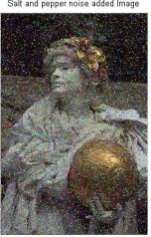
Fig 3 is the image with salt and pepper noise it is generally caused by malfunctioning of camera’s sensor cells, by memory cell failure or by synchronizing error in image digitizing or transmission.
Fig3. Salt & Pepper image
ISSN(Online): 2320-9801
ISSN (Print): 2320-9798
I
nternational
J
ournal of
I
nnovative
R
esearch in
C
omputer
and
C
ommunication
E
ngineering
(An ISO 3297: 2007 Certified Organization)
Vol. 3, Issue 7, July 2015
Fig 4.Median filter image
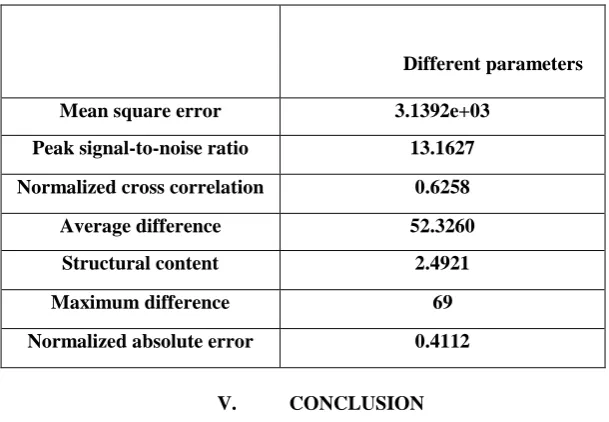
Image quality measure exploiting the difference between corresponding pixels of original and degraded images. Identifying the image quality measures that have high sensivity to these distortion would help to systematic design of coding, communication and imaging system and of improving or optimizing the image quality for a desired quality of service at a minimu cost.
Table for picture quality measures
V. CONCLUSION
Multi Histogram Equalization technique improves image contrast by brightness preserving andgenerates natural looking images.
REFRENECES
[1] Y.-T. Kim, “Contrast enhancement using brightness preserving bi histogram equalization,” IEEE Trans. onConsumer Electronics, vol. 43,no. 1, pp. 1-8, Feb. 1997
[2] Y. Wang, Q. Chen, and B. Zhang, “Image enhancement based on equal area dualistic sub-image histogramequalization method,” IEEE Trans. on Consumer Electronics, vol. 45, no. 1, pp. 68-75, Feb. 1999.
[3] S.-D. Chen and A. Ramli, “Minimum mean brightness error bi-histogram equalization in contrast enhancement,”IEEE Trans. on Consumer Electronics, vol. 49, no. 4, pp. 1310-1319, Nov. 2003.
[4] N. Otsu, “A threshold selection method from grey-level histograms,” IEEE Trans. on Systems, Man and Cyb.,vol. 9, no. 1, pp. 41-47, 1979. [5] C. Wang and Z. Ye,”Brightness preserving histogram equalization with maximum entropy: A variationalperspective,” IEEE Trans. On Consumer Electronics, vol. 51, no. 4, pp. 1326-1334, Nov. 2005.
[6] C. Shannon, “A mathematical theory of communication,” Bell Syst. Tech. J., vol. 27, pp. 379-423, 1948.
Different parameters
Mean square error 3.1392e+03
Peak signal-to-noise ratio 13.1627
Normalized cross correlation 0.6258
Average difference 52.3260
Structural content 2.4921
Maximum difference 69
ISSN(Online): 2320-9801
ISSN (Print): 2320-9798
I
nternational
J
ournal of
I
nnovative
R
esearch in
C
omputer
and
C
ommunication
E
ngineering
(An ISO 3297: 2007 Certified Organization)
Vol. 3, Issue 7, July 2015
[7] M. Luessi, M. Eichmann, G. Schuster, and A. Katsaggelos, “New results on efficient optimal multilevel imagethresholding,” in IEEE International Conference on Image Processing, 2006, pp. 773-776.
[8] David Menotti, Laurent Najman, Jacques Facon, and Arnaldo de A. Araújo “Multi-Histogram EqualizationMethods for Contrast Enhancement and Brightness Preserving”
[9] Sim S., Tso P., and Tan Y., “Recursive Sub Image Histogram Equalization Applied to Gray Scale Images,”Computer Journal of Pattern Recognition Letters, vol. 28, no. 10, pp. 1209-1221, 2007.
[10] Abdullah-Al-Wadud, M., Kabir, Md. Hasanul., Dewan, M. Ali Akber. and Chae, Oksam. (2007) “A DynamicHistogram Equalization for Image Contrast Enhancement” IEEE 2007International Journal of Computer Science, Engineering and Applications (IJCSEA) Vol.3, No.4, August 201324 [11] Young-tack Kim and Yong-hun Cho, “Image Enhancing Method Using Men-Separate HistogramEqualization,” United States Patent, Patent No. 5,963,665, Oct 5, 1999..
[12] J. S. Weszka, R. N. Nagel, and A. Rosenfeld, "A threshold selection technique."IEEE Trans.Comput., vol. C-23,pp. 1322 -1326, 1974
[13] Yu Wan, Qian Chen and Bao-Min Zhang., “Image Enhancement Based On Equal Area Dualistic Sub-ImageHistogram Equalization Method,” IEEE Trans Consumer Electronics, vol. 45, no. 1, pp. 68-75, Feb. 1999.
[14] Manpreet Kaur, Jasdeep Kaur, Jappreet Kaur “Survey of Contrast Enhancement Techniques based onHistogram Equalization” (IJACSA) International Journal of Advanced Computer Science and Applications, Vol.2, No. 7, 2011
[15] R. Gonzalez and R. Woods, Digital Image Processing, 2nd ed. Prentice Hall, Jan. 2002.
[16] Iyad Jafar, and Hao Ying,” Multilevel Component-Based Histogram Equalization for Enhancing the Quality ofGrayscale Images”, IEEE EIT, pp. 563-568, 2007.
[17] Pei C., Zeng C., and Chang H., “Virtual Restoration of Ancient Chinese Paintings Using Color ContrastEnhancement and Lacuna Texture Synthesis,” Computer Journal of IEEE Transactions Image Processing, vol.13, no. 3, pp. 416-429, 2004.
BIOGRAPHY
P. Susmitha has received B.Tech degree in Electronics and communication engineering from
JNTU Ananthapur, India in the year2013. Presently she is with Shree institute of technical Education, Tirupathi, A.P. pursuing M.Tech in specialization of digital electronics and communications. The major areas of interest are communication and signal processing.