Development and Application of a Cross-language Document Comparability
Metric
Fangzhong Su, Bogdan Babych
Centre for Translation Studies, University of LeedsLS2 9JT, Leeds, UK
E-mail: [email protected], [email protected]
Abstract
In this paper we present a metric that measures comparability of documents across different languages. The metric is developed within the FP7 ICT ACCURAT project, as a tool for aligning comparable corpora on the document level; further these aligned comparabl e documents are used for phrase alignment and extraction of translation equivalents, with the aim to extend phrase tables of statistica l MT systems without the need to use parallel texts. The metric uses several features, such as lexical information, document st ructure, keywords and named entities, which are combined in an ensemble manner. We present the results by measuring the reliability an d effectiveness of the metric, and demonstrate its application and the impact for the task of parallel phrase extraction from comparable corpora.
Keywords: comparable corpora, comparability metric, parallel phrase extraction
1.
Introduction
In recent years, the application of cross-lingual comparable corpora (i.e., corpora in different languages that do not contain translated documents, but are within the same subject domain and contain similar text types) has attracted considerable attention in the NLP community. This is primarily driven by the difficulties in collecting large-scale parallel corpora, e.g., limited availability of high-quality human translations between many language pairs (especially for some under-resourced languages and under-represented subject domains). MT developers can collect comparable corpora from the Web with less effort, in comparison to the effort required for the creation of parallel resources.
Most of the applications focus on discovering translation equivalents from comparable corpora to support machine translation. For example, comparable corpora have been successfully used for the tasks of bilingual lexicon extraction (Rapp, 1995, Rapp, 1999, Yu and Tsujii, 2009, Morin et al., 2007, Prochasson and Fung, 2011, Li and Gaussier, 2010), parallel phrase extraction (Munteanu and Marcu, 2006), and parallel sentence extraction (Fung and Cheung, 2004a, Fung and Cheung, 2004b, Munteanu et al., 2004, Munteanu and Marcu, 2005, Smith et al., 2010).
However, successful detection of translation equivalents from comparable corpora very much depends on the quality of these corpora, specifically – on the degree of their closeness and successful alignment on different levels of text units (e.g., corpus, document, and sub-document units). Therefore, the goal of this work is to provide a comparability metric which can reliably identify comparable documents from raw corpora collected by crawling the web, and characterise the degree of their similarity, which enriches comparable corpora with the document alignment information, filters out documents that are not useful and eventually leads to extraction of good-quality translation equivalents from the corpora.
To achieve this goal, we need a qualitative definition and quantitative measures of comparability, which is the key concept for this task, applicable on the level of corpora, documents and sub-document units. However, so far there is no widely accepted definition of comparability, even though this concept is frequently used informally, to characterise the overlap in the subject domain or genre of the compared documents. Fung and Chueng (2004b) define different levels of corpus comparability as below. A noisy parallel corpus contains many parallel sentences that are not strictly aligned. A comparable corpus
contains topic aligned documents that are not translations of each other. A quasi-comparable corpus contains documents that can talk about the same topic or not.
Similar to Fung and Chueng (2004b), we also analyse the degree of comparability for comparable corpus. For the purposes of our study, we can directly characterise comparability by how useful comparable corpora are for the task of detecting translation equivalents in them, and ultimately – how much finally to machine translation. In this work, we focus on document-level comparability, and use three broad categories for qualitative definition of comparability levels:
Parallel documents are traditional parallel texts that are translation of each other, or with minor language-specific variations.
Strongly-comparable documents are texts that are from the same source or independently-written in different languages, but talk about the same event or subject (e.g., linked articles in Wikipedia about the same topic). These documents can be aligned on the document level on the basis of their origin.
Weakly-comparable documents are texts in the same narrow domain which describe different events, e.g., customer reviews about hotels and restaurants in London. These texts do not have an independent alignment across languages.
5.
Application
The comparability metric is useful for collecting high-quality comparable corpora, as it can help filter out low comparable or non-comparable document pairs from the raw crawled corpora. But is it also useful for other NLP tasks, such as translation equivalent detection from comparable corpora? In this section, we investigate its impact to the task of parallel phrase extraction from comparable corpora.
The algorithm of parallel phrase extraction used in our experiments, which develops the ideas of the algorithm presented in (Munteanu and Marcu, 2006), uses the
lexical overlap and the structural matching measures (Ion, 2012). It first splits the source and target documents into phrases (Step 1). Then it computes parallelism score for each possible pair of phrases by using a bilingual dictionary (base dictionary) generated from GIZA++ (Och and Ney, 2003), and retains all the phrase pairs with score larger than a predefined threshold (Step 2). GIZA++ is then applied on the retained phrase pairs to detect new dictionaries entries, which are then added in the base dictionary (Step 3). Using the augmented dictionary, the algorithm iteratively executes Step 2 and Step 3 for several times (empirically set at 5) and outputs the detected phrase pairs.
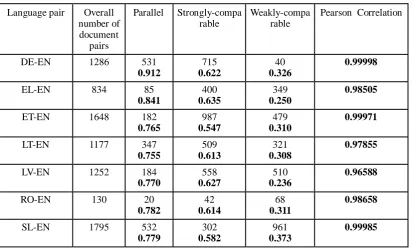
For the experiment of parallel phrase extraction, we use another dataset called USFD corpora, which is much Language pair Overall
number of document
pairs
Parallel Strongly-compa rable
Weakly-compa rable
Pearson Correlation
DE-EN 1286 531
0.912
715 0.622
40 0.326
0.99998
EL-EN 834 85
0.841
400 0.635
349 0.250
0.98505
ET-EN 1648 182
0.765
987 0.547
479 0.310
0.99971
LT-EN 1177 347
0.755
509 0.613
321 0.308
0.97855
LV-EN 1252 184
0.770
558 0.627
510 0.236
0.96588
RO-EN 130 20
0.782
42 0.614
68 0.311
0.98658
SL-EN 1795 532
0.779
302 0.582
961 0.373
0.99985
Table 1: Number of document pairs (top) and average comparability scores (bottom, bold) for different comparability
DE-EN EL-EN ET-EN LT-EN LV-EN RO-EN SL-EN 0
0.1 0.2 0.3 0.4 0.5 0.6 0.7 0.8 0.9 1
Parallel
Strongly-comparable
larger than ICC, and was collected in ACCURAT project by the partner at the University of Sheffield. We test the performance of the extraction algorithm on the same seven language pairs. We first apply our comparability metric on USFD dataset to assign comparability scores for all the document pairs in USFD. For each language pair, we set three different intervals based on the comparability score (SC). They are (1) 0.1<=SC<0.3, (2) 0.3<=SC<0.5, and (3) SC>=0.54. We then randomly select 500 document pairs from each interval, which serve as the data source for parallel phrase extraction. The experiment focuses on counting the number of extracted parallel phrases with parallelism score>=0.45, and computes the average
4
There is not special strategy about the selection of boundary for the intervals. We can set other intervals for experiment as well, such as SC>=0.6, as long as that there is enough amount of comparable document pairs in the corresponding intervals for evaluation.
5
From the evaluation of the parallel phrase extraction performance on a small testing dataset, automatically extracted parallel phrase pairs with parallelism
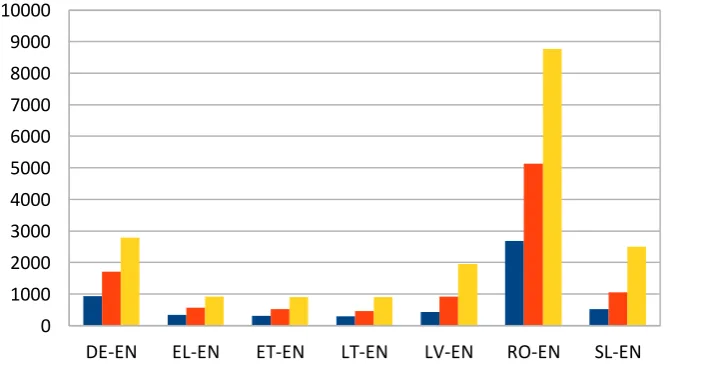
number of extracted phrases per 100000 words (the sum of words in a language pair) for each interval. In addition, the Pearson correlation measure is also applied to measure the correlation between the average comparability score6of each interval and the number of extracted parallel phrases. The results are presented in Chart 2 and Table 2.
From Chart 2 and Table 2, we can see that for all the 7 language pairs, based on the average number of extracted aligned phrases, clearly we have interval (3)>(2)>(1). In other word, higher comparability level always leads to significantly more number of aligned phrases extracted from the comparable documents.
Pearson's R correlation between the average numeric value of the comparability score and the number of extracted equivalents is very close to 1 for all language pairs, which indicates that the metric results are in line score>=0.4 are shown to be more reliable.
6
The average comparability scores computed from the 500 randomly selected document pairs for the three intervals are about 0.2, 0.4, and 0.6, respectively. Language pair 0.1<=SC<0.3
(ave 0.2)
0.3<=SC<0.5 (ave 0.4)
SC>=0.5 (ave 0.6)
Pearson correlation
DE-EN 927 1707 2788 0.9956
EL-EN 340 575 920 0.9940
ET-EN 312 528 897 0.9887
LT-EN 297 466 903 0.9689
LV-EN 433 924 1950 0.9799
RO-EN 2682 5130 8773 0.9936
SL-EN 519 1061 2504 0.9673
Table 2: Number of extracted parallel phrases for different intervals in USFD
Chart 2: Number of extracted parallel phrases for different intervals for different comparability scores in USFD DE-EN EL-EN ET-EN LT-EN LV-EN RO-EN SL-EN
0 1000 2000 3000 4000 5000 6000 7000 8000 9000 10000
0.1<=SC<0.3
0.3<=SC<0.5
SC>=0.5
Louvain-la-Neuve, Belgium.
Sharoff, S., Babych, B., and Hartley, A. (2006). Using comparable corpora to solve problems difficult for human translators. In proceedings of ACL 2006, Syndey, Australia.
Smith, J. Quirk, C., and Toutanova, K. (2010). Extracting parallel sentences from comparable corpora using document level alignment. In proceedings of NAACL 2010, Los Angeles, USA.
Yu, K., Tsujii, J. (2009). Extracting bilingual dictionary from comparable corpora with dependency heterogeneity.
In proceedings of HLT-NAACL 2009, Boulder, Colorado, USA.