Necessity of adopting writing rules
MSA is a natural language with linguistic rules and a typographic system of writing, dialects do not have any standardized set of rules. In fact, there is no reason to write dialects which are usually spo-ken in daily conversations. But a new phenomenon arises with social networks: people are free to write whatever they want and express their opinions such as they speak, it means in their dialect. Accord-ingly, they write dialectal words just as they are pro-nounced. For instance, to writetell him, one would write it, just as he heard it: ”q¯ullu”
ñËñ¯
while the right expression is ”q¯ul l¯u”ñË Èñ¯
(original expres-sion in MSA iséË É¯
).This freedom of writing pushed us to adopt some writing rules for standardizing our corpus. In our work each dialectal word is written by adopting MSA rules, that means if a dialectal word does exist in MSA, it must be written such as in MSA, oth-erwise the word is written as it is uttered. In this last case, we could extract the phonetic directly form from its orthographic representation, which will be necessary in the frame of the ultimate goal of this study which is Speech-To-Speech translation. In Arabic dialects, some foreign words contain non Arabic phonemes, such as /g/ which could be written either with /
¨
/ or /h.
/ such as for the English wordsEnglish and Ghana which are respectively written
ø QÊm.
'@
andA KA «
.However, the few dialectal texts retrieved from the web constitute a big challenge to researchers. This is not only because of the non standardization of or-thographies, but also due to the absence of diacritics as it is the case for MSA and all its dialects (Har-rat et al., 2013). In social networks, Arabic dialects are written in different ways, sometimes in Arabic script, sometimes in Latin one and in some cases such as a mixture of letters and some specific num-bers. For example, the number3is used to represent the phoneme /
¨
/ because of the similarity between3and /
¨
/. In Table 1, we address some Arabic letters and the adopted Arabic numbers used to represent them. Note the similarity in the form between the letters and the numbers.To illustrate the different ways of writing dialects in social networks, in Table 2, some examples of
Al-Table 1: Numbers adopted to represent some Arabic let-ters when Latin grapheme are used to write Arabic
Example Arabic number Arabic letter
tbarra3 3 /
¨
/fra7 7 /
h
/sou9 9 /
/gerian sentences are given.
3 Building a parallel corpus
It is well known that parallel corpora are the foun-dation stone of several natural language processing tasks, particularly cross-language applications such as machine translation, bilingual lexicon extraction and multilingual information retrieval. Building this kind of resources is a challenging task espe-cially when it deals with under-resourced languages (Skadin¸a et al., 2010). The problem is much deeper with the Arabic dialects which are used by a huge number of people only in daily oral communication. Moreover, they are not taught in schools and are absent from formal written communications. This makes building dialectal resources automatically al-most impossible. The few available texts in social networks, usually produced by less educated Arab people are not homogeneous and suffer from the va-rieties in orthography, due to the absence of writing rules. In addition, some Arabic dialects are writ-ten by using Latin graphemes by a slice of Ara-bic societies. The reason is that AraAra-bic language was not widely supported by devices. Consequently, Arab people have been used to this situation by us-ing Latin graphemes.
For all the aforementioned reasons, crawling the web is not a solution to build a parallel corpus, thus, we decided to build it from scratch.
PADIC: A New Parallel Arabic Dialect Corpus
Table 2: Different ways of writing dialects on Facebook.
Cases of writing dialects Dialectal sentences Equivalent in English Written with Arabic letters
AKñ k ¼@P @ð
How do you do my brother? Written only with Latin letters Wachrak khouya? How do you do my brother? Written with a mixture of Latin rabi ya7fedek God protect youletters and Arabic numbers
A sentence that contain both Et bienhakda rak So you have lost both of them Arabic and French words f9edt’houmles deux
French, Berber, ...). Also, because they are not much used on the Web and when it is the case, people use generally Latin script for writing, as we mentioned it in section 2.
A preliminary study of the PADIC corpus was given in (Harrat et al., 2015). The goal of this work is to focus more on Statistical Machine Translation ex-periments from MSA to dialectal Arabic and vice versa. This work in turn is part of a big and challeng-ing project, a Speech to Speech Translation system that we are working on. Challenging not only be-cause speech recognition and speech synthesis are involved, but also because of the lack of dialectal Arabic parallel corpora.
Five dialects, in addition to MSA, are concerned by this study: Annaba’s dialect (ANB), spoken in the east of Algeria, Algiers’s dialect (ALG), used in the capital of Algeria, Sfax’s dialect (TUN) spoken in the south of Tunisia, Syrian and Palestinian dialects (SYR) and (PAL) which are spoken in Damascus and Gaza respectively.2
ANB corpus was created by recording different con-versations from every day life, whereas, for ALG, we used the recordings corresponding to movies and TV shows which are often expressed in the dialect of Algiers. Then we transcribed both of them by hand. To increase the size of the two corpora, we translated each of them into the other. Afterwards, these two corpora have been translated into MSA.
MSA was then used as a pivot language to get other dialectal corpora. To do that, we translated the MSA corpus to TUN, SYR and PAL. The Tunisian corpus
2
The only argument in the choice of these dialects and not others is that the authors of this paper are from Algeria and Tunisia and for the two others we asked kindly colleagues from Syria and Gaza to help us to translate a MSA corpus into these two dialects without any financial compensation. Translating the corpus into Moroccan dialect is under work.
was produced by20native speakers. Each one was responsible of translating almost320sentences from MSA to TUN. Speakers have very slight differences in their spoken languages. All of them are from the south of Tunisia where people tend to use Arabic words rather than French words as it is the case in the north of the country. In fact, the dialect used in the south is closer to MSA than that used in the north of Tunisia. Syrian and Palestinian corpora were created in the same way by respectively two native speak-ers. Finally, we get a multi-dialectal parallel cor-pus PADIC composed of the five aforementioned di-alects, in addition to MSA. PADIC is made of6400
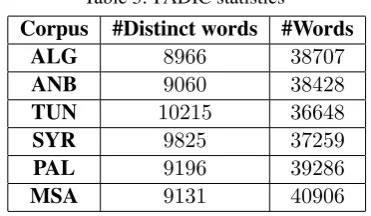
parallel sentences, for which we present some statis-tics in Table 3.
Table 3: PADIC statistics
Corpus #Distinct words #Words
ALG 8966 38707
ANB 9060 38428
TUN 10215 36648
SYR 9825 37259
PAL 9196 39286
MSA 9131 40906
The MSA part contains 40906 words including
9131different words. PADIC includes an average of37500words for one a dialect with a vocabulary which does not exceed10250 words. The average number of words in a dialectal sentence is of6while it is of7for MSA. The shortest sentence in the cor-pus is composed of4words and the longest one con-tains25words.
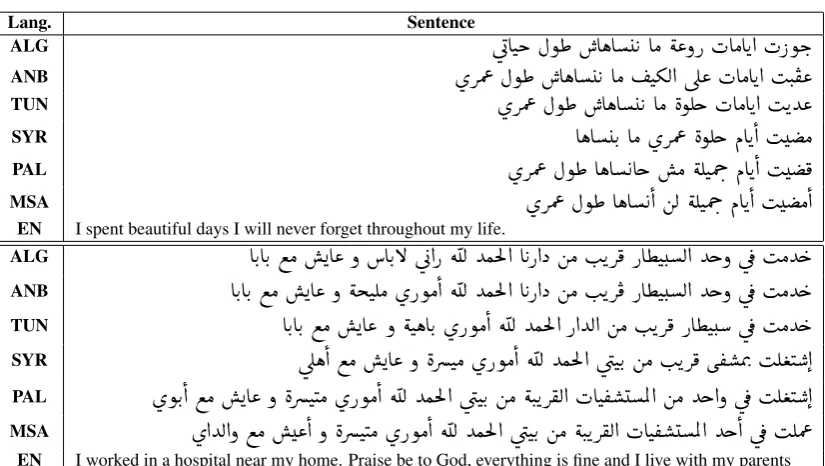
dif-Table 4: Examples of parallel sentences from PADIC
Lang. Sentence
ALG
úGAJk Èñ£ AëA K AÓ é«ðP HAÓAK@ H Pñk.
ANB
øQÔ« Èñ£ AëA K AÓ JºË@ úΫ HAÓAK@ IJ.®«
TUN
øQÔ« Èñ£ AëA K AÓ èñÊg HAÓAK@ IKY«
SYR
AëA K. AÓ øQÔ« èñÊg ÐAK
@ I Ó
PAL
øQÔ« Èñ£ AëA Ag Ó éÊJÔg. ÐAK
@ I ¯
MSA
øQÔ« Èñ£ AëA
@ áË éÊJÔg. ÐAK@ I Ó@
EN I spent beautiful days I will never forget throughout my life.
ALG
AK.AK. ©Ó A« ð AK.B ú G@P é<Ë YÒmÌ'@ A KP@X áÓ I.KQ¯ PA¢J.Ë@ Ygð ú ¯ IÓY g
ANB
AK.AK. ©Ó A« ð éjJÊÓ øPñÓ
@ é<Ë YÒmÌ'@ A KP@X áÓ I.KQ¯ PA¢J.Ë@ Ygð ú ¯ IÓY g
TUN
AK.AK. ©Ó A« ð éJëAK. øPñÓ
@ é<Ë YÒmÌ'@ P@YË@ áÓ I.KQ¯ PA¢J. ú ¯ IÓY g
SYR
úÎë@ ©Ó A« ð èQåJÓ øPñÓ@ é<Ë YÒmÌ'@ úæJK. áÓ I.KQ¯ ù ®Öß. IÊ ªJ @
PAL
øñK.
@ ©Ó A« ð èQåJJÓ øPñÓ@ é<Ë YÒmÌ'@ úæJK. áÓ éJ.KQ®Ë@ HAJ ®ÖÏ@ áÓ Yg@ð ú ¯ IÊ ªJ @
MSA
ø@YË@ð ©Ó «
@ ð èQåJJÓ øPñÓ@ é<Ë YÒmÌ'@ úæJK. áÓ éJ.KQ®Ë@ HAJ ®ÖÏ@ Yg@ ú ¯ IÊÔ«
EN I worked in a hospital near my home. Praise be to God, everything is fine and I live with my parents
ferent.
4 Experiments on Machine Translation of Arabic dialects
In the following, we present several experiments in machine translation in both sides between all the combinations of dialect pairs. We conduct also ex-periments of machine translation between these di-alects and MSA also in both sides.
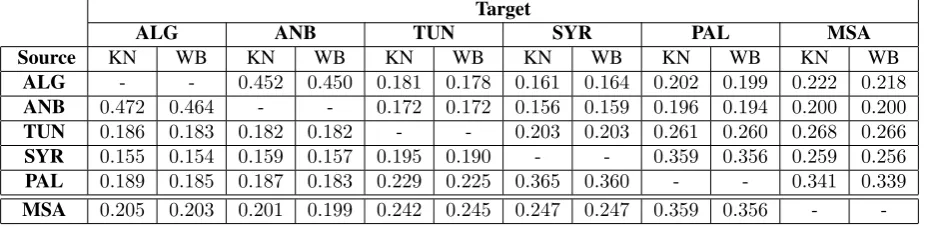
All the MT systems we used are phrase-based (Koehn et al., 2007) with default settings: bidirec-tional phrase and lexical translation probabilities, distortion model, a word and a phrase penalty and a trigram language model. We have not used a larger language model because PADIC is not suitable for large ngrams. We used GIZA++ (Och and Ney, 2003) for alignment and SRILM toolkit (Stolcke, 2002) to compute trigram language models. Since the parallel corpus is small, we experimented the Kneser-Ney and Witten-Bell smoothing techniques hoping to identify the one which best fits. The re-sults conducted on a test set of 500 sentences are presented in terms of BLEU, TER and METEOR in Tables 5, 6 and 7 respectively.
Because it is difficult to increase the size of PADIC, we decided to interpolate the correspond-ing language models by larger Arabic corpora when
the target language is MSA. For this purpose, we used two MSA corpora: Tashkeela3and LDC Ara-bic Treebank (Part3,V1.0) (Maamouri et al., 2004). Unfortunately, the results of the interpolation did not outperform those of Table 5.
5 Discussion
5.1 Impact of the smoothing techniques on BLEU
Several conclusions can be presented regarding re-sults of the Table 5. First of all, for a small par-allel corpus, it seems that the smoothing technique has an impact on the BLEU scores. A difference of almost2points has been observed for translating from ANB to ALG. But, we can not generalize by affirming that one smoothing technique is definitely better than another. We have not calculated the sig-nificance of this difference because our corpus is too small, consequently we can not have several small test corpora in order to perform significance tests. In order to have an idea about the impact of the smooth-ing technique on the results and to have a scale com-parison of the BLEU for small corpora we did some
3
Table 5: BLEU score of Machine Translation on different pairs of languages using two smoothing techniques
Target
ALG ANB TUN SYR PAL MSA
Source KN WB KN WB KN WB KN WB KN WB KN WB
ALG - - 61.06 60.81 9.67 9.36 7.29 7.95 10.61 10.14 15.1 14.64
ANB 67.31 65.55 - - 9.08 8.64 7.52 7.95 10.12 9.84 14.44 13.95
TUN 9.89 9.48 9.34 9.01 - - 13.05 12.93 22.55 22.21 25.99 25.21
SYR 7.57 7.50 7.50 7.64 13.67 13.23 - - 26.60 25.74 24.14 22.96
PAL 11.28 10.67 9.53 9.15 17.93 16.64 23.29 23.07 - - 40.48 39.76
MSA 13.55 13.05 12.54 11.72 20.03 20.44 21.38 20.32 42.46 41.37 -
-Table 6: TER score (in %) of Machine Translation on different pairs of languages using two smoothing techniques
Target
ALG ANB TUN SYR PAL MSA
Source KN WB KN WB KN WB KN WB KN WB KN WB
ALG - - 21.41 21.75 75.17 76.37 79.54 79.51 69.63 70.75 65.63 66.85
ANB 17.12 17.81 - - 74.83 75.62 79.13 79.13 69.10 70.26 67.40 68.47
TUN 71.10 71.76 73.13 73.71 - - 66.03 66.55 51.20 51.57 50.85 51.30
SYR 76.89 77.67 76.89 77.67 66.54 67.91 - - 32.28 33.24 52.81 53.59
PAL 71.43 72.51 72.25 73.47 58.51 59.65 32.44 33.86 - - 36.74 36.87
MSA 67.02 67.91 68.94 70.16 57.18 57.28 56.60 57.08 34.00 34.66 -
-Table 7: METEOR score of Machine Translation on different pairs of languages using two smoothing techniques
Target
ALG ANB TUN SYR PAL MSA
Source KN WB KN WB KN WB KN WB KN WB KN WB
ALG - - 0.452 0.450 0.181 0.178 0.161 0.164 0.202 0.199 0.222 0.218
ANB 0.472 0.464 - - 0.172 0.172 0.156 0.159 0.196 0.194 0.200 0.200
TUN 0.186 0.183 0.182 0.182 - - 0.203 0.203 0.261 0.260 0.268 0.266
SYR 0.155 0.154 0.159 0.157 0.195 0.190 - - 0.359 0.356 0.259 0.256
PAL 0.189 0.185 0.187 0.183 0.229 0.225 0.365 0.360 - - 0.341 0.339
cor-Table 8: Statistics on machine translation with small training corpus and by varying the smoothing techniques of the language model.
KN WB
Corpus Min Max E[X] σ2
Min Max E[X] σ2 σ
XY p-value
S2 4.25 9.56 6.64 2.47 4.1 8.97 6.43 2.23 2.33 0.33 S5 5.15 11.75 8.15 3.26 5.18 11.32 7.99 2.92 3.16 0.35 S12 5.94 14.38 9.58 4.62 5.95 14.13 9.35 4.32 4.45 0.36 S15 6.13 14.39 9.91 4.85 6.19 14.27 9.74 4.72 4.75 0.39
of machine translation by varying the smoothing techniques and by interpolating it with a larger one trained on well known corpora. Unfortunately the results are not significant even if in some cases we get some improvements.
The best results of translation are achieved between the dialects of Algeria. This is not a surprising result since they share a large part of the vocabulary. And even if the size of the training corpus is weak, we noticed that the BLEU is very high. The perfor-mance of machine translation between Palestinian and Syrian are relatively high in accordance to the size of the corpus. This could be explained by the closeness of the two regions. The worst result is achieved between Syrian and Algerian dialects which are, in fact, very different since the Algerian borrowed a lot of French words which do not exist obviously in the Syrian dialect. Concerning MSA, the best results of machine translation have been achieved with Palestinian dialect. This means that the two languages are very close since they share a large number of words.
Our future work consists in extending PADIC to other dialects such as Moroccan in order to have the dialects of the three countries of Maghreb and then we will work on using the large existing corpora of MSA to rewrite part of them into dialects.
Acknowledgement This work has been sup-ported by PNR (Projet National de Recherche of Al-gerian research Ministry).
References
Houda Bouamor, Nizar Habash, and Kemal Oflazer. 2014. A Multidialectal Parallel Corpus of Arabic. In
Proceedings of the Language Resources and Evalua-tion Conference, LREC-2014, pages 1240–1245. David Chiang, Mona Diab, Nizar Habash, Owen
Ram-bow, and Safiullah Shareef. 2006. Parsing Arabic Dialects. InProceedings of the European Chapter of ACL (EACL).
Heba Elfardy and Mona Diab. 2013. Sentence Level Di-alect Identification in Arabic. InACL (2), pages 456– 461.
Nizar Habash and Owen Rambow. 2006. Magead: A Morphological Analyzer and Generator for the Ara-bic Dialects. InProceedings of the 21st International Conference on Computational Linguistics and 44th Annual Meeting of the Association for Computational Linguistics, pages 681–688.
Nizar Habash, Ryan Roth, Owen Rambow, Ramy Eskan-der, and Nadi Tomeh. 2013. Morphological analysis and disambiguation for dialectal arabic. In Proceed-ings of NAACL-HLT, pages 426–432, Atlanta, Geor-gia.
Salima Harrat, Mourad Abbas, Karima Meftouh, and Kamel Smaili. 2013. Diacritics restoration for arabic dialect texts. InProceedings of 14th Annual Confer-ence of the International Communication Association (Interspeech), pages 125–132.
Salima Harrat, Karima Meftouh, Mourad Abbas, and Kamel Smaili. 2014. Building resources for algerian arabic dialects. InProceedings of 15th Annual Confer-ence of the International Communication Association (Interspeech), pages 2123–2127.
Salima Harrat, Karima Meftouh, Mourad Abbas, Salma Jamoussi, and Kamel Smaili. 2015. Cross-dialectal arabic processing. InComputational Linguistics and Intelligent Text Processing, 16th International Confer-ence, CICLing 2015 proceeding, part 1, pages 620– 632, April.
Hanaa Kilany, H. Gadalla, Howaida Arram, A. Yacoub, Alaa El-Habashi, and C. McLemore. 2002. Egyptian Colloquial Arabic Lexicon. InLDC catalog number LDC99L22.
IEEE Intl. Conf. on Acoustics, Speech, and Signal Pro-cessing, pages 344–347.
Philipp Koehn, Hieu. Hoang, Alexandra Birch, Chris Callison-Burch, Marcello Federico, Nicola Bertoldi, Brooke Cowan, Wade Shen, Christine Moran, Richard Zens, Chris Dyer, Ondrej Bojar, Alexandra Con-stantin, and Evan Herbst. 2007. Moses: Open Source Toolkit for Statistical Machine Translation. Proceed-ings of the Annual Meeting of the Association for Com-putational Linguistics, demonstation session, pages 177–180.
Mohamed Maamouri, Ann Bies, Tim Buckwalter, and Hubert Jin. 2004. Arabic treebank: Part 3 v 1.0. In
Linguistic Data Consortium.
Franz Josef Och and Hermann Ney. 2003. A Systematic Comparison of Various Statistical Alignment Models.
Computational Linguistics, Volume 29, No 1, pages 19–51.
Arfath Pasha, Mohamed Al-Badrashiny, Ramy Kholy Ahmed El Eskander, Mona Diab, Nizar Habash, Manoj Pooleery, Owen Rambow, and Ryan Roth. 2014. Madamira: A fast, comprehensive tool for morphological analysis and disambiguation of arabic. In LREC 2014, Language Resources and Evaluation Conference, Reykjavik, Iceland.
Tachicart Ridouane and Bouzoubaa Karim. 2014. A hy-brid approach to translate moroccan arabic dialect. In
SITA’14, 9th International Conference on Intelligent Systems.
Wael. Salloum and Nizar. Habash. 2012. Elissa: A dialectal to standard arabic machine translation sys-tem. In Coling’2012, 24th International Conference on Computational Linguistics, pages 385–392. Wael Salloum and Nizar Habash. 2013. Dialectal
Ara-bic to English Machine Translation: Pivoting through Modern Standard Arabic. InProceedings of the 2013 Conference of the North American Chapter of the As-sociation for Computational Linguistics: Human Lan-guage Technologies, NAACL HLT 13, pages 348–358. Hassan. Sawaf. 2010. Arabic dialect handling in hybrid machine translation. InAMTA’2010, 9th Conf. of the Association for Machine Translation in the Americas. Inguna Skadin¸a, Ahmet Aker, Voula Giouli, Dan Tufis,
Robert Gaizauskas, Madara Mierin¸a, and Nikos Mas-tropavlos. 2010. A Collection of Comparable Corpora for Under-resourced Languages. InProceedings of the 2010 Conference on Human Language Technologies – The Baltic Perspective: Proceedings of the Fourth In-ternational Conference Baltic HLT 2010, pages 161– 168.
Andreas Stolcke. 2002. Srilm – an Extensible Language Modeling Toolkit. InICSLP, pages 901–904, Denver, USA.