Event Based Emotion Classification for News Articles
Minglei Li, Da Wang, Qin Lu, Yunfei Long
Computing Department, The Hong Kong Polytechnic University,
Hung Hom, Hong Kong
{
csmli, csluqin, csylong
}
@comp.polyu.edu.hk
[email protected]
Abstract
Reading of news articles can trigger emotional reactions from its readers. But comparing to other genre of text, news articles that are mainly used to report events, lack emotion linked words and other features for emotion classification. In this paper, we propose an event anchor based method for emotion classi-fication for news articles. Firstly, we build an emotion linked news corpus through crowd-sourcing. Then we propose a CRF based event anchor extraction method to identify event related anchor words that can poten-tially trigger emotions. These anchor words are then used as features to train a classifier for emotion classification. Experiment shows that our proposed anchor word based method achieves comparable performance to bag-of-word based method and it also performs bet-ter than emotion lexicon features. Combining anchor words with bag-of-words can increase the performance by 7.0% under weighted F-score. Evaluation on the SemEval 2007 news headlines task shows that our method outper-forms most of other methods.
1
Introduction
Emotion classification from text, an extension of sentiment analysis, aims at assigning emotional la-bels to a given text. It has wide applications such as customer review (Pang et al., 2002), emotion based recommendation (Cambria et al., 2011), emo-tional human-computer interaction (Hollinger et al., 2006), eLearning (Rodriguez et al., 2012), etc. It is also important to understand reader’s emotion re-actions for reading news articles as they may trigger
emotionally charged reactions which may lead to se-rious social and political consequences. However, news articles are normally used to describe recent events. To maintain objectivity, writers normally avoid using subjectivity and emotion-linked words. Thus, current works on emotion analysis, which use more social media type of text, would not work well for news text.
words and use them as features for emotion classi-fication. The main steps involved in event anchor word extraction involves three steps: First, we make use of the ACE 2005 data as our raw source cor-pus where event information was already annotated and crowdsourcing is used to obtain emotion linked labels for the news articles. Second, we use the an-notated event information to train a CRF model for event anchor words extraction. Last, the extracted event anchor words can then be used as features to train a classifier for emotion prediction. This is dif-ferent from lexicon based method because lexicon based method relies on externally prepared knowl-edge. In contrast, anchor words are automatically extracted from training data to be used as features. The main contributions of this work include:
1. The construction of an important annotated re-source for event based emotion analysis based on ACE 2005 English news articles which can be made available to the research community. 2. The identification of more suitable features
for document level emotion classification of news articles without emotion lexicon, and a feasible feature extraction method, which can also be used by other event based applications. The proposed features are more effective than emotion lexicon features and can improve the performance when combined with the bag-of-word features.
The rest of the paper is organized as follows: Sec-tion 2 discusses related works for emoSec-tion classifi-cation. Section 3 introduces the construction of the annotated corpus as a training data resource. Sec-tion 4 presents our event anchor word extracSec-tion and emotion analysis framework. Section 5 gives perfor-mance evaluation. The conclusion and future work are summarized in section 6.
2
Related Works
Any method on emotion analysis must rely on an emotion model to provide a framework for emo-tion classificaemo-tion. Emoemo-tion models can be char-acterized as discrete models and coordinate based
els (Xu and Lin, 2008), etc. Dimension based models include evaluation-activation based els (Whissell, 1989) and valence-arousal based mod-els (Russell, 1980; Mehrabian, 1996; Wang et al., 2015), which is widely used for emotion classifica-tion. When using dimension based models, emotion prediction becomes a regression problem to predict the values in the two axis (Wu et al., 2013). When using discrete models, emotion prediction becomes a multi-class classification problem, which is the most commonly used methods in literature. This two representation methods are well compared in (Calvo and Mac Kim, 2013).
One of the problems that hinder emotion analysis is the lack of training data. Annotated emotion cor-pus is relative scarce compared to other NLP tasks. Manually labeled emotion corpora include SemEval 2007 for news headlines (Strapparava and Mihal-cea, 2007), RenCECps for blogs in both sentence and document levels (Quan and Ren, 2009), and NLP&CC 2013 for Chinese microblogs. Because of the rapid development of social networks, many studies also try to automatically construct emotion corpus from the web using reader added emotion tags as labels. Lin crawled a news article corpus based on the emotion related tags by readers from Yahoo!s news (Lin et al., 2007). Hashtags, emoti-cons, and emoji characters are also used as naturally annotated labels to construct large emotion corpus from social media (Bandhakavi et al., 2014; Mo-hammad et al., 2013; Wang et al., 2012). However, these naturally annotated labels often contain noise. A recent trend is to make use of crowdsourcing to obtain annotated data. Crowdsourcing can be re-liable if some control strategies are properly used. Example of resources obtained by crowdsourcing in-clude lexicons constructed by Hutto (2013) and Mo-hammad (2013).
system, Strapparava (2008) represents each emo-tion and text using latent semantic analysis (LSA) and analyzes the corresponding emotion based on the similarity between the text and the correspond-ing emotions. Machine learncorrespond-ing based methods, on the other hand, heavily rely on the availability of training data as well as good feature selection meth-ods. Mohammad shows that the combined using of emotion lexicon and N-gram features is more effec-tive than N-gram feature only (Mohammad, 2012). Quan makes use of emotional words based features and tries to apply them to different classifiers such as SVM, Naive Bayes, and decision trees for sen-tence level blog emotion classification (Quan and Ren, 2009). Based on word embedding, Chen uses a sentence vector in combination with ML-KNN for microblog data (Chen et al., 2014). Inspired by Po-ria (2014) that uses dependency features and CRF model, a segment-based method is proposed to ex-tract sentence segments using dependency trees and the semi-CRF model is used to label emotions of all the segments, and then the log linear model is used to infer the final emotion of the whole sen-tence (Wang, 2014). Similar idea is adopted by Wen (2014) where the data mining technique class se-quential rules (CSR) mining is used to analyze the emotion of the whole microblog containing several sentences.
Based on psychological studies that events can trigger emotions (Cacioppo and Gardner, 1999), many studies propose event based emotion predic-tion methods. Tokuhisa extracts events that can trigger emotions from the web based on emotion words and uses k-NN to predict new text for di-alogs (Tokuhisa et al., 2008). Extending from Tokuhisa (2008), Vu constructs an event corpus by first defining a set of seed events and then extends it using boot-strapping (Vu et al., 2014). Lee builds an emotion linked event corpus from Chinese sto-ries (Lee et al., 2014). Li proposes a system to de-tect and extract the cause event in microblogs, and uses these events as features to train a classifier for emotion prediction in microblogs (Li et al., 2014).
3
Corpus Construction
In order to serve the objective of our work for event based emotion prediction on news articles, we need
to first prepare an appropriate training data which is currently not available. With consideration of re-sources, we choose to use the crowsourcing platform to annotate the data.
3.1 Data Source
The raw data comes from the Automatic Content Ex-traction 2005 (ACE 2005), a complete set of multi-language training data for the ACE 2005 evaluation (Walker et al., 2006). In this work, we only use the English collection of Automatic Content Extrac-tion 2005 (ACE 2005)1which contains 754 English texts collected from newswire (18.57%), broadcast news (39.79%), broadcast conversation (9.15%), web log (18.30%), UseNet newsgroups/discussion forum (8.22%), and conversational telephone speech (5.97%). Though not all of these texts are news ar-ticles, they are all descriptions about events, consis-tent for our event based emotion analysis for news articles. So we simply name this set of the data as the news articles in the rest of this paper.
The news articles dataset was originally created by the Linguistic Data Consortium (LDC) prepared for event identification. The news articles dataset al-ready have annotated event related information such as the anchor words for events, event types and event subtypes. For example, in the below sentence,114 people were wounded in Tues-day’s southern Philip-pines airport, it contains an event aboutinjury. The event anchor word is ”wounded” while the event type and subtype are ”Life” and ”Injure” corre-spondingly. This dataset is quite appropriate to serve as the training data for our work because it is highly related with event description. However, there is no emotion related annotation that can be used directly as training data for emotion analysis.
3.2 Data Annotation
In order to use this collection as training data, we need to identify the emotion associated with each ar-ticle. For annotation, we choose the most commonly used emotion model (Ekman, 1993), which includes six discrete emotion labels:anger, disgust, fear, joy, sadness, and surprise, respectively. We also add the category,neutral, to be used for those articles which may not trigger any emotion. This label is
partic-1http://www.itl.nist.gov/iad/mig/tests/ace/2005/
each article to be annotated by 5 contributors. Ob-viously, there may be different labels given by dif-ferent annotators. The principle is to use the major-ity as the label for each article. If the result has no majority, the filtering process after crowdsourcing is initiated. The annotation platform used is Crowd-Flower2. To ensure quality of annotation, a qual-ity control (QC) mechanism is included in Crowd-Flower to prevent people from randomly labeling the text (and also possibly eliminate people who have low English proficiency). Inspired by Hutto (2014), the QC process is conducted through a four step pro-cess as described below:
1. A subsetH of eight articles are labeled by the research team as the ground truth for QC pur-pose. We asked 3 persons in the research team to serve as experts to annotate a selected set of articles independently. The articles which re-ceived the same labels by all three people are used as the ground truth for future usage.
2. We choose a subsetHt (6 articles) fromH as quality test data and the contributors who cor-rectly labelled 80% inHt are qualified for fu-ture batches of work. Here correctness means the label given by the contributor is the same as the ground truth.
3. In the real annotation tasks, we randomly pick one instance fromHin every batch of 6 articles to test whether they are doing random labeling. Results by those who wrongly labeled the test instances are discarded and the person will not be given new tasks. Even though this added re-dundancy costs more for annotation, it gives us more assurance of the quality of acquired data.
4. After completing the annotation for each arti-cle, the annotators are asked to briefly give ra-tionales for their choice of label. We randomly check the written responses to ensure that the contributors are not making random choices.
2http://www.crowdflower.com/
4 3,1,1,0,0 22.68%(171) 15.78%(119) 5 2,2,1,0,0 22.81%(172) 10.08%(76) 6 2,1,1,1,0 26.13%(197) 20.42%(154)
7 1,1,1,1,1 4.24%(32)
-Sum 100.00%(754) 60.74%(458)
Fleiss Kappa 0.212
Table 1: Crowdsourcing based annotation result
Table 1shows the distribution of the seven types of patterns in the annotation result (including the ar-ticles inH. Different annotators may give the same article different labels. The first pattern (5,0,0,0,0) means that all five annotators gives an identical emo-tion label. The second pattern (4,1,0,0,0) means 4 people give the same label whereas one person gives a different label. The pattern (1,1,1,1,1) means that every annotator give it a different emotion label. The labels for text inH are also refined through the la-bels given by the contributors. The 3rd column in Table 1shows the distribution percentage (%) and total articles number (Number) and the last column shows the percentage for data that have one major label and falls into the non-neutral categories. Out of the 7 possible patterns, only 3.18% of data falls into Type 1, the best scenario where the same label is given by all annotators. In Type 7, everyone gives a different label and 4.24%( 32 articles) of data falls into this category.
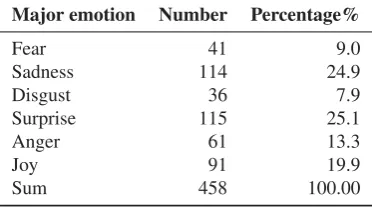
consider five of the patterns to have a major shared emotion including Type 1 to Type 4 and type 6. If the major label is the neutral label, however, the data will be removed. In other words, only the articles that has non-neutral labels are used as training data. In fact, in our data, 22.28% percent of annotated data falls into the neutral class which is only natural for news type of text. Obviously, this is very different for text from social media. The Type 5 pattern in-dicates two major emotion labels with equal num-bers. Only if one of the major labels is neutral, the data is retained. Finally, we obtain 458 (60.74% of 754) articles with an improved Fleiss Kappa value of 0.214 (fair agreement), which is slightly better than the original 754. The distribution of the 6 emotion classes for the 458 articles are listed inTable 2. Note that the ratio of the largest set to the smallest set is about 3.2. Compare to other genre of text, the train-ing data is not so skewed as the emotion labels in social media based corpus (Chen et al., 2014). To support research in emotion analysis. We make the annotated data available.3
Major emotion Number Percentage%
Fear 41 9.0
Sadness 114 24.9
Disgust 36 7.9
Surprise 115 25.1
Anger 61 13.3
Joy 91 19.9
Sum 458 100.00
Table 2: Emotion distribution of obtained data
4
Our Proposed Method
Our method for classification consists of two parts: the first part is anchor word extraction and the sec-ond part is the appropriate classification method for emotion classification.
4.1 Anchor Word Extraction
Many emotion prediction methods use NLP related features such as N-gram, POS tags, and position in-formation of lexical sequences because they can be easily extracted to train classifiers. The ACE 2005 data contains many annotated latent information can
3https://github.com/MingleiLI/ACE2005 emotion corpus
potentially be useful for event identification. The annotated data in ACE 2005 at the summarization level includes topic, event type, event subtype, and event anchor word, etc. However, without appropri-ate method to extract lappropri-atent information for testing data, they cannot be used. Because of this reason, other than lexical features which we can extract us-ing NLP tools, most of the annotation information in ACE 2005 are not used as it is difficult to auto-matically infer event related summary information. We choose to focus our attention on extract event anchor words (anchors for short) as our features be-cause they are easier to extract. Generally speaking we can consider event anchor word extraction as a kind of keyword extraction. The only difference is that the keyword here is linked to certain event (in-dicated by actions), and thus events provide the cues to identify the corresponding anchors.
Problem definition: Given a text sequence,X = {x1, x2, . . . , xn}wherexi is a corresponding word andnis the number of words inX. Our goal is to find one or more wordsxj, . . . , xk used to describe the event inX. This problem can be converted into a sequential labeling problem. The objective of se-quential labeling is to find the corresponding label sequenceY = {y1, y2, . . . , yn}whereyi ∈ {0,1}; 0 means not an anchor word; 1 otherwise. As this is a typical sequential labeling problem, the Condi-tional Random Field (CRF) algorithm can be used for anchor word extraction, the same method used by Zhang for keyword extraction (Zhang, 2008). The most important performance issue for CRF is feature construction. In our algorithm, we consider a context window of 2 on both sides of an anchor. Since we can easily use NLP tools to identify POS tags, features considered for anchor words include both the context words and their POS tags. The CRF model is trained using our 754 news articles which already contain the anchor annotation.
4.2 Classifier for Emotion Classification
4.3 Features Used for Emotion Classification
To train an emotion classifier, we investigate the fol-lowing features which are potentially useful. All features are considered using a context window of 5. In addition to an anchor word, the 2 words on each side of the anchor are included.
1. F1: Frequency of anchors - Occurrences of an identified anchor word in an article.
2. F2: Word similarity- Similarity between an-chors and all the other words in the article. The motivation is if more words with similar mean-ing occur, the emotion tendency is more ap-parent. Similarity calculation is based on Lin’s similarity module of WordNet, which is based on information content (Pedersen et al., 2004). 3. F3: Frequency of POS tag of anchors-
Oc-currences of POS tags of anchors.
4. F4: Frequency of POS tag of context- Oc-currences of POS tag of context words. context words are not used because our training dataset is small.
Based on the above features, we form different ture sets to evaluate the effectiveness of these fea-tures and select the best one.
5
Performance Evaluation
Evaluations are conducted for both the event anchor word extraction and the selection of features in emo-tion predicemo-tion.
5.1 Evaluation on Anchor Word Extraction
Since anchor words are used to identify events, an-chor word extraction can use all the 754 news ar-ticles as training data. The Stanford POS tagger is used for POS tagging4. CRF++5 is used for event anchor extraction. As the training data is relatively small, 10-fold, 5-fold and 3-fold cross validation are conducted to see the effect of data size to anchor ex-traction performance. Results are shown inTable 3:
4http://nlp.stanford.edu/software/tagger.shtml 5http://taku910.github.io/crfpp/
Table 3: Event anchor word extraction result
Table 3 shows that the size of training dataset does affect performance. However, the difference is mostly on recall. From 3-fold to 10-fold, the in-crease in F-score is only little over 2% when the training data size is increased by about 35%. Close examination found that the extracted anchors are very stable. In other words, they are very similar under similar event types and similar topics. Thus, they are very good representatives. For example, if a news text is aboutinjury, it is highly likely that the text would contain anchor words such aswounded or injured. Anchor extraction is a special kind of keyword extraction, yet its performance is much bet-ter compared to the state-of-art keyword extraction (Hasan and Ng, 2014) which has F-score of 31.7% on news articles. In addition, event anchor extrac-tion is different because general keyword extracextrac-tion focuses on extracting only a few keywords for the whole article while anchor extraction focuses on on extracting keyword more at the sentence level where the event is described. Ultimately, we care if the ex-tracted anchors do serve as good features for emo-tion classificaemo-tion.
5.2 Evaluation on Emotion Classification
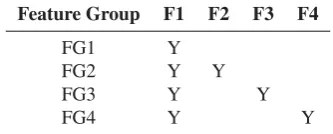
(F1 to F4), our test plan tries four feature groups to explore the best feature combination as shown in Ta-ble 5. In the first feature group (FG1), only anchor words are used. The other three groups use the ba-sic anchor words to be combined with an additional single feature.Table 5gives the F-score of the 4
fea-Feature Group F1 F2 F3 F4
FG1 Y
FG2 Y Y
FG3 Y Y
FG4 Y Y
Table 4: Feature combinations
ture groups with details on the performance of each emotion type. The Weighted F-scores in the last row is the micro average of individual F-scores.
Emotion FG1 FG2 FG3 FG4
Fear 12.9 21.8 13.8 12.4
Sadness 44.4 36.0 46.0 40.6
Disgust 6.50 3.2 5.3 0.0
Surprise 36.4 31.1 29.5 22.4
Anger 18.8 15.9 19.9 14.5
Joy 30.0 27.0 31.8 30.2
Weighted F-score 30.3 26.5 29.5 24.7
Table 5: Performance of different feature combinations
Table 5shows that the best feature group is FG1 which takes only anchor text using frequency as the feature. The POS tags of context words (FG4) is the noisiest and produces the worst result. The use of the additional POS tags for anchor words (FG3) does not give overall better result. Yet, it gives better per-formance in 3 emotion types. Compared to the other two features, it is the least noisy because the perfor-mance degradation is less than 1%. This may be be-cause frequency information is already used by FG1, and the frequency of POS tags of anchors are largely represented. It is interesting to see that context word does not give overall gain in performance except in the Fear emotion type. We can generally conclude that using POS tags do not translate into overall per-formance improvement. The F2 similarity feature degrades the performance maybe because this simi-larity is based on semantic simisimi-larity, not emotional similarity. In conclusion, anchor word as single
fea-ture achieves the best performance and thus we only use anchor words in the following experiments.
In thesecondset of experiments, we compare our event anchor based (EA) features to features used by other works for emotion classification using news articles. The features used by other methods include (1) lexicon feature based method (LF) which simply use a given emotion lexicon as features; (2) Bag of word (BOW) (Mohammad, 2012); (3) LF plus BOW based method (LF+BOW) that combines BOW and LF by increasing the weight of words that occur in the emotion lexicon, and (4) feature combination of event anchor words with BOW (EA+BOW) which does not use any external knowledge. The lexicon for LF is from WordNet-Affect (Strapparava and Valitutti, 2004). The parameters of SVM are the same for all SVMs used in this experiment. The re-sult of F-score is shown inTable 6.
Table 6 shows that LF achieves the worst re-sult which indicates that classification based only on an externally provided lexicon is not enough for document level emotion classification. BOW and EA use training data supplied information without any external knowledge and achieve much better re-sult than LF as they are learning based methods. Our event anchor word based EA method achieves 75.1% better result than lexicon feature and slightly better performance than BOW based method. In this experiment, the size of the anchor words is 890, far smaller than the size of BOW at 13,793. This indicates that fewer effective features can actually achieve comparable result. As combined features, LF+BOW achieves better result than BOW (when LF in BOW is given more emphasis), which is con-sistent with the result of (Mohammad, 2012). In EA+BOW, anchor words in the bag of words are also given extra weight, and the performance is in-creased by 2.1% compared to BOW, which trans-lates to 7.0% improvement over using BOW alone and also 4.9% improvement over using LF+BOW. The experiment shows that event anchors are more effective features than emotion lexicon and bag-of-words for news article emotion classification. This validates our assumption that news articles trigger emotions through specific set of event anchor words. Just a note that experiments show that increasing the frequency LF or EA in LF+BOW and EA+BOW by 3 achieves the best result.
Disgust 6.5 4.7 6.5 7.3 4.7
Surprise 20.8 28.8 30.4 28.8 30.8
Anger 11.1 24.7 18.8 24.6 30.2
Joy 27.1 35.9 30.1 40.6 32.5
Weighted
F-score 17.3 30.2 30.3 30.8 32.3
Table 6: Results on Crowdsourcing Annotated Data
The third set of experiments are conducted on the SemEval 2007 data to test the usefulness of our proposed anchor feature. The SemEval 2007 affec-tive task contains 1,000 annotated news headlines for testing and 250 annotated headlines as develop-ment data (though labelled, but too small to be used as training data). The dataset is similar in genre al-though has much less content. In this experiment, we directly use the event anchor words extracted in the second set of experiment as the feature set. To make easy comparison to other methods on the same dataset, our classifier is trained using the 250 valida-tion dataset and test on the 1,000 test dataset for both the EA method and the EA+BOW method. We list the top three systems in SemEval 2007 labeled by SWAT, UA and UPAR7. We also compare with the DepecheMood (DM) method (Staiano and Guerini, 2014) which uses emotion lexicon as simple fea-tures. Their emotion lexicon contains aroun thirty seven thousand terms from 25.3K crowd-annotated news. The performance evaluation in terms of F-score is shown inTable 7
Emotion SWAT UA UPA
R7 DM BOW EA
EA+ BOW
Fear 18.3 20.1 4.7 32 13.4 16.2 13.4
Sadness 17.4 1.8 30.4 40 29.9 35.6 27.9
Disgust 0 0 0 0 0 0 0
Surprise 11.8 15.0 2.3 16 6.9 10.6 14.6
Anger 7.1 16.0 3.0 0 0 12.4 12.6
Joy 14.9 4.2 11.9 30 34.5 16.8 37.6
Weighted
F-score 14.5 8.6 11.9 27.1 22.0 18.7 25.0
Table 7: Results on News Headline Data
news headlines are too short to identify anchor words. Secondly, the news sources of ACE is dif-ferent from the news headlines in SemEval 2007. So the anchor word extracted from ACE may not cover the news headlines well. EA+BOW, however performs better (13.6% improvement) than BOW only, which indicates the usefulness of event an-chors. However, comparing to the DM method, we are still behind by about 2.1%. This may be because we have only 890 anchor words extracted from only 754 news articles and the training data size of our method is only 250 news headlines, whereas the lex-icon of DM comes from 25.3K documents and their lexicon size is 37K.
6
Conclusion and Future Work
In this paper, we propose a novel method to make use of event anchor words as features for emotion classification in news articles. The use of event an-chor words is based on the intuition that a small set of semantically relevant features should be more useful than a large set of noisy features. Experi-mental results show that anchor words are indeed quite effective. Another contribution of this work is the establishment of an important annotated re-source for event based emotion analysis based on the ACE 2005 English dataset. The first limitation of this work is that the dataset used to extracted event anchors is relatively small. The second limitation is anchor words associated with events may not be suf-ficient to represent an event as an emotionally linked event may also be related to other attributes such as who, when, where, and others. In the future, we can extend the method on a larger dataset and explore the use of topics, event types, and other information to further improve the performance.
Acknowledgments
Mood: a Lexicon for Emotion Analysis from Crowd Annotated News. Proceedings of the 52nd Annual Meeting of the Association for Computational Linguis-tics (Volume 2: Short Papers), 2:427–433. 00000. Carlo Strapparava and Rada Mihalcea. 2007.
Semeval-2007 task 14: Affective text. InProceedings of the 4th International Workshop on Semantic Evaluations, pages 70–74. Association for Computational Linguis-tics.
Carlo Strapparava and Rada Mihalcea. 2008. Learning to identify emotions in text. pages 1556–1560. ACM. Carlo Strapparava and Alessandro Valitutti. 2004.
Word-Net Affect: an Affective Extension of WordWord-Net. vol-ume 4, pages 1083–1086.
Ryoko Tokuhisa, Kentaro Inui, and Yuji Matsumoto. 2008. Emotion classification using massive examples extracted from the web. pages 881–888. Association for Computational Linguistics.
Hoa Trong Vu, Graham Neubig, Sakriani Sakti, Tomoki Toda, and Satoshi Nakamura. 2014. Acquiring a Dic-tionary of Emotion-Provoking Events. Proceedings of the 14th Conference of the European Chapter of the Association for Computational Linguistics, volume 2: Short Papers, pages 128–132. 00000.
Christopher Walker, Stephanie Strassel, Julie Medero, and Kazuaki Maeda. 2006. ACE 2005 multilin-gual training corpus. Linguistic Data Consortium, Philadelphia. 00057.
Wenbo Wang, Lu Chen, Krishnaprasad Thirunarayan, and Amit P. Sheth. 2012. Harnessing twitter” big data” for automatic emotion identification. InPrivacy, Security, Risk and Trust (PASSAT),2012 International Confernece on Social Computing (SocialCom), pages 587–592. IEEE.
Jin Wang, K. Robert Lai, Liang-Chih Yu, and Xue-jie Zhang. 2015. A locally weighted method to improve linear regression for lexical-based valence-arousal pre-diction. In Affective Computing and Intelligent In-teraction (ACII), 2015 International Conference on, pages 415–420. IEEE.
Zengfu Wang. 2014. Segment-based Fine-grained Emo-tion DetecEmo-tion for Chinese Text. CLP 2014, page 52. Shiyang Wen and Xiaojun Wan. 2014. Emotion
Clas-sification in Microblog Texts Using Class Sequential Rules. In Proceedings of the Twenty-Eighth AAAI Conference on Artificial Intelligence, July 27 -31, 2014, Qubec City, Qubec, Canada., pages 187–193. Cynthia Whissell. 1989. The dictionary of affect in
lan-guage. Emotion: Theory, research, and experience, 4(113-131):94.
287. SIAM.
Linhong Xu and Hongfei Lin. 2008. Constructing the Affective Lexicon Ontology [J]. Journal of the China Society for Scientific and Technical Informa-tion, 2:006.