Cross-Corpus Textual Entailement for Sublanguage Analysis in Epidemic
Intelligence
Avar´e Stewart , Kerstin Denecke , Wolfgang Nejdl
L3S Research Center
Appelstr. 9A, 30169 Hannover, Germany [email protected], [email protected], [email protected]
Abstract
Textual entailment has been recognized as a generic task that captures major semantic inference needs across many natural language processing applications. To date, textual entailment has not been considered in a cross-corpus setting, nor for user generated content. The emergence of Medicine 2.0, has made medical blogs an increasingly accepted source of information; but given the characteristics of blogs ( which tend to be noisy and informal; or contain a interspersing of subjective and factual sentences) a potentially large amount of irrelevant information may be present. Considering this potential noise, the overarching problem with respect to information extraction from social media for medical intelligence gathering, is achieving the correct level of sentence filtering - as opposed to document or blog post level. In this paper, we propose an approach to textual entailment which uses the text from one source of user generated content (T text) for sentence-level filtering within a new and less amenable one (H text), when the underlying domain, tasks or semantic information is the same, or overlaps.
1.
Introduction
Textual entailment has been recognized as a generic task that captures major semantics inference needs across many natural language processing applications (Iftene, 2009). However, to date textual entailment has not been consid-ered in a cross-corpus setting for medical blogs nor user generated content.
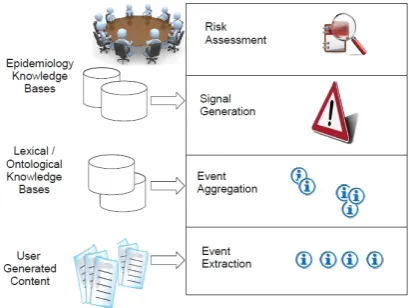
Given the emergence of Medicine 2.0, social medical blogs are becoming an increasingly accepted source of informa-tion for public health event extracinforma-tion. For example, con-sider a typicalMedical Intelligence Gatheringscenario (see Figure 1) where disease-reporting events (i.e. victim, loca-tion, time, disease) are extracted from raw text to get infor-mation about potential disease outbreaks. The events are then aggregated to produce signals; which are intended to be an early warning against potential public health threats. Epidemiologists use them to assess risk, or corroborate and verify the information locally and with international agen-cies.
Figure 1: Epidemic Intelligence Scenario
There are challenges faced in extracting events in such a
scenario. Given the nature of blog data, acquiring infor-mation relevant to public health events requires filtering a huge number of irrelevant events, some based on hypothet-ical events or opinions (Denecke and Nejdl, 2009).
Though abundant, a rich set of annotated data for linguis-tic tasks is scarce, or non-existent. Moreover, given the dynamic nature of social media, potentially may types of event extraction patterns may be needed, even for extract-ing a sextract-ingle type of event. Furthermore, blogs are charac-teristically noisy and informal, containing a interspersing of subjective and factual sentences, or even many authors with different styles. Given the potential noise , the over-arching problem with respect to the event extraction from social media is achieving the correct level of sentence fil-tering - as opposed to document or blog post level. Finally, for the intelligence gathering task, today’s noise can be to-morrow’s information, so adaptable filtering is desired.
In this paper we propose an approach to textual entailment with uses the text from one source of user generated content (T text) for sentence-level filtering within a new and less amenable one (H text), when the underlying domain, tasks or semantic information is the same, or overlaps.
The contribution of this work are three-fold: (1) an ex-ploratory data analysis on the sub-language of medical blog content for epidemic intelligence gathering; (2) overlay ap-proach to cross-corpus textual entailment; and (3) the use of cross-corpus textual entailment as a pre-processing step in the linguistic pipeline for adaptive sentence level filtering
2.
Related Work
11, 2009 through August 13, 2009. In total, 14,816 Med-Worm and 1,120 ProMED documents were used in the ex-periments. Documents below a size of 300 Kb, as well as raw sentences below a length of 51 characters, were filtered out. These sentences were mostly due to the incomplete sentences or noise present in the data. In total 49,711 Med-Worm and 26,635 ProMED sequences were used.
Sentence Sequence Database For constructing the Sen-tence Sequence Databases, two types of annotations were used. The first annotation was based on concepts present in the UMLS lexicon (UMLS CUI). The other was based on the semantic class of these concepts (UMLS TUI). In total, 22,256 distinct CUI literals were exploited. A collapsed version of the TUI candidate given as output by the anno-tation process was used. This collapsed version aggregates similar classes into a single class based on theis−a rela-tionship within the UMLS semantic network. This yielded a total 133 distinct TUI literals.
4.2. Results Data Summarization
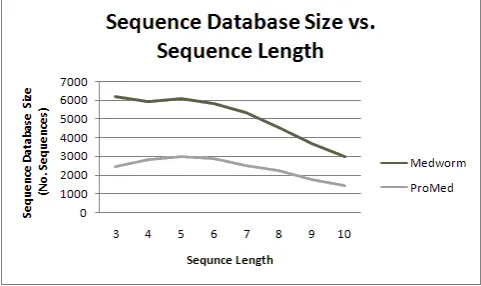
In Figure 2, the sizes of the sentence sequence database against the sequence length is presented. It can be noticed that there is a slight increase of the amount of sequences that have a length five. With increasing sequence length, the sequence database size drops greatly.
Figure 2: Sequence Database Sizes
Figure 3 shows the average sentence weight for sequences of varying length. As expected, we notice that the TUI an-notations (semantic class level) annotation has higher av-erage due to the fact that they represent an aggregation of the concept level. However (corresponding to the results in Figure 2) the TUI annotations peak at a sequence length of 5 and fluctuate thereafter. The overall low weights are quite noticeable and can be explained by the results shown in Figure 4.
4.2.1. Sequence Alignment
In Figure 4 we plot the cumulative relative frequency of the sentence weight to show the proportion of weights in the overlapping data for each annotation type that are less than or equal to a particular values. We notice that 80 percent of the overlapping sequences have a sentence weight of .35 or less. This can be explained by the choice of our
sen-Figure 3: Average Sentence Weight
Figure 4: Cumulative Relative Frequency vs. Sentence Weight
tence weight scheme, which effectively filters non-relevant sentences based on criteria of disease reporting.
4.2.2. Cross-Corpus Sequence Alignment
The sentences that overlapped across the copora for a sentence weight of .8 or higher fell into three cate-gories - each category. In first category, the sentences were identical. In the second category, there was a slight variation is a single token. One example of this token-level difference is represented in Table 1; where the H and T texts differed only by the term “first” and “1st“.
In the third type of variation, we noticed the overall position of the entities were preserved, even though different words were present. This third type of category is represented in the H and T text shown in Table 2:
4.2.3. Assessment of Aligned Sequences
Finally, the quality of the aligned sequences is considered, we present two examples of the favorable and unfavorable sentence quality.
ProMed Sentence (H text): This report describes the first recognized case of imported simian malaria in sev-eral decades in the LOCATION, diagnosed in 2008 in a patient from LOCATION who had traveled to the LOCA-TION.(Sentence Weight = .9)
Medworm Sentence (T text): This report describes the 1st recognized case of imported simian malaria in sev-eral decades in the LOCATION, diagnosed in 2008 in a patient from LOCATION who had traveled to the LOCA-TION.(Sentence Weight = .9)
Table 1: Sentence alignment with a single token variation between T and H texts.
ProMed Sentence (H text): This was the 5th case of rabies reported in LOCATION this year.
(Sentence Weight = .9)
MedWorm Sentence (T text): There are approximately 40,000 cases of infection reported in the LOCATION each year.(Sentence Weight = .9)
Table 2: Sentence alignment in which the overall position of entities types are preserved.
single entity type to be noise, this includes comma sepa-rated list.
Ex 1: They were adenovirus, 4.8 % , influenza virus , 1.0 % , RS virus , 6.3%, and human metapneumovirus , 2.9 %(Sentence Weight = 0)
Ex 2: fatigue, anxiety, headache(Sentence Weight = 0)
Table 3: False Negative Example
4.3. Discussion
The Disease Reporting Weighting Scheme can be used to for task-specific adaptive filtering - achieving the desired information based on a task. A smoother weighting scheme should be considered to avoid steps in the data and to have a more fine-grained tuning over the filtering process. The weighting scheme could be extended to include a domain-independent component to achieve this smoothing or using a logarithm instead of an inverse measure. Finally, a classifier could also be learnt to handle the weighting and relevance for sentences. Yet another limitations in the
weighting scheme is that other entity types, besides the selected ones, can have the role in classifying a sentence as disease reporting; for example, the class of medical findings, such as: “discomfort”, “sleepiness“.
Annotation Errors: In such an experimental setting, the results are only as good as the precision of the underlying annotation system. We notice that there are ambiguities (false positive and false negative) in the named entity system. Consider the example in Table 4, where the term ”Flu” is taken to be a unit.
Sentence:The real name for swine flu is H1N1 flu. Meta Mapping (888):
694 C1963039:Swine [Immunologic Factor]
861 C2348686:FlU (Fluorescence Units) [Quantitative Concept]
Table 4: Example UMLS MetaMap Annotation Error
Moreover, the domain specific annotator tends to over emphasize the presence of biomedical concepts due to the high prevalence of medical abbreviations and acronyms. For example, the terms “ate” (past tense of eat) and “Oct.” (month of the year) are mapped to proteins. We have only made a work-around for these domain-specific over-specification errors by first preprocessing the documents with a domain independent annotator which replaced the names of persons, locations and organizations with a predefined keyword.Although an attempt was made to overcome the high prevalence of domain-specific error, the potential arises to introduce more error, that is derived instead, from the domain independent named entity recog-nition (NER). The results here would also suggest the need for a NER tagger to be trained on a medical corpus, so that CWD (Cronic Wasting Disease), would not be tagged as an organization.
5.
Conclusion
In this early work we outlined an exploratory data anal-ysis using Cross-Corpus Textual Entailment for Medical Intelligence gathering. The goal has been to consider an unsupervised techniques to automatically filtering disease reporting event extraction patterns at the sentence level in this more noisy setting. We have shown that the approach taken here is quite effective at sentence-level filtering in medical blogs. The sentence weighting scheme we used, also allow an adaptive level of filtering and allow overlapping sentences to be quantified in terms of their quality.
consider how state of the art algorithms for textual entail-ment perform in a cross-corpus setting as well and test the approach presented here on other data sets. Finally, higher levels of abstractions based on dependency and syntatic parse trees will be taken into account; and a learner for overlapping patterns and the interchange of auxiliary and target domains will be investigated.
6.
References
Kerstin Denecke and Wolfgang Nejdl. 2009. How valu-able is medical social media data? content analysis of the medical web. Inf. Sci., 179(12):1870–1880.
Zheng Chen Heng Ji, Ralph Grishman and Prashant Gupta. 2009. Cross-document event extraction and tracking: Task, evaluation, techniques and challenge. Proc. Recent Advances in Natural Language Processing.
Adrian Iftene. 2009. Textual Entailment. Phd-thesis, Uni-versity of Iasi.
Heng Ji and Ralph Grishman. 2008. Refining event extrac-tion through unsupervised cross-document inference. In Proceedings of the Annual Meeting of the Association of Computational Linguistics.
B. Magnini. Y. Mehdad. 2009. A word overlap baseline for the recognizing textual entailment task.Proc. Recent Advances in Natural Language Processing.
Roman Yangarber and Lauri Jokipii. 2005. Redundancy-based correction of automatically extracted facts. InHLT ’05: Proceedings of the conference on Human Language Technology and Empirical Methods in Natural Language Processing, pages 57–64, Morristown, NJ, USA. Associ-ation for ComputAssoci-ational Linguistics.