A Fully Annotated Corpus for Studying the Effect of Cognitive Ageing on
Users’ Interactions with Spoken Dialogue Systems
Kallirroi Georgila(1), Maria Wolters(1), Vasilis Karaiskos(1), Melissa Kronenthal(1),
Robert Logie(2), Neil Mayo(1), Johanna D. Moore(1), Matt Watson(3)
(1) Human Communication Research Centre, University of Edinburgh (2) Human Cognitive Neuroscience-Psychology, University of Edinburgh
(3) Psychology, University of Sunderland
[email protected] (K. Georgila), [email protected] (M. Wolters)
Abstract
In this paper we present a corpus of interactions of older and younger users with nine different dialogue systems. The corpus has been fully transcribed and annotated with dialogue acts and “Information State Update” (ISU) representations of dialogue context. Users not only underwent a comprehensive battery of cognitive assessments, but they also rated the usability of each dialogue system on a standardised questionnaire. In this paper, we discuss the corpus collection and outline the semi-automatic methods we used for discourse-level annotations. We expect that the corpus will provide a key resource for modelling older people’s interaction with spoken dialogue systems.
1.
Introduction
In the last decade, spoken dialogue systems have not only been a major research area, but they have also been widely adopted by industry. Most of the work to date focuses on young, healthy users. However, as the average life ex-pectancy increases it will very soon become essential to design dialogue systems in such a way that they can ac-commodate older people’s interaction styles and adapt to a wide range of cognitive abilities.
Despite the growing importance of older users, there is still a dearth of fully annotated corpora of interactions between older people and spoken dialogue systems. This is a par-ticular problem for state-of-the-art statistical approaches to dialogue management (Lemon and Pietquin, 2007), since they crucially rely on adequate training data. Extrapolating from data collected with younger users, who are typically university students, may not be feasible. Firstly, cognitive abilities often deteriorate with age (Baeckman et al., 2001). Thus, an older user may well stumble over aspects of the system that a college student in their prime navigates with barely a glitch. Secondly, older users may well interact dif-ferently with spoken dialogue systems than younger users (M¨oller et al., 2008). Hence, user simulations (Georgila et al., 2005b; Georgila et al., 2006) based on data from younger users may be incapable of covering patterns of be-haviour typical of older users.
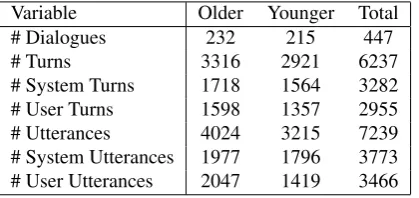
In this paper, we present the MATCH1corpus, which con-sists of 447 interactions between older and younger users and spoken dialogue systems. The corpus was designed to provide researchers with a solid, extensively annotated data set that will allow them to investigate older users’ interac-tions with spoken dialogue systems in depth. Our corpus is unique in the amount of additional information available for each participant. We include not only a comprehensive range of cognitive measures, but also extensive user satis-faction assessments for each of the 447 dialogues.
1
http://www.match-project.org.uk
This paper is structured as follows. In Section 2 we outline the design of the corpus, which was collected as part of a cognitive psychology experiment. In Section 3, we discuss our data collection method. Then in Section 4, we present an overview of the manual and automatic techniques used for annotating the corpus. In Section 5, we present an ini-tial comparison of the ways in which older versus younger users interact with our simulated appointment scheduling systems. In section 6, we propose ideas for future work. Finally, in Section 7, we present our conclusions.
2.
Corpus Design
The MATCH corpus is one of very few corpora that was specifically designed to include older users. Although a couple of existing dialogue corpora contain data from older speakers, those were included more by accident than by de-sign. There are two notable exceptions:
• the JASMIN-CGN corpus, which contains over 14 hours of interactions between Dutch and Flemish older users and a Wizard-of-Oz (WoZ) system (Cucchiarini et al., 2006),
• the MeMo corpus, which contains 62 interactions be-tween 31 older and younger users and a Smart Home WoZ system (M¨oller et al., 2008).
Demographics Cognition
# Users Age % female MillHill DSST Ravens WMS
Younger 24 22±3 71% 42 75 54 37
Older 26 66±9 61.5% 52 51 49 28
∆sig. n/a ** n.s. ** ** ** .
Table 1: Participant statistics .: p<0.05, **: p<0.001 or better.
Group Speech Acts
Confirmation confirm pos, confirmimplicit pos Grounding confirm pos, confirmimplicit pos
reprovide info overall
Table 3: List of user speech acts associated with confirma-tions and grounding.
firmed must be the same as the value with which the slot has been filled. In the same way, a slot is “grounded” if it is either confirmed or if the system and the user have reached a mutual agreement regarding the status of this slot, indi-cated by the fact that the dialogue has moved to the next stage. Table 3 lists the speech acts which are associated with confirmations and grounding. Furthermore, the Infor-mation State contains fields about the slots that have been marked as unavailable by the user (“blocked”) and their val-ues.
Note also in figure 3 the difference between the groups of Information State fields{ FilledSlotsHist, FilledSlotsVal-uesHist, BlockedSlotsHist, BlockedSlotsValFilledSlotsVal-uesHist, Con-firmedSlotsHist, GroundedSlotsHist } and { Filled-SlotsStatus, FilledSlotsValuesStatus, BlockedFilled-SlotsStatus, BlockedSlotsValuesStatus, ConfirmedSlotsStatus, Ground-edSlotsStatus}. The former give us information about the exact order in which slots have been filled, blocked, con-firmed or grounded and may contain several instances of the same slot, e.g. the slot “hp” could be confirmed twice. The latter (“FilledSlotsStatus”, etc.) inform us about the current status of the slots and thus may only contain one instance per slot. This distinction is very important because, for ex-ample, if a confirmed slot is refilled with a new value it will remain in the “ConfirmedSlotsHist” field even though its new value has not been confirmed yet. The history of dialogue acts, speech acts, and tasks is also included in our annotations.
Initially, the complete corpus was automatically annotated with dialogue acts and ISU representations of dialogue con-text. These annotations were then processed manually by an experienced human annotator. The annotator did not have to annotate the dialogues from scratch but only cor-rect the automatic annotations, in particular, the dialogue acts, filled slots, filled slots values, blocked slots, blocked slots values, confirmed slots, and grounded slots. From the hand-corrected annotations, the automatic annotation tool then computed the list ofhspeech act, taskipairs that cor-responded to each dialogue act and also dialogue history-level annotations, such as the current status of each of the slots required by the task, the history of speech acts, etc.
DIALOGUE LEVEL Turn: user
TotalTurnNumber: 4 TurnNumber: 2 Speaker: user
TotalUtteranceNumber: 5 UtteranceNumber: 2
DialogueAct: [accept halfday,social polite,block slot,provide slot] SpeechAct: [accept info,social,block info,provide info]
TransInput: Monday afternoon please but not at two, better at four.
SystemOutput:
TASK LEVEL
Task: [halfday,polite,slot,slot] FilledSlot: [halfday,slot]
FilledSlotValue: [monday pm,four pm] BlockedSlot: [slot]
BlockedSlotValue: [two pm] ConfirmedSlot: [hp] GroundedSlot: [hp]
LOW LEVEL
Segmentation: [monday afternoon],[please],[but not at two,],[better at four]
HISTORY LEVEL
FilledSlotsStatus: [hp],[halfday],[slot]
FilledSlotsValuesStatus: [physiotherapist],[monday pm],[four pm] BlockedSlotsStatus: [slot]
BlockedSlotsValuesStatus: [two pm] ConfirmedSlotsStatus: [hp] GroundedSlotsStatus: [hp]
DialogueActsHist: greeting,suggest hp 2,[accept hp,social polite], suggest halfday 2 implicit,[accept halfday,social polite,
block slot,provide slot]
SpeechActsHist: opening closing,suggest 2,[accept info,social], suggest 2 implicit,[accept info,social,block info,provide info] TasksHist: greeting,hp,[hp,polite],halfday,[halfday,polite,slot,slot] FilledSlotsHist: [hp],[halfday,slot]
FilledSlotsValuesHist: [physiotherapist],[monday pm,four pm] BlockedSlotsHist: [slot]
BlockedSlotsValuesHist: [two pm] ConfirmedSlotsHist: [hp] GroundedSlotsHist: [hp]
Figure 3: Example dialogue context/Information State in text format, simplified from the NXT format. User-provided information appears between [ ] brackets.
5.
Older Versus Younger Users
Variable Older Younger Sig.
# Turns 79 59 ***
# Word Types 81 30 ***
# Word Tokens 312 102 ***
# Speech Act Types 14 9 ***
# Speech Act Tokens 126 73 ***
Table 4: Overall dialogue-level differences. Numbers are summed over all dialogues and divided by the number of users ***:p<0.0001 or better.
not have part-of-speech tagging and parsing at present, our analysis concentrates on the lexical level and the dialogue act level. All significance tests were Wilcoxon tests con-ducted using R (R Development Core Team, 2006). Due to the large number of tests, comparisons that are significant at p<0.05 are treated as only barely significant.
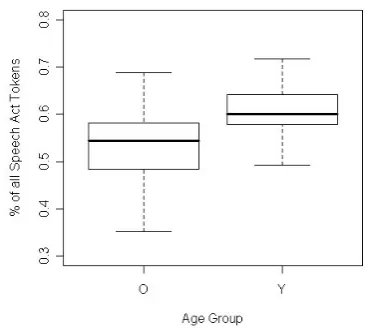
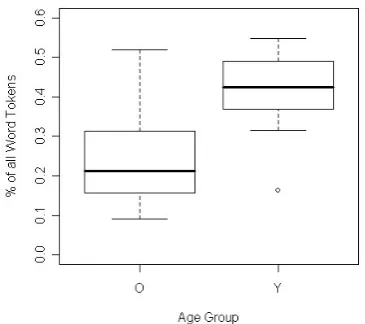
Looking at overall dialogue statistics, we see that older users produce longer dialogues than younger users (table 4). They also have a richer vocabulary and use a larger va-riety of speech acts. While the three most frequent speech acts always account for more than half of younger users’ total speech acts, the proportion can vary between 30% and 70% for older users (figure 4). The difference in vocabu-lary is even more drastic: 30%–50% of all words spoken by younger users are instances of the three most frequent lexi-cal items (figure 5), whereas the three most frequent lexilexi-cal items may only cover as little as 10%–30% of all words spoken by older users. Figures 4 and 5 also demonstrate that there is no such thing as a stereotypical older user. In both cases, the variation observed in the older users sub-sumes most of the variation seen in the younger users. Table 5 illustrates some typical speech act patterns. Younger users tend to restrict themselves to speech acts that are of immediate relevance to the task. 73.6% of all speech acts produced by younger users are variations of
accept *, where users accept options presented by the system, andconfirm *, where users confirm a slot. For older users, that proportion falls by nearly a third to 50.4%. The additional speech acts come from two main groups:
• instances of social interaction with the system, such as bidding the system goodbye or thanking it for provid-ing information,
• instances of the user taking the initiative, such as users giving details about the slots that they can or cannot make.
The relative frequencies of selected lexical items, which are summarised in table 6, show a very similar pattern. A third of all words uttered by younger users are “yes” and “no” (category YesNo). This percentage drops dramati-cally to 13.0% for our older users. Moreover, when older users express approval or disapproval, they are more likely to use expressions other than “yes”, such as “fine” (category
PosNeg). As we would expect from our speech act analy-sis, older users are also more likely to use expressions that are more appropriate in human/human interactions (cate-gory SocWords), such as forms of “goodbye” (category
Speech Act Older Younger Sig.
Accept * 22.1 32.1 ***
Confirm * 28.3 41.5 ***
Social 17.9 5.3 ***
Acknowledge 0.8 0.0 ***
Provide * 7.8 3.4 *
Reprovide * 1.8 0.2 **
Block 0.5 0.0 *
Garbage 3.2 0.5 ***
Table 5: Differences in relative frequencies of speech acts *:p<0.01, **:p<0.001, ***:p<0.0001 or better.
Lexical Cat. Older Younger Sig.
YesNo 13.0 33.8 ***
PosNeg 4.1 1.8 *
SocWords 7.7 3.6 *
Thanks 2.3 0.3 ***
Bye 1.2 0.2 ***
Please 4.0 2.9 n.s.
Sorry 0.2 0.1 n.s.
Table 6: Differences in relative frequencies of lexical cate-gories *:p<0.01, **:p<0.001, ***:p<0.0001 or better.
Bye) or “thank you” (categoryThanks). When compar-ing our statistics to the word-level analyses of the MeMo corpus (G¨odde et al., 2008), we see that the social interac-tion words that distinguish between older and younger users appear to be task-specific. While older people were signifi-cantly more likely to use forms of “please” in the MeMo command-and-control task, we did not find a significant difference in the appointment scheduling context.
Figure 4: Relative frequency of the three most frequent speech acts.
6.
Future Work
Figure 5: Relative frequency of the three most frequent words.
we will use the wave files and the transcriptions of the user utterances in order to train acoustic models for older people or adapt existing general models to the peculiarities of older people’s speech. As previously mentioned, speech recogni-tion for older people is known to be challenging compared to younger populations (Anderson et al., 1999; M¨uller et al., 2003).
7.
Conclusions
We have presented a richly annotated corpus of older and younger users’ interactions with simulated spoken dialogue systems that contains information about task success, task completion, users’ cognitive abilities, and users’ subjective ratings of each system. All of this information has been stored using the open standard NITE XML (Carletta et al., 2003). We hope that this corpus will prove a rich resource for learning dialogue management strategies, creating real-istic user simulations, investigating how older users interact with dialogue systems, assessing the impact of cognitive ageing on spoken human-machine interaction, and last, but not least, adapting speech recognisers to older voices.
8.
Acknowledgments
This research was supported by the MATCH project (SHEFC-HR04016, http://www.match-project. org.uk) and the Wellcome Trust VIP Award. We would like to thank Mark Core for our interesting discussions re-garding the set of dialogue acts. We also thank the anony-mous reviewers.
9.
References
S. Anderson, N. Liberman, E. Bernstein, S. Foster, E. Cate, B. Levin, and R. Hudson. 1999. Recognition of Elderly Speech and Voice-Driven Document Retrieval. InProc. ICASSP.
M. Aylett, C. Pidcock, and M.E. Fraser. 2006. The Cerevoice Blizzard Entry 2006: A prototype database unit selection engine. InProc. BLIZZARD Challenge.
L. Baeckman, B. J. Small, and A. Wahlin. 2001. Aging and memory: Cognitive and biological perspectives. In J. E. Birren and K. W. Schaie, editors,Handbook of the Psychology of Aging, pages 349–377. Academic Press, San Diego, CA etc.
L. A. Black, C. McMeel, M. McTear, N. Black, R. Harper, and M. Lemon. 2005. Implementing autonomy in a dia-betes management system. J Telemed Telecare, 11 Suppl 1:6–8.
J. Carletta, S. Evert, U. Heid, J. Kilgour, J. Robertson, and H. Voormann. 2003. The toolkit: Flexible annotation for multi-modal language data. Behavior Research Meth-ods, Instruments, and Computers, 35:353–363.
Jean Carletta. 2007. Unleashing the killer corpus: experi-ences in creating the multi-everything ami meeting cor-pus. Language Resources and Evaluation, 41(2):181– 190.
Jacob Cohen. 1960. A coefficient of agreement for nom-inal scales. Educational and Psychological Measure-ment, 20:37–46.
P. Commarford. 2006. Working Memory, Search, and Sig-nal Detection: Implications for Interactive Voice Re-sponse System Menu Design. Ph.D. thesis, University of Central Florida.
Catia Cucchiarini, Hugo Van Hamme, Olga van Herwijnen, and Felix Smits. 2006. Jasmin-cgn: Extension of the spoken dutch corpus with speech of elderly people, chil-dren and non-natives in the human-machine interaction modality. InProc. LREC, pages 135–138.
N. Dahlbaeck, A. Joensson, and L. Ahrenberg. 1993. Wiz-ard of oz studies - why and how. Knowledge-Based Sys-tems, 6:258–266.
Kallirroi Georgila, Oliver Lemon, and James Henderson. 2005a. Automatic annotation of COMMUNICATOR di-alogue data for learning didi-alogue strategies and user sim-ulations. InProc. DIALOR.
Kallirroi Georgila, Oliver Lemon, and James Henderson. 2005b. Learning user simulations for information state update dialogue systems. InProc. Interspeech.
Kallirroi Georgila, James Henderson, and Oliver Lemon. 2006. User simulation for spoken dialogue systems: Learning and evaluation. InProc. Interspeech.
Kallirroi Georgila, Oliver Lemon, James Henderson, and Johanna D. Moore. 2008. Automatic annotation of con-text and speech acts for dialogue corpora. Natural Lan-guage Engineering, submitted.
Florian G¨odde, Sebastian M¨oller, Klaus-Peter Engelbrecht, Christine Khnel, Robert Schleicher, Anja Naumann, and Maria Wolters. 2008. Study of a speech-based smart home system with older users. In International Work-shop on Intelligent User Interfaces for Ambient Assisted Living, pages 17–22.
B. W. Huguenard, F. J. Lerch, B. W. Junker, R. J. Patz, and R. E. Kass. 1997. Working memory failure in phone-based interaction. ACM Transactions on Computer-Human Interaction, 4:67–102.
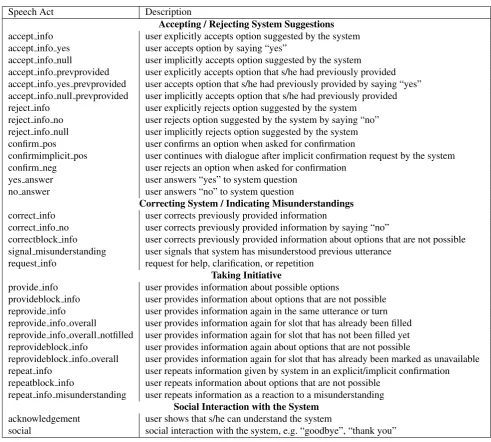
Speech Act Description
Accepting / Rejecting System Suggestions
accept info user explicitly accepts option suggested by the system accept info yes user accepts option by saying “yes”
accept info null user implicitly accepts option suggested by the system
accept info prevprovided user explicitly accepts option that s/he had previously provided accept info yes prevprovided user accepts option that s/he had previously provided by saying “yes” accept info null prevprovided user implicitly accepts option that s/he had previously provided reject info user explicitly rejects option suggested by the system
reject info no user rejects option suggested by the system by saying “no” reject info null user implicitly rejects option suggested by the system confirm pos user confirms an option when asked for confirmation
confirmimplicit pos user continues with dialogue after implicit confirmation request by the system confirm neg user rejects an option when asked for confirmation
yes answer user answers “yes” to system question no answer user answers “no” to system question
Correcting System / Indicating Misunderstandings
correct info user corrects previously provided information
correct info no user corrects previously provided information by saying “no”
correctblock info user corrects previously provided information about options that are not possible signal misunderstanding user signals that system has misunderstood previous utterance
request info request for help, clarification, or repetition
Taking Initiative
provide info user provides information about possible options
provideblock info user provides information about options that are not possible reprovide info user provides information again in the same utterance or turn reprovide info overall user provides information again for slot that has already been filled reprovide info overall notfilled user provides information again for slot that has not been filled yet reprovideblock info user provides information again about options that are not possible
reprovideblock info overall user provides information again for slot that has already been marked as unavailable repeat info user repeats information given by system in an explicit/implicit confirmation repeatblock info user repeats information about options that are not possible
repeat info misunderstanding user repeats information as a reaction to a misunderstanding
Social Interaction with the System
acknowledgement user shows that s/he can understand the system
social social interaction with the system, e.g. “goodbye”, “thank you”
Table 7: List of user speech acts.
Oliver Lemon and Oliver Pietquin. 2007. Machine learn-ing for spoken dialogue systems. InProc. Interspeech. S. E. Linville. 2000. The aging voice. In R. Kent,
edi-tor,Voice Quality Measurement, pages 359–376. Singu-lar, San Diego, CA.
S. M¨oller, P. Smeele, H. Boland, and J. Krebber. 2007. Evaluating spoken dialogue systems according to de-facto standards: A case study. Computer Speech and Language, 21(1):26–53.
Sebastian M¨oller, Florian G¨odde, and Maria Wolters. 2008. Corpus analysis of spoken smart-home interactions with older users. InProc. LREC.
C. M¨uller, F. Wittig, and J. Baus. 2003. Exploiting Speech for Recognizing Elderly Users to Respond to their Spe-cial Needs.
R Development Core Team, 2006.R: A Language and En-vironment for Statistical Computing. R Foundation for Statistical Computing, Vienna, Austria. ISBN 3-900051-07-0.
J. Raven, J.C. Raven, and J.H. Court, 1998. Manual for
Raven’s Progressive Matrices and Vocabulary Scales. Harcourt Assessment, San Antonio, TX.
N. Unsworth and R. W. Engle. 2005. Individual differ-ences in working memory capacity and learning: evi-dence from the serial reaction time task. Mem Cognit, 33:213–20.
D. Wechsler, 1981. Manual for the Wechsler Adult Intelli-gence Scale-Revised. New York. The Psychological Cor-poration, New York.
Maria Wolters, Pauline Campbell, Christine DePlacido, Amy Liddell, and David Owens. 2007. Making syn-thetic speech accessible to older people. In Proc. Sixth ISCA Workshop on Speech Synthesis, Bonn, Germany. Maria Wolters, Kallirroi Georgila, Robert Logie, Sarah
MacPherson, Johanna Moore, and Matt Watson. 2008. Accommodating cognitive ageing: Do we need fewer op-tions? submitted.