Minding the Source:
Automatic Tagging of Reported Speech in Newspaper Articles
Ralf Krestel,
1Sabine Bergler,
2and Ren´e Witte
31L3S Research Center
Universit¨at Hannover, Germany
2Department of Computer Science and Software Engineering
Concordia University, Montr´eal, Canada
1Institut f¨ur Programmstrukturen und Datenorganisation (IPD)
Universit¨at Karlsruhe (TH), Germany
Abstract
Reported speech in the form of direct and indirect reported speech is an important indicator of evidentiality in traditional newspaper texts, but also increasingly in the new media that rely heavily on citation and quotation of previous postings, as for instance in blogs or newsgroups. This paper details the basic processing steps for reported speech analysis and reports on performance of an implementation in form of a GATE resource.
1.
Introduction
Despite the rapid growth of alternative information sources, newspaper articles continue to be the staple source most readily accessible. Accessibility is, indeed, a major preoccu-pation for newspaper editors, and most papers are available on-line with “breaking news” features. News aggregators are automatic systems that use on-line information from news-feeds or on-line newspaper sources and collate overviews across newspapers, worldwide. For example, the European Commission’s Joint Research Centre’s NewsExplorer1 clus-ters news stories by type and country, but also provides additional indexes in form of names, related and associated people, related stories, etc. Names mentioned underRelated Peopleinvoke a screen with links to stories, in which the person plays a role, as well as two special sections:Quotes fromandQuotes about(Pouliquen et al., 2007). This reflects the importance of information attributed to a source. Newspaper articles typically report information collected from a single (or multiple) source(s). Especially in the North American tradition, this information is usually attributed to the source explicitly in form ofquoted orindirectspeech. We will refer to both forms here asreported speech.2 Reported speech is an important indicator of evidentiality (Bergler, 1992). The reliability of the information conveyed has to be assessed differently for different tasks (an expert on child care and an expert on nuclear physics may have the same high reliability associated when speaking on their respective domains of expertise, yet low reliability when speaking on the other’s). Reported speech is thus a form of valence shifter (Bergler, 2005), which marks the embedded information as not simply factual. Reported speech is of increasing importance outside newspaper articles in new media such as blogs and discussion groups, where citations and quotations form a major backbone for the structure of
1EU EMM NewsExplorer,http://press.jrc.it/NewsExplorer/ 2In contrast to Quirk (Quirk, 1985, page 1021), who considers
only indirect speech under the term “reported speech.”
discussion.
NewsExplorer only identifies material in direct quotes, which is mostly of importance for possibly contentious ma-terial or claims. But most reported speech is in form of indirect reported speech. We have developed a set of re-sources that identifies and tags thesource,reporting verb andcontentof reported speech sentences.
These resources have been implemented as components for the GATE framework (Cunningham et al., 2002) and are distributed under an open source license.3This is intended as a first module for more sophisticated representation and reasoning with attributed information, such as belief reason-ing based on nested belief structures as suggested by (Ballim and Wilks, 1991) and recently illustrated for the reported speech context by theFuzzy Believer System(Krestel et al., 2007a;Krestel et al., 2007b).
2.
Reported Speech
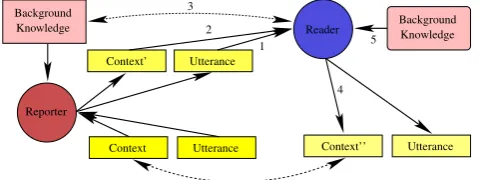
The function of reported speech is to convey information in two steps: from asourceto areporter, and from thereporter to areader. The utterance and its context will be interpreted by the reporter, encoded by the reporter for the reader, and decoded by the reader. The reporter can use the mechanism of reported speech to not only reproduce the content of the utterance, but to reproduce and clarify the whole speech act (Austin, 1962;Searle, 1969).
From the reader’s point of view, reading a newspaper article is a multilevel process, as illustrated in Figure2. The reader has to:
1. Understand the content of what is expressed in the article (the reported clause);
2. Evaluate the additional information given by the re-porter to reconstruct not only the original utterance but the original speech act (the reporting clause);
3
according accuse acknowledge add admit
agree allege announce argue assert
believe blame charge cite claim
complain concede conclude confirm contend
criticize declare decline deny describe
disagree disclose estimate explain fear
hope insist maintain mention note
order predict promise recall recommend
reply report say state stress
suggest tell testify think urge
warn worry write observe
Table 1: Reporting verbs identified by the reporting verb marker
These components can easily be embedded in more complex NLP pipelines, depending on the concrete application sce-nario. In turn, they rely on lower-level analysis components, such as a noun phrase chunker and verb grouper, which are distributed with the GATE system (see Section6.).
3.1. Reporting Verb Marker
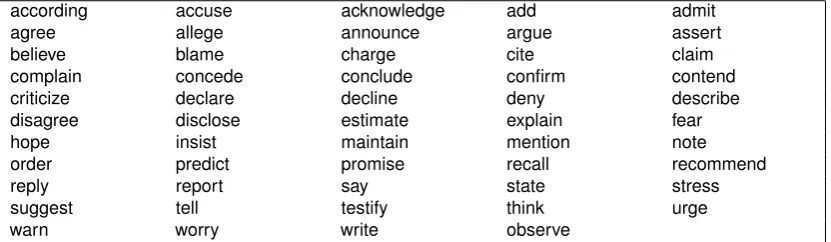
The Reporting Verb Marker tags verbs used to express re-ported speech using a finite state transducer. This component was first developed and implemented by (Doandes, 2003) to extract information related to evidential analysis. Currently, we recognize only the most frequent reported speech verbs as listed in Table1.
The reporting verb marker is implemented using GATE’s Java Annotation Patterns Engine(JAPE) (Cunningham et al., 2000). It works with the chunker notion ofverb groups, contiguous sequences of auxiliaries and verbs. When one of the listed verbs is detected as the head of a verb group, the reporting verb finder marks it as a reported speech verb by adding a corresponding annotation containing the lemma of the reported speech verb.
3.2. Reported Speech Finder
To identify reported speech in newspaper articles, we extract six general patterns. They differ in the position of the report-ing verb, the source, and the reportreport-ing clause. An overview of those six patterns is shown in Table2.
Source Verb Content
Verb Source Content
Content Source Verb
Content Verb Source
Content Source Verb Content
Content Verb Source Content
Table 2: Six patterns for finding reported speech in newspa-per articles
Identifying reported speech sentences enables us to label the different elements for further analysis. Our components have been designed to allow extracting statements in form of declarative sentences. Currently, we exclude structures where the reported clause is not a grammatical sentence, since infinitival and other omitted constructs no longer report the speech of others, but interpret their actions or utterances, which requires a different treatment; e.g.:
The President denied to sign the bill. (8)
The six patterns are not exhaustive, for example, they will ignore the second source and reporting verb in (Wall Street Journal12.09.1986):
Mr. Coen predictedthat a weak sector in 1987 will be na-tional print – newspapers and magazines – whichhe said will see only a 4.8% increase in advertising expenditures.
(9)
Constructs that do not fit into our six basic patterns are rare,4 and additional patterns can be easily added in the future.
4.
Implementation
This section contains more details concerning our imple-mentation, which is realized in form of processing resources in the GATE (Cunningham et al., 2002) framework.
4.1. Reporting Verb Marker
A number of verbs used within the reporting verb marker can be found in Table1. We use a gazetteer to detect these verbs within the original article by comparing the root forms of the verbs with our verb list.
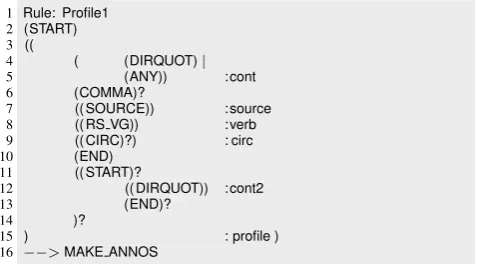
The reporting verb marker is implemented as a JAPE ( Cun-ningham et al., 2000) grammar. Figure3shows a code snippet of the JAPE-rule for the verb “concede.”5 After detecting these verbs within a document, the reporting verb marker marks them as reported speech verbs by adding an annotation containing the root of the main verb of the re-ported speech verb phrase.
4.2. Reported Speech Finder
The reported speech finder is implemented as a regular gram-mar using the Montr´eal Transducer, which supports an en-hanced version of the JAPE language.6 Our grammar con-sists of a set of rules to identify reported speech structures and to label the source, reporting verb, and the reported clause. An example annotation for two sentences from the Wall Street Journal(03.19.1987) is given asreported clause, source, andreporting verb:
4Numbers depending on the literary style of the newspaper,
around 3% 5
This rule also specifies the semantic dimensions of the verb, which are not of importance for the remainder of this paper, but are used for further interpretation, see (Doandes, 2003).
6Developed by Luc Plamondon, Universit´e de Montr´eal, see
WSJ Article Reported Clause Source/Verb
Precision Recall F-measure Precision Recall F-measure
861203-0054 1.00 0.50 0.67 1.00 0.63 0.77
861209-0078 1.00 0.77 0.87 1.00 0.79 0.88
861211-0015 0.97 0.88 0.96 1.00 0.89 0.94
870129-0051 1.00 0.71 0.83 1.00 0.71 0.83
870220-0006 0.96 0.74 0.84 1.00 0.93 0.96
870226-0033 1.00 0.58 0.74 1.00 0.58 0.74
870409-0026 1.00 1.00 1.00 1.00 1.00 1.00
No Example Sentence Source of Fault
1
“I was doing those things before, but we felt we needed to create a position where I can spend full time accelerating the creation of these
(cooperative) arrangements,”Mr. Sick, 52 years old,said. max-NP Transducer
2
Mr. Furmark, asked whether he had a role in the arms sale,said, “I’m
not in that business, I’m an oil man.” Reported Speech Finder
3
However, Charles Redman, the department’s spokesman, saidduring a briefingthatfollowed the meetingthat the administration hadn’t altered its viewthatsanctions aren’t the way to resolve South Africa’s problems.
Reported Speech Finder
4
In his annual forecast, Robert Coen, senior vice president and director of forecasting at the ad agency McCann-Erickson Inc., said1987 “looks
good for the advertising industry.” Reported Speech Finder
5
Praising the economic penalties imposed by Congress last year,he
saidit was “necessary to pursue the question of sanctions further.” Reported Speech Finder
6 Hedid acknowledgethat he knows Mr. Casey from their past
associa-tion with Mr. Shaheen. Verb Phrase Marker
7
Hedeclined to be more specific, but stressedthat Texas Instruments wasn’t concentrating on alliances with Japanese electronics concerns, but also would explore cooperative agreements with other domestic and European companies.
Reported Speech Finder
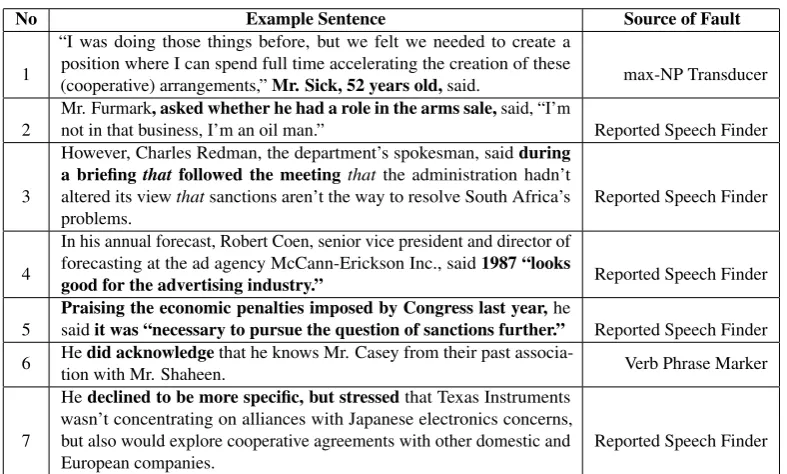
Table 4: Samples showing different sources of errors for the reported speech finding component
It is not clear if this is a circumstantial information referring to the date the utterance was made or, more likely, a non-contiguous part of the quoted reported clause.
5. Example 5 also contains complex circumstantial information and the phenomenon of a partly quoted reported clause.
6. Example 6 was not recognized as reported speech by the system because the verb grouper component, whose output is used by the reported speech finder, failed to mark the verb construct correctly.
7. Example 7 illustrates a coordinated reported speech structure, juxtaposing two reported clauses, where the second one is not a full clause. Since this is a problem not particular to reported speech but chunking in gen-eral, we leave this to future work. Our system only tags the first reported clause as reported speech.
6.
Deployment and Application
In this section, we describe how to deploy our reported speech components in practice.
6.1. Pipeline Configuration
Our reported speech components are designed to be embed-ded within a complete GATE analysis pipeline. They rely on annotations added by a number of existing GATE process-ing resources, in particular tokenization, sentence splittprocess-ing, part-of-speech tagging, noun phrase chunking, verb group-ing, and rudimentary morphological analysis. A complete example for a possible pipeline configuration, with the com-ponents needed for complete reported speech tagging, is shown in Figure5.
6.2. Annotations
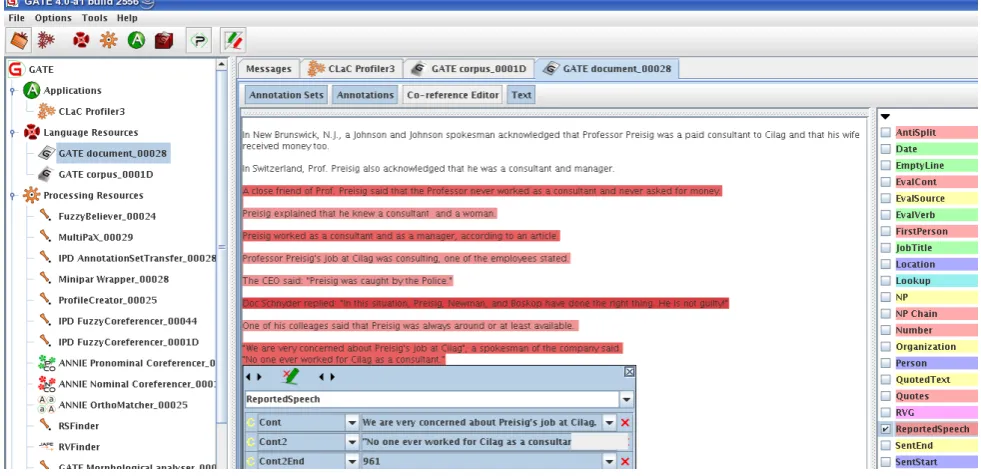
Our components then add annotations for the detected re-porting verbs and reported speech constructs (see Figure6).
Figure 5: GATE Pipeline
All potential reporting verbs are annotated with their se-mantic dimensions and their main verb. This annotation is labeledreporting verb group(“RVG”) and is generated by the reporting verb marker. All detected reported speech occurrences receive a “Reported Speech” annotation gener-ated by the reported speech finder. Different features of the generated annotation contain detailed information about the reported speech construct, see Table5.
Name Value
source source of the reported speech sentence sourceStart start offset of the source
sourceEnd end offset of the source verb reporting verb
cont1-3 content, possibly fragmented (up to 3 parts)
cont1-3Start start offset of the content cont1-3End end offset of the content
Figure 6: Example reported speech annotation in GATE
6.3. Application
Further processing of the generated reported speech results can then be performed in application-specific pipelines uti-lizing further components, e.g., for quote attribution as per-formed by NewsExplorer or belief analysis of reporting clauses as performed by theFuzzy Believer(Krestel et al., 2007a;Krestel et al., 2007b).
7.
Conclusion
Reported Speech is an important linguistic phenomenon in newspaper articles, where it serves to provide evidential scope for second hand information. It serves this function also in many of the new, more argumentative media, such as blogs, where proper attribution is part of good style and carries with it subtle information about both content and social structure. Our system takes the first step in making this information explicit and accessible. We provide an open source GATE component to identify and functionally anno-tate reported speech sentences for both direct and indirect speech, extracting the reported clause, the source, the report-ing verb, and circumstantial information. For our test corpus we achieve 83% recall and 98% precision.
8.
References
J. A. Austin. 1962. How to Do Things with Words. Harvard University Press.
Afzal Ballim and Yorick Wilks. 1991. Artificial Believers: The Ascription of Belief. Lawrence Erlbaum Associates, Inc., Mahwah, NJ, USA.
Sabine Bergler. 1992. The Evidential Analysis of Reported Speech. Ph.D. thesis, Brandeis University, Massachusetts, USA.
Sabine Bergler. 1995. Generative lexicon principles for machine translation: A case for meta-lexical structure. Journal of Machine Translation, 9(3).
Sabine Bergler. 2005. Conveying Attitude with Reported Speech. In James C. Shanahan, Yan Qu, and Janyce Wiebe, editors, Computing Attitude and Affect in Text: Theory and Applications. Springer Verlag.
H. Cunningham, D. Maynard, and V. Tablan. 2000. JAPE: a Java Annotation Patterns Engine (Second Edition). Re-search Memorandum CS–00–10, Department of Com-puter Science, University of Sheffield, November. H. Cunningham, D. Maynard, K. Bontcheva, and V. Tablan.
2002. GATE: A framework and graphical development environment for robust NLP tools and applications. In Proc. of the 40th Anniversary Meeting of the ACL. Monia Doandes. 2003. Profiling For Belief Acquisition
From Reported Speech. Master’s thesis, Concordia Uni-versity, Montr´eal, Qu´ebec, Canada.
Ralf Krestel, Ren´e Witte, and Sabine Bergler. 2007a. Creat-ing a Fuzzy Believer to Model Human Newspaper Read-ers. In Z. Kobti and D. Wu, editors,Proc. of the 20th Canadian Conference on Artificial Intelligence (Cana-dian A.I. 2007), LNAI 4509, pages 489–501, Montr´eal, Qu´ebec, Canada, May 28–30. Springer.
Ralf Krestel, Ren´e Witte, and Sabine Bergler. 2007b. Pro-cessing of Beliefs extracted from Reported Speech in Newspaper Articles. InProc. of Recent Advances in Nat-ural Language Processing (RANLP-2007), Borovets, Bul-garia, September 27–29.
Bruno Pouliquen, Ralf Steinberger, and Clive Best. 2007. Automatic Detection of Quotations in Multilingual News. InProc. of Recent Advances in Natural Language Pro-cessing (RANLP-2007), Borovets, Bulgaria, September 27–29.
Randolph Quirk. 1985. A comprehensive grammar of the English language. Longman Group Limited.