Using Richly Annotated Trilingual Language Resources for Acquiring Reading
Skills in a Foreign Language
Drago
ş
Ciobanu, Tony Hartley and Serge Sharoff
Leeds University Centre for Translation Studies Leeds, UK
E-mail: [email protected], [email protected], [email protected]
Abstract
In an age when demand for innovative and motivating language teaching methodologies is at a very high level, TREAT - the Trilingual REAding Tutor - combines the most advanced natural language processing (NLP) techniques with the latest second and third language acquisition (SLA/TLA), as well as computer-assisted language learning (CALL) research in an intuitive and user-friendly environment that has been proven to help adult learners (native speakers of L1) acquire reading skills in an unknown L3 which is related to (cognate with) an L2 they know to some extent. This corpus-based methodology relies on existing linguistic resources, as well as materials that are easy to assemble, and can be adapted to support other pairs of L2-L3 related languages, as well. A small evaluation study conducted at the Leeds University Centre for Translation Studies indicates that, when using TREAT, learners feel more motivated to study an unknown L3, acquire significant linguistic knowledge of both the L3 and L2 rapidly, and increase their performance when translating from L3 into L1.
1.
2.
3.
Introduction
The need to devise new, more effective and motivating methodologies for language teaching and learning has become a priority of language tutors, researchers and decision makers alike. Demand exceeds the supply of such courses and adult education in particular requires serious attention (Chisholm et al., 2004; Colpaert, 2004). Technology also needs to be applied more carefully to the needs of language teaching, because it seems that in the last 25 years computers have not been put to good use in order to support language progress (Barrière & Duquette, 2002; Plass et al., 2003; Rouse & Krueger, 2004).
Moreover, a lot of attention is paid to phonetic and grammar exercises at the expense of acquiring reading skills, despite evidence from research that this skill is valued more than any other: “the majority of 167 distance teaching organisations [...] regarded reading and understanding the foreign language as the most important study aim” (Holmberg, 2005). For reasons such as lack of resources or inadequate training of tutors and learners in the use of ICT, it is often the case that language curricula do not provide enough time for the development of reading skills (Hunt & Beglar, 2005), although reading has also been proven to benefit many other areas of language learning (Pressley in Grabe & Stoller, 2002; Sun, 2003).
This paper demonstrates how a novel language learning methodology can be designed and implemented within a web-based environment using both new and already available linguistic resources. Specifically, our system is designed to help adult speakers (language L1, here English) acquire reading skills in a foreign language (L3, here Romanian) that is cognate with a second language they know to some extent (L2, here French). TREAT (Trilingual REAding Tutor) dynamically processes user requests to provide learners with linguistic information extracted from the corpora that is intended to facilitate reading comprehension.
Research Questions
Our first hypothesis was that a multilingual, corpus-based reading model that provides users with extensive reading materials and other relevant linguistic information extracted using natural language processing (NLP) techniques is more effective than traditional instruction in helping users acquire reading skills in an unknown L3 which is typologically related to an L2 they have some knowledge of.
Secondly, we hypothesised that given an effective learning environment, users can acquire the lexical and grammatical features of the target L3 without explicit instruction.
Thirdly, we aimed to show that reading resources can be arranged automatically in multilingual clusters that can boost the user’s background knowledge to the level necessary for completing reading tasks successfully. To our knowledge, TREAT is the first computer-assisted language learning (CALL) application to demonstrate this.
The fourth hypothesis was that, by involving the L2 in the process, learners will both perceive and appreciate its support function, and seize the opportunity to use and improve their L2.
Methodology
Although there have been few attempts to create a framework for teaching and learning L3s that belong to the same language family as an L2 learners are somewhat familiar with - e.g. the EuroComRom initiative (Klein et al., 2002), whose main am was to show users “How to read all the Romance languages right away”-, the deliverables of such projects have fallen short of expectations and the evidence on which they were based was often anecdotal.
customised concordance tool, which we present in section 5.
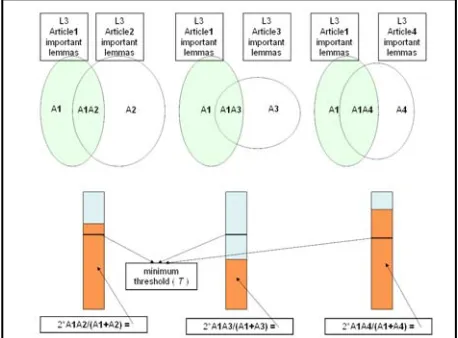
We performed a qualitative evaluation of the accuracy with which our tool identified authentic related articles (ARAs) for each L3 text in our multilingual, comparable corpus. We analysed a random sample of 50 L3 articles out of the total of 182. We looked at the top 5 SRAs for L3, L2 and L1 and noted the position in which the first ARA was, as well as the percentage represented by ARAs out of the first 5 suggested. If the first ARA was in the first position, we gave it 5 points; if it was third, we gave it 3 points; if none of the 5 SRAs turned out to be ARAs, the score was 0. Table 1 presents our results: S represents the average score for the first ARA; StDev represents the standard deviation from this score; and P represents the percentage of ARAs among the first 5 SRAs.
S StDev P
L3 4.4 1.439 70%
L2 3.9 1.723 70%
L1 4 1.774 52%
Table 1: Accuracy of automatic related article identification
These results show that, overall, users can easily find ARAs at the top of the list of SRAs, as well as the fact that, at almost any time, 2 or 3 of the top 5 SRAs will be ARAs. This gives learners easy access to several reading resources on the same/similar topic and enables them to become familiar with relevant target vocabulary and structures more quickly.
5.
5.1.
5.2.
Features of Treat
Article Selection Criteria
In order to enable users to identify the most pertinent resources, we have built several article selection criteria into our web-based interface. Initially we tested the most popular mechanisms for assessing the readability of a particular piece of writing – i.e. the Kincaid formula, the Flesch reading ease formula, and the Fog Index. However, such formulae rely on the length of words and sentences and, as our experiments have shown, our users had very few problems understanding and translating long L3 words and sentences. Therefore, we judged these formulae unsuitable for our purpose and made available a new set of criteria which include: article length; average sentence length; publication date; the occurrence of a particular part of speech in an article significantly more frequently than in the entire L3 corpus; the lexical density score; the number of SRAs in L3/L2/L1 or in all of these languages; the percentage of L3 content lemmas covered by the L1 and L3 WordNets together with the L1-L2 wordlist; and the domain.
Once the user selects an L3 article that suits their interests, the interface enables him/her to both read the article and browse through the suggested related articles in order to increase their background knowledge (Figure 2 demonstrates this very aspect).
Figure 2: Accessing SRAs in three languages from within TREAT
Concordance Window
In order to enable users to check their hypotheses about the way in which the target L3 works, we designed a custom multilingual concordance tool.
We are aware that the users’ knowledge of the L3 is underdeveloped at this stage, yet SLA and TLA research indicates that even in the case of minimally useful contexts, even low-ability students can find useful information and can get an insight into the workings of the L2/L3, namely “word form, affixation, part of speech, collocations, referents and associations, grammatical patterning, as well as global associations with the topic” (Nation in Hunt & Beglar, 2005).
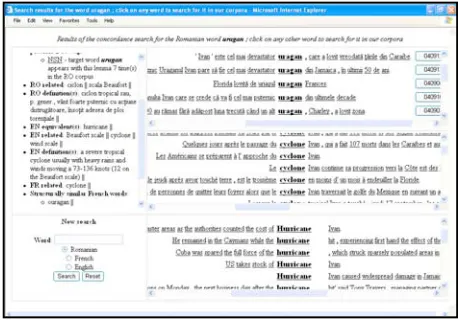
Our concordance engine enables users to perform searches in all three languages and, depending on the availability of WordNet information and current corpus data, it returns concordance lines in up to three languages, as well as relevant linguistic information about the target L3 word – i.e. POS, lemma, L3/L2/L1 synonyms /equivalents and related words, L2/L3 definition(s), L1/L2 structurally similar tokens, and L3 collocations. For each L1/L2 word search, the engine also consults L3 data in order to identify and return L3 vocabulary that is equivalent/related to the L1/L2 target one. In order to increase the performance of the engine in this case, we use L1 and L2 lemma information. Figure 3 presents the results of a search for the L3 word uragan.
& C. White (Eds.) Distance Education and Languages. Multilingual Matters.