User-friendly ontology authoring using a controlled language
Valentin Tablan, Tamara Polajnar, Hamish Cunningham, Kalina Bontcheva
Department of Computer Science University of Sheffield Regent Court, 211 Portobello Street
S1 4DP, Sheffield, UK
{V.Tablan, T.Polajnar, H.Cunningham, K.Bontcheva}@dcs.shef.ac.uk
Abstract
In recent years, following the rapid development in the Semantic Web and Knowledge Management research, ontologies have become more in demand in Natural Language Processing. An increasing number of systems use ontologies either internally, for modelling the domain of the application, or as data structures that hold the output resulting from the work of the system, in the form of knowledge bases. While there are many ontology editing tools aimed at expert users, there are very few which are accessible to users wishing to create simple structures without delving into the intricacies of knowledge representation languages. The approach described in this paper allows users to create and edit ontologies simply by using a restricted version of the English language. The controlled language described within is based on an open vocabulary and a restricted set of grammatical constructs. Sentences written in this language unambiguously map into a number of knowledge representation formats including OWL and RDF-S to allow round-trip ontology management.
1.
Introduction
Research work in recent years in the fields of Semantic Web (SW) and Knowledge Management (KM) has pro-duced tools that are useful in a variety of contexts and sce-narios. Many of these tools require a structuring of the in-formation space most commonly in the form of ontologies. A growing trend is the use of natural language processing (NLP) methods, from the area of Information Extraction, for automatic derivation of semantic meta-data, from ex-isting textual documents, in order to bootstrap the layer of formal knowledge required by Semantic Web tools. Out-side of the SW field, ontologies are also a popular method of representing domain information used internally by NLP systems. All these create a need for user-friendly methods of authoring ontological data.
A number of ontology editing tools, such as Prot´eg´e (Noy et al., 2001), are available to knowledge engineers; how-ever, these tools require some training and an understand-ing of underlyunderstand-ing representation formalisms. The ontol-ogy representation languages such as OWL (Dean et al., 2004) or RDF-S (Lassila and Swick, 1999) are quite com-plex and descriptive, but not easy to comprehend for non-expert users. Our experience has shown that in many cases where ontologies are used within NLP systems, only a few of the features supported by languages such as OWL are actually used. In most cases the requirements only include representing a taxonomy of classes, being able to define properties that apply to class members, and the ability to describe new instances for the classes and the property val-ues for them; however, in order to assure compatibility, the format used for data interchange needs to comply with the standards. This creates a situation where relatively simple information, i.e. that people would find easy to put into words, needs to be represented using an advanced mecha-nism that requires a deep understanding of the intricacies of the representation formalism.
The approach proposed by this paper bridges that gap by defining a controlled language which, while restricted, still feels natural to people and at the same time is unambiguous
and simple enough for the machines to process. This allows non-specialists to create and edit ontological data while in-sulating them from the complex syntax and semantics of the ontology representation language.
2.
Context and Related Work
Human language is the most natural method of communi-cation for people; however, it has very complex structures and a large degree of ambiguity. This makes it difficult to process automatically and machines can currently only ex-tract a limited amount of the information contained within. People are able to understand language by using the con-text of the discourse or extraneous information such as our world-knowledge, clues like facial expressions, or tone of voice. On the other side of the coin, formal data that is rigidly structured is easily processed by machines but hard and unnatural for people to use.
One way of resolve this dichotomy is by defining controlled languages. A controlled language (CL) is a subset of a natu-ral language which is genenatu-rally designed to be less complex than the complete language and to include only certain vo-cabulary terms and grammar rules which are relevant for a specific task. The reduced complexity and the lack of am-biguity makes it “understandable” by machines. Design-ing a CL requires findDesign-ing the right balance between power of expression and simplicity, so that, while some linguis-tic choices are restricted, the resulting language still feels natural to the people using it.
The idea of controlled languages is not new, early con-trolled languages can trace their roots to 1970’s Caterpillar Fundamental English (CFE). CFE was designed to restrict the complexity of the language used (it only had 850 terms) so that the text is unambiguous enough that it can reliably translated automatically into a variety of other languages. Further examples are the Caterpillar Technical English (CTE) which had 70,000 carefully chosen domain-specific terms, the KANT (Kamprath et al., 1998) system developed at Carnegie Mellon University, ClearTalk1 (Skuce, 2003),
or Attempto Controlled English which is directly translat-able into first order logic (Schwertel, 2000). The approach taken here differs from the previous work in that the gram-mar is quite small while the vocabulary is quite broad. CTE, KANT, ClearTalk, and Attempto all have more complex grammars and limited vocabularies. The advantage of our approach is that virtually no training is required to master using a grammar which only allows a few constructs. Given the aim to develop a user-friendly ontology authoring system for NLP research, the choice of using a controlled language to serve that purpose is reinforced by several fac-tors. The previous work in CLs proves that it can be done and provides pointers on how to approach the task. The task of parsing CL input is essentially a language process-ing task so it can make use of the existprocess-ing infrastructure for NLP. This also makes it easily customisable by language engineers. While ontology authoring is mainly a task for system developers, situations can be foreseen where the end user will need to perform it as well, e.g. for customising an existing system or in order to manually correct the results of NLP systems. Because the input is text, the step of on-tology maintenance will be easier to integrate in the overall work-flow of the system which is designed to work with text anyway.
3.
From Text to Ontologies
The controlled language proposed here is modelled to al-low maximum expressibility within the smallest set of syn-tactic structures. The limited number of allowed synsyn-tactic sentence structures makes the language easier to learn, and much easier to use than OWL, RDF, or SQL. While the syn-tactic structure of the sentences is constrained, the vocab-ulary permitted is unrestricted: apart from a small number of key-phrases that are used to mark phenomena of interest, any terms can be used freely. This allows for the ontologies created to be open-domain.
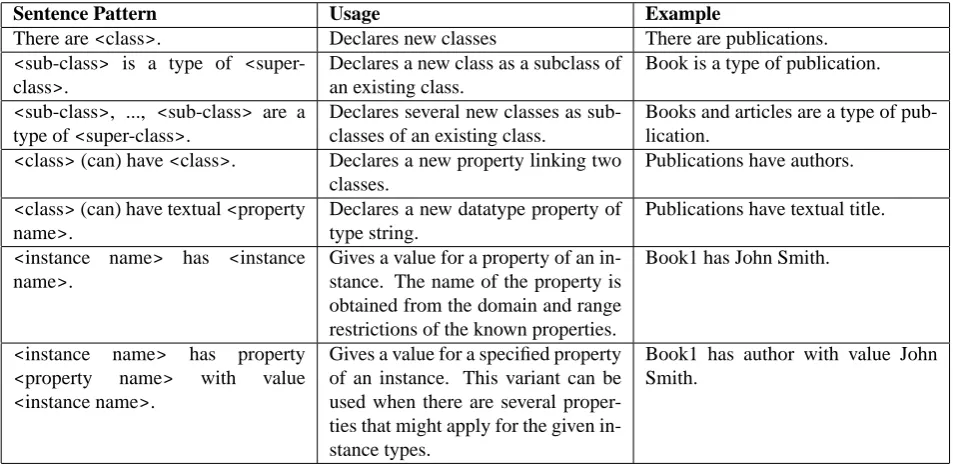
The possible types of actions are: definition of new classes, creation of hierarchies between classes, definition of object and data-type properties, creation of instances, and setting of property values for instances.
The greatest advantage of this approach is that it requires essentially no training; there are no complicated user inter-faces to be learnt, there are no complex formalisms to be understood. The user can simply start from a simple ex-ample which shows all of the types of utterances accepted by the system and continue the ontology authoring work by re-using and modifying the provided examples. After the editing is finished, the resulting ontology can then be previewed using a simple ontology viewer implemented for this purpose. Once the output has been validated, the ontol-ogy can be saved into a variety of formats including RDF-S and OWL variants.
The language analysis is carried out by a Controlled Lan-guage Information Extraction (CLIE) application based on the GATE language processing framework (Cunningham et al., 2002a). The application is a pipeline comprising the GATE English tokeniser, the Hepple part-of-speech tag-ger, a morphological analyser, a transducer that identifies quoted strings, a list look-up component that recognises useful key-phrases, followed by two more finite-state
trans-Figure 1: The CLIE application.
ducers, one for finding noun phrases and the last one that actually parses the CL text and generates the ontology. All the transducers are implemented using GATE’s JAPE pat-tern matching language (Cunningham et al., 2002b). The work-flow of the application is depicted in Figure 1.
There are publications and authors. Papers, articles and books are a type
of publication. Publications have
authors. Publications have textual
titles.
Paper 1 is a paper. John Smith is an
author. Paper 1 has author with value
John Smith. Paper 1 has title with
value "A Paper About Something".
Figure 2: Example of input text
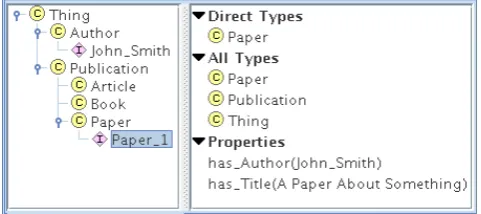
Figure 3: The resulting ontology.
The first three components are standard NLP tools and are used here to pre-process the input text while the quote finder and the NP chunker are simple JAPE transducers. The work of actually parsing CL input is mainly performed by the CLIE transducer together with the key-phrase finder. The key-phrase finder is implemented using the GATE Gazetteer component and has the role of finding and an-notating words and phrases that are part of the controlled language. After all of the processing by the components upstream is done, the CLIE parser needs only to look for sentences that contain pre-determined types of key-phrases at given locations inside. The remaining tokens from the sentence that are not part of the key-phrases are used to generate the names of the ontological objects that are cre-ated.
<!-- Template for defining top classes --> <template>
<in>
<triple id="t1">
<property ns="rdf" name="type"/> <object ns="owl" name="Class"/> </triple>
</in> <out>
<singular>
<phrase>There are <ref ref="t1.subject" number="plural"/>. </phrase> </singular>
<plural>
<phrase>There are <ref ref="t1.subject" number="plural"/>. </phrase> </plural>
</out> <ignoreIf>
<triple id="t2">
<subject ref="t1.subject"/>
<property ns="rdfs" name="subClassOf"/> </triple>
</ignoreIf> </template>
Figure 4: Example of a generation template.
the style of RDF. Next all generation templates are used to find triples that match their input specification. For all the triples that have been matched with a template, a group-ing process, which finds sets of triples that can be used to-gether to generate a single sentence, is performed. Finally, for each set of triples matched to a template, a sentence is generated and written to the output.
The generation of triples from the input ontology is fairly trivial. First, the class hierarchy is traversed in breadth-first manner to create a list of classes where the super-classes are always mentioned before their corresponding subclasses. For each class in the list, one or more triples are generated that include the declaration of a new class, the link with any super-class through therdfs:subClassOfproperty and the list of all the instances for the new class. After the pro-cessing of the classes and their instances has been finished, the properties are next to be converted. Finally, triples that declare property values for all the instances are generated. At the end of this process, the entire ontology has been con-verted into a list of triples.
The next step matches the generation templates from the configuration file with triples from the list obtained in the previous step. A generation template (see the example in Figure 4) has three main components: aninelement con-taining a list of triple specifications, anoutelement con-taining phrases that are generated when a successful match has occurred, and an optionalignoreIfelement that can be used to specify additional triple specifications that cause the match specified in theinelement to be ignored if the conditions are satisfied.
Theinpart of a template consists of a list of triple speci-fications, where each triple may have a subject, a property, and an object element. A triple specification should be seen as a restriction – it lists the conditions required for an input
triple to match this template. If there is more than one triple included in theinelement, they should be seen as a con-junction of restrictions: the template will only match when several triples have been found, one for each triple spec-ification included. References from one triple to another are permitted: one can specify for instance that the second triple should have the sameobjectas thesubjectof the first triple. The triples in theinelement are matched in the order they were listed in the template so only backward references are permitted – a triple can only refer to a previ-ously defined one. An example of using references can be seen in theignoreIfelement of the template presented in Figure 4.
The outsection of a template specification describes the text that gets generated when a successful match occurs. It contains phrase templates that have text elements and references to values that were matched from thein part. The phrases are divided into singular and plural forms, the plural variants being used when several triples are grouped together and are used to generate a single sen-tence using a list of ontology objects (e.g. saying “There
are publications and authors.” will declare
two new top classes in the same sentence). The text el-ements inside a phrase template are simply copied to the output while the reference elements are replaced with the actual values based on the triples that were matched with the specifications from theinsection. Theoutsection of a template can include several phrase templates for each of thesingularandpluralsections. These are seen as alternative variants of expressing the same message and are used by rotation. This facility was added to avoid tedious repetitions of similar phrases.
O. Lassila and R.R. Swick. 1999. Resource Descrip-tion Framework (RDF) Model and Syntax Specifica-tion. Technical Report 19990222, W3C Consortium,
http://www.w3.org/TR/REC-rdf-syntax/.
N.F. Noy, M. Sintek, S. Decker, M. Crubzy, R.W. Ferger-son, and M.A. Musen. 2001. Creating Semantic Web Contents with Prot´eg´e-2000. IEEE Intelligent Systems, 16(2):60–71.
Uta Schwertel. 2000. Controlling plural ambiguities in At-tempto Controlled English. In Proceedings of the 3rd In-ternational Workshop on Controlled Language Applica-tions, Seattle, Washington.