Inductive and deductive inferences
in a Crowdsourced Lexical-Semantic Network
Manel ZARROUK LIRMM
Mathieu LAFOURCADE LIRMM
Alain JOUBERT LIRMM
Abstract
In Computational Linguistics, building lexical-semantic networks and validat-ing contained relations are paramount issues as well as adding some reasoning skills in order to enrich these knowledge bases. In this paper we devise an in-ference engine which aims at producing new "potential" relations from already existing ones in the JeuxDeMots network. This network is constructed with the help of a GWAP (game with a purpose) thanks to thousands of players. It handles terms and weighted relations between these terms, and currently contains over 2 mil-lion relation occurences. Polysemous terms may be refined in several senses (bank may be a bank>financial institu-tion or a bank>river) but as the net-work is indefinitely under construction (in the context of a Never Ending Learn-ing approach) some senses may be miss-ing at a given time. The approach we proposed here is founded on the tri-angulation method through two kinds of inference schemes: deduction (top-down from generic to specific terms) and induction (bottom-up from specific to generic terms). A blocking mechanism, whose purpose is to avoid proposing highly dubious new relations, is based on logical and statistical constraints. Auto-matically inferred relations are then pro-posed to human contributors to be vali-dated. In case of invalidation, a reconcili-ation dialog is undertaken to identify the cause of the wrong inference: an excep-tion, an error in the premises or a previ-ously undetected confusion due to pol-ysemy on the central term common to both premises.
1 Introduction
Developing resources in NLP is one of the cru-cial issue of the field. Most of the existing lexico-semantic networks have been constructed man-ually, like for instance the famous WordNet. Of course some tools are generally designed for consistency checking, but nevertheless the task remains time consuming and costly. Fully auto-mated approaches are generally limited to term coocurrences as extracting precise semantic re-lations between terms from text remains really difficult. New approaches involving crowdsourc-ing are flowercrowdsourc-ing in NLP especially with the ad-vent of Amazon Mechanical Turk or in a broader scope Wikipedia and Wiktionnary, to cite the most well known examples. WordNet ((?) and (?)) is such a lexical network based on synsets which can be roughly considered as concepts. EuroWordnet (?) a multilingual version of Word-Net and WOLF (?) a French version of Net, were built by automated crossing of Word-Net and other lexical resources along with some manual checking. (?) constructed automati-cally BabelNet a large multilingual lexical net-work from term coocurrences in the Wikipedia encyclopedia.
A highly lexicalized lexical-semantic network can contain concepts but also plain words (and multi-word expressions) as entry points (nodes) along with word meanings. The idea itself of word sensesin the lexicographic tradition may be debatable in the context of resources for seman-tic analysis, and we generally prefer to consi..0 der word usages. Byword usageswe mean re-finements of a given word which is clearly iden-tified by locutors. A polysemic term has several usages that might differ substantially from word senses as classically defined. A given usage can also in turn have several deeper refinements and the whole set of usage can take the form of a
cision tree. In the context of a collaborative struction, such a lexical resource should be con-sidered as being constantly evolving and a gen-eral rule of thumb is to have no definite certitude about the state of an entry.
The building of a collaborative lexical network (or any similar resource) can be devised accord-ing to two broad strategies. First, it can be de-signed as a contributive system like Wikipedia where people willingly add and complete en-tries (like for Wiktionary). Second, contributions can be made indirectly thanks to games (better known as GWAP (?) and (?)) and in this case players do not need to be aware that while play-ing they are helpplay-ing buildplay-ing a lexical resource. In any case, the lexical network that is built is not free of errors which are corrected along their discovery. Thus a large number of obvious rela-tions are not contained in the lexical network but are indeed necessary for a high quality resource usable in various NLP application and notably semantic analysis. For example, contributorsdo not indicate that a particular bird type can fly, as it is considered as an obvious generality. Only notable facts which are not easily deductible are naturally contributed. Well known exceptions are also generally contributed and take the form of a negative weight for the relation (for example, fly ag ent−−−−−−−→:−100ostrich).
In order to consolidate the lexical network, we adopt a strategy based on a simple (if not simplistic) inference mechanism to propose new relations from those existing. The approach is strictly endogenous as it doesn’t rely on any other external resources. Inferred relations are submitted either to contributors for voting or to expert for direct validation/invalidation. A large percentage of the inferred relations has been found to be correct. However, a non negligible part of them are found to be wrong and under-standing why is both relevant and useful. The explanation process can be viewed as a reconcil-iation between the inference engine and the val-idator who is guided through a dialog to explain why he found the considered relation as incor-rect. A wrong inferred relation may come from three possible origins: false premises used by the inference engine, exception or confusion due to polysemy.
In this article, we first present the princi-ples behind of lexical network construction with
crowdsourcing and games with a purpose(also know as human-based computation games) and illustrated them with the JeuxDeMots (JDM) project. Then, we present the outline of an elici-tation enginebased on aninference engineusing deduction and induction schemes and a recon-ciliation engine. An experimentation is then re-ported on the performances of the system.
2 Lexical Network and Crowdsourcing
There are many ways for building a lexical net-work considering some crucial factors as the quality of data, cost and time. Beside manual or automated strategies, contributive approaches are more and more popular as they are both cheap to set up and efficient in quality. More specifically, there is an increasing trend of using on-line GWAPs ((?) and (?)) method for feeding such resources.
The JDM lexical network is constructed through a set of on-line associative games. In these games, players are appealed to contribute on lexical and semantic relations between terms or verbal expressions which are presented in the network by the arcs interconnecting nodes in a graph. The informations in the JDM network are gathered by an unnegotiated crowd agree-ment (classical contributive systems rely on a negotiated crowd agreement).
2.1 JeuxDeMots: a GWAP for Building a Lexical-Semantic Network
JeuxDeMots1 is a two player GWAP which aims to build a large lexical-semantic network (?). The network is composed of terms (as vertices) and typed relations (as links between vertices). It contains terms and possible refinements in a similar way to the WordNet synset (?). The se-mantic network is constructed by connecting terms by typed and weighted relations, validated by pairs of players. These relations are labelled according to the instructions given to the players and weighted according to the number of pairs of players who choose them. Other Web-based systems exist, such as Open Mind Word Expert (?), which aims at creating large sense-tagged corpora with the help of Web users, and SemKey (?) which makes use of WordNet and Wikipedia to disambiguate lexical forms referring to con-cepts, thus identifying semantic keywords.
2.2 Diko as a Contributive Tool
Diko2is a web based tool for displaying the in-formation contained in the JDM lexical network which can also be used as a contributive tool. The necessity to not rely only on the JDM game for building the lexical network comes from the fact that many relation types of JDM are either difficult to grasp for a casual player or not very productive (not many terms can be associated).
The principle of the contribution process is that a proposition made by a user will be voted pro or con by other users then included or ex-cluded by an expert validator. What we propose in this paper falls under this type of scenario of contributions/validations.
3 Elicitation by Inference and Reconciliation
We designed a system for augmenting the num-ber of relations in the JDM lexical network hav-ing two main components: (a) an inference gine and (b) a reconciliator. The inference en-gine proposes relations as if it was a contribu-tor, to be validated by human contributors or ex-perts. In case of invalidation of an inferred re-lation, the reconciliator is invoked to try to as-sess why the inferred relation was found wrong. Elicitation here should be understood as the pro-cess to transform some implicit knowledge of the user into explicit relations in the lexical network.
3.1 Making Inferences
The core ideas about inferences in our system are the following:
• for the engine, inferring is to derive new premises (under the form of relations between terms) from previously known premises, which are existing relations;
• candidate inferences may be logically blocked on the basis of the presence or absence of some other relations;
• candidate inferences can be filtered out on the basis of a strength evaluation.
3.1.1 Deduction Scheme
In this paper, the first type of inference we are working with is the deduction or top-down scheme, which is based on the transitivity of the ontological relationis-a(hypernym). If a term A
2http://www.jeuxdemots.org/diko.php
is a kind of B and B holds some relation R with C, then we can expect that A holds the same rela-tion with C. The scheme can be formally written as follows:
∃A −−−→i s−a B ∧ ∃B −−−→R C ⇒ A −−−→R C
Global processing -Let us consider a term T with a set of weighted hypernyms. From each hyper-nym, the inference engine deduces a set of in-ferences. Those inference sets are not disjoint in the general case, and the weight of an inference proposed in several sets is the incremental geo-metric mean of each occurrence.
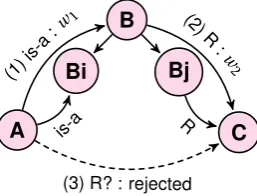
Logical filtering -Of course, this scheme above is far too naive, especially considering the re-source we are dealing with. In effect, B is pos-sibly a polysemous term and ways to block in-ferences that are certainly wrong can be devised. If there are two distinct meanings of the term B that hold respectively the first and the second re-lation, as in the Figure??below, then most prob-ably the inference is wrong.
B
Bi Bj
A C
(1) is-a
:w1
(3) R? : rejected is-a
(2) R
:w
2
R
Figure 1: Triangular inference scheme with logi-cal blocking based on the polysemy of B.
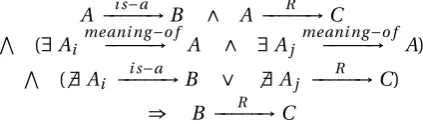
In this case, a relation R -to be inferred- must fulfill some constraints as formulated below:
A −−−−−→i s−a B ∧ B −−−−−→R C
V (
∃Bi
meani ng−o f
−−−−−−−→ B ∧ ∃Bj
meani ng−o f
−−−−−−−→ B)
V (
6 ∃A −−−−−→i s−a Bi ∨ 6 ∃Bj R
−−−−−→C)
⇒ A −−−−−→R C
arith-3.2.1 Errors in the premises
In this case, suppose that relation (1) has a rela-tively low weight. The reconciliator asks the val-idator about the relation (1) .
• If is false, a negative weight is attributed to (1) and the reconciliation is completed. As such, this relation will not be used later on as premises on further inferences;
• If it is true, ask if relation (2) is true and pro-ceed as above if the answer is negative; • Otherwise, move to checking the other
cases (exception, polysemy).
3.2.2 Errors as exceptions
For thededuction, if the validator indicates that the inferred relation is an exception relatively to the term B, the relation is stored in the lex-ical network with a negative weight along with a meta-information which indicates that it is an exception.3
For theinduction, if the alidator indicates that the relation (A −−−→R C) (which served as premise) is an exception relatively to the termB, in ad-dition to storing the false inferred relation (B
R
−−−→C) in the network with a negative weight, the relation (A −−−→R C) is tagged with a meta-information indicating it as an exception. In the induction case, the exception is a true premise which leads to a false induced relation.4
In both cases of induction and deduction, the exception tag concerns always the relation (A
R
−−−→ C). Once this relation is tagged as an ex-ception, it will not participate as a premise in in-ferring generalized relations (bottom-up model) but can still be used in inducing specified rela-tions (top-down model).
3.2.3 Errors due to Polysemy
In this case, if the middle term (Bfor deduction and A for induction) presenting a polysemy is mentioned as polysemous in the network, the refinement terms t er m1, t er m2, ...,t er mn are
presented to the validator so he can choose the
3For example, suppose we have (ostrich ag ent−−−−→fly) in-ferred bydeductionwith the central termB. In this case,
it’s true that an (ostrich−−−−→i s−a bird) and that a (birdag ent−−−−→ fly), but the inferred relation anostrich can flyisfalseand it is considered as anexceptionconsidering the central term
"bird".
4As for the relation (fish ag ent−−−−→fly) which is a false in-ferred relation based on the central termexocet. The (exocet
i s−a
−−−−→fish) and (exocetag ent−−−−→fly) are true but the latter one is anexceptionin the form of atruerelation.
appropriate one. The validator can propose new terms as refinements if he is not satisfied with the listed ones (inducing the creation of new appropriate refinements). After this procedure, two new relations (A −−−→i s−a Bi andBj −−−→R C in
the case of deduction, orAi i s−a
−−−→BandAj
R −−−→
Cin the induction case) will be included in the network with positive values and the inference engine will use them later on as premises.
4 Experimentation
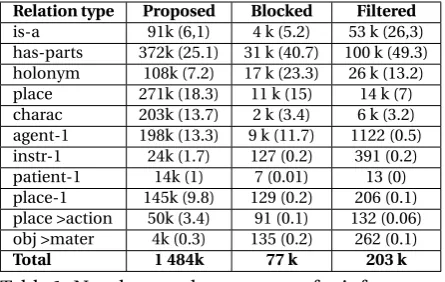
We made an experiment with a unique run of the engine over the lexical network of JDM. The purpose is to measure the production of the in-ference engine along with the blocking and fil-tering. From the set of supposedly valid in-ferred relations (both by induction and deduc-tion), we took a random sample of 400 proposi-tions for each relation type and undertook the validation/reconciliation process. The experi-ment conducted is for evaluation purpose only, as actually the system is running iteratively along with contributors and games.
4.1 Unleashing the Inference Engine
Relation type Proposed Blocked Filtered
is-a 91k (6,1) 4 k (5.2) 53 k (26,3) has-parts 372k (25.1) 31 k (40.7) 100 k (49.3) holonym 108k (7.2) 17 k (23.3) 26 k (13.2) place 271k (18.3) 11 k (15) 14 k (7) charac 203k (13.7) 2 k (3.4) 6 k (3.2) agent-1 198k (13.3) 9 k (11.7) 1122 (0.5) instr-1 24k (1.7) 127 (0.2) 391 (0.2)
patient-1 14k (1) 7 (0.01) 13 (0)
place-1 145k (9.8) 129 (0.2) 206 (0.1) place >action 50k (3.4) 91 (0.1) 132 (0.06) obj >mater 4k (0.3) 135 (0.2) 262 (0.1)
Total 1 484k 77 k 203 k
Table 1: Numbers and percentages for inferences (proposed, blocked or filtered) by the deduction.
4.2 Figures on Reconciliation
Table??contains some evaluation of the status of the inferences proposed by the inference en-gine through deduction. Inferences are valid for an overall of 80-90% with around 10% valid but not relevant (like for instancedog has−−−−−−−→−par t s pro-ton). We observe that error number in premises is quite low, and nevertheless errors can be eas-ily corrected. Of course, not all possible errors are detected through this process.The reconcili-ation allows in 5% of the cases to identify polyse-mous terms. Globally false negatives (inferences voted false but are true) and false positives (in-ferences voted true but are false) are evaluated to less than 0, 5%. For the induction process (table
??), the relationis-ais not obvious (a lexical net-work is not reductible to an ontology and multi-ple inheritance is possible). Result seems about 5% better than for the deduction process: infences are valid for an overall of 80-95%. The er-ror number is very low. The main difference with the deduction process is on errors due to poly-semy which is lower with the induction process. 5 Conclusion
We presented some issues about inferring new relations from existing ones in a contributed lexical-semantic network in which word usages are discovered incrementally along its construc-tion. Errors are naturally present as they might originate from games played on difficult rela-tions, but they are usually spotted and corrected by contributors for terms they are interested in. To be able to enhance the network quality, we proposed an elicitation engine based on infer-ences and reconciliations. Inferinfer-ences are here proposed with two different schemes (induction and deduction), along with a logical blocking and statistical filtering. If an inferred relation is proven wrong, a reconciliation is conducted
to identify the underlying cause. As global fig-ures, we can conclude that inferred deductive relations are correct and relevant in about 78% of the cases and correct but irrelevant in 10% of the case. Overall wrong deductive inferences is about 12% with at least one error in the premises of about 2%, exceptions about 5% and poly-semy confusion about 5%. Induction is natu-rally less productive but more reliable. Beside a tool for increasing relations in a lexical network, the elicitation engine is both an error detector and a polysemy identifier. Actions taken dur-ing the reconciliation forbid an inference proven wrong or exceptional to be proposed again. Such an approach should be pushed forward with other types of inference scheme like abduction, and possibly with distribution evaluation of term semantic classes on which inferences are con-ducted. Indeed, some classes like concrete ob-jects or living beings may be substantially more productive for certain relation types than ab-stract nouns of processes or events. Anyway, such discrepancies of inference productivity be-tween classes are worthy to investigate further.
Deduction % valid % error
Relation type rlvt ¬rlvnt prem excep pol
is-a 76% 13% 2% 0% 9%
has-parts 65% 8% 4% 13% 10%
holonym 57% 16% 2% 20% 5%
typical place 78% 12% 1% 4% 5%
charac 82% 4% 2% 8% 4%
agent-1 81% 11% 1% 4% 3%
instr-1 62% 21% 1% 10% 6%
patient-1 47% 32% 3% 7% 11%
typical place-1 72% 12% 2% 10% 6%
place >action 67% 25% 1% 4% 3%
object >mater 60% 3% 7% 18% 12%
Table 2: Results of the validation/reconciliation according to relation types in the deduction. Valid relations can be relevant or not, and errors can be inpremises,exceptions orpolysemy.
Induction % valid % error
Relation types rlvt ¬rlvnt prem excep pol
has-parts 78% 10% 3% 2% 7%
holonym 68% 17% 2% 8% 5%
typical loc 81% 13% 1% 2% 3%
carac 87% 6% 2% 2% 3%
agent-1 84% 12% 1% 2% 1%
instr-1 68% 24% 1% 4% 3%
patient-1 57% 36% 3% 2% 2%
typical loc-1 75% 16% 2% 5% 2%
lieu-action 67% 28% 1% 3% 1%
object mater 75% 10% 7% 5% 3%
References
von Ahn, L. and Dabbish, L. (2008) Designing games with a purpose. Communications of the ACM, number 8, volume 51. pp. 58-67.
Chamberlain, J., Fort, K., Kruschwitz, U., Lafourcade, M. and Poesio, M. (2013) (2013) Using Games to Create Language Resources: Successes and Lim-itations of the Approach. Gurevych, Iryna; Kim, Jungi (Eds.), Springer, ISBN 978-3-642-35084-9, 2013, 42 p.
Fellbaum, C. (1988, ed.) WordNet: An Electronic Lex-ical Database. The MIT Press.
Law, E., Luis von Ahn, L. and Mitchell, T. (2009)
Search war: a game for improving web search.
KDD Workshop on Human Computation 2009. 31p.
Law, E., Luis von Ahn, L., Dannenberg, R. B. and Crawford, M.. (2007) TAgATune: A Game for Music and Sound Annotation. ISMIR 2007. pp. 361-364.
Lafourcade, M. and Joubert, A. (2012) Long Tail in Weighted Lexical Networks. In proc of Cogni-tive Aspects of the Lexicon (CogAlex-III), COLING, Mumbai, India, December 2012. 16 p.
Lafourcade, M. (2007) Making people play for Lex-ical Acquisition. In Proc. SNLP 2007, 7th Sym-posium on Natural Language Processing. Pattaya, Thailande, 13-15 December. 8 p.
Marchetti, A., Tesconi, M., Ronzano, F., Mosella, M and Minutoli, S. (2007) SemKey: A Semantic Col-laborative Tagging System. in Procs of WWW2007, Banff, Canada. 9 p.
Mihalcea, R. and Chklovski, T. (2003) Open Mind-Word Expert: Creating large annotated data collec-tions with web users help.. In Proceedings of the EACL 2003, Workshop on Linguistically Annotated Corpora (LINC). 10 p.
Miller, G.A., Beckwith, R., Fellbaum, C., Gross, D. and Miller, K.J. (1990) Introduction to WordNet: an on-line lexical database.International Journal of Lex-icography. Volume 3, pp. 235-244.
Miller, G.A. (1995) WordNet: A Lexical Database for English. Communications of the ACM Vol. 38, No. 11, pp. 39-41.
Navigli, R. and Ponzetto, S. (2010) BabelNet: Build-ing a very large multilBuild-ingual semantic network. In Proceedings of the 48th Annual Meeting of the As-sociation for Computational Linguistics, Uppsala, Sweden, 11-16 July 2010. pp: 216-225.
Navigli, R. and Ponzetto, S. (2012) BabelNet: The Au-tomatic Construction, Evaluation and Application of a Wide-Coverage Multilingual Semantic Net-work., Artificial Intelligence. 193: pp. 217-150.
Sagot, B. and Fier, D. (2010) Construction d’un word-net libre du français à partir de ressources multi-lingues. In Proceedings of TALN 2008, Avignon, France, 2008.12 p.
Thaler, S., Siorpaes, K., Simperl, E. and Hofer, C. (2011) A Survey on Games for Knowledge Acquisi-tion.STI Technical Report, May 2011.19 p.