Computational Linguistics and Chinese Language Processing
Vol. 10, No. 4, December 2005, pp. 519-532 519 © The Association for Computational Linguistics and Chinese Language Processing
[Received April 14, 2005; Revised June 15, 2005; Accepted August 14, 2005]
A Synchronous Corpus-Based Study on the
Usage and Perception of Judgement Terms in the
Pan-Chinese Context
Oi Yee Kwong
∗and Benjamin K. Tsou
∗Abstract
This paper reports on a synchronous corpus-based study of the everyday usage of a set of Chinese judgement terms. An earlier study on Hong Kong data found that these terms were more polysemous than their English counterparts within the legal domain, and were even more fuzzily used in general news reportage. The current study further compares their usage in general texts from other Chinese speech communities (Beijing, Taiwan, and Singapore) to explore the regional differences in lexicalisation and perception of the relevant legal concepts. Corpus data revealed the distinctiveness of the Singapore data, and that the contrasting frequency distributions of the terms and senses could be a result of the varied focus in reportage or the use of alternative expressions for the same concepts in individual communities. The analysis will contribute to the construction and enrichment of Pan-Chinese lexico-semantic resources, which will be useful for many natural language processing applications, such as machine translation.
Keywords: Synchronous Corpus-Based Study, Legal Concept and Terminology, Regional Differences, Pan-Chinese Lexico-Semantic Resources
1.
Introduction
In this paper, we report on a synchronous corpus-based study on a set of semantically related legal terms, and propose a Pan-Chinese lexico-semantic resource for the legal domain, such as one in the form of a thesaurus, to differentiate the usage and perception of closely related legal concepts and terminology across various Chinese speech communities.
The situation with language and law is a very interesting one in Hong Kong. As pointed out by Tsou and Kwong [2003], the legal system in Hong Kong has operated through English
∗
Language Information Sciences Research Centre, City University of Hong Kong, Tat Chee Avenue, Kowloon, Hong Kong
520 Oi Yee Kwong and Benjamin K. Tsou
solely for more than 150 years. Following the implementation of legal bilingualism in the 90’s, Hong Kong became the first community that follows the Common Law system which at the same time allows the use of both English and Chinese in court proceedings. In contrast to the many precisely lexicalised legal concepts in English, given its long and established tradition in Common Law, the use of their Chinese equivalents is apparently more fuzzy, as is evident from the lack of one-to-one correspondence of legal terms between English and Chinese. This difference in the cross-lingual lexicalisation of legal concepts between English and Chinese has thus become a substantial linguistic hurdle in the implementation of legal bilingualism, and is directly related to whether both languages could eventually be used in balanced and proper ways to the same effect in the legal domain. The apparent fuzziness with Chinese legal terms is nevertheless peculiar in the Hong Kong context, but not in other places where Chinese is also used as the official language in the legal domain, such as in Mainland China. A possible reason is that preciseness is somehow diluted upon translation. In English, for instance, a “verdict” and a “sentence” are sufficiently distinguished, despite their semantic relatedness (as both are related to the results of a trial). However, when expressed in, or more often translated into, Chinese, the preciseness is somehow weakened. On the one hand, the expression or translation in Chinese might have to take into account the corresponding syntactic constraints and stylistic differences in the two languages in order to sound natural, hence the variation in expressing the same concept in different contexts. On the other hand, the translation could sometimes be affected by usages in other places. For example, although “contract” is mostly expressed as “合約” in Hong Kong, it is sometimes expressed as “合同”, which is the term used in Mainland China for this concept.
A set of semantically related legal terms was studied by Tsou and Kwong [2003] with respect to their usage in the legal domain and in general texts. The terms are “裁定” (hold, convicted), “裁決” (determine, verdict), “判決” (judgement, conviction), “裁斷” (find, finding), and “裁判” (Magistracy)1
, all of which have one or more senses referring to some aspects of “judgement”. Their uses were studied via a corpus of bilingual court judgments2
and a general corpus of news articles from Hong Kong. From the corpus of bilingual judgments, it was observed that these Chinese terms were considerably polysemous, such that most of them were found as the renditions for multiple English terms, which are distinct though closely related in meaning. Even more varied usages were found for the Chinese terms
1
The English terms are the more common translations of the corresponding Chinese terms as observed from Hong Kong court judgments. They are included here for reference only and are not necessarily the absolute or correct translations per se.
2
A Synchronous Corpus-Based Study on the Usage and Perception of 521 Judgement Terms in the Pan-Chinese Context
in the general corpus, and the sense boundaries appeared to be more ambiguous. Although the confusion might be insignificant to the perception of the general readers, the subtlety therein could bear significant conceptual difference in the stricter legal domain, which is far less tolerable of impreciseness and ambiguity. Attempts were made to identify near-synonymous senses from the corpus examples, and to arrange them in terms of their semantic relatedness into a verb hierarchy and a noun hierarchy, in a way similar to WordNet [Miller et al. 1990].
The current work aims at expanding on the above study, to further explore and analyse the different usages and finely grained senses of the aforementioned Chinese legal terms, among news texts from various Chinese speech communities including Hong Kong, Beijing, Taiwan, and Singapore. Based on the usages of these terms in the corpus texts from different communities, we look for local differences in the lexicalisation, if any, and thus the perception of the corresponding legal concepts, which might be a result of the differences in social structures or legal systems. On the one hand, the different societies and legal systems might share similar legal concepts which are expressed in the same ways. On the other hand, in the case where they do not share similar lexical items, it is important to see what alternatives are used in different places to express related concepts. This is a necessary though preliminary step in the development of a Pan-Chinese lexico-semantic resource for legal terminology.
Efforts have been made by researchers in lexical semantics on the study of semantic relations among Chinese lexical items, with a view toward organising the lexical items into semantic networks. Gao [2001], for example, proposed a quantitative measure for the closeness and differentiation of near-synonyms among verbs denoting physical actions from a range of lexical semantic features. Cheng [2001] discussed the differentiation of related words from their individual focus and orientation. Nevertheless, work on lexical semantics and corpus-based lexicography often only drew reference from one particular corpus. Huang et al. [2000] worked on verbal semantics and near-synonyms of Mandarin Chinese as used in Taiwan. Tongyici Cilin [梅等 1984] is based exclusively on Chinese as used in post-1949 Mainland. However, linguistic variation is significant and especially salient for Chinese language used in different communities [Tsou et al. 2004]. Our corpus-based, Pan-Chinese approach, beginning with a set of domain-specific lexical items, thus has additional advantages for its indigenousness, portability, and versatility. Such a Pan-Chinese lexical resource, when done in large scale, could contribute to natural language processing applications like machine translation and serve as a rich reference for legal and paralegal professionals. More importantly, the resource would capture the linguistic norms from more than one Chinese speech community.
522 Oi Yee Kwong and Benjamin K. Tsou
the corpus analysis done in the current study. Results are discussed in Section 4, and we will conclude with future directions in Section 5.
2.
Polysemy of Legal Terms
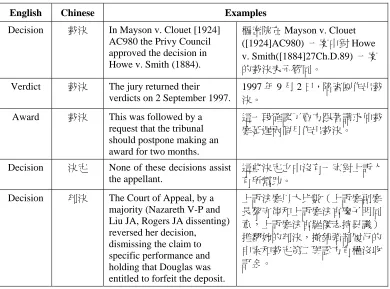
Tsou and Kwong [2003] started with a set of Chinese legal terms, all with senses related to “judgement” or “the action of judging” in the legal context, to study how the preciseness of legal concepts lexicalised in English is captured in their Chinese translations as shown in bilingual court judgments in Hong Kong, and how the preciseness of the latter is in turn preserved in a general corpus. The set of “judgement” terms includes “裁定” (hold, convicted), “裁決” (determine, verdict), “判決” (judgement, conviction), “裁斷” (find, finding), and “裁 判” (Magistracy). They observed that in Hong Kong, despite the implementation of legal bilingualism for several years, legal concepts are not as precisely lexicalised in Chinese as in English. Thus while a particular legal concept could be relatively unambiguously expressed by one term in English, the same concept may not have a direct one-to-one corresponding term in Chinese. The fuzziness is carried over from legal contexts as in court judgments to informal contexts as in news reports. For instance, “裁決” has been identified as the translation equivalent for “decision”, “verdict”, and “award” in the bilingual corpus of court judgments. Similarly, the word “decision” has been rendered as “決定”, “裁決”, and “判決”, among many possibilities. Such a complex correspondence (as further illustrated in Table 1 and Figure 1) between English and Chinese legal terms can be explained by the fact that the use of English is much more mature in the Common Law system in Hong Kong. Many legal concepts are thus lexicalised and can be precisely expressed in English, whereas this preciseness is greatly weakened when terms are translated into Chinese.
Figure 1. Interwoven mapping between English and Chinese legal terms determine
decision
hold
verdict
award
find
裁定
判決
裁決
524 Oi Yee Kwong and Benjamin K. Tsou
3.
A Synchronous Corpus-Based Study
3.1
Materials
In this study, we further analyse three terms (called “target words” hereafter) which Tsou and Kwong [2003] studied, namely “裁定” (hold, convicted), “裁決” (determine, verdict), and “判 決” (judgement, conviction). We leave out “裁斷” (find, finding), as it was only found in the bilingual court judgment corpus but not at all in the general corpus (LIVAC, as introduced below), and “裁判” (Magistracy), as it was found to mostly refer to the sense of “umpire” or “adjudication in a contest” when used in the general corpus.
Sentential contexts for the target words were extracted from a subset of the LIVAC corpus [Tsou et al. 2000]. LIVAC (http://www.livac.org) is a synchronous corpus developed by the Language Information Sciences Research Centre of the City University of Hong Kong. The corpus contains newspaper articles collected synchronously and regularly from six Chinese speech communities. The subset we used in the current study consists of texts from Hong Kong (HK), Beijing (BJ), Taiwan (TW) and Singapore (SG), covering local news, international news, sports news, entertainment news, and financial news, collected over the same period of time (for two years, 1997-98 and 2002-03). Each sub-corpus, that is, texts from each of the four places, contains about 5M Chinese characters, which yields about 3M words upon segmentation.
3.2
The Analysis
A Synchronous Corpus-Based Study on the Usage and Perception of 525 Judgement Terms in the Pan-Chinese Context
4.
Results and Discussion
4.1
Relative Frequency Distribution
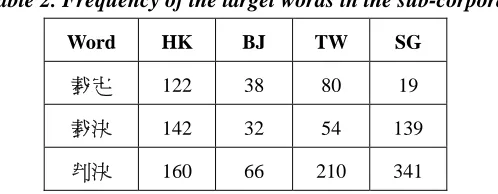
The frequency of the target words from the various sub-corpora is shown in Table 2. The relatively low frequency of all the target words in BJ data is most notable. The small numbers readily indicate that court news does not receive as much attention in Beijing newspapers as in other places.
Table 2. Frequency of the target words in the sub-corpora
Word HK BJ TW SG
裁定 122 38 80 19
裁決 142 32 54 139
判決 160 66 210 341
Just comparing the absolute frequencies, “判決” ranked highest across the board. Its relative frequency is especially high for TW and SG. In the most dramatic case of SG data, there are 341 occurrences of “判決” but only 19 occurrences of “裁定”. This is very different from, for example, HK data, where the relative frequency of “判決” and “裁定” differs by less than 10%. To a certain extent, this difference in relative frequency suggests a variation of focus in news reportage in the two communities, assuming that the use of these words in them is not arbitrary. According to many legal dictionaries [e.g. 《法學詞典》編輯委員會 1985; 劉清景 2001], “判決” and “裁定” refer to different aspects of the ruling of a court. In particular, “判決” is often associated with the final determination on the main issue in a trial, whereas “裁定” usually refers to the conclusions to other factual disputes during a trial.
4.2
Sense Distribution
A Synchronous Corpus-Based Study on the Usage and Perception of 529 Judgement Terms in the Pan-Chinese Context
4.3 Regional Variation
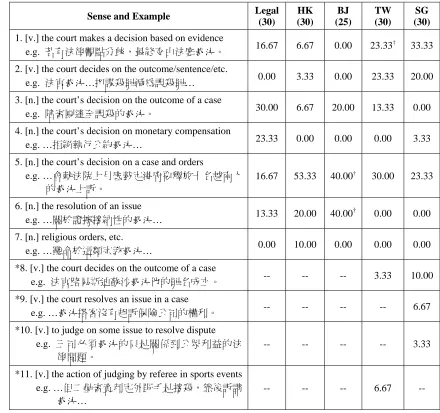
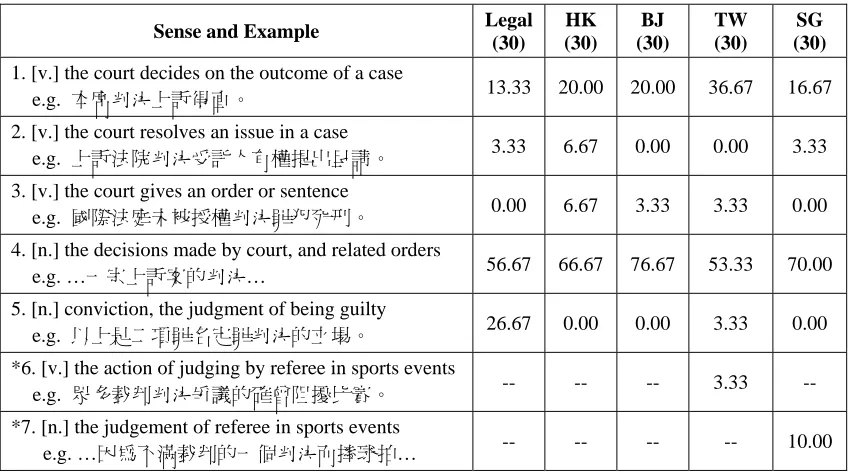
An obvious difference among the three target words is that verb uses tend to dominate for “裁 定”4
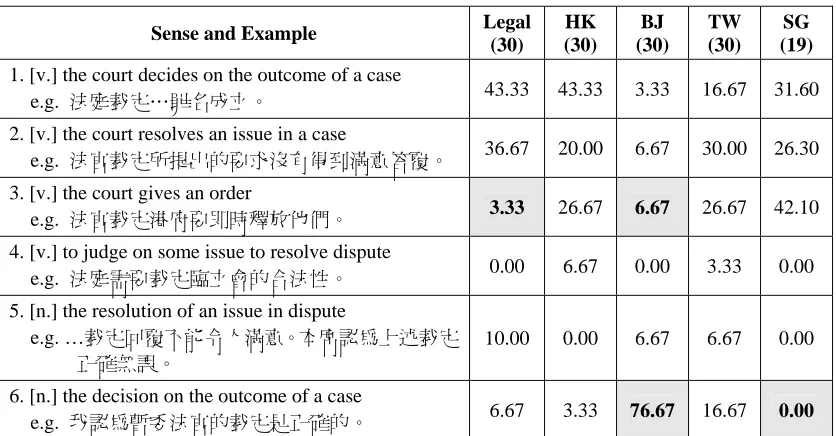
whereas “裁決” and “判決” are used more often as nouns. However, from Table 3, it can be seen that BJ has a lot more nominal usages (sense 6) of “裁定”. This observation is nevertheless in line with the findings of Kwong and Tsou [2003] on verb-noun categorial fluidity in Chinese, where in texts from BJ, about 18% of the verbs were found to undergo the verb-noun shift, compared to about 15% of the verbs in the TW and HK data. Hence this linguistic phenomenon might account for the dominance of sense 6 of “裁定” in BJ data.
There remain some interesting questions regarding the differences in sense distribution across the various regions:
1. Table 3 shows that “裁定” is mostly used in SG to state the order given by the court, that is, sense 3. Does this tell us anything about the salience of court orders in SG reportage?
2. Table 3 also shows that “裁定” is least used in sense 3 in BJ, compared to other places. The frequency of its synonymous senses 裁決/2 and 判決/3 is also extremely low in BJ data. So is the concept missing or expressed in another manner?
3. 裁決/3 is absent from SG data, and so is its synonym 裁定/6. Do SG news reports pay little attention to verdicts? Otherwise where has the concept been absorbed into other expressions?
The difference in sense distribution across various regions is on the one hand a result of the different linguistic norms and styles of language use, as exhibited by the dominance of nominal usages in BJ. Hence even though BJ does not use 裁定/3 or its synonyms, the relevant concepts might have been expressed via nominal uses such as 判決/4. On the other hand, it could reflect the varied approaches and perception in different communities regarding the concepts of judgement. For instance, these concepts are apparently less salient in BJ contexts given the relatively low frequency of the target words in BJ data. Moreover, since SG is found to use 裁定/3 heavily but not 裁決/3, it suggests that SG news tends to treat the conclusion (verdict) and the consequence (sentence and order) as a whole.
To further understand this Pan-Chinese variation, we have simultaneously, though only briefly, surveyed the use of more similar and related lexical items from various resources. For instance, among the words mined from the seed morpheme “判” from the corpus materials used in this study, words like “判刑”, “判監”, “判罰”, “判囚” and “判處” (all related to sentencing) are relatively more abundant in HK and TW than in SG, suggesting that HK and TW tend to distinguish between the verdict and the sentence more clearly. On the other hand,
4
530 Oi Yee Kwong and Benjamin K. Tsou
a preliminary survey through some internet resources on legal documents (e.g. websites with PRC judgments5
and Taiwan judgments6
) shows that terms related to “decision” and “sentencing” like “判定”, “判處”, “判令”, and “判決” are shared by judgments produced in Hong Kong, Mainland China, and Taiwan region. However, a related but probably more specific term, “判命” (which appears to combine decision, sentencing and order), is found only in Taiwan judgments. The variation and the subtle difference among such related terms would be useful and should be captured in a comprehensive Pan-Chinese lexico-semantic resource for the legal domain. Thus the use of these words, their relations with the target words, and their variation in the Pan-Chinese context all require further investigation.
5.
Conclusion
Thus in this study we have further analysed the usage and sense distribution of a set of closely related legal terms pertaining to judgement in the Pan-Chinese context. Linguistic data reveal variation in the salience of these concepts in various Chinese speech communities and the distinctiveness of the SG data. Based on the subtleties among various uses, we have further probed the salience of these concepts in the various communities, and the differences therein might be a result of the difference in legal systems. For instance, the use of the target words in HK and SG might be more influenced by translation from English legal terms than in BJ and TW. Alternatives for expressing similar and related legal concepts should be further explored and the study should be expanded with other sets of closely related legal terms.
As mentioned in the beginning of this paper, the subtle differences among the target words may be insignificant to the general readers. However, when it comes to high quality translation, especially translations which bear legal implications, the preciseness therein will definitely be indispensable. Hence our analysis of the use of legal terms in various Chinese speech communities will provide useful information for the construction of a Pan-Chinese legal term lexical resource as we witness the growing maturity of the Chinese language in the legal domain. Such an enriched lexical resource would be useful to legal and paralegal professionals, and for legal document translation between English and Chinese, by machines or by humans, as well as for many other natural language processing tasks.
5
http://www.chinaiprlaw.com/wsjx/wsjx.htm
6 法源法律網
A Synchronous Corpus-Based Study on the Usage and Perception of 531 Judgement Terms in the Pan-Chinese Context
Acknowledgements
An earlier version of this paper was presented in the Fifth Chinese Lexical Semantics Workshop, Singapore, June 2004. This work was supported by Competitive Earmarked Research Grants (CERG) of the Research Grants Council of Hong Kong under grant nos. CityU1233/01H and CityU1317/03H.
References
Cheng, C.C., “論同義詞的語意輕重與側重”, Presented at the Second Workshop on Chinese Lexical Semantics, 2001, Peking University, Beijing, China.
Gao, H., “A Specification System for Measuring Relationship among Near-synonyms of Physical Action Verbs,” Presented at the Second Workshop on Chinese Lexical Semantics, 2001, Peking University, Beijing, China.
Huang, C-R., K. Ahrens, L-L. Chang, K-J. Chen, M-C. Liu, and M-C. Tsai, “The Module-Attribute Representation of Verbal Semantics: From Semantics to Argument Structure,” Computational Linguistics and Chinese Language Processing, 5(1), 2000, pp.19-46.
Kwong, O.Y., and B.K. Tsou, “A Synchronous Corpus-Based Study of Verb-Noun Fluidity in Chinese,” In Proceedings of the 17th Pacific Asia Conference on Language, Information and Computation (PACLIC 17), 2003, Singapore, pp. 194-203.
Miller, G.A., R. Beckwith, C. Fellbaum, D. Gross, and K.J. Miller, “Introduction to WordNet: An on-line lexical database,” International Journal of Lexicography, 3(4), 1990, pp. 235-244.
Tsou, B.K., and O.Y. Kwong, “When Laws Get Common: Comparing the Use of Legal Terms in Two Corpora,” Language and Linguistics, 4(3), 2003, pp. 609-629.
Tsou, B.K., T.B.Y. Lai, and K. Chow, “Comparing Entropies within the Chinese Language,” In K.Y. Su, J. Tsujii, J.H. Lee and O.Y. Kwong (Eds), Natural Language Processing – IJCNLP 2004, LNAI Vol. 3248, Springer-Verlag, pp.466-475.
Tsou, B.K., W.F. Tsoi, T.B.Y. Lai, J. Hu, and S.W.K. Chan, “LIVAC, A Chinese Synchronous Corpus, and Some Applications,” In Proceedings of the ICCLC International Conference on Chinese Language Computing, 2000, Chicago, pp. 233-238.
《法學詞典》編輯委員會, 《法學詞典(增訂版)》, 上海辭書出版社, 1985.
劉清景, 《新編法律大詞典》, 學知出版事業股份有限公司, 2001.