Computational Linguistics and Chinese Language Processing
Vol. 14, No. 2, June 2009, pp. 221-236 221 © The Association for Computational Linguistics and Chinese Language Processing
[Received August 4, 2009; Revised January 29, 2010; Accepted February 1, 2010]
A Corpus-based Study on Figurative Language through
the Chinese Five Elements and Body Part Terms
Siaw-Fong Chung
∗Abstract
Using a corpus-based approach, this paper analyzes figurative language through observing the Chinese five elements (五 行) of 金 ‘metal,’ 木 ‘wood,’ 水 ‘water,’ 火 ‘fire’ and 土 ‘earth.’ This work found that there are at least two types of figurative language in Mandarin Chinese – one of which occurs at the morphosyntactic level and the other occurs during the mappings between two domains (between the body part terms and these five elements). When the figurative uses of the co-occurring five elements with body part terms were tested in a psycholinguistic experiment composed of two groups of subjects (non-native and native speakers of Mandarin), a majority of the non-native speakers were unable to comprehend these figurative uses. This study attempts to prove that a linguistically-driven understanding of the five elements will be of great help to teaching or learning figurative language in a Mandarin L2 context.
Keywords: Corpus, Five Elements, Figurative Language, Body Part, Learners of
Chinese, Psycholinguistic Experiment.
1.
Introduction
The relationship between body part terms and emotion metaphors was discovered by early psychologists, such as William James (1884) and Carl Lange (1884), who suggested that the origin of emotions is inside one’s body. Linguists of present days, such as Kovecses (2003) and Wierzbicka (1999), have also examined emotions in English and compared them to those in different languages. In Yu’s (1995: 85) inspection of Mandarin metaphorical expressions related to anger and happiness in Chinese, he noted that the “underlying cognitive model based on the fundamental theories of Chinese medicine has led to a cultural emphasis in China of sensitivity to the physiological effects of emotions on the internal organs.” Therefore, it holds that Chinese people are aware of the relatedness between the five elements and emotions
∗
222 Siaw-Fong Chung
in Chinese. Our current study is different from Yu’s by addressing the following questions.
(1) (a) What are the distributional patterns of the Chinese five elements in corpora data?
(b) To what extent will a corpus-based method help to extract figurative language containing the Chinese five elements?
(c) How will a linguistic analysis contribute to the understanding of figurative language by learners of Mandarin as a second language?
In addition to extracting figurative language, our work aims to explain how a corpus-based method can be used to assist teaching and learning. We intend to see the extent to which corpora and collocational understanding help in extracting these figurative patterns and how these patterns can be applied to teaching and learning of Mandarin to foreigners.
2.
The Chinese Five Elements (
五行
)
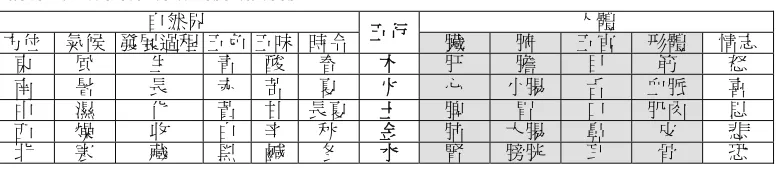
Traditional Chinese medicine believes that the five elements also control one’s internal body – they “are said to vanquish one another and to produce one another” (Veith, 2002: 19). These elements are also reckoned by philosophers to be phenomena that rule nature. Table 1 provides these resonances (of mapping), according to traditional Chinese beliefs.
From Table 1, it can be seen that the five elements are related to emotions (last column of Table 1) and to body parts (shaded).
Table 1. Five element resonances
自然界 五行 人體
方位 氣候 發展過程 五色 五味 時令 臟 腑 五官 形體 情志
東 風 生 青 酸 春 木 肝 膽 目 筋 怒
南 暑 長 赤 苦 夏 火 心 小腸 舌 血脈 喜
中 濕 化 黃 甘 長夏 土 脾 胃 口 肌肉 思
西 燥 收 白 辛 秋 金 肺 大腸 鼻 皮 悲
北 寒 藏 黑 鹹 冬 水 腎 膀胱 耳 骨 恐
A Corpus-based Study on Figurative Language through the 223 Chinese Five Elements and Body Part Terms
and 膀胱 ‘bladder’) can be easily explained, many others, such as the combinations of 腎 ‘kidney’ and 水 ‘water,’ as well as 肺 ‘lung’ and 金 ‘metal,’ are not entirely linguistically-driven. Chinese speakers, however, do not seem to find this a problem – that is, they can use 肚子 ‘stomach’ and 水 ‘water’ on the one hand and believe that 腎 ‘kidney’ and 水 ‘water’ are closely related on the other. This discrepancy between world versus linguistic knowledge may be confusing to a learner of Mandarin. Therefore, we hope to provide some insights to explain these apparent ‘discrepancies’ from a linguistic perspective, further supported by empirical data from corpora and a psycholinguistic experiment1
. It is also through a metaphor framework (Lakoff & Johnson, 1980; Lakoff, 1999) that we hope to explain the mapped meanings of these five elements when they appear as physical entities (of metal, wood, water, fire, and earth) and as abstract elements.
This study claims that collocational data from corpora can be utilized to raise awareness amongst foreign learners of Mandarin so that patterns in the target language can be recognized. These patterns may cause difficulty for learners both at word formation and at sentential levels. For example, some non-existent associations in English (e.g., 肝 ‘liver’ with 火 ‘fire’ to mean ‘irascibility’) can be better explained with corpora data2
. By providing quantitative data, our research can shed light on the differing conceptualizations a foreign learner of Mandarin may need to overcome. The following expresses the methodology used in this work.
3.
Methodology and Results for Corpora Analyses
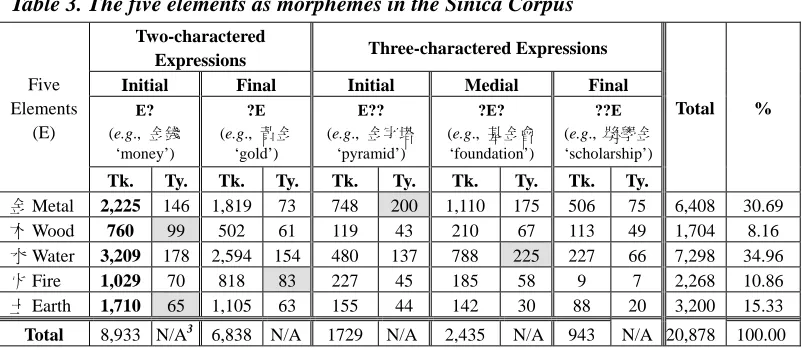
All single- (e.g., 火 ‘fire’) and multiple- (e.g., 肝 火 liver-fire’) character expressions containing the five elements were extracted from the Academia Sinica Balanced Corpus of Modern Chinese (hereafter Sinica Corpus), shown in Table 2. From Table 2, a total of 25,079 instances were found containing these five elements either as single-character expressions (Column 4) or in multiple-character morphemes (Column 6). Among these, 水 ‘water’ constitutes the biggest proportion, with about 40% of the total number of instances. This may be due to the fact that water has a wide applications of functions – to drink, to wash, to flow, to move, to flood, etc., not mentioning its possibilities of combination with different morphemes ranging from aquatic-related attributes (e.g., 水 田 ‘paddy field’ and 水 產
1
This observation was made based on the resonances in Table 1 versus the linguistic data observed. This did not include other relations amongst the elements such as the克 ‘control’ cycle, which may explain some conflict between elements.
2
226 Siaw-Fong Chung
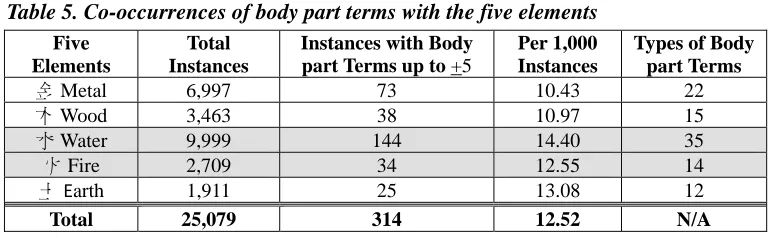
Sinica (with expansion by the author). From Table 4, there are forty-two Mandarin body part terms used in this part of the research. The number of co-occurrences of the body part terms with the five elements in +5 window span (for words, not characters) was recorded (see Table 5). When more than one body part term was found appearing within the designated window size (as in伸手捧了些清水洗去臉上沙塵 ‘to stretch and hold some clean water to wash away the dirt on the face’), the body part terms (‘hand’ and ‘face,’ in this case) were counted in each category, respectively.
Table 5. Co-occurrences of body part terms with the five elements
Five Elements
Total Instances
Instances with Body part Terms up to +5
Per 1,000 Instances
Types of Body part Terms
金Metal 6,997 73 10.43 22
木Wood 3,463 38 10.97 15
水Water 9,999 144 14.40 35
火Fire 2,709 34 12.55 14
土Earth 1,911 25 13.08 12
Total 25,079 314 12.52 N/A
As displayed in Table 5, there are only 314 instances from the total hits in which these body parts were found in the designated contexts of the five elements. This frequency is rather low as there are, on average, only 13 instances of body part terms appearing in every 1,000 instances of the (combined) five elements.
From Table 5, we can see that 水 ‘water’ is the most frequently used element with body part terms compared to the other four elements (14 instances per 1,000 instances). This is followed by火 ‘fire’ and 土 ‘earth,’ each with 13 instances in every 1,000 instances. Sample sentences for水 ‘water’ and 火 ‘fire’ are, respectively, 增加肚子裡的『墨水』‘increase the ink (knowledge) in one’s stomach’ and 眼睛幾乎要冒出火 ‘fire seems to be bursting out from his/her eyes.’ These examples show the co-occurrences of the body part terms with the five elements (regardless whether the five elements appear in single- or multiple- character expressions, or whether they are literal or figurative). A non-figurative use of 土 ‘earth’ can be seen in 他滿口滿鼻都是沙土 ‘his mouth and nose are full of sand.’ “Types of Body part Terms” (last column of Table 5) refers to the number of types of body parts found with a particular element. For instance, 水 ‘water’ co-appears with 35 (83.33%) out of the 42 body part terms selected for the analysis of this work, indicating that 水 ‘water’ appears most frequently with body part terms. 金 ‘metal,’ the second most frequent, is found with twenty-two (52.38%) body part terms.
228 Siaw-Fong Chung
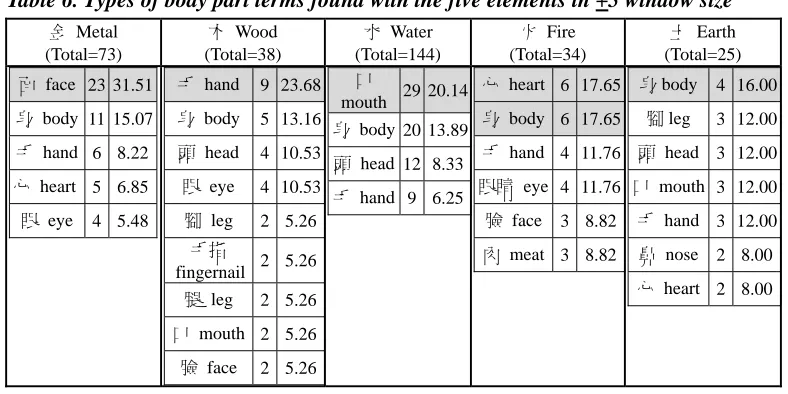
made. For instance, we predicted a higher percentage of figurative language could possibly be found with 火 ‘fire’ when it co-appears with body part terms such as 心 ‘heart’ and 眼睛 ‘eye.’ We also predicted that 金 ‘metal,’ 木 ‘wood,’ and 土 ‘earth’ would be used less figuratively, based on their most often appearing (body part) collocates being a classifier, hand, and body, respectively, each possessing a relation that is likely to be literal. These predictions were made based on the collocational patterns found in a corpus. Nevertheless, we could not make a solid prediction regarding 水 ‘water’ since its collocates of 口 ‘mouth,’ 身 ‘body,’ 頭 ‘head,’ and 手 ‘hand’ can be used both literally and figuratively. These (linguistic) collocates in Table 6 are obviously different from the resonances of the five elements presented in Table 1 earlier, further confirming that language use and traditional beliefs might be two separate knowledge systems for the Chinese.
4.
The Five Elements, Body Part Terms and Figurative Language
This section carries out an analysis of figurative language, calculating the number of co-occurrences of body part terms and the five elements which are non-literal. We used the term ‘figurative language’ to refer to the above phenomenon of figurative use, focusing particularly on instances where the Chinese five elements co-appear with body part terms, especially when they carry a figurative meaning. Our definitions of figurative language are also in accordance with the following two important features listed by Liu (2008: 23) for idioms (a term he uses to refer generally to figurative language)5
.
(1) Idioms are often non-literal or semi-literal in meaning – that is, an idiom’s meaning is often not completely derivable from the interpretation of its components. (2) They are generally rigid in structure – that is, some of them are completely invariant but others allow some restricted variance in composition... (Liu, 2008: 23)
The linguistic data of our concern are also non-literal (opaque) or semi-literal (semi-opaque). Their meaning cannot be derived completely from their components. Opaque instances including four-character idioms in Chinese such as冷水澆頭 ‘to pour cold water on one’s head (to discourage).’ These four-character idioms were checked against the Ministry of Education’s Dictionary of Chinese Idioms (because not all four-character expressions in Mandarin are idioms)6
. Figurative language concerned in this work is generally rigid in nature but does allow for some restricted variance in composition. For instance, both 眼睛冒金星
5
Liu listed three features with the last one being “[i]dioms are multiword expressions consisting minimally of two words, including compound words” (pg. 23) which refers mainly to English and is not applicable here.
6
A Corpus-based Study on Figurative Language through the 229 Chinese Five Elements and Body Part Terms
‘Venus is at view (to be dazed)’ and 撞了個滿頭金星亂冒 ‘Venus appears above one’s head due to a collision’ are two variant forms of 冒金星 ‘Venus appears’7
. Our analyses of figurative language also included similes, which usually appear in the construction ‘body part X is like Y,’ as in祂的心像死水 ‘His heart is like dead (still) water.’ In this example, even though 死水 ‘still water’ itself is a personification of the water by giving it a feature of death, we concentrated on the figurative language found between the mappings of body part terms and the five elements. We also included examples in which the relationship between the body part terms and the five element terms is implicit. For instance, in清肝退火 ‘to clean up liver and to reduce internal bodily heat,’ 火 ‘fire’ has no explicit reference to 肝 ‘liver’ but the implied meaning is 退肝火 ‘to recede the fire of the liver’ (also, ‘to cool down’).
Based on the above criteria, our final results concerning the figurative uses of the five elements with the body part terms are given in Table 7.
Table 7. Literal and figurative uses of body part terms with the five elements
Five Elements Literal Figurative Total
金Metal 69 (95%) 4 (5%) 73 (100%)
木Wood 32 (84%) 6 (16%) 38 (100%)
水Water 134 (93%) 10 (7%) 144 (100%)
火Fire 18 (53%) 16 (47%) 34 (100%)
土Earth 25 (100%) 0 (0%) 25 (100%)
Total 278 (89%) 36 (11%) 314 (100%)
Based on the total 314 instances for all five elements (from Table 5), we can see the distributions of literal versus figurative usage in Table 7. From this total, about 89% are literal and only 11% are figurative. Previous work (Chung, 2009: 77) found that about 30% of metaphorical expressions are used in newspapers, and the percentages in Table 7 are obviously lower, except for 火 ‘fire,’ which distributes differently with half (53%) of its instances being figurative and the other half (47%) literal. This displays the possibility that 火 ‘fire’ not only is used more often with body part terms but also that half of its instances in a corpus are likely to be figurative. All of the other four elements pattern the same – with more than 84% of the uses carrying literal meanings. This demonstrates that most of their co-occurrences with body part terms refer to their concrete entities, rather than the abstract elements. Co-occurrences of 火 ‘fire’ with body parts are as along the lines of 他胸中的熱 火何等地狂燒 ‘the hot fire inside his chest is burning crazily’ and 坦利一時心嫉如火
7
230 Siaw-Fong Chung
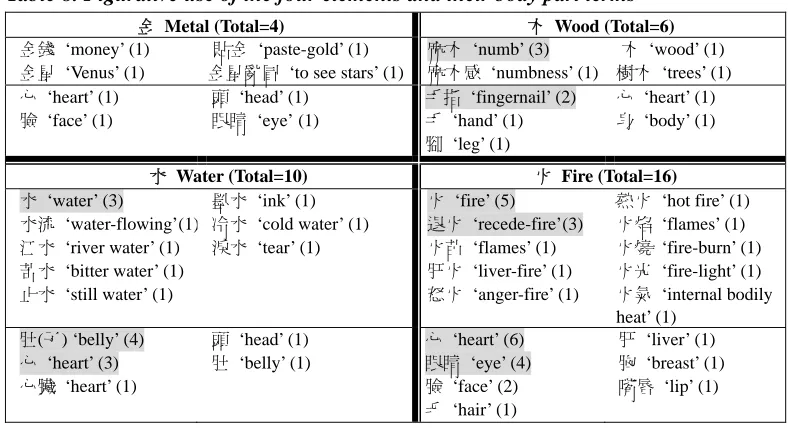
‘Terry’s heart was momentarily jealous like fire burning.’ We also predicted that 金 ‘metal,’ 木 ‘wood,’ and 土 ‘earth’ would be used less figuratively, based on their most commonly appearing (body part) collocates. The results in Table 7 make clear that, from all the co-occurrences of body part terms with the five elements, only 5% of the instances of 金 ‘metal’ are used figuratively, i.e. 心被金錢佔據 ‘the heart is invaded by money (gold and money,’ in which a mapping between 心 ‘heart’ and 金錢 ‘money’ is found through the action of ‘invading.’ As for土 ‘earth,’ surprisingly, all of its instances have literal meanings in our corpus (e.g., 哥哥洗去父親滿身的泥土 ‘(my) brother washed away the soil all over father’s body’). An intuitive observation did find instances such as 面如土灰 ‘a face like grey soil (earth),’ but uses such as this were not present in our data. One reason could be that 土 ‘earth’ is not used with body parts but with other aspects of humans, such as ‘aspiration’ (e.g., 土 氣 ‘to be unrefined in appearance’ and ‘language’ 土 話 or 土 語 ‘the local language’). As for 木 ‘wood,’ 16% of its instances are used figuratively and the most commonly seen figurative use is 麻木 ‘become numb/numbness.’ (Even though both 麻 ‘hemp’ and 木 ‘wood’ can refer to a type of crop or plant, respectively, when they are combined, a new meaning of ‘being numb’ is derived.) Intuitive investigation found examples such as 石木心腸 ‘a heart as hard as stone and wood’ and 心如木石 ‘a heart like wood and stone,’ but these examples were again not found in the data set of the corpus. In the following, four out of the five elements (excluding 土 ‘earth,’ which consists of zero instances of figurative use) that were used figuratively are laid out in Table 8. The words in which the five elements were found are displayed in the first row of each element. The second row of each element shows the body part terms used with these four elements to form figurative language.8
From Table 8, one can see the most commonly found figurative language for all four elements. The results differ slightly from those in Table 6. In 金 ‘metal,’ no particular pattern is displayed, as all instances were sparsely found. For木 ‘wood,’ 麻木 ‘being numb’ and 手 指 ‘fingernail’ are highlighted to be the most frequent in their respective cells. For 水 ‘water,’ its appearance as a single word is used most commonly in the figurative sense, while the corresponding body part terms are 肚子 ‘belly’ and 心 ‘heart’ (e.g., 他們有一肚子的 苦水 ‘they have one full stomach of bitter water (complaints) and 江水像跳動的心臟般 ‘the river water is pumping like the heart’). As for 火 ‘fire,’ it is most frequently used in a figurative sense as a single word, followed by 退火 ‘recede fire.’ The corresponding body part terms for 火 ‘fire’ are 心 ‘heart’ and 眼睛 ‘eyes.’ If one contrasts this table with Table 6, one can produce several observations which are important for the learning of Mandarin, for example, when 金 ‘metal’ co-appears with 面 ‘face’ (see Table 6), it is likely to be used
8
232 Siaw-Fong Chung
linguistic ones. Furthermore, a corpus-based study will also help discover characteristics that are often implicit in the language. For a second language learner of Mandarin, these implicit uses can be made clearer if their linguistic patterns are displayed, as shown in this work. In addition to being able to predict language usage, this study has also found that there are at least two types of figurative language in Mandarin Chinese – namely, those occurring at the morphosyntactic level and those occurring during the mappings between two domains (the body part terms and the five elements). At both levels, we found mappings from the concrete meaning of the five elements to their less concrete meaning, although there might be one or more levels of abstractness involved. Our analyses also show that figurative language in Chinese involves complex domain mappings, which can prompt discussion regarding the theoretical issues related to metaphor mappings.
5.
Figurative Language and Foreign Learners of Mandarin
In order to examine the understanding of figurative language by native and non-native speakers of Mandarin, we conducted a psycholinguistic experiment based on a translation task. In this task, we asked both (foreign) learners and native speakers of Mandarin to translate from Mandarin to English some figurative sentences containing the five elements and the body parts. Only subjects who truly understood the figurative meanings would be able to translate these sentences. A questionnaire was created for this purpose, with examples taken or modified from the Sinica Corpus. Subjects were asked to translate the Mandarin sentences in (2) into fluent English. All of the keywords are highlighted in (2) but were not highlighted in the questionnaire. All subjects were told not to refer to dictionaries while answering10
.
(2)
(a) 老李最擅長的就是往自己臉上貼金了。
(b) 整個嘴唇因為休息太少而火氣上升腫了
起來。
(c) 肝火旺盛會導致口乾舌燥。
(d) 這種中藥吃了之後退火顧眼睛。
(e) 廣泛閱讀可以增加肚子裡的墨水。
(f) 一直坐在電腦桌前,容易造成四肢麻木。
(g) 他們在這場比賽中輸得灰頭土臉。
(h) 上一場失敗的戀愛後,小華心如止水。
(i) 她找朋友吐了一肚子的苦水。
(j) 興奮的他頭上被澆了一盆冷水。
(k) 心裡愛的火苗一下子滅了。
(l) 水深火熱
(m) 一頭霧水
(n) 大動肝火
(o) 眼冒金星
Only six non-native (NN) speakers of Mandarin were recruited, and all of them were advanced Mandarin learners at National Chengchi University (average age=29.5). Their
10
A Corpus-based Study on Figurative Language through the 233 Chinese Five Elements and Body Part Terms
answers were contrasted with the answers provided by six other native (N) speakers of Mandarin (average age=30). The two groups of subjects differed in their language proficiencies based on a scale of 1 to 7, with 1 being least fluent and 7 being most fluent, in Mandarin (NN=5.0; N=6.8) and in English (NN=6.5; N=5.5)11
. We hypothesized that the native speakers of Mandarin would fully understand the figurative stimuli in (2) and would express their meanings in English adequately. The non-native speakers, however, would only partially understand these figurative uses and as a result, their answers might differ slightly from the original meanings of the stimuli. These hypotheses were tested in terms of how many out of the total six subjects in the respective group answered adequately according to the figurative meaning of each stimulus. By ‘adequate answer,’ we referred to cases when an English translation fully expressed the figurative meaning of the idioms, even if the target words might not be directly translated, as in (3a) and (4a). Inadequate answers were such as (3b), (4b) and (4c).
(3) 老李最擅長的就是往自己臉上貼金了。
(a) “Old Lee’s expertise is flattering himself.” (S5, N) (b) “Lao Li’s habit is to pretend to be rich.” (S4, NN)
(4) 上一場失敗的戀愛後,小華心如止水。
(a) “After the last love disappointment, Xiaohua’s heart is like a still water.” (S2, NN) (b) “After the failure of the last relationship, her heart feels like running water.” (S4, NN) (c) “After the crazy love affair ends, the heart bleeds water.” (S1, NN)
Missing translation in other parts of the sentences which did not affect the understanding of the target words was acceptable (as in (5a)). Scores were either one or zero. Unanswered or missing information in any of the target words (e.g., 火氣上升 in (5b) (translated as ‘swollen lips’)) was considered inadequate; thus, an answer falling into this category would be accorded a zero score. In some cases, over interpretation (5c) occurred, and these cases were also considered inadequate.
(5) (a) 廣泛閱讀可以增加肚子裡的墨水。
“Broad range literature can increase one’s knowledge.” (S4, NN)
(b) 整個嘴唇因為休息太少而火氣上升腫了起來。
“My lips are entirely swollen due to lack of rest.” (S5, NN)
11
234 Siaw-Fong Chung
(c) 一直坐在電腦桌前,容易造成四肢麻木。
“If you sit in front of the computer all day, you will become unfit and begin to progress your body shape in a horizontal manner.” (S5, NN)
All of the answers were then marked as adequate or inadequate (one for adequate and zero for inadequate). The results showed that the non-native speaker group only obtained a 41% (SD=20.77) score for adequate answers. The native speaker group, in contrast, obtained high performance with 92% (SD=8.61) of adequate answers, indicating almost all the answers were correct. Nonetheless, a higher standard deviation value (SD) for the non-native speaker group means that the subjects’ answers in this group varied greatly compared to those given by the native speaker group. When tested using a Mann-Whitney test, significance was found, U (28)=0.00, p<.05, suggesting that the two groups differed significantly from each other. From the experiment, we found that most non-native speakers had problems with the following stimuli in (6), as each had only one adequate answer (16.67%) from the six subjects who participated. Some of these stimuli were left empty.
(6) (a) 整個嘴唇因為休息太少而火氣上升腫了起來。(b)
“She always talks and that’s why she’s getting angry so easily.” (S3, NN) (b) 這種中藥吃了之後退火顧眼睛。(d)
“Eating this traditional Chinese medicine will help healing conjunctivitis.” (S5, NN) “Having eaten herbal medicine, your eyes will feel as if it suddenly can see clearly again.”
(S6, NN) (c) 大動肝火 (n)
“Being quick to reacting to emotions leads to distress.” (S5, NN) “He has the guts to take a risk.” (S1, NN)
(d) 眼冒金星 (l)
“reach for the stars.” (S3, NN) “eye twinkling.” (S4, NN)
A Corpus-based Study on Figurative Language through the 235 Chinese Five Elements and Body Part Terms
in a different language, it is very hard for a foreign or second language learner to master the meanings in the target language. Therefore, analyzing the similarities and differences between any two languages is important as the learning of metaphors not only involves learning new vocabulary but also learning a different culture. Since learners do not know many of the opaque or semi-opaque meanings of these figurative expressions, by understanding the relationships between the five elements and the body part terms, learners are likely to improve in their ability at guessing the figurative meanings of these uses.
6.
Conclusion and Future Work
Our paper proposes a criteria-based method to identify figurative language through observing co-occurrences of body part terms with the Chinese five elements. The research questions of this work were answered based on a detailed analysis of the five elements and their appearances in a corpus either as a single-character expression or as a morpheme. Our study also finds results regarding figurativeness in word formation and that metaphors may occur at units as small as morphemes. The findings of this work also show the different uses of the five elements – these five elements are not treated equally when formulating figurative language. For instance, we found that, in the Sinica Corpus, 水 ‘water’ is the most frequently occurring element compared to the other four elements. When examined with body part terms, however, the element of 火 ‘fire’ stands out and also comprises the highest percentage of figurative usage. Additionally, the research herein also shows that a corpus can be of great help to language learners, as it presents linguistic data in the form of statistics to them. A corpus-based study is also able to present distributions of collocated data, through which we predict the possible occurrences of literal versus figurative usage. Through a psycholinguistic experiment, we found that linguistic analysis is needed in teaching and learning of Mandarin since figurative language constantly causes great difficulty to learners of Mandarin.
Since our study also finds results regarding occurrences of figurativeness in word formation, for future research, we intend to analyze figurativeness at the morphosyntactic level, as we found that there are many uses of 木 ‘wood’ in the sense of ‘stupidity’ (e.g., 木 頭木腦 ‘one without expression’ and 木頭人 ‘a blockhead’). In addition, 木舌 ‘a tongue that is made of wood’ is also used to mean ‘someone who is silent.’ These examples may be low in frequency and, therefore, not collected in the corpus we used. Another explanation for this may be attributed to their denotation of negative meanings (usually used to mock people). These uses are considered improper or impolite, resulting in lower production both in speech and in writing.
236 Siaw-Fong Chung
An extension of this work can examine the relation of body parts and the five elements in English. The English phrase ‘my heart is on fire’ seems to differ in meaning from its Chinese equivalent (’to be angry’). Therefore, a cross-cultural investigation is also feasible. In addition, this paper finds ambiguity with regard to translating the Chinese 金 to ‘gold’ or ‘metal’ and 土 to ‘soil’ or ‘earth’ in some phrases. It would, therefore, be interesting to see how English translation deals with this ambiguity and how this can become useful to studies in machine translation. The paper is also able to pinpoint the existence of traditional Chinese concepts in Mandarin and how they can be contrasted with linguistic data for the purpose of computer-assisted language learning.
Acknowledgments
This research was supported in part by National Science Council under Grant NSC 97-2410-H-004-001-. Acknowledgements also go to Professor Chu-Ren Huang and the reviewers for their comments on the previous versions of this work.
References
Chung, S.-F. (2009). A Corpus-driven Approach to Source Domain Determination. Language and Linguistics Monograph Series. Nankang, Academia Sinica.
Hicks, A, Hicks, J. & Mole, P. (2004). Five Element Constitutional Acupuncture. Edinburgh & New York, Churchill Livingstone.
James, W. (1884). What is Emotion?. Mind, ix, 188-205.
Kovecses, Z. (2003). Metaphor and Emotion. Language, Culture and Body in Human Feeling. New York, Cambridge University Press.
Lakoff, G. (1999). Philosophy in the Flesh: The Embodied Mind and Its Challenge to Western Thought. New York, Basic Book.
Lakoff, G. and Johnson, M. (1980). Metaphors We Live By., Chicago & London, The University of Chicago Press.
Lange, C. (1887). Ueber Gemuthsbewgungen, 3(8).
Liu, D. (2008). Idioms: Description, Comprehension, Acquisition, and Pedagogy. New York & London, Routledge.
Swadesh, M. (1971). The Origin and Diversification of Language. Edited post mortem by Joel Sherzer. Chicago, Aldine.
Veith, Z. (Translator). (2002). The Yellow Emperor’s Classic of Internal Medicine. Berkeley, Los Angeles & London, University of California Press.
Wierzbicka, A. (1999). Emotions across Languages and Cultures: Diversity and Universals. New York, Cambridge University Press.