ISSN(Online): 2319-8753 ISSN (Print): 2347-6710
International Journal of Innovative Research in Science,
Engineering and Technology
(An ISO 3297: 2007 Certified Organization)
Website: www.ijirset.com Vol. 6, Issue 8, August 2017
Comparative Study on Alkali Activated Fly
Ash of Different Classes, Emphasizing Pore
Characteristics
Madhusudan Barman1, D. Dutta2, Dr.Sarmistha Das3
PG Student, Department of Civil Engineering, Institute of Science and Technology, Medinipur, West Bengal, India1
Professor and Head, Department of Civil Engineering, Camellia School of Engineering & Technology, Kolkata,
West Bengal, India2
Professor, Department of Civil Engineering, Institute of Science and Technology, Medinipur, West Bengal, India3
ABSTRACT:This study comprises the progress of alkali activated fly ash paste ensuing from altered fly ash classes. The exploration was carried out to check the strength and microstructure of series of specimens.Low calcium (Black and Grey) and high calcium (White) fly ash were used in the present research. The amalgamation of KOH and Na2SiO3 has been used as alkali activator. The simple aim of this paper is to study the progress of various physical properties along with change in pore morphology.FESEM were piloted to realize pore morphology and assess the reacted and unreacted areas of the trials.
KEYWORDS:Fly-ash, Alkali activator, strength, pore morphology, FESEM.
I. INTRODUCTION
The ordinary Portland cement (OPC) formation emits pollutants which put big impact on environmental pollution. The production of Portland cement releases enormous amount of carbon dioxide. Report depicts that one ton CO2 is
produced by making one ton ordinary Portland cement [1]. Alkali alumino-silicate cementitious material has good functional properties paralleled to Portland-based cements and less contribution to CO2 production [2].Freely dissolved
pozzolanic compound or source of silica and alumina in the alkaline solution is termed as geopolymer [3]. After Portland cement the polymer technology shows pronounced possibility in industrial application [4]. These alternative materials show better strength and durability asreported in earlier research [5]. Different types of fly ash containing altered potion of calcium may impact on the activation as earlier research depicts that using calcium compound to the fly-ash affect its physical and green level properties [6]. Class F fly ash based geopolymers has been reported to show good strength and durability properties already [7-9].
II. MATERIALS
2.1 Fly ash
ISSN(Online): 2319-8753 ISSN (Print): 2347-6710
International Journal of Innovative Research in Science,
Engineering and Technology
(An ISO 3297: 2007 Certified Organization)
Website: www.ijirset.com Vol. 6, Issue 8, August 2017
Compound Black Fly Ash Grey Fly Ash White Fly Ash SiO2 51.3 46.5 35.4
Al2O3 30.5 24.1 16.4
Fe2O3 6.7 5.4 5.3
SO3 3.1 0.9 3.3
MgO 1 1.2 4.6 CaO 3.5 7.9 28.4 Na2O3 1.2 2.5 1.6
K2O 0.86 0.9 0.9
Loss of Ignition 0.6 0.4 0.8
Figure 1: Chemical Composition of different Fly Ash
2.2 Alkaline activator
Laboratory grade Potassium hydroxide in pellet form (84% purity) and Sodium silicate solution (Na2O = 8%, SiO2 =
26.5% and 65.5% water) with silicate modulus ~ 3.3 and bulk density of 1410 kg/m3 was supplied by LOBA CHEMIE Ltd.
2.3 Preparation of Solution & Sample
Hydroxide solution was prepared by using potassium hydroxide and measured water. The mixture was placed in room temp (around 27°c.) for 24 hrs. After that the calculated amount of Na2SiO3 solution was added before 3 hours of
mixing geo-polymer sample. The SiO2/K2O and K2O percentage were kept as 1 and 8.5% respectively. Water to fly ash
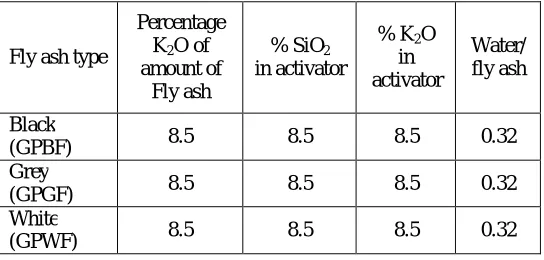
ratio was 0.32. In the mixing process the fly ash was mixed with the prepared solution for five minutes. After that the mix was placed into (50×50×50 mm3) cube (wooden) mould for casting. To drive out air the casting mould was tampered. After casting the specimens, they were kept in rest period for five days and then they were demoulded. The term ‘Rest Period’ was coined to indicate the time taken from the completion of casting of test specimens to the start of curing at an elevated temperature. This may be important in certain practical applications. For instance, when fly ash-based geopolymer concrete is used in precast concrete industry, there must be sufficient time available between casting of products and sending them to the curing chamber. At the end of the Rest Period, test specimens were kept at 85oC in hot oven for 48 hrs [10]. After that the sample was placed in the oven for cooling (without heating). The mix proportion is shown above in the Table-1.
Fly ash type
Percentage K2O of
amount of Fly ash
% SiO2
in activator
% K2O
in activator
Water/ fly ash
Black
(GPBF) 8.5 8.5 8.5 0.32 Grey
(GPGF) 8.5 8.5 8.5 0.32 White
(GPWF) 8.5 8.5 8.5 0.32
ISSN(Online): 2319-8753 ISSN (Print): 2347-6710
International Journal of Innovative Research in Science,
Engineering and Technology
(An ISO 3297: 2007 Certified Organization)
Website: www.ijirset.com Vol. 6, Issue 8, August 2017
III.DETAIL OF TESTS
3.2 Density & Apparent porosity Test in paste
This test method is useful in developing the data required for conversions between mass and volume for concrete. This test method covers the determinations of density, percent absorption and percent voids in hardened concrete.The procedure was taken from earlier research [11].
3.4 Compressive Strength Test
Compressive strength directly exhibits the ability of a material to withstand loads tending to reduce its geometry.Aimil Compression Testing Machines confirming IS: 14858 (2000) and calibrated with one percent accuracy as per the requirement of 1828 (Class 1) were used.
3.5 Field Emission Scanning Electron Microscopy (FESEM)
Field Emission Scanning Electron Microscopy was led by QUANTA FEG 250. The geopolymer sample was composed as a slight brawl form to routine this reading. For the investigation scraps were composed from innermost portion of the sample under concern. The geopolymer sample was composed as a small scrap form to conduct this study. Samples with rough shape were composed at the phase of crushing. Sometime grinding or polishing were finished for FESEM study.
IV.RESULT AND DISCUSSION
4.1 Compressive strength test
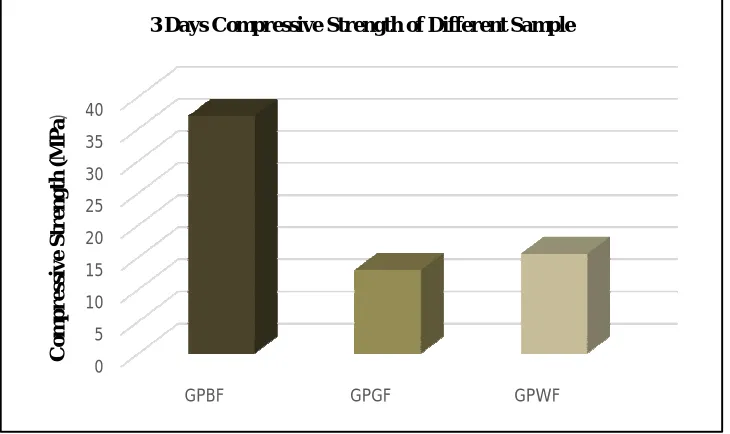
Sample GPBF (BLACK) shows the high characteristic strength in compare to GPGF (GREY) and GPWF (WHITE) as plotted in Figure 2. The strength of GPBF sample was 37 MPa. Sample GPGF and sampleGPWF provide 13 MPa and 15.5 MPa. From the compressive strength result, it is clear that Black fly-ash provides more strength compared to the Grey and White at higher alkalinity. It may be due to excessive presence of reactive silica in black fly ash which accelerate the rate of reaction under alkali activation.
Figure 2: Graphical representation of compressive strength of different samples 0
5 10 15 20 25 30 35 40
GPBF GPGF GPWF
C
o
m
p
r
e
ss
iv
e
S
tr
e
n
gth
(M
P
a
)
ISSN(Online): 2319-8753 ISSN (Print): 2347-6710
International Journal of Innovative Research in Science,
Engineering and Technology
(An ISO 3297: 2007 Certified Organization)
Website: www.ijirset.com Vol. 6, Issue 8, August 2017
4.2 Apparent Porosity
Sample Dry Weight
of
Sample(gm)
Weight of
Suspended
Sample(gm)
Weight of Sample
At S.S.D
Condition(gm)
Apparent
Porosity
(%)
GPBF 194 82.5 203 7.46
GPGF 164 84 174 11.11
GPWF 173 90.5 182.5 10.33
Table-2. Apparent Porosity
The apparent porosity directs the percentage of void volume occupied by fluid. The result (shown in Figure 3) indicates that permeable pore is high for GPGF sample. It may be because of lower formation of amorphous phase. But the further reduction in the values for sample GPWF indicating the secondary formation of CSH results from excessive presence of calcium.This secondary formation may partially fill the permeable portion of pores.This may be the cause behind the further decrement in permeable pores.
Figure 3. Graphical representation of apparent porosity of different samples
4.4 Field Emission Scanning Electron Microscopy Test
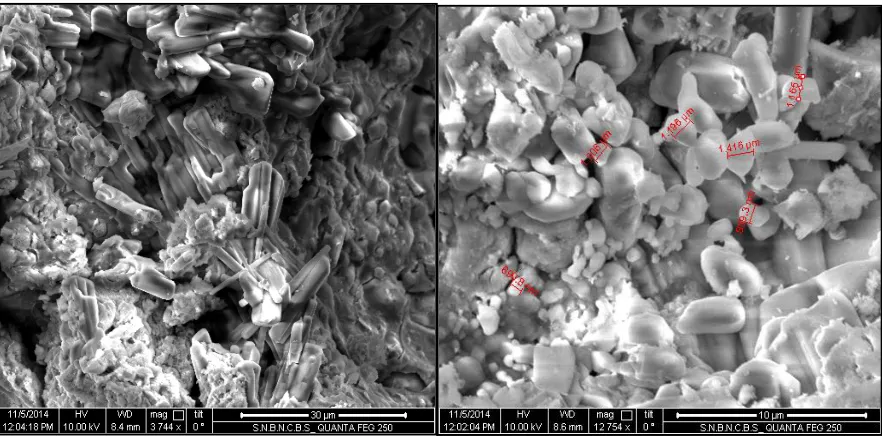
Scraps of the activated samples, collected from the inner part of the specimens were subjected to scanning electron microscopy. For GPBF samples in common cases, amorphous structure was observed. The presence of non –reacted alkali portion was observed. Whereas more compact structure is obvious for GPBF samples. The presence of white capsule shape structure in GPWF indicates the existence of Calcium. It is mainly because of secondary CSH formation
0 2 4 6 8 10 12
GPBF GPGF GPWF
A
ppa
re
n
t P
o
ro
si
ty
(%
)
ISSN(Online): 2319-8753 ISSN (Print): 2347-6710
International Journal of Innovative Research in Science,
Engineering and Technology
(An ISO 3297: 2007 Certified Organization)
Website: www.ijirset.com Vol. 6, Issue 8, August 2017
after zeolite structure. This secondary phase is responsible for the betterment of structure of sample GPWF in compare to GPGF as shown in Figure 4.
Figure 4. Scanning Electron Microscopy of typical samples of GPBF & GPWF under resolution of 3744 X & 12754 X zoom respectively
V. CONCLUSION
1.More amorphous and compact structure are obvious for GPBF samples. Secondary CSH formation after zeolite structure is responsible for the betterment of structure of sample GPWF in compare to GPGF.
2.Permeable pore is high for GPGF sample. The apparent porosity is less for GPBF which again supports the lower intrusion of moisture through pores. Lowering of apparent porosity in the case of GPWF further is an indication of filled pores with secondary CSH.
3. Compressive strength of GPBF fly ash sample is higher than GPGF and GPWF fly ash sample. The strength of GPBF fly ash is 37 MPa. The strength of GPGF and GPWF fly ash sample are 13MPa and 15.5 MPa respectively. Increased strength is proportional to polymerization while the rate of polymerization directly depends on the presence of reactive silica. Secondary CSH formation is the cause behind the further increment of GPWF series in compressive strength.
VI.SCOPE FOR FUTURE STUDY
Huge of areas should be explored for further studies in future, few of them are statedhere: Study on AAFAthrough MIP tests.
Effects on durability of different class AAFA.REFERENCES
[1] Mc Caffrey, R. (2002), “Climate change and cement industry”, Global cement and lime Magazine (Environmental special issue), 15 -19.
ISSN(Online): 2319-8753 ISSN (Print): 2347-6710
International Journal of Innovative Research in Science,
Engineering and Technology
(An ISO 3297: 2007 Certified Organization)
Website: www.ijirset.com Vol. 6, Issue 8, August 2017
[4] 3.Duxson P, Provis J L, Luckey G.C and Van Deventer JSJ (2007)," The role of Inorganic Polymer technology in the development of green
concrete", cement and concrete research,37(12),1590-1597.
[5] J. Davidovits, Properties of geopolymer cements, Proceedings of the first International conference on alkaline cements and concretes, 1
(1994) 131-149.
[6] S. Antiohos, S. Tsimas, Activation of fly ash cementitious systems in the presence of quicklime Part 1. Compressive strength and pozzolanic
reaction rate, Cement Concrete Res. 34 (2004) 769–779.
[7] Recent Research Geopolymer Concrete- Nguyen Van Chanh Bui Dang Trung, Dang Van Tuan during the 3rd ACF International
Conference-ACF/VCA 2008.
[8] Vijai K, Kumutha R andVishnuram B.G, (2012). “Experimental Investigations on mechanical properties of Geopolymer Concrete
composites”, Asian journal of Civil Engineering (building and housing) vol. 13, no. 1 pages 89-96
[9] Geopolymer Concrete with Fly Ash byN. A. Lloyd and B V Rangan
[10] Microstructure of Fly Ash geopolymer paste with blast furnace slag, Debabrata Dutta* 1, Somnath Ghosh2, CACE Volume 2, Issue 3rd
July,2014 PP.95-101©American V-King Scientific Publishing.
[11] S. Thokchom, P. Ghosh, S. Ghosh, “Influence of alkali content on performance of geopolymer Pastes in magnesium sulphate” Arabian J. for
Science and Engineering, Accepted for publication.
[12] S. Thokchom, P. Ghosh, S. Ghosh, “Porosity and sorptivity on performance of fly ash based geopolymer Pastes in Nitric acid”, Int. J Applied