NEGWeb: Static Defect Detection via Searching Billions of
Lines of Open Source Code
∗Suresh Thummalapenta
Department of Computer ScienceNorth Carolina State University Raleigh, USA
[email protected]
Tao Xie
Department of Computer Science North Carolina State University
Raleigh, USA
[email protected]
ABSTRACT
To find defects in programs, existing approaches mine pro-gramming rules as common patterns out of program source code and classify defects as violations of these mined pro-gramming rules. However, these existing approaches often cannot surface out many programming rules as common pat-terns because these approaches mine patpat-terns from only one or a few project code bases. To better support static bug finding based on mining code, we develop a novel frame-work, called NEGWeb, for substantially expanding the min-ing scope to billions of lines of open source code based on a code search engine. NEGWeb detects violations related to neglected conditions around individual API calls. We evaluated NEGWeb to detect violations in local code bases or open source code bases. In our evaluation, we show that NEGWeb finds three real defects in Java code reported in the literature and also finds three previously unknown defects in a large-scale open source project called Columba (91,508 lines of Java code) that reuses 2225 APIs. We also report a high percentage of real rules among the top 25 reported patterns mined for five popular open source applications.
1.
INTRODUCTION
To improve software quality, developers can write down programming rules and then apply static or runtime ver-ification tools to detect software defects related to viola-tions of these rules. But in practice, these programming rules often do not exist or even when they exist, they are written informally, not amenable to verification tools. To tackle the issue of lacking programming rules, various ap-proaches have been developed in recent years to mine pro-gramming rules from program executions [3, 6, 18], program source code [1,2,4,5,10,12,13,15], or version histories [11,16]. Then these approaches detect likely defects as those viola-tions of the mined programming rules. A common method-ology adopted by these approaches is to discover common ∗This work is supported in part by NSF grant CNS-0720641 and Army Research Office grant W911NF-07-1-0431.
Permission to make digital or hard copies of all or part of this work for personal or classroom use is granted without fee provided that copies are not made or distributed for profit or commercial advantage and that copies bear this notice and the full citation on the first page. To copy otherwise, to republish, to post on servers or to redistribute to lists, requires prior specific permission and/or a fee.
Copyright 200X ACM X-XXXXX-XX-X/XX/XX ...$5.00.
patterns (e.g., frequent occurrences of pairs or sequences of API calls) across a sufficiently large number of data points (e.g., code locations). Then these common patterns often reflect programming rules that should be obeyed when pro-grammers write code using a similar set of rule elements such as API calls and condition checks. However, these ex-isting approaches often cannot surface out many program-ming rules as common patterns because these approaches mine patterns from a small number of project code bases and there are often too few data points in these code bases to support the mining of desirable patterns. In other words, the number of data points to support a pattern related to a particular programming rule is often insufficient. This phe-nomenon is reflected on the empirical results reported by these exiting approaches: often a relatively small number of real programming rules mined from huge code bases.
A natural question to ask is how we can address this issue of lack of relevant data points in mining programming rules. Code Search Engines (CSEs) such as Google code search [7] and Koders [9] give us some hope. These CSEs can be used to assist programmers by providing relevant code examples with usages of the given query from a huge number of pub-licly accessible source code repositories.
To address the issue of lacking relevant data points in min-ing programmmin-ing rules, we develop a novel framework, called NEGWeb, for static bug finding based on searching and min-ing billions of lines of open source code with the help of a code search engine such as Google code search [7]. Our new approach is the first bug finding approach with this scale and based on a Code Search Engine (CSE). Our previous work also developed the MAPO [17] and PARSEWeb [14] approaches for mining source files returned by a CSE but these previous approaches focus on mining API usage pat-terns to assist programmers to write API client code effec-tively. In contrast, our new NEGWeb framework focuses on static bug finding based on mining programming rules, which poses a different set of mining requirements. In static bug finding based on mining, one important challenge is to reduce false positives (e.g., reported warnings that do not indicate real defects or patterns that do not reflect real pro-gramming rules).
approach of revealing neglected conditions, neglected con-ditions are quite common among the defects in programs. Different from their approach, which focuses on mining one project code base, NEGWeb mines a much larger scope of code bases based on a CSE. In addition, NEGWeb’s mining based on simple statistical analysis is more scalable than their approach based on frequent sub-graph mining with known scalability issues.
While enjoying the benefits provided by a CSE in terms of expanding the analysis scope, NEGWeb faces one challenge that existing approaches do not face: the code samples re-turned by a CSE are often partial and not compilable, be-cause the CSE retrieves individual source files with usages of the given query API method, instead of entire projects. We develop several new heuristics along with previously de-veloped heuristics [14] to tackle this challenge.
This paper makes the following main contributions: • A novel framework for static bug finding based on a
CSE. Our framework is the first bug finding approach that can deal with that large scale of open source code through a CSE.
• A set of rule templates for describing common ne-glected conditions around individual API calls. These templates allow us to exploit program dependencies among rule elements (e.g., condition checks and API calls) to reduce false positives.
• A technique for analyzing partial code samples through Abstract Syntax Trees (AST) and Directed Acyclic Graphs (DAG) and a set of heuristics for further re-ducing false positives.
• An Eclipse plugin implemented for the proposed frame-work and several evaluations to assess the effectiveness of the tool. In particular, NEGWeb confirms three real defects in Java code reported in the literature and also detects three previously unknown defects in a large-scale open source project that reuse 2225 APIs. We also report a high percentage of real rules among the top 25 reported patterns mined for five open source applications.
The rest of the paper is organized as follows. Section 2 explains the framework through an example. Section 3 de-scribes key aspects of the framework. Section 4 discusses evaluation results. Section 5 discusses the threats to va-lidity. Section 6 presents related work. Finally, Section 7 concludes.
2.
EXAMPLE
We next use an example to describe how our NEGWeb framework mines condition patterns from billions of lines of open source code available on the web and uses the mined condition patterns to detect violations in either an input source application or in available open source projects on the web. We use the class org.apache.bcel.verifier.Verifier
and its methods doPass1, doPass2, doPass3a, and doPass3b
from the BCEL library as an illustrative example for ex-plaining our framework. TheVerifierclass is mainly used for verifying generated class files.
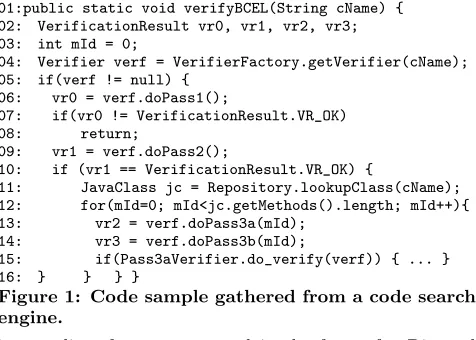
Given an API such as Verifier and its methods, NEG-Web constructs a query with the class name and gathers relevant code samples from a CSE. An example code sam-ple gathered from a CSE is shown in Figure 1. NEGWeb parses each code sample and transforms the sample into an
01:public static void verifyBCEL(String cName) { 02: VerificationResult vr0, vr1, vr2, vr3; 03: int mId = 0;
04: Verifier verf = VerifierFactory.getVerifier(cName); 05: if(verf != null) {
06: vr0 = verf.doPass1();
07: if(vr0 != VerificationResult.VR_OK)
08: return;
09: vr1 = verf.doPass2();
10: if (vr1 == VerificationResult.VR_OK) {
11: JavaClass jc = Repository.lookupClass(cName);
12: for(mId=0; mId<jc.getMethods().length; mId++){
13: vr2 = verf.doPass3a(mId);
14: vr3 = verf.doPass3b(mId);
15: if(Pass3aVerifier.do_verify(verf)) { ... }
16: } } } }
Figure 1: Code sample gathered from a code search engine.
intermediate form, represented in the form of a Directed Acyclic Graph (DAG). NEGWeb usesdominanceand data-dependency concepts, and gathers preceding and succeeding conditions around the nodes that include any of the meth-ods such asdoPass1ordoPass2. NEGWeb identifies different condition patterns forRECEIVER,ARGUMENT, andRETURNobjects around the given method. A few condition patterns identi-fied from the example code sample are shown as below.
01: doPass1 RECEIVER NULLITY
02: doPass2 PRE_METHOD CONST_EQUAL doPass1
03: doPass1 RETURN CONST_EQUAL VerificationResult.VR_OK 04: doPass3a ARGUMENT GEN_EQUALITY
Each condition pattern consists of the method name, pat-tern type, condition type, and optional additional informa-tion separated by spaces. The condiinforma-tion pattern in Line 1 describes that before invoking thedoPass1method, aNULLITY
check must be done on the receiver variable of that method. An example of the pattern type PRE_METHOD shown in Line 2 describes that the methoddoPass2 must be invoked only after the doPass1method. Line 3 describes that the return value of the doPass1 method should be compared with the constantVerificationResult.VR_OK. Line 4 describes the
AR-GUMENT pattern type where the argument must be verified
before invoking thedoPass3amethod.
NEGWeb mines the extracted condition patterns to com-pute frequent condition patterns, referred as mined patterns. NEGWeb applies these mined patterns on either the input source application or gathered code samples to detect vio-lations. For example, consider the code sample below taken from existing open source projects with violations:
Verifier v = VerifierFactory.getVerifier(args[k]); VerificationResult vr;
vr = v.doPass1(); vr = v.doPass2();
NEGWeb detects a violation from the preceding code sam-ple as the samsam-ple violated the condition pattern “doPass1
RE-TURN CONST_EQUAL VerificationResult.VR_OK”. Sometimes, the
same violation can appear multiple times because the code sample can violate multiple condition patterns. For exam-ple, the preceding code sample also violates the condition pattern “doPass2 PRE_METHOD CONST_EQUAL doPass1”.
3.
FRAMEWORK
! " # $
% &
'
( % '
'
$ %
% !
'
) # * #
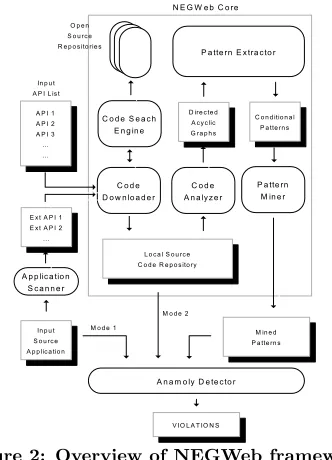
Figure 2: Overview of NEGWeb framework
components in NEGWeb. NEGWeb accepts an input source application or a set of interested APIs as input. When a source application is given as input, the application scanner identifies external classes and methods used by the applica-tion through package names of those classes. We use nota-tionICxfor each interested class, which can be an external
class of a given source application or a class in the inter-ested set of APIs. Each classICxincludes a set of methods
represented as{IMx1,IMx2, ..., IMxn}. We use the same
code sample shown in Figure 1 as an illustrative example to describe the process defined in our NEGWeb framework. We refer theVerifierclass in the code sample asICx and
methodsdoPass1,doPass2,doPass3a, and doPass3bas differ-entIMxyof theICxclass.
3.1
Application Scanner
The application scanner accepts a source application as input and gathers the external classes and methods used by that application. A class is recognized as an external class if the package name of that class does not belong to the set of package names of the given application. The applica-tion scanner initially collects all packages and classes of the source application, and then uses the collected information to identify the external classes through their package names. The application scanner also gathers the set of methods re-ferred by the source application for each such external class. The set of external classes and methods is provided as input to the code downloader.
3.2
Code Search Engine
Code Search Engines (CSE) such as Google [7] and Koders [9] are primarily used by programmers in searching for related samples from the available open source projects on the web. As CSEs can search billions of lines of source code available on the web, CSEs can serve as powerful resources of open source code. Due to the strength of these CSEs in searching for related samples, these CSEs can be exploited for other tasks such as detecting violations in the applications that reuse existing open source projects. Therefore, our frame-work uses CSEs to gather related samples for the given set of APIs.
Our framework uses Google code search (GCSE) [7] for collecting related samples because of two main reasons: (1) GCSE provides client libraries that can be used by other tools to interact with and (2) GCSE has public forums that provide good support. However, our framework is indepen-dent of GCSE and can leverage any other CSE to gather related samples.
3.3
Code Downloader
The code downloader accepts theICxset and their
associ-atedIMxysets as input, and interacts with CSE for
search-ing and gathersearch-ing related samples. To improve performance, the code downloader constructs only one query for eachICx
instead of different queries for each pair (ICx,IMxy). The
gathered code samples are applicable to allIMxyof theICx
that is included in the query. An example code sample gath-ered from CSE for the query“org.apache.bcel.verifier.Verifier” related to the BCEL library is shown in Figure 1. The gath-ered code samples are stored in a repository and is referred as a local source code repository.
3.4
Code Analyzer
The code analyzer accepts the local source code repository as input and analyzes the code samples statically through Abstract Syntax Trees (AST) to construct DAGs. The code analyzer uses several type heuristics while analyzing these code samples as the code samples gathered through CSE are partial. The reason for the partial nature of these code samples is that the CSE extracts only the source files with usages of the given query instead of entire projects. These type heuristics help identify the object types in the code samples. For example, for the methoddoPass1in Statement 6, the type heuristics identify the return type as
Verifica-tionResult from the left-hand side of the assignment
state-ment.
The constructed DAG consists of two kinds of nodes: con-trol and non-concon-trol. Concon-trol nodes, referred as CT, rep-resent the control-flow statements such as if, while, and for, which control the flow of the program execution. Non-control nodes, referred asN T, represent statements such as method-invocations or type casts. For example, Statement 5 in the code sample is a control node and Statement 6 is a non-control node. While encountering a control node, say CTi, the code analyzer also identifies all variables, say{V1,
V2, ..., Vn}, that participate in the conditional expression
of that node. Each variableVjis associated with its
corre-sponding condition typeTj. Therefore, a control nodeCTi
includes a set of pairs{(V1,T1) ,(V2,T2),..,(Vn, Tn)}. For
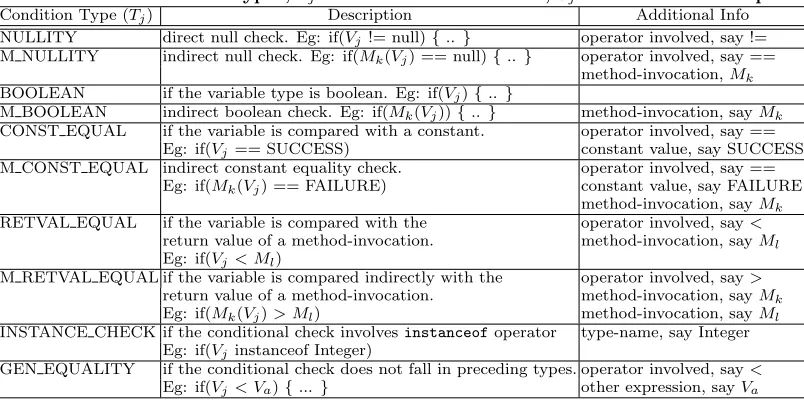
example, the control node CT5 (suffix indicates the state-ment id) includes the {(verf, NULLITY)}pair. The possible values for Tj are shown in Table 1. The table also shows
the description and additional information associated with each Tj. The additional information represents operators,
constants, or method-invocations associated with each pair (Vj,Tj). For example, the control nodeCT10 includes the pair{(vr1,CONST_EQUAL)}and the additional information as-sociated with this pair includes the constant Verification-Result.VR_OK.
In general, the variable Vj can participate in the
condi-tional expression either directly or indirectly. A direct par-ticipation refers to the scenario where the conditional check is conducted directly on theVjsuch as theNULLITYcondition
Table 1: Values of condition types,Tj associated with variable,Vj in a conditional expression.
Condition Type (Tj) Description Additional Info
NULLITY direct null check. Eg: if(Vj!= null){.. } operator involved, say != M NULLITY indirect null check. Eg: if(Mk(Vj) == null){.. } operator involved, say ==
method-invocation,Mk BOOLEAN if the variable type is boolean. Eg: if(Vj){.. }
M BOOLEAN indirect boolean check. Eg: if(Mk(Vj)){.. } method-invocation, sayMk CONST EQUAL if the variable is compared with a constant. operator involved, say ==
Eg: if(Vj== SUCCESS) constant value, say SUCCESS M CONST EQUAL indirect constant equality check. operator involved, say ==
Eg: if(Mk(Vj) == FAILURE) constant value, say FAILURE method-invocation, sayMk RETVAL EQUAL if the variable is compared with the operator involved, say<
return value of a method-invocation. method-invocation, sayMl Eg: if(Vj< Ml)
M RETVAL EQUAL if the variable is compared indirectly with the operator involved, say> return value of a method-invocation. method-invocation, sayMk Eg: if(Mk(Vj)> Ml) method-invocation, sayMl INSTANCE CHECK if the conditional check involvesinstanceofoperator type-name, say Integer
Eg: if(Vjinstanceof Integer)
GEN EQUALITY if the conditional check does not fall in preceding types. operator involved, say< Eg: if(Vj< Va){...} other expression, sayVa
scenario whereVj is an argument of a method-invocation,
sayMk, that is involved in the conditional expression. For
example, the condition typeM_NULLITYrefers to the preced-ing scenario. To distpreced-inguish the direct and indirect partic-ipations, the condition types of indirect participation are prefixed with “M ”.
The constant values shown in Table 1 can be literals or constant variables. The code analyzer identifies constant variables such as SUCCESS or FAILURE by using a heuristic based on general guidelines of the Java programming lan-guage. The guidelines describe that variable names with all capital letters can be treated as constants.
While constructing the DAG, the code analyzer identi-fies nodes in the graph that containIMxy and marks those
nodes as APINodes, referred asANi. The constructed DAG
can contain one or moreANi nodes and this DAG serves
as a Control Flow Graph (CFG) for the pattern extractor that identifies the condition patterns around eachIMxy. In
the example code sample, the code analyzer identifies State-ments 6, 9, 13, and 14 as APINodes.
3.5
Pattern Extractor
The pattern extractor accepts the constructed DAG as in-put from the code analyzer and performs forward and back-ward traversal over eachANinode to identify condition
pat-terns around eachIMxy. In particular, the pattern extractor
uses the concept ofdominance with a blend ofcontrol-flow anddata-flow dependencies. The condition patterns identi-fied by the pattern extractor can be classiidenti-fied into two major categories: preceding and succeeding patterns. We next de-scribe how the pattern extractor identifies these preceding and succeeding condition patterns.
3.5.1
Preceding Condition Patterns
The pattern extractor extracts preceding condition pat-terns by using the concept of dominance. The definition of dominance concept is given below:
Dominance:A nodeN dominates another nodeMin a con-trol flow graph (represented as N dom M) if every path from the starting node of the CFG toM includesN.
Initially, the pattern extractor identifies the dominantCTi
nodes for each ANk node. For example, the pattern
ex-tractor identifies that CT5 dominates AP6. The pattern
extractor computes an intersection between the variable set associated with the CTi node, say {V1, V2, ..., Vn}, and
the receiver or argument variables of the ANk node, say
{RECk, ARGk1, ..., ARGk2}. If the intersection {V1, V2, ..., Vn} ∩ {RECk, ARGk1, ..., ARGk2} 6= Φ, the pattern extractor checks whether the ANk node is data-dependent
on theCTinode. The data-dependency check ensures that
the variable involved in the CTi node is not re-defined in
the path between CTi and ANk nodes. If the ANk node
is data-dependent on the CTi node, the pattern extractor
extracts the associated condition pattern. The associated condition pattern for nodes CT5 and AN6 in the example code sample is “doPass1 RECEIVER NULLITY”, which indicates that aNULLITYcheck must be done on the the receiver vari-able of the methoddoPass1. The general condition pattern format extracted by the pattern extractor includes IMxy,
pattern type, and condition type (Tj). However, for some
condition patterns, a fourth element that represents other method-invocations is included in the pattern format.
The pattern extractor extracts three types of preceding condition patterns: RECEIVER,ARGUMENT, andPRE_METHOD. We next describe the details of each pattern type.
RECEIVER: represents condition patterns on the re-ceiver variable preceding the call site ofIMxy. For example,
the receiver condition pattern associated withCT5andAN6 for the methoddoPass1is “doPass1 RECEIVER NULLITY”.
ARGUMENT: represents condition patterns on the ar-gument variable preceding the call site ofIMxy. For
exam-ple, the argument condition pattern associated with CT12 and AN13 for the method doPass3a is “doPass3a ARGUMENT
GEN_EQUALITY”.
PRE METHOD: represents condition patterns on other method-invocations of the same receiver variable preceding the call site of IMxy. For example, the PRE_METHOD
condi-tion pattern associated withCT7 and AN9 for the method
doPass2 is “doPass2 PRE_METHOD CONST_EQUAL doPass1”. This
pattern indicates that before invoking thedoPass2method, the methoddoPass1 must be invoked and a condition check must be performed on the return value of the methoddoPass1.
3.5.2
Succeeding Condition Patterns
pat-tern extractor identifies the post-dominant CTi nodes for
eachANknode and checks whether the identifiedCTi node
is data-dependent on theANknode. The format of
succeed-ing condition patterns is the same as the precedsucceed-ing condi-tion patterns. The pattern extractor extracts three types of succeeding condition patterns: RETURN,SUC_RECEIVER, and
SUC_METHOD. We present the details of each succeeding
pat-tern type below.
RETURN: represents condition patterns on the return variable succeeding the call site ofIMxy. For example, the
return condition pattern associated withAN6 and CT7 for the methoddoPass1is “doPass1 RETURN CONST_EQUAL”.
SUC RECEIVER: represents condition patterns on the receiver variable succeeding the call site ofIMxy. For
ex-ample, the succeeding receiver condition pattern associated withAN14 and CT15 for the method doPass3bis “doPass3b
SUC_RECEIVER M_BOOLEAN do_verify”, which indicates that the
invocation of the doPass3b method must be followed by a boolean check on the receiver variable. The condition type
M_BOOLEANindicates that the receiver variable participates in-directly as an argument of another method-invocation such asdo_verify.
SUC METHOD: represents condition patterns on other method-invocations of the same receiver variable succeeding the call site ofIMxy. For example, theSUC_METHODcondition
pattern for the method doPass1 associated with AN6 and
CT10is “doPass1 SUC_METHOD CONST_EQUAL doPass2”.
In general, theSUC_METHODcondition pattern type is useful for methods such asIterator.next()andIterator.hasNext()
that are often used in loops, where one of the methods such
as hasNext is involved in the conditional expression of the
loop. If not, this condition pattern can result in many false positives. Therefore, in the NEGWeb framework, we limited this condition pattern type to those APIs such as Java Util APIs, which are often suggested to be used in loops.
3.5.3
Empty Condition Patterns
Sometimes the call sites of IMxy do not have any
pre-ceding or succeeding condition patterns. To store the num-ber of call sites that do not have condition patterns, the pattern extractor associates an attribute calledEmpty Con-dition Pattern (ECP). The ECPxy attribute is used by the pattern miner while computing the support values for each condition pattern ofIMxy.
3.6
Pattern Miner
The pattern miner accepts a set of extracted condition patterns, sayCPi, for each IMxy and mines frequent
con-dition patterns among that set. The primary objective of the pattern miner is to reduce the number of false posi-tives while computing the mined patterns. Each condition pattern is associated with a frequency attribute, referred as CP Fi, which gives the number of occurrences of that
con-dition pattern among all call sites of IMxy. Initially, the
pattern miner computes support, referred asCP Si, for each
condition pattern. The formula used for computing CP Si
is given as below:
CP Si = CP Fi / (PN
j=1 CP Fj + ECPxy)
where N is the number of CPi for the I Mxy.
The rationale behind usingECPxy in computingCP Si is
to identify the actual support of a condition pattern among all call sites ofIMxy. The consideration ofECPxycan help
reduce the number of false positives among the mined condi-tion patterns. The pattern miner also computes the support
forECPxy, referred asECP Sxy, using the formula given as
below:
ECP Sxy = ECPxy / (PNj=1 CP Fj + ECPxy)
The pattern miner uses two threshold values Upper Thresh-old (UT) and Lower ThreshThresh-old (LT) for computing frequent condition patterns and for classifying the mined patterns in to three confidence levels: HIGH,AVERAGE, andLOW. Initially, the pattern miner compares the value ofECP Sxy and UT.
If the value ofECP Sxy is greater than UT or the support
values of all condition patterns are less than LT, the pattern miner ignores all extracted condition patterns. The pattern miner checks the condition patterns with support greater than UT and identifies them as mined patterns with con-fidence HIGH. Instead, if the support values of all condition patterns are near the maximum support value, which will be less than UT, the pattern miner identifies all condition patterns as mined patterns with confidence level HIGH. The rationale behind this assumption is that a group of condition patterns can often appear together in code samples. For ex-ample, consider that twoRETURNcondition patters, say
SUC-CESSandFAILURE, appeared together in 10 code samples. The
computed support values for these two condition patterns will be 0.5 each, resulting in a low confidence level. How-ever, these condition patterns appeared in all code samples and should have a high confidence level. We use the value ofECP Sxyto classify non-high condition patterns into
con-fidence levelsAVERAGE andLOW. We used values 0.75 for UT and 0.1 for LT. These values are based on our empirical experience with different subjects.
3.7
Anamoly Detector
The anamoly detector operates in two modes. In Mode 1, the anamoly detector uses mined heuristics to detect vi-olations in the source application. In Mode 2, the anamoly detector uses mined heuristics to detect violations in the gathered code samples. In particular, the anamoly detector re-extracts the condition patterns for eachIMxy, and checks
whether the newly extracted condition patterns contain the mined patterns. Any missing mined patterns are reported as violations. For each detected violation, the anamoly de-tector assigns a confidence level, which is the same as the confidence level of the associated condition pattern.
Additionally, the anamoly detector uses two heuristics to reduce the number of false positives and to sort the detected violations based on their importance.
Anamoly Heuristic 1:A violation detected for succeed-ing condition patterns can be ignored if the correspondsucceed-ing variable is a part of the return statement of the enclos-ing method declaration or an argument of another method-invocation.
This heuristic is based on our experience with different subjects where an expected conditional check often appears at the call site of the enclosing method declaration.
Anamoly Heuristic 2:A violation detected for a call site with no conditional checks around can be given higher pref-erence than violations detected for other call sites with a few conditional checks around.
Table 2: Condition patterns mined by NEGWeb and their violations.
Application Input Application CSE Categories of first 25 patterns Time # #Classes #Methods #Samples #Patterns #Rules #Usage Patterns #False Positivies (in min.) Violations
Java Util APIs 19 144 49858 64 20 5 0 7.98 15234
BCEL 357 2691 9697 322 13 8 4 1.04 776
Hibernate 1233 11452 32486 542 21 2 2 5.17 850
Java Servlet APIs 19 89 16628 53 18 0 7 2.92 505
Java Transaction APIs 7 37 5555 15 12 2 1 0.80 421
4.
EVALUATION
We conducted four different evaluations on NEGWeb to show that NEGWeb can effectively mine real rules from re-lated code samples gathered through a CSE, and can be effective in identifying real defects. In the first evaluation, we used two applications and three API libraries to mine condition patterns and manually confirmed the extracted top 25 condition patterns through the available documen-tation and source code of the applications. For generality, we refer all subjects as applications. In the second evalu-ation, we applied the mined condition patterns in a novel way to detect violations in available open source applica-tions. As NEGWeb mainly targets at neglected conditions that help increase the robustness of applications, we man-ually confirmed the top 50 violations as defects or other categories through inspection. In the third evaluation, we verified whether NEGWeb can confirm known Java defects reported in the literature by earlier related approaches. In the fourth evaluation, we conducted a case study with a large-scale application called Columba. The details of sub-jects and results of our evaluation are available at http: //ase.csc.ncsu.edu/negweb/.
4.1
Open Source Applications
In this section, we describe condition patterns mined by NEGWeb for two open source applications and three API libraries that vary in size and purpose. We also apply the mined condition patterns onto the gathered code samples to detect violations in available open source projects.
4.1.1
Condition Patterns
The characteristics such as the number of classes and methods of the five applications used for mining condition patterns are shown in Columns “Classes” and “Methods” of Table 2. The Java Util package includes the collections framework and other popular utilities used by many differ-ent applications. The BCEL library, developed by Apache, is mainly used to analyze, create, and manipulate Java class files. The Hibernate framework abstracts relational databases into an object-oriented methodology. Java servlets and Java Transactions are industry standards for developing multi-tier server-side Java applications. The common reason for selecting these applications is the presence of condition pat-terns as described by their associated documentations that can help confirm the real patterns. We feed the set of classes and methods of each application as input to NEGWeb.
Column “Samples” of Table 2 shows the number of code samples gathered and analyzed for each application from the code search engine. For example, NEGWeb gathered and analyzed 49,858 code samples for Java Util packages. The number of condition patterns mined for each applica-tion is shown in Column “Patterns” of Table 2. We manually analyzed the first 25 patterns of each application and clas-sified them into three categories: rules, usage patterns, and false positives. Rules describe the properties that must be
Table 3: Classification of mined patterns of Java Util package.
Pattern type #Total #Rule #UP #FP
RECEIVER 5 3 0 2
ARGUMENT 6 5 0 1
PRE_METHOD 12 11 0 1
RETURN 19 12 7 0
SUC_METHOD 22 5 10 7
SUC_RECEIVER 0 0 0 0
SUM 64 36 17 11
UP: usage pattern, FP: false positive
satisfied for using an API, whereas usage patterns are com-mon ways of using an API. We used the available on-line documentations, JML specifications1
, or the source code of the application for classifying the mined condition patterns into these three categories. As shown in Table 2, most of the mined patterns are classified as rules and a few are classified as false positives. The number of false positives is a little more for Java Servlet, because of one common pattern that appeared among these false positives. The common pat-tern is “ServletRequest INSTANCE_CHECK HttpServletRequest”, which describes that an instance check has to be performed with theServletRequest class before invoking its methods. Although this pattern is a common usage, the available spec-ification of Java Servlet does not confirm this pattern as a real rule. The primary reason for the lesser number of false positives in other subjects is due to the large number of analyzed data points gathered through CSE.
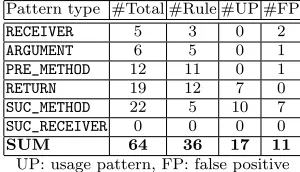
We manually classified all condition patterns of the Java Util package. The primary reason for selecting the Java Util package for manual analysis is the availability of JML specification that can help confirm the mined patterns. The classified categories of all patterns for the Java Util APIs are shown in the last row of Table 3. Among all mined patterns, the real rules constitute 56.25% (36/64) and usage patterns constitute 26.56% (17/64). A non-negligible percentage of 17.18% (11/64) is classified as false positives. However, the number of false positives in the top 25 rules shown in Ta-ble 2 is zero. This evaluation shows the effectiveness of our mining heuristics that surface out real rules by ranking false positives below. Table 3 further shows the classification of the mined condition patterns based on the pattern types of NEGWeb. NEGWeb is effective in extracting and mining real rules for pattern types PRE_METHOD and RETURN, which are usually the main sources of neglected conditions. The pattern typeSUC_METHODhas the largest number of false pos-itives.
We next describe the mined patterns for theMatcherclass of Java Util pacakges. NEGWeb identified 10 patterns for this class, which is an engine that performs matching opera-tions on a character sequence by interpreting a given regular expression. For each mined pattern, we show the method
1
name, pattern type, condition type, and additional informa-tion. The additional information is optional and is shown for pattern types such asPRE_METHODandSUC_METHOD.
find, RETURN, BOOLEAN,
start, PRE_METHOD, BOOLEAN, find end, PRE_METHOD, BOOLEAN, find group, PRE_METHOD, BOOLEAN, find start, SUC_METHOD, BOOLEAN, find find, SUC_METHOD, BOOLEAN, group group, SUC_METHOD, BOOLEAN, find
The preceding mined patterns indicate that aBOOLEANcheck must be performed on the return value of thefind method and this find method must precede and succeed methods
start, end, andgroup. These mined patterns indicate that
the methodsstart, end, and group are used inside a loop with a boolean check on thefindmethod.
NEGWeb also mined undocumented condition patterns in the input applications. We confirmed these condition patterns by inspecting the source code and the comments written in source files. For example, in the BCEL library, the method copy of the class Instruction cannot be used for its child class Select. Therefore, before using the copy
method, a condition check on the receiver variable must be performed. The associated mined condition pattern of NEG-Web is “copy RECEIVER INSTANCE_CHECK Select”. The pattern describes that before invoking thecopymethod of Instruc-tionclass, an instance check must be performed on the re-ceiver variable with the sub-class Select. Similarly, while using the methodsdoPass3aand doPass3bof the class Veri-fier, the caller must make sure that the index value passed as a parameter should be within the range of the number of methods in the corresponding class. The reason is that these methods operate on theVectorclass that throws
IndexOut-OfBoundsExceptionwhen the parameter value is not within
the required range.
Column “Time” in Table 2 presents the amount of time taken by NEGWeb for mining patterns from the gathered code samples for each application. The amount of process-ing time depends on the number of samples gathered for the corresponding application. For example, NEGWeb took 7.98 minutes for mining patterns from 49,858 code samples gathered for Java Util packages. All experiments are con-ducted on a machine with 3.0GHz Xeon processor and 4GB RAM.
4.1.2
Defects in Open Source World
As NEGWeb mines patterns by gathering related code samples from available open source applications through a CSE, we applied the mined patterns in a novel way to detect violations in the gathered code samples themselves. Given a set of interested APIs, NEGWeb can detect the set of open source applications that violate properties of the given APIs. This feature of NEGWeb could be quite useful while dealing with APIs such as security APIs to check whether there are any security holes in applications used on the web. We used applications of Table 2 to detect violations in their gathered code samples. The results of our evaluation are shown in Column “Violations” in Table 2.
Given the large number of violations that we have de-tected, we manually analyzed violations of the mined rule (from the top 25 mined patterns of each application) that is used to detect the largest number of violations. We clas-sified the detected violations into five categories: defect, code smell, wrapper, hint, and false positive. The
viola-tion categories of code smell and hint are inspired by the approach of Wasylkowski et al. [15]. A code smell indicates that something may go wrong, whereas a hint helps increase the readability of the program. We introduced the category of wrappers to indicate that the mined patterns are spread across several methods of a wrapper class. For example, a user-defined class such asUIteratorabstracts the function-ality of theIteratorby providing different methods such as
next()and hasNext(). In this scenario, the patterns mined
for the Iterator class are applicable to the wrapper class
UIteratoras well. These wrappers can be useful
The API chosen from each application and the classifica-tion categories for the first 50 are shown in Table 4. Columns “Pattern Type” and “Support” give the type of the condition pattern such asRECEIVERand support value of the condition pattern, respectively. Column “Open Source” gives the to-tal number of open source projects that contain those de-tected violations. The total number of violations for each API is shown in Column “Total”. The manual classification results of the first 50 violations are shown in Columns “De-fect”, “CS”, “WP”, “Hint”, and “FP”. Except for BCEL, the number of false positives is quite low for APIs of other ap-plications. The reason for a high number of false positives in BCEL is due to limitations in the current NEGWeb im-plementation such as not handling conditional expressions in assignment statements, which we plan to address in near future work without difficulty.
We next describe details of defects detected in open source applications for Java Servlet APIs. The API used from this application is “ServletConfig,getInitParameter(String)” and the condition pattern used is “getInitParameter RETURN NUL-LITY”, which indicates that a nullity check must be per-formed on the return value of thegetInitParametermethod. We confirmed this pattern from the JTA specification, which describes that this method can returnnull, if the parameter does not exist. However, 31 open source projects violated this mined condition pattern. Among the top 50 violations, 38 violations are classified as defects in our inspection. We found some more interesting facts during this evaluation. We use the below code sample that is collected from the existing open source projects to describe these facts.
...String jspCP = config.getInitParameter("jspCP"); if (jspCP != null) {...}
this.javaEncoding = config.getInitParameter("javaEncoding");
In the preceding code sample, thegetInitParametermethod is used two times. However, theNULLITYcheck on the return value is done only once, and is ignored during the second in-vocation. As thegetInitParametermethod can returnnull, the absence of NULLITY check can cause NullPointerExcep-tion. We also found that the same piece of code that has violations is used in different applications. For example, we found a similar violated code in open source projects tom-cat, fisheye, and jboss for thegetInitParametermethod. As programmers often tend to copy related code from existing applications, the violations can also propagate from appli-cations to appliappli-cations. Our results show the number of neglected conditions that exist in the available open source applications and the necessity for an approach such as NEG-Web.
4.2
Real defects from the literature
Table 4: Classification of violations detected in open source world.
Application Input API Pattern Support #Open # Categories of first 50 violations (Class,Method) Type Source Total #Defect #CS #WP #Hint #FP
Java Util APIs Matcher,group PRE_METHOD 0.810 7 21 0 12 2 3 4
BCEL Type,equals RETURN 0.967 2 7 0 0 0 1 6
Hibernate Filter,setParameterList RECEIVER 0.875 1 4 4 0 0 0 0
Java Servlet APIs ServletConfig,getInitParameter RETURN 0.577 31 50 38 2 0 8 2 Java Transaction APIs TransactionManager,getTransactionRETURN 0.283 40 230 22 3 0 19 6
CS: code smell, WP: wrapper, FP: false positive defects in the AspectJ application detected by JADET2
[15] and two defects in Java SSE Library and Joeq detected by DIDUCE [8]. We next describe details of these defects and explain the evaluation results with NEGWeb.
4.2.1
Defects Detected by JADET
In the AspectJ application, JADET detected two defects related to loops that are incorrectly executed at most once. We show the code sample taken from JADET as below:
private boolean verifyNIAP (...) {... Iterator iter = ...;
while(iter.hasNext()) {
... = iter.next(); ...;
return verifyNIAP(...); } }
As shown in the preceding code sample, thereturn state-ment in thewhileloop causes the method to return without iterating all elements in theIterator. NEGWeb confirmed this defect with a support value of 0.895 as the code sam-ple violated the pattern “nextSUC_METHOD BOOLEANhasNext” of the classIterator. NEGWeb confirmed the other defect reported by JADET that is also related to a similar scenario.
4.2.2
Defects Detected by DIDUCE
We collected two defects reported by DIDUCE in appcations Java SSE and Joeq. The defect in the Java SSE li-brary is related to not handling the return value of theread
method of the classInputStream. The methodreadreturns the number of bytes that are actually read; programmers often forget to check whether the number of read bytes is equal to the expected number of bytes to be read. NEGWeb confirmed this defect with a support value of 0.708.
The second defect in the Joeq application is related to not checking the return value of the methodputof the class
Hashtable. When an object is inserted into the Hashtable
through theput method, the method either returns an ex-isting associated object with that key value or returnsnull. NEGWeb could not confirm this defect as the support for the extracted pattern is low. Among 774 related code samples gathered from the code search engine, NEGWeb detected that only 5 code samples have theNULLITY check on their return value. However, this defect mainly depends on the semantic logic of the application rather than the usage com-monality of the API. Therefore, reporting violations based on these kinds of patterns can result in a large number of false positives. We want to emphasize that the motivation of NEGWeb is mainly to mine the most common condition patterns that can cause potential defects and to reduce the number of false positives among the detected violations.
2
JADET reported three defects in the paper. One defect with BCEL APIs is not related to neglected conditions and does not fall into the scope of our current approach.
Table 5: Evaluation results of Columba case study.
SNo Rank Supp. PC # Categories of violations Total #Defect #CS #WP #Hint #FP
1 1 0.944 Rule 2 2
2 2 0.939 Rule 2 1 1
3 3 0.929 Rule 13 2 2 9
4 4 0.917 UP 13 2 11
5 5 0.875 Rule 1 1
6 6 0.869 Rule 3 3
7 7 0.861 Rule 2 2
8 8 0.850 Rule 2 1 1
9 8 0.850 Rule 1 1
10 8 0.850 Rule 1 1
11 8 0.850 FP 1 1
12 8 0.850 Rule 1 1
13 8 0.850 Rule 1 1
14 9 0.833 FP 4 4
15 10 0.800 FP 2 2
16 11 0.786 Rule 1 1
17 12 0.782 Rule 4 4
18 13 0.771 UP 6 6
19 14 0.762 Rule 1 1
20 15 0.756 Rule 1 1
21 16 0.750 Rule 1 1 22 16 0.750 Rule 1 1
23 17 0.727 FP 4 4
24 18 0.722 Rule 1 1
25 19 0.710 Rule 1 1
4.3
Case Study: Columba
Columba 1.43
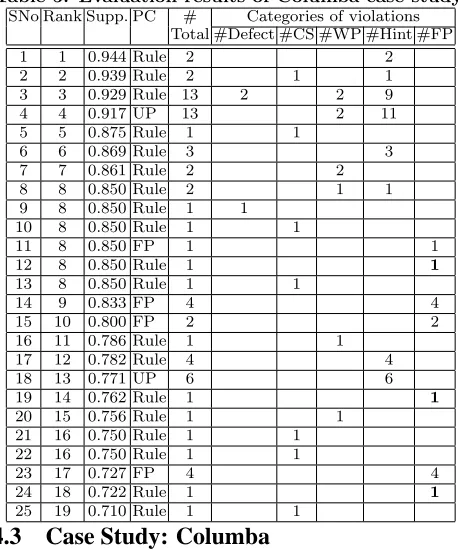
is an open source email client application written in Java. Columba provides a user-friendly graphi-cal interface and is suitable for internationalization support. The Columba application includes 1165 classes and 6894 methods that contain a total of 91,508 lines of Java code. We used NEGWeb to mine rules and detect violations in the Columba application. NEGWeb identified the external classes and methods used by Columba and mined condition patterns for those classes by interacting with CSE. NEG-Web gathered and analyzed 309,757 code samples for mining these condition patterns. NEGWeb applied the mined con-dition patterns to detect violations in Columba. NEGWeb mined 559 condition patterns related to the external classes and methods used by Columba. Among these 559 condition patterns, 370 condition patterns were used to detect 1647 violations. Each mined condition pattern can be used to de-tect multiple violations at different locations of the source code. We manually analyzed violations of the first 25 mined patterns. As each mined pattern can detect multiple viola-tions at different locaviola-tions of source code, these 25 patterns detected 70 violations. We classified these 70 violations into different violation categories using the same classification criteria described in Section 4.1.2.
The results of our evaluation are shown in Table 5. Each row in the table represents a mined pattern. Columns“Supp.”
3
and “PC” give the support and manually assigned category of each pattern, respectively. Column “Total” gives the to-tal number of violations detected by that pattern. Among the first 25 mined patterns, 19 patterns are classified as real rules, 2 are classified as usage patterns, and 4 are classified as false positives. The results also show that the top 10 patterns do not have any false positives. As each pattern type can be used to detect multiple violations of different categories, depending on the usage in the source code, we show how many of the total violations of each pattern fall into different violation categories. In total, there are 70 vi-olations among which, 3 are defects, 7 are code smells, 9 are wrappers, 37 are hints, and 14 are false positives. All three defects among 70 violations are detected with the top 10 mined patterns. In general, a false-positive pattern leads to a false-positive violation. For example, Patterns 11 and 14 are false positives that caused 5 violations of the false-positive category. However, the additional 3 false false-positives highlighted in the table are due to limitations in the cur-rent NEGWeb implementation such as not handling condi-tional expressions in assignment statements. We plan to address these limitations in near future work and these limi-tations can be addressed without any difficulty. The largest number of hints are detected with Pattern 4, which is “next
SUC_METHOD BOOLEAN hasNext” of theIteratorclass. Although
this mined pattern is a real rule, lists are used for stor-ing a sstor-ingle object instead of multiple objects in Columba. Therefore, we classified these violations as hints that can help improve the maintainability and readability of code.
We next describe defects detected by NEGWeb in Columba. We confirmed these defects through inspecting the source code of the associated class and call sites of the violated methods. The first defect is in the method
removeDoubleEn-triesof the MessageBuilderHelperclass. We show the code
sample of that method as below:
private static String removeDoubleEntries(String input) { Pattern sP = Pattern.compile("s*(<[^s<>]+>)s*"); ArrayList entries = new ArrayList();
Matcher matcher = sP.matcher(input); while (matcher.find()) {
entries.add(matcher.group(1)); } Iterator it = entries.iterator(); ... String last = (String) it.next(); ... }
The methodremoveDoubleEntriestries to identify charac-ter sequences that match with a regular expression. If the given input string does not match with the regular expres-sion “s*(<[^s<>]+>)s*”, no elements will be added to the
en-trieslist. The preceding code sample violated the mined
pattern “next PRE_METHOD BOOLEAN hasNext”, which describes
thathasNextmust be invoked before callingnextof the
It-eratorclass. In the code sample, the first element from the
itvariable is retrieved without checking whether there are any elements in the list throughhasNext. Moreover, the re-trieved variable is type casted to a string. This defect can cause NullPointerException in the described scenario. Al-though the current method isprivate, the other public caller methods of the current class do not handle any exceptions, resulting in the propagation of the exception to their call sites. The second defect is also related to a similar scenario that violated the mined pattern “next PRE_METHOD BOOLEAN hasNext”.
The third defect is related to the JPIM4
library used by the Columba application. Columba invokes the method
un-4
http://jpim.cvs.sourceforge.net/jpim/
marshallContactsof the classContactUnmarshallerthat is
de-fined by the JPIM library. NEGWeb identified the pattern
“unmarshallContacts RETURN NULLITY”, which indicates that a
null check must be performed on the return value of the
unmarshallContacts method. As this pattern is an
undoc-umented one, we confirmed this pattern by inspecting the source code of the JPIM library. In Columba, this method is invoked in the classVCardParserand noNULLITYcheck on the return variable was done. The absence of the NULLITY
check can cause aNullPointerException.
The first code smell is in the methodcreatePagesof the
cDocumentclass. We show the code sample of thecDocument
class as below:
public class cDocument { ... boolean uptodate = false; List objects;
public void print() {
if (!uptodate) {createPages();} ... } public void appendPO(cPO obj){
objects.add(obj); uptodate = false;}
private void createPages(){ ... Enumeration objEnum = ...;
nextObj = (cPO) objEnum.nextElement(); ...}
As shown in the preceding code sample, the first ele-ment of theEnumerationis retrieved and is type casted with-out checking whether there are any elements through the methodhasMoreElements. Although the methodcreatePages
cannot be invoked from outside, invocation of the method
printprior to invokingappendPOcauses a
NullPointerExcep-tion. Although this violation can be a defect, we classified this violation as a code smell because the current call sites of these two methods invoke the methods in the proper order such asappendPOfollowed byprint.
4.4
Summary of the Evaluation
The major advantage of NEGWeb compared to existing approaches [1, 2, 4, 10, 15] is that NEGWeb can identify real rules due to the large number of data points used for min-ing the condition patterns. The number of false-positive patterns mined by NEGWeb is relatively low compared to other existing approaches as shown in our first evaluation. NEGWeb confirmed three out of four defects that are re-ported in the literature and are related to neglected condi-tions. NEGWeb detected three new defects in the Columba application, which is a popular email client. We showed that NEGWeb can identify defects in existing open source appli-cations when a set of interested APIs is given as input. This feature could be quite useful for APIs such as security APIs. We also showed that NEGWeb can deal with the scalability issues in processing the large number of related code samples gathered from a CSE.
5.
THREATS TO VALIDITY
NEGWeb prototype might cause such effects. There can be errors in our inspection of source code for confirming de-fects. To reduce these threats, we inspected the available specifications and also call sites in source code.
6.
RELATED WORK
The most related work to our NEGWeb approach is the approach developed by Chang et al. [4] that applies frequent subgraph mining on C code to mine implicit condition rules and to detect neglected conditions. Both NEGWeb and their approach target at the same type of defects: neglected con-ditions. NEGWeb significantly differs from Chang et al.’s approach in three main aspects. First, their approach is limited on a much smaller scale of code repositories (in fact, only one project code base) than NEGWeb, which exploits a CSE to search for billions of lines of code. Second, the scal-ability of their approach is heavily limited by its underlying graph mining algorithms, which are known to suffer from scalability issues, whereas NEGWeb uses simple statistics to surface out condition rules, being much more scalable. Third, their approach reports “few apparent violations of rules” in the code base being analyzed, whereas NEGWeb detected not only known bugs detected by other existing approaches but also previously unknown bugs.
PR-Miner developed by Li and Zhou [10] uses frequent itemset mining to extract implicit programming rules from C code and detect their violations. DynaMine developed by Livshits and Zimmermann [11] uses association rule mining to extract simple rules from software revision histories for Java code and detect bugs related to rule violations. PR-Miner or DynaMine may suffer from issues of high false pos-itives as their rule elements are not necessarily associated with program dependencies. In addition, NEGWeb targets at a much larger scale of code bases than PR-Miner or Dy-naMine.
Williams and Hollingsworth [16] incorporates an API call return value checker for C code, which checks that a value returned by an API call is tested before being used. This type of return-value testing before use falls into a subset of the types of rules being mined by NEGWeb. Different from their tool, NEGWeb does not require or rely on ver-sion histories, which may not include the types of bug fixing (required by their tool) related to the rules being mined. Acharya et al. [2] developed a tool to mine interface details (such as an API call’s return values on success or failure and error flags) from model-checker traces for C code, and then generate interface robustness properties for bug find-ing. Similar to Williams and Hollingsworth [16], Acharya et al.’s tool mines only a subset of neglected conditions (e.g., return-value testing before use) mined by NEGWeb. In ad-dition, as shown by Acharya et al. [2], only the interface details of 22 out of 60 POSIX API functions can be success-fully mined by their tool, whereas NEGWeb exploits a CSE to alleviate the issue by collecting relevant API call usages from the web.
Engler et al. [5] proposed a general approach for finding bugs in C code by applying statistical analysis to rank de-viations from programmer beliefs inferred from source code. Their approach allows users to define rule templates. NEG-Web follows a similar methodology to find bugs. However, beyond the general rule templates proposed in their ap-proach, NEGWeb’s rule templates are more specific to de-tecting neglected conditions around API calls and NEGWeb
incorporates various heuristics to help reduce false positives.
7.
CONCLUSION
We developed a framework, called NEGWeb, that tries to address the issue of lacking relevant data points faced by the existing static defect finding approaches that mine programming rules from source code of one or a few project code bases. NEGWeb tries to address the preceding issue by leveraging a code search engine, which can search for related code samples in billions of lines of available open source code. NEGWeb detects violations related to neglected conditions around individual API calls by mining condition patterns from the gathered code samples. We evaluated our frame-work with five open source projects and confirmed the top 25 mined condition patterns. We confirmed three known Java defects in the literature and found three new defects in a large-scale application called Columba. We also detected de-fects in existing open source applications that reuse a given API. In future work, we plan to extend NEGWeb framework to the C programming language.
8.
REFERENCES
[1] M. Acharya, T. Xie, J. Pei, and J. Xu. Mining API Patterns as Partial Orders from Source Code: From Usage Scenarios to Specifications. InProc. ESEC/FSE, September 2007. [2] M. Acharya, T. Xie, and J. Xu. Mining Interface Specifications
for Generating Checkable Robustness Properties. InProc. ISSRE, pages 311–320, November 2006.
[3] G. Ammons, R. Bodik, and J. R. Larus. Mining specifications. InProc. POPL, pages 4–16, 2002.
[4] R.-Y. Chang, A. Podgurski, and J. Yang. Finding what’s not there: a new approach to revealing neglected conditions in software. InProc. ISSTA, pages 163–173, 2007.
[5] D. Engler, D. Y. Chen, S. Hallem, A. Chou, and B. Chelf. Bugs as deviant behavior: a general approach to inferring errors in systems code. InProc. SOSP, pages 57–72, 2001. [6] M. Ernst, J. Cockrell, W. Griswold, and D. Notkin.
Dynamically Discovering Likely Program Invariants to Support Program Evolution.IEEE Trans. Softw. Eng., 27(2):99–123, 2001.
[7] Google Code Search Engine, 2006. http://www.google.com/codesearch.
[8] S. Hangal and M. S. Lam. Tracking Down Software Bugs Using Automatic Anomaly Detection. InPro. ICSE, pages 291–301, 2002.
[9] The Koders source code search engine, 2005. http://www.koders.com.
[10] Z. Li and Y. Zhou. PR-Miner: Automatically Extracting Implicit Programming Rules and Detecting Violations in Large Software Codes. InProc. FSE, pages 306–315, 2005.
[11] V. B. Livshits and T. Zimmermann. DynaMine: Finding Common Error Patterns by Mining Software Revision Histories. InProc. ESEC/FSE, pages 296–305, 2005. [12] M. K. Ramanathan, A. Grama, and S. Jagannathan.
Path-Sensitive Inference of Function Precedence Protocols. In Proc. ICSE, pages 240–250, 2007.
[13] S. Shoham, E. Yahav, S. Fink, and M. Pistoia. Static specification mining using automata-based abstractions. In Proc. ISSTA, pages 174–184, 2007.
[14] S. Thummalapenta and T. Xie. PARSEWeb: A Programmer Assistant for Reusing Open Source Code on the Web. InProc. ASE, November 2007.
[15] A. Wasylkowski, A. Zeller, and C. Lindig. Detecting Object Usage Anomalies. InProc. ESEC/FSE, September 2007. [16] C. C. Williams and J. K. Hollingsworth. Recovering system
specific rules from software repositories. InProc. MSR, pages 1–5, 2005.
[17] T. Xie and J. Pei. MAPO: Mining API usages from open source repositories. InProc. of MSR, pages 54–57, 2006. [18] J. Yang, D. Evans, D. Bhardwaj, T. Bhat, and M. Das.