Alternative Genetic Foundations for a Key Social Polymorphism in Fire Ants
Kenneth G. Ross,*
,1Michael J. B. Krieger* and D. DeWayne Shoemaker
†*Department of Entomology, University of Georgia, Athens, Georgia 30602 and†Department of Entomology,
University of Wisconsin, Madison, Wisconsin 53706
Manuscript received April 1, 2003 Accepted for publication August 12, 2003
ABSTRACT
Little is known about the genetic foundations of colony social organization. One rare example in which a single major gene is implicated in the expression of alternative social organizations involves the presumed odorant-binding protein geneGp-9in fire ants. Specific amino acid substitutions in this gene invariably are associated with the expression of monogyny (single queen per colony) or polygyny (multiple queens per colony) in fire ant species of theSolenopsis richtericlade. These substitutions are hypothesized to alter the abilities of workers to recognize queens and thereby regulate their numbers in a colony. We examined whether these same substitutions underlie the monogyny/polygyny social polymorphism in the distantly related fire antS. geminata. We found thatGp-9coding region sequences are identical in the polygyne and monogyne forms of this species, disproving our hypothesis that one or a few specific amino acid replacements in the protein are necessary to induce transitions in social organization in fire ants. On the other hand, polygyneS. geminatadiffers genetically from the monogyne form in ways not mirrored in the two forms ofS. invicta, a well-studied member of theS. richtericlade, supporting the conclusion that polygyny did not evolve via analogous routes in the two lineages. Specifically, polygyneS. geminatahas lower genetic diversity and different gene frequencies than the monogyne form, suggesting that the polygyne form originated via a founder event from a local monogyne population. These comparative data suggest an alternative route to polygyny inS. geminatain which loss of allelic variation at genes encoding recognition cues has led to a breakdown in discrimination abilities and the consequent acceptance of multiple queens in colonies.
A
major goal in evolutionary biology is to understand few major transitions in the history of life (Maynard the genetic architecture underlying complex ad- SmithandSzathma´ry1995).aptations (Orr and Coyne 1992;Orr 1998; Glazier One rare example in which a candidate gene of major et al.2002). Nowhere is this interest in the architecture effect on a key social trait has been identified involves the of adaptation stronger than in the study of animal social gene Gp-9 in fire ants. Many fire ant species display behavior (Robinsonet al.1997;Robinson1999;Young two fundamentally different types of social organization et al.1999;RossandKeller2002;Ben-Shaharet al.2002). distinguished by, among other features, the number of A number of studies that demonstrate heritable influences egg-laying queens in a colony (RossandKeller1995). on key traits associated with complex social behavior now Colonies of the monogyne type are headed by a single exist (e.g., Page and Robinson 1994; O’Donnell 1996; egg-laying queen, whereas those of the polygyne type Huntet al.1998;OsborneandOldroyd1999;Fraser contain multiple queens. InSolenopsis invicta, the best-et al.2000; Plateaux-Que´nuet al. 2000;Buschinger studied fire ant species, the form of social organization andSchreiber2002;Hugheset al. 2003; reviewed in displayed by a colony depends on the Gp-9 genotypic Robinsonet al.1997;RossandKeller2002). However, composition of the worker force (Ross1997;Rossand progress in identifying the numbers and effects of spe- Keller1998). Two major classes of coding region vari-cific genes influencing these traits has been slow. Con- ants exist atGp-9, designated theB-like andb-like classes tinued progress in these efforts is critical for understand- (Krieger andRoss2002). Colonies of the monogyne ing how specific gene products function to shape social form of S. invicta contain workers bearing only B-like behavior, as well as for constructing improved evolution- alleles, whereas colonies of the polygyne form contain ary models of the origins of eusociality, one of relatively substantial proportions of workers bearingb-like alleles. KriegerandRoss(2002) determined that the product ofGp-9is a member of a family of proteins that mediate perception of chemical cues from conspecifics in
in-Sequence data from this article have been deposited with the
EMBL/GenBank Data Libraries under accession nos. AF427905 and sects, known as odorant-binding proteins (Pelosi and
AY254475–AY254489.
Maida1995;Hekmat-Scafeet al.2002). Fire ant work-1Corresponding author:Department of Entomology, 413 Biological
ers regulate colony queen number on the basis of
cuticu-Sciences Bldg., University of Georgia, Athens, GA 30602-2603.
E-mail: [email protected] lar chemical signals produced by individual queens
(KellerandRoss1998;RossandKeller2002), so it allele coding the characteristicb-like isoleucine residue at position 95, position 139, or both positions.
has been hypothesized that workers with Gp-9 alleles
In this article we characterize theGp-9sequences of of the different classes may differ in their abilities to
polygyne S. geminata from northern Florida. We also recognize queens, leading to different tolerance
thresh-describe in detail the population genetic structure of olds for queen number in monogyne and polygyne
colo-both social forms of this species in this area, and we nies. Apart fromGp-9, the two forms ofS. invictastrongly
compare these results with those fromS. invictain order resemble one another genetically where they occur in
to comprehensively evaluate the likelihood that polyg-sympatry, typically harboring the same alleles and levels
yny evolved via analogous routes in both lineages. We of variation at numerous marker genes. This similarity
find that the polygyneS. geminatathat we studied possess between the forms over many genes, interpreted as the
the sameGp-9allele reported previously for the mono-signature of substantial interform gene flow (Shoemaker
gyne form, indicating that the molecular mechanisms andRoss1996;Rosset al.1997, 1999;Ross2001),
pro-underlying regulation of social organization in fire ants vides strong ancillary evidence thatGp-9(and, perhaps,
are not universal. On the other hand, the polygyne study genes with which it is in strong disequilibrium) plays a
population appears to have experienced a recent popu-direct role in determining colony social organization in
lation bottleneck that resulted in a loss of genetic diver-S. invicta.
sity and the emergence of reproductive isolation from KriegerandRoss(2002) also sequencedGp-9from
the monogyne form. These features, which are unchar-polygyne fire ants of three other species closely related
acteristic of polygyny inS. invicta, support the conclu-toS. invicta(all are members of theS. richtericlade; see
sion that the origin of polygyny in the genus Solenopsis Figure 1). In every case, these specimens possessedb-like
has followed at least two different evolutionary routes, alleles, suggesting that particular substitutions at Gp-9
with alternative genetic foundations for regulation of induce the expression of polygyny in fire ants.
Specifi-colony queen number characteristic of each. cally, all b-like alleles share three amino acids that are
absent from all B-like alleles over the 134 residues of
the mature protein (see Figure 2), implying that one MATERIALS AND METHODS or more of these amino acids may be crucial to the
func-Sample collection and processing:Samples of S. geminata
tional role of GP-9 protein in queen discrimination. The
were collected from 37 nests in Gainesville, Florida and the four species of theS. richteri clade studied byKrieger immediately surrounding area (Alachua County) in the spring andRoss(2002) are the only members of a larger group of 2002. Samples of 8 additional nests of this species were of South American fire ant species, known as theS. saevis- collected in Leon County, Florida, some 200 km distant from the other nests, during the same period. Many adult workers
simaspecies group (Trager1991;Pitts2002), that are
were collected from each nest. In addition, worker brood reported to exhibit polygyny as an alternative form of
and wingless (presumably egg-laying) queens were collected social organization. Outside of this group, polygyny in opportunistically from 22 and 7 of the nests, respectively. the genus is well documented only for S. geminata Collected ants either were frozen in the field on dry ice or were returned alive to the laboratory for further processing. (Adams et al.1976;Mackayet al.1990), a member of a
All samples were stored in a laboratory freezer at⫺80⬚pending primarily North American clade of fire ants (Figure 1).
genetic analysis. Collected ants were identified asS. geminata We wished to determine whether the conserved b-like by J. P. Pitts on the basis of the morphological characteristics of residues invariably associated with polygyny in the S. voucher specimens from several nests (Trager1991). Species richtericlade are associated with polygyny inS. geminata identity was further confirmed by use of diagnostic allozyme
markers on samples from every nest (see below). as well. Because polygyny in S. geminata apparently
The mating status of a subset of the wingless queens col-evolved independently from polygyny in the S. richteri
lected from polygyne nests was determined by one of two clade, comparative sequence analysis of Gp-9 in this methods. Nine queens from three nests were dissected and species provides a test of the hypothesis that one or few the spermatheca (sperm storage organ) of each was examined; mated queens possessed opaque, whitish spermathecae whereas specific amino acid replacements in the protein product
unmated queens possessed translucent spermathecae (e.g., are necessary determinants of colony social organization
GoodismanandRoss1999). Fourteen queens from four addi-in Solenopsis and, perhaps, addi-in other groups of ants. tional nests were isolated in laboratory rearing units with work-TheGp-9sequence of a monogyneS. geminataspeci- ers and brood from their parent colony (e.g.,Ross1997) and men was determined previously by Krieger andRoss brood production patterns were tracked over the ensuing 6-week period; mated queens produced worker brood by the (2002). As expected, this sequence features the
charac-end of this period whereas unmated queens produced males teristic B-like residues methionine and valine at
posi-or no brood.
tions 95 and 139, respectively (Figure 2). However, the Total DNA was extracted from individual worker ants from sequence includes theb-like glycine residue at position each nest with the Puregene kit (Gentra Systems, Research Triangle Park, NC) by following the manufacturer’s instruc-42, suggesting that the amino acid at this position may
tions for solid tissue samples. not be essential to the function of GP-9 protein in
Figure1.—Phylogeny ofGp-9 al-leles in fire ants (fromKriegerand Ross 2002). The 2200 bp of se-quence determined for each allele includes the coding regions, in-trons, and 3⬘flanking region. Each allele is labeled with the name of the species in which it was found (several alleles of each class were discovered in the multiple samples ofS. invictasequenced). Branches for the native South American fire ant species placed in theS. saevis-sima species group are black; the socially polymorphic members of this group comprise theS. richteri
clade. Branches for the primarily North American clade of fire ants that includes S. geminata are stip-pled. The two classes ofGp-9alleles found in the S. richteri clade are identified by shaded boxes. The phylogeny is rooted using the se-quence from the non-fire-ant spe-ciesS. globularia littoralisas an out-group.
andEst-6), or adult (Est-2,G3pdh-1,Gpi,Fbp-2, andOdh) work- sample of known repeat length for each of the loci on each gel to ensure accurate size assessments. The samples were run ers (for methods, seeShoemakeret al.1992). Among the loci
polymorphic inS. geminata,GpiandOdhwere developed by on an ABI 370 DNA sequencer (Applied Biosystems), and the genotypes were scored using GENESCAN 3.1.2 software Rosset al.(1987), whereasAcoh-5,Est-6,Fbp-2, andHexawere
developed in the course of this study. Mendelian inheritance (Applied Biosystems). Between 4 and 10 (mean is 8.5) workers from each nest were genotyped at each microsatellite locus. of the allelic enzymes distinguishable by electrophoresis was
demonstrated byRosset al.(1988) and by virtue of the geno- mtDNA sequencing:A 784-bp portion of the COI gene from the mtDNA genome ofS. geminata workers was sequenced. type distributions observed in monogyne colonies in this study.
The lociEst-2andG3pdh-1were scored because alleles fixed The PCR reaction mixes, sequences of external PCR and se-quencing primers, and thermal cycling conditions are de-inS. geminataare not found in the only other fire ant species
that also occur in the study area,S. invictaandS. xyloni(Ross scribed inShoemakeret al.(2000). mtDNA amplicons were purified for sequencing using Agencourt magnetic beads, and
et al.1987; our unpublished data). Thus, these loci were used
to check ourS. geminatasamples for evidence of introgression the purified products were used directly in standard fluores-cent cycle-sequencing PCR reactions (ABI Prism Big Dye ter-from these other species. Between 8 and 60 (mean is 22)
workers from each nest were genotyped at each allozyme locus. minator chemistry, Applied Biosystems). Because monogyne colonies comprise simple family groups of single matrilines
Microsatellite analysis: Genotypes of S. geminata workers
were determined at three microsatellite loci (Sol-11, Sol-42, (Ross et al. 1988), the mtDNA of only a single worker per monogyne nest was sequenced. Polygyne colonies comprise andSol-49). These loci constitute a subset of the polymorphic
dinucleotide-repeat loci developed forS. invictabyKrieger multiple matrilines, so the mtDNA of four workers per nest was sequenced.
andKeller(1997). Genotypes were determined by means of
multiplex PCR reactions performed with fluorescently labeled Gp-9sequence analyses:We sequenced the entire coding re-gions of the Gp-9 gene from two wingless (presumably egg-primers (Applied Biosystems, Foster City, CA), followed by
laser detection of the denatured PCR products separated in laying), matedS. geminataqueens collected from separate con-firmed polygyne nests. Wingless queens were selected as source polyacrylamide gels. Primers used to amplify the loci were
those described by Krieger and Keller (1997), with one material because such females invariably bearb-like alleles in the polygyne form ofS. invicta(Ross andKeller1998) and, primer of each pair distinctively labeled at the 5⬘ end [
Sol-11.rev(6FAM),Sol-42.for(NED), andSol-49.rev(HEX)] so that presumably, otherS. richteri-clade species (Krieger and Ross 2002). The initial template DNA for PCR amplification ofGp-9
the products of all three loci could be detected simultaneously
on single gels. The three loci were amplified together in 20- was single-stranded cDNA synthesized from oligo(dT18)-primed RNA. Total RNA was isolated (RNeasy Mini kit, QIAGEN) and
l reaction mixtures containing 1.6⫻ PCR buffer (2.4 mm
MgCl2), 1⫻ Q-Solution (QIAGEN, Valencia, CA), 300 m reverse transcribed with avian myeloblastosis reverse tran-scriptase (Roche Molecular Biochemicals, Indianapolis) for dNTPs, 0.25mSol-11primers, 0.38mSol-42primers, 0.25
mSol-49primers, 1.5 units ofTaqpolymerase, and 2l of 30 min at 42⬚. PCR reactions were set up in 20-l reaction mixtures containing 1⫻PCR buffer (1.5 mmMgCl2), 500m hydrated template DNA, using the cycling profile ofKrieger
andKeller(1997). Following PCR, 2.0 l of product from dNTPs, 0.5meach of primersGp-9/-33.for(5⬘-CATTCAAAG TACAGTAGAATAACTGCC-3⬘) andGp-9_490.rev(5⬘-GTATG each multiplex reaction was combined with 2.0l deionized
formamide, 0.5l GeneScan-400 (ROX) size standard (Ap- CCAGCTGTTTTTAATTGC-3⬘), located in the 5⬘and 3⬘ flank-ing sequences ofGp-9, respectively, 1.5 units of proofreading plied Biosystems), and 0.5l loading dye in a 0.5-ml tube.
The mixture was denatured for 3 min at 95⬚, and then 1.3l DNA polymerase (TaqPlus Precision, Stratagene, La Jolla, CA), and 1l of template DNA. Amplification was performed was loaded in a polyacrylamide gel (4.8% acryl-bisacrylamide,
Figure2.—Consensus of amino acid sequences (variable sites only) forGp-9alleles in the socially polymorphicS. richteri-clade species and in monogyneS. geminata(fromKriegerand Ross2002). Residues identical to those in the first allele listed are indicated by periods. Alleles of the b-like class invariably are associated with polygyny in theS. richteri clade. Positions of the three amino acid residues that distinguish allb-like from allB-like alleles in this clade are shaded. No synonymous substitutions occur among sequences at the sites depicted.
58⬚(30 sec), and 72⬚(1 min), and a final elongation step at stage-2 primers was paired with the appropriate general primer 72⬚ (10 min). The resulting PCR product was gel purified from the stage-1 PCR to amplify templates with b-like se-(QIAquick gel extraction kit, QIAGEN) and cloned into a quences at either codon 95 or 139; thus, the presence of the pCR 4-TOPO vector (Invitrogen, San Diego), which was used predicted 380-bp amplicon signified the presence of ab-like to transfect competent Escherichia coli cells (TOP10F, In- sequence at either codon (depending on the particular assay) vitrogen). Eight clones representing the PCR amplicon of each in the source individual. Reactions in the stage-2 PCR forb-like queen were sequenced using ABI Prism Big Dye terminator codon 139 were set up in 20-l reaction mixtures containing 1⫻ chemistry. This number of clones was sequenced to detect PCR buffer, 100mdNTPs, 0.08meach of primersGp-9.for
alternate alleles if the focal individuals were heterozygous (the and all_b.rev (5⬘-AGCACAGCTTCAGCTGCTAAGAT-3⬘), 1 binomial probability of not finding two sequences in such unit of Taq DNA polymerase, and 2 l of diluted product individuals is⬍0.005). from the stage-1 PCR. The cycling profile was identical to that To efficiently screenS. geminataworkers for the presence for the stage-1 PCR, but with an annealing temperature of of b-like nucleotide substitutions at Gp-9, we designed two 69.3⬚. Reactions in the stage-2 PCR forb-like codon 95 were different two-stage PCR assays that distinguishb-like fromB-like set up in 20-l reaction mixtures containing 1⫻PCR buffer, sequences in all fire ant species studied to date. One assay 100mdNTPs, 0.04meach of primersall_b.for(5⬘-GGAGCT detects theb-like substitution at codon 95, whereas the other GATTATGATGAAGAGAAAATA-3⬘) and Gp-9.rev, 1 unit of detects the b-like substitution at codon 139 (Figure 2). We platinum Taq DNA polymerase (Invitrogen), and 2 l of screened for these two substitutions separately because either diluted product from the stage-1 PCR. The following cycl-or both may underlie the functional differences in the allelic ing profile was used for this reaction: initial denaturation at GP-9 proteins. In the first stage of both assays, a segment of 94⬚(2 min) and 16 cycles of 94⬚(30 sec), 65⬚(30 sec), and
Gp-9was amplified using primers that bind to invariant sites 72⬚ (35 sec). Preliminary experiments using template DNA in all fire ant species just upstream and downstream of codons from fire ants of eight species whoseGp-9was sequenced by 95 and 139, respectively. PCR reactions were set up in 20-l KriegerandRoss(2002) confirmed that ants withb-like al-reaction mixtures containing 1.6⫻ PCR buffer (2.4 mm leles consistently yielded an intense 380-bp gel band in the MgCl2), 1⫻Q-solution, 100mdNTPs, 0.5meach of primers specific assay for each codon, whereas ants lacking alleles of
Gp-9.for(5⬘-GGAGCTGATTATGATGAAGAGAAAAT-3⬘) and this class did not. Several such individuals bearing or lacking
Gp-9.rev (5⬘-AGCACAGCTTCAGCTGCTAAGA-3⬘), 1 unit of
b-like alleles were included in each assay as positive or negative
TaqDNA polymerase, and 2l of template DNA. The following
controls, respectively. cycling profile was used: initial denaturation at 92⬚(2 min);
ThreeS. geminataworkers from each polygyne nest (n⫽
35 cycles of 92⬚(45 sec), 57⬚(45 sec), and 72⬚(1 min); and
51), as well as two from each monogyne nest (n⫽54), were a final step at 72⬚(5 min). After confirming successful
amplifi-surveyed forb-like sequences at each of the two crucial codons cation of the predicted 380-bp product via electrophoresis of
using these PCR assays. an aliquot in an ethidium bromide-stained agarose gel, a 1:200
Phylogenetic analysis of mtDNA sequences: A minimum
dilution of this product was used as the template for two
spanning tree (Rohlf 1973) representing the relationships separate second-stage PCRs. The stage-1 PCR product was used
of theS. geminatasequence haplotypes was constructed using as the template for the stage-2 PCRs (rather than genomic
the program ARLEQUIN 2.000 (Schneideret al.2000). The DNA) because this enhanced the sensitivity of and reduced
distance matrix used in this procedure was composed of the variation in the assays.
square of the nucleotide differences between haplotypes. Se-In the two separate stage-2 PCRs, primers fully
complemen-quences obtained from the congenersS. aureaandS. xyloni, tary tob-like but notB-like sequences at either codon 95 or
which are also members of the primarily North American fire 139 were employed to achieve selective amplification of the
ant clade (Trager1991), were included as outgroups. same gene segment amplified in the first stage. The selective
Assay for Wolbachia: S. geminata workers were screened
stage-2 primers are identical to those used initially, but include
for the presence of the bacterial endosymbiont Wolbachia by additional 3⬘nucleotides matching the diagnostic nucleotides
andWsp691R [for methods, seeZhouet al.(1998) andShoe- A number of procedures were conducted to assess the proba-bility that the polygyne study population was derived from makeret al. (2000)]. These primers amplify a 575- to
625-bp portion of a gene encoding the major surface protein of the monogyne form after having experienced a reduction in effective population size (a population bottleneck). Allelic Wolbachia (Braiget al.1998;Zhouet al.1998). Primers for
a nuclear EF-1␣gene were included in the PCRs to provide richness (A, mean number of alleles per nuclear locus) was estimated for each form. For the monogyne form this was an internal positive control for successful amplification. All
samples for which the mtDNA was sequenced were screened done by means of repeated random subsampling (Leberg 2002) to correct for the difference in number of nests of each for Wolbachia.
Determination of colony social organization: The study of form sampled; 50 subsamples of the genotypes in 17 randomly
Rosset al.(1988) revealed that monogyneS. geminatacolonies selected monogyne nests were drawn, and the mean value of have a simple family structure in which all workers are the daugh- Aover the 50 subsamples was calculated. Numbers of alleles ters of a single queen mated to a single (haploid) male. Thus, at the nine nuclear loci were compared between the social we determined that a given nest was monogyne after inspecting forms by means of pairedt-tests, with the counts transformed the arrays of worker genotypes at all nine polymorphic nuclear as (x⫹1)1/2(SnedecorandCochran1980). Expected heter-loci and confirming that the genotype identities and proportions ozygosity (gene diversity) was calculated for each nuclear locus were consistent with simple family structure. Nests with more (hexp) and for the loci combined (Hexp) from the allele fre-complex genotype arrays were considered to be polygyne. Polyg- quency estimates for the two forms using Equations 8.4 and yny was further confirmed in several such nests by recovering 8.6, respectively, ofNei(1987). Estimates ofHexpwere com-multiple wingless, mated queens in the field. pared between the forms using pairedt-tests on thehexpvalues;
Colony and population genetic data analyses:Allele frequen- values of zero were first converted to 1/(4n), wherenis the
cies at the nine nuclear loci were estimated for the monogyne number of nests sampled, and all values were then angular-and polygyne forms separately, as well as for the metapopula- transformed for the tests (Snedecor and Cochran 1980; tion as a whole, using the program RELATEDNESS 5.0 Archie1985). Haplotype diversity (h) was calculated from (QuellerandGoodnight1989); nests were weighted equally the mtDNA sequence data for each social form using Equation for these calculations. Relatedness of nestmate workers in each 8.4 ofNei(1987). For comparative purposes, many of these form was estimated from genotype distributions using the same statistics were calculated for the two social forms ofS. same program. For the monogyne form, the reference popula- invicta, using data collected from two separate native popula-tion for relatedness estimapopula-tion was defined as all monogyne tions in Argentina [the Corrientes and Formosa populations nests, with allele frequency differentiation between the Ala- studied byRosset al.(1997)]. Genetic data forS. invictawere chua County and Leon County nests taken into account (by obtained from 15 nuclear loci (8 allozyme and 7 microsatellite employing the “deme” option in RELATEDNESS 5.0). For loci) and from restriction fragment length polymorphism vari-the polygyne form, vari-the reference population initially was de- ants of the mtDNA control region.
fined as the entire metapopulation, and, because of differ- Two statistics developed to detect past bottlenecks and/or ences in levels of variation between the two classes of nuclear the population expansions expected to follow such events markers, relatedness was estimated using just the microsatel- were estimated from theS. geminata microsatellite allele size lites as well as all loci combined. Polygyne nestmate relatedness and frequency data, and their values were compared between also was estimated while excluding monogyne nests from the the social forms. The M ratio of Garza and Williamson reference population. Finally, relatedness between polygyne (2001) is the ratio of the allele number to the range in allele workers collected from different nests was estimated using the sizes at a locus estimated from population samples. Reductions metapopulation as the reference population. For all relat- in effective population size increase the relative force of drift, edness calculations, nests were weighted equally and standard leading to an expected disproportionate decrease in allele errors and their derivative 95% confidence limits were ob- numbers compared to the size ranges they encompass, with tained by jackknifing over nests or loci. a commensurate decrease in the estimate ofM. The imbalance
Genotype proportions in the two forms were tested for con- index (-statistic) of
Kimmelet al.(1998) is the ratio of the formity to Hardy-Weinberg expectations (HWE) using exact variance in allele sizes to the expected heterozygosity based tests implemented in the program GENEPOP 3.3 (Raymond
on allele frequencies at a locus estimated from population andRousset 1995a). To avoid the use of nonindependent
samples. Under a general asymmetric stepwise mutation genotypes, a single genotype per nest was drawn at random
model for an equilibrium population, the two measures of (with replacement) for each of 100 tests conducted (e.g.,Ross
microsatellite variability used in this ratio are expected to be
et al.1997). Fisher’s method of combining test results (Manly
equal ( ⫽ 1). Bottlenecks followed by population growth 1985) was used to evaluate the overall significance of
depar-cause transient inflations in the allele size variance relative to tures from HWE across all nine loci in each test. Values ofFIS
the heterozygosity, leading to the expectation that estimates were estimated for each locus in each test using the method
of exceed one and are greater than values estimated for ofWeirandCockerham(1984).
nonbottlenecked reference populations. Genetic differentiation between the monogyne and
poly-Computer simulations of a founder event: We wished to
gyne forms was evaluated by conducting exact tests
imple-learn whether a population bottleneck and subsequent expan-mented in GENEPOP 3.3 (seeRaymondandRousset1995b).
sion, as would have occurred if the polygyne study population For the nuclear loci, a single genotype per nest was drawn at
was derived via a founder event from the local monogyne form, random (with replacement) for each of 25 tests conducted,
could reasonably explain the specific patterns of variation and Fisher’s method of combining results was used to assess
observed in the polygyne form at all three classes of markers. the significance of differentiation across all loci in each test.
Specifically, we asked whether such an event could give rise For the mtDNA, a single test was conducted using only one
to the different levels of polymorphism between the social of the four identical haplotypes scored from each polygyne
forms of S. geminata, as well as among the three classes of nest (to avoid inflating sample sizes). Values ofFSTfor marker
markers within the polygyne form. Computer simulations were genes of each class (allozymes, microsatellites, and mtDNA)
carried out to model the effects of such an event on allele/ also were estimated for each of the subsampled data sets, using
haplotype counts (seeappendix a). The models simulated the method ofWeirand Cockerham(1984) implemented
the founding of an ancestral polygyne population by mated in GENEPOP 3.3. Sequence differences among microsatellite
popula-teristic of monogyne colonies (e.g., Ross et al. 1988). Only the three microsatellite loci were useful for this analysis, because the six allozyme loci are essentially monomorphic in the polygyne form (see below). Using the most polymorphic microsatellite locus (Sol-42) as an example, workers from each of these presumed po-lygyne nests typically possessed four to six different ge-notypes, whereas a maximum of only two genotypes can occur at any given locus in a simple family with male haploidy. Multiple wingless (presumably egg-laying) queens were collected from 7 of the polygyne nests, and Figure3.—Relationships of mtDNA sequence haplotypes most of these queens (19/23) were mated judging from fromS. geminatadepicted as a minimum spanning tree. Areas
the appearance of their spermathecae or their brood of the circles are proportional to the frequency of occurrence
production patterns in the laboratory. This constitutes of eachS. geminatahaplotype in the sample of 44 nests. Ticks
on the branches correspond to presumed single-nucleotide independent evidence of functional polygyny in this substitutions. H1 is the haplotype that occurs uniquely in the subset of nests. All 17 polygyne nests occurred in a polygyne form of S. geminata. Sequences of S. aurea and S. restricted (ⵑ2000 m2) patch on a roadside in the city
xyloniare included as outgroups.
of Gainesville (Alachua County). Each of the remaining 27 nests sampled possessed worker genotype arrays at the allozyme and microsatellite loci indicative of monog-tion, using the observed allele frequencies to specify the
geno-types of founder queens and their mates. Subsequent genera- yny (e.g.,Rosset al.1988); these include 3 nests found tions of descendant queens mated either with males produced at the periphery of the polygyne patch in Gainesville, in the newly founded population or with males immigrating
16 nests sampled at varying distances from this patch from the neighboring monogyne population. The models
as-in Alachua County, and the 8 nests from Leon County. sumed Hardy-Weinberg genotype proportions at the nuclear
Wingless queens were not found in any of these mo-markers and random mating with respect to
genotype/haplo-type. We varied several model parameters, including numbers nogyne nests.
of founder queens, population growth rates, extent of gene Colony and population genetic structure:As expected flow from the monogyne form, and the presence of mutation given the genotype arrays observed, average worker nest-at the microsnest-atellites. The numbers of alleles/haplotypes nest-at
mate relatedness in the 27 monogyne nests is statistically each marker were tracked through time as the simulated
popu-indistinguishable from the value of 0.75 expected for lations grew and were compared with the actual counts
ob-tained from the polygyne study population. daughters in simple families (Figure 4). Surprisingly, nestmate relatedness in the 17 polygyne nests averages even higher than this (0.88), despite the evidence for RESULTS
multiple egg-laying queens in each nest. However, this value is inflated by two factors. First, the allozyme loci are General results:Each of the six polymorphic allozyme
loci scored inS. geminatawas found to have two electro- virtually monomorphic in the polygyne form (below), contributing to elevation of the relatedness estimates phoretically distinguishable alleles. The three
microsa-tellite loci possessed from 7 to 17 alleles, with single based on all loci. When only the three microsatellite loci were employed, the estimate of nestmate relatedness in dinucleotide differences separating almost all of the
most similar alleles at each locus. Fifteen unique se- this form falls significantly below the simple-family value of 0.75 (Figure 4). Second, substantial microsatellite quence haplotypes were detected at the COI gene of the
mtDNA (GenBank accession nos. AY254475–AY254489), allele frequency differences exist between the forms (below), contributing to an elevation of relatedness esti-which encompass a total of 19 synonymous point
substi-tutions over the 784 bp of sequence. Average pairwise mates over the expected pedigree values when the entire metapopulation is used as the reference population sequence divergence among the 15 haplotypes is modest
at 0.576% (SD⫽0.076%). Considerable AT bias exists (e.g., Pamilo 1989). When monogyne nests were ex-cluded from the reference population, polygyne worker in the base composition of these sequences (average of
63.44% AT), consistent with previous studies of this nestmate relatedness dropped further toⵑ0.2 (Figure 4). Average relatedness between workers from different mtDNA gene in other fire ants (Shoemakeret al.2003).
The relationships of the haplotypes are depicted as a polygyne nests, estimated by necessity using the metapo-pulation as the reference pometapo-pulation, again is substan-minimum spanning tree in Figure 3. Frequencies of all
alleles and haplotypes detected in the two forms ofS. tial, exceeding 0.75 when all nine loci are used and 0.5 when just the microsatellites are employed (Figure 4). In geminataare reported inappendix b.
Colony social organization:Seventeen nests of the 44 aggregate, the relatedness data indicate that the entire polygyne study population may represent an extended studied were determined to constitute polygyne
colo-nies on the basis of complex worker genotype arrays family derived from relatively few ancestors, with each nest likely inhabited by a mixture of close and more observed at the nuclear markers; such complex arrays
tion between the social forms confirmed that they are highly genetically divergent. At the nuclear loci, all 25 tests conducted indicated highly significant between-form differentiation across all loci (allP⬍0.0001), with the same results found individually for each of the seven most polymorphic loci. Not surprisingly, the single test conducted on the mtDNA haplotype frequencies simi-larly revealed highly significant between-form differenti-ation (P ⬍ 0.0001). Results of these tests were similar when the monogyne sample was composed of all monog-yne nests or just the Alachua County nests (which can reasonably be considered to be sympatric with the polyg-yne population).
Estimates of FSTbetween the social forms, averaged over the 25 samples of single individuals per nest, were Figure4.—Estimates of worker relatedness within and
be-0.27 for the allozymes and 0.17 for the microsatellites, tween nests ofS. geminata. Squares indicate estimates derived
with an estimate of 0.23 over all nine nuclear loci (Ala-from all nine nuclear loci studied, whereas circles indicate
chua County nests only). For the mtDNA haplotypes, estimates derived from the three microsatellite loci only. For
the polygyne form, open shapes indicate estimates obtained FSTwas estimated at 0.51 (Alachua County nests only). by defining the entire metapopulation as the reference popu- Thus, about one-quarter of the total nuclear gene diver-lation, whereas the shaded circle indicates the within-nest
sity and one-half of the mtDNA diversity reside between relatedness estimate obtained by excluding monogyne nests
rather than within the social forms where they occur in from the reference population. Vertical bars indicate 95%
effective sympatry. confidence intervals around the point estimates.
Genetic diversity in the two social forms:A compari-son of the numbers of variants found at each class of marker gene in each form of S. geminata is shown in Analyses of genotype proportions in the monogyne
form revealed that the genotypes at the nine nuclear the top panel of Figure 5. A total of 44 nuclear alleles were detected in the monogyne form (40 in the Alachua loci departed significantly from HWE in 7 of the 100
tests conducted, a slight excess over the 5% of significant County samples), whereas 33 alleles were found in the polygyne form. Fourteen mtDNA haplotypes were de-tests expected by chance. The single-locus FIS values
associated with these 7 significant tests typically were tected in the monogyne form (12 in the Alachua County samples), whereas only a single haplotype was found negative, indicating that the departures were due to
an excess of heterozygotes at some loci. These results in the polygyne form. The differences in numbers of nuclear alleles between the forms are reflected in the suggest a general conformity of the genotypes observed
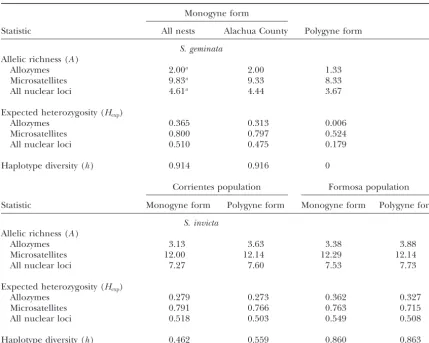
in the monogyne form to HWE and rule out widespread higher estimates of allelic richness (A) for the monog-yne than for the polygmonog-yne form (Table 1, top). None local inbreeding as a feature of the mating biology.
Similar analyses in the polygyne form were limited to of the 50 values ofAobtained by subsampling the mo-nogyne form was as low as the value obtained for the the three microsatellite loci, for which variation was
sufficient to conduct such tests. The combined signifi- polygyne form, regardless of whether only the allozymes, only the microsatellites, or all nuclear markers were cance of departure from HWE at these loci reached the
P⬍ 0.05 level in just 4 of the 100 tests conducted, an considered. Pairedt-tests over the nine nuclear loci for-mally confirmed that the monogyne form has higher outcome expected by chance. Thus, there also is no
evidence for extensive consanguineous mating in the allelic richness than the polygyne form (t⫽ 3.04,P⫽ 0.016), even when just the Alachua County samples were polygyne population ofS. geminatathat we studied.
Clear differences exist between the monogyne and considered (t⫽3.00,P ⫽0.017).
Estimates of expected heterozygosity at the nuclear polygyne forms in their allele and haplotype frequencies
(seeappendix b). This is most obvious for the allozyme loci (Hexp), which reflect the frequencies as well as num-bers of alleles, also are higher in the monogyne form loci and the mtDNA. A single allele is fixed or virtually
fixed in the polygyne form at each of the six allozyme than in the polygyne form (Table 1, top). Pairedt-tests over the individual-locus heterozygosities again con-loci, yet at four of these loci (Acoh-5,Est-6,Gpi, andOdh)
these same alleles occur at only moderate frequencies firmed that this difference is significant (t ⫽ 4.98,P ⫽ 0.001 for the Alachua County samples). Haplotype diver-in the monogyne form. A sdiver-ingle mtDNA haplotype is
fixed in the polygyne form, yet this haplotype was not sity (h), which is zero in the polygyne form, is very high in the monogyne form (Table 1), reflecting the large among the 14 haplotypes found in the monogyne form.
Allele frequency disparities also are apparent between number of haplotypes discovered in our limited number of samples.
the forms at the microsatellite loci, in the frequencies
of Sol-11153, Sol-42161, and Sol-49158, for instance. Exact The relatively low genetic variation in the polygyne
differentia-Figure 5.—Numbers of alleles/haplotypes found in the monogyne (M) and polygyne (P) forms ofS. geminataandS. invicta. ForS. geminata, black bars represent data for all monogyne nests sampled, whereas gray bars represent data for mo-nogyne nests from Alachua County only. Samples ofS. invictacome from two geographic popula-tions in the native range [Corrientes and Formosa Provinces, Argentina; seeRosset al.(1997)]. Sam-ple sizes (numbers of nests samSam-pled) are: all mo-nogyneS. geminata, 27; Alachua County monog-yne S. geminata, 19; polygyne S. geminata, 17; Corrientes monogyne S. invicta, 37; Corrientes polygyneS. invicta, 44; Formosa monogyneS. in-victa, 35; and Formosa polygyneS. invicta, 35.
have suffered a reduction in effective population size nata population was derived from the local monogyne population could reasonably explain the different levels (bottleneck), perhaps associated with its derivation via
a founder event from the local monogyne population of variation observed between the forms, as well as the different levels observed among the three classes of or similar ancestral population. The results of two tests
designed to detect the genetic signatures of such an markers within the polygyne form. A relatively narrow window of model parameter values led to allele/haplo-event in the microsatellite data are presented in Table
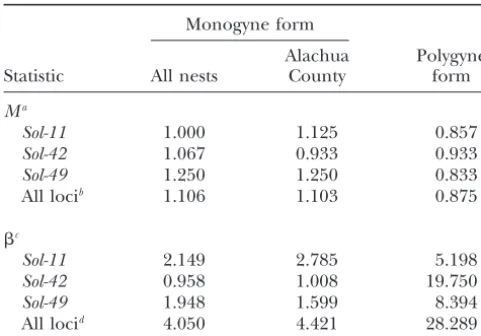
2. Values of theMratio generally are lower in polygyne type counts in such simulated populations that were compatible with actual counts in the polygyne study than in monogyneS. geminata, reflecting the
dispropor-tionate reduction in allele numbers relative to allele population for all of the markers (seeappendix a). The highest probabilities of the simulated and observed data size ranges in the polygyne form expected following a
bottleneck (Garza andWilliamson 2001). Although being compatible were reached when the modeled pop-ulation was founded by a small number of mated queens values of the imbalance index (-statistic) typically are
slightly⬎1 in the monogyne form, suggesting a possible (7–15), had a low growth rate (ⱕ20%), and experienced a small amount of gene flow from the monogyne source mild bottleneck and period of subsequent growth in the
history of this form that inflated the allele size variance population (2–5%). Incorporating mutation at the mi-crosatellites improved the probability of the simulation relative to the heterozygosity (Kimmelet al.1998),
esti-mates of this statistic for the polygyne form are consider- results being compatible with the observed data but did not substantially widen the range of parameter values ably higher, consistent with the occurrence of a more
recent or more pronounced bottleneck and subsequent leading to such results. The most significant conclusion from these simulations is that the particular patterns expansion in the polygyne study population.
Computer simulations of a founder event:Computer of genetic variation we observed in the polygyne study population can be explained by assuming that it is de-simulations were undertaken to determine whether a
TABLE 1
Estimates of genetic diversity statistics forS. geminataandS. invicta
Monogyne form
Statistic All nests Alachua County Polygyne form
S. geminata
Allelic richness (A)
Allozymes 2.00a 2.00 1.33
Microsatellites 9.83a 9.33 8.33
All nuclear loci 4.61a 4.44 3.67
Expected heterozygosity (Hexp)
Allozymes 0.365 0.313 0.006
Microsatellites 0.800 0.797 0.524
All nuclear loci 0.510 0.475 0.179
Haplotype diversity (h) 0.914 0.916 0
Corrientes population Formosa population
Statistic Monogyne form Polygyne form Monogyne form Polygyne form
S. invicta
Allelic richness (A)
Allozymes 3.13 3.63 3.38 3.88
Microsatellites 12.00 12.14 12.29 12.14
All nuclear loci 7.27 7.60 7.53 7.73
Expected heterozygosity (Hexp)
Allozymes 0.279 0.273 0.362 0.327
Microsatellites 0.791 0.766 0.763 0.715
All nuclear loci 0.518 0.503 0.549 0.508
Haplotype diversity (h) 0.462 0.559 0.860 0.863
Sample sizes are reported in the legend to Figure 5. The two populations of nativeS. invictaare located in Corrientes and Formosa Provinces, Argentina (seeRosset al.1997).
aCorrected for sample size bias by method of repeated random subsampling (Leberg2002).
neighboring monogyne form. The simulation results fur- resulted in the lack of amplification of the major surface protein gene in allS. geminatasamples. Thus, there is ther suggest that such a founder event is likely to have
occurred within the past 50 generations (⬍100 years). no evidence that the study populations of either form harbor this common bacterial endosymbiont of other Examination for hybridization and infection by
Wol-bachia: We examined whether interspecific hybridiza- fire ant species (e.g.,Shoemakeret al.2000, 2003).
Gp-9 sequence of polygyneS. geminata: All eightGp-9 tion or infection with Wolbachia may be associated with
polygyny inS. geminataat our study site. No alleles diag- coding region sequences from each of two polygyneS. geminata queens were identical to the sequence ob-nostic for the sympatric fire ant speciesS. invictaorS. xyloni
were observed in the samples ofS. geminataobtained for tained from a monogyne queen of this species from Florida in a previous study (Krieger and Ross 2002; this study. Rather, all 882 workers surveyed at the two
diagnostic allozyme loci possessed only the null allele GenBank accession no. AF427905). ThisGp-9allele en-codes a protein with amino acids typical of the B-like atEst-2and the105allele atG3pdh-1, alleles
characteris-tic ofS. geminatabut not known to occur in the other rather than the b-like alleles of the S. richteri clade at the key positions 95 and 139 (Figure 2). Results of our species (Rosset al.1987; our unpublished data). Thus,
there is no evidence of introgression from other fire PCR assays for detecting b-like sequences at these two codons confirm that only alleles encoding B-like resi-ant species into the S. geminata study populations of
either form, in contrast to the widespread hybridization dues are likely to exist inS. geminatafrom Florida: none of the 51 polygyne or 54 monogyne workers assayed that occurs between related fire ant species in some
areas of the United States (Shoemaker et al. 1996; yielded the 380-bp amplicons indicative of b-like se-quences at position 95 or position 139. Thus, there is Helms CahanandVinson 2003).
TABLE 2 endosymbiont Wolbachia, both of which are common in some fire ants, might be associated with the
expres-Estimates of statistics to detect bottlenecks inS. geminata
sion of polygyny inS. geminata.
using data from three microsatellite loci
Gp-9sequences in the polygyneS. geminatapopulation we studied were found to be identical to the coding region Monogyne form
sequence previously determined for the monogyne Alachua Polygyne
form of this species (KriegerandRoss2002).
Further-Statistic All nests County form
more, application of our specific PCR assays on numer-Ma
ous polygyne specimens suggests that no sequences with
Sol-11 1.000 1.125 0.857
b-like codons at positions 95 or 139 are likely to be present
Sol-42 1.067 0.933 0.933
at our study site. Thus, the predicted amino acid
replace-Sol-49 1.250 1.250 0.833
ments characteristic of allb-like alleles are not present
All locib 1.106 1.103 0.875
in polygyneS. geminata, refuting our working hypothesis
c that one or both of these substitutions are necessary for
Sol-11 2.149 2.785 5.198 the expression of polygyny in fire ants. Moreover,
be-Sol-42 0.958 1.008 19.750 cause no nucleotide substitutions of any kind distinguish
Sol-49 1.948 1.599 8.394
theGp-9coding region sequences of polygyne and
mo-All locid 4.050 4.421 28.289
nogyne S. geminata, variation in this gene apparently
aMratio ofGarzaandWilliamson(2001).
does not obligately correspond with variation in colony
bEstimated as the mean across loci.
social organization in this species, as it does in the S. cImbalance index ofKimmelet al.(1998).
richtericlade. From this we conclude that sequence
poly-dEstimated using the formula ofKimmelet al.(1998, p. 1927).
morphism atGp-9does not always underlie social poly-morphism involving colony queen number in the genus Solenopsis.
GP-9 protein have occurred betweenS. geminataand the
S. richteri-clade species in association with the origin of Gp-9notwithstanding, we found marked genetic dif-ferences between the polygyne and monogyne forms of polygyny. Indeed, there apparently is no association
what-soever between colony social organization andGp-9geno- S. geminata, and these differences are not paralleled in the two social forms ofS. invicta. These findings are taken type inS. geminata, given that the sequenced individuals
representing both social forms were all homozygotes to support the necessary conclusion from the Gp-9 se-quence data that polygyny has not evolved in analogous for the identical allele.
fashion inS. geminataand theS. richtericlade. The social forms ofS. geminataare strongly differentiated at both DISCUSSION
their nuclear and mitochondrial genomes, a pattern not found inS. invicta. Whereas⬍2% of the total nuclear The objective of this study was to compare sequences
of theGp-9 gene from the polygyne social form of the diversity in native S. invicta from the Corrientes and Formosa populations in Argentina resides between the fire ant S. geminata with the sequence found in the
monogyne form of this species, as well as with sequences social forms (Rosset al.1997;Ross2001), almost one-quarter of the nuclear diversity inS. geminataoccurs at from fire ant species in theS. richtericlade displaying a
similar polymorphism in colony social organization. We this level. Differentiation between the forms ofS. invicta is somewhat more pronounced at the mtDNA than at hypothesized that if polygyny inS. geminata originated
in the same manner as inS. invicta, a well-studied member the nuclear genome, ranging from 4 to 32% of the total haplotype variation (Rosset al.1997;Shoemakeret al. of the S. richteri clade, then theGp-9 variant associated
with polygyny in S. geminata would code for partic- 2003), but this still is considerably less than the mtDNA differentiation found between the forms ofS. geminata ular amino acid residues characteristic of the
polygyny-inducingb-like alleles in theS. richteri-clade species. Spe- (51%). These and other results are consistent with the idea that substantial nuclear gene flow occurs between cifically, we reasoned that polygyne S. geminata would
bear aGp-9sequence coding for isoleucine at position 95 the social forms ofS. invictawhere they occur in sym-patry (Shoemaker and Ross 1996; Ross et al. 1997, or 139 (or both); these residues are unique to all b-like
alleles, and thus one or both are hypothesized to be 1999; Ross2001), while gene flow between the forms of S. geminata appears from our data to be minimal. responsible for the altered queen-recognition
capabili-ties of workers in polygyne nests (Krieger and Ross We speculate that the events inducing a shift in social organization in the ancestral polygyneS. geminata popu-2002; see Figure 2). To establish if polygyny likely arose
in an analogous fashion inS. geminataandS. invicta, an lation also caused a change in the breeding biology of this form that has resulted in its more or less complete assumption implicit in the comparative analysis of Gp-9
sequences, we also characterized the colony and popula- reproductive isolation from the monogyne form. Evi-dently, this change did not involve the adoption of local-tion genetic structure of both social forms ofS. geminata
Hymenoptera (Hamilton 1972), because both forms crimination is all but absent, leading to the development of geographically extensive “supercolonies” in which ofS. geminatadisplay genotype distributions in general
agreement with Hardy-Weinberg expectations. individual ants mix freely among physically distinct nests (Holwayet al.1998; TsutsuiandCase2001;Giraud The two forms of S. geminata differ further in that
genetic diversity is significantly reduced in the polygyne et al.2002). Diminished nestmate recognition and ensu-ing supercolony organization in the introduced ranges form relative to the monogyne form, with this reduction
apparently due to a substantial bottleneck in the history coincide with losses of microsatellite allele diversity stemming from colonization of these areas (Tsutsuiet of the polygyne population. Numbers of nuclear alleles
and mtDNA haplotypes are significantly lower in the al.2000;Giraudet al.2002). These observations have led to the suggestion that losses of alleles encoding polygyne than in the monogyne form ofS. geminata, as
are the expected heterozygosity and haplotype diversity. individual chemical recognition cues, caused by the founder events and/or by subsequent frequency-depen-Again, these differences are not characteristic ofS.
in-victa: numbers of alleles (allelic richness) and numbers dent selection (Tsutsuiet al.2000, 2003;Giraudet al. 2002), have compromised the nestmate discrimination of haplotypes are virtually identical between the
sympat-ric forms in each of two native populations (Figure 5, abilities of Argentine ant workers in their introduced ranges, thereby inducing the transition to supercoloni-bottom; Table 1, bottom), and the expected
heterozy-gosity and haplotype diversity in the paired forms are ality. In the case ofS. geminata, loss of genetically based chemical recognition cues in the ancestral polygyne similar as well (Table 1, bottom; heterozygosity does not
differ significantly between sympatricS. invicta forms: population may similarly have eroded the ability of work-ers to distinguish nestmates from non-nestmates as well pairedt-tests, bothP ⬎0.05).
These comparative data lead us to speculate that the as to recognize individual queens, leading to a break-down of colony boundaries (high between-nest relat-polygyne form of S. geminataoriginated from a small,
isolated founder population derived from the nearby edness) and a contingent runaway process of acceptance of multiple related and unrelated egg-laying queens in monogyne population, with the inception of polygyny
driven by a loss of genetic variation rather than by spe- each nest (see alsoCrozierandPamilo1996, p. 144; van der Hammenet al.2002). Weakly developed nest-cific amino acid replacements atGp-9, the crucial
evolu-tionary event presumed to have driven the origin of mate discrimination and permeable colony boundaries are common correlates of polygyny in ants (Bourke polygyny in theS. richteri-clade species. Monogyny
gener-ally is assumed to be ancestral to polygyny in ants and andFranks1995).
Reduced genetic variation in the polygyne form ofS. other social Hymenoptera (e.g.,Ross and Carpenter
1991;Bourke and Franks 1995), and Gp-9 sequence geminatais the only factor we could identify that corre-sponds with this alternative social organization and that data specifically support this evolutionary polarity in the
transition of social organization in theS. richteri clade therefore constitutes a plausible causal agent in the social transition from monogyny.Gp-9sequences appar-(KriegerandRoss2002). Additional evidence for the
derivation of the polygyneS. geminatapopulation from ently are identical between the forms, indicating that changes in the recognition capabilities of workers associ-the monogyne form is that, in general, associ-the polygyne
population possesses a subset of the nuclear alleles ated with amino acid replacements in GP-9 protein did not elicit the switch to polygyny. Inbreeding cannot be found in the neighboring monogyne populations (
ap-pendix b). Moreover, the sole polygyne mtDNA haplo- considered a contributory factor to the divergence be-tween the forms, nor apparently can habitat specializa-type is embedded in the clade composed of all
monog-yne haplotypes (Figure 3), suggesting that it previously tion, given that colonies of both forms were collected alongside one another at one site in Alachua County. occurred in monogyne populations or that it still occurs
there but was not sampled. Finally, results of our simula- Wolbachia infections, which potentially could explain both the loss of mtDNA variation in the polygyne form tion models indicate that the particular patterns of
varia-tion observed in the polygyne form at all three classes of [via selective sweeps and hitchhiking (Turelli et al. 1992)] and reproductive isolation between the forms markers we employed can be explained by assuming that
this population originated via a founder event from the [via reproductive incompatibility between populations harboring alternate strains (Werren 1998)], were not neighboring monogyne form within the past 100 years.
A loss of genetic variation has been invoked previously detected in either form and so also cannot be implicated in the social transition. Finally, there is no evidence of to explain another radical shift in colony social
organiza-tion in an ant, and the proximate genetic mechanisms introgression from related fire ant species into the S. geminata populations of either form that we studied. hypothesized to be involved may pertain also to the
inception of polygyny inS. geminata. The Argentine ant, This is in contrast to the widespread introgression ofS. xylonigenes intoS. geminatain central Texas (Hungand Linepithema humile, exhibits well-developed nestmate
dis-crimination that functions to maintain distinct colony Vinson1977;Trager1991), where such hybridization appears to be inextricably linked to the adoption of boundaries in its native South American range. In areas
where it has been introduced, such as the western polygyne social organization (Helms CahanandVinson 2003).
dis-graminicola(Hymenoptera, Formicidae). Insectes Soc.49:344–
We conclude from this study that polygyny evolved
353.
via a different route inS. geminatathan in fire ant species Crozier, R. H., andP. Pamilo, 1996 Evolution of Social Insect Colonies :
Sex Allocation and Kin Selection. Oxford University Press, Oxford.
in the S. richtericlade, although both evolutionary
sce-Crozier, R. H., B. Kaufmann, M. E. CarewandY. C. Crozier, 1999
narios invoke changes in the molecular components of
Mutability of microsatellites developed for the antCamponotus
the chemoreception systems functioning in individual consobrinus.Mol. Ecol.8:271–276.
Fraser, V. S., B. Kaufmann, B. P. OldroydandR. H. Crozier, 2000
recognition of conspecifics. On the one hand, evolution
Genetic influence on caste in the ant Camponotus consobrinus.
of polygyny via nonsynonymous substitutions in the
pre-Behav. Ecol. Sociobiol.47:188–194.
sumed odorant-binding protein geneGp-9, characteris- Galindo, K., andD. P. Smith, 2001 A large family of divergent
Drosophila odorant-binding proteins expressed in gustatory and
tic of the S. richteri-clade species, seems to involve a
olfactory sensilla. Genetics159:1059–1072.
change in the pheromone-signal transduction
compo-Garza, C., andE. G. Williamson, 2001 Detection of reduction in
nent, with polygyne workers that bear the derivedb-like population size using data from microsatellite loci. Mol. Ecol. 10:305–318.
alleles thought to exhibit altered recognition
capabili-Giraud, T., J. S. PedersenandL. Keller, 2002 Evolution of
super-ties compared to other workers. On the other hand,
colonies: the Argentine ants of southern Europe. Proc. Natl.
evolution of polygyny via loss of alleles at loci encoding Acad. Sci. USA99:6075–6079.
Glazier, A. M., J. H. NadeauandT. J. Aitman, 2002 Finding genes
recognition cues seems to involve a reduction in the
that underlie complex traits. Science298:2345–2349.
diversity of chemical labels necessary for the proper
Goodisman, M. A. D., andK. G. Ross, 1999 Queen recruitment in
functioning of a discrimination system that serves in a multiple-queen population of the fire ant Solenopsis invicta.
Behav. Ecol.10:428–435.
both maintaining colony integrity and regulating queen
Hamilton, W. D., 1972 Altruism and related phenomena, mainly
number. Additional polygyne populations ofS. geminata
in social insects. Annu. Rev. Ecol. Syst.3:193–232.
occurring elsewhere in its vast range should be studied Hekmat-Scafe, D. S., C. R. Scafe, A. J. McKinneyandM. A. Tanouye,
2002 Genome-wide analysis of the odorant-binding protein
to determine whetherGp-9sequence variation ever
cor-gene family inDrosophila melanogaster.Genome Res.12:1357–
responds with polygyny in the manner we initially
hy-1369.
pothesized or if reductions in effective population size Helms Cahan, S., andS. B. Vinson, 2003 Reproductive division of
labor between hybrid and non-hybrid offspring in a fire ant hybrid
are consistently evident in the history of these polygyne
zone. Evolution57:1562–1570.
populations (e.g.,van der Hammen et al. 2002). Also,
Holway, D. A., A. V. SuarezandT. J. Case, 1998 Loss of
intraspe-other odorant-binding protein genes, which may often cific aggression in the success of a widespread invasive social
insect. Science282:949–952.
occur in multigene clusters in insect genomes (Galindo
Hughes, W. O. H., S. Sumner, S. Van Bormand J. J. Boomsma,
and Smith 2001; Hekmat-Scafe et al. 2002), should
2003 Worker caste polymorphism has a genetic basis in
Acromyr-be examined for variation that corresponds with social mexleaf-cutting ants. Proc. Natl. Acad. Sci. USA100:9394–9397.
Hung, A. C. F., andS. B. Vinson, 1977 Interspecific hybridization
organization in this species. Detailed molecular
exami-and caste specificity of protein in fire ant. Science196:1458–1459.
nation of both the transduction and the cue diversity
Hunt, G. J., E. Guzma´n-Novoa, M. K. FondrkandR. E. Page, 1998
components in chemoreception systems of appropriate Quantitative trait loci for honey bee stinging behavior and body
size. Genetics148:1203–1213.
social insects promises to yield new insights into the
Keller, L., andK. G. Ross, 1998 Selfish genes: a green beard in
genetic foundations of the transition from monogyny
the red fire ant. Nature394:573–575.
to polygyny and, in so doing, may shed light on the Kimmel, M., R. Chakraborty, J. P. King, M. Bamshad, W. S. Watkins evolution of other complex social adaptations. et al., 1998 Signatures of population expansion in microsatellite
repeat data. Genetics148:1921–1930.
We thank Sanford Porter and Walter Tschinkel for invaluable assis- Krieger, M. J. B., andL. Keller, 1997 Polymorphism at dinucleo-tance in the field and Dietrich Gotzek for comments on the manu- tide microsatellite loci in fire antSolenopsis invictapopulations. script. This work was funded by Kenneth Ross and by grants from Mol. Ecol.6:997–999.
the laboratory of Laurent Keller; the National Science Foundation; the Krieger, M. J. B., andK. G. Ross, 2002 Identification of a major gene regulating complex social behavior. Science295:328–332. U.S. Department of Agriculture; the Georgia Agricultural Experiment
Leberg, P. L., 2002 Estimating allelic richness: effects of sample size Stations, University of Georgia; and the College of Agriculture and
and bottlenecks. Mol. Ecol.11:2445–2449. Life Sciences at the University of Wisconsin.
Mackay, W. P., S. Porter, D. Gonzalez, A. Rodriguez, H. Armendedo
et al., 1990 A comparison of monogyne and polygyne popula-tions of the tropical fire ant,Solenopsis geminata(Hymenoptera: Formicidae), in Mexico. J. Kans. Entomol. Soc.63:611–615.
LITERATURE CITED Manly, B. F. J., 1985 The Statistics of Natural Selection on Animal
Populations. Chapman & Hall, New York. Adams, C. T., W. A. BanksandJ. K. Plumley, 1976 Polygyny in the
Maynard Smith, J., andE. Szathma´ry, 1995 The Major Transitions
tropical fire ant,Solenopsis geminatawith notes on the imported
in Evolution. Freeman, New York. fire ant,Solenopsis invicta.Fla. Entomol.59:411–415.
Nei, M., 1987 Molecular Evolutionary Genetics. Columbia University Archie, J. W., 1985 Statistical analysis of heterozygosity data:
inde-Press, New York. pendent sample comparisons. Evolution39:623–637.
O’Donnell, S., 1996 RAPD markers suggest genotypic effects on Ben-Shahar, Y., A. Robichon, M. B. SokolowskiandG. E.
Rob-forager specialization in a eusocial wasp. Behav. Ecol. Sociobiol. inson, 2002 Influence of gene action across different time
38:83–88. scales on behavior. Science296:741–744.
Orr, H. A., 1998 The population genetics of adaptation: the distribu-Bourke, A. F. G., andN. R. Franks, 1995 Social Evolution in Ants.
tion of factors fixed during adaptive evolution. Evolution 52:
Princeton University Press, Princeton, NJ.
935–949. Braig, H. R., W. Zhou, S. DobsonandS. L. O’Neill, 1998 Cloning
Orr, H. A., andJ. A. Coyne, 1992 The genetics of adaptation revis-and characterization of a gene encoding the major surface
pro-ited. Am. Nat.140:725–742. tein of the bacterial endosymbiontWolbachia.J. Bacteriol.180:
Osborne, K. E., andB. P. Oldroyd, 1999 Possible causes of repro-2373–2378.
ductive dominance during emergency queen rearing by honey-Buschinger, A., andM. Schreiber, 2002 Queen polymorphism and