Efficient Image Denoising Algorithm for
Gaussian and Impulse Noises
Rasmi.K1, Devasena.D2
PG Student, Department of Control and Instrumentation Engineering, Sri Ramakrishna Engineering College,
Coimbatore, Tamil Nadu, India1
Assistant Professor, Department of Control and Instrumentation Engineering, Sri Ramakrishna Engineering College,
Coimbatore, Tamil Nadu, India2
ABSTRACT: One of the fundamental challenges in the field of image processing and computer vision is image denoising, whose underlying goal is to estimate the original image by suppressing noise from a noise-contaminated version of the image. Image noise may be caused by different intrinsic and extrinsic conditions which are often not possible to avoid in practical situations. Therefore, image denoising plays an important role in a wide range of applications via image restoration, image registration, visual tracking, image classification and image segmentation, where obtaining the original image content is crucial for strong performance. While many algorithms have been proposed for the purpose of image denoising, the problem of image noise suppression remains an open challenge, mainly in situations where the images are acquired under poor conditions where the noise level is very high. This paper deals with comparing the denoised images obtained from various denoising algorithms, by introducing gaussian and impulse noises to the image. The algorithms used are Fuzzy rule based filtering algorithm and Decision based Switching Median filter algorithm which denoises the noisy image and comparison is made in terms of quality and smoothness.
KEYWORDS: Denoising, Fuzzy rule based filters, Noise suppression, Noise models, Switching median filters.
I. INTRODUCTION
ompared so as to determine a better denoising technique which can be implemented for both impulse and gaussian noises. Rai et al [5] and Hao- Tian Wu et al [6] through their paper gives an idea on the application of various image denoising models and how their impact on the various models.
In this paper, the better image denoising technique is found for the removal of gaussian and salt and pepper noises in an image using the decision based median filtering and fuzzy rule based filtering which has been explained by Rafael et al[7] for the various noise densities. Several non-linear filters have been proposed to remove the salt and pepper noise from the images. Among these standard median filter has been a reliable method to remove salt and pepper noise without damaging the edges. The main disadvantage of standard Median Filter (MF) is that it is only effective in low noise densities. Adaptive Median Filter (AMF) whose effectiveness is tested by Vasanth et al[8] is also performing well at low noise density but at high noise density it blurs the image. To overcome these drawbacks, different algorithms such as Decision Based Switching Median Filter (DBSMF), abstracted from the idea by Arbinda Dash et al [9] and fuzzy ruled based filtering is algorithm is designed and compared for finding the effective algorithm for the removal of impulse and gaussian noises. The images are considered with various noise densities and its image quality factors such as Peak Signal to Noise Ratio (PSNR) and Mean Squared Error (MSE) values are estimated.
II. RELATED WORK
2.1 Decision Based Switching Median Filter (DBSMF)
The removal of noises using the Decision Based Switching Median Filter (DBSMF) consists of two stages. They are the noise pixels detection stage and the filtering of corrupted pixels. The noise detection stage build a binary decision map which denotes whether the current pixel have the intensity value either 0 or 255.If the current pixel value is found to be 0 or 255, the binary decision map hold the binary 1 to indicate that the pixel is being corrupted. On the other hand, for the pixels with intensity value lying between the range 0 and 255, the decision map hold binary 0 which indicates that the current pixel is uncorrupted. The algorithm for DBSMF is described below.
Step 1: Select the processing pixel in the image read.
Step 2: If 0<Pij<255, then Pij is considered as uncorrupted pixel and is left unchanged.
Step 3: Otherwise, calculate the median of the pixels in the window and replace processing pixel by the median value.
Step 4: Move the window to the next pixel in the image. And repeat steps 1 to 3 until all the pixels in the entire image are processed.
2.2 Fuzzy Rule Based Filtering
Fuzzy image processing is not a unique theory. It is a collection of all approaches that understand, represent and process the images, their segments and features as fuzzy sets. The representation and processing depend on the selected fuzzy technique and on the problem to be solved. Fuzzy image processing has 3 main steps: image fuzzification, modification of membership values, and if necessary, image defuzzification. It is used in many applications e.g., object recognition, sense analysis, etc.
In this approach, first the filtering process is started by looking at the edges. Main aim is to make distinction between the local variations due to noise and due to image structure. For that consider the 3x3 neighborhood of pixel (x, y). A simple derivative with respect to the central pixel (x, y) is calculated by finding difference between the central pixel and its neighbor in the direction D (where D dir = {N, S, W, E, NE, SE, SW, NW}).This derivative value is denoted as in the equation (1) and (2):
ΔNW(x, y) = F(x-1, y-1) – F(x, y) (1)
After this, fuzzy filtering is performed by calculating the fuzzy derivatives. In order to find out the value of fuzzy
derivative for a particular direction, the values of ΔNW(x, y), ΔNW(x-1, y+1) and ΔNW(x+1, y-1) are calculated. If any
two of the derivative value are small, it is safe to assume that no edge is present in the considered direction and this variation is due to the noise. The algorithm is described as follows.
Step 1: Read the image to be processed
Step 2: Choose a mask of 5*5 size; For each central pixel, 8 neighbours in the eight directions are considered Step 3: Calculate the fuzzy derivative values for a particular direction
Step 4: Calculate the correction term and add it to the central pixel of the selected mask Step 5: Repeat the process till each and every pixel of the image is traversed
III. SIMULATION RESULTS
The image denoising using Decision based Switching Median Filter and Fuzzy Rule Based Filtering for various noise densities in the images lena.jpg and indddex.jpg with impulse and gaussian noises are tested. The images are of 512*512 8-bit/pixels with noise densities from 20% to 90% and their performance is quantitatively measured by Mean Squared Error (MSE) and Peak Signal to Noise Ratio (PSNR) values.
Let f(x,y) be the original image with size MxN and f’(x,y) be the restored image with the same size. The MSE and PSNR values are given by the equations (3) and (4) respectively:
MSE = Σxy (f’(x, y) - f(x, y))2 (3)
PSNR = 10 log10 ( ) (dB) (4)
3.1 Impulse Noise Image Result
The images obtained in decision based switching algorithm for impulse noise at the noise density of 50% are shown in the fig. 1.
(a) lena.jpg
(b) indddex.jpg
The images obtained in fuzzy rule based algorithm for impulse noise at the noise density of 50% are shown in the fig. 2.
(a) lena.jpg
(b) indddex.jpg
Fig 2: Performance of fuzzy rule based algorithm with noise density of 50% for impulse image
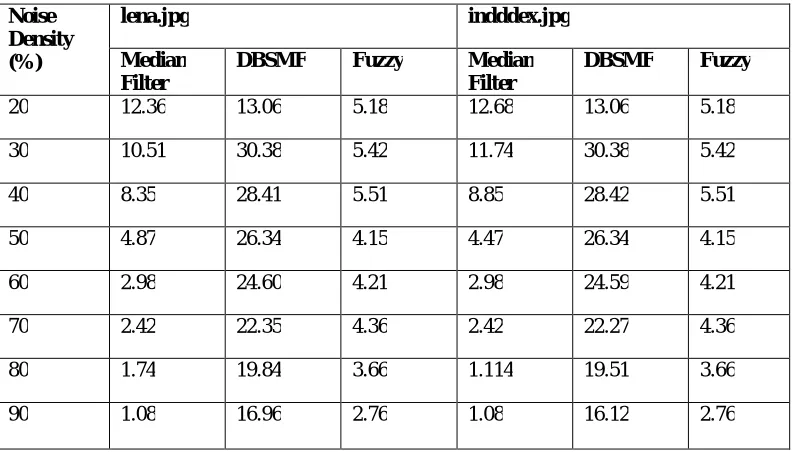
The calculated values of MSE and PSNR for the impulse noise images lena.jpg and indddex.jpg are presented in the Tables I – II.
Table I MSE value comparison at various noise densities of the image lena.jpg and indddex.jpg with impulse noise
Noise Density (%)
lena.jpg indddex.jpg
Median Filter
DBSMF Fuzzy Median
Filter
DBSMF Fuzzy
20 12.36 13.06 5.18 12.68 13.06 5.18
30 10.51 30.38 5.42 11.74 30.38 5.42
40 8.35 28.41 5.51 8.85 28.42 5.51
50 4.87 26.34 4.15 4.47 26.34 4.15
60 2.98 24.60 4.21 2.98 24.59 4.21
70 2.42 22.35 4.36 2.42 22.27 4.36
80 1.74 19.84 3.66 1.114 19.51 3.66
Table II PSNR value comparison at various noise densities of the image lena.jpg and indddex.jpg with impulse noise
Noise Density (%)
lena.jpg indddex.jpg
Median Filter
DBSMF Fuzzy Median
Filter
DBSMF Fuzzy
20 25.69 33.09 14.01 26.19 33.09 14.03 30 22.14 30.38 14.43 23.14 30.38 14.45
40 18.31 28.41 14.851 18.31 28.41 14.76 50 14.81 26.34 13.29 14.81 26.34 13.22
60 12.23 24.60 13.607 12.23 24.60 13.34 70 9.98 22.35 13.36 9.98 22.35 12.85 80 8.10 19.84 12.676 8.10 19.84 12.25 90 6.68 16.96 11.728 6.68 16.96 11.403
3.2 Gaussian Noise Image Result
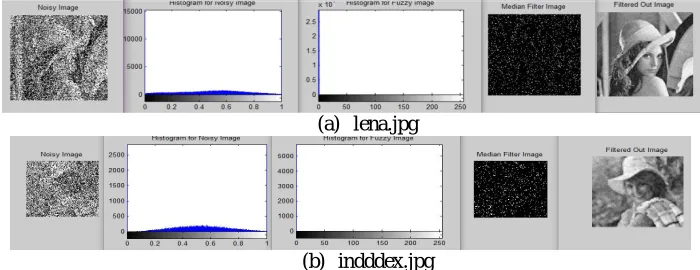
The images obtained in decision based switching algorithm for gaussian noise at the noise density of 50% are shown in the fig. 3.
(a) lena.jpg
(b) indddex.jpg
Fig 3: Performance of decision based switching median algorithm with noise density of 50% forgaussian image
The images obtained in fuzzy rule based algorithm for gaussian noise at the noise density of 50% are shown in the fig. 4.
(a) lena.jpg
(b) indddex.jpg
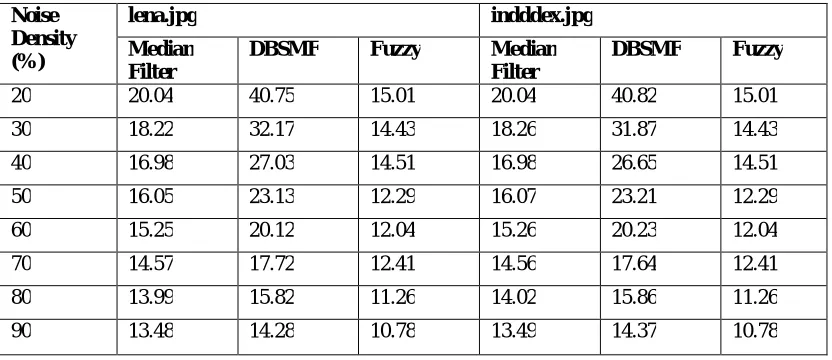
The calculated values of MSE and PSNR for the gaussian noise images lena.jpg and indddex.jpg are presented in the Tables III - IV.
Table III MSE value comparison at various noise densities of the image lena.jpg and indddex.jpg with gaussian noise
Noise Density (%)
lena.jpg indddex.jpg
Median Filter
DBSMF Fuzzy Median
Filter
DBSMF Fuzzy
20 0.05 0.15 1.80 0.05 0.15 1.80
30 0.07 0.17 2.08 0.08 0.21 2.08
40 0.12 0.24 2.62 0.11 0.32 2.62
50 0.17 0.39 3.53 0.14 0.51 3.53
60 0.15 0.65 4.11 0.17 0.79 4.11
70 0.17 1.06 4.62 0.19 1.19 4.62
80 0.24 2.08 5.34 0.22 1.73 5.34
90 0.29 5.09 5.81 0.25 2.26 5.18
Table IV PSNR value comparison at various noise densities of the image lena.jpg and indddex.jpg with gaussian noise
Noise Density (%)
lena.jpg indddex.jpg
Median Filter
DBSMF Fuzzy Median
Filter
DBSMF Fuzzy
20 20.04 40.75 15.01 20.04 40.82 15.01
30 18.22 32.17 14.43 18.26 31.87 14.43
40 16.98 27.03 14.51 16.98 26.65 14.51
50 16.05 23.13 12.29 16.07 23.21 12.29
60 15.25 20.12 12.04 15.26 20.23 12.04
70 14.57 17.72 12.41 14.56 17.64 12.41
80 13.99 15.82 11.26 14.02 15.86 11.26
90 13.48 14.28 10.78 13.49 14.37 10.78
From the Tables I- IV, it is seen that for the images with impulse noise, the fuzzy based values have better performance criteria in the high densities alone. Compared to this, decision based switching median filter gives the average range of values for both the impulse and gaussian noises at all the noise densities without affecting the quality of the image.
VI. CONCLUSION
In this paper, algorithms created for impulse and gaussian noises, the decision based switching median filter works well for impulse noises at both high and low noise densities,thoughtheydoesnotgowellwithgaussiannoises.Thefuzzybased filtering performance is better at highernoisedensities. Thus, we can conclude that the usage of decision based switching median filter suits to both algorithms to an extent.
REFERENCES
[1] GanchaoLiu,HuaZhongand LichengJiao,‘ComparingNoisy PatchesforImageDenoising:ADoubleNoiseSimilarity Model’,IEEE TransactionsonImageProcessing,Vol.24,No.3, pp. 862-872, 2015.
[2] AparnaSarkar,SuvamoyChangderandMandal.J.K,‘AThreshold basedDirectionalWeightedMedianFilterforRemovalofRandomImpulses inThermalImages’,2ndInternationalConferneceonBusinessandInformationManagement,pp.69-74, 2014.
[3] Ayush Kumar, Nimisha Agarwal, Juhi Bhadviya, Gaurav Mittal and GiovanniRamponi,‘AnEfficientNewEdgePreservingTechnique for Removal ofSaltandPepperNoise’,8thInternationalSymposiumonImageandSignalProcessing andAnalysis, 2013.
[4] JezebelPriestley.J,Nandhini.VandElamaran.V,‘ADecision basedSwitchingMedianFilterforRestoration ofImagesCorruptedbyHigh Density ImpulseNoise’,InternationalConferneceonRobotics,Automation,ControlandEmbeddedSystem, pp. 1-5, 2015.
[5] Rai.C.S,MunishKumar,VidhiandVeebhoreVarun,‘Removal ofHighDensityGaussianandSalt& PepperNoisein ImageswithFuzzyRule BasedFilteringusingMATLAB’, IEEEInternationalConferenceonComputationalIntelligence&Communication Technology, pp. 166-172, 2015. [6] Hao-TianWu,Jean-LucDugelay andYun-QingShi,‘Reversible Image Data Hiding with ContrastEnhancement’,IEEE Signal Processing Letters,Vol.22,No.1, pp. 81-85, 2015.
[7] Rafael.C.Gonzalez,Richard.E.WoodsandSteven.L.Eddins, ‘Digital Image Processing using MATLAB’, McGraw Hill Publications, SecondEdition, 2010.
[8] Vasanth. K and Jawahar Senthilkumar, ‘A Decision Based Unsymmetrical Trimmed Midpoint Algorithm for the Removal of High Density SaltandPepperNoise’,JournalofTheoreticalandApplied InformationTechnology,Vol.42,No.2,pp. 245-251, 2012.
[9] ArabindaDashandSujayaKumarSathua,‘HighDensityNoise
RemovalbyusingCascadingAlgorithms’,FifthInternationalConferenceonAdvancedComputational &CommunicationTechnology, 2015.
[10] Manali Mukherjee, Kamarujjaman and Mausumi Mitra, ‘ReconfigurableArchitectureofAdaptiveMedianFilter-AnFPGABased Approach forImpulseNoiseSuppression’, ThirdInternationalConferenceonComputer, Communication,ControlandInformationTechnology, pp. 1-6, 2015. [11] De-AnHuang,Li-WeiKang,Yu-ChiangFrankWangandChia-WenLin, ‘Self-Learning based Image Decomposition with Applications to SingleImageDenoising’, IEEETransactionsonMultimedia,Vol.16,No.1, pp. 83-93, 2014.
[12] JianzhouFeng, Li Song, Xiaoming Huo, Xiaokang Yang andWenjun Zhang, ‘AnOptimized Pixel-WiseWeighting ApproachforPatch BasedImageDenoising’, IEEESignal Processing Letters, Vol.22,No.1, pp. 115-119, 2015.
[13]HuanjingYue,XiaoyanSun,JingyuYangandFengWu,‘Image Denoising by Exploring External and Internal Correlations’, IEEE TransactionsonImageProcessing,Vol.24,No.6, pp. 1967-1982, 2015.
[14] Seungin Back, Soowoong Jeong, Jong-Soo Choi and Sangkeun Lee ,‘ImpulseNoiseReductionusingDistanceWeightedAverageFilter’, 21st Korean–JapanJointWorkshoponFrontiersof ComputerVision, 2015.