PARKER, ALISON E. Parental Socialization of Positive and Negative Emotions: Associations with Children’s Everyday Coping and Display Rule Knowledge. (Under the direction of Amy G. Halberstadt).
This study investigated relationships among parents’ self-reported emotion-related beliefs and behaviors, children’s display rule knowledge for positive and negative emotions, and children’s coping with everyday peer stressors. One hundred and thirteen 6th graders and their parents were recruited from middle schools to participate. Children were interviewed about their display rule knowledge for various emotions, as well as their coping with peer stressors. Parents completed self-report questionnaires regarding their beliefs about emotion, their reactions to children’s positive and negative emotions, and their emotion expressiveness in the family. Relationships among parents’ beliefs, reactions, and emotion expressivity were found. Specifically, parents’ beliefs that positive emotions are good predicted parents’ positive expressiveness and beliefs that positive emotions are dangerous predicted parents’ controlling of children’s positive emotions. Parents’ beliefs that negative emotions are good did not predict parents’ negative expressiveness; however, these beliefs did predict parents’ encouragement of children’s negative emotions. Parental guidance beliefs were also related to their emotion expressiveness. Parents’ belief that it is the parents’ job to teach children about emotions was positively related to their own positive emotion expressiveness, whereas parents’ belief that children should learn on their own was related to their own negative emotion expressiveness. Additionally, relationships were established between parents’
negative emotion expressiveness, and reactions to children’s displays of positive emotions predicted children’s use of coping strategies. Lastly, gender moderated the relationships between parents’ punishing reactions to children’s negative emotions and children’s display rule knowledge for negative emotions, and between parents’
RULE KNOWLEDGE by
ALISON E. PARKER
A dissertation submitted to the Graduate Faculty of North Carolina State University
in partial fulfillment of the requirements for the
Degree of Doctor of Philosophy
PSYCHOLOGY Raleigh
2006
APPROVED BY:
_____________________________ Amy Halberstadt, Ph. D. Chair of Advisory Committee
_____________________________ _____________________________ Lynne Baker-Ward, Ph. D. Jason Allaire, Ph. D.
ii
iii
greatly appreciated all the support (with writing and emotions), guidance and enthusiasm throughout this process.
In addition, I would like to thank my committee members: Dr. Lynne Baker-Ward, Dr. Jason Allaire, Dr. James Kalat and Dr. Julie Dunsmore. I appreciated their willingness to provide me with constructive feedback and support when needed. And, I am very grateful for the help to make my study the best it could be.
I would like to thank my collaborator, Julie Thompson, for being forever optimistic, hard working, and responding quickly to my demands and queries.
I want to thank the parents and children that participated in this study, as well as the teachers at both middle schools who helped us recruit families and welcomed us into their classrooms. With this, I greatly appreciate all the help from the army of
undergraduate and graduate students who helped interview the children and made the data collection run smoothly. I also need to give a special thank you to Molly Stroud and Ashley Craig for their assistance with coding.
iv
List of Tables……… vi
List of Figures……….. vii
I. Introduction……….. 1
A. What are positive emotions and why are they important?………. 2
B. The Role of Parents………... 5
1. Specific mechanisms of parental socialization of emotion……….. 7
2. Parental Reactions to Children’s Emotions………. 8
3. Parental Expression of Emotion……… 11
C. Parents’ Beliefs about Children’s Emotions……….... 13
D. Relationship between Parents and Peer World ……….. 16
1. Children’s Display Rule Knowledge and Use……….. 17
2. Children’s Everyday Coping with Peer Stressors………. 26
E. Developmental Period: Pre-adolescence……….…………. 35
F. Gender Differences……….. 37
II. Specific Aims and Hypotheses……… 39
III. Method……… 43
A. Participants……….………. 43
B. Measures………..… 43
1. Parents’ Beliefs about Children’s Emotions………. 43
2. Self-Expressiveness in the Family Questionnaire………. 45
3. Coping with Children’s Negative Emotions Scale ………….……. 46
4. Parents’ Reactions to Children’s Positive Emotions Scale………... 47
5. Demographics……….... 48
6. Coping Orientations to Problems Experienced (COPE)……… 48
7. Display Rules for Positive and Negative Emotions………... 49
8. Jar Estimation Task……… 52
IV. Procedure……… 55
V. Results………. 58
A. Overview……….. 58
1. Data Reduction……….. 58
2. Children’s coping………... 58
B. Preliminary Analyses for Parent and Child Measures………. 60
C. Aim 1: Parents’ Beliefs Predicting Parents’ Self-Reported Emotion-Related Behaviors………. 65
D. Children’s Peer Outcomes ………... 69
1. Children’s peer stressors and coping………. 69
2. Display rules knowledge and goals……… 71
E. Aim 2: Parents’ Beliefs and Emotion-Related Behaviors Predicting Children’s Coping………. 72
1. Simultaneous Regression Analyses with Predictors of Children’s Coping……….. 84
v
Behaviors and Children’s Display Rule Knowledge………... 90
I. Aim 5: Children’s Display Rule Knowledge and Actual Behaviors During Jar Estimation Task……… 95
J. Overall Summary of Findings………... 95
VI: Discussion………. 97
A. The Relationship Between Parents’ Beliefs and Their Emotion-Related Behaviors………. 97
B. Children’s Coping with Peer Stressors……….. 101
C. Children’s Display Rule Knowledge and Reasoning……… 105
D. Parents’ Beliefs and Emotion-Related Behaviors Predicted Children’s Coping……… 107
E. Parents’ Beliefs and Their Emotion-Related Behaviors Predicted Children’s Display Rule Knowledge and Reasoning………. 113
F. Mediational Model of Parents’ Beliefs and Children’s Peer Outcomes… 116 G. Conclusion………. 116
H. Strengths of Study………. 117
I. Limitations of Study………. 118
J. Future Research………. 120
VII. References ……….... 123
VIII. Appendices……….. 140
A. Parents’ Beliefs about Children’s Emotions……….. 141
B. Self-Expressiveness in the Family Questionnaire……….. 144
C. Parent Attitude/Behavior Questionnaire (CCNES)... 146
D. Parental Reactions Questionnaire ……… 150
E. Demographics………. 156
F. COPE……….. 157
vi
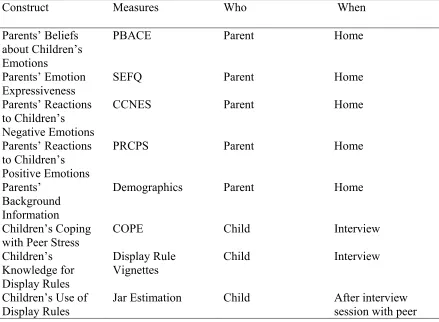
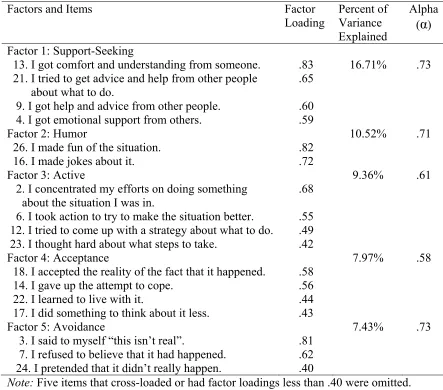
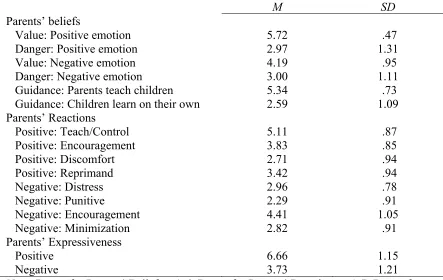
1. Organization of Parent and Child Measures……….. 57 2. Variable Loadings on COPE Factors………... 60 3. Means and Standard Deviations for Parents’ Beliefs and Behaviors………… 61 4. Means and Standard Deviations for Children’s Perceptions and Use of
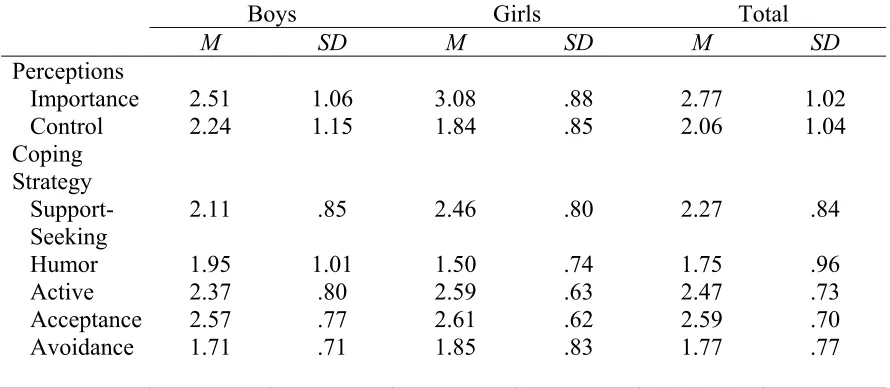
Coping Strategies………... 63 5. Means and Standard Deviations for Children’s Display Rule Knowledge…... 63 6. Means and Standard Deviations for Children’s Intensity of Positive Affect
During Baseline and Jar Estimation Competition……… 64 7. Hierarchical Regression Models with Parents’ Beliefs about Value and
Danger of Positive Emotion Predicting Parents’ Reactions to Children’s
Positive Emotions………. 66 8. Hierarchical Regression Models with Parents’ Beliefs about Value and
Danger of Negative Emotion Predicting Parents’ Reactions to Children’s
Negative Emotions……… 67 9. Simultaneous Regression Models with Parents’ Beliefs about Value and
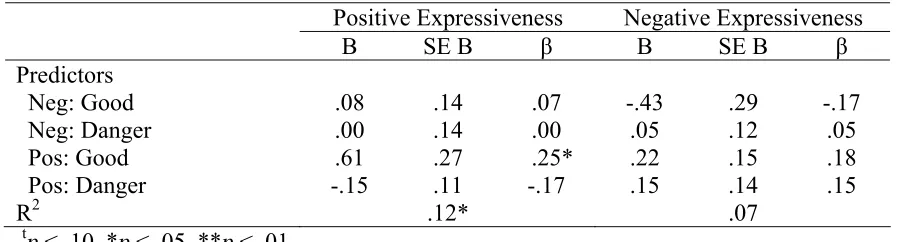
Danger of Emotion Predicting Parents’ Emotion Expressiveness……… 68 10. Simultaneous Regression Models with Parents’ Beliefs about Guidance
Predicting Parents’ Emotion Expressiveness……… 69 11. Hierarchical Regression Models with Parents’ Beliefs about the Value and Danger of Emotion Predicting Children’s Coping with Peer Stressors…….. 75 12. Hierarchical Regression Models with Parents’ Beliefs about Guidance
Predicting Children’s Coping……….. 76 13. Hierarchical Regression Models with Parents’ Reactions to Children’s
Positive Emotions Predicting Children’s Coping……… 79 14. Hierarchical Regression Models with Parents’ Reactions to Children’s
Negative Emotions Predicting Children’s Coping……….. 81 15. Hierarchical Regression Models with Parents’ Emotion Expressiveness
Predicting Children’s Coping………. 83 16. Simultaneous Regression Models with Parents’ Beliefs about Value of
Emotion Predicting Children’s Display Rule Knowledge and Goals………. 86 17. Simultaneous Regression Models with Parents’ Reactions to Children’s
Positive Emotion Predicting Children’s Display Rule Knowledge…………. 87 18. Simultaneous Regression Models with Parents’ Reactions to Children’s
Negative Emotion Predicting Children’s Display Rule Knowledge………. 88 19. Simultaneous Regression Models with Parents’ Emotion Expressiveness
Predicting Children’s Display Rule Knowledge and Goals……… 89 20. Simultaneous Regression Analyses for Parental Teaching/Controlling of
Children’s Positive Emotions and Child Gender Predicting Children’s
vii
1. Interaction Between Parent Teach/Control and Child Gender on Display
Rule Knowledge for Positive Emotions……….. 91 2. Interaction Between Parent Punishment and Child Gender on Display Rule
Parents play a pivotal role in children’s emotional experience and expression. Parents’ behaviors and beliefs regarding emotion have been associated with children’s emotion knowledge (e.g., Denham & Kochanoff, 2002); expressivity (e.g., Halberstadt, Crisp & Eaton, 1999); knowledge of display rules (e.g., Jones, Abbey, & Cumberland, 1998); social competence (e.g., Garner & Estep, 2001) and regulation of emotion (e.g., McDowell, Kim, O’Neil & Parke, 2002). However, how parents teach their children about positive emotions and how this influences children’s socio-emotional competence and coping in the peer world has not been widely studied.
This study explored the pathways through which parental socialization of both positive and negative emotions relates to children’s everyday peer coping and display rule knowledge. The focus on positive emotion in this research helps to balance an area overpopulated by negative emotions. Whereas some researchers argue that parental reactions to children’s negative emotions provide rich opportunities for emotion
socialization, and rightly so (e.g. Eisenberg, Cumberland, & Spinrad, 1998), I argue that parental reactions to children’s experience and expression of positive emotions are also important in teaching children about emotions and developing children’s repertoire of social skills.
with them. Children’s knowledge of display rules is also an important skill in maintaining positive peer relations (Jones et al., 1998). Children’s knowledge for replacing a felt emotion, when it is appropriate to do so, with the display of a socially appropriate emotion and the motivation for doing so was examined in this study. Of interest to the current study was how parental socialization of positive and negative emotion prepares children for interactions in the peer world. To explore this, parents in the current study were asked to report their beliefs about children’s emotions, their positive and negative emotion expressiveness in the family, as well as their reactions to children’s display of positive and negative emotions.
In the next section, I will discuss the importance of positive emotions. In the following sections, I will explore the role of parents’ beliefs, reactions to children’s emotions and emotion expressiveness in the family in children’s socio-emotional competence and everyday coping. Following these sections, I will discuss children’s stress and coping, followed by children’s display rule knowledge and reasoning. Lastly, I will outline the aims and hypotheses for the study.
What Are Positive Emotions and Why Are They Important? We have all experienced positive emotions (e.g. joy, pride, excitement,
1995; Liable & Thompson, 2000), whereas others provide greater specificity (e.g., Bosacki & Moore, 2004; Cole, Teti & Zahn-Waxler, 2003; Tugade, Fredrickson & Feldman-Barrett, 2004). Sixteen specific positive or enjoyable emotions were proposed by Ekman (2003). These include joy, happiness, contentment, excitement, relief, wonder, ecstasy or bliss, gratitude, elevation, schadenfreude (gloating over success), fiero (more than just pride – you bask in your success without others needing to know about your accomplishment) and naches (the glow of pleasure plus pride that only a child can give to its parents). Some, but not all, of these sixteen of these positive emotions have been empirically studied in the past and in the current study, parents’ reactions to children’s displays of pride, excitement/exuberance, interest and happiness, as well as children’s knowledge for display rules for these positive emotions were investigated. This subset of positive emotions was selected because these positive emotions appear to be the most salient in families’ lives, as well as the most empirically measured in emotion literature.
For example, feeling happy encourages one to continue until the goal is reached, whereas feeling angry or frustrated signals that one needs to stop and re-evaluate the situation and possibly alter one’s course of action (Oatley & Johnson-Laird, 1996). Therefore, it may be possible that parents’ socialization of positive and negative emotions play different roles in children’s development of social and emotional skills.
Positive emotions may be highly motivating and cause us to do things that are good for us (Ekman, 2003; Fredrickson, 1998). Positive emotions and related positive states have been linked to broadened scopes of attention, cognition, and action. For example, positive emotions, specifically amusement and contentment, broadened the scope of college students’ attention on a visual processing task (Fredrickson & Branigan, 2005). Additionally, positive emotions enhance creativity and problem solving, as well as promote flexible and adaptive thinking (Greene & Noice, 1988; Isen, Daubman, &
Nowicki, 1987; Isen, 2002).
The experience of positive emotions serves an important function in helping an individual to regulate negative emotional experiences and may work to undo the effects of negative emotions (Fredrickson, 2002; Tugade & Fredrickson, 2002). According to Fredrickson’s (2002) ‘undoing’ hypothesis, positive emotions tend to function as
“efficient antidotes” for the narrowing and deleterious effects of negative emotions. The experience of joy and contentment by others may undo the cardiovascular aftereffects of negative emotions such as sadness (e.g., Fredrickson & Levenson, 1998).
These studies, primarily with adults, suggest that the experience of positive emotions in children’s lives may well enhance well-being, broaden children’s thought and action which make them better problem solvers, build children’s physical,
intellectual, and social resources, and enrich their social networks. To examine how positive emotions may influence children, parents in the current study were asked to report on positive emotion expressivity in the family and reactions to children’s positive emotions.
The Role of Parents
Fredrickson (1998) suggests that parents may cultivate positive emotions by encouraging their children to be reflective about their positive experiences. Over time, parents’ socialization goals seem to shift from inducing positive emotions in their children directly to children generating these positive emotions on their own
(Fredrickson, 1998; 2001). Parents may foster pride in their children by praising them for their accomplishments and teaching children to recognize their own accomplishments. Eventually, children will be able to generate this pride in themselves without direct praise from parents (Denhman, Mitchell-Copeland, Strandberg, Auerbach & Blair, 1997;
Fredrickson, 1998).
Parents’ appropriate responsiveness to children’s positive affect, but also to distress, appears to be an important contributor to optimal child functioning (Denhman, et al., 1997). Paying attention to and positively reinforcing children’s emotions by accepting and acknowledging them may pave the way for children to learn more about emotions in themselves and others, reflected in their social and emotion competence. Lower levels of maternal acceptance of a child’s negative emotion have been linked to lower levels of emotion regulation in children and higher levels of child aggression (Ramsden & Hubbard, 2002). This may be reflected in parents’ self-reported reactions to children’s displays of positive and negative emotion, a main feature of the current study.
be investigated in this study via parental beliefs, self-reported parental reactions and emotion expressivity.
Specific Mechanisms of Parental Socialization of Emotion
Parental socialization of emotion is defined as “parenting behaviors that reflect parental beliefs, goals, and values in regard to their children’s experience, expression and modulation of emotion.” (Eisenberg et al., 1998a, p. 97). Parents utilize four types of socialization behaviors: parental reactions, parental expressiveness, parental discussion of emotion, and parental control of niches (see Eisenberg, et al., 1998a; 1998b; Parke & McDowell, 1998).
Parental reactions to children’s negative emotions have received the most empirical attention (e.g., non-supportive reactions, Eisenberg, Fabes & Murphy, 1996). Parent emotion-related socializing behaviors of neglecting, punishing, and overriding of sadness, anger, and fear have been found to contribute to higher levels of children’s psychological distress (Garside & Klimes-Dougan, 2002). Although research is limited, parental reactions to children’s expression of positive emotions appear to influence children’s academic achievement and positive peer and teacher ratings of social competence (e.g., Gottman, Katz, & Hooven, 1996; McDowell et al., 2002).
Additionally, parental discussion of both positive and negative emotions, another important emotion-related socialization behavior, has been linked to children’s display rule knowledge (Garner, 1999); emotion understanding (Brown & Dunn, 1996; Denham, Zoller & Couchoud, 1994); and high ratings of prosocial behavior (Denham, 1997). Niche selection, although more in the theory stage than empirically tested, has been argued to be another form of parental socialization of emotion (Fredrickson, 2001; Parke & McDowell, 1998). Parents and children actively seek out environments or niches in which they feel comfortable. Niche-picking is a highly effective means of regulating emotions and maximizing the experience of desired emotions (Campos, Frankel, & Camras, 2004). Parents may select niches or situations where young children can maximize their experiences of joy or pride and minimize the experience of negative emotions (Fredrickson, 2001).
Two of the four parental emotion-related socialization behaviors were
investigated in the current study: Parental reactions to children’s displays of emotion, and parental emotion expressivity. Parental reactions and expressivity were chosen as
mechanisms to examine because they appear to be the behaviors that parents are most likely to model or utilize to teach children about positive emotions (Duff, 2004). Parental Reactions to Children’s Emotions
associated with children’s low socioemotional competence (Jones, Eisenberg, Fabes & MacKinnon, 2002). In addition, parental support and emotional encouragement of children’s negative emotions have been positively related to children’s decoding of emotions and emotion expressiveness in contrast to parental distress and non-supportive reactions, such as punishing (Fabes et al, 2002).
Recognizing that positive emotions may also need to be encouraged and/or
regulated (e.g., Rydell, Berlin & Bohlin, 2003), a measure was recently created to capture parents’ reaction to children’s expression of positive emotions. Parental reactions to children’s positive emotions are thought to take the form of teaching/controlling, encouragement, reprimand, or discomfort (Ladouceur, Reid, & Jacques, 2002).
Teach/Control is directing the child’s actions, but also includes reasons for a change in behavior (e.g., tell the child that he may not jump on his seat because it bothers other spectators). Encouragement is similar to the encouraging behaviors in relation to negative emotions as measured by the CCNES (e.g., smile to let my child know that I am happy to see she is enjoying herself). Reprimand is most like punishing behaviors in relation to negative emotions (e.g., tell my child to sit and calm down). Discomfort is most similar to distress as depicted in relation to negative emotions (e.g., be embarrassed by my child’s behavior). Ladouceur et al. (2002) do not include emotion-focused or problem-focused solving, as they do not think most parents will have a need to “solve” the
problem of positive emotions. Problem- and emotion-focused strategies have more to do with responding to children’s distress or helping the child to feel better and these
We do not yet know anything about children’s outcomes based on these self-reported parental reactions to children’s positive emotions. The current study utilized the new parent self-report measure, PRCPS, which assesses parental reactions to preschool and elementary school-aged children’s positive emotions (Ladouceur, et al., 2002). Parents responded to a variety of vignettes by choosing how they would react in the situation. Because of the newness of this measure, only preliminary validity is available. However, links between this measure and measures of parents’ reactions to negative emotions, parents’ expressiveness, and family environment suggest that the PRCPS possesses acceptable levels of convergent validity. For example, a significant relationship was established between the PRCPS subscale of discomfort and parents’ distressed reactions to children’s negative emotions, as measured by the CCNES. In addition, relationships were established between PRCPS subscales of discomfort and reprimand and parents’ negative expressivity. No relationships were established between positive expressivity and any of the four reactions, although one would expect a relationship between positive expressivity and parents’ encouragement (Ladouceur et al., 2002).
Additional relationships have been found among subscales of the PRCPS and the Parents’ Beliefs About Children’s Emotions Questionnaire (PBACE; Halberstadt, Dunsmore, Bryant, Parker, Rudd, & Thompson, 2005). For example, the Teach/Control subscale was related to parents’ beliefs that emotions are bad. Parents’ belief that emotion expression is dangerous was positively associated with the reprimand and
and its relation to children’s coping and knowledge of display rules. These hypotheses are further delineated in the coping and display rule sections.
Parental Expression of Emotion
Parental expression of emotion is another parental emotion-related socialization behavior examined in the current study. Expressiveness is defined as a persistent pattern or style of exhibiting nonverbal and verbal expressions that often, but not always, appear to be emotion related (Halberstadt, 1991). Emotional expressions may be considered either positive or negative and either dominant or submissive. Positive emotion expressions involve emotions such as happiness or pride, whereas negative emotion expressions involve emotions such as anger or fear (Halberstadt, 1991).
Children actively construct the rules for appropriate internalization and expression of emotion from individuals, mostly parents, who they observe (Burrowes & Halberstadt, 1987). Early socialization practices can be seen as impacting individual emotion
expressiveness over the period from preschool to early elementary school (Roberts, 1999). Parental emotion expressiveness teaches children, through modeling, which emotions are acceptable to express in the family and in certain situations. For example, children whose mothers are more positively expressive with them are, in turn, more expressive with their mothers (Cassidy et al., 1992). Additionally, parents’ negative expressiveness is positively associated with children’s self-expressiveness of negative affect (Halberstadt et al., 1999). Both positive and negative expressiveness were explored in the current study.
emotion, are more popular with peers, and have a good understanding of both positive and negative emotions and other emotional reactions (Boyum & Parke, 1995; Cassidy, et al., 1992; Denham & Kochanoff, 2002; Dunsmore & Smallen, 2001; Halberstadt, et al., 1999; Saarni, 1999). Children from positively expressive families also have greater emotion regulation as rated by their teachers (see Halberstadt et al., 1999, for a review). In another study, children’s regulation of emotion mediated the relationship between mothers’ expression of positive emotions and children’s social competence and
adjustment (Eisenberg, Gershoff, Fabes, Shepard, Cumberland, Losoya, et al., 2001). The evidence for negative expressiveness is more complex than for positive expressiveness. Although some have found that parents’ negative expressivity negatively contributes to children’s prosocial behaviors (e.g., children’s aggression, Ramsden & Hubbard, 2002) this relationship may change depending on clarity of communication (Boyum & Parke, 1995).
In the current study, parents reported on their emotion expressiveness in the family for both positive and negative emotions. One goal was to determine if parental expressiveness in the family influences children’s development of display rule
develop coping resources necessary to cope with peer stressors. Instead, these children may minimize or avoid the stressors because they do not know how to deal with them.
Parents’ Beliefs about Children’s Emotions
Parental beliefs represent what parents think about their children and their own parenting behaviors. Parents’ emotion-related behaviors, as highlighted by Eisenberg et al. (1998), may be preceded by parental beliefs. For example, parental meta-emotion, a combination of parental thoughts, attitudes, and behaviors about emotions, has been linked with a wide assortment of important outcomes for children, including peer relations, academic achievement, and child illness (Gottman, Guralnick, Wilson,
Swanson, & Murray, 1997; Katz, Wilson, & Gottman, 1999; Katz & Windecker-Nelson, 2004). Whereas parents with dismissive beliefs ignore or trivialize children’s emotions, parents who believe in guiding their children with regard to emotion are thought to be aware of emotions, to assist children in experiencing and regulating emotion, and to be supportive of their children’s emotional expressions and experiences (Gottman, 1997). However, because the meta-emotion construct includes a broad mixture of belief and behavior, it is useful in new studies to distinguish specific beliefs and behaviors, and their subsequent impact on children (Cowan, 1996; Eisenberg, 1996).
& Dunsmore (2006) argued that beliefs about the value and danger of emotion should be treated separately so as to allow parents to consider them as orthogonal dimensions. This is based on the idea that the simultaneous presence of two seemingly oppositely-valenced feelings (e.g., graduation as a happy and sad moment) may suggest that seemingly
contradictory beliefs may also exist concomitantly (Schimmack, Oishi & Diener, 2002). In a qualitative analysis of parental beliefs about children emotions, similarities and differences among these three dimensions were found across three different cultures (Parker, Halberstadt, Dunsmore, Townley, Beale, Thompson & Bryant, 2005). In the current study, I explored how parental beliefs about children’s emotions influence parents’ self-reported emotion-related behaviors, specifically expressivity and reactions to children’s emotions.
In the current study, I predicted that parents’ value of emotion would be positively related to parents’ supportive reactions (teaching and encouraging) to
Hypotheses were also generated to link parents’ beliefs about children’s negative emotions and parents’ reaction to children’s negative emotions. Parents’ belief that negative emotions are good was predicted to be positively related to parents’
encouragement of children’s negative emotions. Parents may believe that the expression of anger is valuable and may be more likely to encourage their children’s expression of these negative feelings. Across three cultures, parents tended to believe that it is good for children to express anger in a constructive way, rather than suppress those feelings (Parker et al., 2005). Additionally, I predicted that parents’ belief that emotions are dangerous would be positively related to parents’ non-supportive reactions (e.g., distress, punishment) to children’s negative emotions. The more parents believe that expressing anger or sadness is dangerous for the child the more parents punish their children’s emotion expression or try to minimize the children’s feelings.
Parents’ beliefs about emotions may also be related to their own emotion expressiveness in the family. I predicted that parents’ belief that positive emotions are good would be positively associated with parents’ positive emotion expressiveness. Parents’ belief that negative emotions are good would be positively related to parents’ negative emotion expressiveness. I hypothesized that parents’ belief that parents should teach children about emotions would be positively related to parents’ positive
expressiveness. Additionally, I predicted that the more parents believe that children should learn on their own, the more negative emotions parents report expressing in the family.
was predictive of children’s use of emotion-oriented and support-seeking coping, and lack of distraction as a coping strategy (Halberstadt, Thompson, Parker, & Dunsmore, 2006). Although this research examined children’s coping in response to an intense event, it is possible that we may find similar relationships between parents’ beliefs about the value of emotion and children’s coping with everyday peer stressors. Regarding
guidance, mothers’ beliefs about teaching emotion language were associated with greater increases in children emotion knowledge over the first semester of kindergarten
(Dunsmore & Karn, 2004). Parents’ beliefs in the value and teaching of emotion may be related to children’s knowledge of display rules and coping with peer stressors. The current study’s hypotheses for children’s coping and display rule knowledge will be discussed in those respective sections.
Based on Eisenberg et al.’s, (1998) model of parental socialization of emotion, it is likely that parental beliefs will influence children’s outcomes via parental emotion-related behaviors. Whether or not parental self-reported behaviors mediated the
relationships among parental beliefs and children’s coping and display rules was tested in the current study. Parental beliefs about children’s emotions were expected to be
Relationship between Parents and Peer World
Children in middle childhood confront challenges in their emotional lives that may create difficulties at the time, but in the long run foster emotion development (von Salisch, 2001). One of the major challenges that children face is taking what they learned in the parent-child relationship and incorporating those emotion lessons into their
relationships with their peers. Balance of power is one of the contributors in this challenge. The balance of power between parent and child is asymmetrical in that most parents transmit their values, beliefs and rules, and children are expected to comply (von Salisch, 2001). Although children do influence parents’ emotional behaviors, more often than not parents set the emotional tone in the house. In many, but not all peer
relationships, the balance of social power is more symmetrical (von Salisch, 2001). Peers also have an influence on children’s emotion development because they have first-hand knowledge of the emotional climate of “kid culture”, whereas most parents do not. Peer groups have their own set of rules about the expression and regulation of emotions that may be separate from that of parents.
Children’s Display Rule Knowledge and Use
importance of following display rules (e.g. when it is appropriate to express anger). As they get older, children begin to make the distinction between genuine versus managed displays of emotions and have an increased awareness of emotional scripts in conjunction with social roles (Saarni, 1999). By elementary school, there is substantial awareness of display rules and the ability to articulate goals to support the use of display rules (Cole, 1986; Jones et al., 1998).
Display rules in the peer culture seem to favor dampening the expression of many emotions (e.g. not showing sadness in the form of crying) (von Salisch, 2001). Children’s decisions to regulate their emotionally expressive behavior may be influenced by the type of observer present and emotions experienced. For example, children were more likely to control the expression of negative emotions such as anger or sadness in the presence of their peers than their parents (Shipman, Zeman & Stegall, 2001; Shipman, Zeman, Nesin, & Fitzgerald, 2003; Zeman & Garber, 1996).
What this research indicates is that an important rule in the peer emotional world is remaining calm or in control in the face of most negative emotions. However, we do not know whether or not the experience of positive emotions, such as joy or exuberance, need to be dampened in the presence of peers. The capacity to modulate positive
Two components comprise children’s display rule knowledge: The understanding that the expression of emotion must be regulated in accord with situational demands (termed expressive regulation), and the goals/motivation underlying the use of display rules (Gnepp & Hess, 1986; Jones, et al., 1998). Children learn the need to mask an internal feeling with a discrepant facial expression and thus, regulate their emotional expression (Jones et al., 1998). Along with this, children must be motivated to express an emotion that is different from their internal feeling and should be able to articulate, as well as understand, the reason or goal for doing so. It is important to consider both knowledge of display rules and goals for the use of display rules because it is possible that children may acquire the knowledge of display rules without actually using them (McDowell & Parke, 2005). Several different goals for display rule use have been distinguished, including prosocial, self-protective, and norm-maintenance (Jones et al., 1998; Zeman & Garber, 1996). Of particular interest to this study were prosocial and self-protective reasons for display rule use. Children may use a display rule for prosocial reasons to protect feelings of others and to maintain harmonious relationships, in contrast to self-protective reasons, which include avoiding negative consequences, gaining
Children’s knowledge of what are real and apparent emotions may vary according to the motivation to hide emotions in peer interactions (Gosselin, Warren & Diotte, 2002). Elementary school-aged children understood prosocial and self-protective display rules with similar accuracy (Gosselin et al., 2002). This may mean that although children are often told by parents to modify their expressive behavior to protect other people’s feelings, they may also experience the consequences of overtly expressing their emotions. Children in middle school report being more likely to inhibit emotional expression for prosocial rather than self-protective goals (Shipman et al., 2001). Additionally, children who endorsed regulating one’s emotion expression along with a prosocial goal
consistently demonstrated social competence in terms of being accepted by peers, highly rated by teachers, and less likely to respond to hypothetical peer conflicts with anger (Jones et al., 1998).
As mentioned, the research on display rule knowledge and goals for regulation of positive emotions is limited, despite a call for more research in this area (von Salisch, 2001). One exception is a study that examined children’s display rule knowledge and use for negative and positive emotions (McDowell & Parke, 2000). Children were more likely to offer a prosocial reason than a self-protective reason for using a display rule in the presence of a positive event (McDowell & Parke, 2000). For example, if a child achieves a high test score or wins a special class position and his/her friend does not, that child may hide his/her positive feelings to avoid hurting the friend’s feelings. The
modulation of positive emotions may have benefits. Children who endorsed more
study was whether or not children utilize display rules for positive emotions or if this knowledge is only important for negative emotions.
Given that display rule knowledge is important for peer relationships, it is important to have a valid method for assessing children’s use and knowledge of display rules for both positive and negative emotions. Hypothetical vignettes have been used by past researchers for this purpose (Gnepp & Hess, 1986; Jones et al., 1998; McDowell & Parke, 2000). However, children’s responses to these hypothetical vignettes may not correspond to the behaviors they would enact or emotions they would express during live peer interactions; the one study comparing them for anger found moderate relations (Parker, et al., 2001). Therefore, in addition to interviewing children with hypothetical vignettes in the current study, children participated in a live peer interaction, creating an observation-based index of display rules for positive emotions. The strength of the current study is that to date, only one study has created an observational paradigm to explore children’s display rules for positive emotions. Early work by Reissland and Harris (1991) examined toddlers and preschool-aged children’s behaviors and emotion expression during a pride-eliciting game with their siblings. The older children used display rules to mask their pride more often than the younger children. No one has, as yet, compared knowledge and behavior for positive emotion with middle-school aged children.
negative emotions. Children’s reactions to an inappropriate gift may reflect their ability to use display rules in a disappointing situation (e.g., McDowell & Parke, 2000; 2005). However, this method may not tap into peer relations because children are observed modulating their emotion in the presence of the interviewer/adult rather than a peer. Other researchers have observed children playing challenging games with cheating confederate children or with games that are rigged for failure. Children’s responses, mostly negative, during the game are then coded for appropriate display rule use (e.g., Parker et al., 2001). Employing a confederate for the current study was unfortunately not possible (due to peer contamination and IRB) but definitely warrants further
consideration.
vignettes and children’s use of display rules during the jar estimation. If children report masking positive emotions in the context of earning a better grade or being chosen for a special role, they may be likely to also modulate their positive emotion in the context of winning praise and a prize for the better guess. These associations may provide evidence for the relationship between children’s display rule knowledge and actual use of this knowledge in live interactions with peers.
Parenting behaviors, as well as the emotional climate of the family may also impact children’s development of display rule knowledge. Mothers’ explanation of the causes and consequences of emotions to their preschool-aged children was positively associated with children’s expressive regulation knowledge and use of prosocial display rules as third graders (Garner, 1999). Additionally, parents’ positive affect displayed during a parent-child discussion also predicted children using fewer negative and more positive emotional displays during a disappointing gift situation (McDowell & Parke, 2005). Parents’ self-reported behaviors may also influence children’s display rule use. Parents’ self-reported control over their children’s emotions was negatively related to children’s overall knowledge of display rules for negative emotions, but not related to children’s reasoning (McDowell & Parke, 2000). This does not mean that negative environments will necessarily stifle the development of emotion knowledge structures. Higher levels of negative emotion expressiveness in the family, as reported by mothers, enhanced children’s usage of display rules with self-protective goals but detracted from the generation of prosocial display rule knowledge (Jones, et al, 1998).
expression. Parents’ beliefs about the value and danger of emotions may be one influence on children’s display rule knowledge and reasoning. I predicted that parents’ belief that positive emotions are good would be positively related to children’s
knowledge for positive emotions and prosocial reasoning. Additionally, parents’ belief that negative emotions are good would be related to children’s knowledge for negative emotions and prosocial reasoning. No specific hypotheses were delineated for parental guidance beliefs.
Parents’ reactions to children’s emotions may be another influence on children’s display rule knowledge and reasoning. No study to date has investigated the relationships among parents’ reactions to children’s positive or negative emotions and children’s display rule knowledge for positive or negative emotions. However, it makes sense that parents’ self-reported reactions to children’s emotion would influence children’s knowledge for regulating their emotions because parents are reacting to their children’s displays of emotions in support or non-supportive ways. These parental reactions may shape children’s future expressions of positive or negative emotions in the presence of others. I predicted that parents’ supportive reactions (teaching and encouragement) to children’s expression of positive emotions would be positively related to children’s knowledge of display rules for positive emotions, as well as prosocial goals for display rule use. Parents’ non-supportive reactions to children’s positive emotions (distress and reprimand) may be negatively related to children’s knowledge and positively related to self-protective reasons for display rule use. However, it may be possible that no
rule use because children who are constantly reprimanded for their expression without any explanation may not fully understand the reasons for regulating their emotion.
Parents’ encouraging reactions to children’s negative emotions were hypothesized to be positively associated with children’s display rule knowledge for negative emotions and endorsement of prosocial reasons. Parents’ non-supportive reactions, in the form of punishment, distress and minimization, were expected to be negatively related to
children’s display rule knowledge for negative emotions, and positively related to self-protective reasoning. Children who are punished for expressing negative emotions may not have the opportunity to develop knowledge for display rules. Additionally, these children may endorse self-protective reasoning for regulating their emotions because they are likely to get into trouble or punished and need to protect themselves from further punishment.
A third influence on children’s display rule knowledge and goals may be parents’ emotion expressiveness in the family. Children of parents who encourage emotional expression have more access to their own emotions and may come to understand emotions better (Denham & Kochanoff, 2002). Children who experience high parental emotion expressivity (whether positive or negative) in the family may have knowledge for display rules, but the difference may lie in their motivation for using those display rules. As mentioned before, parents’ expressiveness has been linked to children’s use of prosocial and self-protective goals for regulating negative emotions (e.g., Jones et al., 1998).
reasons for modulating positive and negative emotions. Parents model the expression of happiness, pride, empathy, gratitude and this shapes children’s expression of positive emotions. These children will be better able to understand the need to modify their
emotion expressions in the presence of others, especially if it may hurt another’s feelings. Parents who express negative emotions in the family will have children who have display rule knowledge for negative emotions and endorse self-protective reasons for display rule use. It is important to note that the relationships between parents’ reactions and
expressivity with children’s display rule knowledge and reasoning may be moderated by child gender (Brody, 1999). This will be discussed in the following sections on gender differences in emotion socialization.
Children’s Everyday Coping with Peer Stressors
Although it has been well documented that major life stressors have a negative impact on various aspects of children’s lives, minor daily stressors may also disrupt children’s lives (Repetti, McGrath & Ishikawa, 1999). Elementary and middle school-aged children’s everyday stressors fall into four categories: school (e.g., bad grades), siblings (e.g., yelling/bothering), parent-child conflict (e.g., punishments) and friends (e.g., being teased or bullied) (Spirito, Stark, Grace, & Stamoulis, 1991). Children may experience one or more of these stressors on a daily basis and, over time, the cumulative effect of these stressors may drain the intrapsychic resources that children rely on to succeed in school. The cumulative impact of daily stressors has been linked to psychological maladjustment (Compas, Conner-Smith, Saltzman, Thomsen, &
Children’s appraisal and response to these everyday stressors have been studied in relation to children’s negative peer experiences, such as rejection; children’s transition to junior high school; and children’s daily experiences with siblings and parents (Causey & Dubow, 1993; Preuss & Dubow, 2004; Sandstrom, 2004; Spirito, et al., 1991). Coping has been defined as “constantly changing cognitive and behavioral efforts to manage specific external and/or internal demands that are appraised as taxing or exceeding the resources of the person” (Lazarus & Folkman, 1984). There is a large literature on coping with different views on the dimensions for coping. Children’s coping abilities have been conceptualized by some as ‘problem-focused’ or ‘emotion-focused’ (Lazarus & Folkman, 1984) and by others as approach or avoidant strategies (Causey & Dubow, 1993). Others argue for more than a two-dimension distinction to include strategies that may not fit into two categories. For example, in the specific area of children’s coping with peer rejection, four types of strategies have been distinguished: active, denial, ruminative and aggressive (Sandstrom, 2004).
In the broader context of peer stressors, which includes peer rejection, exploring which strategies middle-school age children use to deal with everyday stress was of interest in the current study. Because of the importance of friendship in middle childhood (e.g., Hartup, 1992), and the linkage between peer relationships and adjustment later in life (Parker & Asher, 1987), children in the current study were asked to focus on
friendship problems when discussing current stressors to investigate the different types of peer situations that children report as stressful in middle childhood. Focusing on
failure) contributes to researchers’ abilities to learn much more about how children cope within each context (Repetti et al., 1999).
Various self-report measures and checklists have been developed to assess which children’s coping strategies deal with common everyday problems (Causey & Dubow, 1993; Spirito, Stark & Williams, 1988). For example, the ‘KidCope’ was designed to assess children’s cognitive and behavioral coping strategies in response to a
self-generated everyday stressor, as well as responses to a various problem scenarios (Spirito et al., 1988). Although this checklist has been used to measure children’s coping with everyday stressors, its original use was as a diagnostic tool for clinical populations and hence it may not be appropriate for this purposes of this study (e.g., Spirito, Francis, Overholser, & Frank, 1996). Another measure developed by Carver, Scheier & Weintraub (1989), ‘COPE’, has been used in studies to assess the coping strategies of older children and young adolescents. For example, a recent study used the COPE to assess adolescents’ coping with peer stressors (Washburn-Ormachea, Hillman &
utilized to measure both minor and major stressors (e.g., Ayers, Sandler, West, & Roosa, 1996; Lengua & Long, 2002).
How children respond to peer stressors may be predictive of adaptation to important events in middle childhood. For example, higher levels of approach coping (e.g., talking to someone) and lower levels of avoidance coping (e.g., pretending nothing happened) in response to a problematic stressor when transitioning into junior high predicted improvement in effectiveness in coping, as well as positive adaptation to junior high school (Causey & Dubow, 1993). Additionally, active coping strategies (e.g.,
thinking more positively or attempting to solve the problem) have been linked with lower levels of psychological symptoms and higher self-esteem (Ayers, et al., 1996). These problem-focused/active coping strategies are considered adaptive, which has been consistently shown across children’s coping literature. Another adaptive coping strategy, support-seeking, has been related to children’s social competence (e.g., Kliewer & Sandler, 1993).
coping strategies in the peer context. Children’s use of these strategies in the peer domain may be associated with the emotions they experience in the family. Positive emotions may facilitate children’s development of effective coping strategies (Fredrickson, 1998).
Children’s perceptions of control over the stressor, as well as the importance of the incident may influence children’s use of coping strategies (e.g., Hunter & Boyle, 2002; Thurber & Weisz, 1997). For example, problem-focused coping efforts were found to be more adaptive when used in situations that were perceived as controllable, as compared to uncontrollable (e.g., Compas, Malcarne, & Fonacaro, 1988). Children in the current study were asked to indicate how much the situation mattered to them and the amount of control they had over the stressor. I predicted that children who feel they had greater control over the stressful situation were more likely to use strategies that involved taking action or seeking support compared to those who felt they did not have a good amount of control over the situation. Children who do not perceive they had a lot of control would be more likely to use avoidance or just accept the situation. Additionally, I predicted that the more importance children placed on the stressful situation, the more children would use active or support-seeking strategies. Children who did not perceive the stressor as important were predicted to report accepting or avoiding the situation.
researchers have found that children are likely to exhibit the same types of coping strategies when faced with different stressors (e.g., sibling or family) rather than alter their use of a particular strategy across situations (Donaldson, Prinstein, Danovsky & Spirito, 2000). However, patterns appeared to differ between sibling and peers stressors and it has been argued that these relationship stressors inside and outside of the family may be dealt with in different ways (Donaldson et al., 2000). For example, blaming others most often occurred in relation to problems involving friends as opposed to problems with family or school (Spirito et al., 1990). These findings demonstrate the importance of measuring children’s coping in a specific context, such as peer
relationships.
Of particular interest is how parents influence children’s coping abilities. Parents play an important role in teaching children how to cope with everyday stress (Power, 2004). For example, maternal support and family structure both contribute to children’s use of coping strategies (Hardy, Power, Jaedicke, 1993). It is important to examine how parents may influence children’s coping strategies because the growth of coping patterns in middle childhood may lead to stable patterns of coping into adolescence and
adulthood. This influence in turn, may lead to adaptive or maladaptive coping trajectories (Compas et al., 2001).
Emotion expressiveness in the family may also contribute to children’s coping. Maternal and paternal acceptance of the child, as well as high levels of family
constructive (support and instrumental) coping strategies (Valiente, Fabes, Eisenberg, & Spinrad, 2004). Children's stress was negatively related to their constructive coping, and this relation was stronger for children exposed to low levels of parents' positive emotion (Valiente et al., 2004).
Parental beliefs about the value and danger of emotion may influence children’s coping with peer stressors. In an investigation of school-aged children’s coping with an emotionally intense event, parents’ belief that emotions are valuable predicted children’s use of emotion-oriented and support-seeking coping. Also, parents’ belief that emotions are dangerous was related to children’s use of avoidance and distraction coping
(Halberstadt et al., 2006). I predicted that parents’ belief that positive and negative emotions are good would be positively related to children’s use of active coping and negatively related to children’s use of avoidance or acceptance. I predicted that parents’ belief that emotions are dangerous would be positively related to children’s use of avoidant coping. These children may avoid their feelings associated with the stressful event because in the home the experience and expression of anger and sadness is
dangerous. Lastly, the more parents believe that emotions are dangerous, the less children will use active strategies for dealing with their stress.
In the current study, I hypothesized that parents’ supportive reactions to children’s expression of positive emotions would be associated with children’s effective coping strategies, such as active coping. Parents may cultivate positive emotions by encouraging children to be reflective about their positive experiences, which in turn will teach children to generate their own feelings of happiness, gratitude or pride. By generating positive emotions on their own, children will then be able to build their coping resources. Parents who react to children’s emotion by controlling or reprimanding children’s display may have children who may just accept or avoid the stressor. These parents may not provide children with the opportunity to use their positive emotions to develop their coping strategies. Children of parents who react in supportive ways to children’s negative emotions are predicted to use more effective coping strategies. Non-supportive reactions (e.g., punitive or minimization) to negative emotions may be associated with avoidant coping. This may be due to children not having the experience to develop an effective strategy for dealing with feelings and thoughts associated with an everyday stressor. These children may not feel as though their parent is not available to them (e.g., no support-seeking).
Children who learn how to express gratitude, happiness, sympathy, praise, etc. will be able to generate these emotions in themselves when they need to cope with a situation. Children who experience positive emotions in the family may be open to feeling and expressing these positive emotions which may open the door to learning new and adaptive coping strategies, as well as building personal resources and broadening their coping abilities (e.g., problem-solving versus support-seeking).
Additionally, I predicted that the more parents express negative emotion in the family, the more children who will utilize non-effective coping strategies (e.g., avoidant) for dealing with peer stressors. Children who experience a high level of negative affect in the family may learn to deal with stressors by avoiding the problem or distracting
themselves in order to avoid experiencing negative affect. Negative emotions may also narrow children’s abilities to develop effective coping strategies for dealing with stress (e.g., Fredrickson, 1998).
Lastly, how parents guide children’s emotions may also influence children’s coping. Parents who believe it is their job to teach children’s emotions may be more likely to discuss children’s feelings and experiences than parents who do not believe it is their job to teach children about emotions (e.g., Duff et al., 2004). Therefore, I predicted that parents’ belief in teaching children about emotions would be positively related to children’s use of active or emotion-focused/support-seeking coping. Parents may also believe that children should learn about emotions on their own, without the support of the parent. The more parents believe that children should learn on their own, the more
These children may have not developed the skills necessary to cope with their feelings and may therefore, give up or avoid the situation.
Developmental Period: Pre-adolescence
The current study focused on children in middle school because, as with other areas of child development, children are developing a wide variety of skills in emotion expression, understanding and knowledge, as well as experiencing a variety of novel situations. The ways in which emotions are expressed are increasingly differentiated as children get older (Saarni, 1999). Preschool-aged children have a good understanding of basic emotions, such as happy or sad and by three and a half years of age, and they have a partial understanding of complex emotions such as pride and embarrassment (e.g.,
Bosacki & Moore, 2004; Lewis, Sullivan, Stanger & Weiss, 1989). Complex or self-conscious emotions require a sense of self and of others and by middle childhood, children understand both the emotion and the situation in which the emotion is evoked. Emotions such as pride and embarrassment involve the ability to self-evaluate against internalized standards of behavior (Lewis et al., 1989; Saarni, 1999). Children’s understanding of emotions is important for their social adjustment in school (Cassidy, Werner, Rourke, Zubernis & Balaraman, 2003). Understanding complex emotions may provide children with the ability to cope with feelings and conflict in peer relationships.
time in the face of the friend’s sadness and frustration may be adaptive; regulating expression of happiness and pride may maintain harmony in the friendship. This
developmental accomplishment provides support for the current study’s plan to explore children in middle childhood’s display rule knowledge and goals.
Children’s emotion regulation develops rapidly in the preschool and elementary years (Murphy, Eisenberg, Fabes, Shepard & Guthrie, 1999). Lack of regulation is more of a problem for older than younger children, possibly because children in middle childhood may have more experiences with their own emotions, of which they need to both understand and manage. Although older children are less likely to express feelings of sadness and pain than younger children, they are more likely to expect more negative interpersonal responses to their emotional displays (Zeman & Garber, 1996). This indicates that older children may have an increased awareness of emotional scripts and display rules in conjunction with social roles.
Children in this age period have also experienced the transition to middle school of which, adds an additional layer of interest and complexity when exploring this population. Experiences in middle school, beginning at age 11, may result in changes in self-esteem and competence beliefs, as well as school self-concept and intrinsic
motivation (Wigfield & Eccles, 1994; Zanobini & Usai, 2002).This experience of middle school, whether positive or negative, will likely increase the number of peer stressors in children’s lives due to making new friends, adjusting to settings, and changing from class to class. Peer sexual harassment is also more likely in middle school than elementary school (American Association of University Women, 1993). Children may be exposed to a variety of novel peer situations and emotional experiences and will need to further develop their social skills and coping strategies for dealing with any stressors. For example, in a sample of Canadian students making the transition to middle school, peer acceptance was less stable during the transition than subsequently. Girls experienced greater instability in reciprocated friendships than did boys, although girls and boys had similar numbers of reciprocated friendships overall (Hardy, Bukowski & Sippola, 2002). During this process of friendship formation, stressful experiences with peers are likely to emerge.
Gender Differences
differed in their use of support-seeking, active, avoidant and acceptance coping strategies. I predicted that girls would utilize more support-seeking and active strategies than would boys (e.g., Losoya et al., 1998).
Children’s gender may also influence the emotion socialization process. In mutual emotional exchanges, girls are more likely to talk about emotional aspects of experiences and convey positive emotions, and are also less likely to communicate anger, in
comparison to boys (Brody & Hall, 1993; Fivush, Brotman, Buckner & Goodman, 2000; Garner, Robertson & Smith, 1997). Additionally, girls have been found to express fewer negative emotions when receiving an unattractive gift than boys do (Cole, 1986), which provides evidence that girls may be more likely to utilize display rules than boys. I predicted that girls would have more knowledge for positive emotions than boys, as well as more use of prosocial reasoning than boys. All of these studies are with European-American children and it is important to note that cultural differences may emerge when exploring these relations in other populations.
Based on the aforementioned, I investigated whether or not child gender moderates the relationships between parents’ self-reported behaviors and children’s display rules. The relationship among parents’ positive expressivity and children’s display rule knowledge may differ depending on the gender of child. I was predicted that parental positive expressivity and parental reactions to positive emotions would be related to better display rule knowledge for girls, but not for boys.
Specific Aims
In the present investigation, I examined the processes by which parents’ beliefs about children’s emotions, parental emotion expressiveness and reactions to children’s emotions relate to children’s knowledge of display rules (both self-report and
observation) and children’s self-reported coping with peer stressors.
The first aim was to determine if parents’ beliefs about children’s emotions predicted parents’ self-reported emotion-related behaviors (expressivity and reactions). I predicted that a) parents’ beliefs that positive emotions are good would be positively related to parents’ supportive reactions (e.g., encouraging) to children’s expression of positive emotions; b) parents’ beliefs that positive emotions are dangerous would be related to parents’ non-supportive reactions (e.g., reprimand); c) parents’ belief that negative emotions are good would be positively related to parents’ encouragement of children’s negative emotions; d) parents’ belief that negative emotions are dangerous would positively related to parents’ non-supportive reactions to children’s negative emotions; e) parents’ belief that positive emotions are good would be positively
parents’ belief that parents’ should teach their children would be positively related to parents’ positive expressiveness; h) parents’ belief that children can learn on their own would be positively related to parents’ negative emotion expressiveness.
The second aim was to explore the relationships among parents’ beliefs and self-reported emotion-related behaviors and children’s coping and display rule knowledge.
For children’s coping, I predicted that: a) parents’ beliefs that positive and
negative emotions are good would be positively related to children’s use of active coping and negatively related to children’s use of avoidance or acceptance; b) parents’ belief that emotions are dangerous would be positively related to children’s use of avoidant coping and negatively related to children’s active coping strategies; c) parents’ supportive reactions to children’s expression of positive and negative emotions would be associated with active and support-seeking coping; d) parents’ non-supportive reactions to children’s positive and negative emotions would be positively related to children’s use of
acceptance or avoidance coping strategies; e) parents’ positive emotion expressiveness would be positively associated with children’s use of effective coping strategies (e.g., active); f) parents’ negative emotion expressiveness would be positively related to children’s use of non-effective coping strategies (e.g., avoidant); g) parents’ belief in teaching children about emotions would be positively related to children’s use of active or emotion-focused/support-seeking coping; h) parents’ belief that children should learn on their own would be positively related to children’s avoidance or acceptance coping.
For children’s display rule knowledge and goals, I predicted that: a) parents’ belief that positive emotions are good would be positively related to children’s
emotions are good would be related to children’s knowledge for negative emotions and prosocial reasoning; c) parents’ supportive reactions (teaching and encouragement) to children’s expression of positive emotions would be positively related to children’s knowledge of display rules for positive emotions, as well as prosocial goals for display rule use; d) parents’ non-supportive reactions to children’s positive emotions would be negatively related to children’s knowledge and positively related to self-protective reasons for display rule use; e) parents’ encouraging reactions to children’s negative emotions would be positively associated with children’s display rule knowledge for negative emotions and endorsement of prosocial reasons; f) parents’ non-supportive reactions, in the form of punishment, distress, and minimization, would be negatively related to children’s display rule knowledge for negative emotions and positively related to self-protective reasons; g) parents’ positive emotion expressiveness would be related to children’s prosocial reasoning; h) parents’ negative emotion expressiveness would be related to children’s self-protective reasoning.
The third aim was to examine if parents’ reactions and expressivity mediated the relationship among parental beliefs about children’s emotions and children’s coping and display rule knowledge and use. As per Eisenberg et al.’s (1998) model of socialization, I predicted that parents’ beliefs would be related to their emotion-related behaviors and, in turn, these self-reported emotion-related behaviors would be related to children’s
everyday coping and display rule knowledge.
related to more knowledge and use of display rules for girls. I do not expect this
relationship for boys. I also predicted that parents’ negative expressivity and reactions to negative emotions would be related to boys’ display rule knowledge and reasoning.
Method Participants
Participants were 113 6th graders (52 girls and 61 boys, M age = 11.55 years, SD = .64) and 83 of their parents (63 mothers, 17 fathers and 3 unknown, M age = 39.01 years, SD = 6.06), recruited from two schools from a rural county in NC. Parents reported their
ethnicities as: African American (26%), European American (70%) and Hispanic (4%). The majority of parents were married (66%). Most parents had completed high school or begun college (64%), or had completed college (30%); 6% had begun but not completed high school.
Measures
Parental Beliefs about Children’s Emotion (PBACE; Halberstadt, et al, 2005.).
Parents responded to a questionnaire assessing parental beliefs, using a Likert-like scale ranging from 1 (strongly disagree) to 6 (strongly agree) (see Appendix A). Previous factor analyses based on a sample of 1108 parents (489 fathers, 597 mothers, and 22 for whom the relationship was no specified) from three different ethnicities (African