DOI: 10.1534/genetics.107.073429
Using Reporter Gene Assays to Identify
cis
Regulatory Differences
Between Humans and Chimpanzees
Adrien Chabot, Ralla A. Shrit, Ran Blekhman and Yoav Gilad
1Department of Human Genetics, University of Chicago, Chicago, Illinois 60637 Manuscript received March 15, 2007
Accepted for publication May 25, 2007
ABSTRACT
Most phenotypic differences between human and chimpanzee are likely to result from differences in gene regulation, rather than changes to protein-coding regions. To date, however, only a handful of human–chimpanzee nucleotide differences leading to changes in gene regulation have been identified. To hone in on differences in regulatory elements between human and chimpanzee, we focused on 10 genes that were previously found to be differentially expressed between the two species. We then designed reporter gene assays for the putative human and chimpanzee promoters of the 10 genes. Of seven promoters that we found to be active in human liver cell lines, human and chimpanzee promoters had significantly different activity in four cases, three of which recapitulated the gene expression difference seen in the microarray experiment. For these three genes, we were therefore able to demonstrate that a change incisinfluences expression differences between humans and chimpanzees. Moreover, using site-directed mutagenesis on one construct, the promoter for theDDA3gene, we were able to identify three nucleotides that together lead to acisregulatory difference between the species. High-throughput appli-cation of this approach can provide a map of regulatory element differences between humans and our close evolutionary relatives.
I
N addition to substitutions at the protein level, changes in gene regulation are likely to underlie many phe-notypes of interest, including adaptations and human diseases (Brittenand Davidson1971; Kingand Wilson1975; Jinet al. 2001; Carroll2003; Abzhanovet al. 2004;
Iftikhar et al. 2004; Shapiro et al. 2004; Taronet al.
2004). Regulation of gene expression may be achieved by a large number of transcriptional and translational mech-anisms (reviewed in Wray et al. 2003). At the
transcrip-tion level, regulatory mechanisms include transcriptranscrip-tional initiation, chromatin condensation, DNA methylation, al-ternative splicing of RNA, and mRNA stability (Wrayet al.
2003). For most genes, however, transcriptional initiation appears to be the principal determinant of the overall mRNA gene expression profile (Lemonand Tjian2000;
White2001; Wrayet al. 2003).
Transcriptional initiation is regulated by a combina-tion oftranselements binding tocisregulatory sequen-ces. The relative contribution of changes incisandtrans regulatory elements to the evolution of gene regulation remains largely unknown. However, accumulating evi-dence suggests that changes incismay underlie many of the mRNA expression differences observed between in-dividuals, strains, or species (Dickinson1988). For
ex-ample, Cowleset al. (2002) observed that of 69 genes
that are differentially expressed in four different mice
strains, at least 4 (6%) show large allelic difference in expression level (.1.5-fold) in F1hybrids, indicative of differences in thecisregulatory regions. In yeast, Yvert
et al. (2003) found that a minimum of 25% of expression differences between strains are due to changes incis reg-ulatory regions. Wittkoppet al. (2004) demonstrated
that 28/29 studied differences in gene expression be-tween Drosophila melanogasterandD. simulanscan be at least partially explained by differences incisregulatory regions. In humans, when Morleyet al. (2004) mapped
gene expression phenotypes, they found that 19% of sig-nificant associations mapped incis. Thus, although the fraction of variation in gene expression levels explained by variation in cisremains unknown, the proportion is likely to be substantial (more examples can be found in a review by Gibsonand Weir2005).
From a theoretical perspective, changes incis regula-tory elements are thought to underlie a large number of adaptive phenotypes because mutations in these ele-ments may be more likely to produce circumscribed expression pattern changes without deleterious pleio-tropic effects (Stern2000; Carrollet al. 2004; Gompel
et al. 2005). Consistent with this view,cis-regulatory mu-tations, through their effect on gene expression levels, were found to underlie important phenotypes in a range of organisms, including beak morphology in Darwin’s finches (Abzhanov et al. 2004), bristle patterns and
wing pigmentation in fruit flies (Stern 1998; Gompel
et al. 2005), branching structure in maize (Clarket al.
2006), skeletal patterning and pelvic reduction in
1Corresponding author:Department of Human Genetics, University of
Chicago, 920 E. 58th St., CLSC 325C, Chicago, IL 60637. E-mail: [email protected]
sticklebacks (Cresko et al. 2004; Shapiro et al. 2004),
and parental care in rodents (Hammock and Young
2005). In humans, mutations in putativecisregulatory regions have been associated with well over 100 pheno-types including diverse aspects of behavior, physiology, and disease (reviewed in KleinjanandvanHeyningen
2005 and Wray2007).
In primates, interspecies gene expression studies sug-gest that extensive regulatory changes have occurred, with 10–20% of genes (depending on the tissue) found to be significantly differentially expressed between humans and chimpanzees (Khaitovich et al. 2005;
Giladet al. 2006). A subset of these genes exhibits
pat-terns of interspecies expression consistent with the action of positive (directional) selection on gene regulation in humans (Giladet al. 2006), suggesting that changes in
expression in these genes are functionally important. However, while many human-specific adaptations in gene copy number and protein sequence have been doc-umented, there are only a few known examples of dif-ferences incis regulation between humans and other apes (Hubyet al. 2001; Rockmanet al. 2003, 2005). The
lack of examples of nucleotide substitutions between human and chimpanzee in functional cis regulatory elements is unlikely to reflect their lack of importance to human adaptations or disease. Instead, it probably stems from the difficulty of identifying specific regulatory ele-ments that may underlie the interspecies expression differences (Wrayet al. 2003; Wray2007). In particular,
cisregulatory elements can be located up to hundreds of kilobases away from genes (i.e., long-rangecisregulatory elements (Pastinenet al. 2006; Prabhakaret al. 2006),
complicating their identification.
Promoter regions, which are located just upstream from transcription start sites (TSS) of genes, may be the simplestcisregulatory elements to identify (Trinklein
et al. 2003; Cooperet al. 2006; Pastinen et al. 2006).
That said, predicting the effect of sequence variation in promoter regions on gene regulation is not straightfor-ward (Wrayet al. 2003; Wray2007). While few nucleotide
changes in promoter sequences can have a substantial effect on gene regulation (e.g., Storgaardet al. 1993;
Haudek 1998), many sites in promoter regions can
change without a discernable effect on the gene ex-pression profile (e.g., Takahashiet al. 1999; Wolffet al.
1999). In humans, only 10–20% of polymorphic sites within promoters are estimated to have an effect on gene regulation (Bucklandet al. 2004a,b). One approach
to confirm putativecisregulatory variation is to test the ability of different variants to enhance transcription using reporter gene assays (Trinkleinet al. 2003; Wray
2007). By this approach, 70–90% of putative human promoters, predicted on the basis of the TSS, can be empirically confirmed in human cell lines (Trinklein
et al. 2003; Cooperet al. 2006).
Here, we used reporter gene assays to test for differ-ences in transcriptional activity between human and
chimpanzee promoters for 10 genes. We chose this set of genes because, in a previous study (Giladet al. 2006),
their expression levels in livers were similar among individuals from three nonhuman primate species, but were consistently elevated or reduced in humans—a pattern consistent with stabilizing selection on expres-sion in nonhuman apes and with directional selection in the human lineage. We hypothesized that interspecies differences in promoter activity of these genes may un-derlie the observed gene expression patterns and could point tocisregulatory changes that were under selection in humans.
MATERIALS AND METHODS
Quantitative RT–PCR: Of the 19 genes whose regulation has been previously inferred to evolve under directional selection in humans (Giladet al. 2006), we chose to study the promoter activity of 13 genes, selected randomly among them. (We originally chose 10 genes, but we failed to amplify a PCR product for the predicted promoters of three of those genes, which were then replaced; see supplemental Table 1 at http://www.genetics.org/supplemental/.) Our general ap-proach to study differences in promoter activity is similar to that of Heissiget al. (2005), who studied differences in activity between 12 human and chimpanzee promoters. However, Heissiget al. (2005) chose their genes on the basis of inter-species gene expression data from a single-inter-species microarray, which can lead to a high error rate (Giladet al. 2005), and did not confirm their original observations using an alternative approach, making it difficult to interpret their results. Instead, we started our study by using TaqMAN (Applied Biosystems, Foster City, CA) quantitative RT–PCR to validate the micro-array results for the 10 genes in which we successfully obtained amplifications of their putative promoters (see below). More specifically, we designed PCR primers and TaqMAN probes for gene regions that are identical between human and chimpan-zee (a list of PCR primers and TaqMAN probes is available in supplemental Table 1). As templates, we used total RNA from livers of three humans and three chimpanzees, which are different from the individuals that were originally used in the microarray study (Giladet al. 2006). We synthesized first-strand cDNA using 5 mg of each RNA sample and pooled together the three cDNA samples from each species. Quanti-tative RT–PCR was performed in a 25-ml reaction containing 23JumpStart Taq ReadyMix (Sigma, St. Louis), 0.2 pmol each primer, 100 pmol dual-labeled probe (BHQ-1 and FAM) (Sigma–Genosys), and 1ml cDNA template. PCR was performed in a 7900HT Fast Real-Time PCR system (Applied Biosystems), in three technical replicates for each sample of pooled cDNA. The detection threshold cycle for every reaction was deter-mined using a standard curve, after normalization of the re-sults using quantitative RT–PCR with primers for thePOLR2C gene, which was shown to have constant expression levels in livers of humans and chimpanzees (Giladet al. 2006). The significance of differences in transcript levels between species was assessed by a (one-tailed)t-test.
http://www.genetics.org/supplemental/). We ligated the PCR products into the Luciferase reporter gene vector pGL4.14 (Promega, Madison, WI) and cloned them in JM109 compe-tent cells. We used touchdown PCR to amplify and then sequence (using an ABI3730 automated sequencer) the insert from individual colonies to confirm that no Taq-generated errors were incorporated. We did so by comparing the se-quence of the individual inserts to the available human and chimpanzee genomic sequence (found at http://genome. ucsc.edu/).
Once the sequence of the insert from individual colonies was confirmed, we proceeded by extracting the plasmid and using it in transfections of human liver HEP cells by using Lipofectamine 2000 (Invitrogen, San Diego) with 200 ng of each plasmid. The HEP cells were also transfected with 20 ng of the Renilla vector pGL4.73 (Promega). The cotransfection allows us to normalize across experiments for transfection efficiency. Luciferase and Renilla activity were measured 24 hr after transfection, using the Dual-glo Luciferase kit (Promega) in a Veritas 96-well plate luminometer (Turner Biosystems).
Reporter gene study design and analysis: The Luciferase activity of each construct was measured using 5 replicates (in-dependent transfections) or 15 replicates for theDDA3 con-structs (see below). In addition, we measured Luciferase activity for an empty (i.e., with no promoter) pGL4.14 vector, in 5 replicates, to estimate background Luciferase transcrip-tion levels. For each replicate, we normalized Luciferase by Renilla luminescence values to control for transfection effi-ciency. We then standardized the normalized luminescence values by the background activity (of the empty vector). Con-structs were identified as enhancing transcriptional activity when the average luminescence across the 5 replicates was at least twice as high as that of the empty vector. When both the human and chimpanzee putative promoters successfully en-hanced transcription, we used a one-tailed t-test to test for differences in promoter activity between the species (the test is one-tailed because we have ana priori expectation from the microarray and quantitative RT–PCR results). With respect to the use of at-test, we note that the data do not depart signif-icantly from a normal distribution (using the Shapiro–Wilk test for normality; see supplemental Figure 1 at http://www. genetics.org/supplemental/ for examples of quantile–quantile plots). Unfortunately, since chimpanzee liver cell lines are not available, we could not perform the reciprocal experiment.
DDA3constructs and analysis:The human and chimpanzee DDA3promoter constructs that we used differ by five nucleo-tides at positions291,295,339,593, and921 (the ‘‘’’ sign indicates that these sites are upstream of the TSS, which is designated position 0). To identify the nucleotides that under-lie the difference in activity between the human and chimpan-zee promoters, we built six constructs with different nucleotide compositions (seeresults). To do so, we initially used diges-tion with theApoI restriction enzyme (New England Biolabs, Beverly, MA), followed by ligations of reciprocal ends of the human and chimpanzee promoters. This step resulted in two ‘‘combo’’ constructs, each containing approximately half the human and half the chimpanzee promoters. Next, we used the Quikchange II site-directed mutagenesis kit (Stratagene, La Jolla, CA) to introduce individual nucleotide changes to each of the existing constructs. Reporter gene assays with allDDA3 plasmids were performed in 15 replicates to increase the power to detect subtle but consistent differences between con-structs that differ by only one nucleotide substitution.
To fit a linear model to the measurements of the expression level in each experiment we used the R software environment for statistical computing (http://www.r-project.org). In con-trast to the analysis of results from different pairs of constructs at a time (using at-test; see above), when we considered the
combined data from all theDDA3combinations, we found that the residuals were not normally distributed (Shapiro–Wilk test for normality;P¼0.003). Thus, we transformed the data using the Box–Cox transformation yðlÞ¼ ðyl1Þ=l, where l was
estimated using the R function box.cox.powers (in the pack-age ‘‘car’’). The lm function was then used to fit the linear model
y¼a1x11a2x21a3x31b1e;
where y consists of the expression values from 60 measure-ments (15 replicates of the original human promoter, 15 rep-licates of constructs with nucleotide substitutions at positions
219 and295, 15 replicates of constructs with nucleotide substitution at position339, and 15 replicates of constructs with all three nucleotide substitutions), andx1,x2, andx3 are categorical variables that represent the effect of substitutions at positions219 and295 only, the effect of substitution at position 339 only, or an interaction effect of all three substitutions, respectively.
RESULTS
Using gene expression estimates from a multispecies cDNA microarray (Giladet al. 2005), we previously
iden-tified 19 genes whose regulation in liver has likely evolved under positive selection in the human lineage (Gilad
et al. 2006). Specifically, the expression levels of these genes are similar in the livers of chimpanzees, orang-utans, and rhesus macaques, but are significantly ele-vated or reduced in human livers. Our aim here was to ask whether nucleotide differences in the putative pro-moters of these genes might contribute to the observed difference in expression levels between humans and other primates.
To address this question, we focused on 10 genes that show either elevated (DUSP6, BAT8, LGALS4, BTAF1, TIMP3, FCN3, andGOSR1) or reduced (CTSC,DDA3, andACADSB) expression levels in human livers relative to the nonhuman primates on the basis of the micro-array results. As a first step, we validated the micromicro-array observations of interspecies differences in gene expres-sion by performing quantitative RT–PCR using RNA from human and chimpanzee livers as a template (see
materials and methods). Importantly, we did not use
RNA from the same individuals that were used in the microarray study, so that we are corroborating the infer-ence of interspecies expression patterns, as well as the reliability of the microarray observations. For 9 of the 10 genes (all but the gene BAT8), we confirmed a signif-icant difference in expression levels between the spe-cies, in the same direction as seen on the array (Figure 1). Confirming the microarray results for 9 of 10 genes is consistent with the original false discovery rate (FDR) (Benjaminiand Hochberg1995) that was used to
iden-tify differentially expressed genes from the microarray data½i.e., an FDR of 0.05 (Giladet al. 2006). Another
possibility is that the expression levels of BAT8in the liver are polymorphic in humans or chimpanzees.
explained, at least in part, by sequence differences be-tween human and chimpanzee in the region immedi-ately upstream of the TSS,i.e., in the putative promoter. To do so, we used the DBTSS (http://dbtss.hgc.jp/index. html) to identify the TSS of each of the 10 genes, on the basis of their longest known transcript. On the basis of that information, we designed PCR primers to amplify a product from100 bp downstream of the putative TSS to900 bp upstream of it, from both human and chim-panzee genomic DNA. These 1-kb segments likely contain the proximal promoter as well as some of thecis regulatory elements for the 10 genes (Trinkleinet al.
2003; Cooperet al. 2006; Wray2007). We ligated these
products into a Luciferase reporter gene vector and confirmed the sequence of the insert by direct sequenc-ing (seematerials and methods). The sequence
diver-gence between human and chimpanzee in these 10 putative promoters was found to be 0.55–1.3%, consis-tent with genomewide estimates (The Chimpanzee
Sequencing andAnalysisConsortium2005).
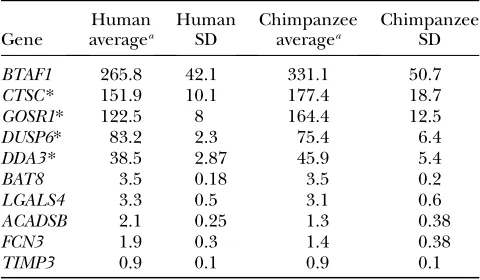
We used the Luciferase constructs to transfect human liver cell lines (Hep) with the empty (control) vector, the vector containing the human promoter, or the one with the chimpanzee promoter. We performed five in-dependent replicates of each transfection. As a measure of transfection efficiency, the Luciferase plasmids were cotransfected along with a vector containing a Renilla gene downstream of an SV40 constitutive promoter. We then measured Luciferase activity in each sample, normalized by Renilla activity, and tested the ability of the different constructs to increase Luciferase activity (by at least twofold) beyond the background activity of the control empty vector (Table 1). If both the chimpan-zee and the human promoters were found to be active, we examined whether the relative activity of the pro-moters from both species is in the same direction as seen in the microarray experiments (Giladet al. 2006).
As can be seen in Table 1, promoters for three of the genes (TIMP3,FCN3, and ACADSB) failed to increase
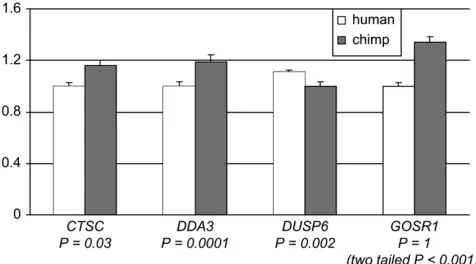
Luciferase activity twofold above that of the control (i.e., the empty vector). We therefore excluded these genes from subsequent analysis. Of the seven promoters that increased Luciferase activity beyond twofold of the control levels, three (the promoters forBAT8,LGALS4, and BTAF1) did not show a significant difference in activity between the human and the chimpanzee pro-moters (Table 1). Finally, for four genes, we observed a significant difference (P,0.05) in activity between the human and the chimpanzee promoters (Table 1 and Figure 2). In one case (GOSR1), the difference in activity between the two promoters was opposite to our previous observation based on the microarray results, which we had confirmed by quantitative RT–PCR (see above). Al-though the GOSR1 gene was found to be highly ex-pressed in humans compared to chimpanzees, the human promoter has lower activity in the HEP human liver cell line compared to the chimpanzee promoter.
In the three remaining cases (the promoters forCTSC, DDA3, andDUSP6), we found a significant difference in activity between the human and chimpanzee promoters that recapitulated the previously observed interspecies difference in gene expression. Thus, it is likely that changes in cis regulatory elements contribute to the observed difference in gene expression levels between human and chimpanzee in 3 of the 10 genes that we examined.
Identifying a specificcisregulatory change:Next, we wanted to identify specific nucleotide substitution that underlie differences in activity between the human and chimpanzee promoters. To do so, we focused on the promoter for theDDA3gene, for which the human and chimpanzee sequence differs by only five nucleotide changes (Figure 3A). As a first step, we constructed (see
materials and methods) two combinations of
approx-imately half of the human and half of the chimpanzee Figure1.—Quantitative RT–PCR results. Mean fold
differ-ences (y-axis) and standard errors for three replicates are given for either the human (open bars) or the chimpanzee (shaded bars) RNA templates. For each gene (x-axis), results were standardized on the basis of the species with the lower expression level (set to one). All gene expression differences between human and chimpanzee are significant atP,0.05.
TABLE 1
Reporter gene assays of 10 human and chimpanzee promoters
Gene
Human averagea
Human SD
Chimpanzee averagea
Chimpanzee SD
BTAF1 265.8 42.1 331.1 50.7
CTSC* 151.9 10.1 177.4 18.7
GOSR1* 122.5 8 164.4 12.5
DUSP6* 83.2 2.3 75.4 6.4
DDA3* 38.5 2.87 45.9 5.4
BAT8 3.5 0.18 3.5 0.2
LGALS4 3.3 0.5 3.1 0.6
ACADSB 2.1 0.25 1.3 0.38
FCN3 1.9 0.3 1.4 0.38
TIMP3 0.9 0.1 0.9 0.1
*The difference in activity between the human and the chim-panzee promoters is significant atP,0.05 (see Figure 2).
aAverage luminescence for each construct over 5 replicates
promoters (combo 1 and combo 2; see Figure 3A). We then tested the ability of the combo constructs to en-hance Luciferase activity using the same approach that was described above.
The results of this experiment led us to exclude two of the five nucleotide differences (at positions593 and 921 upstream of the TSS), as they did not contribute significantly to the difference in activity between the human and chimpanzee promoters (P¼0.33; Figure 3B and supplemental Table 2 at http://www.genetics.org/ supplemental/). Two of the remaining three nucleotide substitutions between human and chimpanzee are only 4 bp apart (at positions291 and295 upstream of the TSS). To test whether these two substitutions underlie the difference in expression between the human and chimpanzee DDA3gene in the liver, we proceeded to substitute these two nucleotides, by site-directed muta-genesis, on the human, the chimpanzee, or the combina-tion backgrounds, resulting in four addicombina-tional constructs (Figure 3A). We then tested the ability of each of the four constructs to enhance Luciferase activity. We did not find significant differences in activity associated with any of the individual constructs (minimum P ¼0.31; Figure 3B and supplemental Table 2), suggesting a non-additive effect of the different substitutions. This result was confirmed when we applied a linear model to esti-mate the individual effects of the substitution at position 339 and the effect of the two substitutions at positions 291 and 295, as none of these effects were found to be significant (minimumP,0.12). In contrast, we found a significant interaction effect, suggesting that the effects of substitutions at different sites are not sim-ply additive (P¼0.037; seematerials and methodsfor
details). Thus, on the basis of these results, it appears that nucleotide differences in three sites (at positions
291,295, and339 upstream of the TSS) are needed to attain the higher level of chimpanzee promoter ac-tivity inDDA3.
DISCUSSION
To identify specific nucleotide differences between human and chimpanzee that led to changes incis reg-ulatory elements, we focused on 10 genes that were pre-viously identified as differentially expressed between humans and chimpanzees (Gilad et al. 2006). Using
reporter gene assays in a human liver cell line, we con-firmed the ability of 7 of the 10 promoters to enhance transcription beyond background levels.
The proportion of predicted promoters that failed to enhance Luciferase activity in this experiment (30%) is consistent with previous observations using reporter gene assays in human cell lines (Trinkleinet al. 2003;
Cooperet al. 2006) and might be explained by poor
prediction of the TSS or the existence of alternative promoters in different tissues. An additional explana-tion is that some of the transcripexplana-tion factors that are expressed in human livers are not expressed in the particular human liver cell line with which we worked (HEP). If so, the three promoters may not be active in this cell line because of missingtransregulatory elements. One would then predict that the genes downstream of the endogenous promoters may not be expressed in the cell line either. We tested this hypothesis by attempting to amplify a cDNA product for each of the 10 genes using RNA extracted from the cell line as template (we used the quantitative RT–PCR primers for the 10 genes; see supplemental Table 1 at http://www.genetics.org/ supplemental/). We failed to amplify a product only for 2 of the 10 genes:FCN3andACADSB. These genes are two of the three cases for which no promoter activity was observed. Hence, it is likely that in these two cases, lack of promoter activity can be explained by cell-line-specific artifacts.
Although none of the human–chimpanzee promoter pairs are identical at the sequence level (the range of sequence divergence is 0.55–1.3%), we did not find sig-nificant differences in transcriptional activity between the human and the chimpanzee promoter constructs for three of the seven active promoter pairs. An obvious explanation for this observation is that the three genes are differentially expressed between the species due to changes outside of the promoter regions examined in this study (e.g., inciselements that are further upstream or downstream from the TSS) or to changes in trans regulatory elements that bind to the promoters of these three genes.
Differences in promoter activity:In one case (the pro-moter for the gene GOSR1), the reporter gene assays were not consistent with the observation from the mi-croarray. While the GOSR1 gene shows elevated Figure 2.—Differences in promoter activity between
expression in humans compared to chimpanzees, there is significantly higher transcriptional activity for the chimpanzee promoter compared to the human pro-moter. This discrepancy is unlikely to reflect a spurious result of the microarray analysis, as we confirmed the array observations by using quantitative RT–PCR (see
results). Instead, it might be explained by
compensa-tory changes in regulacompensa-tory elements in chimpanzee (either incisor in trans), which are missing from the human cell line or are not located within the 1-kb chim-panzee segment that was used in the construct. Com-pensatory changes in transcription-factor binding sites have been observed previously in fruit flies (Ludwig
et al. 1998, 2005) and have been inferred from a comparison of human and mouse regulatory sequences (Dermitzakisand Clark2002). In theory, this
hypoth-esis could be tested by a reciprocal experiment in which the activity of both human and chimpanzee promoters is tested in chimpanzee liver cell lines. Unfortunately, there are no chimpanzee liver cell lines available, so this approach is not feasible at present.
In contrast to theGOSR1gene, a comparison of the transcriptional activity of promoters for three other genes (CTSC,DDA3, andDUSP6) yielded results that are in agreement with the observations from the micro-array. It is difficult to compare fold changes across the different techniques (microarrays, quantitative RT–PCR, and reporter gene assays). This caveat notwithstanding, our results strongly suggest that the expression of the genesCTSC,DDA3, andDUSP6differs between human and chimpanzee due, at least in part, to changes incis
regulatory elements that reside within a segment 100 bp downstream of the TSS to 900 bp upstream of the TSS. Identifying cis regulatory changes: Ultimately, our goal was to identify particular nucleotide substitutions between human and chimpanzee that contribute to dif-ferences in gene regulation between the species. We chose to focus on theDDA3gene as a test case because it has the fewest nucleotide substitutions between human and chimpanzee among the three genes for which our experiments suggested an interspecies difference incis regulation. Using site-directed mutagenesis, we were able to identify three nucleotides that underlie the dif-ference in transcriptional activity between the human and the chimpanzee promoters of theDDA3gene. Inter-estingly, we observed a significant difference in promoter activity only when all three nucleotides were substituted. It remains possible that single-nucleotide substitutions have subtle effects onDDA3promoter activity, which our reporter gene assays (even using 15 replicates) were underpowered to detect.
The expression level of theDDA3gene was originally inferred to be under directional selection in the human lineage (Giladet al. 2006). This conclusion was based
rhesus macaque sequence, the three nucleotides sub-stitutions were inferred to have occurred on the chim-panzee lineage. Hence, although we were able to identify individual nucleotides that underlie acisregulatory dif-ference between human and chimpanzee, our obser-vations do not point to the genetic basis for adaptive changes inDDA3expression level in humans. Instead, our observations suggest that a regulatory change (out-side of the 1-kb segment used in the reporter construct or in trans) occurred in the ancestor of humans and chimpanzees, which reduced levels of expression of DDA3. This regulatory change was then compensated in the chimpanzee lineage by the three nucleotide sub-stitutions, but not in the human lineage, where the reduced levels of DDA3 expression may have been ad-vantageous (Giladet al. 2006).
PossibleDDA3regulatory mechanism:DDA3has been shown to be a downstream target ofP53and to be in-volved in activation of theb-catenin pathway (Hsiehet al.
2007), which has a role in regulating a large number of cellular processes including cell growth and circadian rhythm (Meijeret al. 2004). We hypothesized that the
three nucleotide substitutions in the DDA3 promoter region are part of at least two transcription-factor binding sites, with one binding site that includes the locus at position 339 and another that includes the loci at positions291 and295. If so, and assuming the rele-vant transcription factor(s) did not change between hu-man and chimpanzee (i.e., the protein is identical) and therefore have similar binding properties, we would ex-pect the nucleotide differences between the species to change the affinity with which the transcription factor(s) binds to theDDA3promoter.
To find candidate transcription factors that are con-sistent with this hypothesis, we used the TRANSFAC database (BioBase biological databases) to identify all known transcription-factor binding sites that overlap these two locations (using a matrixP-value cutoff for the match of the predicted binding site of 0.8 for the core and 0.7 for the extended consensus element). We note that it is unclear how to assign significance to the iden-tification of transcription-factor binding sites on the basis of a single sequence (Vavouriand Elgar2005).
In particular, since transcription-factor binding sites are short (6–12 mers), multiple false positives are expected at nearly every locus. That said, we were able to identify only one transcription factor (albumin D-box binding protein,DBP) that met our criteria. TheDBP transcrip-tion factor can bind to both locatranscrip-tions in the human DDA3 promoter. In chimpanzee, DBP is expected to bind much less efficiently to both locations: The two nucleotide substitutions at positions 291 and 295 change the binding site forDBPsuch that it is no longer recognized using our statistical cutoff. Similarly, the substitution at position339 is expected to disrupt the chimpanzee binding site for DBP (see supplemental Table 3 at http://www.genetics.org/supplemental/). In
addition, there are no differences at the protein level between the human and the chimpanzeeDBP ortholo-gous genes. Thus, it seems reasonable to assume that there are no interspecies differences in DBP DNA-binding properties. Finally,DBPhas been demonstrated to regulate circadian gene expression in the liver and kidney (Wuarinet al. 1992; Rippergeret al. 2000),
con-sistent with our limited knowledge regarding the role of DDA3 (Hsiehet al. 2007). In summary, these
observa-tions, although clearly speculative, suggest thatDBPis a repressor of theDDA3 gene and that both its binding sites were weakened or disrupted in chimpanzee.
Outlook:Our work demonstrates that, by using inter-species gene expression profiles followed by reporter gene assays, it is possible to hone in on specificcis regu-latory differences between human and chimpanzee. High-throughout application of this approach will allow us to identifycisregulatory elements that are function-ally important in humans, and, in particular, which have evolved under positive selection in the human lineage. In that respect, an important resource would be the development of chimpanzee cell lines from a large num-ber of tissues. Such a resource will facilitate the elucida-tion of the relative contribuelucida-tion ofcisandtransregulatory changes in humans and chimpanzees.
We thank Molly Przeworski, Paola De Candia, Alicia Oshlack, and Matthew Stephens for comments on the manuscript and helpful dis-cussions. This research was supported by National Institutes of Health grant GM077959.
LITERATURE CITED
Abzhanov, A., M. Protas, B. R. Grant, P. R. Grantand C. J. Tabin, 2004 Bmp4 and morphological variation of beaks in Darwin’s finches. Science305:1462–1465.
Benjamini, Y., and Y. Hochberg, 1995 Controlling the false discov-ery rate: a practical and powerful approach to multiple testing. J. R. Stat. Soc. B57:289–300.
Britten, R. J., and E. H. Davidson, 1971 Repetitive and non-repetitive DNA sequences and a speculation on the origins of evolutionary novelty. Q. Rev. Biol.46:111–138.
Buckland, P. R., S. L. Coleman, B. Hoogendoorn, C. Guy, S. K. Smithet al., 2004a A high proportion of chromosome 21 pro-moter polymorphisms influence transcriptional activity. Gene Expr.11:233–239.
Buckland, P. R., B. Hoogendoorn, C. A. Guy, S. L. Coleman, S. K. Smithet al., 2004b A high proportion of polymorphisms in the promoters of brain expressed genes influences transcriptional activity. Biochim. Biophys. Acta1690:238–249.
Carroll, S. B., 2003 Genetics and the making of Homo sapiens. Na-ture422:849–857.
Carroll, S. B., J. K. Grenier and S. D. Weatherbee, 2004 From DNA to Diversity: Molecular Genetics and the Evolution of Animal De-sign. Science, Malden, MA.
The Chipmanzee Sequencing and Analysis Consortium, 2005 Initial sequence of the chimpanzee genome and compar-ison with the human genome. Nature437:69–87.
Clark, R. M., T. N. Wagler, P. Quijadaand J. Doebley, 2006 A dis-tant upstream enhancer at the maize domestication gene tb1 has pleiotropic effects on plant and inflorescent architecture. Nat. Genet.38:594–597.
Cowles, C. R., J. N. Hirschhorn, D. Altshulerand E. S. Lander, 2002 Detection of regulatory variation in mouse genes. Nat. Genet.32:432–437.
Cresko, W. A., A. Amores, C. Wilson, J. Murphy, M. Curreyet al., 2004 Parallel genetic basis for repeated evolution of armor loss in Alaskan threespine stickleback populations. Proc. Natl. Acad. Sci. USA101:6050–6055.
Dermitzakis, E. T., and A. G. Clark, 2002 Evolution of transcrip-tion factor binding sites in mammalian gene regulatory regions: conservation and turnover. Mol. Biol. Evol.19:1114–1121. Dickinson, W. J., 1988 On the architecture of regulatory systems:
evolutionary insights and implications. BioEssays8:204–208. Gibson, G., and B. Weir, 2005 The quantitative genetics of
tran-scription. Trends Genet.21:616–623.
Gilad, Y., S. A. Rifkin, P. Bertone, M. Gersteinand K. P. White, 2005 Multi-species microarrays reveal the effect of sequence divergence on gene expression profiles. Genome Res.15:674– 680.
Gilad, Y., A. Oshlack, G. K. Smyth, T. P. Speedand K. P. White, 2006 Expression profiling in primates reveals a rapid evolution of human transcription factors. Nature440:242–245.
Gompel, N., B. Prud’homme, P. J. Wittkopp, V. A. Kassnerand S. B. Carroll, 2005 Chance caught on the wing: cis-regulatory evo-lution and the origin of pigment patterns in Drosophila. Nature
433:481–487.
Hammock, E. A., and L. J. Young, 2005 Microsatellite instability gen-erates diversity in brain and sociobehavioral traits. Science308:
1630–1634.
Haudek, S. B., B. E. Natmessnig, H. Redl, G. Schlagand B. P. Giroir, 1998 Genetic sequences and transcriptional regulation of the TNFA promoter: comparison of human and baboon. Im-munogenetics48:202–207.
Heissig, F., J. Krause, J. Bryk, P. Khaitovich, W. Enardet al., 2005 Functional analysis of human and chimpanzee promot-ers. Genome Biol.6:R57.
Hsieh, P. C., J. C. Chang, W. T. Sun, S. C. Hsieh, M. C. Wanget al., 2007 p53 downstream target DDA3 is a novel microtubule-asso-ciated protein that interacts with end-binding protein EB3 and activates beta-catenin pathway. Oncogene (in press).
Huby, T., C. Dachet, R. M. Lawn, J. Wickings, M. J. Chapmanet al., 2001 Functional analysis of the chimpanzee and human apo(a) promoter sequences: identification of sequence variations re-sponsible for elevated transcriptional activity in chimpanzee. J. Biol. Chem.276:22209–22214.
Iftikhar, R., R. D. Kladney, N. Havlioglu, A. Schmitt-Graff, I. Gusmirovicet al., 2004 Disease- and cell-specific expression of GP73 in human liver disease. Am. J. Gastroenterol.99:1087–1095. Jin, W., R. M. Riley, R. D. Wolfinger, K. P. White, G. Passador -Gurgel et al., 2001 The contributions of sex, genotype and age to transcriptional variance in Drosophila melanogaster. Nat. Genet.29:389–395.
Khaitovich, P., I. Hellmann, W. Enard, K. Nowick, M. Leinweber et al., 2005 Parallel patterns of evolution in the genomes and transcriptomes of humans and chimpanzees. Science 309:
1850–1854.
King, M. C., and A. C. Wilson, 1975 Evolution at two levels in hu-mans and chimpanzees. Science188:107–116.
Kleinjan, D. A., and V.vanHeyningen, 2005 Long-range control of gene expression: emerging mechanisms and disruption in dis-ease. Am. J. Hum. Genet.76:8–32.
Lemon, B., and R. Tjian, 2000 Orchestrated response: a symphony of transcription factors for gene control. Genes Dev.14:2551– 2569.
Ludwig, M. Z., N. H. Pateland M. Kreitman, 1998 Functional analysis of eve stripe 2 enhancer evolution in Drosophila: rules governing conservation and change. Development125:949–958. Ludwig, M. Z., A. Palsson, E. Alekseeva, C. M. Bergman, J. Nathan et al., 2005 Functional evolution of a cis-regulatory module. PLoS Biol.3:e93.
Meijer, L., M. Flajoletand P. Greengard, 2004 Pharmacological inhibitors of glycogen synthase kinase 3. Trends Pharmacol. Sci.
25:471–480.
Morley, M., C. M. Molony, T. M. Weber, J. L. Devlin, K. G. Ewens et al., 2004 Genetic analysis of genome-wide variation in human gene expression. Nature430:743–747.
Pastinen, T., B. Geand T. J. Hudson, 2006 Influence of human ge-nome polymorphism on gene expression. Hum. Mol. Genet.
15(Spec. No. 1): R9–16.
Prabhakar, S., F. Poulin, M. Shoukry, V. Afzal, E. M. Rubinet al., 2006 Close sequence comparisons are sufficient to identify hu-man cis-regulatory elements. Genome Res.16:855–863. Ripperger, J. A., L. P. Shearman, S. M. Reppertand U. Schibler,
2000 CLOCK, an essential pacemaker component, controls ex-pression of the circadian transcription factor DBP. Genes Dev.14:
679–689.
Rockman, M. V., M. W. Hahn, N. Soranzo, D. B. Goldsteinand G. A. Wray, 2003 Positive selection on a human-specific tran-scription factor binding site regulating IL4 expression. Curr. Biol.13:2118–2123.
Rockman, M. V., M. W. Hahn, N. Soranzo, F. Zimprich, D. B. Goldsteinet al., 2005 Ancient and recent positive selection transformed opioid cis-regulation in humans. PLoS Biol.3:e387. Shapiro, M. D., M. E. Marks, C. L. Peichel, B. K. Blackman, K. S. Nerenget al., 2004 Genetic and developmental basis of evolu-tionary pelvic reduction in threespine sticklebacks. Nature428:
717–723.
Stern, D. L., 1998 A role of Ultrabithorax in morphological differ-ences between Drosophila species. Nature396:463–466. Stern, D. L., 2000 Evolutionary developmental biology and the
problem of variation. Evol. Int. J. Org. Evol.54:1079–1091. Storgaard, T., J. Christensen, B. Aastedand S. Alexandersen,
1993 cis-acting sequences in the Aleutian mink disease parvovi-rus late promoter important for transcription: comparison to the canine parvovirus and minute virus of mice. J. Virol.67:1887– 1895.
Takahashi, H., Y. Mitani, G. Satohand N. Satoh, 1999 Evolution-ary alterations of the minimal promoter for notochord-specific Brachyury expression in ascidian embryos. Development 126:
3725–3734.
Taron, M., R. Rosell, E. Felip, P. Mendez, J. Souglakos et al., 2004 BRCA1 mRNA expression levels as an indicator of chemo-resistance in lung cancer. Hum. Mol. Genet.13:2443–2449. Trinklein, N. D., S. J. Aldred, A. J. Saldanhaand R. M. Myers,
2003 Identification and functional analysis of human transcrip-tional promoters. Genome Res.13:308–312.
Vavouri, T., and G. Elgar, 2005 Prediction of cis-regulatory ele-ments using binding site matrices–the successes, the failures and the reasons for both. Curr. Opin. Genet. Dev.15:395–402. White, R. J., 2001 Gene Transcription: Mechanims and Control.
Black-well Science, Malden, MA.
Wittkopp, P. J., B. K. Haerumand A. G. Clark, 2004 Evolutionary changes in cis and trans gene regulation. Nature430:85–88. Wolff, C., M. Pepling, P. Gergenand M. Klingler, 1999 Structure
and evolution of a pair-rule interaction element: runt regulatory sequences in D. melanogaster and D. virilis. Mech. Dev.80:87–99. Wray, G. A., 2007 The evolutionary significance of cis-regulatory
mutations. Nat. Rev. Genet.8:206–216.
Wray, G. A., M. W. Hahn, E. Abouheif, J. P. Balhoff, M. Pizeret al., 2003 The evolution of transcriptional regulation in eukaryotes. Mol. Biol. Evol.20:1377–1419.
Wuarin, J., E. Falvey, D. Lavery, D. Talbot, E. Schmidtet al., 1992 The role of the transcriptional activator protein DBP in circadian liver gene expression. J. Cell Sci. Suppl.16:123–127. Yvert, G., R. B. Brem, J. Whittle, J. M. Akey, E. Foss et al., 2003 Trans-acting regulatory variation in Saccharomyces cerevi-siae and the role of transcription factors. Nat. Genet.35:57–64.