THERMAL TESTS OF A CP5.2 PACKAGING SYSTEM: POST
EXPERIMENTAL TEST DESCRIPTION
Rosa Lo Frano1, Donato Aquaro2 and Daniele Del Serra3
1
Researcher, DICI- University of Pisa, IT
2
Professor, DICI- University of Pisa, IT
3
Ph. D student, DICI- University of Pisa, IT
ABSTRACT
Managing radioactive waste must be carried out within a strict framework and with a constant requirement to protect human beings and the environment. A safety management of the radioactive material or waste (RAM or RW) unavoidably involves transportation activities by using robust safe and reliable packaging system.
The integrity is a crucial aspect in the design of these systems; to certify it packages should demonstrate to withstand loads, that could occur under normal and accident conditions, and to meet the safety requirements in terms of performances of containment and radiation protection, like the IAEA ones. This study deals with the thermal performances of an Italian CP5.2 packaging system aimed at the transportation of bituminised wastes, which have been evaluated by executing experimental tests in the fire scenario as specified in the IAEA regulations (i.e. engulfing fire of 800 °C for 30 minutes).
To the purpose a dedicated small scale mock-up has been designed and built at the Dept. DICI of the University of Pisa. The experimental test allowed to set up the test procedure to be adopted for the fire tests of a large scale system in consideration of risk related to the stowed bituminised wastes.
The results of the thermal test are presented and discussed.
Analysing them it is possible to conclude that the overall integrity of the packaging system is assured.
INTRODUCTION
A package to be used for the transport of hazardous /radioactive materials must demonstrate to fulfil the International standards requirements in order to provide protection to the human being and environment even under accident conditions, such as rigorous fire events (Lo Frano et al. 2011; Rains D.J., 1999). In these conditions, the packaging system, constituted, in general, by a massive sealed steel vessel, must demonstrate to be robust, safe and reliable so to guarantee both structural strength and radiation shielding. In addition, it must be designed according to the activity, physical state and nature of the radioactive material or waste (RAM or RW) and to the requirements set forth by the International and National Safety Authority and, like the IAEA (IAEA, 2012; UNI, 2011 and (ENEA, 1987).
Aim of this study is to investigate, through numerical analyses, the thermo-mechanical response induced in a scaled system of the packaging system CP5.2 (1:6 ratio) during the executed fire test.
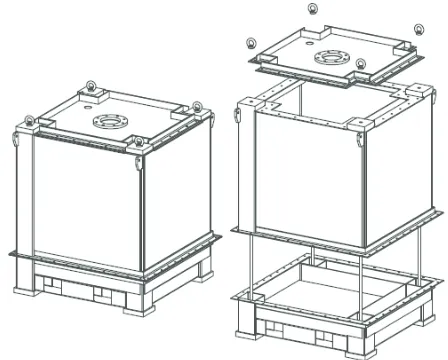
This mock-up, shown in, is described in Lo Frano et al., 2015.
In particular it is intended to furnish a post-test evaluation of the thermal performances (and effects) caused by the thermal exposure:as specified in the IAEA regulations fire test must represent the exposure to an engulfing fire of 800 °C for 30 minutes.
23rd Conference on Structural Mechanics in Reactor Technology Manchester, United Kingdom - August 10-14, 2015 Division V
For this reason adequate test procedure were adopted as well as emergency action planned.
Figure 1. Experimental mock-up simulating 1/6 CP 5.2 packaging system.
To simulate the model behaviour and determine the thermal performance of the experimental mock-up a numerical model (by ANSYS©) was set up and implemented in a rather refined way, taking into account material properties and constitutive laws as well as all the heat transfer modes.
The comparison of the results will be presented and discussed in what follows.
Thermal test requirements for accident conditions of transport
Before packages were firstly used, qualification tests or corresponding validated numerical simulations, covering normal and accident situations, which can be realistically envisaged in order to guarantee safety throughout the package lifetime, must be done to demonstrate their ability to withstand such conditions of transport.
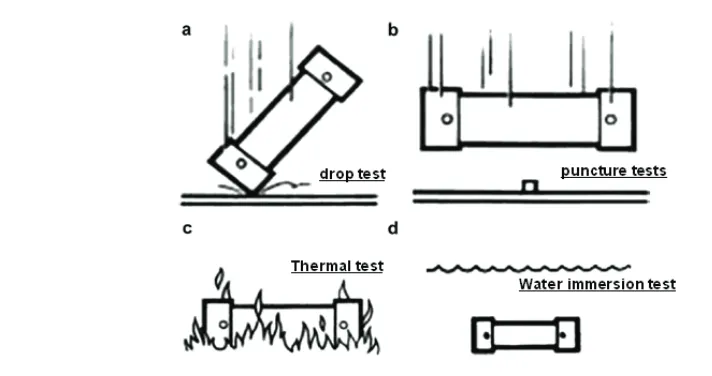
In particular, the accident condition (Figure 2 c) of transport taken into account for the experimental test carried out consisted in:
1) exposure of a specimen for a period of 30 min to a thermal environment that provides a heat flux at least equivalent to that of a hydrocarbon fuel-air fire in sufficiently quiescent ambient conditions to give a minimum average flame emissivity coefficient of 0.9 and an average temperature of at least 800°C, fully engulfing the specimen, with a surface absorptivity coefficient of 0.8 or that value the package demonstrated to possess if exposed to the fire specified.
2) cooling down of the specimen to an ambient temperature of 38°C, which would be only subject to the solar insulation conditions and to the design maximum rate of internal heat generation within the package by the radioactive contents for a sufficient period to ensure that temperatures in the specimen are everywhere decreasing and/or are approaching initial steady state conditions.
Figure 2. Sequence of possible accident conditions according to IAEA requirements.
DESCRIPTION OF THE MOCK-UP OF THE CP- 5.2 PACKAGING
As indicated in Lo Frano, 2015, the main design characteristics and geometrical and material properties of the mockup of the CP 5.2 prismatic packaging (1:6 scale ratio) are in agreement with the UNI 11196 (UNI, 2011), which represents the Italian reference standard. Moreover it consists of a steel packaging, inside which is positioned one bituminized wastes package, cement matrix and of a closure lid with suitable gasket.
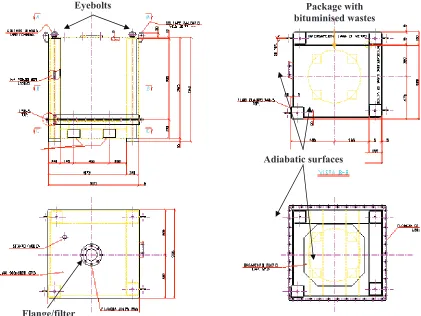
This not symmetric system has been entirely designed and built at the Dept. DICI of the University of Pisa; as indicated in Figure 3, its main dimension are: about 1x1m and 1 m height.
To correctly represent the large scale packaging behaviour, two of the four outside surfaces have been thermally insulated by means of 150 mm mineral wool, so to represent the adiabatic condition (null heat flux). In addition a flange is present onto the cover lid; it allowed not only to grout cement inside the system but also behave as a filtering system during the test execution.
It was equipped with four to facilitate the handling and lifting during the suspension for the positioning on the slide of oven.
The instrumentation used were made of thermocouples (TC), type K duly calibrated, immersed in the concrete and connected to the walls of the inner package and to the outer walls of the mock-up in order to measure the temperature distribution during the heating and cooling phases, control the temperatures of the oven and reached by the bitumen. The nomenclature of the thermocouples, accordingly to the scheme of Figure 4, are:
- T1=TC16, TC17, TC18 and TC20 on the packaging surface;
- T2=TC1, TC2, TC3, TC4, TC5, TC6, TC8, TC9, TC10 and TC19 at half thickness of the cement mortar;
- T4 and T5 = TC7, TC11 on the bottom of the bituminised package;
23rd Conference on Structural Mechanics in Reactor Technology Manchester, United Kingdom - August 10-14, 2015 Division V
The positioning of T2 has been obtained by means of a sump within which was placed the thermocouple.
Figure 3. Drawings of the packaging mock-up (Lo Frano et al., 2015).
Figure 4. Thermocouples position schemes.
The mock up has been tested in the oven at 800°C for 30 minutes; the temperatures were measured by means of an adequate data acquisition system; after that the simulacrum was handled for the cooling phase in air (Figure 5).
Eyebolts Package with
bituminised wastes
Adiabatic surfaces
a) b)
Figure 5. Positioning of the mock-up on the slide of the oven before (a) and after fire test (b) .
NUMERICAL ANALYSIS
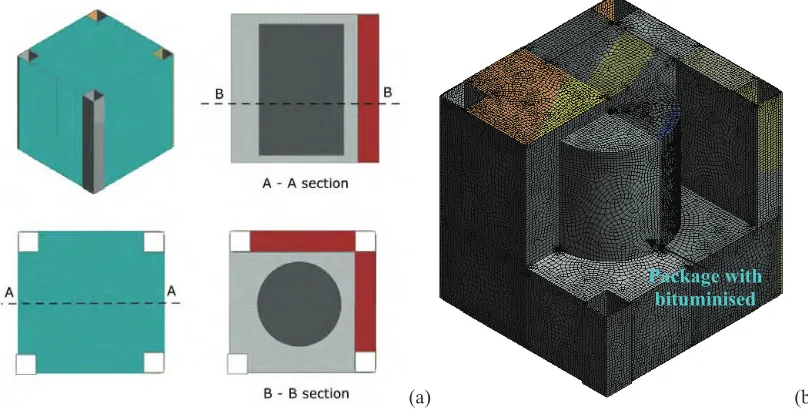
To simulate the thermal behaviour of the mock-up a numerical model (Figure 6) was set up and implemented by ANSYS© in order to be as consistent as possible with the real system tested. Some simplifications have been introduced: the lower brackets were not represented while the cover lid was modelled like a simple plate. Moreover, structural parts as lifting trunnions, bolts and threads were not modeled since these parts have little influence on the temperature distribution.
(a) (b)
Figure 6. Solid model of the experimental mock-up (a) and FEM model (b)
These simplifications allowed to reduce the number of elements and consequently the computational effort associated with the thermal transient analysis carried out.
23rd Conference on Structural Mechanics in Reactor Technology Manchester, United Kingdom - August 10-14, 2015 Division V
The 3-D FEM model, shown in previous Errore. L'origine riferimento non è stata trovata. (b), has 496333 type SOLID70 elements representing the bituminised RWs package, the cement mass, the overall packaging system with closure lid. This element (Ansys, 2013) was used to simulate all heat transfer modes (conductive, convective and radiation) inside the package and between the package and the surrounding oven environment.
To avoid numerical instability the maximum size of the mesh has been evaluated by using the following relation (module of Fourier for each material):
! "
!
M#"
x t
2
$ %
$ (1)
! is the thermal diffusivity dependent on the time step, the average length of the element and material properties.
The conductive coefficient values were consistent with the packaging material properties and temperature while the convective heat input must be included on the basis of still ambient air at 800 °C, in the accident condition, assuming also the absence of artificial cooling after the end of external heat input.
The engulfing fire exposure (fire test) has been simulated by applying a temperature of 800°C on the outer muck-up surfaces and assuming an equivalent convection coefficient, equal to 230 W/m2°C to simulate the convection and radiation between the flames and the container.
Moreover, each radiating surface pair has been defined by means of the emissivity (values equal to 0.8), the Stefan-Boltzmann constant (5.67e-8 W/m2K4) and the temperature offset.
POST TEST ANALYSIS OF THE EXPERIMENTAL FIRE TEST
The comparison between the experimental and numerical results highlight an agreement although the temperatures behaviours do not perfectly overlap.
In the following figures the label with star identifies the numerical results. The discrepancy seemed to affect the temperature behaviours carried out at bituminised package and could be due to the assumption in modelling the material behaviour of the bitumen (implemented as linear elastic). The difference reduces as the accuracy in the modelling increases; as an example for the values measured by the TC 13 or TC10 it resulted less than 10% (Figure 7 and Figure 8).
0 20 40 60 80 100
0 5000 10000 15000 20000 25000
Time (s) T em p er a tu re ( °C )
Figure 7. Comparison of the temperatures on the lateral surface of the bituminised package.
0 20 40 60 80 100 120
0 5000 10000 15000 20000 25000
Time (s)
T
em
p
er
a
tu
re
(
°C
)
TC8 TC9 TC10
TC8* TC9* TC10*
Figure 8. Comparison of the temperatures on the mock-up outer surfaces.
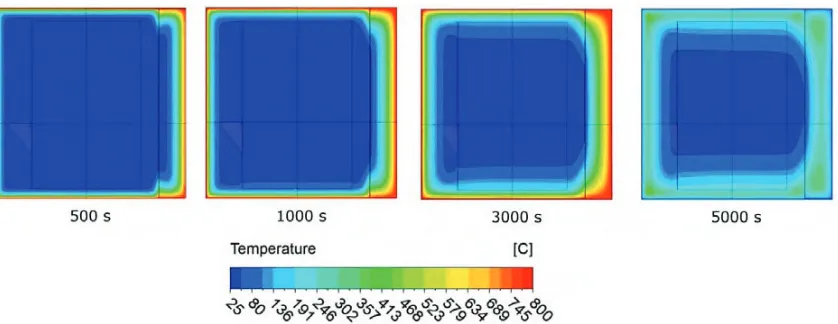
The overview of the temperature distribution at the section A (Figure 5) of mock-up is showed in Figure 9. The thermal gradient leads to the rapid increase of the temperature of the outer surface and of the closer internal components (gasket, closure lid, etc.), as observed in the temperature behaviour measured by TC9 (Figure 8) positioned at the half thickness of the cement mortar far from the adiabatic walls. This implies that the temperature did not propagate in the same way inside the mock-up.
Moreover it is worthy to observe that at the end of heating phase the maximum temperature reached inside the simulacrum is varying form 300°C to about 100°C .
Figure 9. Overview of temperatures distribution at the section A of mock-up.
23rd Conference on Structural Mechanics in Reactor Technology Manchester, United Kingdom - August 10-14, 2015 Division V
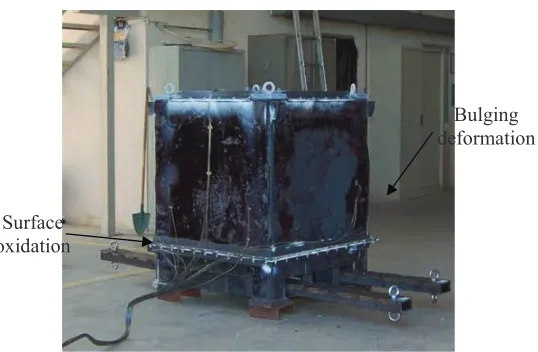
Figure 10. Overview of the mock-up after the fire test.
CONCLUSION
This study discussed the thermal performances of a small scale mock-up representing an Italian CP5.2 packaging system aimed at the transportation of bituminised wastes.
The experimental test simulating the fire scenario as specified in the IAEA regulations (i.e. engulfing fire of 800 °C for 30 minutes) was presented and results obtained discussed along with he post-test evaluation of its thermal performance (and effects).
A brief description of the 1/6 packaging system (also the material and geometrical properties) has been also carried out.
The comparison between experimental and numerical results highlights a quite good agreement although the temperatures behaviours do not perfectly overlap each others.
The discrepancy seemed to affect the temperature behaviours carried out at bituminised package and could be due to the assumption in modelling the material behaviour of the bitumen (implemented as linear elastic): this difference reduces as the accuracy in the modelling increases.
The results after half an hour of fire exposure at 800 °C, highlighted that the temperature in the bituminised waste package was about 100°C: this value is below 250°C that represents the temperature beyond which auto-ignition of the bitumen occurs.
As for the outer surfaces of the mock-up, it was observed that the maximum temperature was about 650°C and so not sufficient to determine severe structural damages: no loss of structural integrity was observed even if in presence of outward bulging deformation and oxidation of the surface.
Finally it was shown that the design of mock-up of the CP 5.2 packaging is able to withstand the accident conditions of transport, and demonstrated that no cliff effect or failure occurred.
NOMENCLATURE
CP prismatic packaging system DAS Data Acquisition System
IAEA International Atomic Energy Agency RAM Radioactive material
RW Radioactive waste TC Thermocouple
Bulging deformation
REFERENCES
IAEA (2012). Regulations For The Safe Transport Of Radioactive Material, Specific Safety Requirements No. SSR-6.
UNI 10621 (2011). Manufatti di rifiuti radioattivi condizionati – Caratterizzazione, UNI. ENEA, 1987, La gestione dei rifiuti radioattivi, G.T. ENEA DISP n. 26.
Lo Frano R., Pugliese G. and Forasassi G.(2011). “Thermal analysis of a spent fuel cask in different transport conditions,” Energy, 36 2285-2293.
Rains D.J. (1999). “Analysis for spent nuclear fuel multi-canister overpack drop into the cask from the multi-canister overpack-handling machine with air cushion”, SNF-5276 Rev. 0. Site-Wide Nuclear Safety Project.
IAEA (1987). Directory Of Transport Packaging Test Facilities, TECDOC- 295.